Where Israel's Folklore Lives Today
Folklore in Israel is not one single national fairy-tale tradition. It is a layered field of Jewish, Arab, Bedouin, Druze, Christian, Muslim and immigrant storytelling, shaped by sacred geography, migration, religion, modern Hebrew culture and everyday protective customs.
Page outline Jump by section
Why Israel’s folklore is so layered
Israel’s folklore is unusually dense because the country’s story-world is built from several overlapping sources. Some traditions are ancient and text-based, preserved through biblical, rabbinic and mystical literature. Others are local oral traditions attached to villages, tombs, caves, trees, springs and pilgrimage routes. Others arrived with Jewish immigrants from North Africa, Yemen, Iraq, Iran, Ethiopia, Eastern Europe and elsewhere. Still others belong to Arab, Bedouin, Druze, Christian and Muslim communities whose local storytelling is rooted in the same landscape but not reducible to Jewish tradition.
This is not just a modern interpretation. UNESCO describes the Israel Folktale Archives as a collection based on Jewish oral tradition and Israeli folk narratives, gathered from more than 5,000 narrators from 70 ethnic groups, with documents dating from 1956 to 1999. Its description explicitly includes Jewish immigrants from around the world as well as Bedouin, Christian, Muslim and Druze narratives from communities living in Israel.[UNESCO]unesco.orgIsrael Folktale ArchivesIsrael Folktale Archives The University of Haifa’s own archive page says the collection contains over 25,000 tales and was created to collect, preserve and research oral folk narratives from numerous ethnic and cultural backgrounds in Israel.[lib.haifa.ac.il]lib.haifa.ac.ilארכיון הסיפור העממי בישראל על שם דב נוי (אסע"יארכיון הסיפור העממי בישראל על שם דב נוי (אסע"י
That matters because “Israeli folklore” can easily be misunderstood as a neat list of monsters or legends. In practice, it is closer to a crossroads. A single motif, such as a dangerous spirit, a blessed grave, a saintly tree or an amulet against harm, may look different in a Jewish Moroccan family story, a Galilean Muslim custom, a Negev Bedouin healing practice or a modern Hebrew retelling. The country’s folklore is therefore best read as a cultural map: it shows how different communities have made sense of danger, blessing, exile, return, illness, childbirth, memory and sacred land.
The archive that changed how Israeli folklore is understood
The Israel Folktale Archives, named for the folklorist Dov Noy, is central to any serious account of folklore in Israel. It was established in the 1950s to record oral narratives at a moment when new immigrants were arriving from many parts of the Jewish world. The project preserved stories that might otherwise have disappeared as families changed language, moved into new towns and adapted to modern Israeli life. The archive was later recognised by UNESCO’s Memory of the World programme, which treats it as a documentary heritage collection rather than a simple storybook.[lib.haifa.ac.il]lib.haifa.ac.ilארכיון הסיפור העממי בישראל על שם דב נוי (אסע"יארכיון הסיפור העממי בישראל על שם דב נוי (אסע"י
Its importance is not only its size. The collection shows that Israel’s folklore is multilingual and multi-communal. Tales in the archive include wonder stories, moral tales, comic stories, saint legends, miracle stories, family memories, tales of cleverness and survival, and supernatural narratives involving spirits, demons, omens and sacred objects. The archive’s scope also helps correct a common mistake: many tales now discussed under “Israeli folklore” are not newly invented by the modern state. They often come from older Jewish diasporic communities, Palestinian Arab oral tradition, local Muslim and Druze practice, or shared Middle Eastern narrative worlds.
A good example is the publication history of collected folktales. Dov Noy’s Folktales of Israel, published in 1963, helped present these oral traditions to English readers, while later volumes such as Folktales of the Jews drew on the Haifa archive to organise tales from Sephardic, Eastern European, Arab-land and other Jewish communities.[Internet Archive]archive.orgOpen source on archive.org. These books do not simply “nationalise” old tales. They show how a new Israeli setting became a home for stories carried from Baghdad, Sana’a, Fez, Vilnius, Salonica, Addis Ababa and many other places.
Demons, amulets and protective folklore
Some of the most recognisable supernatural figures connected with Jewish folklore in Israel are not uniquely Israeli in origin, but they are deeply relevant to Israel’s story culture because Jewish communities brought, adapted and studied them there. Figures such as Lilith, the dybbuk and the golem belong to a wider Jewish supernatural imagination that crossed regions and centuries before being archived, retold and reinterpreted in Israeli culture.
Lilith is one of the clearest examples of how a figure can change over time. In post-biblical Jewish literature she appears as a night demon, and later folk belief strongly associated her with danger to infants and women in childbirth. Jewish Encyclopedia records that amulets and childbirth tablets were used to protect mother and child from her, especially in eastern Europe and the East.[jewishencyclopedia.com]jewishencyclopedia.comLILIT HLILIT H Modern readers may also know Lilith as a feminist symbol or fantasy character, but that is a later reinterpretation layered on top of a much older protective and domestic folklore.
The dybbuk is different. It is usually understood as a clinging or possessing spirit, often the soul of a dead person whose unresolved sin, promise or desire disturbs the living. In early modern and later Jewish folklore, dybbuk stories often centre on possession, confession and exorcism; in the 20th century, S. Ansky’s play The Dybbuk, based on ethnographic work in Eastern European Jewish communities, turned the motif into one of the most famous dramatic images of Jewish supernatural tradition.[The New York Public Library]nypl.orgOpen source on nypl.org. In an Israeli context, the dybbuk is important not because it began in the modern state, but because Hebrew theatre, scholarship and popular culture helped carry it into a modern national and global imagination.
The golem is another travelling figure. The word originally means something unformed or incomplete, and Jewish Encyclopedia notes its biblical and rabbinic associations with the embryo or unfinished form.[jewishencyclopedia.com]jewishencyclopedia.comGOLE MGOLE M Later legend made the golem a clay or earth creature animated by sacred knowledge, most famously in the Prague tradition of Rabbi Judah Loew. Modern Jewish and Israeli culture often reads the golem in two ways at once: as a protector of a threatened community and as a warning about power that exceeds human control. This is why the golem has been so easily adapted into modern stories about technology, war, artificial life and moral responsibility.
Protective objects are just as important as named beings. Amulets, charms, inscriptions, bowls and household protections show how supernatural belief entered everyday life. The Israel Antiquities Authority’s recovery of late antique “magic bowls” in a Jerusalem raid, reported by Smithsonian Magazine, is a modern example of how material objects linked to protection against demons, disease and misfortune remain archaeologically and culturally significant, even when individual objects have moved through illicit antiquities markets.[Smithsonian Magazine]smithsonianmag.comSmithsonian Magazine1,500-Year-Old 'Magic Bowls' Seized in Jerusalem RaidSmithsonian Magazine1,500-Year-Old 'Magic Bowls' Seized in Jerusalem Raid Such finds remind readers that folklore is not only told; it is worn, buried, hung on walls, placed near beds and carried on the body.
Sacred places make stories feel local
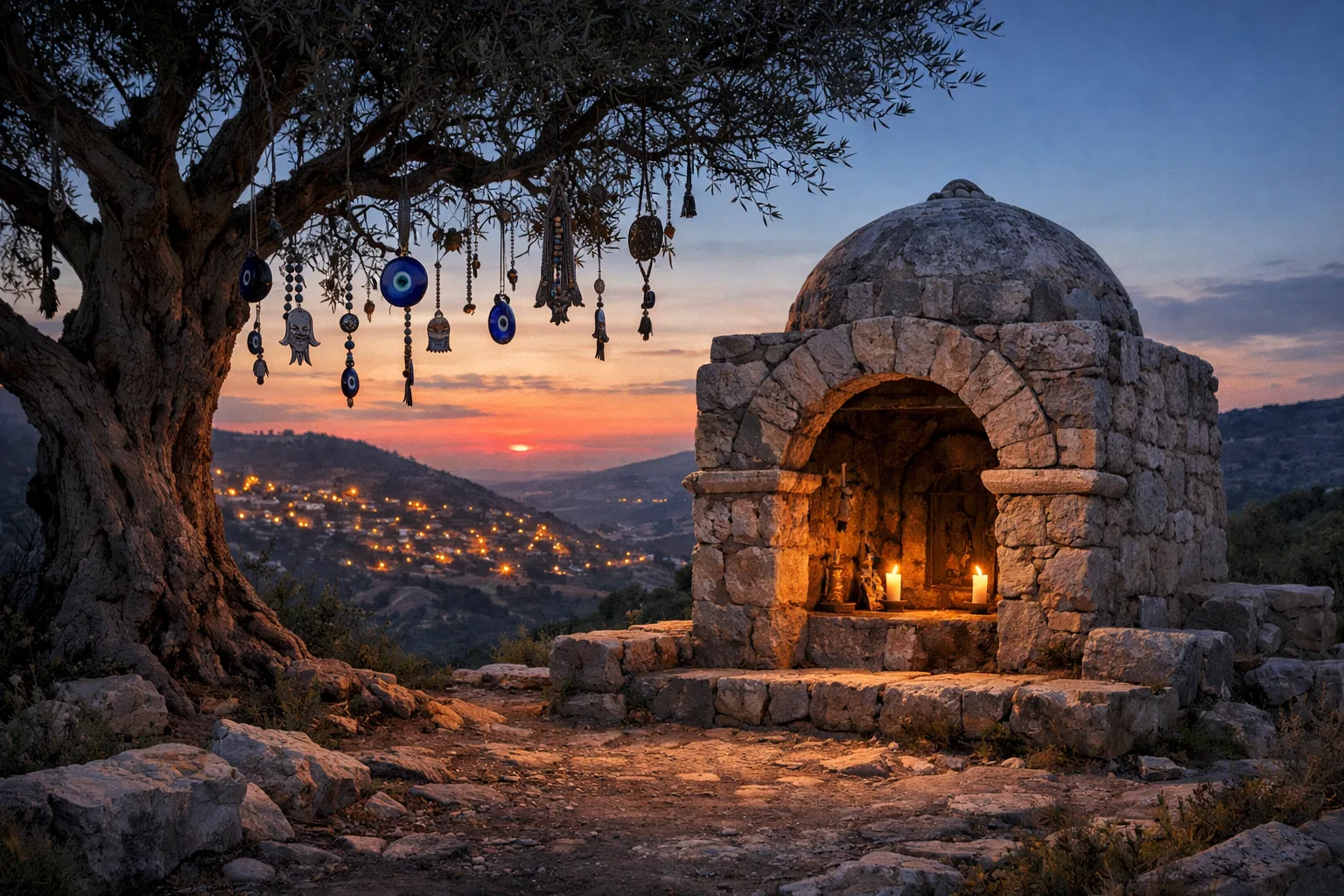
Israel’s folklore is strongly tied to place. Hills, tombs, caves, ruined cities, trees and pilgrimage routes often carry stories that make the landscape feel inhabited by memory. This is one reason folklore in Israel cannot be separated neatly from religion. A shrine may be a formal religious site, a tourist stop, a family place of prayer and a storehouse of local legend all at once.
Mount Meron in the Galilee is one of the clearest examples. It is associated with the tomb of Rabbi Shimon bar Yochai and with Lag BaOmer pilgrimage traditions. Contemporary descriptions of the site emphasise processions, music, bonfires, dancing and mass gathering, while historical accounts connect the modern pilgrimage to centuries of Jewish devotional practice in the Galilee.[הכנסת אורחים רשב"י]harashbi.org.ilOpen source on harashbi.org.il. For folklore readers, Meron is not merely a “holy site”. It is a living ritual landscape where story, seasonal time, bodily movement and collective memory meet.
Sacred trees provide another window into local belief. A field study of sacred trees in present-day Israel, based on interviews in Arab, Bedouin and Druze villages in the Galilee, found that such trees were treated as sacred entities and that customs around them overlapped with customs at graves, shrines and mosques. The study recorded practices such as leaving objects to absorb blessing, charity-related customs and the use of sacred trees as social spaces, while also noting differences among Muslim, Bedouin and Druze communities.[Springer Link]link.springer.comOpen source on springer.com.
These tree traditions are especially useful because they show folklore outside the printed tale. A sacred tree may not have a single famous “story” in the way a monster does. Its power lies in repeated practice: people visit it, touch it, swear by it, settle disputes near it, leave cloth or objects, or tell children not to damage it. That is folklore as behaviour, not just narrative.

Arab, Bedouin and Druze traditions within Israel
A country-level page on Israel must include non-Jewish traditions because they are part of the lived folklore of the country. Palestinian Arab folktales, Bedouin protective belief and Druze shrine practice all contribute to Israel’s folklore landscape, even when their political and cultural identities extend beyond the state’s borders.
Palestinian Arab folktales are especially rich in household storytelling, women’s oral tradition, animal tales, clever heroines, enchanted beings, family conflict and moral testing. Speak, Bird, Speak Again, a major collection of Palestinian folktales first published in English in 1989, presents 45 tales drawn from a larger body of 200 narrated by women from areas including the Galilee, the West Bank and Gaza.[Yplus]yplus.psSpeak, Bird, Speak Again: Palestinian Arab FolktalesSpeak, Bird, Speak Again: Palestinian Arab Folktales Within the Israel scope, the Galilee connection is especially important: it shows that Palestinian oral tradition is not an external comparison but part of the local story-world of the land.
Among Bedouin communities in the Negev, beliefs around the evil eye are a major example of living protective folklore. A study of Bedouin tribes of the Negev describes the evil eye as a feared force linked to envy and misfortune, with associated practices of diagnosis, prevention and treatment.[JSTOR]jstor.orgThe Evil Eye and Cultural Beliefs among the BedouinThe Evil Eye and Cultural Beliefs among the Bedouin For a mainstream reader, the key point is not whether the evil eye is “real”, but how the belief works socially. It gives language to vulnerability, jealousy, unexplained illness, family tension and the dangers of praise or exposure.
Druze tradition in Israel is strongly connected to sacred shrines, especially Nabi Shu’ayb near the Sea of Galilee, associated with the prophet identified in English as Jethro. The site is widely described as the most important Druze religious shrine, and annual pilgrimage there includes ritual gathering and communal celebration.[Wikipedia]WikipediaNabi Shu'aybNabi Shu'ayb The shrine also shows how folklore, religion and landscape interlock: stories of a prophet’s presence, a tomb, a foot imprint, oil, blessing and pilgrimage all make the site meaningful beyond its architecture.
Ancient Israelite religion and the roots of folk belief
Some of Israel’s folklore reaches back into ancient Israelite and wider Levantine religion, but this area needs careful wording. Archaeology does not give us fairy tales in the modern sense. It gives us objects, cult sites, inscriptions, figurines, amulets and household practices that help scholars reconstruct ancient “folk” or “family” religion: the everyday religious life that existed alongside official temple ideology.
William Dever’s discussion of archaeology and folk or family religion in ancient Israel is useful here because it highlights the gap between official biblical ideals and local practice. He notes that the biblical programme emphasises one central sanctuary in Jerusalem, while archaeology shows regional sanctuaries at places such as Arad and Dan, with altars, standing stones, offering vessels and figurines.[MDPI]mdpi.comArchaeology and Folk or Family Religion in Ancient Israel | MDPIArchaeology and Folk or Family Religion in Ancient Israel | MDPI This matters for folklore because many later traditions about sacred places, protective objects and household rituals make more sense against a long background of local religious practice, not only formal doctrine.
The danger is to flatten everything into one continuous survival. A sacred tree in a Galilean village today is not automatically a direct descendant of an Iron Age cult object. A modern amulet is not simply “the same thing” as an ancient inscription. But the continuities of concern are striking: protection, fertility, illness, blessing, divine presence, dangerous spirits and the holiness of particular places recur across many periods, even as theology and community identity change.
Modern retellings and internet-era folklore
Modern Israeli and Jewish culture has not preserved folklore in a glass case. It has rewritten it. The dybbuk moved from possession legend into theatre and film. The golem moved from mystical and communal legend into stories about technology, artificial intelligence and national protection. Lilith moved from childbirth demon to feminist and pop-cultural symbol. These shifts do not erase the older meanings; they add new layers.
Theatre was especially important. Ansky’s The Dybbuk became one of the great modern works of Jewish supernatural drama, and its 20th-century performances helped transform a folk belief into an internationally recognisable cultural symbol.[The New York Public Library]nypl.orgOpen source on nypl.org. Modern literature and cinema have done similar work with the golem and other supernatural figures, turning them into metaphors for trauma, memory, power, gender and the dangers of creating something that cannot easily be controlled.
There is also modern Israeli folklore in the looser sense: rumours, legends of wartime miracles, stories of haunted buildings, tales of strange encounters on roads or military bases, and moralised urban legends about danger, youth culture or hidden enemies. These often circulate orally, through newspapers, social media and community memory rather than formal archives. Scholarship on contemporary legends in Israel has examined, for example, moral panics around alleged satanic activity in local press coverage, showing how imported global legend patterns can take on local Israeli meanings.[ResearchGate]researchgate.netResearch Gate(PDF) The Cultural Construction of Contemporary SatanicResearch Gate(PDF) The Cultural Construction of Contemporary Satanic
This modern layer matters because folklore is not only old. It is a way communities process uncertainty. In Israel, where sacred history, migration, conflict, family memory and modern media constantly meet, new legends can form quickly. Some are playful; some are political; some are frightening; some are clearly borrowed from global internet culture. The useful question is not “is this ancient?” but “who tells it, why here, and what anxiety or hope does it organise?”

What readers should remember about folklore in Israel
The most important point is that Israel’s folklore is plural. It includes Jewish supernatural beings such as Lilith, the dybbuk and the golem; local practices around amulets, childbirth protection and the evil eye; sacred landscapes such as Mount Meron and Druze pilgrimage shrines; Palestinian Arab oral tales; Bedouin and Galilean traditions around blessing, envy, trees and saints; and modern retellings in Hebrew, Yiddish, Arabic, English and global popular culture.
It is also unusually well documented. The Israel Folktale Archives gives researchers and readers a rare record of oral tradition gathered from thousands of narrators across dozens of communities.[UNESCO]unesco.orgIsrael Folktale ArchivesIsrael Folktale Archives At the same time, much living folklore remains outside archives: in family warnings, pilgrimage songs, shrine customs, charms, local jokes, rumours, seasonal practices and stories told at home.
For curious readers, the best approach is to resist the urge to find one “official” Israeli myth. Israel’s folklore is more interesting than that. It is a crowded story-world in which ancient texts, immigrant memories, Arab village tales, Bedouin protective customs, Druze sacred geography, Jewish demonology and modern media all speak to one another across the same small, intensely remembered landscape.
Amazon book picks
Further Reading
Books and field guides related to Where Israel's Folklore Lives Today. Use these as the next step if you want deeper reading beyond the article.
Folktales of the Jews, Volume 2
Documents Jewish folk narratives from diverse communities.
eBay marketplace picks
Marketplace Samples
Live-tested eBay searches with available results related to this page.
Endnotes
1.
Source: lib.haifa.ac.il
Title: ארכיון הסיפור העממי בישראל על שם דב נוי (אסע”י)
Link:https://lib.haifa.ac.il/asai/en/
2.
Source: unesco.org
Title: Israel Folktale Archives
Link:https://www.unesco.org/en/memory-world/israel-folktale-archives
3.
Source: archive.org
Link:https://archive.org/details/folktalesofisrae00dovn
4.
Source: jewishencyclopedia.com
Title: LILIT H
Link:https://www.jewishencyclopedia.com/articles/9986-lilith
5.
Source: jewishencyclopedia.com
Title: GOLE M
Link:https://www.jewishencyclopedia.com/articles/6777-golem
6.
Source: link.springer.com
Link:https://link.springer.com/article/10.1186/1746
7.
Source: yplus.ps
Title: Speak, Bird, Speak Again: Palestinian Arab Folktales
Link:https://yplus.ps/wp-content/uploads/2021/01/Muhawi-Ibrahim-and-Sharif-Kanaana-Speak-Bird-Speak-Again-Palestinian-Arab-Folktales.pdf
8.
Source: jstor.org
Title: The Evil Eye and Cultural Beliefs among the Bedouin
Link:https://www.jstor.org/stable/30035294
9.
Source: Wikipedia
Title: Nabi Shu’ayb
Link:https://en.wikipedia.org/wiki/Nabi_Shu%27ayb
10.
Source: mdpi.com
Title: Archaeology and Folk or Family Religion in Ancient Israel | MDPI
Link:https://www.mdpi.com/2077-1444/10/12/667
11.
Source: researchgate.net
Title: Research Gate(PDF) The Cultural Construction of Contemporary Satanic
Link:https://www.researchgate.net/publication/249014426_The_Cultural_Construction_of_Contemporary_Satanic_Legends_in_Israel
12.
Source: jstor.org
Link:https://www.jstor.org/stable/30035295
13.
Source: jewishencyclopedia.com
Title: AZAZE L
Link:https://www.jewishencyclopedia.com/articles/2203-azazel
14.
Source: Wikipedia
Link:https://en.wikipedia.org/wiki/Jews
15.
Source: Wikipedia
Title: Rachel’s Tomb
Link:https://en.wikipedia.org/wiki/Rachel%27s_Tomb
16.
Source: Wikipedia
Link:https://en.wikipedia.org/wiki/Encyclopedia
17.
Source: Wikipedia
Link:https://en.wikipedia.org/wiki/Shedim
18.
Source: Wikipedia
Link:https://en.wikipedia.org/wiki/Dybbuk
19.
Source: Wikipedia
Link:https://en.wikipedia.org/wiki/Golem
20.
Source: Wikipedia
Title: Ancient Jewish magic
Link:https://en.wikipedia.org/wiki/Ancient_Jewish_magic
21.
Source: Wikipedia
Title: Jewish mythology
Link:https://en.wikipedia.org/wiki/Jewish_mythology
22.
Source: Wikipedia
Link:https://en.wikipedia.org/wiki/Lilith
23.
Source: researchgate.net
Title: 269503498 What do we Think an Encyclopaedia is
Link:https://www.researchgate.net/publication/269503498_What_do_we_Think_an_Encyclopaedia_is
24.
Source: researchgate.net
Link:https://www.researchgate.net/publication/233321212_The_Evil_Eye_and_Cultural_Beliefs_among_the_Bedouin_Tribes_of_the_Negev_Middle_East_1
25.
Source: researchgate.net
Title: 324910711 Syriac and Mandaic Incantation Bowls
Link:https://www.researchgate.net/publication/324910711_Syriac_and_Mandaic_Incantation_Bowls
26.
Source: researchgate.net
Link:https://www.researchgate.net/publication/7080454_On_the_typology_and_worship_status_of_sacred_trees_with_a_special_reference_to_the_Middle_East
27.
Source: researchgate.net
Link:https://www.researchgate.net/publication/6218042_Rituals_ceremonies_and_customs_related_to_sacred_trees_with_a_special_reference_to_the_Middle_East
28.
Source: jstor.org
Link:https://www.jstor.org/stable/10.13110/storselfsoci.9.2.0277
29.
Source: jstor.org
Link:https://www.jstor.org/stable/j.ctvh9w0gb.14?seq=7
30.
Source: encyclopedia.com
Link:https://www.encyclopedia.com/
31.
Source: encyclopedia.com
Link:https://www.encyclopedia.com/philosophy-and-religion/judaism/judaism/lilith
32.
Source: archaeology.wiki
Title: ancient magical bowls uncovered in the home of a jerusalem resident
Link:https://www.archaeology.wiki/blog/2022/03/09/ancient-magical-bowls-uncovered-in-the-home-of-a-jerusalem-resident/
33.
Source: nypl.org
Link:https://www.nypl.org/blog/2025/10/17/golems-and-ghosts-supernatural-jewish-tradition
34.
Source: smithsonianmag.com
Title: Smithsonian Magazine1,500-Year-Old ‘Magic Bowls’ Seized in Jerusalem Raid
Link:https://www.smithsonianmag.com/smart-news/1500-year-old-magic-bowls-seized-in-jerusalem-raid-180979705/
35.
Source: harashbi.org.il
Link:https://harashbi.org.il/en/lag-bomer/
36.
Source: blog.nli.org.il
Title: dov noy
Link:https://blog.nli.org.il/en/dov_noy/
37.
Source: youtube.com
Title: Jewish Folklore
Link:https://www.youtube.com/watch?v=TdwDQzkGSA8
38.
Source: summerprogram.yivo.org
Link:https://summerprogram.yivo.org/Magic
39.
Source: jmberlin.de
Link:https://www.jmberlin.de/en/topic-golem
40.
Source: traditionarchives.org
Link:https://www.traditionarchives.org/archives/israel
41.
Source: ejmmm2007.blogspot.com
Link:https://ejmmm2007.blogspot.com/2006/11/lilith-semen-demon-or-feminist-icon.html
42.
Source: faculty.history.umd.edu
Link:https://faculty.history.umd.edu/BCooperman/NewCity/Myth.html
Additional References
43.
Source: youtube.com
Link:https://www.youtube.com/watch?v=fI2XxEEo8N8
Source snippet
2017: Performance: Out of the Shadows by Jumana Emil Abboud...
44.
Source: youtube.com
Title: A Guide to Bedouin Folklore | Human Voiced, No Ads
Link:https://www.youtube.com/watch?v=Wfl6ogNepTA
Source snippet
Jewish Folktales of the Mediterranean: International Ladino Day 2018...
45.
Source: academia.edu
Link:https://www.academia.edu/9881497/Asherah_as_Tree_Worship_in_Ancient_Israel
46.
Source: academia.edu
Link:https://www.academia.edu/7490503/Folklore_in_Modern_Israel
47.
Source: academia.edu
Link:https://www.academia.edu/71544352/Folklore_of_the_Arab_World1
48.
Source: avesis.erciyes.edu.tr
Link:https://avesis.erciyes.edu.tr/yayin/b43a4ab4-43c1-44bd-93f7-ba0bca88fc0b/2005b-evil-eye-and-cultural-beliefs-among-the-bedouin-tribes-of-the-negev-folklore-vol-116-no
49.
Source: brill.com
Link:https://brill.com/downloadpdf/display/title/6028.pdf?srsltid=AfmBOoqGalyVLrtkomC7miZpBfE2nsQY97ey0bCQY0pdU_bNpEwWVhBM
50.
Source: amazon.de
Link:https://www.amazon.de/-/en/Folktales-Palestine-Raphael-Folklore-Anthropology/dp/0814327109?tag=searcht-20
51.
Source: jewishmonsterhunting.com
Link:https://jewishmonsterhunting.com/category/demons/
52.
Source: fox13news.com
Link:https://www.fox13news.com/news/florida-leaders-jewish-community-protest-ye-concerts-raymond-james-stadium
Topic Tree
Follow this branch
Related pages 192
- Afghan Folklore
- Albanian Folklore
- Algerian Folklore
- Australian Folklore
- Azerbaijan Folklore
- +187 more in sidebar