Within Central African Folklore
When Folklore Is Sung, Not Written
Aka polyphonic song shows how folklore can live in voices, rituals, hunting, funerals and shared forest knowledge rather than written myths.
On this page
- Four Voice Forest Polyphony
- Rituals, Hunting and Funerals
- Heritage, Tourism and Protection
Page outline Jump by section
Introduction
For many readers, folklore means stories: legends about spirits, tricksters, monsters or sacred places. Among the Aka people of the south-western forests of the Central African Republic, however, folklore is also sung. Their famous polyphonic singing tradition preserves knowledge, values, memories and relationships with the forest through performance rather than through written texts. UNESCO has recognised these songs as one of humanity’s important forms of intangible cultural heritage, describing them as a distinctive oral tradition developed by Aka communities of the Central African rainforest.[ICH UNESCO]ich.unesco.orgPolyphonic singing of the Aka Pygmies of Central AfricaThe Aka Pygmies living in the south-west region of the Central African R…

What makes Aka singing especially important in a folklore context is that it is not merely entertainment. The songs accompany hunting, funerals, the founding of new camps and other key moments of community life. They carry shared understandings of the forest, social obligations and spiritual relationships that have been transmitted orally for generations.[apuntsdeviatge.com]apuntsdeviatge.comPolyphonic singing of the Aka PygmiesApunts de ViatgeThe Aka Pygmies living in the south-west region of the Central African Republic have developed a distinctive vocal musica…
When Folklore Is Sung, Not Written
The Aka are among the forest peoples of Central Africa whose cultural traditions developed in close connection with the equatorial rainforest. Rather than relying on written chronicles or formal religious texts, many aspects of cultural memory have historically been passed from person to person through speech, ritual, dance and song. In this setting, music functions as a living archive.
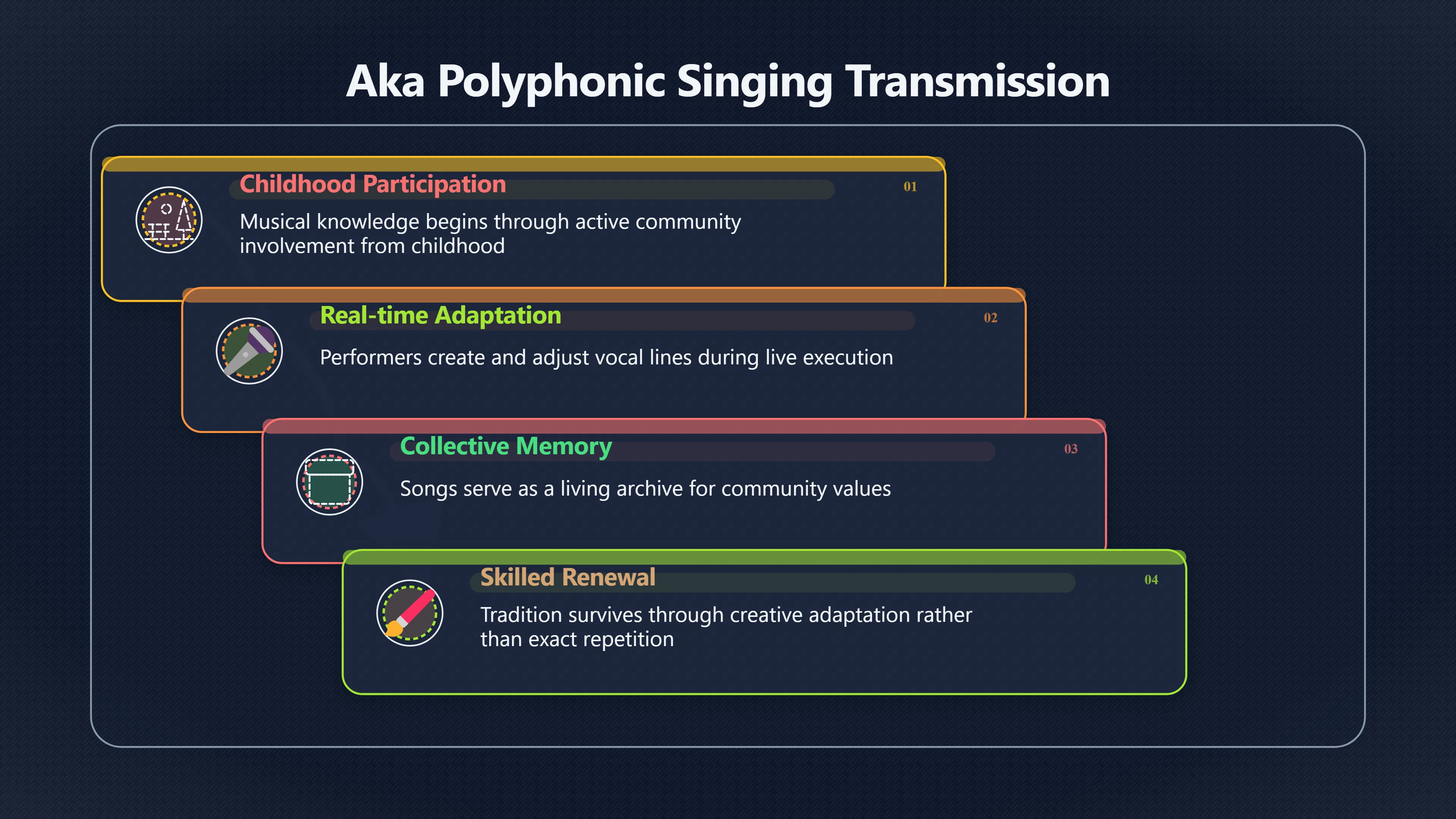
UNESCO’s description of Aka polyphony emphasises that the tradition belongs to the whole community rather than to a specialised professional class. Musical knowledge is learned through participation from childhood onwards, making performance itself a method of cultural transmission.[ICH UNESCO]ich.unesco.orgPolyphonic singing of the Aka Pygmies of Central AfricaThe Aka Pygmies living in the south-west region of the Central African R…
This helps explain why Aka singing belongs within a discussion of folklore. The songs preserve community values and practical knowledge, while also expressing beliefs about the forest and the unseen forces associated with it. Ethnomusicological research has noted that many Aka musical repertoires are connected in some way to spiritual life and ritual practice.[SHS HAL Science]shs.hal.scienceAka Polyphony: Music, Theory, Back and Forthby S Fürniss · 2006 · Cited by 65 — This explains why the majority of musical repertoires cal…
Four-Voice Forest Polyphony
One reason the tradition attracted international attention is its remarkable musical structure. UNESCO describes Aka singing as a complex form of contrapuntal polyphony built around four vocal parts. Instead of following a written score, performers create and adjust their lines in real time, producing music that is highly organised yet flexible.[ICH UNESCO]ich.unesco.orgPolyphonic singing of the Aka Pygmies of Central AfricaThe Aka Pygmies living in the south-west region of the Central African R…
The result can sound astonishing to listeners unfamiliar with the tradition. Multiple voices enter and weave around one another, each singer contributing an individual line while remaining connected to the group. Because performers can shift and vary their parts during a performance, no two renditions are exactly alike. UNESCO notes that this improvisational quality creates the impression of music that is constantly evolving.[apuntsdeviatge.com]apuntsdeviatge.comPolyphonic singing of the Aka PygmiesApunts de ViatgeThe Aka Pygmies living in the south-west region of the Central African Republic have developed a distinctive vocal musica…
For folklorists, that flexibility is significant. A written text tends to preserve a story in a fixed form. Aka polyphony preserves tradition differently. The structure remains recognisable across generations, but each performance allows creativity and adaptation. Folklore survives not through exact repetition but through skilled renewal.
The songs are often accompanied by instruments used for particular occasions, including drums, string bows and harp-like instruments. Yet the human voice remains the centre of the tradition, reinforcing the idea that collective memory lives within the community itself.[apuntsdeviatge.com]apuntsdeviatge.comPolyphonic singing of the Aka PygmiesApunts de ViatgeThe Aka Pygmies living in the south-west region of the Central African Republic have developed a distinctive vocal musica…
Rituals, Hunting and Funerals
The strongest evidence that Aka singing functions as living folklore comes from the occasions on which it is performed. Music and dance are closely tied to ceremonies connected with hunting, funerals and the establishment of new encampments. These are not random performances but moments that help define community identity.[apuntsdeviatge.com]apuntsdeviatge.comPolyphonic singing of the Aka PygmiesApunts de ViatgeThe Aka Pygmies living in the south-west region of the Central African Republic have developed a distinctive vocal musica…
In hunting contexts, songs can reinforce cooperation, shared knowledge and the relationship between people and the forest that sustains them. In funeral contexts, music helps communities remember the dead, express grief and reaffirm social bonds. During the creation of a new camp, singing marks the transformation of a physical space into a social and cultural one.[apuntsdeviatge.com]apuntsdeviatge.comPolyphonic singing of the Aka PygmiesApunts de ViatgeThe Aka Pygmies living in the south-west region of the Central African Republic have developed a distinctive vocal musica…
Many observers have noted that Aka musical traditions are inseparable from forest life. Songs are not simply about the environment; they emerge from daily engagement with it. As a result, folklore is embedded in practice. Knowledge about places, animals, relationships and spiritual understandings is maintained through participation rather than through formal instruction alone.[ICH UNESCO]ich.unesco.orghunting and life-cycle rituals, a tool of communication and reaffirmation of community…Read more…
This differs from the common image of folklore as a collection of old tales told beside a fire. Among the Aka, singing itself can be the folklore event: a performance that teaches, remembers and strengthens community identity at the same time.
The Forest as a Cultural Landscape
The rainforest is more than a backdrop to Aka singing. It is a cultural landscape that shapes the themes, meanings and functions of performance. Recordings and ethnographic studies have repeatedly highlighted the close connection between Aka music and forest life.[Smithsonian Folkways Recordings]folkways.si.eduSmithsonian Folkways Recordings Aka Pygmy MusicSmithsonian Folkways RecordingsAka Pygmy Music - Smithsonian Folkways RecordingsThis recording was annotated, compiled, and produced by S…
Some documentary accounts describe songs as expressing relationships with forest spirits or spiritual forces associated with the woodland environment. These beliefs should be understood as part of a traditional worldview rather than as claims that can be independently verified. What matters from a folklore perspective is that music serves as a medium through which people interpret their place within the forest and communicate those understandings to younger generations.[YouTube]youtube.comThe fascinating songs of the Pygmies | SLICEUNESCO proclaimed the oral tradition of the Baaka Pygmies a masterpiece of the Oral an…
The forest therefore functions much like a legendary landscape in other traditions. Instead of being remembered primarily through written legends, it is remembered through performance, ritual and sound.

Heritage, Tourism and Protection
Aka polyphonic singing gained international recognition when UNESCO proclaimed the oral traditions of the Aka a Masterpiece of the Oral and Intangible Heritage of Humanity in 2003. The tradition was later incorporated into UNESCO’s Representative List of the Intangible Cultural Heritage of Humanity in 2008.[ICH UNESCO]ich.unesco.orgCentral African RepublicThe Central African Republic has one element on the Representative List of the Intangible Cultural Heri…
Recognition brought visibility but also concerns. UNESCO and associated safeguarding projects have warned that deforestation, declining game populations, migration and broader social change threaten the conditions that traditionally supported Aka cultural life. When communities are separated from the forest environment that shaped their traditions, songs can become harder to sustain in their original context.[ICH UNESCO]ich.unesco.orghunting and life-cycle rituals, a tool of communication and reaffirmation of community…Read more…
Another challenge is what researchers sometimes call the folklorisation of heritage: traditions performed mainly for outsiders rather than for their original social purposes. Tourism and cultural festivals can help preserve visibility, but they can also encourage performances to be detached from the hunting, ritual and community settings that originally gave them meaning. UNESCO safeguarding programmes have therefore combined documentation, community participation, festivals, archives and educational initiatives in an effort to support the tradition without reducing it to a stage performance.[ICH UNESCO]ich.unesco.orghunting and life-cycle rituals, a tool of communication and reaffirmation of community…Read more…
Today, Aka polyphonic singing remains one of the most distinctive cultural traditions associated with the Central African Republic. Its importance lies not only in its musical complexity but also in what it demonstrates about folklore itself: stories, beliefs and communal memory do not always survive in books. Sometimes they survive in many voices singing together in the forest.[unesco.org]ich.unesco.orgPolyphonic singing of the Aka Pygmies of Central AfricaThe Aka Pygmies living in the south-west region of the Central African R…
eBay marketplace picks
Marketplace Samples
Live-tested eBay searches with available results related to this page.


Endnotes
1.
Source: ich.unesco.org
Link:https://ich.unesco.org/en/RL/polyphonic-singing-of-the-aka-pygmies-of-central-africa-00082
Source snippet
Polyphonic singing of the Aka Pygmies of Central AfricaThe Aka Pygmies living in the south-west region of the Central African R...
2.
Source: unesco.org
Title: document 3750
Link:https://www.unesco.org/archives/multimedia/document-3750
Source snippet
Oral Traditions of the Pygmies Aka | Intangible Heritage28 Nov 2014 — Music and dance form an integral part of Aka rituals including cere...
3.
Source: apuntsdeviatge.com
Title: Polyphonic singing of the Aka Pygmies
Link:https://www.apuntsdeviatge.com/2011/04/polyphonic-singing-of-aka-pygmies.html
Source snippet
Apunts de ViatgeThe Aka Pygmies living in the south-west region of the Central African Republic have developed a distinctive vocal musica...
4.
Source: ich.unesco.org
Link:https://ich.unesco.org/en/projects/action-plan-for-the-safeguarding-and-revitalization-of-the-oral-tradition-of-the-aka-pygmies-of-the-central-african-republic-00014
Source snippet
hunting and life-cycle rituals, a tool of communication and reaffirmation of community...Read more...
5.
Source: shs.hal.science
Link:https://shs.hal.science/halshs-00453689/document
Source snippet
Aka Polyphony: Music, Theory, Back and Forthby S Fürniss · 2006 · Cited by 65 — This explains why the majority of musical repertoires cal...
6.
Source: youtube.com
Link:https://www.youtube.com/watch?v=ApZVPIP1uhg
Source snippet
The polyphonic songs of the Aka pygmies of Central AfricaMusic and dance are integral to Aka rituals, particularly ceremonies accompanyin...
7.
Source: youtube.com
Link:https://www.youtube.com/watch?v=fHNkSYXbVMI
Source snippet
The fascinating songs of the Pygmies | SLICEUNESCO proclaimed the oral tradition of the Baaka Pygmies a masterpiece of the Oral an...
8.
Source: ich.unesco.org
Link:https://ich.unesco.org/en/state/central-african-republic-CF?info=periodic-reporting
Source snippet
Central African RepublicThe Central African Republic has one element on the Representative List of the Intangible Cultural Heri...
9.
Source: ich.unesco.org
Title: central african republic CF
Link:https://ich.unesco.org/en/state/central-african-republic-CF
Source snippet
Central African RepublicListing of ICH. 1 elements inscribed. 2008: Polyphonic singing of the Aka Pygmies of Central Africa (RL...
10.
Source: ich.unesco.org
Link:https://ich.unesco.org/en/state/central-african-republic-CF?cp=CF&info=projects&topic=fr-etat
Source snippet
go · The polyphonic songs of the Aka Pygmies are an integral...Read more...
11.
Source: ich.unesco.org
Link:https://ich.unesco.org/en/video/41484
Source snippet
singing of the Aka Pygmies of Central AfricaPolyphonic singing of the Aka Pygmies of Central Africa (Central African Republic) Representa...
12.
Source: ich.unesco.org
Link:https://ich.unesco.org/en/video/41485
Source snippet
unesco.orgVideo: - UNESCO Intangible Cultural HeritageVideo: Polyphonic singing of the Aka Pygmies of Central Africa.Read more...
13.
Source: ich.unesco.org
Title: photo pop up 00973
Link:https://ich.unesco.org/en/photo-pop-up-00973?photoID=00492
Source snippet
pop-up - UNESCO Intangible Cultural HeritageElement Polyphonic singing of the Aka Pygmies of Central Africa (Central African Republic): I...
14.
Source: ich.unesco.org
Link:https://ich.unesco.org/en/RL/cultural-space-of-the-brotherhood-of-the-holy-spirit-of-the-congos-of-villa-mella-00006?RL=00006&id=41484&include=film_inc.php
Source snippet
the Lists of Intangible Cultural...Polyphonic singing of the Aka Pygmies of Central Africa (Central African Republic) Representative Lis...
15.
Source: ich.unesco.org
Title: central african republic CF
Link:https://ich.unesco.org/en-state/central-african-republic-CF?call=film&id=41484&include=film_inc.php&width=700
Source snippet
singing of the Aka Pygmies of Central AfricaPolyphonic singing of the Aka Pygmies of Central Africa © UNESCO...
16.
Source: ich.unesco.org
Title: photo pop up 00973
Link:https://ich.unesco.org/en/photo-pop-up-00973?photoID=00159
Source snippet
pop-up - UNESCO Intangible Cultural HeritageTitle EN: The polyphonic songs of the Aka Pygmies are an integral part of their hunting and l...
17.
Source: youtube.com
Title: The Polyphonic Singing of the Aka Pygmies of Central Africa
Link:https://www.youtube.com/watch?v=yKLxFmnYO_I
Source snippet
The Music Of The Aka Pygmies (1978)...
18.
Source: youtube.com
Link:https://www.youtube.com/watch?v=RODfQo2amg8
Source snippet
Aka Pygmies Song "Echo of the Forest"...
19.
Source: youtube.com
Title: Aka Pygmies Song “Echo of the Forest”
Link:https://www.youtube.com/watch?v=_2r5DdMt2EY
Source snippet
Central Africa (Aka Pygmies) - 2 Songs by 2 Girls...
20.
Source: youtube.com
Title: Central Africa (Aka Pygmies)
Link:https://www.youtube.com/watch?v=MDhhtNADEfs
Source snippet
The fascinating songs of the Pygmies...
21.
Source: folkways.si.edu
Title: Smithsonian Folkways Recordings Aka Pygmy Music
Link:https://folkways.si.edu/aka-pygmy-music/world/music/album/smithsonian
Source snippet
Smithsonian Folkways RecordingsAka Pygmy Music - Smithsonian Folkways RecordingsThis recording was annotated, compiled, and produced by S...
22.
Source: folkways.si.edu
Title: Often stereotyped as “primitive” or “backward,”Read more
Link:https://folkways.si.edu/news-and-press/unesco-collection-week-40-music-of-the-aka-and-baka-pygmies
Source snippet
Collection Week 40: Music of the Aka & Baka Pygmies3 Feb 2015 — This week's UNESCO releases feature music of the pygmies on Aka Pygmy Mus...
Additional References
23.
Source: melodigging.com
Link:https://www.melodigging.com/genre/pygmy-music
24.
Source: facebook.com
Title: african intangible cultural heritagethe aka pygmies living in the south west reg
Link:https://www.facebook.com/AFRIESC2063/posts/african-intangible-cultural-heritagethe-aka-pygmies-living-in-the-south-west-reg/750737413762170/
Source snippet
African Intangible Cultural Heritage The Aka Pygmies living...30 Dec 2023 — Unlike polyphonic systems that are written down in notation...
25.
Source: researchgate.net
Link:https://www.researchgate.net/publication/290695244_Concept_Style_and_Structure_in_the_Music_of_the_African_Pygmies_and_Bushmen_A_Study_in_Cross-Cultural_Analysis
Source snippet
Fürniss, Susanne. 2006. “Aka Polyphony: Music, Theory, Back and Forth.” In Analytical...Read more...
26.
Source: facebook.com
Link:https://www.facebook.com/fb-answers/unesco-aka-polyphonic-singing-central-african-republic-intangible-heritage/
Source snippet
complex musical tradition recognized by UNESCO as an Intangible Cultural...
27.
Source: afropop.org
Title: remembering louis sarno
Link:https://www.afropop.org/articles/remembering-louis-sarno
Source snippet
Afropop WorldwideRemembering Louis Sarno31 Oct 2019 — Louis Sarno, an American original who lived for 30 years among Bayaka Pygmies in th...
28.
Source: Wikipedia
Title: Pygmy music
Link:https://en.wikipedia.org/wiki/Pygmy_music
Source snippet
Pygmy musicPygmy music refers to the sub-Saharan African music traditions of the Central African foragers (or "Pygmies"), predominantl...
Topic Tree