Where Bahamian Legends Meet Sea and Forest
Folklore in The Bahamas is not a single mythology with one sacred book or fixed pantheon. It is a living mixture of island storytelling, African-Caribbean spirit belief, Lucayan memory, Christian moral language, sea lore, bush medicine, seasonal masquerade and modern retellings.
Page outline Jump by section
What makes Bahamian folklore distinctive?
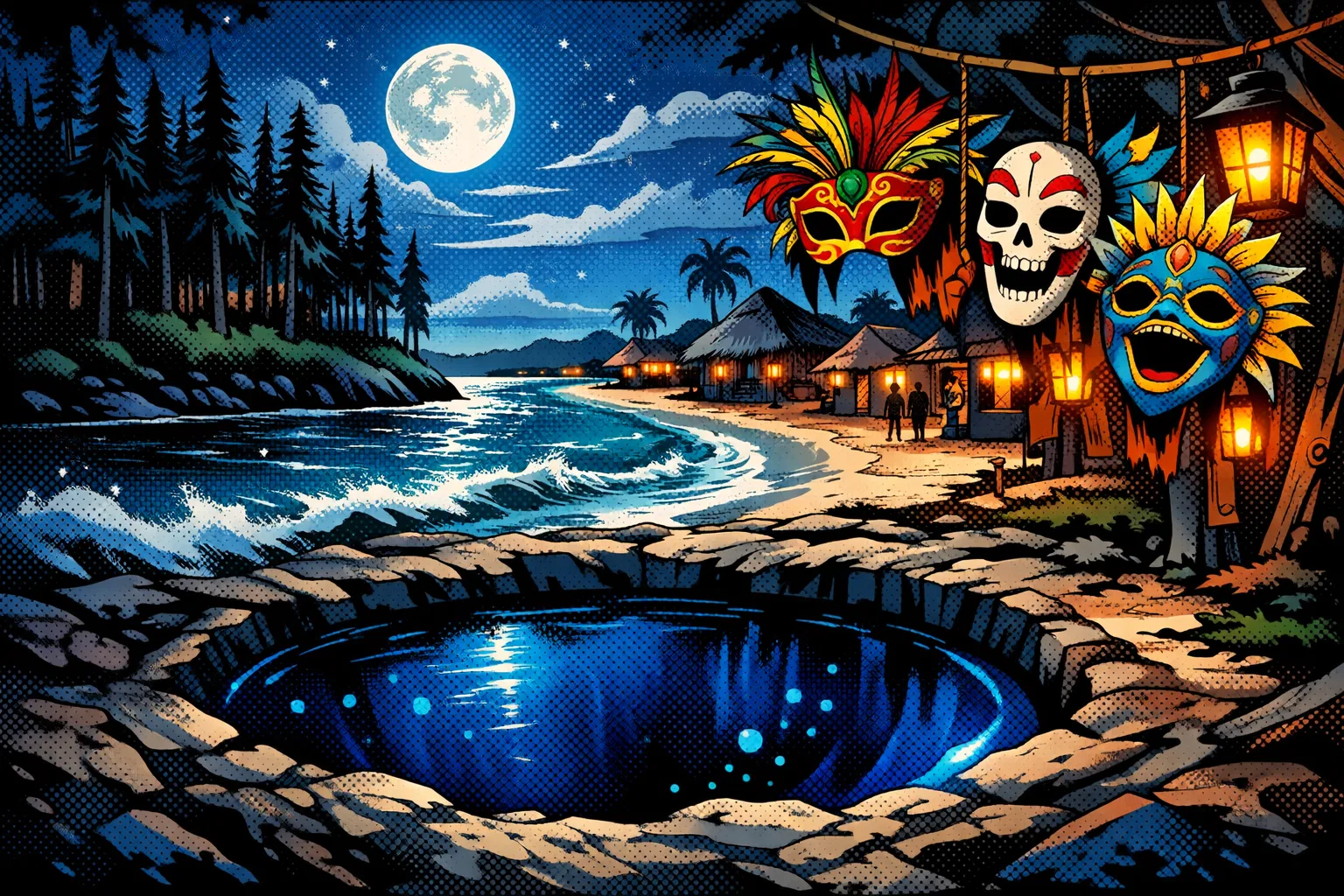
The Bahamas is an archipelagic country, so its folklore is strongly shaped by island geography. Many of its most memorable traditions are not abstract tales about distant gods; they are attached to specific environments. Andros gives the country two of its most famous legendary beings: the Chickcharney, linked to pine forests, and the Lusca, linked to blue holes and underwater cave systems. The Bahamas National Trust describes Andros as having the highest concentration of blue holes in the world, with Blue Holes National Park protecting 40,000 acres of inland blue holes, coppice and pine forest. That physical setting gives the folklore unusual force: dangerous water, sudden depths, tidal currents and remote woodland are not just scenery, but part of the meaning of the stories.[bnt.bs]bnt.bsOpen source on bnt.bs.
The country’s folklore also reflects layered history. The Lucayans were the original inhabitants of the Bahamian archipelago before European arrival, and modern museum work in The Bahamas increasingly stresses that their story belongs inside Bahamian identity, not merely as a preface to colonial history. After European colonisation, slavery, emancipation, migration and British-Caribbean religious law reshaped the islands’ cultural life. The result is a folklore field in which Indigenous place-memory, African-derived spiritual practices, Protestant moral language, British colonial law and local humour often sit side by side.[tcmuseum.org]tcmuseum.orgOpen source on tcmuseum.org.
A first-time reader should also know that Bahamian folklore is not limited to monsters. Patricia Glinton-Meicholas’s survey of Bahamian oral tradition, published by the Inter-American Development Bank Cultural Centre, treats “talkin’ ol’ story” as a central cultural practice: storytelling as entertainment, instruction, memory and verbal art. Her folktale collection An Evening in Guanima gathers Bahamian tales with characters such as Bouki and Rabbi, Jack and B’er Debbil, and the Gaulin Woman, showing a world where wit, appetite, trickery and moral reversal are as important as fear.[iadb.org]publications.iadb.orgPublicationstalkin' ol story: a brief survey of the oral traditionPublicationstalkin' ol story: a brief survey of the oral tradition
The Chickcharney: Andros’s forest guardian
The Chickcharney is probably the most famous land creature in Bahamian folklore. It is usually associated with Andros, especially the island’s pine forests. In popular descriptions, it is an owl-like or bird-like being, sometimes mischievous, sometimes protective, and capable of bringing good or bad luck depending on how a person treats it. Accounts often describe it as a strange forest dweller rather than a simple animal: a creature that watches travellers, punishes disrespect and rewards courtesy.[Wikipedia]WikipediaOpen source on wikipedia.org.
The Chickcharney is interesting because it sits at the border between folklore and natural history. One theory links the legend to Tyto pollens, an extinct giant barn owl known from Bahamian fossil material. Smithsonian work on fossil vertebrates from The Bahamas records Tyto pollens among the extinct birds of the archipelago, and later writing on Bahamian fossil birds describes a large extinct barn owl associated with hutia remains in fossil deposits. This does not “prove” that the Chickcharney was a surviving giant owl, and the strongest scientific evidence is more cautious than many internet retellings. It does, however, show why the comparison remains attractive: Bahamian fossil history really did include remarkable owls.[Smithsonian Research Online]repository.si.eduSmithsonian Research Online Fossil Vertebrates from the BahamasSmithsonian Research Online Fossil Vertebrates from the Bahamas
That distinction matters. Folklore pages sometimes present the Chickcharney as if palaeontology has solved the story. It has not. The safer reading is that the legend may preserve, echo or later absorb memories of unusual island birds, but it also functions as a moral landscape story. It tells people that the forest is inhabited, watched and ethically charged. In that sense the Chickcharney is not just a “cryptid”. It is a local way of imagining right behaviour in a fragile island environment.[Biodiversity Heritage Library]biodiversitylibrary.orgBiodiversity Heritage Library DetailsBiodiversity Heritage Library Details
The creature has also moved into modern cultural use. Tourism and popular folklore sites present the Chickcharney as a symbol of Andros’s storytelling heritage, while local festivals and ecotourism writing use it as a recognisable emblem of the island. That modern visibility does not make the legend fake; it shows how an oral figure can become a public cultural icon once a country begins packaging local tradition for visitors, schools and heritage projects.[discoverbahamas.com]discoverbahamas.comOpen source on discoverbahamas.com.

The Lusca: why blue holes became monster country
The Lusca is the great water monster of Bahamian legend. It is most often said to live in the blue holes around Andros, and modern retellings describe it as a giant octopus, a shark-octopus hybrid, or a many-tentacled creature that can pull swimmers, divers or boats into the depths. The details vary, but the core fear is consistent: calm-looking water may hide a dangerous vertical world beneath.[wikipedia.org]WikipediaOpen source on wikipedia.org.
The power of the Lusca story is easier to understand once the geology is taken seriously. Blue holes are not ordinary ponds. The Bahamas National Trust explains that Andros’s limestone bedrock has eroded over thousands of years into underwater cave systems, some containing unusual cave fish and invertebrates found nowhere else. George Mason University’s science reporting on King Kong Cavern, a 500-foot-deep sinkhole on the Andros barrier reef, explicitly notes local stories of the Lusca and of mermaids in Andros blue holes before turning to the real microbial life of the cave. Folklore and science are looking at the same uncanny place, but asking different questions.[bnt.bs]bnt.bsOpen source on bnt.bs.
The Lusca should not be treated as proven zoology. There is no good evidence for a giant shark-octopus monster in Bahamian waters. But as folklore it is highly legible. It personifies real hazards: depth, darkness, currents, cave passages, disorientation and the possibility of drowning. In many island cultures, dangerous places gather stories because stories are memorable safety systems. “Do not go too close” becomes more powerful when the warning has teeth, tentacles and a name.[A Book of Creatures]abookofcreatures.comOpen source on abookofcreatures.com.
Modern media has pushed the Lusca towards cryptid entertainment. Television investigations, online monster lists and travel writing often emphasise the creature’s spectacle. That is not wrong as popular culture, but it can flatten the older function of the story. The Lusca is most valuable as a Bahamian sea-and-cave legend: a narrative that turns a distinctive natural feature into a place of awe, caution and local identity.[Wikipedia]WikipediaOpen source on wikipedia.org.
Spirits, duppies and the moral world of the dead
Bahamian ghost belief belongs to a wider Afro-Caribbean world in which the dead may remain active, troubling, protective or dangerous. The word “duppy” is widely associated with Caribbean spirit lore, especially Jamaica, but Bahamian discussions of spirits, “sperrits”, graveyard danger and supernatural retaliation sit in a related regional field. In these traditions, the dead are not always gone in a tidy way. They may appear in dreams, haunt places, punish wrongdoing or become part of everyday explanation for misfortune.[Museum and]museumand.orgOpen source on museumand.org.
This ghostly world overlaps with Obeah, a broad term used across the Anglophone Caribbean for practices involving spiritual power, healing, protection, charms and sometimes harmful magic. Scholars stress that Obeah is not one uniform religion; it is a varied set of practices and labels shaped by African diasporic traditions, colonial hostility, Christian moral judgement and local secrecy. In The Bahamas, as elsewhere, people may avoid publicly naming practices as Obeah because the word carries stigma and legal risk.[Wikipedia]WikipediaOpen source on wikipedia.org.
The legal history is important. The Bahamas Penal Code has treated Obeah as a criminal matter, and United States religious freedom reporting has noted that Obeah is illegal under Chapter 84, Section 232 of the Penal Code. Legal scholar Danielle N. Boaz places Bahamian provisions within a wider Anglophone Caribbean pattern in which colonial-era laws criminalised “pretending” to possess supernatural powers or practising Obeah. That means Bahamian folklore cannot be separated from power: some spiritual traditions were not merely mocked, but regulated and punished.[state.gov]2009-2017.state.govDepartment BahamasDepartment Bahamas
For readers, the key is to avoid two mistakes. The first is to romanticise Obeah as harmless “magic”. The second is to repeat colonial caricatures that treated African-derived spiritual work as primitive fraud or evil. A grounded account recognises that Obeah has been used in stories of healing, protection, fear, accusation, graveyard power and social conflict. It is part of Bahamian belief culture, but it is also a contested and stigmatised subject.[wikipedia.org]WikipediaOpen source on wikipedia.org.
Bush medicine: where folklore and practical knowledge meet
Bush medicine is one of the clearest examples of how Bahamian tradition can be both folkloric and practical. It refers to the use of indigenous and introduced plants for healing, especially in the Family Islands. A study on bush medicine in the Family Islands describes it as traditional plant-based medicine and notes that elderly Bahamians may continue to rely on it because remedies are affordable, culturally accepted, readily available and sometimes considered more effective than biomedical or over-the-counter treatments.[OhioLINK Rave]rave.ohiolink.eduOpen source on ohiolink.edu.
Edith Gibson’s article “Bahamian Bush Medicine: Fact or Folklore?” is careful about its scope: it does not try to prove or disprove every claimed healing power, but treats bush medicine as part of Bahamian cultural heritage. That caution is useful. Some plant remedies may have pharmacological value; others may work through comfort, ritual, memory or placebo; some may be ineffective or unsafe. Folklore here is not a synonym for falsehood. It is the social setting in which knowledge is remembered, transmitted and trusted.[Public Knowledge Project]journals.sfu.caOpen source on sfu.ca.
Bush medicine also blurs boundaries with Obeah, Christianity and everyday household care. A tea, bath or plant remedy may be framed as common sense by one person, spiritual work by another, and superstition by a third. That ambiguity is part of Bahamian belief culture. It shows how healing traditions survive not only in dramatic stories of witches and spirits, but in ordinary decisions about illness, ageing, money, access to clinics and trust in elders.[OhioLINK Rave]rave.ohiolink.eduOpen source on ohiolink.edu.
Tricksters, talking animals and “talkin’ ol’ story”
Not all Bahamian folklore is supernatural. Much of it is comic, social and sharply observant. In Bahamian folktale collections, characters such as Bouki and Rabbi carry the familiar Caribbean trickster pattern: appetite, cunning, embarrassment, rivalry and reversal. These stories entertain, but they also teach listeners how to read people. The fool may expose the clever person; the weak may outwit the strong; greed may become self-punishment.[Guanima Press Ltd.]guanimacreative.comOpen source on guanimacreative.com.
The phrase “talkin’ ol’ story” points to oral tradition as performance. A story is not just a plot; it is timing, voice, audience, local expression and shared recognition. Glinton-Meicholas’s work is especially important because it treats Bahamian oral tradition as a serious cultural archive rather than as quaint children’s material. Her role as a Bahamian writer, cultural scholar and founding president of the Bahamas Association for Cultural Studies gives her work particular weight for readers trying to understand folklore from within the country’s own literary and cultural conversation.[IADB Publications]publications.iadb.orgPublicationstalkin' ol story: a brief survey of the oral traditionPublicationstalkin' ol story: a brief survey of the oral tradition
These tales also help explain why Bahamian folklore should not be reduced to monsters. The Chickcharney and Lusca may attract the most online attention, but trickster stories preserve something just as important: a Bahamian pleasure in verbal agility, social satire and survival intelligence. In a small-island setting where reputation, family, church, class and community memory matter, the clever tale can be as culturally revealing as the ghost story.[Guanima Press Ltd.]guanimacreative.comOpen source on guanimacreative.com.
Junkanoo: masquerade, memory and national performance
Junkanoo is not usually described as a “legend”, but it belongs in any serious account of Bahamian folklore because it is a living festival of masquerade, music, costume, rhythm and collective memory. The Government of The Bahamas calls Junkanoo a national festival, marked by colour, sound, cowbells, goatskin drums and whistles. The official tourism site describes months of preparation, large organised groups, handmade costumes and parades on Boxing Day and New Year’s Day.[bahamas.gov.bs]bahamas.gov.bsOpen source on bahamas.gov.bs.
Its origins are debated, but most accounts connect Junkanoo to the era of slavery and to Christmas-time periods when enslaved Africans and their descendants could gather, celebrate and perform. The Educulture Junkanoo Museum presents it as a celebration that grew from temporary freedom at Christmas into an exuberant Bahamian parade. UNESCO’s listing of Junkanoo as intangible cultural heritage also recognises it as a major cultural practice of The Bahamas, centred on communal creativity and participation.[Nassau Paradise Island]nassauparadiseisland.comOpen source on nassauparadiseisland.com.
Junkanoo matters because it shows folklore in motion. It is not a story told about the past; it is a public practice through which Bahamians make culture visible. Costumes, music and group rivalry turn memory into street theatre. The parade also shows how tradition changes: what may have begun as informal, resistant celebration has become national performance, museum subject, tourism attraction and competitive art form.[bahamas.com]bahamas.comOpen source on bahamas.com.
That transformation brings a useful tension. Heritage institutions and tourism can preserve a tradition, but they can also tidy it up, stage it and sell it. Junkanoo’s cultural power lies in the fact that it has survived that process without becoming merely decorative. It remains one of the strongest ways The Bahamas performs identity in public.[bahamas.gov.bs]bahamas.gov.bsOpen source on bahamas.gov.bs.
Lucayan memory and the problem of missing old myths
Readers often ask whether The Bahamas has surviving Indigenous mythology. The honest answer is complicated. The Lucayans were the original inhabitants of The Bahamas and were part of the wider Indigenous Caribbean world, but Spanish enslavement and displacement after 1492 devastated Lucayan society. Modern knowledge of Lucayan lifeways comes from archaeology, colonial records and comparison with related Taíno cultures, rather than from a large continuous body of recorded Bahamian Indigenous myths.[tcmuseum.org]tcmuseum.orgOpen source on tcmuseum.org.
This absence should not be mistaken for insignificance. The Bahamas Museum of History and Natural Science argues that Lucayan traditions, respect for nature and communal values still resonate in Bahamian identity. Recent public history work has also emphasised that history does not begin with Columbus simply because Europeans began writing about the islands then. For folklore readers, this means Lucayan memory is present less as a neat catalogue of named gods and more as a contested heritage field: archaeology, museum interpretation, place names, craft traditions and national rethinking.[bmhns.org]bmhns.orgOpen source on bmhns.org.
A careful Bahamian folklore page should therefore resist filling the gap with generic Taíno mythology copied from elsewhere. Comparison with the wider Taíno world can help explain context, but The Bahamas has its own historical rupture. The more honest approach is to say that Indigenous Bahamian story culture was profoundly damaged by colonisation, and that modern recovery depends on archaeology, museum work and respectful interpretation rather than invented certainty.[Smithsonian Magazine]smithsonianmag.comOpen source on smithsonianmag.com.
How Bahamian folklore is understood today
Today, Bahamian folklore lives in several forms at once. It appears in books and lectures, in family storytelling, in school and museum heritage work, in tourism pages, in Halloween features, in ecotourism around Andros, and in online monster culture. The same figure can move between these settings. A Chickcharney can be a childhood warning, an Andros symbol, a possible echo of extinct bird life, or a playful tourism mascot. The Lusca can be local water lore, a diver’s cautionary tale, a cryptid, or a television monster.[iadb.org]publications.iadb.orgtalkin ol story brief survey oral tradition bahamastalkin ol story brief survey oral tradition bahamas
The healthiest way to read these traditions is neither gullible nor dismissive. Folklore does not need to be factually literal to be culturally true. The Lusca tells the truth that blue holes are awe-inspiring and dangerous. The Chickcharney tells the truth that forests are not empty resources, but inhabited moral spaces. Duppy and Obeah stories tell the truth that death, illness, envy, love, fear and power are social realities as well as private experiences. Junkanoo tells the truth that memory can be danced, drummed, worn and argued over in the street.[bnt.bs]bnt.bsOpen source on bnt.bs.
The evidence remains uneven, and that is worth saying plainly. Bahamian folklore has been less systematically collected and digitised than the traditions of some larger countries. Some claims online are recycled without clear sourcing, especially around monsters. Stronger evidence comes from Bahamian cultural scholars such as Patricia Glinton-Meicholas, institutional sources such as the Bahamas National Trust and museum projects, legal and religious scholarship on Obeah, and scientific work on the landscapes that shaped the stories.[iadb.org]publications.iadb.orgPublicationstalkin' ol story: a brief survey of the oral traditionPublicationstalkin' ol story: a brief survey of the oral tradition

What The Bahamas’ folklore preserves for later generations
Bahamian folklore matters because it gives emotional shape to a country made of islands, water, forests, migration and memory. It teaches caution around dangerous places, preserves comic intelligence in trickster tales, keeps alive debates over spiritual power and healing, and turns public celebration into national identity. It also reminds readers that folklore is not frozen in the past. In The Bahamas, old story forms continue to change through conservation, tourism, literature, law, popular media and cultural pride.[guanimacreative.com]guanimacreative.comOpen source on guanimacreative.com.
The most useful way to understand Bahamian folklore is to keep the landscape in view. Andros’s blue holes make the Lusca believable as a warning, even if not as an animal. Pine forests make the Chickcharney feel rooted, even when its connection to fossil owls remains uncertain. The festival street makes Junkanoo more than a performance; it becomes a way of remembering slavery, freedom and creativity in public. The oral tale makes everyday speech into cultural inheritance. Together, these traditions show The Bahamas not as a place with a few colourful legends attached, but as a country whose stories rise directly from its waters, woods, histories and voices.
Amazon book picks
Further Reading
Books and field guides related to Where Bahamian Legends Meet Sea and Forest. Use these as the next step if you want deeper reading beyond the article.
Tales from the Caribbean
Introduces common themes found across Caribbean oral traditions.
An Embarrassment of Mangoes
Captures island life and cultural atmosphere relevant to Caribbean folklore.
The Book of Caribbean Folktales, Legends and Myths
Provides regional context for Bahamian legends and storytelling.
eBay marketplace picks
Marketplace Samples
Live-tested eBay searches with available results related to this page.
Endnotes
1.
Source: publications.iadb.org
Title: Publicationstalkin’ ol story: a brief survey of the oral tradition
Link:https://publications.iadb.org/publications/english/document/Talkin-Ol-Story-A-Brief-Survey-of-the-Oral-Tradition-of-the-Bahamas.pdf
2.
Source: publications.iadb.org
Title: talkin ol story brief survey oral tradition bahamas
Link:https://publications.iadb.org/en/talkin-ol-story-brief-survey-oral-tradition-bahamas
3.
Source: bnt.bs
Link:https://bnt.bs/explore/andros/blue-holes-national-park/
4.
Source: bahamas.gov.bs
Link:https://www.bahamas.gov.bs/junkanoo
5.
Source: bmhns.org
Link:https://bmhns.org/lucayan-legacy/
6.
Source: cambridge.org
Link:https://www.cambridge.org/core/journals/journal-of-law-and-religion/article/obeah-vagrancy-and-the-boundaries-of-religious-freedom-analyzing-the-proscription-of-pretending-to-possess-supernatural-powers-in-the-anglophone-caribbean/11EEE1AD5948F72F423FE174FFE61F87
7.
Source: Wikipedia
Link:https://en.wikipedia.org/wiki/Chickcharney
8.
Source: discoverbahamas.com
Link:https://www.discoverbahamas.com/directory/the-mystery-of-the-chickcharney-andros-most-famous-mythical-creature-article-1023.aspx
9.
Source: Wikipedia
Link:https://en.wikipedia.org/wiki/Lusca
10.
Source: science.gmu.edu
Title: what really lives king kong cavern
Link:https://science.gmu.edu/news/what-really-lives-king-kong-cavern
11.
Source: Wikipedia
Link:https://en.wikipedia.org/wiki/Afro-Bahamians
12.
Source: Wikipedia
Link:https://en.wikipedia.org/wiki/Obeah
13.
Source: 2009-2017.state.gov
Title: Department Bahamas
Link:https://2009-2017.state.gov/j/drl/rls/irf/2005/51625.htm
14.
Source: laws.bahamas.gov.bs
Link:https://laws.bahamas.gov.bs/cms/images/LEGISLATION/PRINCIPAL/1873/1873-0015/1873-0015_2.pdf
15.
Source: rave.ohiolink.edu
Link:https://rave.ohiolink.edu/etdc/view?acc_num=miami1335445242
16.
Source: bahamas.com
Link:https://www.bahamas.com/events/junkanoo
17.
Source: ich.unesco.org
Title: Intangible Cultural Heritage Junkanoo
Link:https://ich.unesco.org/en/RL/junkanoo-01988
18.
Source: junkanooworld.org
Link:https://junkanooworld.org/
19.
Source: Wikipedia
Title: Lucayan people
Link:https://en.wikipedia.org/wiki/Lucayan_people
20.
Source: laws.bahamas.gov.bs
Link:https://laws.bahamas.gov.bs/cms/images/LEGISLATION/PRINCIPAL/1939/1939-0022/1939-0022.pdf
21.
Source: bahamas.gov.bs
Link:https://www.bahamas.gov.bs/museums
22.
Source: Wikipedia
Title: The Bahamas
Link:https://en.wikipedia.org/wiki/The_Bahamas
23.
Source: Wikipedia
Title: Tyto pollens
Link:https://en.wikipedia.org/wiki/Tyto_pollens
24.
Source: Wikipedia
Link:https://en.wikipedia.org/wiki/Junkanoo
25.
Source: Wikipedia
Title: Blue Holes National Park
Link:https://en.wikipedia.org/wiki/Blue_Holes_National_Park
26.
Source: archive.org
Link:https://archive.org/details/fossilvertebrat48olso
27.
Source: discoverbahamas.com
Link:https://www.discoverbahamas.com/directory/bahamas-folklore-and-legends-mystical-stories-that-shape-island-culture-article-183.aspx
28.
Source: discoverbahamas.com
Link:https://discoverbahamas.com/directory/cousteaus-blue-hole-andros-guide-exploring-the-legendary-blue-holes-of-the-bahamas-article-1844.aspx
29.
Source: time.com
Title: junkanoo holiday history
Link:https://time.com/7202192/junkanoo-holiday-history/
30.
Source: lawcommission.gov.kn
Title: Ch 04 20 Obeah Act
Link:https://lawcommission.gov.kn/wp-content/documents/Act02and09TOC/Ch-04_20-Obeah-Act.pdf
31.
Source: youtube.com
Title: THE GAULIN WOMAN. Patricia Glinton Meicholas
Link:https://www.youtube.com/watch?v=l1xNEBf5WRk
Source snippet
The Chickcharney | The Fate Changing Owls of the Bahamas...
32.
Source: youtube.com
Title: The Chickcharney | The Fate Changing Owls of the Bahamas
Link:https://www.youtube.com/watch?v=9cYjqNCmbdM
Source snippet
The Lusca | The Caribbean's Giant Sea Monsters...
33.
Source: youtube.com
Title: The Lusca | The Caribbean’s Giant Sea Monsters
Link:https://www.youtube.com/watch?v=MzB36TuRnxU
Source snippet
Island boy Alex Episode 2 - The Lost Souls Tree- Bahamian Folklore...
34.
Source: abookofcreatures.com
Link:https://abookofcreatures.com/2020/06/15/lusca/
35.
Source: tcmuseum.org
Link:https://www.tcmuseum.org/culture-history/lucayans/
36.
Source: guanimacreative.com
Link:https://www.guanimacreative.com/aneveninginguanima
37.
Source: repository.si.edu
Title: Smithsonian Research Online Fossil Vertebrates from the Bahamas
Link:https://repository.si.edu/bitstream/handle/10088/15601/vz_Bahamas_fossils.pdf?isAllowed=y&sequence=1
38.
Source: repository.si.edu
Link:https://repository.si.edu/bitstreams/7ed3a377-484c-4f8e-90c8-e2802be44c6b/download
39.
Source: repository.si.edu
Link:https://repository.si.edu/bitstreams/518ddad3-d25c-4bdb-a572-4bfff904004c/download
40.
Source: biodiversitylibrary.org
Title: Biodiversity Heritage Library Details
Link:https://www.biodiversitylibrary.org/bibliography/159193
41.
Source: museumand.org
Link:https://www.museumand.org/2020/11/09/caribbeanghoststory/
42.
Source: tribune242.com
Title: bahamians continue use obeah
Link:https://www.tribune242.com/news/2022/feb/23/bahamians-continue-use-obeah/
43.
Source: journals.sfu.ca
Link:https://journals.sfu.ca/cob/index.php/files/article/view/259/pdf_29
44.
Source: guanimacreative.com
Link:https://www.guanimacreative.com/patriciaglintonmeicholas
45.
Source: nassauparadiseisland.com
Link:https://www.nassauparadiseisland.com/experiences/educulture-junkanoo-museum
46.
Source: smithsonianmag.com
Link:https://www.smithsonianmag.com/history/how-archaeologists-are-unearthing-the-secrets-of-the-bahamas-first-inhabitants-180983548/
47.
Source: facebook.com
Link:https://www.facebook.com/groups/4585999861/posts/10156163493999862/
48.
Source: repository.si.edu
Link:https://repository.si.edu/items/b65a931f-f82e-4ae9-8b2c-cd2186921544
49.
Source: geospatial.tnc.org
Link:https://geospatial.tnc.org/datasets/the-bahamas-blue-holes/about
50.
Source: nixillustration.com
Title: tyto pollens
Link:https://nixillustration.com/tag/tyto-pollens/
51.
Source: biodiversitylibrary.org
Link:https://www.biodiversitylibrary.org/itemdetails/266616
52.
Source: cryptidz.fandom.com
Link:https://cryptidz.fandom.com/wiki/Chickcharney
53.
Source: cryptidz.fandom.com
Link:https://cryptidz.fandom.com/wiki/Lusca
54.
Source: warriorsofmyth.fandom.com
Link:https://warriorsofmyth.fandom.com/wiki/Chickcharney
55.
Source: sciifii.fandom.com
Title: Tyto pollens
Link:https://sciifii.fandom.com/wiki/Tyto_pollens
56.
Source: cryptidarchives.fandom.com
Link:https://cryptidarchives.fandom.com/wiki/Lusca
57.
Source: caribbeanfolkloremonth.wordpress.com
Link:https://caribbeanfolkloremonth.wordpress.com/2025/09/15/lusca/
58.
Source: lisagbuckley.wordpress.com
Link:https://lisagbuckley.wordpress.com/tag/caribbean/
59.
Source: openlibrary.org
Title: An evening in Guanima
Link:https://openlibrary.org/books/OL891308M/An_evening_in_Guanima
60.
Source: atlantisbahamas.com
Link:https://www.atlantisbahamas.com/junkanoo-bahamian-tradition
61.
Source: yumpu.com
Title: Penal Code
Link:https://www.yumpu.com/en/document/view/13384858/penal-code-the-bahamas-laws-on-line-the-government-of-the-
62.
Source: tripadvisor.com
Title: Blue Holes National Park
Link:https://www.tripadvisor.com/Attraction_Review-g147425-d185160-Reviews-Blue_Holes_National_Park-Andros_Out_Islands_Bahamas.html
63.
Source: nassauparadiseisland.com
Title: 5 things you didnt know about junkanoo
Link:https://www.nassauparadiseisland.com/blog/5-things-you-didnt-know-about-junkanoo
64.
Source: end-blasphemy-laws.org
Link:https://end-blasphemy-laws.org/countries/americas/bahamas/
Additional References
65.
Source: youtube.com
Title: Powerful Females In Bahamian Folklore. Patricia Glinton Meicholas
Link:https://www.youtube.com/watch?v=m-Xo_QRUb0k
Source snippet
THE GAULIN WOMAN. Patricia Glinton Meicholas...
66.
Source: academia.edu
Link:https://www.academia.edu/56401913/Bahamian_Bush_Medicine_Fact_or_Folklore
67.
Source: researchgate.net
Link:https://www.researchgate.net/publication/265573554_Owls_of_Old_Forests_of_the_World
68.
Source: researchgate.net
Link:https://www.researchgate.net/publication/359659393_Smithsonian_Collections_Lucayan_Histories_The_Research_Potential_of_Legacy_Collections_from_The_Bahamas_and_Turks_and_Caicos_Islands
69.
Source: amazon.de
Link:https://www.amazon.de/Evening-Guanima-Treasury-Folktales-Bahamas-ebook/dp/B075MJ8TC3?tag=searcht-20
70.
Source: amazon.de
Link:https://www.amazon.de/-/en/Patricia-Glinton-Meicholas-ebook/dp/B075MJ8TC3?tag=searcht-20
71.
Source: bookinform.com
Link:https://www.bookinform.com/2017/09/an-evening-in-guanima-treasury-of.html?m=1
72.
Source: amazon.de
Link:https://www.amazon.de/evening-Guanima-treasury-folktales-Bahamas/dp/9768140127?tag=searcht-20
73.
Source: inaturalist.org
Link:https://www.inaturalist.org/taxa/543556-Tyto-pollens
74.
Source: museumofmiami.org
Link:https://museumofmiami.org/south-florida-folklife-center/artist-in-residence-programs/bahamas-junkanoo-revue/
Topic Tree
Follow this branch
Related pages 192
- Afghan Folklore
- Albanian Folklore
- Algerian Folklore
- Australian Folklore
- Azerbaijan Folklore
- +187 more in sidebar