Why El Salvador's Legends Still Feel Alive
El Salvador’s folklore is a living blend of Indigenous memory, Catholic ritual, rural warning tales, local landscapes and modern cultural pride.
Page outline Jump by section
Why Salvadoran folklore feels so local
Salvadoran folklore is often shared with wider Central America, but it has a strongly local flavour because the stories are tied to particular rivers, ravines, volcanoes, roads, villages and patron-saint celebrations. A tale may be recognisable across the region, yet the Salvadoran version is shaped by where people imagine meeting the being: a riverbank at night, a rural kitchen, a road home after drinking, a town square during Holy Week, or the volcanic memory of Nejapa. The Ministry of Culture’s accounts of oral storytelling in San Antonio Abad, for example, describe people remembering the black and white Cadejo, the Siguanaba and the Cipitío not as museum curiosities but as stories heard from grandparents and linked to rural life, horses, midnight journeys and warnings about staying out too late.[Ministerio de Cultura]cultura.gob.svOpen source on gob.sv.
The country’s folklore also reflects El Salvador’s deeper cultural layering. Joya de Cerén, the country’s UNESCO World Heritage archaeological site, preserves a pre-Hispanic farming community buried by volcanic ash around AD 600, offering an unusually vivid picture of everyday life in ancient Mesoamerica rather than only elite temples and monuments. That does not mean today’s legends can be read straight back into that village, but it helps explain why Salvadoran tradition so often treats ordinary spaces — kitchens, fields, steam baths, maize, rivers, household courtyards — as places where the sacred and uncanny can break through.[UNESCO World Heritage Centre]whc.unesco.orgOpen source on unesco.org.
The Indigenous background is especially important in western and central El Salvador, where Nahua-Pipil heritage, Nawat language memory and local sacred geography continue to influence cultural identity. Scholars and cultural organisations describe the Nahuat-Pipil, Lenca and Cacaopera as surviving Indigenous communities in El Salvador, while current language-revival work around Nawat shows that folklore is not only about old stories but also about the words, ecological knowledge and community memory that carry them.[culturalsurvival.org]culturalsurvival.orgresilience and resistance nahuat pipil peoples el salvadorresilience and resistance nahuat pipil peoples el salvador
The famous night beings
The best-known Salvadoran legends tend to work like social maps. They warn people about water after dark, drunken wandering, sexual misconduct, neglect of family duties, or the dangers of lonely roads. Modern retellings can make them sound like horror characters, but in oral tradition they are usually more flexible: frightening, moralising, comic, protective or mischievous depending on who is telling the story.
The river woman
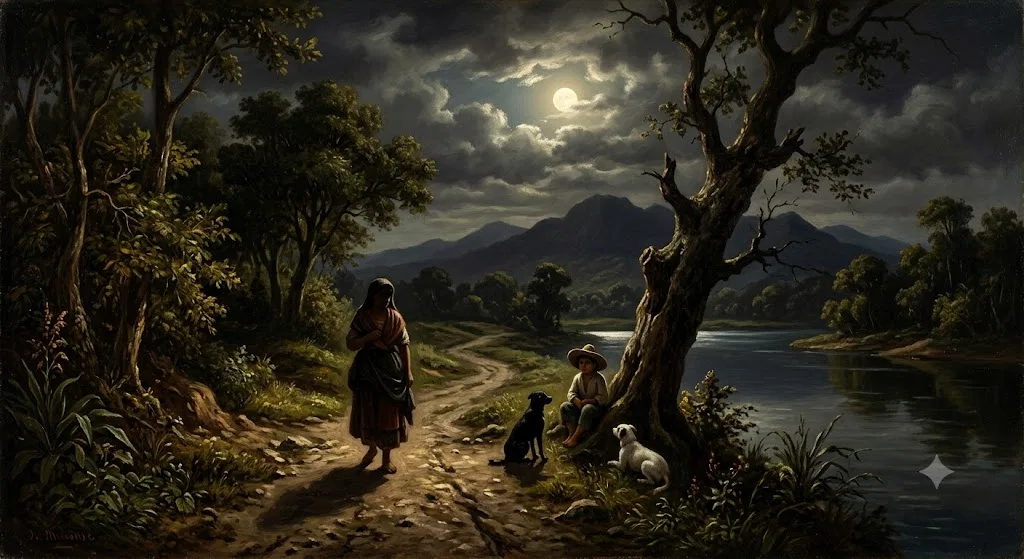
The Siguanaba is probably El Salvador’s most recognisable legendary figure. In Salvadoran versions, she appears near rivers, ravines or lonely waters as an alluring woman, usually seen from behind, before revealing a terrifying face or body and driving the victim into shock, madness or humiliation. A 1967 edition of Miguel Ángel Espino’s Mitología de Cuscatlán presents her as a punished woman condemned to wander along riverbanks, and explicitly frames her as a myth of punished infidelity.[Fandom Images]images.wikia.comFandom Images Miguel Ángel Espino Mitología de CuscatlánFandom Images Miguel Ángel Espino Mitología de Cuscatlán
That moral frame matters, but it should not be treated as the only meaning of the legend. The Siguanaba is also a water spirit, a night-road warning, a gendered cautionary tale and a figure through which communities talk about danger, desire and shame. The same broad figure appears in other Central American traditions under related names, but Salvadoran storytelling often links her closely to the Cipitío and to river landscapes, making her feel less like a generic ghost and more like part of a local family of beings.[Wikipedia]WikipediaOpen source on wikipedia.org.
The eternal child
The Cipitío is usually described as the son of the Siguanaba: a small boy, often pot-bellied, mischievous, sometimes with backward feet, and commonly associated with a large hat. In popular retellings, his name is linked to a Nawat word for child, and the story explains his childlike state as a curse that keeps him young forever.[Wikipedia]WikipediaOpen source on wikipedia.org.
Unlike his mother, the Cipitío is often less terrifying than disruptive. He steals food, makes messes, teases people and pursues girls in versions that can range from playful to uncomfortable by modern standards. That range is a useful reminder that folklore is not fixed. A grandparent’s warning story, a children’s book, a classroom retelling and an internet horror post may all preserve the name while changing the tone. A 1996 Salvadoran educational study on legends, for instance, notes the popularity of the Siguanaba and the Cipitío in rural areas and discusses them as orally transmitted figures used across generations.[rd.udb.edu.sv]rd.udb.edu.svA, EL LA CONDUCTA DEL LEYENDAS= CIPITIOA, EL LA CONDUCTA DEL LEYENDAS= CIPITIO
The two dogs of the road
The Cadejo is one of the clearest examples of Salvadoran folklore’s moral double vision. The being is normally imagined as a supernatural dog, split into a white protective form and a black dangerous form. In many retellings, the white Cadejo guards travellers at night, while the black Cadejo threatens, deceives or punishes. Tourism and folklore summaries often repeat a Christianised explanation: the good dog is divinely sent, while the evil one is a demonic counterpart.[Espooky Tales]espookytales.comThe Legend of El CadejoThe Legend of El Cadejo
The power of the Cadejo story lies in its everyday setting. It is not a palace myth or a cosmic battle; it belongs to roads, drinking, late journeys, rural darkness and the uncertainty of whether an unseen presence is guarding or stalking you. That makes it highly adaptable. In one family it can be a warning against drunkenness; in another, a reassuring story about being accompanied home; in a modern horror context, a monster tale about red eyes and hoof-like footsteps.[Ministerio de Cultura]cultura.gob.svOpen source on gob.sv.
Water, weather and haunted landscapes
Salvadoran folklore repeatedly returns to water. Rivers, lakes, beaches and rain are not just scenery; they are places where desire, punishment, fertility, danger and blessing are imagined. This is partly because water is practical — fishing, washing, crossing and farming all depend on it — and partly because water is liminal, marking the boundary between ordinary life and the unknown.
Chasca, sometimes called the “virgin of the water”, is a good example of a more romantic water legend. In the version associated with Salvadoran oral tradition and literary retellings, Chasca is a young woman whose love for a fisherman ends in death; her spirit appears on moonlit waters, and fishermen respect her presence by avoiding disturbance on full-moon nights. The tale is often linked in bibliographies to Miguel Ángel Espino’s Mitología de Cuscatlán, showing how oral tradition and literary reshaping can become difficult to separate.[Wikipedia]WikipediaChasca (Salvadoran folkloreChasca (Salvadoran folklore
The Cuyancúa is stranger and more creaturely: a hybrid being often described as part pig and part serpent, associated with Izalco, rivers, underground rumbling and the coming of rain. Some popular accounts connect it to Nahua-Pipil tradition and describe its sound as a sign that weather is changing. The evidence for precise ancient origins is thinner than for its modern presence as a Salvadoran legendary creature, so it is safest to treat the Cuyancúa as a well-known regional oral figure with Indigenous associations rather than as a fully reconstructable pre-Hispanic deity.[centralamericancollective.com]centralamericancollective.comCentral American myths and legendsCentral American myths and legends
Lake Güija shows how landscape, archaeology and legend meet in public imagination. El Salvador’s official tourism site promotes the lake for its natural beauty, archaeological findings and legends, while geological descriptions identify it as a volcanic lake on the Guatemala–El Salvador border. The result is a place where visitors are invited to see scenery, deep time and story as part of the same experience.[El Salvador Travel]elsalvador.travelEl Salvador Travel Güija LakeEl Salvador Travel Güija Lake
Devils, fire and public ritual
Not all Salvadoran folklore is told quietly at night. Some of it is performed in broad daylight, in streets filled with spectators, masks, whips, flames or lanterns. These traditions are especially important because they show folklore as organised community practice, not merely as spooky stories.
The Talcigüines of Texistepeque take place during Holy Week and are among the country’s most striking ritual performances. The name is explained by El Salvador’s official tourism site and Ministry of Culture as meaning “devilish men”; performers wear red costumes and masks, carry whips, and move through the town in a symbolic drama of temptation, penitence and purification. The Ministry of Culture notes that the ceremony received an Intangible Cultural Heritage declaration from the Legislative Assembly in 2014.[Ministerio de Cultura]cultura.gob.svel muna dedica su pieza del mes a los talciguines de texistepequeel muna dedica su pieza del mes a los talciguines de texistepeque
What makes the Talcigüines powerful is the way they turn Christian Holy Week into street theatre with older Indigenous and local dramatic textures. The “devils” are frightening, comic, disciplinary and communal all at once. Their public whipping is symbolic, but the performance still carries the physical charge of a town confronting evil in visible form. It is folklore as movement, costume and social memory.
Nejapa’s Fireballs, also known as La Recuerda, are another vivid case. Every 31 August, participants throw flaming balls in a tradition officially linked to the memory of the 1658 eruption of the El Playón volcano and the relocation of the old settlement. The Ministry of Culture says the tradition was declared a Cultural Asset in 2019 and describes its place within the patron-saint festivities for Saint Jerome, including mass, procession, tamales and the evening fireball battle.[Ministerio de Cultura]cultura.gob.svcelebraron los 101 anos de la tradicion de las bolas de fuego de nejapacelebraron los 101 anos de la tradicion de las bolas de fuego de nejapa
The Fireballs also have a legendary explanation: the eruption is remembered through a story of Saint Jerome battling the devil with fire. Reuters’ account of the 2022 festival describes masked participants throwing gasoline-soaked flaming rags, while official cultural accounts emphasise memory, community participation and heritage. Read together, these sources show the festival’s dual nature: spectacular and risky to outsiders, but also deeply local as a ritualised way of remembering volcanic disaster.[Reuters]reuters.comBalls of fire light up sky in El Salvador festivalBalls of fire light up sky in El Salvador festival
Saints, lanterns and household belief
Salvadoran belief culture is not limited to monsters. Patron saints, Marian festivals, household customs and popular Catholic practices form a large part of the country’s folklore. These are not always “supernatural” in the horror sense, but they are central to how communities imagine blessing, danger, protection and continuity.
The Day of the Lanterns in Ahuachapán is a clear example. The Ministry of Culture describes it as a tradition held every 7 September on the eve of the Virgin Mary’s birth, with more than 170 years of history and recognition as Intangible Cultural Heritage by the Legislative Assembly in 2014. The tradition has also spread to nearby western municipalities such as Ataco, Tacuba and Apaneca, showing how a local devotional practice can become a regional identity marker.[Ministerio de Cultura]cultura.gob.svMinisterio de Cultura Invitan al 31.° Concurso de Farolitos de Ahuachapán enMinisterio de Cultura Invitan al 31.° Concurso de Farolitos de Ahuachapán en
Other traditions are taught today through state cultural programming for children. Ministry of Culture activities for early childhood have presented Salvadoran traditions including the Fireballs of Nejapa, the Lanterns of Ahuachapán, the Day of the Cross, Flowers and Palms of Panchimalco, and the Canchules of Nahuizalco. This matters because folklore survives not only through “authentic” old storytelling, but also through schools, festivals, museums, children’s books and public heritage events.[Ministerio de Cultura]cultura.gob.svMinisterio de Cultura San Antonio del Monte recibirá el tercer Festival deMinisterio de Cultura San Antonio del Monte recibirá el tercer Festival de
Household belief also includes ideas such as witchcraft, the evil eye, healing and blame for misfortune. General cultural accounts of Salvadorans note that witchcraft may be invoked to explain illness or love problems, and that the evil eye is associated especially with babies harmed by a powerful gaze. Such beliefs are hard to document neatly because they often live in family practice rather than formal performance, but they are part of the same belief world as the better-known legends.[EveryCulture]everyculture.comEvery Culture SalvadoransEvery Culture Salvadorans
Collectors, writers and the making of national folklore
A reader should be careful with Salvadoran folklore sources because many “ancient” versions have passed through twentieth-century books, school culture and tourism writing. That does not make them false; it means they are mediated. The same legend may exist as oral memory, literary adaptation, children’s literature, nationalist folklore, stage performance and internet content.
Miguel Ángel Espino’s Mitología de Cuscatlán is one of the key literary touchpoints. Published in editions including 1950 and 1967, it gathers and reshapes mythic material associated with the old name Cuscatlán. It is important because many modern summaries of Chasca, the Siguanaba and the Cipitío echo versions familiar from Espino’s text, but it should be read as literature and folklore mediation, not as a transparent recording of pre-Hispanic belief.[Google Books]books.google.comBooks Mitología de CuscatlánBooks Mitología de Cuscatlán
María de Baratta is another essential figure, especially for music, performance and Indigenous cultural memory. Her Cuzcatlán típico, first published in the early 1950s, is catalogued as a major work on El Salvador’s folklore and civilisation, with the Biblioteca Virtual Miguel de Cervantes identifying it as an essay on Salvadoran ethnophony, folklore and folkways. Recent scholarship describes it as a pioneering ethnomusicological study of Indigenous music in El Salvador and an important force in shaping national cultural memory.[cervantesvirtual.com]cervantesvirtual.comOpen source on cervantesvirtual.com.
The existence of these collectors and writers means Salvadoran folklore has a double life. On one side, there are living tellers, family memories and local festivals. On the other, there are printed books, museum displays, official heritage declarations and literary retellings. The most trustworthy reading of the tradition keeps both sides visible rather than pretending there is a single untouched ancient version.
What is old, what is shared, and what is modern?
Some Salvadoran legends are often described online as pre-Hispanic, but the evidence is not always that simple. The country’s folklore plainly contains Indigenous elements: Nawat names, water spirits, animal transformation, sacred landscape, maize-centred life, and memories associated with Nahua-Pipil communities. It also contains Catholic saints, devils, Marian festivals, colonial moral codes and modern national identity.[digitalhumanities.org]dhq-static.digitalhumanities.orgOpen source on digitalhumanities.org.
A practical way to read Salvadoran folklore is to sort claims into four layers:[Wikipedia]WikipediaChasca (Salvadoran folkloreChasca (Salvadoran folklore
- Older Indigenous and landscape motifs: water beings, animal transformation, rain signs, sacred mountains, maize and household cosmology.
- Colonial and Catholic reframing: devils, saints, penitential processions, Marian festivals and moral punishment tales.
- Twentieth-century national folklore: literary versions by writers such as Miguel Ángel Espino and documentation by researchers such as María de Baratta.
- Modern retelling: tourism pages, school activities, diaspora podcasts, horror blogs, social media and illustrated children’s books.
This layered approach helps avoid two common mistakes. The first is flattening Salvadoran folklore into generic “Latin American myths”. The second is claiming every famous creature as an unchanged survival from antiquity. A figure such as the Siguanaba may contain older water-spirit and moral-warning elements, but the specific story told today has been shaped by Catholic morality, rural family storytelling and modern literary circulation.[wikia.com]images.wikia.comFandom Images Miguel Ángel Espino Mitología de CuscatlánFandom Images Miguel Ángel Espino Mitología de Cuscatlán

How Salvadoran folklore is understood today
Today, Salvadoran folklore is at once entertainment, identity, tourism, education and cultural recovery. Official cultural events still invite elders and tradition-bearers to tell stories of the Cadejo, the Siguanaba, the Cipitío and local “devils” as oral transmission to new generations. Museums and ministries frame festivals such as the Talcigüines, Fireballs and Lanterns as heritage. Tourism sites present archaeological parks, lakes and ritual celebrations as part of the country’s cultural landscape.[gob.sv]cultura.gob.svMinisterio de Cultura MUNA recibió a ministros de Cultura y Educación de la CECCleyendas de su cantón. «Acá hemos visto cadejo blanco y negro, Siguanaba, Cipitío, los diablos negros y rojos. Le pedimos al diablito que…
In the Salvadoran diaspora, folklore also works as a portable homeland. Stories of the Cipitío, the Cadejo or the Siguanaba can be told in English, illustrated online, adapted for podcasts or used in classrooms to connect younger Salvadorans with family memory. That shift changes the tradition: a story once tied to a particular river or village road may become a general symbol of Salvadoran identity abroad.[Teaching Central America]teachingcentralamerica.orgOpen source on teachingcentralamerica.org.
The most interesting thing about El Salvador’s folklore is therefore not just the creatures themselves, but the way they move between settings. A river woman becomes a literary icon. A child-trickster becomes a children’s character and a ghost-story figure. A dangerous road dog becomes both a protector and a warning. A volcanic disaster becomes a fire festival. A Holy Week devil becomes recognised cultural heritage. In that movement, Salvadoran folklore remains what it has long been: a way of making landscape, danger, morality, memory and belonging feel close enough to meet on the road after dark.
Amazon book picks
Further Reading
Books and field guides related to Why El Salvador's Legends Still Feel Alive. Use these as the next step if you want deeper reading beyond the article.
Latin American Folktales
Provides context for Salvadoran legends within Latin America.
eBay marketplace picks
Marketplace Samples
Example marketplace items related to this page. Use the search link to explore similar finds on eBay.


Endnotes
1.
Source: whc.unesco.org
Link:https://whc.unesco.org/en/list/675/
2.
Source: books.google.com
Title: Books Mitología de Cuscatlán
Link:https://books.google.com/books/about/Mitolog%C3%ADa_de_Cuscatl%C3%A1n.html?hl=es&id=tkVrAAAAMAAJ
3.
Source: Wikipedia
Link:https://en.wikipedia.org/wiki/Sihuanaba
4.
Source: Wikipedia
Link:https://en.wikipedia.org/wiki/Cipit%C3%ADo
5.
Source: rd.udb.edu.sv
Title: A, EL LA CONDUCTA DEL LEYENDAS= CIPITIO
Link:https://rd.udb.edu.sv/bitstreams/b36e3368-8398-4c58-a8e6-a9d4795de858/download
6.
Source: Wikipedia
Title: Chasca (Salvadoran folklore)
Link:https://en.wikipedia.org/wiki/Chasca_%28Salvadoran_folklore%29
7.
Source: Wikipedia
Link:https://es.wikipedia.org/wiki/Chasca
8.
Source: centralamericancollective.com
Title: Central American myths and legends
Link:https://centralamericancollective.com/myths-legends/
9.
Source: Wikipedia
Title: Lake Güija
Link:https://en.wikipedia.org/wiki/Lake_G%C3%BCija
10.
Source: reuters.com
Title: Balls of fire light up sky in El Salvador festival
Link:https://www.reuters.com/world/americas/balls-fire-light-up-sky-el-salvador-festival-2022-09-01/
11.
Source: everyculture.com
Title: Every Culture Salvadorans
Link:https://www.everyculture.com/wc/Costa-Rica-to-Georgia/Salvadorans.html
12.
Source: repositorio.ues.edu.sv
Title: Repositorio Institucional UES
Link:https://repositorio.ues.edu.sv/bitstreams/2e4a145e-d2e4-472d-a1b0-8356d3b976e2/download
13.
Source: search.worldcat.org
Link:https://search.worldcat.org/title/Cuzcatlan-tipico-ensayo-sobre-etnofonia-de-El-Salvador-folklore-folkwisa-y-folkway/oclc/1059803970
14.
Source: Wikipedia
Title: Folklore (Taylor Swift album)
Link:https://en.wikipedia.org/wiki/Folklore_%28Taylor_Swift_album%29
15.
Source: Wikipedia
Link:https://en.wikipedia.org/wiki/Salvadorans
16.
Source: Wikipedia
Title: Salvadoran folklore
Link:https://en.wikipedia.org/wiki/Salvadoran_folklore
17.
Source: Wikipedia
Title: Francisco Gavidia
Link:https://en.wikipedia.org/wiki/Francisco_Gavidia
18.
Source: Wikipedia
Title: María de Baratta
Link:https://es.wikipedia.org/wiki/Mar%C3%ADa_de_Baratta
19.
Source: Wikipedia
Title: Pipil people
Link:https://en.wikipedia.org/wiki/Pipil_people
20.
Source: books.google.com
Title: Timeless Stories of El Salvador
Link:https://books.google.com/books/about/Timeless_Stories_of_El_Salvador.html?id=EmgCEAAAQBAJ
21.
Source: unesdoc.unesco.org
Link:https://unesdoc.unesco.org/ark%3A/48223/pf0000136723
22.
Source: cultura.gob.sv
Title: Ministerio de Cultura MUNA recibió a ministros de Cultura y Educación de la CECC
Link:https://www.cultura.gob.sv/muna-recibio-a-ministros-de-cultura-y-educacion-de-la-cecc-sica/
Source snippet
leyendas de su cantón. «Acá hemos visto cadejo blanco y negro, Siguanaba, Cipitío, los diablos negros y rojos. Le pedimos al diablito que...
23.
Source: cultura.gob.sv
Link:https://www.cultura.gob.sv/mitos-y-tradiciones-de-san-antonio-abad-se-conocieron-en-maquilishuat-bajo-la-luna/
24.
Source: cultura.gob.sv
Title: el muna dedica su pieza del mes a los talciguines de texistepeque
Link:https://www.cultura.gob.sv/el-muna-dedica-su-pieza-del-mes-a-los-talciguines-de-texistepeque/
25.
Source: cultura.gob.sv
Title: celebraron los 101 anos de la tradicion de las bolas de fuego de nejapa
Link:https://www.cultura.gob.sv/celebraron-los-101-anos-de-la-tradicion-de-las-bolas-de-fuego-de-nejapa/
26.
Source: elsalvador.travel
Link:https://elsalvador.travel/article/discover-joya-de-ceren-world-historic-heritage/en/
27.
Source: culturalsurvival.org
Title: resilience and resistance nahuat pipil peoples el salvador
Link:https://www.culturalsurvival.org/news/resilience-and-resistance-nahuat-pipil-peoples-el-salvador
28.
Source: globalissues.org
Link:https://www.globalissues.org/news/2024/05/06/36651
29.
Source: dhq-static.digitalhumanities.org
Link:https://dhq-static.digitalhumanities.org/pdf/000491.pdf
30.
Source: images.wikia.com
Title: Fandom Images Miguel Ángel Espino Mitología de Cuscatlán
Link:https://images.wikia.com/departamentodeletras/es/images/4/43/Espino_Miguel_Angel_-_Mitologia_De_Cuscatlan.pdf
31.
Source: espookytales.com
Title: The Legend of El Cadejo
Link:https://www.espookytales.com/blog/The-Legend-of-El-Cadejo/
32.
Source: elsalvador.travel
Title: El Salvador Travel Güija Lake
Link:https://elsalvador.travel/destination/lago-de-guija/en/
33.
Source: elsalvador.travel
Link:https://elsalvador.travel/article/talciguines/en/
34.
Source: cultura.gob.sv
Title: nejapa celebro 100 anos de la tradicion de las bolas de fuego
Link:https://www.cultura.gob.sv/nejapa-celebro-100-anos-de-la-tradicion-de-las-bolas-de-fuego/
35.
Source: cultura.gob.sv
Title: Ministerio de Cultura Invitan al 31.° Concurso de Farolitos de Ahuachapán en
Link:https://www.cultura.gob.sv/invitan-al-31-concurso-de-farolitos-de-ahuachapan-en-modalidad-virtual/
36.
Source: cultura.gob.sv
Title: Ministerio de Cultura San Antonio del Monte recibirá el tercer Festival de
Link:https://www.cultura.gob.sv/san-antonio-del-monte-recibira-el-tercer-festival-de-tradiciones-para-la-primera-infancia/
37.
Source: cultura.gob.sv
Link:https://www.cultura.gob.sv/primera-infancia-disfruto-y-aprendio-en-el-festival-de-tradiciones-en-san-antonio-del-monte/
38.
Source: books.google.com.sv
Title: Google Books La mitología de Cuscatlán
Link:https://books.google.com.sv/books?cad=2&id=2JNaNmG9eKYC&source=gbs_book_other_versions_r
39.
Source: cervantesvirtual.com
Link:https://www.cervantesvirtual.com/obra/cuzcatlan-tipico-ensayo-sobre-etnofonia-de-el-salvador-folklore-folkwisa-y-folkway-877002/
40.
Source: teachingcentralamerica.org
Link:https://www.teachingcentralamerica.org/spooky
41.
Source: espookytales.com
Title: The Legend of El Cipitio
Link:https://www.espookytales.com/blog/The-Legend-of-El-Cipitio/
42.
Source: scholar.archive.org
Link:https://scholar.archive.org/work/alihvwmuwncu5fswfd6logyoeu/access/wayback/https%3A//www.lamjol.info/index.php/REALIDAD/article/download/4803/4476
43.
Source: scholar.archive.org
Link:https://scholar.archive.org/work/su22zlgfojesdauuv5tgh74b7q/access/wayback/http%3A//rdtp.revistas.csic.es%3A80/index.php/rdtp/article/download/121/122
44.
Source: scholar.archive.org
Link:https://scholar.archive.org/work/tld6mdbimjd3bp2rdfrts4b7aq/access/wayback/https%3A//revistasipgh.org/index.php/rehiam/article/download/1122/1962
45.
Source: scholar.archive.org
Link:https://scholar.archive.org/work/cthl37tljvcnnnp7fiq3rsy2bi/access/wayback/https%3A//revistas.ucr.ac.cr/index.php/anuario/article/download/49074/49077
46.
Source: scholar.archive.org
Link:https://scholar.archive.org/work/mugnlblkq5egjmypm2wj6r7anq/access/wayback/http%3A//revista.redlatt.org/index.php/revlatt/article/download/3/3
47.
Source: scholar.archive.org
Link:https://scholar.archive.org/work/wbo2frdexjfefk26zfy6bqousy/access/wayback/https%3A//www.revistas.una.ac.cr/index.php/perspectivas/article/download/15796/22430
48.
Source: teachingcentralamerica.org
Link:https://www.teachingcentralamerica.org/pipils-el-salvador
49.
Source: cultura.gob.sv
Title: Revista identidades 19-Digital_c
Link:https://www.cultura.gob.sv/wp-content/uploads/2025/02/Revista-identidades-19-Digital_c.pdf
50.
Source: cultura.gob.sv
Title: invitan al festival de tradiciones en la palma
Link:https://www.cultura.gob.sv/invitan-al-festival-de-tradiciones-en-la-palma/
51.
Source: cultura.gob.sv
Title: Mapa del Sitio
Link:https://www.cultura.gob.sv/mapa-del-sitio/
52.
Source: cultura.gob.sv
Link:https://www.cultura.gob.sv/category/noticias/page/146/
53.
Source: mythfolks.com
Title: salvadoran folklore
Link:https://www.mythfolks.com/salvadoran-folklore
54.
Source: en.postposmo.com
Title: salvadoran legends
Link:https://en.postposmo.com/salvadoran-legends/
Additional References
55.
Source: youtube.com
Title: Encounter With EL Cipitio: A Terrifying Salvadorian Folklore Horror Story
Link:https://www.youtube.com/watch?v=lGBFm7WmSoU
Source snippet
Salvadoran folklore legends myths Chalchuapa, El Salvador – The Guardians of Tazumal Inspired by Urban Legends...
56.
Source: youtube.com
Title: Exploring Myths & Legends of El Salvador: The Enigmatic Siguanaba
Link:https://www.youtube.com/watch?v=LdO6ZnBuM34
Source snippet
Misterios Desvelados: El Cadejo - Mitos y Leyendas of El Salvador...
57.
Source: youtube.com
Title: Cipitio: The Mischievous Spirit of El Salvador
Link:https://www.youtube.com/watch?v=dnUS8g3Fboc
Source snippet
Encounter With EL Cipitio: A Terrifying Salvadorian Folklore Horror Story...
58.
Source: youtube.com
Title: Misterios Desvelados: El Cadejo
Link:https://www.youtube.com/watch?v=oIa7oUUld_0
Source snippet
MYTHS & LEGENDS OF EL SALVADOR: EL CIPITIO...
59.
Source: researchgate.net
Link:https://www.researchgate.net/publication/376351588_The_Interrelation_Between_Language_History_and_Traditional_Ecological_Knowledge_Within_the_Nahuat-Pipil_Context_of_El_Salvador
60.
Source: facebook.com
Link:https://www.facebook.com/wxow19/videos/a-very-peculiar-festival-in-nejapa-in-el-salvador-every-august-31-two-groups-of-/777764035975801/
61.
Source: instagram.com
Link:https://www.instagram.com/p/DGrtTF1Mqvk/
62.
Source: academia.edu
Link:https://www.academia.edu/37912338/Folklore_e_Identidad_en_la_obra_de_Mar%C3%ADa_de_Baratta_pdf
63.
Source: archive.org
Link:https://archive.org/stream/revistacaratula44homenajeaelsalvador/Revista%20Car%C3%A1tula%2044%20-%20Homenaje%20a%20El%20Salvador_djvu.txt
64.
Source: minorityrights.org
Link:https://minorityrights.org/communities/indigenous-peoples-2/
Topic Tree
Follow this branch
Related pages 192
- Afghan Folklore
- Albanian Folklore
- Algerian Folklore
- Australian Folklore
- Azerbaijan Folklore
- +187 more in sidebar