Within Tanzania Folklore
What Happens in the Hadza Dark Moon Dance?
Hadza stories and epeme dance link sun, moon, ancestors, hunting and maturity in a living ritual tradition.
On this page
- Sun, moon and origin stories
- Ancestors and epeme dance
- Hunting, gender and ritual meaning
Page outline Jump by section
Introduction
Among the many living oral traditions of Tanzania, the Hadza understanding of the sun, moon, ancestors and hunting stands out because it is not simply a set of stories. It is a cosmology woven into everyday life through ritual, song, dance and social relationships. The Hadza, hunter-gatherers who live around Lake Eyasi in northern Tanzania, continue to maintain traditions in which celestial beings, ancestral presence and the responsibilities of adulthood are linked through the monthly epeme ritual, often called the dark-moon dance. Anthropologists regard this ritual as one of the most important expressions of Hadza cosmology because it brings together ideas about gender, hunting success, kinship, maturity and the unseen world.[cultureandmind.sites.sheffield.ac.uk]cultureandmind.sites.sheffield.ac.ukAnthropologists agree, however, that they do have a cosmology - regardless of how we…Read more…
Unlike many mythologies preserved mainly in books, Hadza cosmological beliefs survive through performance. Stories explain how the world was arranged, how humans acquired fire and how celestial beings shaped existence, while ritual action re-enacts relationships between the living, their ancestors and the forces believed to govern success in hunting and social life.[Wikipedia]WikipediaHadza peopleHadza people
Sun, Moon and Origin Stories
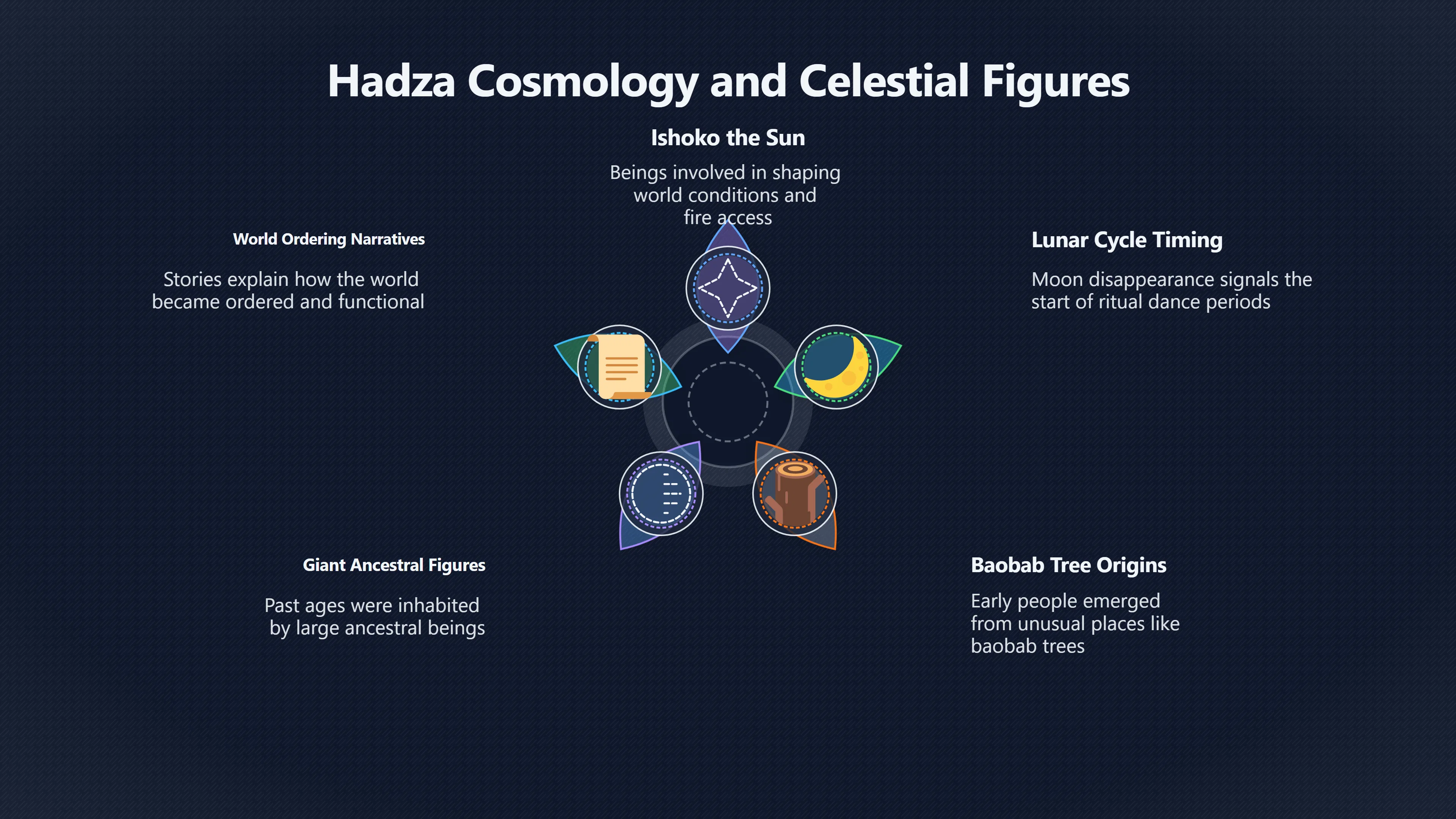
Hadza cosmology centres on a small number of powerful celestial figures rather than a large pantheon of gods. Ethnographic accounts describe the Sun, often called Ishoko, and a lunar figure associated with the Moon as beings involved in shaping the world and establishing the conditions under which humans and animals live. In traditional narratives, these beings are credited with arranging the earth and sky, granting access to fire and determining important aspects of human existence.[Wikipedia]WikipediaHadza peopleHadza people
Creation stories vary between camps and storytellers, as is common in oral traditions. Some accounts describe the earliest people emerging into the world from unusual places such as a baobab tree or a giraffe’s neck. Others divide the distant past into a sequence of ages inhabited by different kinds of beings, including giant ancestral figures who lived before the present human era. These stories are not presented by Hadza narrators as systematic theology. Instead, they function as explanations for how the world became ordered and why human life takes its present form.[sheffield.ac.uk]cultureandmind.sites.sheffield.ac.ukAnthropologists agree, however, that they do have a cosmology - regardless of how we…Read more…
The Moon is particularly important because its cycle provides the timing for ritual activity. The disappearance of the moon from the night sky marks the period when the epeme dance is performed. The darkness of the moonless nights is therefore not simply an astronomical event; it becomes a ritual moment when relations between men, women, ancestors and the wider cosmos are renewed.[wikipedia.org]WikipediaHadza peopleHadza people
Why the Dark-Moon Dance Matters
The ritual known as epeme is one of the best-documented aspects of Hadza ceremonial life. Anthropologists describe epeme not merely as a dance but as a wider concept connecting manhood, hunting, ritual authority and relations between the sexes. The dance is held during the dark phase of the lunar cycle, when the moon is absent and the night is at its darkest.[wikipedia.org]WikipediaHadza peopleHadza people
Accounts of the ceremony describe a carefully structured performance. Women gather and sing while male dancers emerge from darkness wearing distinctive ritual items, including feathered headdresses, rattles and ankle bells. The dance unfolds through rhythmic stamping, call-and-response singing and movement around the camp. The atmosphere created by darkness is essential; the ritual is traditionally associated with nights when the moon is not visible.[Wikipedia]WikipediaHadza peopleHadza people
To outside observers the performance can appear theatrical, but within Hadza tradition it carries deeper meanings. The dance publicly demonstrates the status of adult men, reinforces social bonds and creates a setting in which living people symbolically engage with ancestral powers. Researchers have noted that participation is associated with cooperation, trust and community solidarity, helping explain why the ritual has endured despite dramatic social changes around Hadza territory.[Wikipedia]WikipediaHadza peopleHadza people

Ancestors and the Presence of Spirits
One of the most intriguing features of Hadza cosmology is the relationship between personal identity and ancestral presence. Research by anthropologist Thea Skaanes found that naming practices are deeply connected to ideas about spirit and personhood. A child receives names that link them to family networks and spiritual relationships, and these connections become important during ritual life.[ResearchGate]researchgate.netResearchGate(PDF) Notes on Hadza cosmologyThis article concerns Hadza cosmology examined through objects, rituals and the Hadza concept o…
During epeme dances, participants may call out the names of relatives. Ethnographic interpretations suggest that this is more than a simple dedication. The act invokes relationships that connect living individuals with ancestral or spiritual dimensions of personhood. In this sense, the dark-moon dance is not only about celebrating hunters; it is also about maintaining continuity between generations.[researchgate.net]researchgate.netResearchGate(PDF) Notes on Hadza cosmologyThis article concerns Hadza cosmology examined through objects, rituals and the Hadza concept o…
This helps explain why Hadza cosmology is often described as practical rather than doctrinal. Belief is expressed through action—through naming, singing, dancing and hunting—rather than through formal religious institutions. Anthropologists who once described the Hadza as having little religion have increasingly argued that they possess a rich cosmology embedded in everyday practice.[cultureandmind.sites.sheffield.ac.uk]cultureandmind.sites.sheffield.ac.ukAnthropologists agree, however, that they do have a cosmology - regardless of how we…Read more…
Hunting, Gender and Ritual Meaning
The epeme system is inseparable from hunting. Traditionally, a man becomes a full epeme man through the successful hunting of large game. Certain prized portions of large animals are associated with epeme status and may be eaten only by men who possess that standing. This connection ties ritual prestige directly to skill, maturity and responsibility rather than inherited rank.[Wikipedia]WikipediaHadza peopleHadza people
Yet epeme is not solely a male institution. Women play an essential role through singing, participation and the social relationships that make the ritual meaningful. Research on Hadza gender rituals argues that epeme and female initiation ceremonies should be understood as complementary systems. Each possesses its own forms of knowledge and symbolism, and both contribute to the maintenance of social balance.[ResearchGate]researchgate.netResearchGate(PDF) Hadza gender rituals – epeme and maitokoAug 28, 2015 — Both sexes are participants in each ritual, but epeme is governe…
Some scholars have also noted broader symbolic themes linking hunting and reproduction. These interpretations suggest that Hadza ritual thought often treats successful hunting and human fertility as parallel forms of life-giving activity. While researchers debate the exact meanings involved, there is broad agreement that the epeme complex expresses ideas about cooperation between men and women rather than simple male dominance.[ResearchGate]researchgate.netResearchGate(PDF) Hadza gender rituals – epeme and maitokoAug 28, 2015 — Both sexes are participants in each ritual, but epeme is governe…
A Living Tradition in Contemporary Tanzania
The Hadza dark-moon dance remains significant because it is still part of a living cultural system rather than a reconstructed historical ceremony. Although the Hadza population is small and faces continuing pressures from land loss, tourism, conservation policies and neighbouring agricultural expansion, ritual life continues to provide a framework through which identity and history are expressed.[minorityrights.org]minorityrights.orgMinority Rights GroupHadza/Hadzabe in TanzaniaHadza, numbering an estimated 1,300-1,500, are nomadic hunter-gatherers living in the rocky…
For readers interested in Tanzanian folklore, the importance of the dark-moon dance lies in the way it joins myth and practice. Stories about the Sun, Moon and the origins of humanity are not separated from daily experience. They are renewed in the darkness of moonless nights, through song, dance, hunting traditions and remembrance of ancestors. The result is one of Tanzania’s most distinctive examples of a folklore tradition that remains active, adaptive and closely tied to the landscape around Lake Eyasi.[liverpooluniversitypress.co.uk]liverpooluniversitypress.co.ukNotes on Hadza cosmology: Epeme, objects and ritualsJan 6, 2015 — This article concerns Hadza cosmology examined through objects, rituals…
Amazon book picks
Further Reading
Books and field guides related to What Happens in the Hadza Dark-Moon Dance?. Use these as the next step if you want deeper reading beyond the article.
eBay marketplace picks
Marketplace Samples
Live-tested eBay searches with available results related to this page.

Endnotes
1.
Source: cultureandmind.sites.sheffield.ac.uk
Link:https://cultureandmind.sites.sheffield.ac.uk/fieldsites/hadza
Source snippet
Anthropologists agree, however, that they do have a cosmology - regardless of how we...Read more...
2.
Source: liverpooluniversitypress.co.uk
Link:https://www.liverpooluniversitypress.co.uk/doi/10.3828/hgr.2015.13
Source snippet
Notes on Hadza cosmology: Epeme, objects and ritualsJan 6, 2015 — This article concerns Hadza cosmology examined through objects, rituals...
3.
Source: Wikipedia
Title: Hadza people
Link:https://en.wikipedia.org/wiki/Hadza_people
4.
Source: researchgate.net
Link:https://www.researchgate.net/publication/281291208Hadza_gender_rituals-epeme_and_maitoko-_considered_as_counterparts
Source snippet
ResearchGate(PDF) Hadza gender rituals – epeme and maitokoAug 28, 2015 — Both sexes are participants in each ritual, but epeme is governe...
5.
Source: researchgate.net
Link:https://www.researchgate.net/publication/281480367_Notes_on_Hadza_cosmology
Source snippet
ResearchGate(PDF) Notes on Hadza cosmologyThis article concerns Hadza cosmology examined through objects, rituals and the Hadza concept o...
6.
Source: nature.org
Link:https://www.nature.org/en-us/about-us/where-we-work/africa/stories-in-africa/the-hadza-helping-hunter-gatherers-protect-their-homeland/
Source snippet
The Nature ConservancyHelping the Hadza Protect Their HomelandNorthern Tanzania is home to the Hadzabe, one of the last remaining hunter...
7.
Source: visitnatives.com
Title: hadzabe religion and spiritual life what do tanzania s hunter gatherers believe
Link:https://www.visitnatives.com/post/hadzabe-religion-and-spiritual-life-what-do-tanzania-s-hunter-gatherers-believe
Source snippet
In Hadza belief, Haine is the divine presence, Ishoko the sun, and Seta the moon. Ritual life...Read more...
8.
Source: blackbooksdotpub.wordpress.com
Link:https://blackbooksdotpub.wordpress.com/wp-content/uploads/2021/11/skaanes2015.pdf
Source snippet
This practice of calling a name occurs during the epeme night dance ritual.Read more...
9.
Source: minorityrights.org
Link:https://minorityrights.org/communities/hadza-hadzabe/
Source snippet
Minority Rights GroupHadza/Hadzabe in TanzaniaHadza, numbering an estimated 1,300-1,500, are nomadic hunter-gatherers living in the rocky...
Additional References
10.
Source: lakeforest.edu
Link:https://www.lakeforest.edu/academics/majors-and-minors/environmental-studies/hadza
Source snippet
HadzaThe Hadza language, called Hadzane by its people, is an endangered language isolate spoken in the region surrounding Lake Eyasi in n...
11.
Source: academia.edu
Link:https://www.academia.edu/26464103/Notes_on_Hadza_cosmology
Source snippet
Notes on Hadza cosmologyThis article concerns Hadza cosmology examined through objects, rituals and the Hadza concept of epeme. A brief b...
12.
Source: survivalinternational.org
Link:https://www.survivalinternational.org/galleries/hadza
Source snippet
The HadzaThe Hadza. Just south of the Equator, between the soda waters of Tanzania's Lake Eyasi and the ramparts of the Great Rift Valley...
13.
Source: sciencedirect.com
Title: ScienceDirect Blood symbolism at the root of symbolic culture?
Link:https://www.sciencedirect.com/science/article/pii/S0278416524000588
Source snippet
I Watts · 2024 · Cited by 9 — Both BaYaka Jengi and Hadza Epeme are legitimated through mythic histories where men stole wo...
14.
Source: tosea.net
Link:https://tosea.net/the-creation-of-the-sun-and-the-moon-or-why-mexicans-see-a-rabbit-in-the-moon/
Source snippet
only voices in an uninterrupted darkness, having no sun or moon.Read more...
15.
Source: reddit.com
Link:https://www.reddit.com/r/AskAnthropology/comments/fxcpft/hadza_mythology_dating_back_to_early_hominids/
Source snippet
nts called the Akakaanebe or Gelanebe, "ancestors".Read more...
16.
Source: education.nationalgeographic.org
Title: They are considered one of the last hunter-gatherer tribes in Africa.Read more
Link:https://education.nationalgeographic.org/resource/hadza/
Source snippet
National Geographic EducationNov 20, 2024 — The Hadza are a modern hunter-gatherer people living in northern Tanzania...
17.
Source: visitnatives.com
Link:https://www.visitnatives.com/post/who-are-the-hadzabe-hunter-gatherers-in-lake-eyasi-tanzania
Source snippet
The Ultimate Guide to the Hadza (Hadzabe) People of...May 22, 2024 — The Hadza, also called the Hadzabe, are one of the last remaining h...
Published: May 22, 2024
18.
Source: youtube.com
Title: Living Heritage of Tanzania: Hadzabe Hunters and Maasai Warriors | SLICE
Link:https://www.youtube.com/watch?v=8hyJy4YUevk
Source snippet
World's Last Hunter-Gatherer Tribe | The Hadza...
19.
Source: ehrafworldcultures.yale.edu
Link:https://ehrafworldcultures.yale.edu/cultures/fn11/summary
Source snippet
eHRAF World CulturesThe Hadza are a population of hunter-gatherers living in a 4000 km² area around the shores of Lake Eyasi, which sits...
Topic Tree