Where Fire, Heroes and Monsters Meet
Azerbaijan’s folklore is best understood as a crossroads tradition: Turkic heroic epics, Persianate and Caucasian spirit beliefs, Islamic folk religion, older fire symbolism, spring rituals, children’s fairy tales, and legends attached to dramatic landscapes all overlap.
Page outline Jump by section
Introduction
What makes Azerbaijani folklore distinctive is the way heroic storytelling, everyday moral tales, and sacred landscape all meet. A fire temple on the Absheron Peninsula, a tower in Baku wrapped in tragic legend, rock carvings at Gobustan, and bonfires at Novruz can all be read as part of the same wider culture of memory: places and rituals become story-carriers, while stories give places emotional depth.[azerbaijan.az]azerbaijan.azNovruz HolidayNovruz Holiday
The epic core: why Dede Korkut matters
The central epic monument for Azerbaijani folklore is the Dede Korkut cycle, shared across the Oghuz Turkic world and recognised by UNESCO as the heritage of Azerbaijan, Kazakhstan and Türkiye. UNESCO describes it as an epic culture built around heroic legends, tales, music and oral performance, which is important because the tradition is not only a written medieval text but a living complex of storytelling, values and performance.[UNESCO Intangible Cultural Heritage]ich.unesco.orgIntangible Cultural Heritageich.unesco.orgIntangible Cultural Heritageich.unesco.org
For a general reader, Dede Korkut matters because it gives Azerbaijan a mythic language for courage, kinship, honour, hospitality, loyalty and survival. The stories sit between history and legend: they are not straightforward chronicles, but they preserve a remembered world of Oghuz warriors, family bonds, raids, marriages, tests of bravery and encounters with supernatural danger. Their geography and cultural atmosphere have long been linked with the Caucasus and the wider Oghuz migration zone, which is why the cycle belongs not to one modern nation alone, but to a shared Turkic heritage in which Azerbaijan has a major stake.[Academia]academia.eduHistorical Issues in the Epos of "Book of Dede KorkutHistorical Issues in the Epos of "Book of Dede Korkut
The figure of Dede Korkut himself is also important. He is not simply a character who appears in a plot; he is a wise elder, namer, mediator, poet and memory-keeper. In that role, he resembles the ideal storyteller: someone who gives heroic deeds their social meaning. This is why the tradition naturally connects to Azerbaijani ashiq culture, where poetry, music, improvisation and narrative are performed together rather than separated into neat literary categories. UNESCO describes the art of Azerbaijani ashiqs as a combination of poetry, storytelling, dance, vocal music and instrumental music, making the performer a custodian of memory as well as an entertainer.[UNESCO Intangible Cultural Heritage]ich.unesco.orgIntangible Cultural Heritageich.unesco.orgIntangible Cultural Heritageich.unesco.org
Monsters, fairies and clever survivors
Azerbaijani folk narrative has a strong taste for unequal contests: the small against the giant, the quick-witted against the brutal, the human household against the dangerous outside world. This is clearest in the stories of Tepegoz and Jirtdan, which remain two of the most accessible entry points into the country’s monster folklore.
Tepegoz is the great one-eyed ogre of the Dede Korkut world. In the tale usually known as “Basat kills Tepegoz”, the monster threatens the Oghuz community and demands a terrible tribute. His single eye, cave-dwelling menace and near-invulnerability invite comparison with the Cyclops of Greek epic, but in Azerbaijani and wider Oghuz tradition he is not a borrowed curiosity; he is part of a heroic moral drama about intelligence, courage and communal rescue. The hero Basat defeats him not by being simply stronger, but by finding the monster’s vulnerable point.[Wikipedia]WikipediaOpen source on wikipedia.org.
Jirtdan belongs to a different register: children’s folklore. Azerbaijan International describes him as one of the most popular and beloved Azerbaijani fairy-tale figures, a tiny boy whose strength lies in intelligence rather than size. In the best-known story, the child hero faces a div, a hairy monster who loves to eat children, and survives by wit. The point is clear enough for children but still powerful for adults: smallness is not helplessness, and fear can be beaten by cleverness.[Azerbaijan International Magazine]azer.combaijan International Magazine Children's Folklore: Jirtdanbaijan International Magazine Children's Folklore: Jirtdan
Other supernatural beings in Azerbaijani tale material include divs, peris, jinn and frightening household or wilderness spirits. The evidence for these creatures is uneven: some are well attested in printed tales and regional storytelling, while others circulate through later popular summaries, modern retellings or internet folklore. A cautious reading treats them as part of a broad shared vocabulary across Turkic, Persianate and Islamic story worlds, rather than as fixed “mythological species” with one official description.[Jamnews in English]jam-news.netJamnews in English The magical creatures of Azerbaijani mythologyJamnews in English The magical creatures of Azerbaijani mythology
Koroghlu and the heroic outlaw tradition
Alongside Dede Korkut, the Epic of Koroghlu is one of the most important heroic cycles associated with Azerbaijani oral tradition. The story is known across Turkic-speaking and neighbouring cultures, with Azerbaijani, Turkish, Turkmen and other variants. Its central figure is usually a wronged hero who resists unjust rulers, protects honour, gathers companions and acts in the borderland between rebel, bard and champion.[Wikipedia]WikipediaEpic of KoroghluEpic of Koroghlu
The appeal of Koroghlu is different from that of a remote mythic warrior. He feels closer to social memory: an outlaw-hero who channels anger at injustice. That gives the epic a Robin Hood-like energy without making it a simple copy of European outlaw legend. In Azerbaijani culture, Koroghlu’s importance also lies in performance. Such heroic stories were not merely read; they were sung, recited and reshaped by performers whose art made the tale feel present for each generation.[UNESCO Intangible Cultural Heritage]ich.unesco.orgIntangible Cultural Heritageich.unesco.orgIntangible Cultural Heritageich.unesco.org
This is one reason Azerbaijani folklore often blurs the line between literature and music. A story can be a poem, a song, a performance, a moral lesson and a memory of historical grievance at the same time. For readers used to printed myths, that can be the biggest shift: the tradition lives less as a single canonical “mythology book” and more as a performance culture with recurring heroes, images and values.
Novruz: spring, fire and household magic
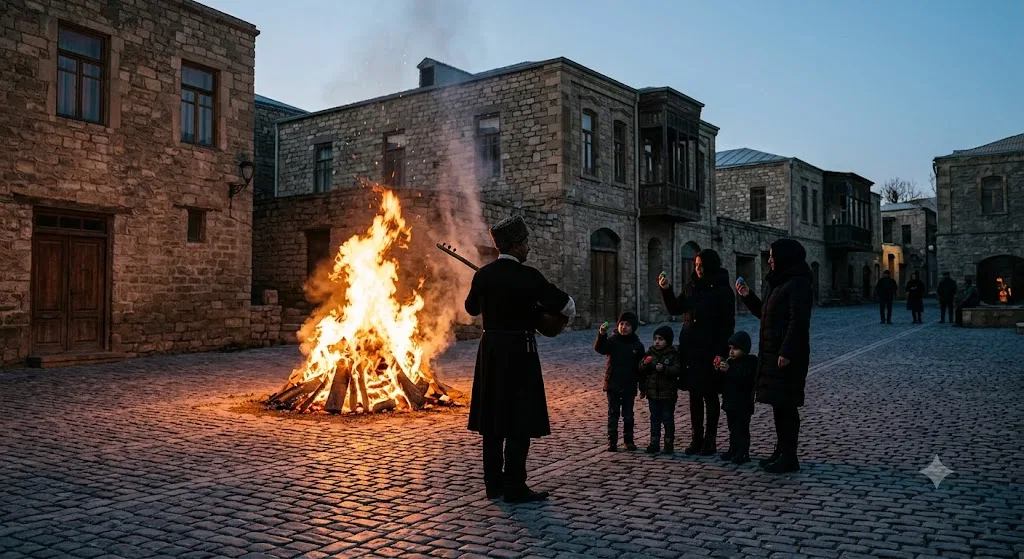
Novruz is one of the most visible living folklore traditions in Azerbaijan. It marks spring and renewal, but its power comes from the details: bonfires, water rites, holiday foods, fortune-telling, games, visits, candles, coloured eggs and symbolic household practices. The official Azerbaijan portal explains the four pre-holiday Tuesdays through folk belief: water purifies and stirs, fire, land and wind awaken nature, and the trees begin to blossom.[Azerbaijan]azerbaijan.azNovruz HolidayNovruz Holiday
The most memorable ritual for many outsiders is jumping over bonfires. In Azerbaijani explanations, fire is a symbol of purification and clarification. Before the holiday, people jump over one bonfire seven times, or over seven bonfires once, using the act to cast off misfortune, weakness or the burden of the old year. The ashes may be taken away from the house, expressing the idea that the household’s bad luck has been removed with them.[Azerbaijan]azerbaijan.azNovruz HolidayNovruz Holiday
Water also has a strong place in Novruz belief. Flowing water is associated with cleansing, renewal and protection from the faults or illnesses of the past year. These customs do not need to be treated as literal magic to be meaningful. Like many seasonal rites worldwide, they give people a physical way to mark transition: winter to spring, old year to new year, misfortune to hope.[Azerbaijan]azerbaijan.azNovruz HolidayNovruz Holiday
Novruz also carries playful folk drama. Official descriptions mention figures and games such as Khidir Ilyas and Kos-Kosa, as well as fortune-telling. These practices show that the holiday is not only a solemn calendar event; it is a theatrical, domestic and communal performance of spring’s arrival.[Azerbaijan]azerbaijan.azNovruz HolidayNovruz Holiday
Fire landscapes and the “Land of Fire”
Azerbaijan’s reputation as the “Land of Fire” is not just a modern tourism slogan, although tourism has certainly amplified it. The Absheron Peninsula has natural gas phenomena that made fire a powerful cultural image. The Ateshgah Fire Temple at Surakhani stands where natural gas once oozed from the ground and fed the “eternal flames” that gave the site its aura. The official site of the reserve links the temple’s deeper roots with Zoroastrian-era fire reverence and later pilgrimage connected with trade routes.[Ateshgah Temple]ateshgahtemple.azAteshgah Temple“ATESHGAH TEMPLE” STATE HISTORICAL-ARCHITECTURAL RESERVEAteshgah Temple“ATESHGAH TEMPLE” STATE HISTORICAL-ARCHITECTURAL RESERVE
The careful distinction is important: the surviving Ateshgah complex is not simply a prehistoric fire shrine frozen unchanged from antiquity. The present complex developed in the early modern period, with strong connections to pilgrims and traders, including communities from the Indian subcontinent. Over time it became a museum and heritage site, while its older sacred associations were folded into national storytelling about fire, purity and Azerbaijan’s distinctive landscape.[Wikipedia]WikipediaAteshgah of BakuAteshgah of Baku
Yanar Dag, the “Burning Mountain”, gives the fire tradition a living natural spectacle. It is a natural gas fire on the Absheron Peninsula, with flames fed by gas seeping from porous layers of the earth. Unlike the Ateshgah flame, which is now maintained artificially, Yanar Dag is valued because its fire continues as a natural phenomenon. Its modern presentation as a reserve and visitor site shows how geology, sacred imagination and national branding can become inseparable in public folklore.[Wikipedia]WikipediaYanar DaghYanar Dagh

Legendary places: towers, rocks and sacred memory
Azerbaijani folklore is strongly attached to place. Baku’s Maiden Tower is the clearest urban example. Historically, it is one of the great monuments of the old city and part of the UNESCO-listed Walled City of Baku with the Shirvanshah’s Palace. Culturally, it is surrounded by legends, especially tragic stories of a young woman connected with forced marriage, imprisonment, love and death.[Wikipedia]WikipediaMaiden Tower (BakuMaiden Tower (Baku
The important point is not that the legend explains the tower’s actual origin. It probably does not. Rather, the story gives emotional meaning to a mysterious structure whose precise purpose has long invited speculation. The Maiden Tower has inspired poems, plays and ballet, including a major Azerbaijani ballet first staged in the twentieth century. That makes it a useful example of how folklore moves from oral legend into national art and staged culture.[Wikipedia]WikipediaMaiden Tower (BakuMaiden Tower (Baku
Gobustan works differently. It is not famous because of one neat legend, but because it gives Azerbaijan a deep-time landscape of human image-making. UNESCO describes Gobustan Rock Art Cultural Landscape as containing more than 6,000 rock engravings testifying to 40,000 years of rock art, along with inhabited caves, settlements and burials. For folklore readers, Gobustan matters because it reminds us that story culture did not begin with written epics. Long before named heroes and printed tales, people were marking animals, dances, boats, hunts and rituals into stone.[UNESCO World Heritage Centre]whc.unesco.orgWorld Heritage Centre Gobustan Rock Art Cultural LandscapeWorld Heritage Centre Gobustan Rock Art Cultural Landscape
Gobustan should not be used carelessly as a direct “source” for later Azerbaijani myths. A rock carving is not the same thing as a fairy tale. But it does form part of the country’s larger sacred and symbolic landscape: a place where visitors encounter the depth of human imagination in Azerbaijan before the medieval epics, before modern nationalism and before museum labels.

Folklore as performance, archive and school memory
Azerbaijani folklore survives through several channels at once. One is performance: ashiq singers, musicians and storytellers continue the idea that narrative can be sung, improvised and embodied. UNESCO’s recognition of Azerbaijani ashiq art underlines that this is not merely “old entertainment”, but a living cultural form combining poetry, storytelling, dance, singing and instrumental music.[UNESCO Intangible Cultural Heritage]ich.unesco.orgIntangible Cultural Heritageich.unesco.orgIntangible Cultural Heritageich.unesco.org
Another channel is institutional collection. The Institute of Folklore of the Azerbaijan National Academy of Sciences has published folklore texts, including anthologies, collections of Azerbaijani folklore, research on oral folk literature and a journal connected with Dede Korkut studies. This matters because oral culture is fragile: once tales, variants, songs and local beliefs stop being performed, archives and publications become crucial evidence.[Azerbaijan]azerbaijan.azOpen source on azerbaijan.az.
A third channel is childhood. Stories such as Jirtdan remain memorable because they enter family life, school culture, animation, children’s books and bedtime storytelling. Their folklore value is not only antiquity. A tale can be culturally important because generations recognise it, repeat it and use it to teach courage, cleverness and caution.[Azerbaijan International Magazine]azer.combaijan International Magazine Children's Folklore: Jirtdanbaijan International Magazine Children's Folklore: Jirtdan
What is old tradition and what is modern retelling?
Azerbaijani folklore is often presented online as if every creature, place and custom belonged to a single ancient mythology. That is too simple. The tradition has layers.
The oldest and best-attested layer includes major oral and written epic traditions, especially Dede Korkut, with manuscript history, scholarly study and UNESCO recognition. A second strong layer includes living performance and seasonal custom, such as ashiq art and Novruz practices. A third layer includes popular fairy tales and children’s stories, which may be old in oral circulation but often reach modern readers through edited print, school versions and animation.[unesco.org]ich.unesco.orgIntangible Cultural Heritageich.unesco.orgIntangible Cultural Heritageich.unesco.org
A more uncertain layer includes neat online catalogues of monsters and spirits. Creatures such as divs, peris and jinn are certainly part of the wider regional imagination, but exact descriptions can change sharply depending on whether the source is a local tale, a literary retelling, a religious belief, a children’s version, or a modern web article. Readers should be wary of any source that turns Azerbaijani folklore into a rigid fantasy bestiary without explaining where the details come from.[Jamnews in English]jam-news.netJamnews in English The magical creatures of Azerbaijani mythologyJamnews in English The magical creatures of Azerbaijani mythology
Modern tourism adds another layer. Ateshgah, Yanar Dag, Gobustan and the Maiden Tower are real places with serious historical or geological importance, but visitor storytelling often compresses complexity into simple phrases: “eternal fire”, “ancient mystery”, “legendary tower”. These phrases are not useless; they help people care. But the strongest reading keeps both sides in view: the romance of the legend and the evidence of archaeology, architecture, geology and documented tradition.[ateshgahtemple.az]ateshgahtemple.azAteshgah Temple“ATESHGAH TEMPLE” STATE HISTORICAL-ARCHITECTURAL RESERVEAteshgah Temple“ATESHGAH TEMPLE” STATE HISTORICAL-ARCHITECTURAL RESERVE
Why Azerbaijan’s folklore still feels alive
Azerbaijani folklore remains alive because it is not confined to one medium. It is sung by performers, told to children, staged in ballet, attached to national monuments, enacted at Novruz, studied by scholars, marketed through tourism and recognised by international heritage bodies. A single reader might meet it through a monster tale, a spring bonfire, a trip to Baku’s Old City, a children’s story about a tiny hero, or a performance of ashiq music.
Its central themes are also easy to recognise: the small outwitting the huge, the hero defending the community, spring defeating winter, fire purifying misfortune, memory clinging to stone, and performance turning history into shared feeling. The tradition is not a sealed ancient system but a living cultural field, shaped by Turkic epic, Caucasian place memory, Persianate and Islamic imagery, local seasonal customs and modern national culture. That mix is precisely what gives Azerbaijani folklore its character: layered, performative, place-rich and still very much in public view.
Amazon book picks
Further Reading
Books and field guides related to Where Fire, Heroes and Monsters Meet. Use these as the next step if you want deeper reading beyond the article.

The book of Dede Korkut
First published 1972. Subjects: Translations into English, Turkish Epic poetry.
Koroghlu: The Epic Tale of the Bandit Hero
One of the central legendary traditions of Azerbaijan.
eBay marketplace picks
Marketplace Samples
Live-tested eBay searches with available results related to this page.


Endnotes
1.
Source: ich.unesco.org
Title: Intangible Cultural Heritage Azerbaijan
Link:https://ich.unesco.org/en/state/azerbaijan-AZ?info=elements-on-the-lists
Source snippet
Heritage of Dede Qorqud/Korkyt Ata/Dede Korkut, epic culture, folk tales and music.Read more...
2.
Source: ich.unesco.org
Title: Intangible Cultural Heritageich.unesco.org
Link:https://ich.unesco.org/en/RL/art-of-azerbaijani-ashiq-00253
3.
Source: ich.unesco.org
Title: Intangible Cultural Heritageich.unesco.org
Link:https://ich.unesco.org/en/RL/heritage-of-dede-qorqud-korkyt-ata-dede-korkut-epic-culture-folk-tales-and-music-01399
4.
Source: azerbaijan.az
Title: Novruz Holiday
Link:https://azerbaijan.az/en/related-information/65
5.
Source: whc.unesco.org
Title: World Heritage Centre Gobustan Rock Art Cultural Landscape
Link:https://whc.unesco.org/en/list/1076/
6.
Source: academia.edu
Title: Historical Issues in the Epos of “Book of Dede Korkut
Link:https://www.academia.edu/89581659/Historical_Issues_in_the_Epos_of_Book_of_Dede_Korkut
7.
Source: Wikipedia
Title: Book of Dede Korkut
Link:https://en.wikipedia.org/wiki/Book_of_Dede_Korkut
8.
Source: Wikipedia
Link:https://en.wikipedia.org/wiki/Tepeg%C3%B6z
9.
Source: Wikipedia
Title: Epic of Koroghlu
Link:https://en.wikipedia.org/wiki/Epic_of_Koroghlu
10.
Source: whc.unesco.org
Title: World Heritage Centre Surakhany, Atashgyakh (Fire
Link:https://whc.unesco.org/en/tentativelists/1172/
11.
Source: Wikipedia
Title: Ateshgah of Baku
Link:https://en.wikipedia.org/wiki/Ateshgah_of_Baku
12.
Source: Wikipedia
Title: Yanar Dagh
Link:https://en.wikipedia.org/wiki/Yanar_Dagh
13.
Source: azerbaijan.travel
Link:https://azerbaijan.travel/sites-of-ancient-fire-leave-a-burning-legacy
14.
Source: Wikipedia
Title: Maiden Tower (Baku)
Link:https://en.wikipedia.org/wiki/Maiden_Tower_%28Baku%29
15.
Source: azerbaijan.az
Link:https://azerbaijan.az/en/related-information/166
16.
Source: Wikipedia
Title: Div (mythology)
Link:https://en.wikipedia.org/wiki/Div_%28mythology%29
17.
Source: Wikipedia
Title: Zoroastrianism in Azerbaijan
Link:https://en.wikipedia.org/wiki/Zoroastrianism_in_Azerbaijan
18.
Source: Wikipedia
Title: Novruz in Azerbaijan
Link:https://en.wikipedia.org/wiki/Novruz_in_Azerbaijan
19.
Source: Wikipedia
Title: Azerbaijani fairy tales
Link:https://en.wikipedia.org/wiki/Azerbaijani_fairy_tales
20.
Source: ich.unesco.org
Title: azerbaijan AZ
Link:https://ich.unesco.org/en/state/azerbaijan-AZ
21.
Source: ich.unesco.org
Link:https://ich.unesco.org/en/video/1236
22.
Source: ich.unesco.org
Link:https://ich.unesco.org/en/lists
23.
Source: ich.unesco.org
Title: 52856 EN
Link:https://ich.unesco.org/doc/src/52856-EN.pdf
24.
Source: whc.unesco.org
Link:https://whc.unesco.org/en/list/1076/maps/
25.
Source: sa.trip.com
Title: baku 21375 146515042
Link:https://sa.trip.com/moments/detail/baku-21375-146515042?locale=en-SA
26.
Source: unesco.ru
Title: 53 gobustan
Link:https://unesco.ru/en/news/53-gobustan/
27.
Source: unesco.az
Link:https://unesco.az/index.php/en/articles/intangible_cultural_heritage/novruz-bayrami
28.
Source: unesco.az
Link:https://www.unesco.az/en/articles/intangible_cultural_heritage/art-azerbaijani-ashiqs
29.
Source: youtube.com
Title: The Art of Azerbaijani Ashiq
Link:https://www.youtube.com/watch?v=oVHr7GP9xns
Source snippet
Azerbaijan Turkic Music of the Ashiq Bards...
30.
Source: youtube.com
Title: Azerbaijan Turkic Music of the Ashiq Bards
Link:https://www.youtube.com/watch?v=75x6xOnuy-o
Source snippet
Ancient Spring Festival: Colorful Novruz Traditions in Azerbaijan...
31.
Source: ateshgahtemple.az
Title: Ateshgah Temple“ATESHGAH TEMPLE” STATE HISTORICAL-ARCHITECTURAL RESERVE
Link:https://ateshgahtemple.az/en/
32.
Source: azer.com
Title: baijan International Magazine Children’s Folklore: Jirtdan
Link:https://www.azer.com/aiweb/categories/magazine/43_folder/43_articles/43_children.html
33.
Source: jam-news.net
Title: Jamnews in English The magical creatures of Azerbaijani mythology
Link:https://jam-news.net/azerbaijani-demons/
34.
Source: scirp.org
Link:https://www.scirp.org/journal/paperinformation?paperid=136566
35.
Source: azer.com
Link:https://www.azer.com/aiweb/categories/magazine/ai151_folder/151_articles/151_novruz.html
36.
Source: azer.com
Link:https://www.azer.com/aiweb/categories/magazine/ai124_folder/124_articles/124_fairy_tales.html
37.
Source: advantour.com
Link:https://www.advantour.com/azerbaijan/culture/folklore.htm
38.
Source: facebook.com
Link:https://www.facebook.com/groups/travelazerbaijan/posts/3268159873340052/
39.
Source: tripadvisor.com
Link:https://www.tripadvisor.com/Attraction_Review-g293934-d3587697-Reviews-Ateshgah_Fire_Temple-Baku_Absheron_Region.html
40.
Source: tripadvisor.com
Title: Maiden Tower
Link:https://www.tripadvisor.com/Attraction_Review-g293934-d459849-Reviews-Maiden_Tower-Baku_Absheron_Region.html
41.
Source: tripadvisor.com
Title: Yanar Dag
Link:https://www.tripadvisor.com/Attraction_Review-g293934-d2390504-Reviews-Yanar_Dag-Baku_Absheron_Region.html
42.
Source: instagram.com
Link:https://www.instagram.com/p/DX9VZhRDAlT/?hl=en
43.
Source: azerbaijantraveller.com
Title: megaliths of azerbaijan
Link:https://azerbaijantraveller.com/2020/07/20/megaliths-of-azerbaijan/
44.
Source: baldhiker.com
Link:https://www.baldhiker.com/ateshgah-the-fire-temple-of-baku/
45.
Source: baldhiker.com
Link:https://www.baldhiker.com/azerbaijan-the-maiden-tower-baku/
46.
Source: orexca.com
Title: unesco intangible cultural heritage
Link:https://www.orexca.com/azerbaijan/culture/unesco-intangible-cultural-heritage.htm
47.
Source: azertag.az
Title: azerbaijan marks first tuesday of novruz water tuesday 4038535
Link:https://azertag.az/en/xeber/azerbaijan_marks_first_tuesday_of_novruz___water_tuesday-4038535
48.
Source: irs-az.com
Link:https://irs-az.com/new/pdf/201505/1430904278207392771.pdf
49.
Source: eurasia.travel
Link:https://eurasia.travel/azerbaijan/culture/folklore/
50.
Source: azeri.org
Title: Azerbaijani Tales
Link:https://azeri.org/Azeri/az_latin/kids/kids_tales/tales_index.html
51.
Source: iticket.az
Link:https://iticket.az/en/events/tourism/ateshgah-temple-state-historical-architectural-reserve
52.
Source: news.az
Title: azerbaijan celebrates wind tuesday of novruz holiday 1
Link:https://news.az/news/azerbaijan-celebrates-wind-tuesday-of-novruz-holiday-1
53.
Source: regionplus.az
Link:https://regionplus.az/en/articles/view/8631
Additional References
54.
Source: youtube.com
Title: Ancient Spring Festival: Colorful Novruz Traditions in Azerbaijan
Link:https://www.youtube.com/watch?v=uWzlMcHmIbU
Source snippet
Jirtdan – Azerbaijani Fairy Tale for Kids...
55.
Source: instagram.com
Link:https://www.instagram.com/reel/DMhetp9zPmk/?hl=en
56.
Source: facebook.com
Link:https://www.facebook.com/groups/persianversion/posts/686614432035592/
57.
Source: aem.az
Link:https://aem.az/en/the-history-geography-publication-research-and-promotion-of-the-epic-koroglu
58.
Source: getyourguide.com
Link:https://www.getyourguide.com/baku-l1408/ateshgah-yanardag-skip-the-line-entry-tickets-t1159689/
59.
Source: oldcity.tours
Link:https://www.oldcity.tours/thing-to-do/attractions/ateshgah-fire-temple-baku
60.
Source: hertz.org.az
Link:https://hertz.org.az/en/tours/atesgah-ve-yanrdag-turu
61.
Source: fourseasons.com
Link:https://www.fourseasons.com/baku/experiences/local-experiences/ateshgah-and-yanardag-tour/
62.
Source: facebook.com
Link:https://www.facebook.com/TahirGul.Official/posts/ateshgah-of-baku-azerbaijan-baku-tahirgul-ateshgah-azerbaijan-firetemple/1536913204753850/
63.
Source: tripadvisor.com
Link:https://www.tripadvisor.com/AttractionProductReview-g293934-d19985206-LEGENDS_of_the_LAND_of_FIRE_GALA_ATESHGAH_YANARDAQ-Baku_Absheron_Region.html
Topic Tree
Follow this branch
Related pages 192
- Afghan Folklore
- Albanian Folklore
- Algerian Folklore
- Australian Folklore
- Belarus Folklore
- +187 more in sidebar