Within Hungarian Folklore
Was the Taltos Really a Hungarian Shaman?
The taltos and related figures reveal how Hungarian villages imagined healing, storms, gifted birth and dangerous knowledge.
On this page
- Birth signs, healing and weather power
- Garaboncias students and storm magic
- What scholars dispute today
Page outline Jump by section
Introduction
Few figures in Hungarian folklore generate as much debate as the táltos. In village tradition, a táltos was not simply a magician or wise person. He or she was believed to be marked from birth, capable of healing, seeing hidden things, battling rival supernatural specialists and influencing storms. Yet modern readers quickly encounter a problem: many books and websites describe the táltos as a straightforward Hungarian version of a Siberian shaman, while a growing body of scholarship argues that the evidence is far more complicated. The táltos sits at the meeting point of folklore, folk religion, nationalism and academic controversy. Understanding the figure means looking not only at old stories but also at how those stories were interpreted and reinterpreted over the last two centuries.[SciSpace]scispace.comSci Space The Hungarian Táltos and the Shamanism of PaganThe Hungarian Táltos and the Shamanism of Pagan…Abstract: One of the purposes of this study is to outline the research problem…
Within Hungarian village belief, the táltos belonged to a wider family of magical specialists that also included weather-workers, healers and the famous storm-raising wandering student known as the garabonciás. Together they reveal how rural communities explained unusual talent, dangerous weather and mysterious knowledge.[SciSpace]scispace.comSci Space The Hungarian Táltos and the Shamanism of PaganThe Hungarian Táltos and the Shamanism of Pagan…Abstract: One of the purposes of this study is to outline the research problem…

Was the Taltos Really a Hungarian Shaman?
For much of the twentieth century, many scholars treated the táltos as evidence that pre-Christian Hungarians had practised a form of shamanism related to traditions found across northern Eurasia. Researchers collected folk stories about gifted individuals who travelled in spirit, fought supernatural battles and possessed extraordinary powers. These features seemed to fit broader theories about ancient shamanic religion.[oszk.hu]mek.oszk.huFigures of the World of BeliefsFirst among the figures of the world of beliefs of the Hungarian peasantry, we will mention the táltos, as…
However, more recent scholarship has become increasingly cautious. Ethnologist Éva Pócs argues that the surviving evidence does not support the existence of a classic Eurasian shaman figure complete with ritual drumming, formal initiation and documented spirit journeys. Instead, many recorded táltos beliefs appear to be part of a complex mixture of Hungarian, Balkan and wider Central European traditions concerning weather magic, dragon-fighters and supernatural specialists.[SciSpace]scispace.comSci Space The Hungarian Táltos and the Shamanism of PaganThe Hungarian Táltos and the Shamanism of Pagan…Abstract: One of the purposes of this study is to outline the research problem…
This does not make the táltos unimportant. Rather, it changes the question. Instead of asking whether the táltos was “really” a shaman, scholars increasingly ask how Hungarian communities understood extraordinary people and why later generations became so invested in finding ancient origins for them.[SciSpace]scispace.comSci Space The Hungarian Táltos and the Shamanism of PaganThe Hungarian Táltos and the Shamanism of Pagan…Abstract: One of the purposes of this study is to outline the research problem…
Birth Signs, Healing and Weather Power
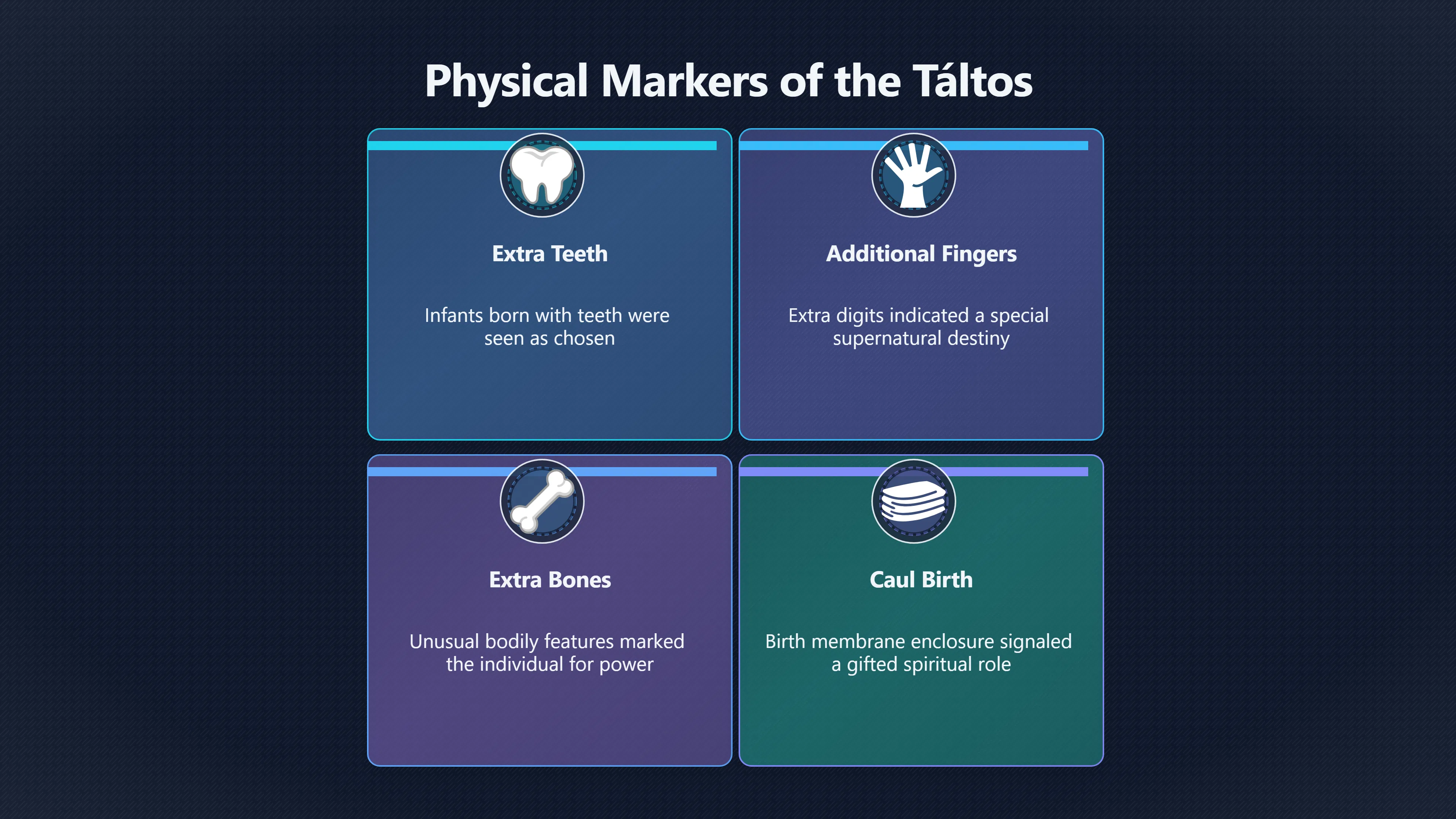
The most distinctive feature of the táltos tradition is the belief that such people were chosen before birth. Unlike an ordinary village healer who learned skills from another practitioner, a táltos was thought to be marked by unusual physical signs.
Common signs recorded in folklore included:
- Being born with teeth.[academia.edu]academia.eduAcademia(PDF) GarabonciásThe garabonciás diák is often depicted as having supernatural powers, including making rain and foretelling the… * Having an extra finger.[academia.edu]academia.eduAcademia(PDF) GarabonciásThe garabonciás diák is often depicted as having supernatural powers, including making rain and foretelling the…
- Possessing an additional bone or unusual bodily feature.
- Being born enclosed in part of the birth membrane, sometimes called a caul birth.[wikipedia.org]WikipediaOpen source on wikipedia.org.
These signs indicated that the child had been selected for a special destiny. In some traditions, the powers could even be lost if the extra tooth or bone disappeared before a certain age.[Wikipedia]WikipediaOpen source on wikipedia.org.
Village stories attributed a wide range of abilities to the táltos. Healing was one of the most respected. Folklore also credited them with locating hidden treasures, foreseeing danger and perceiving things invisible to ordinary people. Court records and later ethnographic collections describe individuals identified as táltos who were consulted during times of illness or uncertainty.[Wikipedia]WikipediaOpen source on wikipedia.org.
Weather power was equally important. Rural communities depended heavily on crops, making storms a matter of survival rather than curiosity. Stories tell of táltos figures who could divert hail, break destructive weather systems or engage in supernatural battles whose outcome affected local harvests. Such narratives transformed natural disasters into struggles between gifted specialists acting on behalf of their communities.[SciSpace]scispace.comSci Space The Hungarian Táltos and the Shamanism of PaganThe Hungarian Táltos and the Shamanism of Pagan…Abstract: One of the purposes of this study is to outline the research problem…
One recurring motif describes rival weather-workers fighting each other in the sky, sometimes taking animal forms or appearing as wheels, flames or other supernatural manifestations. The storm itself became visible evidence of an invisible conflict.[SciSpace]scispace.comSci Space The Hungarian Táltos and the Shamanism of PaganThe Hungarian Táltos and the Shamanism of Pagan…Abstract: One of the purposes of this study is to outline the research problem…
Garaboncias Students and Storm Magic
If the táltos was the gifted local specialist, the garabonciás was the mysterious traveller.
Hungarian folklore often portrays the garabonciás as a wandering student dressed in dark clothing and carrying a magical book. He arrives unexpectedly in a village and asks for simple gifts such as milk or eggs. If treated generously, he may leave peacefully or even bring good fortune. If refused, he can unleash terrifying weather.[academia.edu]academia.eduAcademia(PDF) GarabonciásThe garabonciás diák is often depicted as having supernatural powers, including making rain and foretelling the…
The garabonciás became one of Hungary’s most memorable weather-magicians because of his connection to dragons. In folk belief, he could summon, tame or ride a dragon through the clouds, creating storms as he travelled. Unlike the many-headed dragons of fairy tales, these creatures were often imagined as serpentine beings associated with water, clouds and violent weather.[blogspot.com]multicoloreddiary.blogspot.comfolklore thursday two words stormMulticolored DiaryFolklore Thursday: Two words: Storm dragons21 Jan 2016 — Dragons in garabonciás lore are aquatic, serpentine creatures…
Stories frequently describe a chain of events:
- The wandering student arrives.
- Villagers refuse his request.
- He opens or reads from a magical book.
- Storm clouds gather.
- A dragon appears or carries him into the sky.
- Hail, wind or destruction follows. Mr. Musette+2Multicolored Diary
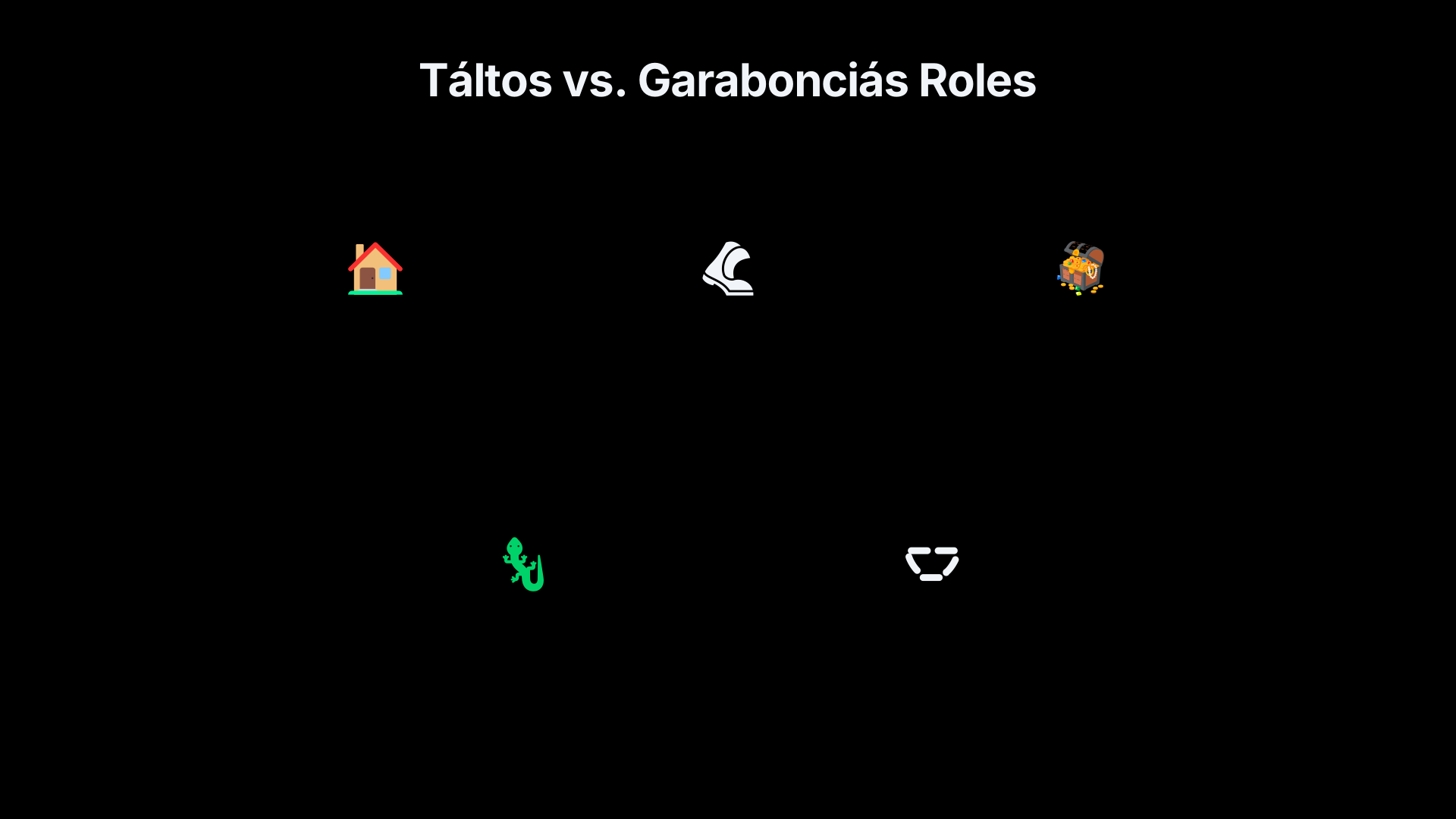
The similarities between the garabonciás and the táltos are striking. Both are associated with unusual birth signs, supernatural selection, weather control and aerial battles. Some folklorists have argued that the two figures overlap so heavily that they may represent different expressions of related traditions rather than entirely separate categories. Academia
Yet their social roles differ in folklore. The táltos is often tied to a local community and acts as its protector. The garabonciás is more ambiguous: a wandering outsider whose powers can help or punish depending on how he is treated. This contrast reflects a common theme in European folklore, where strangers are both feared and respected because they may possess hidden knowledge. Academia
Why Storm Battles Mattered
To modern readers, magical battles in the clouds may sound fantastical, but they served practical cultural purposes.
Before meteorology could explain severe weather, communities still needed explanations for crop-destroying hailstorms and sudden tempests. Folklore offered narratives that linked weather to human relationships, morality and local responsibility. A devastating storm was not merely random; it might be connected to the actions of a neglected stranger, a rival weather-worker or a gifted protector struggling on behalf of the village. SciSpace
These beliefs also gave social meaning to unusual individuals. People born with visible anomalies, extraordinary talents or unusual behaviour could be interpreted not simply as different but as possessing a recognised role within the community’s supernatural worldview. Wikipedia
What Scholars Dispute Today
The biggest modern dispute is not whether tales about táltos figures existed—they clearly did—but how those tales should be interpreted.
Nineteenth- and twentieth-century researchers, working during periods of intense interest in national origins, often sought evidence for an ancient Hungarian religion preserved beneath later folklore. The táltos became a central figure in these reconstructions. Some scholars assembled traits from many different sources and periods to create a portrait of an ancient Hungarian shaman. SciSpace
Recent criticism argues that this reconstruction may have combined materials that originally belonged to different traditions. Pócs and other researchers point to strong similarities between Hungarian weather-workers and Balkan dragon-fighter traditions, suggesting that some motifs once assumed to be uniquely Hungarian may have developed through long cultural contact across Central and South-Eastern Europe. SciSpace
As a result, many scholars now distinguish between three different things:
- The folkloric táltos recorded in village traditions.
- Hypothetical religious specialists who may have existed before Hungary’s Christianisation.
- Modern reconstructions and revival movements that draw inspiration from both folklore and academic theories. SciSpace
Keeping these categories separate helps avoid a common misunderstanding. The existence of rich táltos folklore does not automatically prove the details of a reconstructed ancient religion. At the same time, the debates themselves have become part of Hungary’s cultural history, showing how folklore can influence ideas about national identity and the distant past. SciSpace
The Taltos in Modern Hungarian Culture
Today the táltos remains one of the most recognisable figures in Hungarian supernatural tradition. Folklore collections, novels, heritage events, neo-pagan movements and popular culture continue to reinterpret the image of the gifted weather-worker and healer. Some presentations emphasise shamanic connections; others focus on the folkloric stories themselves. Wikipedia
What makes the figure enduring is not simply the possibility of ancient origins. The táltos embodies a set of questions that appear in many cultures: Why are some people born different? Who can protect a community from forces beyond human control? And how should extraordinary knowledge be understood? In Hungarian folklore, those questions were answered through stories of storm battles, healing powers, wandering magicians and children marked from birth for an unusual destiny. SciSpace
Amazon book picks
Further Reading
Books and field guides related to Was the Taltos Really a Hungarian Shaman?. Use these as the next step if you want deeper reading beyond the article.
Myths and Symbols in Pagan Europe
Examines pre-Christian belief patterns across Europe.
The Golden Bough
Discusses magic, ritual and traditional explanations of natural forces.
The Encyclopedia of Witches, Witchcraft and Wicca
Covers magical practitioners and folk belief traditions.
eBay marketplace picks
Marketplace Samples
Live-tested eBay searches with available results related to this page.
Endnotes
1.
Source: scispace.com
Title: Sci Space The Hungarian Táltos and the Shamanism of Pagan
Link:https://scispace.com/pdf/the-hungarian-taltos-and-the-shamanism-of-pagan-hungarians-1e7j8dybgc.pdf
Source snippet
The Hungarian Táltos and the Shamanism of Pagan...Abstract: One of the purposes of this study is to outline the research problem...
2.
Source: academia.edu
Link:https://www.academia.edu/48945056/Garabonci%C3%A1s
Source snippet
Academia(PDF) GarabonciásThe garabonciás diák is often depicted as having supernatural powers, including making rain and foretelling the...
3.
Source: mek.oszk.hu
Link:https://mek.oszk.hu/02700/02790/html/176.html
Source snippet
Figures of the World of BeliefsFirst among the figures of the world of beliefs of the Hungarian peasantry, we will mention the táltos, as...
4.
Source: hungarianreview.com
Link:https://hungarianreview.com/article/20131128_shamanic_elements_in_hungarian_folk_tales_an_excerpt_from_fairy_tale_therapy/
Source snippet
They believe that when the shaman is beating his drum, he rides to the sky on his horse;...Read more...
5.
Source: Wikipedia
Link:https://en.wikipedia.org/wiki/T%C3%A1ltos
6.
Source: academia.edu
Link:https://www.academia.edu/126520178/T%C3%A1ltos_Witch_Incubus_Succubus_and_Other_Beings_in_Hungarian_Folklore_and_Mythology
Source snippet
Academia(PDF) Táltos, Witch, Incubus, Succubus and Other Beings...The táltos served as mediators between the living and the dead, posses...
7.
Source: Wikipedia
Link:https://hu.wikipedia.org/wiki/Garabonci%C3%A1s_%28mitol%C3%B3gia%29
Source snippet
Garabonciás (mitológia)A garabonciás (régi magyar: garabantzás deák), bűbájos, ördöngös mesterséghez értő varázsló, vihartámasztó embe...
8.
Source: multicoloreddiary.blogspot.com
Title: folklore thursday two words storm
Link:https://multicoloreddiary.blogspot.com/2016/01/folklore-thursday-two-words-storm.html
Source snippet
Multicolored DiaryFolklore Thursday: Two words: Storm dragons21 Jan 2016 — Dragons in garabonciás lore are aquatic, serpentine creatures...
10.
Source: multicoloreddiary.blogspot.com
Title: g is for garaboncias
Link:https://multicoloreddiary.blogspot.com/2012/04/g-is-for-garaboncias.html
Source snippet
Multicolored DiaryG is for Garabonciás7 Apr 2012 — Garabonciás have powerful magic. They can fly, appear and disappear, bring luck, hunt...
11.
Source: laomedia.com
Link:https://laomedia.com/2025/05/26/taltos/
Source snippet
Táltos26 May 2025 — The táltos is characteristically born with an additional bone, for example an extra tooth or six fingers [like my you...
Published: May 2025
12.
Source: youtube.com
Link:https://www.youtube.com/shorts/FLJ5adek008
Source snippet
The Hungarian Witcher | Mythology MondayGarabonciás, a legendary wizard of Hungarian mythology, is often seen as the Hungarian version of...
Additional References
13.
Source: researchgate.net
Link:https://www.researchgate.net/publication/328115934_The_Hungarian_taltos_and_the_shamanism_of_pagan_Hungarians_Questions_and_hypotheses
Source snippet
(PDF) The Hungarian táltos and the shamanism of pagan...One of the purposes of this study is to outline the research problem related to...
14.
Source: en.wiktionary.org
Link:https://en.wiktionary.org/wiki/garabonci%C3%A1s
Source snippet
wiktionary.orggarabonciásA type of wizard in Hungarian folklore, especially associated with thunderstorms and often described as wearing...
15.
Source: instagram.com
Link:https://www.instagram.com/reel/DJRrGBci25M/
Source snippet
Witcher. A folk hero who uses magic to summon storms and...Read more...
16.
Source: eng.polgariszemle.hu
Link:https://eng.polgariszemle.hu/archive/148-vol-14-special-issue-2018/religious-policy-history-and-ideologies/930-taltos-witch-incubus-succubus-and-other-beings-in-hungarian-folklore-and-mythology
Source snippet
polgariszemle.huTáltos, Witch, Incubus, Succubus and Other Beings in...The táltos is characteristically born with an additional bone, fo...
17.
Source: journal.fi
Link:https://journal.fi/scripta/article/view/67026/27324
Source snippet
Hungarian Shamanismby J Fazekas · 1967 · Cited by 12 — What is generally called in Hungarian folk tradition half-táltos, such as are born...
18.
Source: youtube.com
Link:https://www.youtube.com/watch?v=gYqvD05VGkc
Source snippet
Mythical Creatures and Monsters of Hungarian Folklore...
19.
Source: youtube.com
Title: The Luca Szék: Hungarian witch hunting on Christmas
Link:https://www.youtube.com/watch?v=1KRMku_zIUs
Source snippet
Hungarian Taltos Shamanism folklore Táltos: Ancient Hungarian Shamans Revealed MythXplorer...
20.
Source: youtube.com
Title: Mythical Creatures and Monsters of Hungarian Folklore
Link:https://www.youtube.com/watch?v=YALjN8bL3wQ
Source snippet
Witchcraft and Medicine in Early Modern Hungary: Witch-hunting and epidemics...
21.
Source: go.gale.com
Link:https://go.gale.com/ps/i.do?id=GALE%7CA556871830&issn=12169803&it=r&linkaccess=abs&p=AONE&sid=googleScholar&sw=w&v=2.1
Source snippet
Hungarian Taltos and the Shamanism of Pagan...by E Pocs · 2018 · Cited by 17 — One of the purposes of this study is to outline the resea...
22.
Source: youtube.com
Title: Witchcraft and Medicine in Early Modern Hungary: Witch-hunting and epidemics
Link:https://www.youtube.com/watch?v=dsZUavaxemQ
Source snippet
The History of Witch Trials - Hungary...
Topic Tree