Within Afghan Folklore
Who Haunts Afghanistan's Supernatural Imagination?
Afghan supernatural tradition blends Islamic jinn, Persianate demons and heroic epic landscapes into a vivid language of danger and wonder.
On this page
- Jinn in everyday belief and warning tales
- Demons, giants and the Shahnameh world
- Rostam, Zabulistan and Afghan epic geography
Page outline Jump by section
Introduction
Afghan ideas about the supernatural are filled with beings that stand somewhere between religion, folklore and epic imagination. In everyday belief, many Afghans have traditionally accepted the existence of jinn as part of the Islamic world-view: unseen beings capable of both good and evil, sharing the world with human beings but normally remaining hidden. Alongside them stand older and more dramatic figures inherited from the Persianate cultural sphere: demons, giants and monstrous adversaries from heroic epics. Together these traditions create a landscape where lonely places, ruins, mountains and deserts can feel inhabited by unseen powers, while legendary heroes battle forces that embody chaos, danger and moral disorder.[wikipedia.org]WikipediaDecember 27, 2001 — Jinn (Arabic: جِنّ), also romanized as djinn or anglicized as genies, are supernatural beings in ancient Arabian re…
What makes the Afghan tradition distinctive is the way these different layers overlap. Islamic belief supplies the framework for jinn, while centuries of Persian-language storytelling connect Afghanistan to the world of the Shahnameh, the great epic of Ferdowsi. As a result, ordinary warning tales, local supernatural experiences and heroic legends often exist side by side rather than as separate categories.[Iranica Online]iranicaonline.orgIranica OnlineFOLKLORE STUDIES ii. OF AFGHANISTANIn Afghanistan in the 20th century, as in Persia until recently, a predominantly oral cu…
Who Haunts Afghanistan’s Supernatural Imagination?
The supernatural beings most familiar in Afghan storytelling are not a single class of creatures. Instead, several traditions merge together.
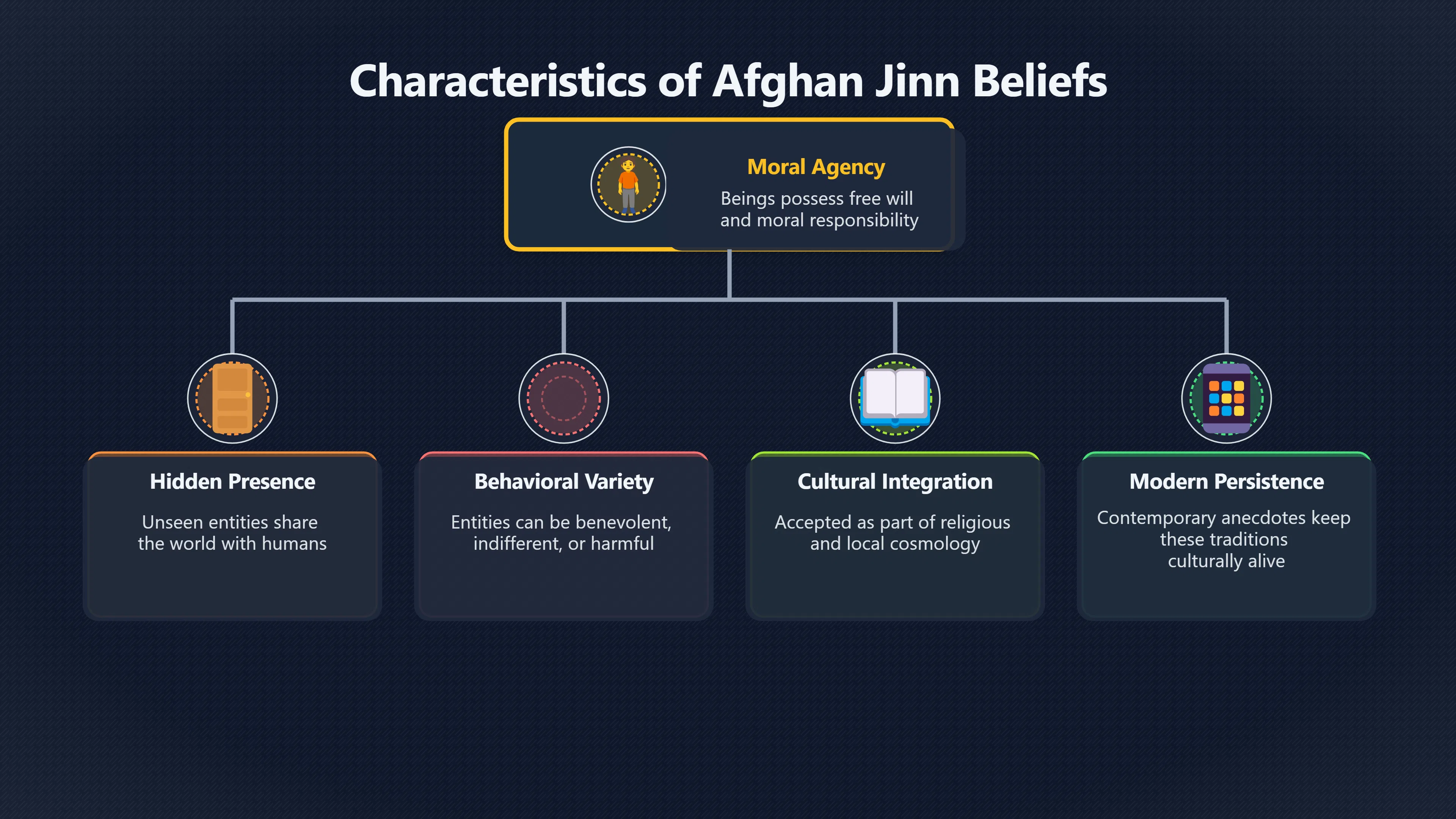
Jinn belong primarily to Islamic belief. They are understood as intelligent, unseen beings who, like humans, possess free will and moral responsibility. They may be benevolent, indifferent or harmful. Across the Muslim world, including Afghanistan, belief in jinn has often been treated not as fantasy but as part of accepted religious cosmology. Surveys of Muslim belief have found particularly high levels of belief in jinn in Afghanistan.[wikipedia.org]WikipediaDecember 27, 2001 — Jinn (Arabic: جِنّ), also romanized as djinn or anglicized as genies, are supernatural beings in ancient Arabian re…
At the same time, Afghan storytelling also inherited the Persian concept of the div—a demon, monster, giant or fiend. Over centuries, folk traditions frequently blurred the distinction between jinn, demons, ogres and other supernatural beings. In Persian literary and folk traditions, the same creature might be described as a demon, giant, monster or even a kind of supernatural adversary comparable to a jinn.[Iranica Online]iranicaonline.orgOpen source on iranicaonline.org.
This overlap matters because Afghan folklore developed in a region where oral storytelling and literary culture constantly interacted. Village tales, epic recitations and religious ideas influenced one another, creating a supernatural world that was both local and deeply connected to the wider Persianate and Islamic cultural sphere.[Iranica Online]iranicaonline.orgIranica OnlineFOLKLORE STUDIES ii. OF AFGHANISTANIn Afghanistan in the 20th century, as in Persia until recently, a predominantly oral cu…
Jinn in Everyday Belief and Warning Tales
Unlike the giant demons of epic literature, jinn are often encountered in stories that feel close to ordinary life. They appear in accounts of strange sounds, deserted buildings, unexplained illnesses, frightening journeys or encounters in isolated places. Such stories function partly as entertainment but also as warnings about behaviour, danger and respect for the unseen world.[PMC]pmc.ncbi.nlm.nih.govPMCProcess of determining the value of belief about jinnby E Guthrie · 2016 · Cited by 19 — In the Muslim faith, beliefs about jinns are common and are widely held by people with and without…
Several recurring themes appear in Afghan and neighbouring regional traditions:
- Remote places are risky. Deserts, abandoned structures, graveyards and lonely mountain routes are often portrayed as places where supernatural encounters may occur.
- Night changes the landscape. Darkness frequently marks the boundary between ordinary reality and the unseen world.
- Respect matters. Many tales warn against arrogance, carelessness or disrespect in places believed to have spiritual significance.
- Not every jinn is evil. Stories often distinguish between harmful and harmless beings, reflecting broader Islamic teaching that jinn possess moral choice.[Wikipedia]WikipediaDecember 27, 2001 — Jinn (Arabic: جِنّ), also romanized as djinn or anglicized as genies, are supernatural beings in ancient Arabian re…
Modern Afghan discussions of jinn show that these ideas remain culturally alive. Contemporary anecdotes collected from Afghans, whether in Afghanistan or the diaspora, still describe allegedly haunted houses, mysterious presences and family stories passed down through generations. Such accounts are important as folklore whether or not listeners accept them literally, because they reveal how communities explain uncertainty, danger and unusual experiences.[Reddit]reddit.comNobody wanted to be his meemon there and people made up stories about itDo you have any supernatural/jinn stories from Afghanistan?January 21, 2023 — My paternal grandfather's house was (allegedly) notor…
Demons, Giants and the Shahnameh World
If jinn occupy the world of everyday caution, demons belong to the world of heroic imagination.
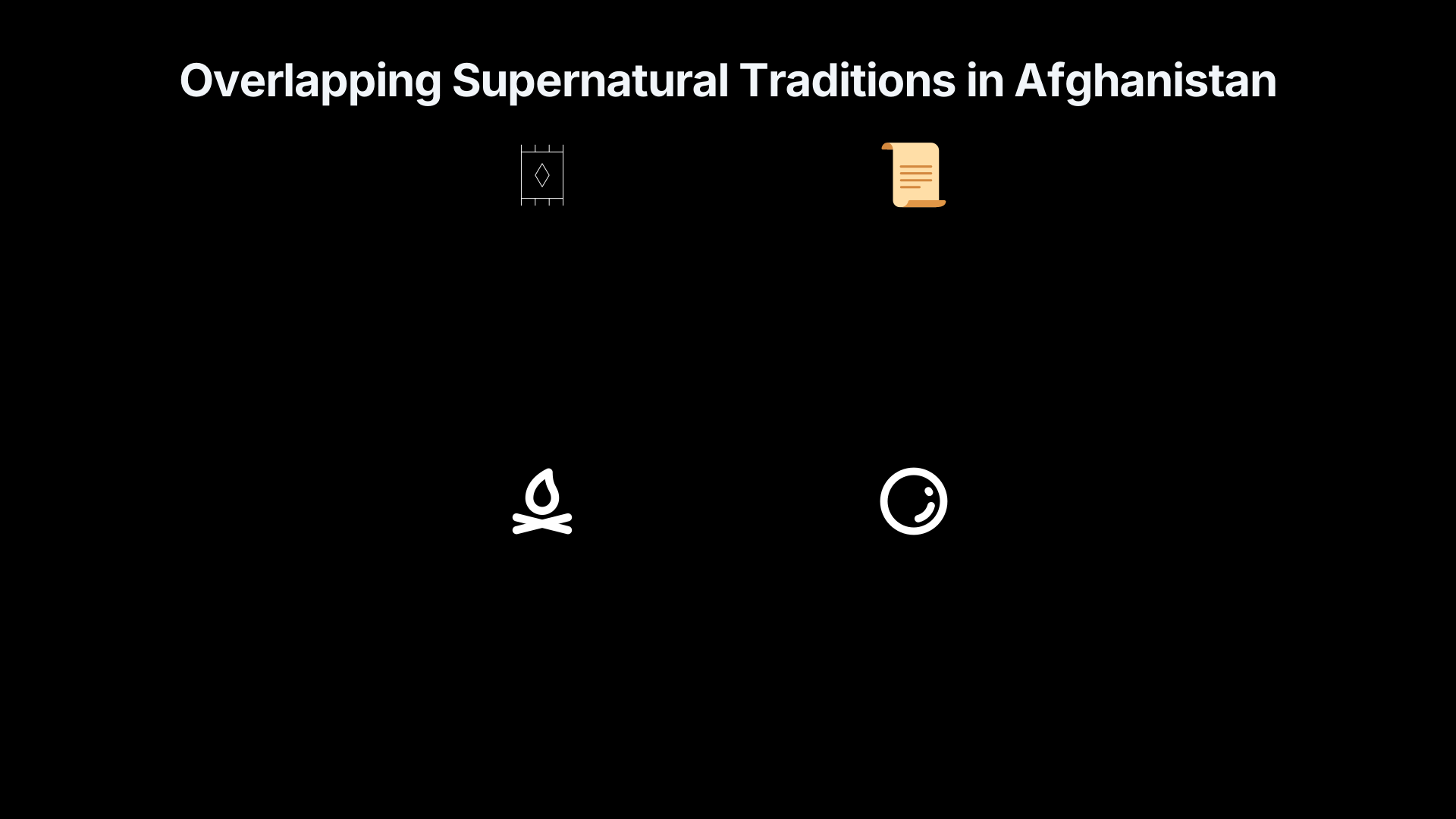
The most influential source for these beings is the Shahnameh, completed around the beginning of the eleventh century and celebrated across the Persian-speaking world, including Afghanistan. The epic presents a universe in which heroes confront monstrous adversaries known as divs. These creatures are not merely animals or ghosts. They are embodiments of chaos, sorcery, destructive power and opposition to rightful order.[wikipedia.org]WikipediaThe Shahnameh, is a long epic poem written by the Persian poet Ferdowsi between c. 977 and 1010 CE and is the national epic of Greater Ir…
The history of the div is especially interesting. In ancient Iranian religious traditions, related terms once referred to divine beings. Over time, particularly through Zoroastrian religious developments, these figures were transformed into demonic enemies. Later Persian literature inherited this idea and turned the divs into the fearsome monsters familiar from epic storytelling.[Iranica Online]iranicaonline.orgthe multiple gods (devas) of Indo-Iranian myths, who…Read more…
By the Islamic period, distinctions between demons, giants and jinn often became blurred in popular storytelling. Encyclopaedia Iranica notes that divs could be understood as demons, ogres, giants or even equivalents of Satan in different contexts. This flexibility helped them survive in folklore long after their original religious background had faded from popular memory.[Iranica Online]iranicaonline.orgOpen source on iranicaonline.org.
For Afghan audiences, these monsters were not simply villains. They represented the terrifying scale of the world beyond ordinary human control: wilderness, chaos, war, temptation and supernatural danger. Heroes proved themselves by confronting such beings directly.[Iranica Online]iranicaonline.orgthe multiple gods (devas) of Indo-Iranian myths, who…Read more…
Rostam, Zabulistan and Afghan Epic Geography
No figure links Afghanistan more strongly to the world of heroic imagination than Rostam.
The greatest champion of the Shahnameh is associated with Zabulistan, a region generally identified with areas around present-day southern Afghanistan and neighbouring territories. Because of this connection, Afghanistan occupies a significant place in the geographical imagination of the epic. The landscape of the country becomes not merely a setting but part of the heroic world itself.[Wikipedia]WikipediaThe Shahnameh, is a long epic poem written by the Persian poet Ferdowsi between c. 977 and 1010 CE and is the national epic of Greater Ir…
Rostam’s most famous adventures involve struggles against demons. In the celebrated Seven Labours, he battles monstrous forces to rescue his king. The climax comes in his confrontation with the White Demon, a gigantic supernatural enemy renowned for strength and magical power. Later stories pit Rostam against other demonic adversaries such as Akvan, a shape-shifting being capable of deception and magical transformation.[wikipedia.org]WikipediaDiv (mythologyDiv (mythology
These episodes matter because they transform geography into mythology. Mountains, wildernesses and distant frontiers become stages on which cosmic struggles unfold. Readers and listeners in Afghanistan could imagine their own landscapes as connected to the same heroic world that produced Rostam’s victories. The result is a form of cultural mapping in which real places acquire legendary depth.[Wikipedia]WikipediaThe Shahnameh, is a long epic poem written by the Persian poet Ferdowsi between c. 977 and 1010 CE and is the national epic of Greater Ir…
The influence of heroic imagination extends beyond Rostam himself. Afghan traditions have also preserved stories of dragons, giant adversaries and saintly heroes who defeat monstrous threats. In some local Islamic legends, for example, Ali appears as a dragon-slayer associated with dramatic Afghan landscapes. These narratives show how epic themes continued to evolve after the arrival of Islam while retaining older ideas about heroic combat against supernatural forces.[Public Intelligence |]info.publicintelligence.netPublic Intelligence |(U) Cultural Islam in AfghanistanIn Afghan Islamic tradition, Caliph Ali is often referred to as the dragon-slayer a…

Spirits in cultural memory
The enduring appeal of Afghan supernatural traditions lies in the different purposes they serve.
Jinn stories help explain uncertainty, danger and the unseen dimensions of life. They provide cautionary narratives, moral lessons and a language for discussing unusual experiences. Demonic and giant adversaries fulfil a different role: they enlarge the scale of imagination, turning landscapes into stages for courage, sacrifice and moral struggle.[nih.gov]pmc.ncbi.nlm.nih.govPMCProcess of determining the value of belief about jinnby E Guthrie · 2016 · Cited by 19 — In the Muslim faith, beliefs about jinns are common and are widely held by people with and without…
Together, these traditions reveal an important feature of Afghan culture. The supernatural is not confined to a distant mythological past. Religious belief, oral storytelling and epic literature continually interact. A village tale about a haunted place and a grand story of Rostam fighting demons may belong to different narrative worlds, yet both express the same fascination with unseen powers, dangerous frontiers and the testing of human character.[Iranica Online]iranicaonline.orgIranica OnlineFOLKLORE STUDIES ii. OF AFGHANISTANIn Afghanistan in the 20th century, as in Persia until recently, a predominantly oral cu…
In that sense, Afghanistan’s supernatural imagination is populated not only by spirits and monsters but also by heroes. The jinn lurking beyond the firelight and the demons challenged by Rostam occupy different scales of storytelling, yet together they form one of the richest and most enduring strands of Afghan legendary culture.[patrickabbott.net]patrickabbott.netPatrick Abbott True Tales of Afghan JinnPatrick AbbottTrue Tales of Afghan Jinn - Patrick Abbott, Sci-fi Author20 Dec 2023 — 70 percent of Muslims in Afghanistan believe in jinn…
Amazon book picks
Further Reading
Books and field guides related to Who Haunts Afghanistan's Supernatural Imagination?. Use these as the next step if you want deeper reading beyond the article.


eBay marketplace picks
Marketplace Samples
Live-tested eBay searches with available results related to this page.
Endnotes
1.
Source: Wikipedia
Link:https://en.wikipedia.org/wiki/Jinn
Source snippet
December 27, 2001 — Jinn (Arabic: جِنّ), also romanized as djinn or anglicized as genies, are supernatural beings in ancient Arabian re...
Published: December 27, 2001
2.
Source: Wikipedia
Link:https://en.wikipedia.org/wiki/Shahnameh
Source snippet
The Shahnameh, is a long epic poem written by the Persian poet Ferdowsi between c. 977 and 1010 CE and is the national epic of Greater Ir...
3.
Source: pmc.ncbi.nlm.nih.gov
Title: PMCProcess of determining the value of belief about jinn
Link:https://pmc.ncbi.nlm.nih.gov/articles/PMC4746541/
Source snippet
by E Guthrie · 2016 · Cited by 19 — In the Muslim faith, beliefs about jinns are common and are widely held by people with and without...
4.
Source: reddit.com
Title: Nobody wanted to be his meemon there and people made up stories about it
Link:https://www.reddit.com/r/Afghan/comments/10i17ky/do_you_have_any_supernaturaljinn_stories_from/
Source snippet
Do you have any supernatural/jinn stories from Afghanistan?January 21, 2023 — My paternal grandfather's house was (allegedly) notor...
Published: January 21, 2023
5.
Source: Wikipedia
Title: Div (mythology)
Link:https://en.wikipedia.org/wiki/Div_%28mythology%29
6.
Source: iranicaonline.org
Link:https://www.iranicaonline.org/articles/folklore-ii/
Source snippet
Iranica OnlineFOLKLORE STUDIES ii. OF AFGHANISTANIn Afghanistan in the 20th century, as in Persia until recently, a predominantly oral cu...
7.
Source: patrickabbott.net
Title: Patrick Abbott True Tales of Afghan Jinn
Link:https://www.patrickabbott.net/p/true-tales-of-afghan-jinn
Source snippet
Patrick AbbottTrue Tales of Afghan Jinn - Patrick Abbott, Sci-fi Author20 Dec 2023 — 70 percent of Muslims in Afghanistan believe in jinn...
8.
Source: iranicaonline.org
Link:https://www.iranicaonline.org/articles/div/
9.
Source: iranicaonline.org
Link:https://www.iranicaonline.org/articles/shahnameh/v-excursus/
Source snippet
the multiple gods (devas) of Indo-Iranian myths, who...Read more...
10.
Source: iranicaonline.org
Link:https://www.iranicaonline.org/articles/akvan-e-div-the-demon-akvan-who-was-killed-by-rostam/
Source snippet
AKVĀN-E DĪVAKVĀN-E DĪV, the demon Akvān, who was killed by Rostam. According to the Šāh-nāma (ed. Mohl, vol. 3, pp. 270ff.) Akvān first c...
11.
Source: info.publicintelligence.net
Link:https://info.publicintelligence.net/MCIA-AfghanCulturalIslam.pdf
Source snippet
Public Intelligence |(U) Cultural Islam in AfghanistanIn Afghan Islamic tradition, Caliph Ali is often referred to as the dragon-slayer a...
12.
Source: iranicaonline.org
Link:https://www.iranicaonline.org/articles/genie/
13.
Source: iranicaonline.org
Link:https://www.iranicaonline.org/articles/gul/
Source snippet
ḠUL - Encyclopaedia IranicaḠUL, designation of a fantastic, frightening creature in the Perso-Arabic lore. It is a hideous monster with a...
Additional References
14.
Source: cais-soas.com
Link:https://www.cais-soas.com/CAIS/Mythology/div.htm
Source snippet
Div (Demon and Monster) in the Iranian MythologyDiv, (demon, monster, fiend), often confused with 'Ghul' (orge, ghoul) and jinn in both p...
15.
Source: facebook.com
Link:https://www.facebook.com/groups/persianversion/posts/1434641893899505/
Source snippet
The Evolution of Persian Peri in Mythology and FolkloreEarly Persian translations of the Quran, identified the good jinn as peris, and th...
16.
Source: eranshahr.com
Link:https://www.eranshahr.com/myths/category/Div
17.
Source: amazon.de
Title: ; Black and white illustrations accompanying each tale, sparking imagination
Link:https://www.amazon.de/Tales-Afghan-History-Cultural-Legends/dp/0369617789?tag=searcht-20
Source snippet
Tales from Afghan History: Heroic Tales and Cultural...200+ pages of enthralling stories that will keep your child captivated for hours...
18.
Source: youtube.com
Link:https://www.youtube.com/watch?v=MClHLjcUygc
Source snippet
Mythology of AfghanistanThrough oral traditions, folktales, and proverbs, Afghanistan's mythology encapsulates the diverse history and va...
19.
Source: crazyalchemist.com
Link:https://www.crazyalchemist.com/bestiary/
Source snippet
Bestiary: Mythical Creatures, Gods, Demons & SpiritsShe belongs to a tradition of infant-killing demons found across the...
20.
Source: scribd.com
Link:https://www.scribd.com/document/882264845/Div-Mythology
Source snippet
arkness, chaos, and magical powers, similar to jinn but much more...Read more...
21.
Source: kurdish-history.com
Title: Kurdish History The Divs: Demons of Iranic Myth
Link:https://www.kurdish-history.com/post/divs-iranic-demons
Source snippet
The Divs: Demons of Iranic Myth - Kurdish History1 June 2026 — The Divs are the demons of the Iranic world, the monstrous, shadowy beings...
Published: June 2026
22.
Source: cfl.modares.ac.ir
Link:https://cfl.modares.ac.ir/article_21734_en.html
Source snippet
On the other hand, Iranians know Div as an independent and solitary...
23.
Source: instagram.com
Link:https://www.instagram.com/reel/DG8whmqAVRN/
Source snippet
book brings ancient legends to life with beautiful illustrations...
Topic Tree