Dark Tales and Living Folklore from Belize
Belizean folklore is not a single mythology with one fixed canon. It is a living mix of Maya, Mestizo, Creole, Garifuna, Catholic, Caribbean and wider Central American story traditions, shaped by village storytelling, forest work, family warnings, ritual calendars, literature, tourism and modern media.
Page outline Jump by section
Introduction
The result is a folklore landscape where the same being may be frightening in one telling, protective in another and playful in a tourist retelling. Tata Duende can be a child-snatching forest dwarf, a guardian of animals, or a symbol of respect for the jungle. Xtabai can be a deadly seductress, a Yucatec Maya figure, or a literary symbol through which Belizean writers think about gender and power. Anansi is a trickster inherited through African and Caribbean routes, while Garifuna song, dance and oral tradition have been recognised internationally as endangered living heritage.[travelbelize.org]travelbelize.orgOpen source on travelbelize.org.
Why Belizean folklore feels so mixed
Belize sits between the Caribbean and Central America, and its folklore reflects that borderland position. The country’s official tourism and cultural materials emphasise Belize as a place of many cultural influences rather than one dominant tradition; the National Institute of Culture and History describes itself as responsible for safeguarding both tangible and intangible cultural heritage, while the national tourism board presents Belizean culture as a blend of many communities, languages, foods, music and traditions.[Travel Belize]travelbelize.orgTravel Belizebelizean cultureTravel Belizebelizean culture
That mixture matters because many stories travel across community boundaries. La Llorona is widely known across Latin America, but she is also part of Belizean storytelling. Anansi has deep West African and Caribbean roots, yet is strongly associated with Belizean Creole oral tradition. Tata Duende resembles broader Central American and Iberian “duende” traditions, but Belizean tellings give him distinct local detail: backwards feet, missing thumbs, forest guardianship and warnings to children.[caribbeanlifestyle.com]caribbeanlifestyle.combelizean folklorebelizean folklore
Belizean folklore is therefore best understood as a layered oral culture. Some tales belong closely to particular communities; others have become nationally familiar through school, family storytelling, newspapers, tourism articles, stamps, illustrated books and Halloween or heritage events. The danger is to flatten that complexity into a single “Belize mythology”. The more useful approach is to ask who tells the story, in what language or setting, and what moral or memory the story is carrying.
Tata Duende: the forest guardian with backwards feet
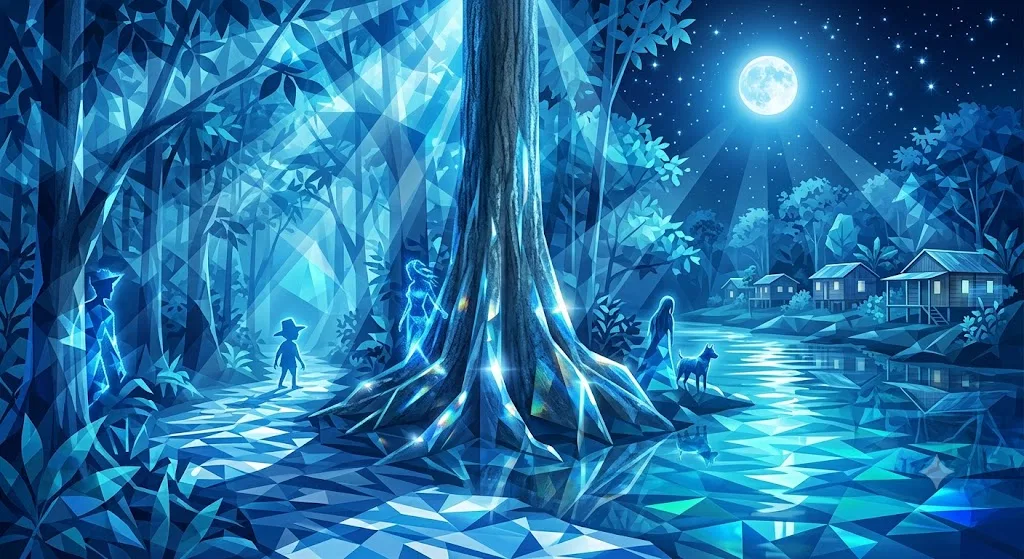
Tata Duende is probably Belize’s most recognisable folk being. He is usually described as a small, old, forest-dwelling figure with a large hat, backwards-facing feet and missing thumbs. In many popular tellings, he whistles, plays music, braids horses’ manes, lures children into the bush, and may harm anyone who foolishly shows him their thumbs. Belize’s tourism board describes him as a forest guardian associated with woodcutters’ encounters, backwards feet, a straw hat, no thumbs and eerie sounds in the night.[Travel Belize]travelbelize.orgOpen source on travelbelize.org.
The story works on several levels at once. For children, Tata Duende is a warning not to follow strangers or wander into the jungle. For adults, he is a reminder that the bush is not empty space but a place with rules, owners and hidden powers. Local and travel accounts repeatedly connect him with forests, farms, hunters, woodcutters, cane workers and remote village life, which is why he feels so tied to Belize’s landscape rather than merely imported from a general goblin tradition.[Caribbean Culture and Lifestyle]caribbeanlifestyle.combelizean folklorebelizean folklore
There is also a less frightening side. Some accounts describe Tata Duende as a protector of animals and people of the forest, punishing wasteful hunters and helping those who respect the bush. This is where the legend becomes more than a bogeyman tale: it expresses an environmental ethic in supernatural form. A child may remember the thumbs; an adult may remember the instruction not to take more from the forest than is needed.[Lower Dover Field Journal]ldfieldjournal.wordpress.combelize folklore tata duendebelize folklore tata duende
Tata Duende has also entered national popular culture. A 1991 Belize stamp series included folklore figures such as Tata Duende and Xtabai, showing that these beings had become public cultural symbols, not only fireside stories. Modern Belizean artists and writers have further reworked him in books, animation and illustrated folklore projects, often balancing documentation, entertainment and tourism appeal.[touchstamps.com]touchstamps.comtata duendetata duende
Xtabai and La Llorona: dangerous beauty, grief and warning
Xtabai is commonly described in Belizean retellings as a beautiful woman with long dark hair who appears near the bush or a ceiba tree and lures men, especially drunk or unfaithful men, towards danger. The Belize Tourism Board presents her as a seductive figure used as a warning for misbehaving children or husbands, with some variants giving her a goat foot, a snake form or the power to become a tree.[Travel Belize]travelbelize.orgOpen source on travelbelize.org.
Her roots are usually linked to Yucatec Maya tradition, and the tale circulates beyond Belize in the Yucatán region. This matters because Xtabai is not simply a “female demon” story. In some versions, the underlying moral is about hypocrisy: outward purity is not the same as kindness, and beauty or desire can be misread. In Belizean popular retellings, however, the story is often sharpened into a cautionary tale about drinking, lust and the dangers of the night road.[GBM]greaterbelize.comGBMX'tabai: The Femme Fatale of the YucatanGBMX'tabai: The Femme Fatale of the Yucatan
La Llorona, the weeping woman, is another widely shared figure in Belizean folklore. She is usually said to haunt riversides or waters after the death of her children, and Belizean travel and culture sources present her as part of the country’s Latin American and Mestizo story world. Her presence in Belize shows how national folklore often includes regional traditions that have been localised through language, family memory and place.[Caribbean Culture and Lifestyle]caribbeanlifestyle.comlocal legends and folklore to experience in belizelocal legends and folklore to experience in belize
Both figures are often framed around women’s sexuality, motherhood, grief and danger. Modern readers should be careful with that. These stories can preserve old moral codes, including gendered warnings that punish women or blame desire. Yet Belizean literature has also reworked such figures more critically. Scholarship on Zee Edgell’s novel The Festival of San Joaquin argues that she uses Belizean folkloric figures, including Ixtabai and La Llorona, as part of a more complex literary treatment of gender, violence, national belonging and decolonisation.[uottawa.scholarsportal.info]uottawa.scholarsportal.infoOpen source on scholarsportal.info.
Anansi and the Creole trickster tradition
Anansi, often called Anancy or Bra Anansi in Caribbean contexts, is the spider trickster whose clever speech and schemes let him survive against stronger opponents. In Belize, he is especially associated with Creole storytelling, though Anansi tales are part of a much wider African and Caribbean world. A scholarly article on a Belizean folktale notes that African strands in Belizean folklore are most obvious in popular Anancy stories, while Belizean culture sources describe Anansi as the small but cunning spider who outwits larger animals such as Brother Tiger.[JSTOR]jstor.orgOpen source on jstor.org.
Anansi stories feel different from the forest-monster legends. They are often funny, sharp and socially observant. Anansi lies, steals, manipulates and escapes punishment, but the tales are not simply praise for bad behaviour. They teach listeners to recognise clever talk, greed, pride, power and survival tactics. Calling someone “Anansi” in Belizean popular explanation can suggest a silver-tongued person who talks their way out of trouble.[Travel Belize]travelbelize.orgOpen source on travelbelize.org.
This trickster tradition also points to Belize’s African diasporic history. Anansi stories travelled through enslavement and Caribbean oral culture, where the small, cunning figure could stand for survival under unequal power. In Belize, that inheritance has become part of local Creole identity while still connecting the country to Jamaica, Ghana and the wider Black Atlantic world.[Wikipedia]WikipediaOpen source on wikipedia.org.
Sisimito, El Cadejo and other night-road warnings
Belizean folklore is full of beings that police boundaries: the edge of the village, the bush path, the riverbank, the rum shop, the road at night. Sisimito is often described as a hairy, humanlike forest creature with backwards feet, sometimes confused with or compared to other Central American wild-man legends. In Belizean tellings he may attack hunters, kidnap people, punish those who kill animals wastefully, or stalk those who enter the bush at the wrong time.[Wikipedia]WikipediaOpen source on wikipedia.org.
El Cadejo belongs to a wider Central American dog-spirit tradition, often involving a supernatural dog encountered at night. Belizean popular retellings usually treat the story as a moral warning about choices, danger and the need to be cautious when travelling. These stories often sound like ghost tales, but their social function is practical: do not walk drunk and alone; do not trust the wrong guide; do not go into dangerous places without sense or respect.[My Beautiful Belize]mybeautifulbelize.combelizean folktales el cadejobelizean folktales el cadejo
Such legends are sometimes dismissed as scare stories for children, but that misses their everyday usefulness. In rural settings, a memorable supernatural warning may be more effective than a dry safety lecture. Folklore turns social knowledge into a story that can be repeated, remembered and adapted.
Sacred places and haunted landscapes
Belizean folklore is strongly tied to landscape. Forests, rivers, caves and Maya sites are not just backdrops; they shape what kinds of beings appear. Xunantunich, the famous Maya archaeological site in western Belize, is a clear example. Its modern name is usually translated as “Stone Woman” or “Maiden of the Rock”, linked to a ghostly woman said to appear near El Castillo, climb the steps and vanish into stone.[Wikipedia]WikipediaOpen source on wikipedia.org.
The legend should not be confused with archaeology. Xunantunich was a major Maya civic and ceremonial centre in the Belize Valley during the Late and Terminal Classic periods, and its ancient name is not known. The “Stone Woman” story is a modern naming tradition attached to the site, not proof of an ancient ghost cult. That distinction makes the legend more interesting, not less: it shows how later Belizeans and visitors have continued to make meaning around ancient ruins.[Wikipedia]WikipediaOpen source on wikipedia.org.
Caves and ruins also sit close to older Maya ideas of sacred geography, where openings in the earth, mountains and ceremonial centres could connect human life with deeper spiritual worlds. Public-facing folklore often turns that complexity into ghost stories, but behind the haunting is a broader pattern: Belizean supernatural tradition frequently treats the land as inhabited, morally charged and not fully under human control.

Ancestors, festivals and the dead
Not all Belizean supernatural tradition is about monsters. Some of the country’s most important living traditions concern ancestors, the dead and communal memory. Garifuna language, dance and music were proclaimed by UNESCO as a Masterpiece of the Oral and Intangible Heritage of Humanity and later inscribed on the Representative List of the Intangible Cultural Heritage of Humanity. UNESCO notes that Garifuna elders maintain ceremonies, festivals and oral traditions, and that Garifuna songs and tales preserve history, livelihood knowledge and community memory.[Intangible Cultural Heritage]ich.unesco.orgOpen source on unesco.org.
Garifuna spirituality includes ancestral ritual practices, often discussed in relation to the dugu ceremony, a complex rite of reconciliation between the living and ancestral spirits. Academic work on the Garifuna dugu in Belize has interpreted it not only as a healing or religious ceremony but also as a social mechanism linking migrants, kin, resources and cultural continuity.[Rozenberg Quarterly]rozenbergquarterly.comOpen source on rozenbergquarterly.com.
Maya-Mestizo communities in northern and western Belize also observe Los Finados, associated with All Souls’ Day and the Day of the Dead. Belize’s tourism board describes it as a tradition blending Indigenous and Catholic practices, honouring deceased loved ones from November 1 to 9, with offerings and remembrance for children and adults who have died. A cultural celebrations document from Belize’s Institute for Social and Cultural Research likewise identifies Los Finados as a commemoration of the souls of the faithful departed returning to their homes.[Travel Belize]travelbelize.orgTravel Belize Honoring the Dead: Los Finados in BelizeTravel Belize Honoring the Dead: Los Finados in Belize
These traditions show why “folklore” should not be reduced to spooky entertainment. In Belize, supernatural belief culture includes care for ancestors, public heritage, mourning, food offerings, music, language and family obligation.
Oral tradition, books and modern reinvention
Belizean folklore has long been oral, but it has not stayed only oral. Newspaper features, tourism blogs, children’s books, academic articles, stamps, museum events and social media have all helped turn local tales into national icons. The National Institute of Culture and History has promoted heritage work through divisions including archaeology, social and cultural research, creative arts and museums, while the Belize Culture Fund aims to protect tangible and intangible heritage and support expressive arts.[nichbelize.org]nichbelize.orgOpen source on nichbelize.org.
Scholars have also studied Belizean storytelling as performance. Chad Ryan Thomas’s work on a Belizean folktale argues that digressions and insertions in a story can reveal the narrator’s storytelling strategy, reminding readers that folktales are not just plots but live performances shaped by voice, audience and occasion.[JSTOR]jstor.orgOpen source on jstor.org.
Modern projects such as Legends of Belize show another stage in the process: artists and animators turning creatures like Tata Duende, Xtabai and Sisimito into illustrated books, presentations and animations. This can help preserve and popularise folklore, especially for younger audiences, but it also changes the material. A being once encountered in a grandparent’s night-time warning becomes a designed character, a tourist image or a pop-culture monster.[legendsofbelize.com]legendsofbelize.comOpen source on legendsofbelize.com.
That change is not automatically bad. Folklore survives by being retold. The key is to notice the difference between an old oral belief, a local family version, a literary reinvention, a heritage presentation and an internet-era creature profile.
What readers often misunderstand
The first common misunderstanding is that Belizean folklore is “Maya mythology” under another name. Maya traditions are crucial, especially in figures such as Xtabai, Tata Duende variants and ideas of sacred landscape, but Belizean folklore also includes Creole Anansi stories, Garifuna ancestral traditions, Catholic-Mestizo ritual calendars and regionally shared Latin American ghosts.[caribbeanlifestyle.com]caribbeanlifestyle.combelizean folklorebelizean folklore
The second misunderstanding is that the stories are simply scary. Many are scary, but fear is often the delivery method, not the whole meaning. Tata Duende teaches forest respect and child safety. Anansi teaches verbal cunning and scepticism. La Llorona and Xtabai preserve anxieties about grief, sexuality, gender and night travel. Los Finados and Garifuna ancestral practice place the dead within continuing social life.[Travel Belize]travelbelize.orgOpen source on travelbelize.org.
The third misunderstanding is that there must be one “authentic” version. Belizean folklore is full of variants because Belize itself is multilingual, multiethnic and regionally connected. A village version, a school version, a tourism-board version and a novelist’s version may all be real cultural evidence, but they are evidence of different things.
Why Belizean folklore still matters
Belizean folklore matters because it helps explain how people imagine the relationship between community and landscape. The jungle is not merely scenery; it is guarded, dangerous and morally alive. Rivers and roads are not empty routes; they are places where grief, temptation or warning may appear. Ruins are not just archaeological remains; they gather stories after abandonment. The dead are not simply gone; in ritual calendars and ancestor practices, they remain part of family and community memory.[historyhit.com]historyhit.comHistory Hit XunantunichHistory Hit Xunantunich
It also matters because it shows how Belizeans have made a national story from many inheritances. A child in Belize may grow up hearing about Anansi, Tata Duende, Xtabai and La Llorona without treating them as belonging to neatly separate cultural boxes. That shared familiarity is one reason these figures appear in tourism writing, public events, stamps, books and heritage projects.[solbery.com]solbery.comOpen source on solbery.com.
The strongest way to read Belizean folklore is therefore not as a catalogue of monsters, but as a map of cultural memory. It marks where people were told not to go, what they were told to respect, whom they were told to remember, and how a small country with many roots keeps turning old stories into present-day meaning.
Amazon book picks
Further Reading
Books and field guides related to What Haunts Belize's Stories?. Use these as the next step if you want deeper reading beyond the article.
The Latin American Cultural Studies Reader
Provides cultural context for Belize's mixed traditions.
eBay marketplace picks
Marketplace Samples
Live-tested eBay searches with available results related to this page.


Endnotes
1.
Source: uottawa.scholarsportal.info
Link:https://uottawa.scholarsportal.info/ottawa/index.php/rceh/article/download/5899/4901/18041
2.
Source: jstor.org
Link:https://www.jstor.org/stable/541288
3.
Source: ich.unesco.org
Link:https://ich.unesco.org/en/RL/language-dance-and-music-of-the-garifuna-00001
4.
Source: nichbelize.org
Link:https://nichbelize.org/
5.
Source: touchstamps.com
Title: tata duende
Link:https://touchstamps.com/Stamp/Details/390878/tata-duende
6.
Source: solbery.com
Link:https://solbery.com/catalog/s670846
7.
Source: legendsofbelize.com
Link:https://www.legendsofbelize.com/
8.
Source: Wikipedia
Link:https://en.wikipedia.org/wiki/Anansi
9.
Source: Wikipedia
Link:https://en.wikipedia.org/wiki/Sisimito
10.
Source: Wikipedia
Link:https://en.wikipedia.org/wiki/Xunantunich
11.
Source: unesco.org
Title: document 1733
Link:https://www.unesco.org/archives/multimedia/document-1733
12.
Source: legendsofbelize.com
Link:https://www.legendsofbelize.com/legends-of-belize-books/
13.
Source: facebook.com
Link:https://www.facebook.com/nich.bz/posts/%F0%9D%97%9B%F0%9D%97%BC%F0%9D%97%BB%F0%9D%97%BC%F0%9D%97%BF%F0%9D%97%B6%F0%9D%97%BB%F0%9D%97%B4-%F0%9D%97%95%F0%9D%97%B2%F0%9D%97%B9%F0%9D%97%B6%F0%9D%98%87%F0%9D%97%B2%F0%9D%97%AE%F0%9D%97%BB-%F0%9D%97%A5%F0%9D%97%BC%F0%9D%97%BC%F0%9D%98%81%F0%9D%98%80-%F0%9D%97%95%F0%9D%97%B2%F0%9D%97%B9%F0%9D%97%B6%F0%9D%98%87%F0%9D%97%B2%F0%9D%97%AE%F0%9D%97%BB-%F0%9D%97%A0%F0%9D%98%86%F0%9D%98%81%F0%9D%97%B5%F0%9D%98%80-%F0%9D%97%9F%F0%9D%97%B2%F0%9D%97%B4%F0%9D%97%B2%F0%9D%97%BB%F0%9D%97%B1%F0%9D%98%80-%F0%9D%97%A1%F0%9D%97%B6%F0%9D%97%B4%F0%9D%97%B5%F0%9D%98%81on-october-31st-2024-the-mus/587762537257789/
14.
Source: facebook.com
Link:https://www.facebook.com/belizehub/posts/belizean-folklore-the-legends-of-belize/1480542688681069/
15.
Source: facebook.com
Title: Tata Duende, La Llorona, Anansi, Alux
Link:https://www.facebook.com/caribbeanlifestylebelize/posts/tata-duende-la-llorona-anansi-alux-these-are-all-characters-from-belizean-folklo/2407511222856302/
16.
Source: facebook.com
Link:https://www.facebook.com/News5Live/posts/tata-duende-the-old-man-who-protects-the-forest-in-last-weeks-installment-of-kol/875168417989207/
17.
Source: facebook.com
Link:https://www.facebook.com/BelizeLibraries/posts/949404530553452/
18.
Source: facebook.com
Link:https://www.facebook.com/groups/2720766191545615/posts/4356420394646845/
19.
Source: facebook.com
Link:https://www.facebook.com/groups/BelizeanDiaspora/posts/25288077047551888/
20.
Source: facebook.com
Link:https://www.facebook.com/ISCRNICHBELIZE/posts/%F0%9D%90%8B%F0%9D%90%A8%F0%9D%90%AC-%F0%9D%90%85%F0%9D%90%A2%F0%9D%90%A7%F0%9D%90%9A%F0%9D%90%9D%F0%9D%90%A8%F0%9D%90%AC-%F0%9D%90%8F%F0%9D%90%AD-%F0%9D%9F%8Fnovember-1-commemorates-the-observation-and-celebration-of-the-m/867169822068366/
21.
Source: facebook.com
Link:https://www.facebook.com/belizenewsnetwork501/posts/tata-duende-spotted-in-orange-walkbelizean-folklore-warns-that-if-you-meet-tata-/1027473450215911/
22.
Source: facebook.com
Title: Belizean folklore
Link:https://www.facebook.com/groups/BelizeBestKeptSecret/posts/10157669250367248/
23.
Source: facebook.com
Link:https://www.facebook.com/photo.php?fbid=794378177830637&id=380951292506663&locale=bs_BA&set=a.381278712473921
24.
Source: facebook.com
Link:https://www.facebook.com/groups/philatelycheatersaroundtheglobe/posts/27863167486618613/
25.
Source: facebook.com
Link:https://www.facebook.com/groups/941137063101645/posts/1714915492390461/
26.
Source: facebook.com
Title: 2022 census preliminary results population up by 23 today the statistical instit
Link:https://www.facebook.com/News5Live/posts/2022-census-preliminary-results-population-up-by-23-today-the-statistical-instit/827872332718816/
27.
Source: facebook.com
Link:https://www.facebook.com/chaacreek/posts/spooky-vibes-but-belizean-folklore-editionthe-young-nation-of-belize-has-been-ma/1129590849286863/
28.
Source: facebook.com
Link:https://www.facebook.com/thehistorygirlnc/posts/the-stone-woman-of-belize-xunantunichif-youre-heading-to-belize-skip-the-crowds-/906243575496232/
29.
Source: facebook.com
Link:https://www.facebook.com/cocoplumislandresortbelize/posts/did-you-know-xunantunich-pronounced-shoo-nahn-too-nich-means-stone-woman-in-maya/1006792221479190/
30.
Source: facebook.com
Link:https://www.facebook.com/groups/519483658064151/posts/25373650215554151/
31.
Source: ich.unesco.org
Title: belize BZ
Link:https://ich.unesco.org/en/state/belize-BZ?info=projects
32.
Source: ich.unesco.org
Link:https://ich.unesco.org/es/00555
33.
Source: unesco.org
Title: document 1
Link:https://www.unesco.org/archives/multimedia/document-1
34.
Source: ich.unesco.org
Title: belize BZ
Link:https://ich.unesco.org/en/state/belize-BZ
35.
Source: ich.unesco.org
Link:https://ich.unesco.org/?call=film&id=41661&include=film_inc.php&width=700
36.
Source: Wikipedia
Title: Tata Duende
Link:https://en.wikipedia.org/wiki/Tata_Duende
37.
Source: Wikipedia
Title: Culture of Belize
Link:https://en.wikipedia.org/wiki/Culture_of_Belize
38.
Source: Wikipedia
Title: Dugu ceremony
Link:https://en.wikipedia.org/wiki/Dugu_ceremony
39.
Source: Wikipedia
Link:https://en.wikipedia.org/wiki/Duende
40.
Source: Wikipedia
Title: Demographics of Belize
Link:https://en.wikipedia.org/wiki/Demographics_of_Belize
41.
Source: Wikipedia
Title: The Festival of San Joaquin
Link:https://en.wikipedia.org/wiki/The_Festival_of_San_Joaquin
42.
Source: Wikipedia
Link:https://en.wikipedia.org/wiki/Xtabay
43.
Source: belize.com
Link:https://belize.com/belize-demographics/
44.
Source: jstor.org
Link:https://www.jstor.org/stable/3299369
45.
Source: touchstamps.com
Link:https://touchstamps.com/Issue/Details/14780/folktales
46.
Source: sib.org.bz
Title: Statistical Institute of Belize Census Key Findings Launch
Link:https://sib.org.bz/wp-content/uploads/CensusLaunch2022.pdf
47.
Source: sib.org.bz
Title: press release census launch
Link:https://sib.org.bz/press-release_census-launch/
48.
Source: travelbelize.org
Link:https://www.travelbelize.org/blog/get-know-belizes-folklore/
49.
Source: travelbelize.org
Title: Travel Belizebelizean culture
Link:https://www.travelbelize.org/culture/
50.
Source: caribbeanlifestyle.com
Title: belizean folklore
Link:https://caribbeanlifestyle.com/belizean-folklore/
51.
Source: ldfieldjournal.wordpress.com
Title: belize folklore tata duende
Link:https://ldfieldjournal.wordpress.com/2011/11/09/belize-folklore-tata-duende/
52.
Source: mayabelize.wordpress.com
Title: the other people in the rainforest
Link:https://mayabelize.wordpress.com/2013/07/03/the-other-people-in-the-rainforest/
53.
Source: greaterbelize.com
Title: GBMX’tabai: The Femme Fatale of the Yucatan
Link:https://www.greaterbelize.com/xtabai-the-femme-fatale-of-the-yucatan/
54.
Source: cushareejournal.wordpress.com
Link:https://cushareejournal.wordpress.com/2018/10/31/if-you-see-her-you-must-never-tell-ghost-stories-and-folk-legends-from-rural-belize/
55.
Source: caribbeanlifestyle.com
Title: local legends and folklore to experience in belize
Link:https://caribbeanlifestyle.com/local-legends-and-folklore-to-experience-in-belize/
56.
Source: mybeautifulbelize.com
Link:https://mybeautifulbelize.com/anansi/
57.
Source: mybeautifulbelize.com
Title: belizean folktales el cadejo
Link:https://mybeautifulbelize.com/belizean-folktales-el-cadejo/
58.
Source: historyhit.com
Title: History Hit Xunantunich
Link:https://www.historyhit.com/locations/xunantunich/
59.
Source: rozenbergquarterly.com
Link:https://rozenbergquarterly.com/the-belizean-garifuna-organization-of-identity-in-an-ethnic-community-in-central-america/
60.
Source: travelbelize.org
Title: Travel Belize Honoring the Dead: Los Finados in Belize
Link:https://www.travelbelize.org/blog/honoring-the-dead-los-finados-in-belize/
61.
Source: chilchile.wordpress.com
Title: the stone lady ruins xunantunich in belize
Link:https://chilchile.wordpress.com/2015/08/30/the-stone-lady-ruins-xunantunich-in-belize/
62.
Source: belize-travel-blog.chaacreek.com
Title: belize culture
Link:https://belize-travel-blog.chaacreek.com/2016/08/belize-culture/
63.
Source: mybeautifulbelize.com
Title: passed one generation next belizean folklore
Link:https://mybeautifulbelize.com/passed-one-generation-next-belizean-folklore/
64.
Source: mybeautifulbelize.com
Title: los finados cultural belief in life after death
Link:https://mybeautifulbelize.com/los-finados-cultural-belief-in-life-after-death/
65.
Source: sib.org.bz
Title: Census2022 Population
Link:https://sib.org.bz/wp-content/uploads/Census2022_Population.pdf
66.
Source: greaterbelize.com
Title: tata duende the old man who protects the forest
Link:https://www.greaterbelize.com/tata-duende-the-old-man-who-protects-the-forest/
67.
Source: greaterbelize.com
Title: bra anansi the trickster spider still beloved by belizeans
Link:https://www.greaterbelize.com/bra-anansi-the-trickster-spider-still-beloved-by-belizeans/
68.
Source: genies.fandom.com
Link:https://genies.fandom.com/wiki/Belize
69.
Source: souzzchef.com
Title: stone woman
Link:https://souzzchef.com/2019/10/29/stone-woman/
70.
Source: bombmagazine.org
Title: zee edgell
Link:https://bombmagazine.org/articles/2003/01/01/zee-edgell/
71.
Source: instagram.com
Link:https://www.instagram.com/reel/DIT2EG-M5dM/
72.
Source: pure.knaw.nl
Link:https://pure.knaw.nl/portal/files/472910/Anansi.pdf
73.
Source: birdseyeviewbelize.com
Link:https://birdseyeviewbelize.com/xunantunich/
Additional References
74.
Source: youtube.com
Title: Learning About Belizean Folklore | Paranormal Activities In Corozal Belize
Link:https://www.youtube.com/watch?v=1zS-f5BkVyU
Source snippet
Put Tata Duende on the Belizean Dollar! | The Captain 501 Broadcast (Episode 5)...
75.
Source: youtube.com
Title: Tata Duende: The Mayan Jungle Gnome Scaring Children In Belize | Boogeymen
Link:https://www.youtube.com/watch?v=KllzQya12MM
Source snippet
FULL MOVIE (OFFICIAL): Tecuani and the Duende - The Voice of the Jaguar...
76.
Source: youtube.com
Title: FULL MOVIE (OFFICIAL): Tecuani and the Duende
Link:https://www.youtube.com/watch?v=QIEqyKo1ris
Source snippet
Tata Duende, The Old Man Who Protects the Forest...
77.
Source: youtube.com
Title: Tata Duende, The Old Man Who Protects the Forest
Link:https://www.youtube.com/watch?v=9VSmVqWOVkY
Source snippet
Learning About Belizean Folklore | Paranormal Activities In Corozal Belize...
78.
Source: ambergriscaye.com
Link:https://ambergriscaye.com/25years/laxtabai.html
79.
Source: researchgate.net
Link:https://www.researchgate.net/publication/352055159_Succouring_an_Ixtabai_Zee_Edgell%27s_Deployment_of_Belizean_Folklore_in_The_Festival_of_San_Joaquin_1997
80.
Source: belizeadventure.ca
Link:https://www.belizeadventure.ca/culture/creole/
81.
Source: belizelivingheritage.org
Link:https://www.belizelivingheritage.org/wp-content/uploads/2019/09/ISCR-Culture-Celebration-Final-00.pdf
82.
Source: minorityrights.org
Link:https://minorityrights.org/country/belize/
83.
Source: countryreports.org
Link:https://www.countryreports.org/country/Belize
Topic Tree
Follow this branch
Related pages 192
- Afghan Folklore
- Albanian Folklore
- Algerian Folklore
- Australian Folklore
- Azerbaijan Folklore
- +187 more in sidebar