Where Iran's Myths Still Touch the Earth
Iran’s folklore is not a single shelf of old stories. It is a living mixture of epic poetry, village storytelling, seasonal rituals, sacred landscapes, demons, dragons, fairies, jokes, charms, heroic legends and family customs.
Page outline Jump by section
Introduction
For a first-time reader, the key is to separate three overlapping layers. One layer is ancient Iranian myth, with roots in pre-Islamic religious and heroic imagination. Another is the literary epic world shaped most famously by Ferdowsi’s Shahnameh, the great national epic of Iran. A third is folk practice: stories performed aloud, festivals repeated each year, local monsters and spirits, and legends attached to mountains, shrines and villages. These layers constantly borrow from each other, which is why Iranian folklore can feel both ancient and surprisingly immediate.[Iranica Online]iranicaonline.orgOpen source on iranicaonline.org.
Why Iranian folklore feels epic even when it is local
Many countries have heroic legends, but Iran’s folklore is unusually shaped by the long afterlife of one literary monument: the Shahnameh, or “Book of Kings”. Encyclopaedia Iranica describes it as Iran’s national epic because it offers a continuous narrative of the Iranian people and their struggle to hold a land understood as their own. The poem was completed by Ferdowsi around the early 11th century, but it drew on older heroic, royal and mythic traditions rather than inventing a national mythology from nothing.[Iranica Online]iranicaonline.orgIranica OnlineŠĀH-NĀMAEncyclopaedia IranicaŠāh-nāma is regarded as Iran's national epic in that it presents a continuous narrative of the Iranian people in a l…
This matters because many famous Iranian legendary figures are not encountered only as museum pieces or literary characters. They have been retold in public storytelling, popular romances, manuscript painting, school memory, theatre, film, political metaphor and everyday cultural reference. The result is a folklore culture in which the border between “book” and “oral tradition” is porous. A tale may be written in a courtly poem, performed by a storyteller, simplified in a children’s book, invoked in a proverb, and then reworked again in modern media.
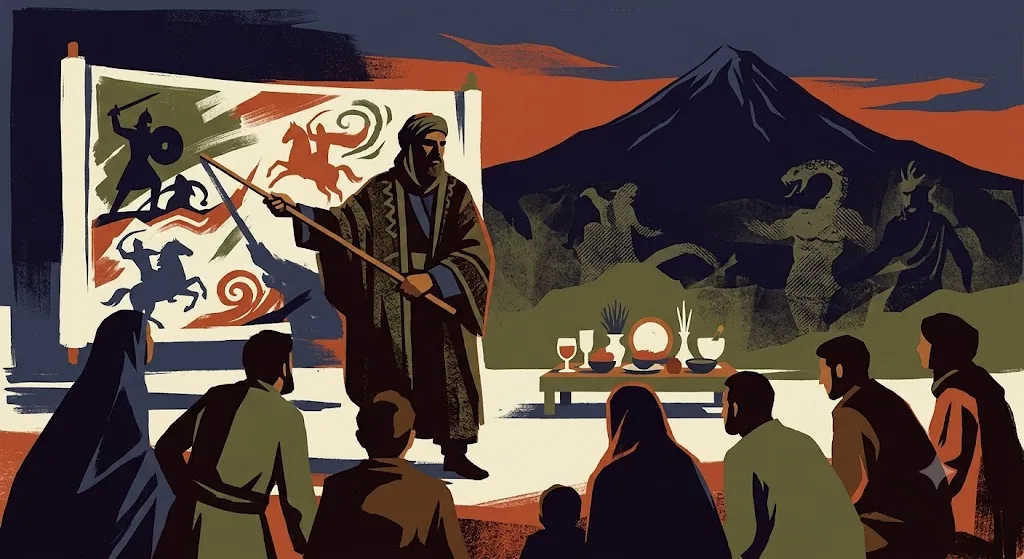
One famous example is the tyrant with serpents growing from his shoulders, defeated by the hero-king who imprisons him beneath Mount Damavand. The story belongs to Iran’s epic-mythic imagination, but its power comes partly from geography: a real mountain becomes the visible prison of a legendary evil. In that sense, Iranian folklore often turns landscape into memory. Mountains, springs and ruins are not just scenery; they become places where old stories appear to have touched the earth.[EciEco]ecieco.orgDamavand The Mountain of Ancient Myths and MysteriesDamavand: The Mountain of Ancient Myths and Mysteries2 Nov 2025 — Among the many legends surrounding it, the story in the Shahnameh…
The heroic world: kings, rebels and monsters
The heroic strand of Iranian folklore is full of kings who fail, champions who must choose between loyalty and justice, and monsters who are rarely just monsters. They often embody disorder, drought, tyranny, deception or moral danger. This is why the stories have remained useful: they can be retold as adventure, but also as ethical and political parable.
The Shahnameh is the main gateway for many readers. It includes mythical beginnings, legendary dynasties, heroic cycles and later historical material, but it should not be read as a simple history book. It is a literary epic fed by older narrative traditions. Encyclopaedia Iranica notes that Iranian narratives circulated in conversation with oral tradition and differed from one another, which helps explain why stories known from the epic also appear in altered forms elsewhere.[Iranica Online]iranicaonline.orgOpen source on iranicaonline.org.
The most famous heroic name is Rostam, the mighty champion of the Iranian epic cycle. His stories have the shape of wonder-tale adventure: battles with supernatural foes, journeys through danger, tests of strength and tragic family recognition. Yet his cultural role is larger than that. In later Persian folktales and popular romances, epic heroes could be adapted, moralised, localised or woven into Islamic-era storytelling. This did not erase the older heroic world; it gave it new audiences and new meanings.[Oral Tradition]journal.oraltradition.orgOral Tradition The Persian Popular Romance osein-e KordOral Tradition The Persian Popular Romance osein-e Kord

Demons, fairies, jinn and dragons
Iranian supernatural folklore is rich because several systems of belief overlap. Pre-Islamic Iranian demonology, Islamic ideas about jinn, literary fantasy, local oral tale and popular superstition all feed into one another. The same being may look different depending on whether it appears in epic poetry, a village tale, a religious story or a modern retelling.
The demon or ogre figure known in Persian tradition as the div is a good example. Encyclopaedia Iranica explains that this being can mean demon, monster, giant, ogre or even Satan-like evil, and that it is often confused or blended with ghouls and jinn in literary and folk traditions. In other words, the category is not neat. It is a flexible supernatural label that changed as stories moved between religious languages and popular narration.[Iranica Online]iranicaonline.orgIranica Online DĪVIranica Online DĪV
Dragons are another major figure, but not always in the way modern fantasy readers might expect. In Iranian folktales, the dragon appears especially in magic tales and legends rather than as a fixed species from a single mythology. It can be a hoarder, a threat to water, a monstrous opponent, or a test for the hero. Encyclopaedia Iranica’s entry on dragons in Iranian folktales notes that the dragon is prominent in tales of magic and legend, showing how the creature moves between wonder-tale adventure and mythic symbolism.[Iranica Online]iranicaonline.orgOpen source on iranicaonline.org.
Fairy-like beings and jinn complicate the picture further. Persianate literature spread such beings widely beyond modern Iran, but within Iranian folklore they are best understood as part of a mixed supernatural vocabulary. Some beings are beautiful and alluring, some dangerous, some morally ambiguous, and some simply narrative tools that let a story move between the ordinary and the marvellous. The important point is not to flatten them into one modern fantasy category. Iranian tradition preserves them as overlapping story-types shaped by religion, poetry, oral tale and local belief.[Iranica Online]iranicaonline.orgIranica Online GENIEIranica Online GENIE
Oral storytelling: how tales were kept alive
Iranian folklore is not only what is told, but how it is told. The public performer matters. UNESCO lists Iranian dramatic storytelling as intangible cultural heritage in need of safeguarding and describes the performer as someone who recounts stories in verse or prose with gestures, movement, and sometimes music and painted scrolls. This tradition has carried heroic, kingly and religious stories from elite texts into public performance spaces.[UNESCO Intangible Cultural Heritage]ich.unesco.orgOpen source on unesco.org.
These performances helped make the epic world social. A listener did not need to own a manuscript or read classical poetry to know the heroes. Storytellers could explain difficult verses, dramatise battles, adapt pacing to the audience, and connect old material to local taste. Encyclopaedia Iranica’s account of Iranian dramatic storytelling stresses that it involves both oral and written traditions, which is exactly the key to understanding Iranian folklore more broadly.[Iranica Online]iranicaonline.orgIranica Online NAQQĀLIIranica Online NAQQĀLI
Alongside public epic performance, Iran has a vast oral literature: folktales, songs, laments, improvised verse, jokes, charms and local stories in many Iranian languages. Encyclopaedia Iranica notes that a huge variety of oral material has been recorded, but that much remains uncollected. That warning is important. Any national summary of Iranian folklore is necessarily partial, because the best-documented Persian-language traditions sit beside Kurdish, Luri, Gilaki, Mazandarani, Balochi, Azeri and many other local and minority traditions whose oral materials have not always been collected equally.[Iranica Online]iranicaonline.orgIranica OnlineORAL LITERATURE IN IRANby E Yarshater — In the Iranian languages a huge variety of material—heroic poetry, improvised lamen…
Seasonal customs: fire, spring and the longest night
Iran’s ritual calendar is one of the most visible parts of its folklore. These customs are not “myths” in the narrow sense, but they carry folk ideas about renewal, danger, luck, warmth, darkness, health, family and the turning of the year.
The best-known seasonal complex is Nowruz, the spring new year. UNESCO describes it as a traditional folk spring festival connected with nature, the sun and the universe, celebrated across several countries, with Iran as one of the central cultural anchors. In Iran, the wider festive period includes household preparation, visiting, symbolic foods, public celebration and the movement from winter into spring.[UNESCO Intangible Cultural Heritage]ich.unesco.orgOpen source on unesco.org.
One of the most vivid associated customs is the fire festival before Nowruz, commonly known for bonfires and leaping over flames. Modern descriptions often emphasise health, renewal and leaving misfortune behind. The British Council, for example, explains that the fire-jumping custom is believed to bring health and good luck in the new year. In contemporary Iran, the festival can also carry public and political meaning, because shared seasonal rituals sometimes become expressions of cultural identity and social defiance as well as celebration.[LearnEnglish - British Council]learnenglish.britishcouncil.orgLearn EnglishLearn English
The winter counterpart is Yalda or Chella, the celebration of the longest night. UNESCO describes it as a traditional celebration of the sun and the warmth of life, practised in Iran and Afghanistan on the last night of autumn. Families gather, eat fruit and nuts, read poetry, tell stories and stay together through the dark. Its folkloric power lies in a simple human pattern: the longest night becomes bearable because people turn it into company, memory and ritual.[UNESCO Intangible Cultural Heritage]ich.unesco.orgOpen source on unesco.org.
Sacred landscapes and haunted geography
Iranian folklore often attaches story to place. Mountains, springs, caves, shrines and old cities become points where religion, legend and local identity meet. These places are not always “haunted” in the ghost-story sense; they are charged with memory, danger, blessing or miracle.
Mount Damavand is the clearest national example. It is a real volcanic mountain and a symbolic landmark, but folklore makes it more than a peak. In the famous epic legend, the tyrant with serpent-shoulders is bound there after being defeated. This transforms the mountain into a mythic prison and a sign that evil may be restrained but not always destroyed. Recent cultural writing still treats Damavand as a meeting point of nature, national identity and mythic imagination.[EciEco]ecieco.orgDamavand The Mountain of Ancient Myths and MysteriesDamavand: The Mountain of Ancient Myths and Mysteries2 Nov 2025 — Among the many legends surrounding it, the story in the Shahnameh…
Zoroastrian pilgrimage sites show another kind of sacred landscape. Chak Chak, also known as Pir-e Sabz, is one of the most important Zoroastrian shrines in Iran, located in the desert landscape of Yazd province. Its legend is attached to a royal woman fleeing conquest, a mountain that opens to protect her, and a spring whose dripping water is read as sacred memory. Whether approached as history, legend or pilgrimage tradition, the site shows how Iranian folklore often preserves stories through place-based ritual.[Pars Diplomatic]parsdiplomatic.comPars Diplomatic Chak Chak: The Zoroastrian PilgrimagePars Diplomatic Chak Chak: The Zoroastrian Pilgrimage
These landscapes also remind readers that Iranian folklore is not only Persian court culture. It is local, regional and religiously layered. A shrine legend, a mountain prison, a village spring and a city ritual may all belong to different communities, but each turns geography into a story that can be visited, repeated and reinterpreted.
Folktales, jokes and everyday wonder
Not all Iranian folklore is solemn or heroic. Persian and Iranian folktale collections include animal tales, trickster stories, magic tales, moral jokes, foolish-person stories, clever deduction tales, romance adventures and stories of supernatural helpers or threats. Some are recognisably connected to international tale-types; others have local textures of speech, setting and custom.
Scholarly work on Persian folktales has often used tale-type classification, the comparative method that groups stories by plot pattern. Ulrich Marzolph’s typology of Persian folk tales is a major reference point, and the Orient-Institut describes it as classifying Persian tales into groups such as legend tales, magician tales and droll stories. This kind of scholarship helps show that Iranian tales are not isolated curiosities. They are part of a wider Eurasian and Middle Eastern traffic of plots, motifs and narrative habits.[orient-institut.org]orient-institut.orgOpen source on orient-institut.org.
At the same time, classification can make stories sound more mechanical than they feel in performance. A tale about a clever person deducing the features of a missing camel, for instance, can be tracked as an international motif, but in actual storytelling it becomes a performance of wit, suspicion and social intelligence. Marzolph’s study of Persian popular romance discusses just such internationally documented tale material, showing how learned classification and living narrative can meet in the same story.[Oral Tradition]journal.oraltradition.orgOral Tradition The Persian Popular Romance osein-e KordOral Tradition The Persian Popular Romance osein-e Kord
Everyday folklore also includes customs that older collectors sometimes treated as minor or domestic. Encyclopaedia Iranica notes that folklore studies in Persia are relatively recent as a discipline, even though the material itself is old and wide-ranging. This means that the archive is uneven. What survives in print may reflect the interests of diplomats, scholars, urban collectors or male literary culture as much as the full range of what families and local communities actually told.[Iranica Online]iranicaonline.orgOpen source on iranicaonline.org.
How religion changed the stories without erasing them
Iranian folklore cannot be understood through a simple before-and-after model in which pre-Islamic myths disappear and Islamic stories replace them. The more accurate picture is layering. Older Iranian mythic figures, Zoroastrian moral worlds, Islamic cosmology, Sufi symbolism, local saint legends and popular magic all interact.
The changing vocabulary of supernatural beings makes this visible. Demons, ghouls and jinn are sometimes distinguished and sometimes blended. A monster from an older Iranian epic imagination may be reinterpreted through Islamic moral language; a jinn may appear in a story that otherwise feels like a local wonder tale; a heroic figure may be absorbed into later religious storytelling.[Iranica Online]iranicaonline.orgIranica Online DĪVIranica Online DĪV
This layering also affects heroes. Later popular romances and folktales could reshape epic material to fit Islamic-era values and audiences. The result is not a loss of folklore but a change in its social life. A story survives because it can be retold under new conditions: in a courtly poem, a coffee-house performance, a shrine legend, a chapbook, a children’s version or a modern national celebration.
For readers, the practical takeaway is simple: when an Iranian legend is described as “ancient”, ask what kind of ancient is meant. The root motif may be pre-Islamic; the best-known version may be medieval; the local performance may be modern; the current political or cultural meaning may be very recent. Iranian folklore often works precisely because all of these times are present at once.
Modern Iran: folklore as heritage, identity and reinvention
Today, Iranian folklore lives in several public forms. Some traditions are formally recognised as heritage, such as Iranian dramatic storytelling and seasonal festivals listed by UNESCO. Some survive through family practice, such as Yalda gatherings and Nowruz customs. Others circulate through tourism, children’s books, television, online posts, diaspora festivals and popular art.[UNESCO Intangible Cultural Heritage]ich.unesco.orgOpen source on unesco.org.
This public afterlife can preserve tradition, but it can also simplify it. A tourist summary may present a fire festival as a timeless celebration of light, while local participants may experience it as family fun, seasonal release, risk, political expression or all of these at once. A dragon may become a fantasy creature in modern illustration, even though older tale traditions used it in more varied ways. A mountain shrine may be promoted as heritage while remaining a sacred place for a specific community.
The strongest modern interpretations are those that keep the layers visible. Iranian folklore is not just “Persian mythology”, not just Zoroastrian survival, not just Islamic popular belief, and not just national epic. It is the long conversation among all of these. Its stories matter because they give Iranians and readers beyond Iran a language for thinking about tyranny, renewal, beauty, danger, family, landscape, memory and the struggle between darkness and light.
What to read first in Iranian folklore
A useful route into Iranian folklore starts with the heroic epic, then moves outward into oral performance, seasonal custom and regional tradition.
The Shahnameh is the essential starting point because so many legendary names, images and conflicts pass through it. It introduces the reader to Iran’s epic imagination: heroic loyalty, monstrous disorder, tragic recognition, royal glory and the moral cost of power.[Iranica Online]iranicaonline.orgIranica OnlineŠĀH-NĀMAEncyclopaedia IranicaŠāh-nāma is regarded as Iran's national epic in that it presents a continuous narrative of the Iranian people in a l…
Iranian dramatic storytelling is the next key, because it shows how epic tradition became public performance rather than remaining only literature. UNESCO’s safeguarding entry is especially useful for understanding the performer’s role and the combination of speech, gesture, music and visual aids.[UNESCO Intangible Cultural Heritage]ich.unesco.orgOpen source on unesco.org.
For supernatural beings, the best approach is to read carefully across categories rather than looking for one fixed monster manual. Demons, ghouls, jinn, dragons and fairy-like beings all exist in Iranian tradition, but their meanings shift by genre and period. Encyclopaedia Iranica’s entries on demons, ghouls, jinn and dragons are particularly helpful because they explain these overlaps rather than flattening them.[Iranica Online]iranicaonline.orgIranica Online DĪVIranica Online DĪV
Finally, the seasonal festivals show why folklore remains socially powerful. Nowruz and Yalda are not merely survivals from the past. They are repeated, adapted and emotionally renewed in homes, streets and diaspora communities. They make folklore visible not as a dead collection of tales, but as a calendar of shared actions: lighting fires, staying awake on the longest night, visiting family, eating symbolic foods, telling stories and marking the return of light.[UNESCO Intangible Cultural Heritage]ich.unesco.orgOpen source on unesco.org.
Amazon book picks
Further Reading
Books and field guides related to Where Iran's Myths Still Touch the Earth. Use these as the next step if you want deeper reading beyond the article.
Iran: Empire of the Mind
First published 2008. Subjects: History, Nonfiction, Iran, history, Iran, civilization.
eBay marketplace picks
Marketplace Samples
Live-tested eBay searches with available results related to this page.
Endnotes
1.
Source: ecieco.org
Title: Damavand The Mountain of Ancient Myths and Mysteries
Link:https://www.ecieco.org/en/article/55/Damavand-The-Mountain-of-Ancient-Myths-and-Mysteries
Source snippet
Damavand: The Mountain of Ancient Myths and Mysteries2 Nov 2025 — Among the many legends surrounding it, the story in the Shahnameh...
2.
Source: ich.unesco.org
Link:https://ich.unesco.org/en/USL/naqqli-iranian-dramatic-story-telling-00535
3.
Source: unesco.org
Title: document 2205
Link:https://www.unesco.org/archives/multimedia/document-2205
4.
Source: ich.unesco.org
Link:https://ich.unesco.org/en/RL/nawrouz-novruz-nowrouz-nowrouz-nawrouz-nauryz-nooruz-nowruz-navruz-nevruz-nowruz-navruz-02097
5.
Source: ich.unesco.org
Title: iran islamic republic of IR
Link:https://ich.unesco.org/en/state/iran-islamic-republic-of-IR
6.
Source: ich.unesco.org
Link:https://ich.unesco.org/en/RL/yald-chella-01877
7.
Source: orient-institut.org
Link:https://www.orient-institut.org/publications/bts-beiruter-texte-und-studien/details/typologie-des-persischen-volksmaerchens.html
8.
Source: ich.unesco.org
Link:https://ich.unesco.org/en/video/5205
9.
Source: ich.unesco.org
Link:https://ich.unesco.org/en/decisions/6.COM/8.9
10.
Source: ich.unesco.org
Title: photo pop up 00973
Link:https://ich.unesco.org/en/photo-pop-up-00973?photoID=03704
11.
Source: unesco.org
Title: delight melodies longest night iranian yalda music
Link:https://www.unesco.org/en/articles/delight-melodies-longest-night-iranian-yalda-music
12.
Source: archive.org
Link:https://archive.org/details/persianfolkfairy0000mehd
13.
Source: iranicaonline.org
Link:https://www.iranicaonline.org/articles/iran-iv-myths-and-legends/
14.
Source: iranicaonline.org
Title: Iranica OnlineŠĀH-NĀMA
Link:https://www.iranicaonline.org/articles/sah-nama/
Source snippet
Encyclopaedia IranicaŠāh-nāma is regarded as Iran's national epic in that it presents a continuous narrative of the Iranian people in a l...
15.
Source: iranicaonline.org
Link:https://www.iranicaonline.org/articles/oral-literature-in-iran/
Source snippet
Iranica OnlineORAL LITERATURE IN IRANby E Yarshater — In the Iranian languages a huge variety of material—heroic poetry, improvised lamen...
16.
Source: iranicaonline.org
Title: Iranica Online IRAN viii
Link:https://www.iranicaonline.org/articles/iran-viii2-classical-persian-literature/
Source snippet
PERSIAN LITERATURE (2) Classicalby E Yarshater — In the linguistic sphere, Persian transmitted to the Muslim world a substantial collecti...
17.
Source: iranicaonline.org
Link:https://www.iranicaonline.org/articles/sah-nama/i-historical-source/
18.
Source: iranicaonline.org
Title: iv popular narratives
Link:https://www.iranicaonline.org/articles/shahnameh/iv-popular-narratives/
19.
Source: journal.oraltradition.org
Title: Oral Tradition The Persian Popular Romance osein-e Kord
Link:https://journal.oraltradition.org/wp-content/uploads/files/articles/14ii/2_marzolph.pdf
20.
Source: iranicaonline.org
Title: Iranica Online DĪV
Link:https://www.iranicaonline.org/articles/div/
21.
Source: iranicaonline.org
Title: Iranica Online GENIE
Link:https://www.iranicaonline.org/articles/genie/
22.
Source: iranicaonline.org
Title: Iranica OnlineḠUL
Link:https://www.iranicaonline.org/articles/gul/
23.
Source: iranicaonline.org
Link:https://www.iranicaonline.org/articles/azdaha/azdaha-iii-in-iranian-folktales/
24.
Source: iranicaonline.org
Title: Iranica Online NAQQĀLI
Link:https://www.iranicaonline.org/articles/naqqali/
25.
Source: iranicaonline.org
Link:https://www.iranicaonline.org/articles/folklore-i/
26.
Source: learnenglish.britishcouncil.org
Title: Learn English
Link:https://learnenglish.britishcouncil.org/free-resources/general/magazine-zone/nowruz
27.
Source: parsdiplomatic.com
Title: Pars Diplomatic Chak Chak: The Zoroastrian Pilgrimage
Link:https://parsdiplomatic.com/iran-sightseeing/chak-chak-zoroastrian-pilgrimage/
28.
Source: Wikipedia
Link:https://en.wikipedia.org/wiki/Shahnameh
29.
Source: Wikipedia
Link:https://en.wikipedia.org/wiki/Nowruz
30.
Source: Wikipedia
Title: Iranian folklore
Link:https://en.wikipedia.org/wiki/Iranian_folklore
31.
Source: Wikipedia
Link:https://en.wikipedia.org/wiki/Naqqali
32.
Source: iranicaonline.org
Title: PAIRI KĀ
Link:https://www.iranicaonline.org/articles/pairika/
33.
Source: iranicaonline.org
Link:https://www.iranicaonline.org/articles/fiction-i-traditional/
34.
Source: the-demonic-paradise.fandom.com
Link:https://the-demonic-paradise.fandom.com/wiki/Div
35.
Source: persianwalk.com
Link:https://persianwalk.com/blog/nowruz
36.
Source: worldhistory.org
Link:https://www.worldhistory.org/shahnameh/
Additional References
37.
Source: academia.edu
Link:https://www.academia.edu/30694657/Persian_Popular_Literature
38.
Source: facebook.com
Link:https://www.facebook.com/groups/persianversion/posts/705074200189615/
39.
Source: facebook.com
Link:https://www.facebook.com/groups/persianversion/posts/686614432035592/
40.
Source: academia.edu
Link:https://www.academia.edu/44004814/101_Middle_Eastern_Tales_and_Their_Impact_on_Western_Oral_Tradition
41.
Source: researchgate.net
Link:https://www.researchgate.net/publication/383510334_The_Legend_of_Zahhak_An_Examination_of_Iranian_Mythology_and_Its_Impact_on_Modern_Social_Crisis
42.
Source: academia.edu
Link:https://www.academia.edu/121923361/The_Legend_of_Zahhak_An_Examination_of_Iranian_Mythology_and_Its_Impact_on_Modern_Socio_Politics
43.
Source: facebook.com
Link:https://www.facebook.com/ParsiZoroastriansWorldwide/posts/chak-chak-also-known-as-pir-e-sabz-is-the-most-sacred-mountain-shrine-of-zoroast/1429908129165459/
44.
Source: cais-soas.com
Link:https://www.cais-soas.com/CAIS/Mythology/div.htm
45.
Source: ft.com
Link:https://www.ft.com/content/707e8d9a-4774-41cc-99c7-d075b763623b
46.
Source: foodandwine.com
Link:https://www.foodandwine.com/what-is-yalda-night-8762426
Topic Tree
Follow this branch
Related pages 192
- Afghan Folklore
- Albanian Folklore
- Algerian Folklore
- Australian Folklore
- Azerbaijan Folklore
- +187 more in sidebar