Within Irish Folklore
Why Irish Heroes Are Glorious and Doomed
Ireland's heroic legends blend medieval manuscripts, warrior tales, tragic fame and later literary reinvention.
On this page
- The Tain and Cú Chulainn
- Fionn and the Fenian stories
- Medieval texts and modern retellings
Page outline Jump by section
Introduction
Irish heroic legend is dominated by two towering figures: Cú Chulainn, the tragic warrior of the Ulster tales, and Fionn mac Cumhaill, leader of the wandering Fianna. Together they represent two different visions of heroism. Cú Chulainn is the young champion who wins immortal fame through sacrifice and violence; Fionn is the wise hunter-warrior whose adventures range across Ireland’s landscapes and whose stories blend battle, poetry, love and memory. Both survive because medieval Irish scholars wrote down traditions that had circulated orally for centuries, preserving some of the most important bodies of heroic literature in Europe. These heroes remain central to Irish cultural identity, appearing in literature, politics, art, tourism and popular media, while continuing to shape how many people imagine Ireland’s mythic past.[Wikipedia]WikipediaTáin Bó CúailngeApril 27, 2026 — It survives in three written versions or "recensions" in manuscripts of the 12th century and later, the first a compilat…

Why Irish Heroes Are Glorious and Doomed
Unlike many later fantasy heroes, Irish legendary champions rarely enjoy uncomplicated victories. Their greatness is tied to fate, loss and mortality. The stories celebrate courage, loyalty and reputation, yet they repeatedly show that even the strongest warrior cannot escape destiny.
This tragic tone is especially visible in Cú Chulainn’s life. He performs impossible feats while still a youth, defends Ulster almost alone, and becomes the greatest warrior of his age. Yet many of his most famous stories involve personal catastrophe: the killing of friends, the death of his son, broken obligations and his own foretold downfall. Medieval audiences admired heroic excellence but also recognised the cost of pursuing glory above all else.[wikipedia.org]WikipediaTáin Bó CúailngeApril 27, 2026 — It survives in three written versions or "recensions" in manuscripts of the 12th century and later, the first a compilat…
Fionn’s tales are often less grim, but they too end in decline. The Fianna, once Ireland’s greatest warrior band, are eventually destroyed. Heroes age, friendships fracture and entire legendary worlds disappear. In many texts, surviving members of the Fianna look back on a lost age from the perspective of Christian Ireland, turning heroic adventure into a story about memory itself.[wikipedia.org]WikipediaAcallam na Senórachis an important prosimetric Middle Irish narrative dating to c. 1200. It is the most important text of the Finn Cycle (also known as the…
The Táin and Cú Chulainn
Ireland’s great heroic epic
Cú Chulainn is the central hero of the Ulster Cycle, a group of medieval tales centred on the kingdom of Ulster and the court of King Conchobar. His most famous appearance is in Táin Bó Cúailnge (“The Cattle Raid of Cooley”), often regarded as Ireland’s national epic. The story survives in several medieval manuscript versions, including material preserved in the twelfth-century Lebor na hUidre (Book of the Dun Cow) and the Book of Leinster.[wikipedia.org]WikipediaTáin Bó CúailngeApril 27, 2026 — It survives in three written versions or "recensions" in manuscripts of the 12th century and later, the first a compilat…
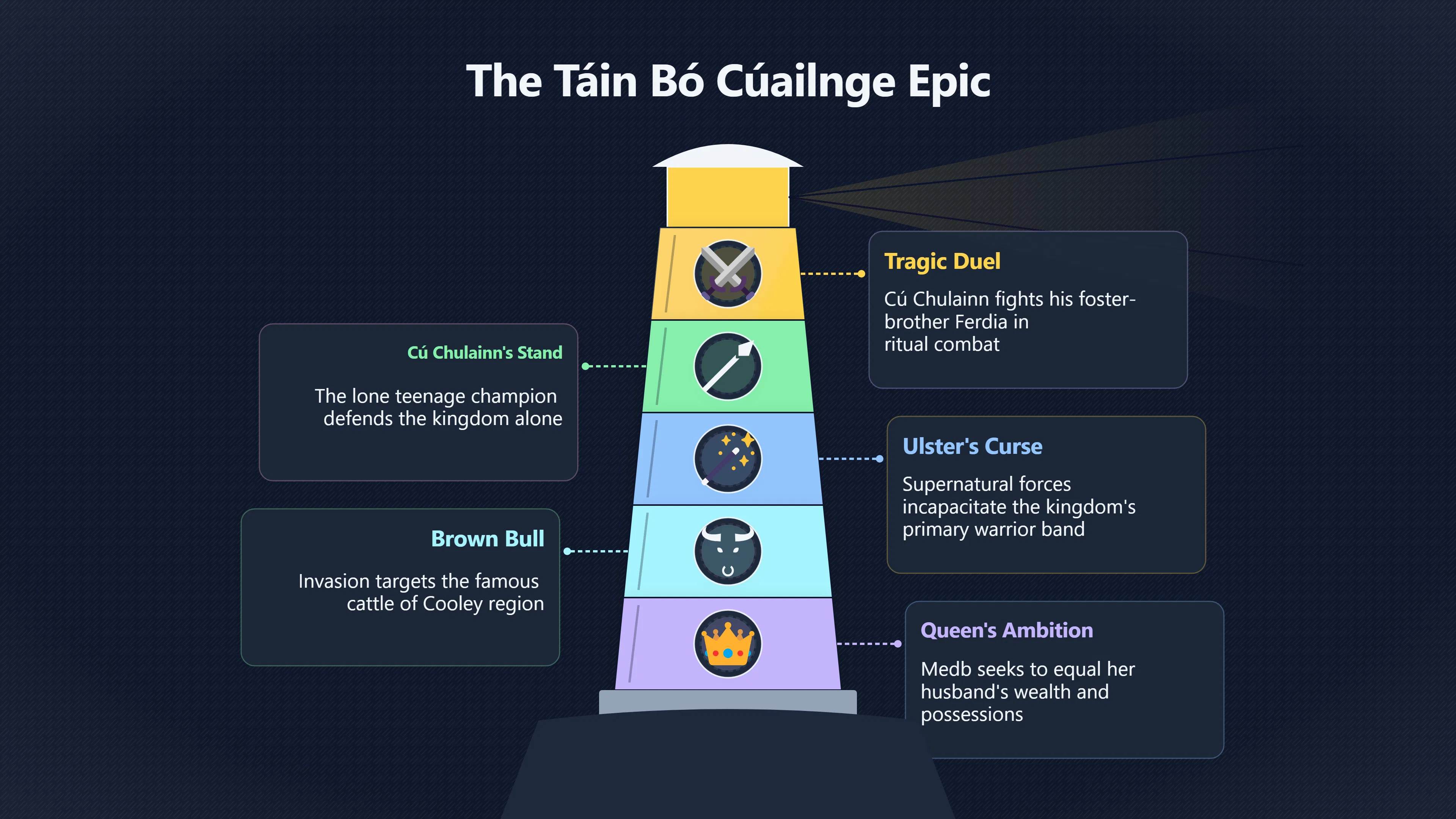
The plot begins with a dispute over wealth between Queen Medb of Connacht and her husband Ailill. Seeking to equal her husband’s possessions, Medb launches an invasion to seize the famous Brown Bull of Cooley. Ulster should be able to resist, but its warriors are incapacitated by a supernatural curse. Only the teenage Cú Chulainn remains capable of fighting. He therefore confronts the invading army almost alone through a series of ritual single combats.[tcd.ie]tcd.ieTrinity College DublinIrish MythsThe Táin is the central story of the Ulster Cycle and tells of Connacht's Queen Méabh as she tries to st…
The hero who stands alone
One reason Cú Chulainn remains memorable is the contrast between his youth and his power. The stories depict him as astonishingly gifted but also dangerously intense. During battle he undergoes terrifying physical transformations, becoming almost monstrous in his fury. Medieval writers used these episodes to show a hero whose greatness places him partly outside ordinary society.[Wikipedia]WikipediaTáin Bó CúailngeApril 27, 2026 — It survives in three written versions or "recensions" in manuscripts of the 12th century and later, the first a compilat…
The emotional centre of the Táin is often the duel between Cú Chulainn and his foster-brother Ferdia. Bound by loyalty yet forced into combat, they fight until Ferdia is killed. The episode captures a recurring theme of Irish heroic literature: personal relationships are repeatedly sacrificed to honour, obligation and fate.[PhilPapers]philpapers.orgIt tells the story of a great cattle-raidThomas Kinsella - From the Irish epic Tain Bo Cuailngeby T Kinsella · 2002 · Cited by 442 — The Táin Bó Cuailnge, centre-piece…
More than a warrior
Although often presented simply as a fighter, Cú Chulainn belongs to a larger network of stories. Medieval texts recount his supernatural birth, youthful training, courtship, battles and death. Some traditions connect him with the divine figure Lugh, while others emphasise his human vulnerability. Together these narratives create a full heroic biography rather than a single epic adventure.[lrc.la.utexas.edu]lrc.la.utexas.edud birth of Cú Chulainn, the main hero of the Ulster saga.Read more…
Fionn and the Fenian Stories
A different kind of hero
Fionn mac Cumhaill belongs to the Fenian Cycle, a separate body of Irish heroic literature. While Cú Chulainn is tied to royal courts and warfare, Fionn’s world is more mobile. He leads the Fianna, an elite warrior band that hunts, fights and travels through forests, mountains and remote landscapes. The stories often feel closer to folklore than court epic, linking adventures to specific places across Ireland.[Wikipedia]WikipediaFenian CycleTimewise, the Fenian cycle is the third, between the Ulster and Kings' cycles. The cycle also contains stories about other fa…
Fionn is famous not only for strength but also for wisdom. One of the best-known legends tells how he gains extraordinary knowledge after tasting the Salmon of Knowledge. This combination of intelligence and martial ability distinguishes him from many heroic figures elsewhere in European tradition.[Wikipedia]WikipediaFenian CycleTimewise, the Fenian cycle is the third, between the Ulster and Kings' cycles. The cycle also contains stories about other fa…

The Fianna and the Irish landscape
Many Fenian stories explain hills, lakes, caves and ancient monuments. As storytellers carried these tales through different regions, local landmarks became attached to the adventures of Fionn and his companions. The result is a heroic tradition deeply rooted in geography.
Among the most famous tales is the pursuit of Diarmuid and Gráinne. Promised in marriage to the older Fionn, Gráinne instead elopes with the young warrior Diarmuid. Their flight across Ireland creates a mixture of romance, adventure and tragedy that remained popular for centuries. The story survives in numerous versions and became one of the best-known narratives of the Fenian tradition.[Wikipedia]WikipediaThe Pursuit of Diarmuid and GráinneJanuary 29, 2026 — A tale from the Fianna Cycle of Irish mythology, it concerns a love triangle between the great warrior Fionn mac Cumha…
Remembering a vanished age
The most important medieval Fenian text is Acallam na Senórach (“The Colloquy of the Ancients”), composed around the beginning of the thirteenth century. In it, surviving members of the Fianna encounter Saint Patrick and recount stories of the old heroic age. The text is remarkable because it brings together pagan-era heroes and Christian Ireland, allowing medieval audiences to admire the legendary past while integrating it into a new religious framework. It is also one of the longest surviving works of medieval Irish literature.[wikipedia.org]WikipediaAcallam na Senórachis an important prosimetric Middle Irish narrative dating to c. 1200. It is the most important text of the Finn Cycle (also known as the…
How Medieval Manuscripts Preserved the Heroes
The stories of Cú Chulainn and Fionn survive largely because medieval Irish scribes recorded them in manuscripts between the eleventh and fifteenth centuries. Many of these scribes were Christian scholars working in monasteries. Rather than eliminating older traditions, they copied and adapted them, often preserving material that might otherwise have disappeared.[fingal.ie]fingal.ieFingal County CouncilTranslations of the Táin – Part 1The Táin Bó Cuailnge is part of the Ulster cycle of stories which focuses on warfar…
Important manuscripts include Lebor na hUidre and the Book of Leinster, which preserve major versions of Ulster Cycle material, including the Táin. Later manuscripts transmitted Fenian stories and the Acallam. These texts are not simple transcripts of oral performances; they are literary works shaped by generations of editors, scribes and storytellers. Nevertheless, they remain invaluable evidence for Ireland’s heroic tradition.[ria.ie]ria.ieLebor na hUidre / The Book of the Dun CowThe earliest surviving manuscript with literature written in Irish, it contains the oldest versi…
The relationship between oral storytelling and written preservation is one reason these legends continue to fascinate scholars. The manuscripts reveal stories that were already old when they were written down, while later folklore collectors found related tales still being told centuries afterwards.[Fingal County Council]fingal.ieFingal County CouncilTranslations of the Táin – Part 1The Táin Bó Cuailnge is part of the Ulster cycle of stories which focuses on warfar…
How the Heroes Were Reinvented
The medieval heroes did not remain confined to manuscripts. During the nineteenth-century Celtic Revival, writers and cultural nationalists rediscovered and reinterpreted them. Cú Chulainn became a symbol of sacrifice, courage and Irish nationhood. Fionn and the Fianna inspired poetry, drama and folklore collections that presented heroic Ireland to new audiences.[Medieval Studies at UC Davis]medieval.ucdavis.eduMedieval Studies at UC DavisThe Táin Bó CuailngeThe manuscript was composed at Clonmacnoise in the twelfth century. The Táin Bó Cuailnge…
These reinventions were not always historically accurate. Victorian authors often softened or reshaped difficult aspects of the stories. Yet their adaptations ensured that the heroes remained culturally visible. By the twentieth century, figures such as W. B. Yeats, Lady Gregory and other literary revivalists had helped place medieval Irish heroes at the centre of modern Irish cultural life.[Medieval Studies at UC Davis]medieval.ucdavis.eduMedieval Studies at UC DavisThe Táin Bó CuailngeThe manuscript was composed at Clonmacnoise in the twelfth century. The Táin Bó Cuailnge…
Today Cú Chulainn appears in murals, sculptures, novels, comics and television programmes. Fionn continues to feature in children’s retellings, fantasy fiction and place-based folklore. Their stories have moved far beyond the manuscripts that preserved them, yet the medieval texts remain the foundation on which every later version is built.[ucdavis.edu]medieval.ucdavis.eduMedieval Studies at UC DavisThe Táin Bó CuailngeThe manuscript was composed at Clonmacnoise in the twelfth century. The Táin Bó Cuailnge…

Why They Still Matter
Cú Chulainn and Fionn endure because they embody different but complementary ideas of heroism. One is the unstoppable champion whose pursuit of honour leads to tragedy. The other is the wise leader whose adventures connect people to landscape, memory and storytelling. Together they demonstrate how Irish folklore blends myth, history, literature and place.
Their legends also reveal something distinctive about Irish tradition itself. The heroes are larger than life, yet they remain tied to real regions, remembered through named hills, rivers, forts and roads. They survive not only as characters in ancient manuscripts but as cultural figures continually reimagined by each generation. In that sense, the heroic age of Ireland has never entirely ended; it has simply acquired new storytellers.[tcd.ie]tcd.ieTrinity College DublinIrish MythsThe Táin is the central story of the Ulster Cycle and tells of Connacht's Queen Méabh as she tries to st…
Amazon book picks
Further Reading
Books and field guides related to Why Irish Heroes Are Glorious and Doomed. Use these as the next step if you want deeper reading beyond the article.
Early Irish Myths and Sagas
Contains key heroic cycles including Cú Chulainn material.
The Mammoth Book of Celtic Myths and Legends
Provides wider Celtic context for Irish heroes.
eBay marketplace picks
Marketplace Samples
Live-tested eBay searches with available results related to this page.
Endnotes
1.
Source: Wikipedia
Title: Táin Bó Cúailnge
Link:https://en.wikipedia.org/wiki/T%C3%A1in_B%C3%B3_C%C3%BAailnge
Source snippet
April 27, 2026 — It survives in three written versions or "recensions" in manuscripts of the 12th century and later, the first a compilat...
Published: April 27, 2026
2.
Source: Wikipedia
Title: Acallam na Senórach
Link:https://en.wikipedia.org/wiki/Acallam_na_Sen%C3%B3rach
Source snippet
is an important prosimetric Middle Irish narrative dating to c. 1200. It is the most important text of the Finn Cycle (also known as the...
3.
Source: fingal.ie
Link:https://www.fingal.ie/translations-tain-part-1
Source snippet
Fingal County CouncilTranslations of the Táin – Part 1The Táin Bó Cuailnge is part of the Ulster cycle of stories which focuses on warfar...
4.
Source: celticstudents.blogspot.com
Title: getting into ulster cycle
Link:https://celticstudents.blogspot.com/2022/08/getting-into-ulster-cycle.html
Source snippet
Getting Into the Ulster CycleAug 31, 2022 — Aided Óenfir Aífe ('Death of Aoife's Only Son') is the tragic tale of how Cú Chulainn kills h...
5.
Source: lrc.la.utexas.edu
Link:https://lrc.la.utexas.edu/eieol/iriol/10
Source snippet
d birth of Cú Chulainn, the main hero of the Ulster saga.Read more...
6.
Source: Wikipedia
Link:https://en.wikipedia.org/wiki/Fenian_Cycle
Source snippet
Fenian CycleTimewise, the Fenian cycle is the third, between the Ulster and Kings' cycles. The cycle also contains stories about other fa...
7.
Source: ria.ie
Link:https://www.ria.ie/collections/manuscripts/irish-language-manuscripts/lebor-na-huidre-the-book-of-the-dun-cow/
Source snippet
Lebor na hUidre / The Book of the Dun CowThe earliest surviving manuscript with literature written in Irish, it contains the oldest versi...
8.
Source: philpapers.org
Title: It tells the story of a great cattle-raid
Link:https://philpapers.org/rec/KINTTF
Source snippet
Thomas Kinsella - From the Irish epic Tain Bo Cuailngeby T Kinsella · 2002 · Cited by 442 — The Táin Bó Cuailnge, centre-piece...
9.
Source: Wikipedia
Title: The Pursuit of Diarmuid and Gráinne
Link:https://en.wikipedia.org/wiki/The_Pursuit_of_Diarmuid_and_Gr%C3%A1inne
Source snippet
January 29, 2026 — A tale from the Fianna Cycle of Irish mythology, it concerns a love triangle between the great warrior Fionn mac Cumha...
Published: January 29, 2026
10.
Source: Wikipedia
Link:https://en.wikipedia.org/wiki/Lebor_na_hUidre
Source snippet
Lebor na hUidreLebor na hUidre or the Book of the Dun Cow (MS 23 E 25) is an Irish vellum manuscript dating to the 12th century. It is...
11.
Source: Wikipedia
Title: Ulster Cycle
Link:https://en.wikipedia.org/wiki/Ulster_Cycle
Source snippet
Ulster CycleThe Ulster Cycle (Irish: an Rúraíocht), formerly known as the Red Branch Cycle, is a body of medieval Irish heroic legend...
12.
Source: kespwriting.blogspot.com
Link:https://kespwriting.blogspot.com/2014/08/old-irish-manuscripts-texts.html
Source snippet
Origins of Ancient Irish Manuscripts & Texts21 Aug 2014 — Lebor na hUidre: (Or The Book of the Dun Cow) dates to the 11 th Century and is...
13.
Source: drb.ie
Title: the high deeds of fionn
Link:https://drb.ie/article/the-high-deeds-of-fionn/
Source snippet
Dublin Review of BooksThe High Deeds of Fionn6 Oct 2017 — In Acallam na Senórach (The Dialogue of the Ancients), Fionn's son Oisín and Ca...
14.
Source: tcd.ie
Link:https://www.tcd.ie/library/exhibitions/wild-waves/irish_myths.php
Source snippet
Trinity College DublinIrish MythsThe Táin is the central story of the Ulster Cycle and tells of Connacht's Queen Méabh as she tries to st...
15.
Source: medieval.ucdavis.edu
Link:https://medieval.ucdavis.edu/TAIN/Index.html
Source snippet
Medieval Studies at UC DavisThe Táin Bó CuailngeThe manuscript was composed at Clonmacnoise in the twelfth century. The Táin Bó Cuailnge...
Additional References
16.
Source: irishgodsandgoddesses.net
Link:https://irishgodsandgoddesses.net/fenian-cycle-myths/
Source snippet
The Fenian Cycle • The Legends of Fionn Mac CumhaillThe stories here are drawn from the major Fenian texts, including the Acallam na Senó...
17.
Source: facebook.com
Link:https://www.facebook.com/61578580222130/posts/it-is-the-oldest-surviving-manuscript-written-entirely-in-the-irish-languagethe-/122118627434952674/
Source snippet
Lebor na hUidre in Irish — was created at the monastery...The **Book of Leinster**, one of the most vital surviving medieval manuscripts...
18.
Source: archive.org
Link:https://archive.org/download/lebornahuidreboo00best/lebornahuidreboo00best.pdf
Source snippet
Lebor na huidre = Book of the dun cowTHE lithographic Facsimile of Lebor na Huidre executed by Joseph O'Longan, and published by the Roya...
19.
Source: facebook.com
Link:https://www.facebook.com/RoyalIrishAcademy/posts/the-manuscript-of-the-week-is-ria-ms-23-e-25-lebor-na-huidre-the-book-of-the-dun/1513372940791507/
Source snippet
The Royal Irish AcademyThe oldest extant manuscript featuring this story is the early 12th century "Lebor na hUidre" ("Book of the Dun Co...
20.
Source: bardmythologies.com
Link:https://bardmythologies.com/ulster-cycle-stories/
Source snippet
Ulster Cycle StoriesThe central story of this cycle is Táin Bó Cúailnge, the Cattle Raid of Cooley. The Táin is an epic tale where the fo...
21.
Source: celt.ucc.ie
Link:https://celt.ucc.ie/published/T301035.html
Source snippet
ucc.ieTáin Bó Cúalnge from the Book of LeinsterOnce upon a time it befell Ailill and Medb that, when their royal bed had been prepared fo...
22.
Source: isos.dias.ie
Link:https://www.isos.dias.ie/AUS1/AUS_MS_Tain_Bo_Cuailgne.html
Source snippet
Táin Bó CuailngeTáin Bó Cuailnge is the central tale of the Ulster Cycle... Cú Chulainn as single-handedly he defends Ulster against an...
23.
Source: irishimbasbooks.com
Link:https://irishimbasbooks.com/important-locations-in-ireland-related-to-fionn-mac-cumhaill-and-the-fenian-cycle/
Source snippet
the Fionn mac Cumhaill Series is based, retains those very strong links to Leinster.Read more...
24.
Source: dokumen.pub
Title: the early finn cycle 1nbsped 9781846828720 9781846826306
Link:https://dokumen.pub/the-early-finn-cycle-1nbsped-9781846828720-9781846826306.html
Source snippet
The Early Finn Cycle [1 ed.] 9781846828720...The Finn (or Fenian) Cycle (fianaigecht) is classified by modern scholarship as one of fou...
25.
Source: amazon.com
Link:https://www.amazon.com/Cuchulain-Hound-Ulster-Classic-Reprint/dp/0656707461?tag=searcht-20
Source snippet
ero, exploring themes of honor, loyalty, and the supernatural from the...Read more...
Topic Tree