Within Bolivian Folklore
Who Rules Bolivia's Haunted Mines?
El Tio shows how Bolivian mining folklore links danger, underground wealth, offerings and respect for powers beneath the earth.
On this page
- The mine spirit below Cerro Rico
- Offerings, fear and workplace protection
- Why El Tio is not just the devil
Page outline Jump by section
Introduction
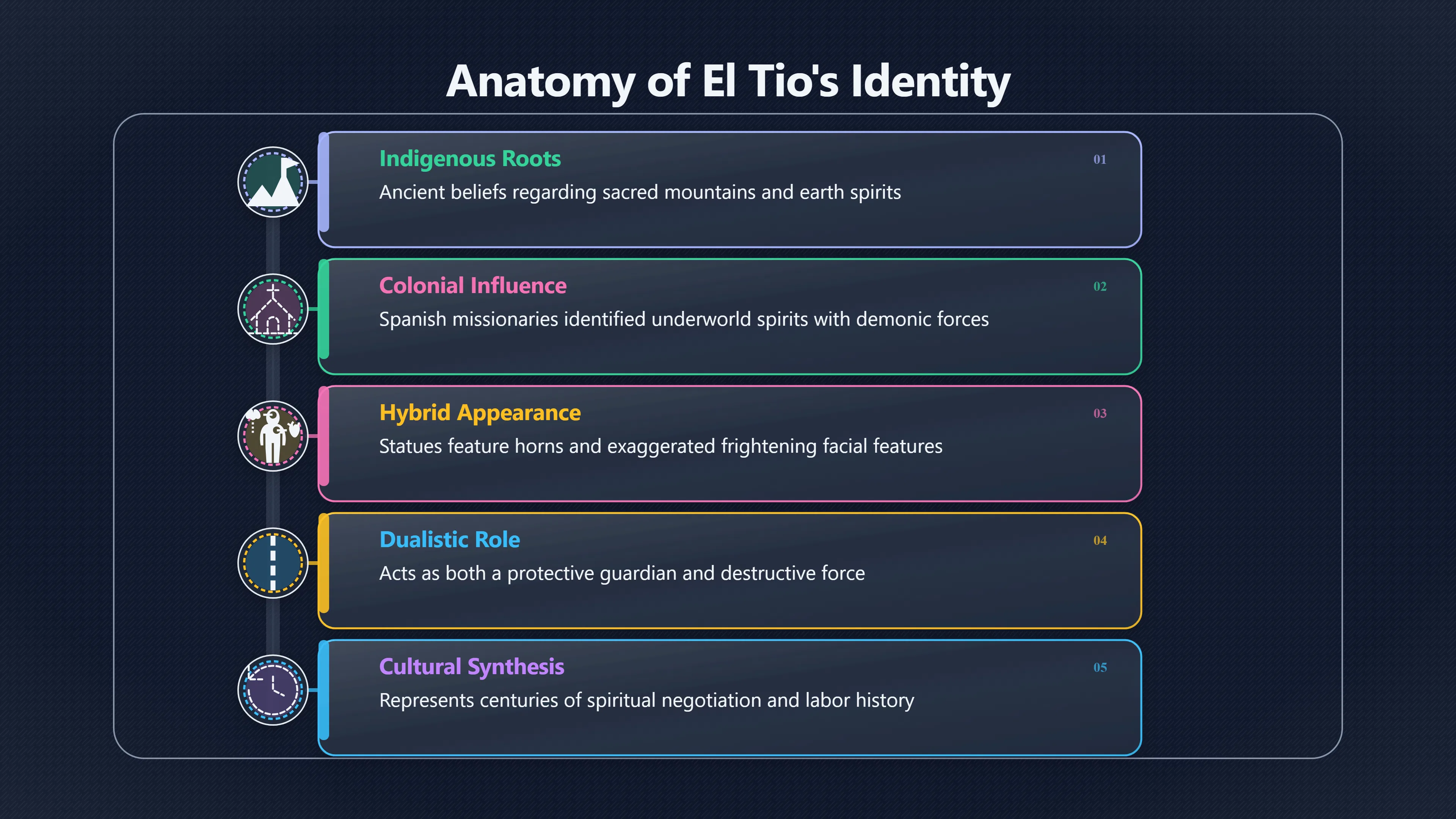
Deep beneath Bolivia’s most famous mining mountain, workers have long believed that another power rules where sunlight cannot reach. That power is El Tio, a supernatural figure found in the mines of Potosí, Oruro and other mining regions. To outsiders he often looks like a devil, complete with horns, glaring eyes and a frightening grin. Yet miners do not usually understand him as simply Satan. Instead, El Tio is a complex guardian of the underground world: a being who can grant rich mineral veins, protect workers from accidents, or bring disaster if neglected. His story reveals how Bolivian mining folklore combines Indigenous beliefs about sacred mountains and earth spirits with ideas introduced during Spanish colonial rule.[wikipedia.org]WikipediaOpen source on wikipedia.org.

More than a monster story, El Tio stands at the centre of a living tradition shaped by danger, labour and survival. In a workplace where cave-ins, toxic dust and explosions have been constant risks for centuries, miners developed a supernatural relationship with the forces they believed governed life underground.[cim.org]magazine.cim.orgThe devil undergroundOctober 27, 2021 — 27 Oct 2021 — Bolivia's mining lord of the underworld. By Angelica Zagorski. October 27, 2021. Over 600 statues of El…
The Mine Spirit Below Cerro Rico
No place is more closely associated with El Tio than Cerro Rico, the “Rich Mountain” that towers above the city of Potosí. Since the discovery of its silver deposits in the sixteenth century, Cerro Rico has become one of the most famous mining sites in world history. The mountain generated enormous wealth for the Spanish Empire, but it also became associated with hardship, forced labour and countless deaths.[Wikipedia]WikipediaCerro RicoCerro Rico
Within this landscape, miners developed the belief that the underground realm belonged to El Tio. While God ruled the world above, El Tio governed the tunnels, shafts and hidden mineral riches beneath the earth. Statues representing him were placed inside working mines, where miners could speak to him directly and seek his favour before beginning work.[Wikipedia]WikipediaOpen source on wikipedia.org.
Anthropologists and historians generally describe El Tio as a product of religious blending. Indigenous Andean traditions already recognised powerful beings connected with mountains, caves and the underworld. During the colonial period these figures became intertwined with Christian images of the devil. Rather than replacing older beliefs, the new religious system created a hybrid figure who carried elements of both worlds.[icimod.org]lib.icimod.org92jnr hjk79HimalDocThe case of El Tío and miners in Bolivia5 Apr 2025 — They are the result of the conflictive combination of Spanish Catholicism an…
This helps explain why El Tio appears contradictory. He is feared but respected, dangerous but protective, destructive yet capable of generosity. Such ambiguity reflects the mine itself: a place that provides livelihoods while constantly threatening death.
Offerings, Fear and Workplace Protection
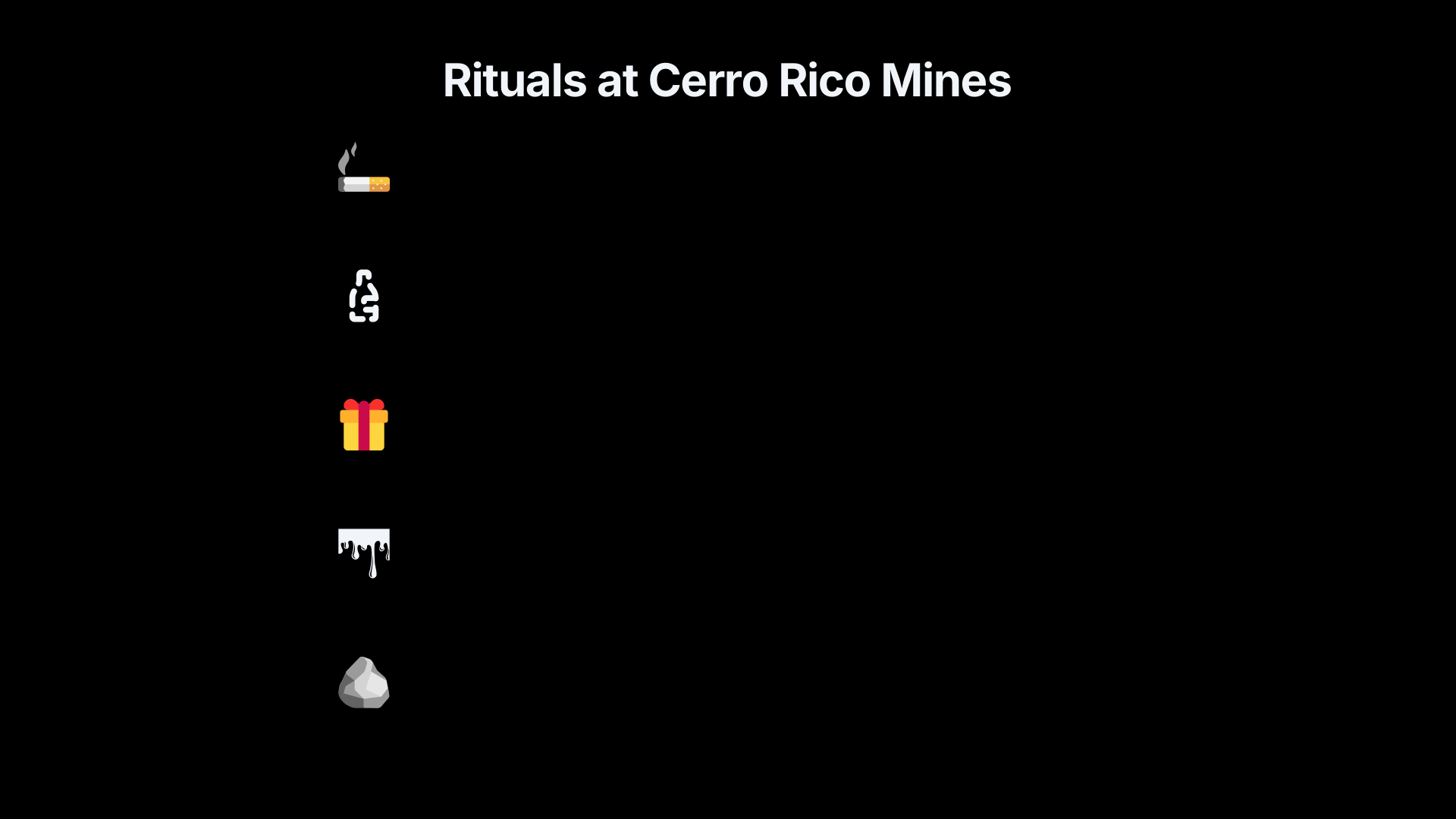
The most visible expression of belief in El Tio is the practice of making offerings. Mine shrines often contain statues decorated with streamers, confetti and traces of previous rituals. Miners commonly leave coca leaves, cigarettes and alcohol. Some place lit cigarettes in the statue’s mouth or pour liquor over it as a gesture of respect.[wikipedia.org]WikipediaOpen source on wikipedia.org.
These rituals are not usually described as worship in the same sense as church services. Instead, miners often explain them as acts of reciprocity. The underground world contains valuable minerals, and El Tio is believed to control access to them. By sharing gifts, workers acknowledge his authority and ask for safe passage through a hazardous environment.[SIT Digital Collections]digitalcollections.sit.eduBut El Tío has the power in the mines, in that dark world. The miners don't worship him but honor him, and in.Read more…
A recurring theme in mining folklore is that El Tio must be kept satisfied. Stories warn that disrespect can lead to accidents, poor mineral yields or fatal collapses. When disasters occur, some miners interpret them through this moral framework, seeing them as signs that proper respect was not shown or that taboos were broken.[wikipedia.org]WikipediaOpen source on wikipedia.org.
Particularly important are larger ritual offerings connected with the Andean ceremonial calendar. In some mining communities, llamas have been sacrificed and their blood offered at mine entrances as a plea for protection and prosperity. Such practices connect El Tio to wider Andean traditions of exchange with powerful forces associated with the land and the earth.[wikipedia.org]WikipediaOpen source on wikipedia.org.
The logic behind these customs is easy to miss if viewed only through a religious lens. Mining has historically been one of Bolivia’s most dangerous occupations. Rituals surrounding El Tio help workers express fear, uncertainty and hope in an environment where human control is limited. The supernatural world of the mine gives meaning to risks that are otherwise difficult to explain or accept.[cim.org]magazine.cim.orgThe devil undergroundOctober 27, 2021 — 27 Oct 2021 — Bolivia's mining lord of the underworld. By Angelica Zagorski. October 27, 2021. Over 600 statues of El…
Why El Tio Is Not Just the Devil
Visitors are often told that Bolivian miners “worship the devil”, but this description oversimplifies the tradition. El Tio certainly borrows imagery associated with the Christian devil. His statues frequently have horns, exaggerated features and a threatening appearance. Yet miners themselves often draw a distinction between El Tio and the theological Satan of Christianity.[theculturetrip.com]theculturetrip.commeet el tio the devil who rules the underworld of bolivias minesCulture TripMeet El Tio: The Devil Who Rules The Underworld Of…20 Oct 2017 — Referred to as El Tio, he is an amalgamation of the indig…
Part of the confusion comes from the history of colonisation. Spanish missionaries identified many Indigenous underworld spirits with demonic forces. Over time, local communities adopted some of this imagery while preserving older ideas about powerful beings who inhabited mountains and subterranean spaces. The result was a figure who looked increasingly devilish without losing his role as a guardian and owner of underground wealth.[wikipedia.org]WikipediaOpen source on wikipedia.org.
For many miners, the relationship between Christianity and El Tio is not necessarily contradictory. A person may attend Mass, honour Catholic saints and still leave offerings underground. Folklore and religious practice operate in different but overlapping spheres. Above ground, divine authority belongs to God and the saints; below ground, the mine has its own ruler.[Wikipedia]WikipediaThe Devil's MinerThe Devil's Miner
This distinction is one reason El Tio remains one of the most misunderstood figures in South American folklore. He is neither a straightforward survival of a pre-Columbian deity nor simply a local version of Satan. Instead, he embodies centuries of cultural adaptation, labour history and spiritual negotiation.
From Mine Tunnels to National Symbol
Although El Tio belongs primarily to mining communities, his influence extends beyond the tunnels. Connections can be seen in the famous Carnival of Oruro, where devil figures play a central role in the celebrated Diablada dance tradition. Researchers have long noted links between carnival devils, underworld spirits and mining beliefs, even though festival performances transform these ideas into public spectacle.[Wikipedia]WikipediaOpen source on wikipedia.org.
El Tio has also appeared in documentaries, journalism, literature and tourism centred on Cerro Rico. Visitors to the mines frequently encounter shrines and hear stories about the spirit from guides and miners. These retellings have helped make El Tio one of the most internationally recognised figures in Bolivian folklore.[Atlas Obscura]atlasobscura.comwhat are potosi silver mines likeIn the heart of the Andes, Catholic miners also pray to satanic statues.Read more…
Yet behind the dramatic imagery lies a deeper cultural meaning. El Tio represents a worldview in which wealth is never free. The silver, tin and other minerals hidden inside the mountains come from a realm that demands respect, reciprocity and caution. In that sense, the folklore of El Tio is not only about a supernatural being. It is also about how mining communities understand risk, survival and humanity’s uneasy relationship with the riches of the earth.[icimod.org]lib.icimod.org92jnr hjk79HimalDocThe case of El Tío and miners in Bolivia5 Apr 2025 — They are the result of the conflictive combination of Spanish Catholicism an…
Amazon book picks
Further Reading
Books and field guides related to Who Rules Bolivia's Haunted Mines?. Use these as the next step if you want deeper reading beyond the article.
Open Veins of Latin America
Provides context for the economic and human history of mining.
The Devil and Commodity Fetishism in South America
Explores devil imagery and labor beliefs in the Andes.
eBay marketplace picks
Marketplace Samples
Live-tested eBay searches with available results related to this page.
Endnotes
1.
Source: Wikipedia
Link:https://en.wikipedia.org/wiki/El_T%C3%ADo
2.
Source: magazine.cim.org
Title: The devil underground
Link:https://magazine.cim.org/en/in-search/the-devil-underground-en/
Source snippet
October 27, 2021 — 27 Oct 2021 — Bolivia's mining lord of the underworld. By Angelica Zagorski. October 27, 2021. Over 600 statues of El...
Published: October 27, 2021
3.
Source: Wikipedia
Title: The Devil’s Miner
Link:https://en.wikipedia.org/wiki/The_Devil%27s_Miner
4.
Source: Wikipedia
Title: Cerro Rico
Link:https://en.wikipedia.org/wiki/Cerro_Rico
5.
Source: Wikipedia
Title: El Tío (deidad)
Link:https://es.wikipedia.org/wiki/El_T%C3%ADo_%28deidad%29
6.
Source: latinlink.org.uk
Link:https://latinlink.org.uk/the-underground-god-of-potosi/
Source snippet
fferings of cigarettes, coca leaves, and alcohol.Read more...
7.
Source: digitalcollections.sit.edu
Link:https://digitalcollections.sit.edu/cgi/viewcontent.cgi?article=2220&context=isp_collection
Source snippet
But El Tío has the power in the mines, in that dark world. The miners don't worship him but honor him, and in.Read more...
8.
Source: 43bluedoors.com
Title: 43Blue Doors A Demon in the Mine: Bolivia Tourism
Link:https://43bluedoors.com/2018/05/20/bolivia-tourism/
Source snippet
A Demon in the Mine: Bolivia Tourism - 43BlueDoors20 May 2018 — Miners regularly bring gifts into the mine for El Tio, a devil-like statu...
Published: May 2018
9.
Source: Wikipedia
Link:https://en.wikipedia.org/wiki/Pachamama
10.
Source: Wikipedia
Title: El Tío (deidade)
Link:https://pt.wikipedia.org/wiki/El_T%C3%ADo_%28deidade%29
11.
Source: lib.icimod.org
Title: 92jnr hjk79
Link:https://lib.icimod.org/records/92jnr-hjk79
Source snippet
HimalDocThe case of El Tío and miners in Bolivia5 Apr 2025 — They are the result of the conflictive combination of Spanish Catholicism an...
12.
Source: theculturetrip.com
Title: meet el tio the devil who rules the underworld of bolivias mines
Link:https://theculturetrip.com/south-america/bolivia/articles/meet-el-tio-the-devil-who-rules-the-underworld-of-bolivias-mines
Source snippet
Culture TripMeet El Tio: The Devil Who Rules The Underworld Of...20 Oct 2017 — Referred to as El Tio, he is an amalgamation of the indig...
13.
Source: atlasobscura.com
Title: what are potosi silver mines like
Link:https://www.atlasobscura.com/articles/what-are-potosi-silver-mines-like
Source snippet
In the heart of the Andes, Catholic miners also pray to satanic statues.Read more...
14.
Source: thejakartapost.com
Title: in bolivia miners sacrifice llamas to appease lord of the underworld
Link:https://www.thejakartapost.com/culture/2022/03/01/in-bolivia-miners-sacrifice-llamas-to-appease-lord-of-the-underworld
Source snippet
In Bolivia, miners sacrifice llamas to appease 'Lord of the...1 Mar 2022 — Once a year, miners from the Oruro region, on the high planes...
Additional References
15.
Source: facebook.com
Title: deep inside the potosí silver mines theres a spirit the miners call el tío the u
Link:https://www.facebook.com/hanmaslah/photos/deep-inside-the-potos%C3%AD-silver-mines-theres-a-spirit-the-miners-call-el-t%C3%ADo-the-u/3692181984245508/
Source snippet
Deep inside the Potosí silver mines, there's a spirit the...24 Oct 2025 — Every day, before entering, miners offer him coca leaves, alco...
16.
Source: facebook.com
Title: Discover the Tio Idols of the Cerro Rico Mines
Link:https://www.facebook.com/traveltheroad/posts/discover-the-tio-idols-of-the-cerro-rico-mines-join-us-on-a-fascinating-journey-/769029135051328/
Source snippet
Join us on a...The picture itself here depicts 'El Tio' (The Uncle), "Lord of the Underworld'. There are many statues of this spirit in...
17.
Source: youtube.com
Link:https://www.youtube.com/watch?v=fFR1gksaZ7I
Source snippet
Into the World's Most Dangerous Mine? Cerro Rico, Potosí Bolivia...
18.
Source: mythus.fandom.com
Link:https://mythus.fandom.com/wiki/El_T%C3%ADo
Source snippet
Tío | Myth and Folklore Wiki - FandomIn Potosí, Bolivia, El Tío (The Uncle) is a god/demon worshipped by miners in the Cerro Rico mountai...
19.
Source: citizendium.org
Link:https://citizendium.org/wiki/El_T%C3%ADo
Source snippet
10 Aug 2024 — In the mines of highland Bolivia, "El Tío" is the familiar name for the spirit owner of the mountain, who is also known as...
20.
Source: youtube.com
Title: The Mountain That Eats Its Men — Potosí Silver Mine
Link:https://www.youtube.com/watch?v=iejS6q3FM9c
Source snippet
EXPLORING the POTOSÍ MINE of DEATH | Meeting "El Tío"...
21.
Source: youtube.com
Title: History of Potosi (Full Episode)
Link:https://www.youtube.com/watch?v=DlhpN5rbsBw
Source snippet
Bolivia's Cerro Rico: The Mountain That Eats Men | FULL DOC...
22.
Source: youtube.com
Title: Into the World’s Most Dangerous Mine? Cerro Rico, Potosí Bolivia
Link:https://www.youtube.com/watch?v=reuU44xzGHc
Source snippet
Villains Wiki - Fandom...
23.
Source: youtube.com
Title: Bolivia’s Cerro Rico: The Mountain That Eats Men | FULL DOC
Link:https://www.youtube.com/watch?v=ckRyF88yx2I
Topic Tree