Within Namibia Folklore
When Animals Become Omens in Namibian Folklore
Namibian animal folklore treats creatures such as the praying mantis as signs, omens and story figures rather than simple animal characters.
On this page
- The mantis as omen and rain sign
- Animal tricksters across Khoisan storytelling
- How signs differ from narrated tales
Page outline Jump by section
Introduction
In Namibian folklore, animals are often more than animals. A creature encountered on a path, circling above a settlement, or appearing unexpectedly after a period of drought may be interpreted as a sign, warning, message or clue about events still to come. Among these animal signs, the praying mantis occupies a particularly important place in traditions associated with Khoisan-speaking communities. It appears both as an omen in everyday life and as a central figure in stories about creation, transformation, cleverness and mischief. Rather than separating nature from the spiritual world, many traditional interpretations treat animal behaviour as part of a wider network of meaning connecting people, weather, ancestors and the landscape.[sahumanities.org]sahumanities.orgthe mythological trickster of the…

This makes animal folklore in Namibia different from simple fables. A jackal, mantis, antelope or bird may appear in a narrated tale, but the same animal might also be observed in daily life and understood as carrying a message. The boundary between story and sign is often fluid, even though the two serve different purposes within oral tradition.[sahumanities.org]sahumanities.orgthe mythological trickster of the…
The Mantis as Omen and Rain Sign
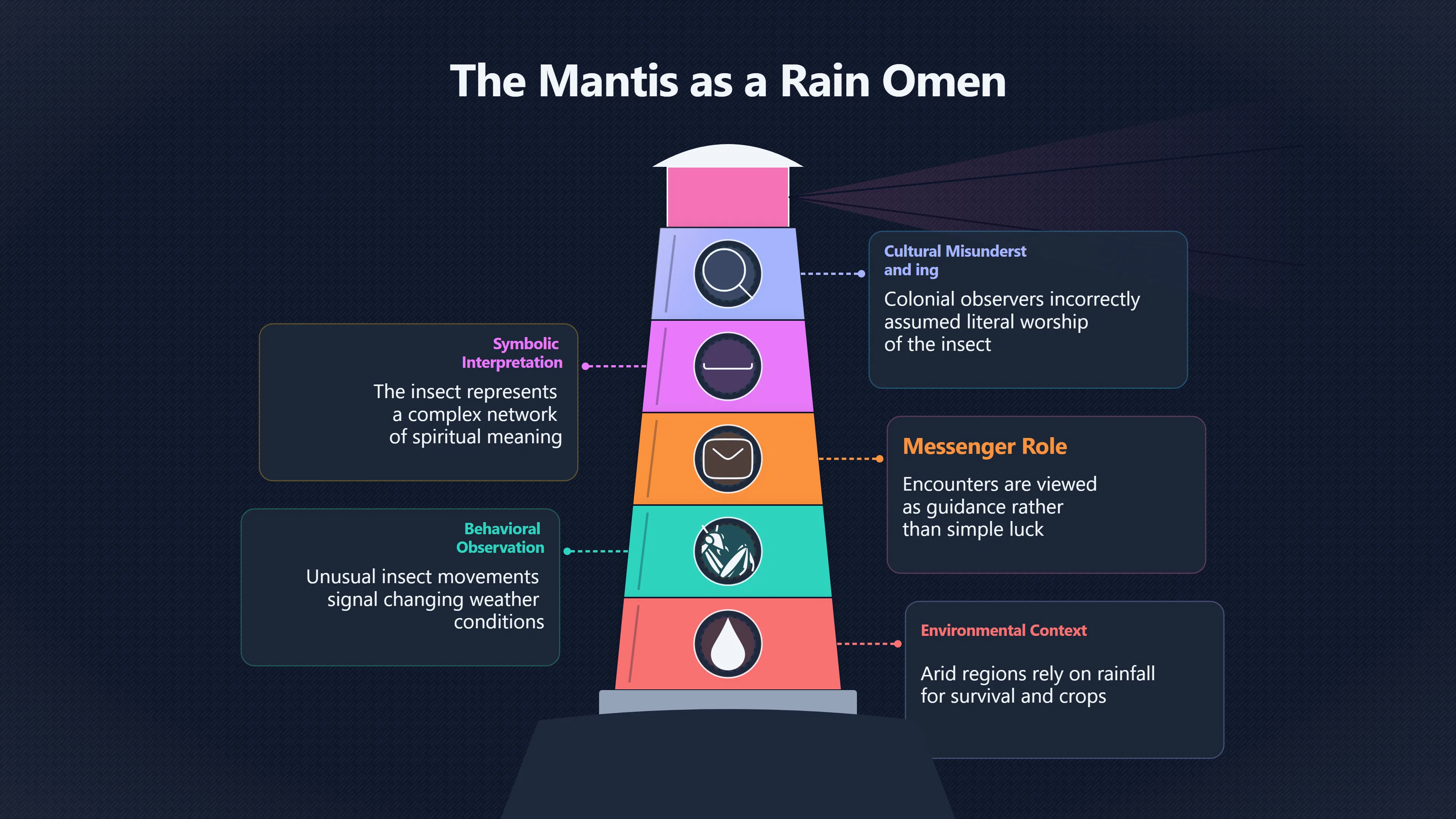
The praying mantis has long held a special place in Khoisan belief. Ethnographic research drawing on interviews among Nama and Damara communities in Namibia records traditions in which the mantis functioned as an omen-bearing creature and was associated with divination, weather signs and especially rain. Researchers note that its appearance could be interpreted as meaningful rather than accidental, particularly in environments where rainfall determined survival.[sahumanities.org]sahumanities.orgthe mythological trickster of the…
Rain occupies a central place in much of southern African folklore because water is both scarce and essential. In Namibia’s arid and semi-arid regions, the arrival of rain transforms landscapes, restores grazing and determines the success of crops and livestock. Traditions connecting the mantis with rainfall therefore carry practical as well as spiritual significance. Observing the insect could become part of a broader system of reading environmental signs, where unusual animal behaviour offered clues about changing conditions.[sahumanities.org]sahumanities.orgthe mythological trickster of the…
The mantis also acquired a reputation as a messenger. In some recorded traditions, encountering one was considered fortunate or worthy of attention rather than something to ignore. Modern retellings often simplify this idea into a belief that a mantis brings good luck, but older traditions suggest a more complex role involving communication, guidance and interpretation rather than simple fortune-telling.[sahumanities.org]sahumanities.orgthe mythological trickster of the…
An important caution is that outsiders have frequently misunderstood these beliefs. Scholars studying Khoisan traditions point out that colonial observers often assumed local communities literally worshipped the insect itself. Later research argues that the mantis was better understood as a symbolic and mythological figure whose meanings extended far beyond the physical insect seen in the grass.[sahumanities.org]sahumanities.orgthe mythological trickster of the…
Animal Tricksters Across Khoisan Storytelling
The mantis is not only an omen. It is also one of the most famous trickster figures in southern African oral literature. Among San traditions, the character often known as Mantis or Kaggen appears in stories as a creator, transformer and deceiver. He can be wise one moment and foolish the next. He helps people, causes trouble, changes shape and repeatedly finds himself caught in situations that require cunning to escape.[sahumanities.org]sahumanities.orgthe mythological trickster of the…
Unlike the tricksters familiar from some European folktales, the Khoisan Mantis is not merely comic. Stories present him as a being whose actions help explain how the world works. He may create animals, interfere with hunting, alter the landscape or establish social rules. His trickery is often creative rather than purely destructive. Through his successes and failures, listeners learn about proper behaviour, respect for animals and the consequences of arrogance or carelessness.[academia.edu]academia.eduThe Mantis and his friends: a praying…That is, colonists thought the San worshipped an insect. On the contrary |kaggn, "the M…
Other animals also play trickster roles in southern African storytelling. Jackals, hares and various birds frequently outwit stronger opponents. Yet the mantis remains distinctive because he is simultaneously a story character, a supernatural being and an animal encountered in everyday life. Few other creatures occupy all three positions at once.[sahumanities.org]sahumanities.orgthe mythological trickster of the…
The connection between trickster stories and the natural world is important. Oral traditions often use animal characters not simply for entertainment but to explore relationships between humans, prey animals, predators and environmental forces. In this sense, animal folklore acts as a way of thinking about survival and social conduct in difficult landscapes.[arXiv]arxiv.orgSystematic quantitative analyses reveal the folk-zoological knowledge embedded in folktalesJuly 9, 2019…
How Signs Differ from Narrated Tales
Although omens and stories often involve the same animals, they perform different functions.
Animal signs are usually tied to direct observation. A person sees a mantis, hears a bird call at an unusual moment or notices unexpected animal behaviour. Meaning is drawn from the event itself and from local knowledge about what such encounters may indicate.[sahumanities.org]sahumanities.orgthe mythological trickster of the…
Narrated tales, by contrast, are structured stories passed from one generation to another. They explain origins, teach moral lessons, entertain audiences or preserve cultural memory. The mantis in a tale may speak, transform himself or travel between worlds in ways that an actual insect cannot.[gateway-africa.com]gateway-africa.comThe Mantis and the San | Stories from NamibiaMantis is a type of San 'super-being', the Namibian San / Bushmen do not regard him as a god…
The same creature can therefore exist in two related but distinct forms:
- As a sign, the mantis may be interpreted as a message connected with rain, luck or a significant event.
- As a story figure, the Mantis becomes a powerful trickster whose adventures explain aspects of the world.
- As a real animal, it remains part of everyday life, making the symbolic and physical worlds feel closely connected.[sahumanities.org]sahumanities.orgthe mythological trickster of the…
This overlap helps explain why animal folklore remains memorable. The stories are reinforced by encounters with real creatures, while the creatures themselves are viewed through the lens of traditional narratives.
Why Animal Omens Matter in Namibian Folklore
Animal signs reveal a broader feature of Namibian folklore: meaning is often drawn from observation of the environment rather than from isolated supernatural beings. In a landscape where rainfall, migration routes and seasonal change have always mattered, paying attention to animals could become both practical knowledge and cultural symbolism.[sahumanities.org]sahumanities.orgthe mythological trickster of the…
The praying mantis stands at the centre of this tradition because it links several layers of belief at once. It is an ordinary insect, a possible omen, a rain-associated sign, a mythic trickster and a figure found throughout Khoisan storytelling. That combination makes it one of the clearest examples of how Namibian folklore turns everyday encounters with animals into reflections on luck, weather, morality and the hidden meanings people find in the natural world.[sahumanities.org]sahumanities.orgthe mythological trickster of the…
Amazon book picks
Further Reading
Books and field guides related to When Animals Become Omens in Namibian Folklore. Use these as the next step if you want deeper reading beyond the article.
The Hero with a Thousand Faces
Helps interpret recurring symbolic creatures in folklore.
eBay marketplace picks
Marketplace Samples
Live-tested eBay searches with available results related to this page.

Endnotes
1.
Source: sahumanities.org
Link:https://www.sahumanities.org/index.php/sah/article/view/429
Source snippet
the mythological trickster of the...
2.
Source: gateway-africa.com
Link:https://www.gateway-africa.com/stories/The_Mantis_San.html
Source snippet
The Mantis and the San | Stories from NamibiaMantis is a type of San 'super-being', the Namibian San / Bushmen do not regard him as a god...
3.
Source: academia.edu
Link:https://www.academia.edu/129985299/The_Mantis_and_his_friends_a_praying_mantis_hartebeest_and_other_persons_from_San_folklore_engraved_in_the_Xam_heartland_of_the_Nama_Karoo_Desert_of_Southern_Africa
Source snippet
The Mantis and his friends: a praying...That is, colonists thought the San worshipped an insect. On the contrary |kaggn, "the M...
4.
Source: Wikipedia
Link:https://en.wikipedia.org/wiki/%C7%80Kaggen
Source snippet
KaggenKaggen is a demiurge and folk hero of the San people of southern Africa. He is a trickster god who can shape shift, usually ta...
5.
Source: arxiv.org
Link:https://arxiv.org/abs/1907.03969
Source snippet
Systematic quantitative analyses reveal the folk-zoological knowledge embedded in folktalesJuly 9, 2019...
Published: July 9, 2019
6.
Source: Wikipedia
Link:https://en.wikipedia.org/wiki/Khoisan
Source snippet
KhoisanKhoisan populations traditionally speak click languages. They are considered to be the historical communities throughout Southe...
7.
Source: Wikipedia
Title: San religion
Link:https://en.wikipedia.org/wiki/San_religion
Source snippet
San religion(sometimes corrupted to "Cagn") is Mantis, a demiurge and hero in Xam folklore. He is a trickster god who can shape-shift...
8.
Source: riverlands.capetown
Title: The Praying Mantis
Link:https://riverlands.capetown/culture/the-praying-mantis/
Source snippet
The Praying Mantis or IKaggen, as it is known by its indigenous name, is one of the most revered figures within the indigenous...
9.
Source: krugerpark.co.za
Title: Kruger National Park San
Link:https://www.krugerpark.co.za/africa_bushmen.html
Source snippet
San people have vast oral traditions, and many of their tales include stories about the gods...Read more...
10.
Source: mythopedia.com
Link:https://mythopedia.com/topics/kaggen/
Source snippet
Kaggen25 Sept 2023 Kaggen is a Khoisan god, he is primarily known as a creator and trickster deity, often appearing in the form of a p...
11.
Source: sahistory.org.za
Link:https://sahistory.org.za/article/khoisan
Source snippet
The Khoisan21 Mar 2011 They were the first pastoralists in southern Africa, and called themselves Khoikhoi (or Khoe), which means 'men...
Additional References
12.
Source: ebsco.com
Link:https://www.ebsco.com/research-starters/ethnic-and-cultural-studies/khoisan-peoples-disperse-throughout-southern-africa
Source snippet
Khoisan Peoples Disperse Throughout Southern AfricaThe Khoisan people are considered one of the oldest living peoples, tracing their orig...
13.
Source: facebook.com
Link:https://www.facebook.com/groups/1042368966366676/posts/1492563164680585/
Source snippet
Praying Mantis Cultural Significance in Southern AfricaThe praying mantis is considered a symbol of good fortune, blessings, and divine p...
14.
Source: facebook.com
Link:https://www.facebook.com/100071906905947/posts/the-khoisan-the-oldest-people-on-the-planet-who-are-the-khoisanthe-khoisan-also-/688091646931059/
Source snippet
THE KHOISAN (THE OLDEST PEOPLE ON THE...The Khoisan, also known as the Khoi-San, are an ethnic group found in southern Africa, particula...
15.
Source: facebook.com
Link:https://www.facebook.com/kamen.c.o/videos/ime-obi-anambra-series-a-messenger-from-the-ancestors-the-praying-mantis-in-igbo/2026651678115250/
16.
Source: app.discoveryeducation.ca
Link:https://app.discoveryeducation.ca/learn/videos/bf1637bc-4403-4361-807c-59567689512f/
Source snippet
The second story is about what happens when everyday objects begin to talk and the third is in the Br’er...
17.
Source: researchgate.net
Link:https://www.researchgate.net/publication/392724586_The_Mantis_and_his_friends_a_praying_mantis_hartebeest_and_other_persons_from_San_folklore_engraved_in_the_Xam_heartland_of_the_Nama_Karoo_Desert_of_Southern_Africa
Source snippet
On the contrary |kaggn, the Mantis, was a man with a wife, children and relatives...Read more...
18.
Source: maypoleofwisdom.com
Link:https://maypoleofwisdom.com/2022/10/04/the-noble-mantis-wisdom-of-the-san-people/
Source snippet
The noble Mantis: Wisdom of the San people4 Oct 2022 When a praying mantis comes to visit, its message may be one of a spiritual nature...
19.
Source: facebook.com
Link:https://www.facebook.com/groups/149669045751159/posts/1500391397345577/
Source snippet
The mantis was revered by the southern African Khoi and San in whose...Read more...
20.
Source: maypoleofwisdom.com
Title: Mantis (/Kaggen), the southern San trickster-deity
Link:https://maypoleofwisdom.com/the-noble-mantis-wisdom-of-the-san-people/
Source snippet
The noble Mantis: Wisdom of the San peopleHe can be foolish, wise or helpful, The Koi San people of Southern Africa worshipped the prayin...
21.
Source: insectlore.com
Title: Cultural Symbolism of the Praying Mantis
Link:https://www.insectlore.com/blogs/praying-mantis/cultural-symbolism-of-the-praying-mantis?srsltid=AfmBOooz5i-5lyFASfuNozh5ASKmOVom4QAMeJoh783qTsefowhtTTmu
Source snippet
Insect Lore7 days ago In their mythology, the insect was believed to serve as a guide for the deceased traveling through the underworld...
Topic Tree