Within Cape Verde Folklore
When Saints, Drums and Play Take Over
Tabanca shows Cape Verdean folklore in motion through saints, drums, flags, feasting, mock authority and community performance.
On this page
- Patron saints and village preparation
- Flags, drums and symbolic theft
- Why tabanca counts as living folklore
Page outline Jump by section
Introduction
Tabanca is one of the clearest examples of living folklore in Cape Verde: a tradition that is not preserved behind museum glass but performed, argued over, celebrated, and reinvented every year in villages and neighbourhoods, especially on the islands of Santiago and Maio. At first glance, a tabanca procession looks like a religious festival filled with drums, banners, uniforms, saints, feasting, and colourful public spectacle. A closer look reveals something richer. Tabanca combines Catholic devotion, community organisation, music, ritual theatre, mock authority, and memories of older forms of mutual aid and resistance. The result is a tradition in which sacred symbols and playful performance exist side by side.[Instituto do Património Cultural]ipc.cvInstituto do Património Cultural TabancaInstituto do Património CulturalTabanca - Instituto do Património CulturalThe tabanca festivities begin with a set of preparations that c…

What makes tabanca especially important as folklore is that its meaning is carried through action rather than through a single story. The ritual roles, processions, songs, drums, flags, and dramatic episodes are passed from generation to generation, keeping collective memory alive while allowing each community to put its own stamp on the celebration.[Instituto do Património Cultural]ipc.cvInstituto do Património Cultural TabancaInstituto do Património CulturalTabanca - Instituto do Património CulturalThe tabanca festivities begin with a set of preparations that c…

Patron Saints and Village Preparation
Tabanca celebrations revolve around the feast day of a patron saint. Different communities honour different saints, while on Maio the best-known celebration is linked to Santa Cruz. Preparations often begin weeks in advance. Members collect donations, repair instruments, organise food supplies, prepare costumes and decorations, and arrange the ceremonial spaces that will become the centre of the festivities.[Instituto do Património Cultural]ipc.cvInstituto do Património Cultural TabancaInstituto do Património CulturalTabanca - Instituto do Património CulturalThe tabanca festivities begin with a set of preparations that c…
These preparations are important because they reveal that tabanca is not simply a parade. It is a community institution. Families contribute food, emigrants send support from abroad, and neighbours cooperate in organising meals and rituals. The festival therefore functions as both a religious observance and a social network that reinforces local bonds.[Instituto do Património Cultural]ipc.cvInstituto do Património Cultural TabancaInstituto do Património CulturalTabanca - Instituto do Património CulturalThe tabanca festivities begin with a set of preparations that c…
In many communities, the days before the feast include evening ceremonies, drumming, prayers, and collective gatherings around the tabanca chapel. Women prepare food for participants, while musicians maintain rhythms that continue deep into the night. The boundary between sacred ritual and festive celebration is deliberately blurred. Prayer, music, dance, and hospitality are all treated as part of the same communal duty.[Instituto do Património Cultural]ipc.cvInstituto do Património Cultural TabancaInstituto do Património CulturalTabanca - Instituto do Património CulturalThe tabanca festivities begin with a set of preparations that c…
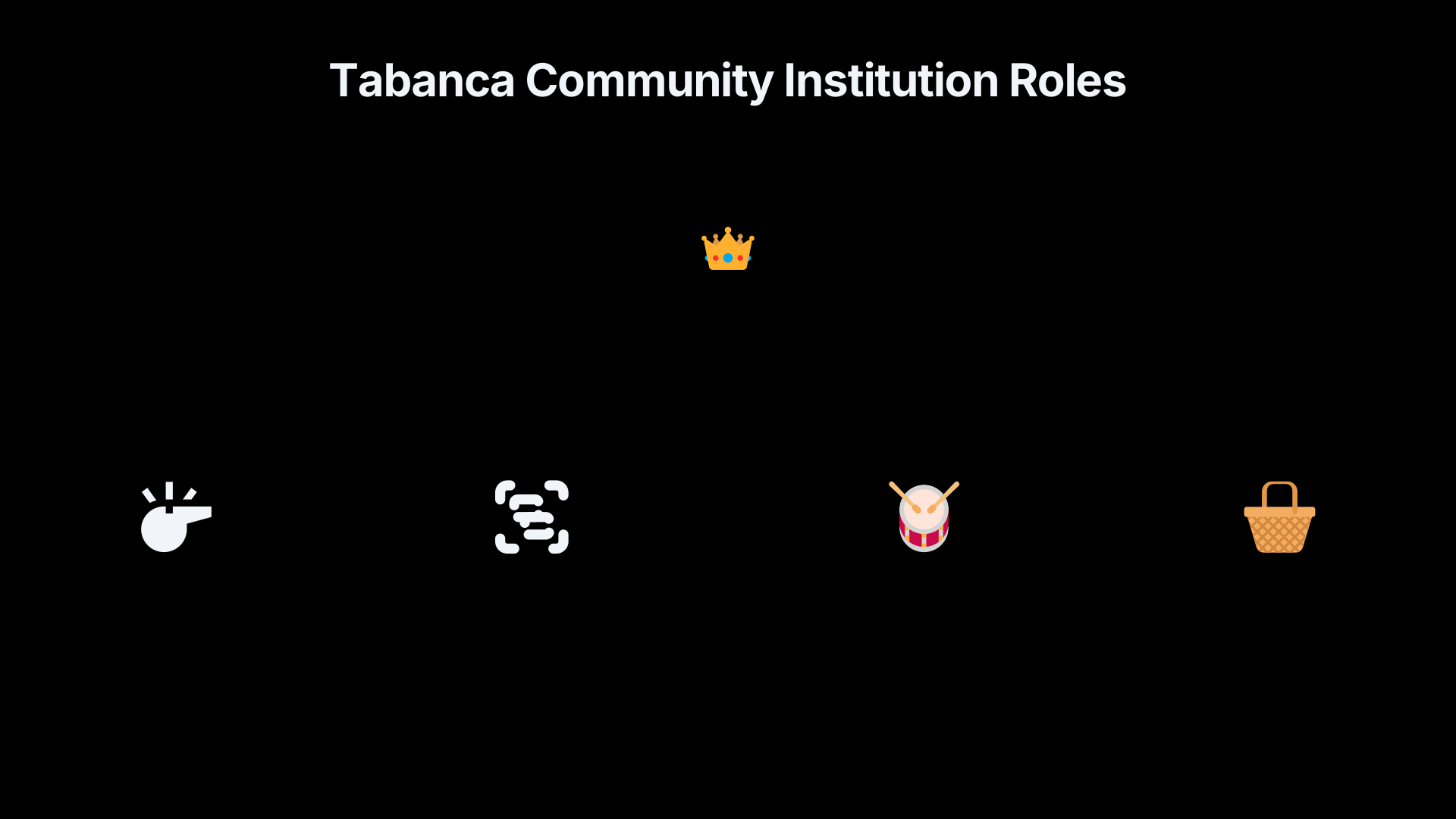
A striking feature is the elaborate ceremonial hierarchy. Tabanca groups often include symbolic kings, queens, commanders, guards, standard-bearers, drummers, and other ritual officers. These roles do not represent actual political authority. Instead, they create a theatrical social world that allows the community to stage ideas about leadership, responsibility, loyalty, and collective identity.[Instituto do Património Cultural]ipc.cvInstituto do Património Cultural TabancaInstituto do Património CulturalTabanca - Instituto do Património CulturalThe tabanca festivities begin with a set of preparations that c…
Flags, Drums and Symbolic Theft
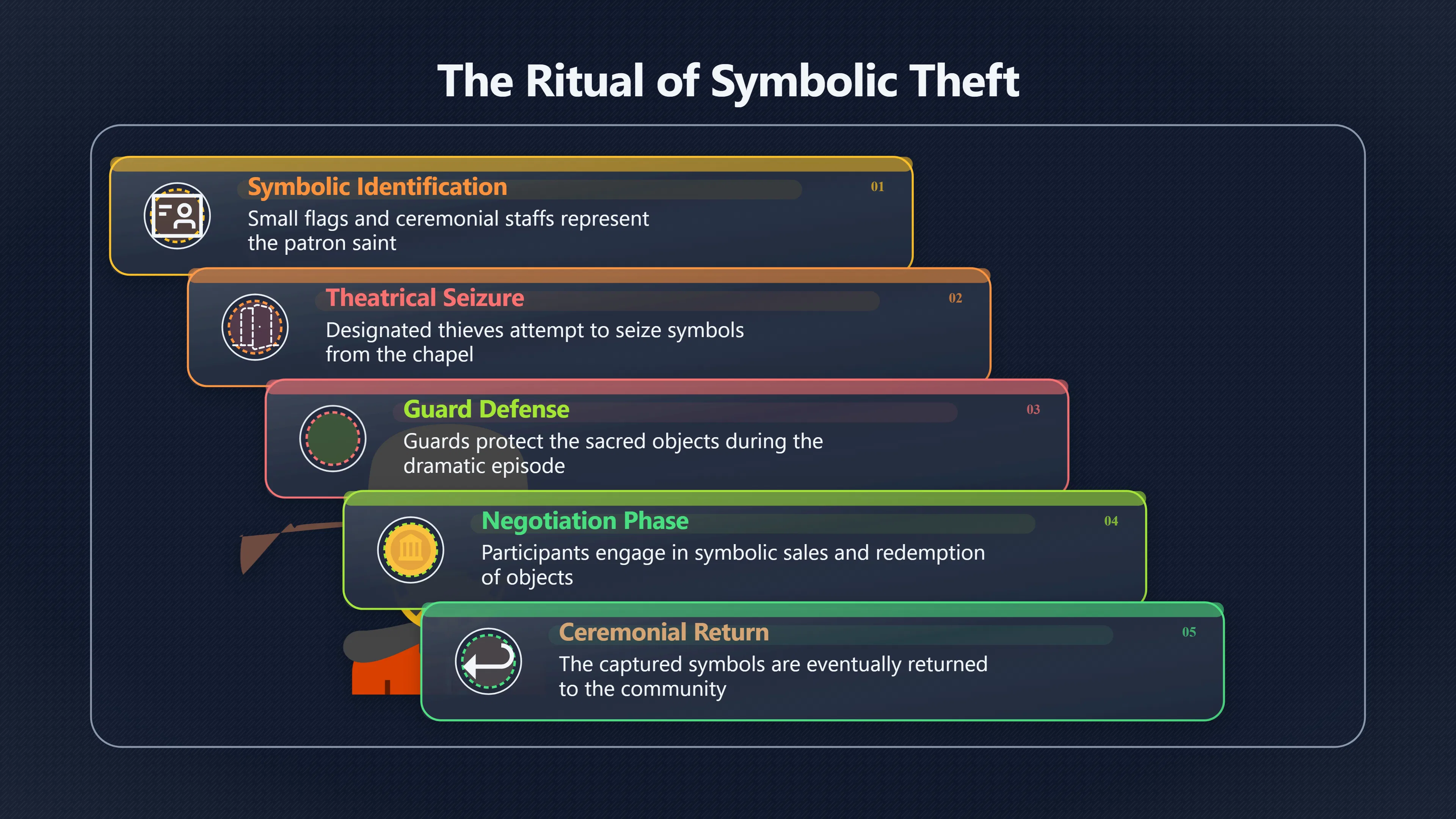
The most memorable part of many tabanca celebrations is the ritual often described as the “theft of the saint”. This dramatic episode turns the procession into a piece of sacred folk theatre. The saint is represented by ritual objects, especially a small flag and a ceremonial staff. A group of designated “thieves” attempts to seize these symbols from the chapel while guards try to protect them.[Instituto do Património Cultural]ipc.cvInstituto do Património Cultural TabancaInstituto do Património CulturalTabanca - Instituto do Património CulturalThe tabanca festivities begin with a set of preparations that c…
The theft is not an act of disrespect. Everyone knows the script, yet the performance is treated with genuine seriousness. Once the saint’s symbols are captured, they are carried away and negotiations begin. The objects may be symbolically sold, redeemed, recovered, or ceremonially returned. Through this playful conflict, participants transform religious devotion into a communal drama that everyone can witness and understand.[Instituto do Património Cultural]ipc.cvInstituto do Património Cultural TabancaInstituto do Património CulturalTabanca - Instituto do Património CulturalThe tabanca festivities begin with a set of preparations that c…
Drums are essential to the event. Their rhythms announce movement, mark ritual transitions, and energise the procession. Conch-shell horns and other instruments add to the atmosphere. The soundscape is so important that it helps define tabanca’s identity as much as the visual spectacle does. The drums do not merely accompany the action; they help create the sacred and emotional environment in which the ritual unfolds.[Instituto do Património Cultural]ipc.cvInstituto do Património Cultural TabancaInstituto do Património CulturalTabanca - Instituto do Património CulturalThe tabanca festivities begin with a set of preparations that c…
The flags are equally significant. In many processions they function as visible signs of the group’s patron saint, honour, and continuity. Carrying, protecting, stealing, and recovering them becomes a symbolic language through which the community expresses belonging. The ritual conflict surrounding the flag turns abstract ideas about faith and solidarity into something that can be seen and enacted in public space.[Instituto do Património Cultural]ipc.cvInstituto do Património Cultural TabancaInstituto do Património CulturalTabanca - Instituto do Património CulturalThe tabanca festivities begin with a set of preparations that c…
Why Tabanca Counts as Living Folklore
Many people think of folklore as old stories about supernatural beings or distant traditions remembered only through books. Tabanca shows a different side of folklore. It survives because people continue to perform it. Its knowledge is transmitted through participation: learning rhythms, preparing meals, decorating ritual spaces, carrying flags, playing ceremonial roles, and understanding the meanings hidden within the performance.[Instituto do Património Cultural]ipc.cvInstituto do Património Cultural TabancaInstituto do Património CulturalTabanca - Instituto do Património CulturalThe tabanca festivities begin with a set of preparations that c…
The tradition also demonstrates how folklore changes without losing its identity. Modern tabanca groups work with local councils, cultural organisations, and heritage programmes, yet the festivals remain rooted in neighbourhood life. Heritage recognition has encouraged preservation, but the celebrations continue to depend on local participation rather than official institutions alone.[Instituto do Património Cultural]ipc.cvInstituto do Património Cultural TabancaInstituto do Património CulturalTabanca - Instituto do Património CulturalThe tabanca festivities begin with a set of preparations that c…
Another reason tabanca is important is that it preserves a distinctly Cape Verdean blend of influences. Catholic saints stand at the centre of the ritual calendar, yet the structure of the celebration, the communal organisation, the drumming traditions, and the ceremonial performances reflect the archipelago’s Creole history and African cultural inheritance. Rather than belonging exclusively to one tradition, tabanca represents the cultural mixing that shaped Cape Verde itself.[Cabo Verde]cabo-verde.cvcape verde festivals traditions a cultural guideCabo VerdeCape Verde Festivals & Traditions: A Cultural Guide24 Mar 2026 — More than just a festival, Tabanca is a cultural association a…
Visitors often notice the costumes, processions, and music first. For local participants, however, the deeper meaning lies in continuity. Every parade, drumbeat, flag ceremony, and symbolic theft links present-day communities with earlier generations who organised the same rituals. In that sense, tabanca is not merely a festival. It is a living form of sacred folklore through which Cape Verdeans continue to tell the story of community, memory, devotion, and belonging.[ipc.cv]ipc.cvInstituto do Património Cultural TabancaInstituto do Património CulturalTabanca - Instituto do Património CulturalThe tabanca festivities begin with a set of preparations that c…
Amazon book picks
Further Reading
Books and field guides related to When Saints, Drums and Play Take Over. Use these as the next step if you want deeper reading beyond the article.
The Power of Myth
Rating: 4.5/5 from 14 Google Books ratings
Useful for readers exploring sacred stories and symbols.
The Anthropology of Performance
Explains ritual, festivals, and communal performance like tabanca.
eBay marketplace picks
Marketplace Samples
Live-tested eBay searches with available results related to this page.

Endnotes
1.
Source: cabo-verde.cv
Title: cape verde festivals traditions a cultural guide
Link:https://cabo-verde.cv/cape-verde-festivals-traditions-a-cultural-guide/
Source snippet
Cabo VerdeCape Verde Festivals & Traditions: A Cultural Guide24 Mar 2026 — More than just a festival, Tabanca is a cultural association a...
2.
Source: cabo-verde.cv
Title: cape verdes tabanka festival the theft of the saint
Link:https://cabo-verde.cv/cape-verdes-tabanka-festival-the-theft-of-the-saint/
Source snippet
Cape Verde's Tabanka Festival: The 'Theft of the Saint'7 Jun 2026 — The “Theft of the Saint” serves as the centerpiece of the Tabanka Fes...
3.
Source: youtube.com
Title: Cape Verde: History, Culture, and Folklore Explained | Nations of the World
Link:https://www.youtube.com/watch?v=_kyi-c_CQNI
Source snippet
Cabo Verde Explained in 16 Minutes | History, Geography, Culture...
4.
Source: youtube.com
Title: Cabo Verde Explained in 16 Minutes | History, Geography, Culture
Link:https://www.youtube.com/watch?v=qJK5Y27xBOg
Source snippet
Cape Verde Tabanca tradition festival Tabanka Cabo Verde Janvieve Williams...
5.
Source: ipc.cv
Title: Instituto do Património Cultural Tabanca
Link:https://ipc.cv/en/patromonio-imaterial/tabanca/
Source snippet
Instituto do Património CulturalTabanca - Instituto do Património CulturalThe tabanca festivities begin with a set of preparations that c...
6.
Source: caboverde-info.com
Link:https://www.caboverde-info.com/eng/Identity/Culture/Tabanca
Source snippet
TabancaThe processions are extremely animated and colourful. They go along the roads attracting groups of people with eye-catching costum...
7.
Source: ipc.cv
Link:https://ipc.cv/en/
Source snippet
Instituto do Património CulturalO Instituto do Património Cultural tem por missão a identificação, inventariação, investigação, salvaguar...
8.
Source: ipc.cv
Link:https://ipc.cv/en/museus/museu-etnografico-da-praia/
Source snippet
Museu Etnográfico da Praia - Instituto do Património CulturalO Centro Interpretativo da Olaria de Fonte Lima é um espaço dedicado à prese...
9.
Source: youtube.com
Link:https://www.youtube.com/watch?v=pcALFjzPsms
Source snippet
caboverde6 likes291 views3 weeks ago...
10.
Source: instagram.com
Link:https://www.instagram.com/institutodopatrimoniocultural/
Source snippet
nstituto do Património Cultural de Cabo Verde”...
Additional References
11.
Source: visit-caboverde.com
Link:https://www.visit-caboverde.com/en/things-to-do/culture-and-art
Source snippet
Culture & Art in Cabo VerdeIlha do Sal is living heritage. Boa Vista Island: Traditions that span through time. Boa Vista is an island wi...
12.
Source: flytap.com
Link:https://www.flytap.com/en-lv/destinations/get-inspired
Source snippet
Get inspiredThis is because frevo, recognized as Intangible Cultural Heritage of Humanity by UNESCO, is the principal rhythm behind the C...
13.
Source: globaljournals.org
Link:https://globaljournals.org/GJHSS_Volume21/E-Journal_GJHSS_%28C%29_Vol_21_Issue_5.pdf
Source snippet
Global Journal of Human Social ScienceKola San Jon De Cova Da Moura: An Instrumental Case of Intangible. Cultural Heritage Safeguarding i...
14.
Source: ich.unesco.org
Link:https://ich.unesco.org/en/inventoryingincaboverde-and-mozambique-a-documentary-00847
Source snippet
UNESCO Intangible Cultural Heritagea documentary on inventorying projects in Cabo Verde and...A regional project aimed at creating the e...
15.
Source: socialscienceresearch.org
Link:https://socialscienceresearch.org/index.php/GJHSS/article/download/3815/3704/37331
Source snippet
ral heritage in Portugal keeps on stirring up questions, which we look.Read more...
16.
Source: dspace.uevora.pt
Title: Deliverable 2.2 Territorial Diagnosis
Link:https://dspace.uevora.pt/rdpc/bitstream/10174/39583/1/Deliverable%202.2Territorial%20Diagnosis.pdf
Source snippet
DIAGNOSISby S Bombico · 2025 — The Instituto do Património Cultural (IPC) of Cabo Verde, currently operating under the Ministry of Cultur...
17.
Source: Wikipedia
Title: Ministry of Culture (Cape Verde)
Link:https://en.wikipedia.org/wiki/Ministry_of_Culture_%28Cape_Verde%29
Source snippet
Ministry of Culture (Cape Verde)The Ministry of Culture and Creative Industries is a national ministry of the Government of Cape Verde...
18.
Source: youtube.com
Link:https://www.youtube.com/watch?v=Bkm1dR0TRiY
Source snippet
Santiago and Maio. Auto-dubbed. 149 views · 4 months ago...more...
19.
Source: academia.edu
Link:https://www.academia.edu/27253777/Cape_Verde_Dimensions_in_Nation_Building
Source snippet
(PDF) Cape Verde: Dimensions in Nation-BuildingThe main dimensions of Cape Verde's nation-building include geographical, social, politica...
20.
Source: youtube.com
Link:https://www.youtube.com/watch?v=bjks3WpPvvQ
Source snippet
Cape Verde: History, Culture, and Folklore Explained | Nations of the World...
Topic Tree