Why Andorra's Mountains Feel Enchanted
Andorran folklore is best understood as mountain folklore: stories tied to lakes, passes, forests, winter rituals, saints’ shrines and the hard work of living in the Pyrenees.
Page outline Jump by section
Introduction
That mixture matters because Andorra’s legends often do cultural work. They explain why a shrine stands where it does, why a lake feels uncanny, why fire is carried down from the mountains, or why a carnival bear can make fun of village life. Some traditions are strongly documented as living heritage, such as the summer solstice fire festivals and bear festivities recognised by UNESCO; others survive mainly as oral or literary retellings, tourist routes, school materials, local memory, and folklore collections.[visitandorra.com]visitandorra.comOpen source on visitandorra.com.
Why Andorra’s folklore feels Pyrenean rather than isolated
Andorra sits between Catalonia and southern France, so its folklore is not sealed off from its neighbours. Many of its beings and customs belong to a wider Pyrenean and Catalan cultural zone: witches meet at high lakes, tiny worker-spirits haunt mountain forests, fire marks the summer solstice, and bears appear in winter festivities. What makes the Andorran version distinctive is the density of local place names. A story is rarely just “somewhere in the mountains”. It is attached to Meritxell, Engolasters, Ordino, Encamp, Sant Julià de Lòria, Auvinyà, Canillo, or a known route through the valleys.
This place-based quality also helps explain why Andorran folklore remains visible to visitors today. Tourism bodies and local councils present legends through walking routes, children’s activities, heritage shelters, festivals and museums. That can make old material easier to find, but it also means readers should distinguish between older oral tradition, historically documented belief, modern educational interpretation, and contemporary tourist storytelling. A route about a magical forest guardian is not the same kind of evidence as a fifteenth-century witch-trial record, even though both now belong to Andorra’s public folklore landscape.[visitandorra.com]visitandorra.comVisit Andorra Find the TamarroVisit Andorra Find the Tamarro
Meritxell: the Marian legend at the heart of national identity
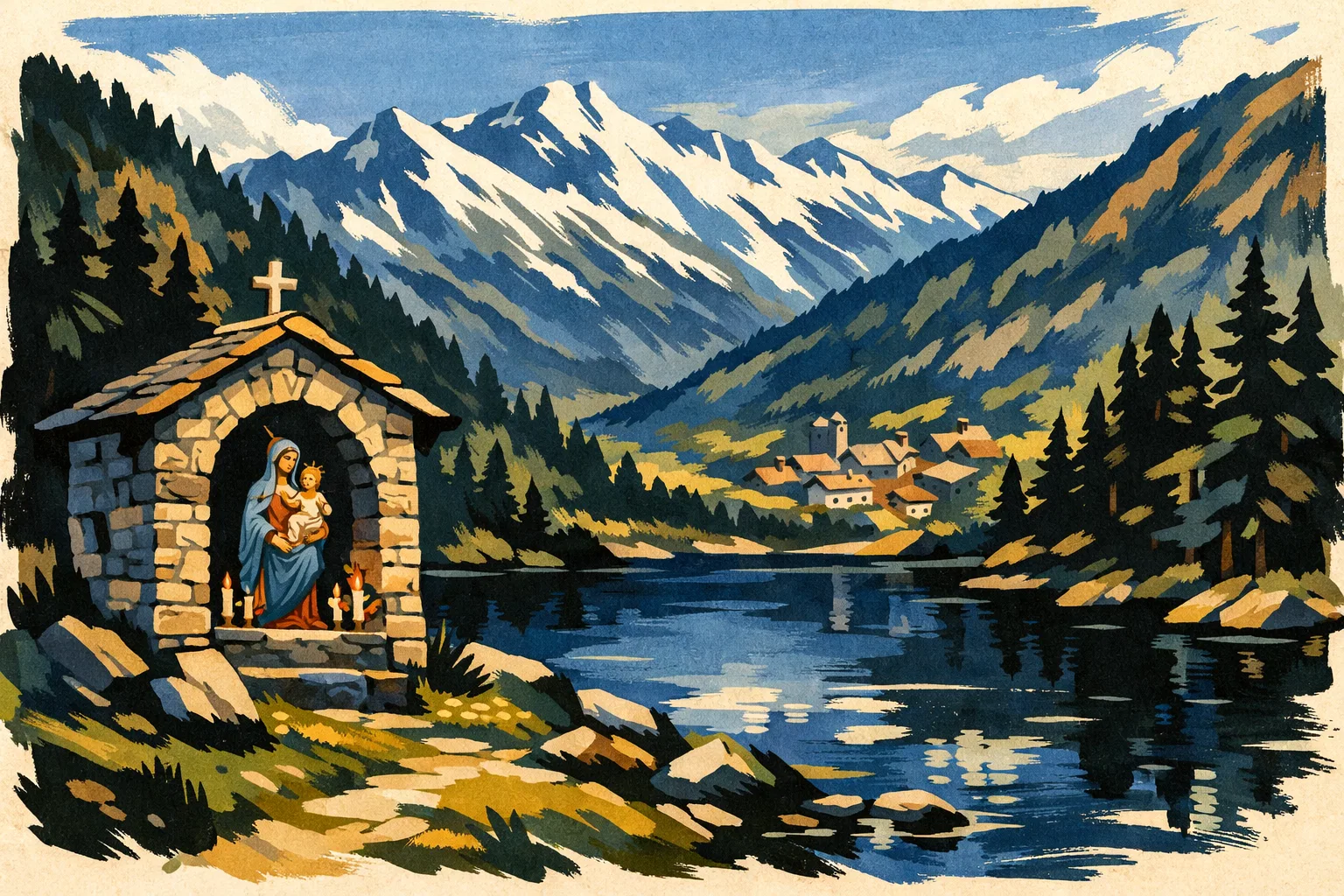
The legend of Our Lady of Meritxell is Andorra’s most important sacred story. In its common form, villagers travelling to Mass find a statue of the Virgin and Child beneath a wild rose blooming out of season in winter. They move the statue to a church, but it returns to the same place; when this happens again, the community understands that the Virgin has chosen Meritxell as her site. The story follows a familiar European pattern of “found image” legends, where a sacred object refuses to be moved and so authorises a shrine.
What makes Meritxell more than a local miracle tale is its national role. The Andorran heritage publication on Meritxell records that, in 1873, the Consell General confirmed Our Lady of Meritxell as patron saint and special protector of the Valleys of Andorra, while later religious and civic support led to her coronation as patron saint on 8 September 1921. That same occasion was also linked with the first performance of the Andorran national anthem, tying Marian devotion to national symbolism.[Museus.ad]museus.admeritxell engmeritxell eng
The story also has a modern rupture. The old sanctuary and its contents were destroyed by fire on the night of 8–9 September 1972, a loss remembered as a national catastrophe in the heritage account. The present sanctuary, associated with the modern architectural rebuilding of the site, therefore preserves not only a medieval-style devotional story but also a twentieth-century memory of destruction and renewal.[Museus.ad]museus.admeritxell engmeritxell eng
For folklore readers, Meritxell shows how legend, religion and nationhood can reinforce each other. The tale is not simply about a miraculous statue; it explains why a small mountain community recognises a particular place as chosen, protected and symbolically central.
Witches: legend, fear and real court records
Witches are among the strongest figures in Andorran tradition, but they need careful handling. There are two overlapping layers. One is legendary: witches dancing or bathing at Lake Engolasters, punishing men who spy on them, gathering in frightening mountain places, and making the lake feel enchanted. The other is historical: Andorra preserves unusually important documentation on witchcraft prosecutions, especially through the Tribunal de Corts.
Lake Engolasters is the best-known legendary setting. Tourism material for the hiking route describes local tales in which a village was swallowed by water and witches bathed in the lake at night; men who watched them were turned into black cats, and the witches supposedly left when modern works around the dam and hydroelectric plant began in the twentieth century. Recent Encamp initiatives have also turned the old shelter on the Pardines path into a space dedicated to the Engolasters witches legend and to the memory of women accused of witchcraft in Andorra.[visitandorra.com]visitandorra.comOpen source on visitandorra.com.
The historical layer is darker. The “Terra de bruixes” research project describes the Andorran valleys as a privileged place for studying the European witch hunt because of the surviving trials held before the Tribunal de Corts. It notes that recent scholarship has highlighted the singularity and relevance of Andorran documentation for the fifteenth to seventeenth centuries, when the Principality became one of the centres of witch-hunt activity.[Historia.ad]historia.adOpen source on historia.ad.
A government-hosted historical text adds important nuance: it says there is abundant documentation of accusations, confessions and persecutions in Andorra, but also notes that, contrary to a common assumption, the Barcelona Inquisition did not condemn Andorrans for this offence; most cases were handled through ordinary civil courts. The same text places the first preserved Tribunal de Corts witchcraft reference in 1471 and states that only one documented Andorran capital sentence used burning, while the others used hanging, the ordinary capital punishment of the court.[Govern d’Andorra]govern.adOpen source on govern.ad.
That distinction matters. The Engolasters witches are part of imaginative folklore; the accused women in the archives were real people caught in legal and social violence. Modern Andorran heritage work increasingly brings those two strands together: preserving the legends while also remembering the women harmed by witchcraft accusations.
The White Lady of Auvinyà: a protective woman in white
The White Lady of Auvinyà is one of Andorra’s most memorable legendary figures. In materials for a family route in Sant Julià de Lòria, she appears during a threatened invasion: as a Saracen king is about to enter the valleys, the White Lady appears on a rock above the valley and warns him that he will be punished if he proceeds. Frightened, he withdraws; later, the story turns him into a talking wolf that attacks flocks until the White Lady intervenes again through magic.[Visit Andorra]visitandorra.comVisit Andorra
This is not simply a ghost story in the generic “woman in white” tradition. In Andorra, the White Lady is usually read as a protector of the land and its freedom. Auvinyà’s modern sculpture of the figure, created by Toni Cruz in 2014, is explicitly presented in local tourism and property material as an identity symbol connected with Andorran freedom, strength and independence.[Andorra Sotheby's International Realty]andorra-sothebysrealty.comOpen source on andorra-sothebysrealty.com.
The figure also shows how flexible folklore categories can be. The same educational route places the White Lady alongside witches, elves, demons and Tamarros as part of a broader magical landscape around Sant Julià de Lòria. She can be understood as a fairy-like woman, a protective enchantress, a local heroine, or a Christianised guardian figure depending on the retelling.[Visit Andorra]visitandorra.comVisit Andorra
The piper of Ordino: a comic survival tale with wolves
Not every Andorran legend is solemn or sacred. The piper of Ordino is a compact folktale about danger, music and luck. In the story, a bagpiper from Ordino is hired to play at a festival in Canillo. On the way, he is chased by wolves on the mountain and climbs a tree. When his instrument sounds, the wolves are frightened away, and in some versions he is found still playing to keep them at bay; in others, he reaches the festival late, playing all the way.[Wikipedia]WikipediaEl buner d'OrdinoEl buner d'Ordino
The tale works because it is small and practical. It does not explain the origin of the nation or a shrine; it turns a real mountain danger into a comic image: a musician stuck up a tree, surviving because the very instrument he carries becomes a weapon. It also preserves a musical texture of Andorran and Catalan mountain life, since the instrument is associated with local bagpipe traditions rather than a generic fairy-tale flute.
Its afterlife shows how folklore becomes public culture. The tale has been represented on a postage stamp and adapted for dance performance, according to summaries of its modern representations. That is typical of Andorran legend today: oral stories are reworked through performance, tourism, education and national branding.[Wikipedia]WikipediaEl buner d'OrdinoEl buner d'Ordino

Fire, bears and the ritual year
Some of Andorra’s strongest traditions are not simply stories told aloud but rituals performed in public. The summer solstice fire festivals, known in Andorra as part of the wider Pyrenean fire tradition, involve people carrying flaming torches from the mountains and lighting beacons or bonfires. Andorran tourism describes the fire as a symbol of purification and renewal, with celebrations in places such as Andorra la Vella, Encamp and Sant Julià de Lòria. UNESCO recognised the wider Pyrenean tradition in 2015 as intangible cultural heritage.[Visit Andorra]visitandorra.comOpen source on visitandorra.com.
Research on the solstice fire festivals places them across Andorra, Spain and France and notes that they are usually celebrated around 23 June, though dates vary in some villages. The same study describes the festivals as being linked to fertility, seasonal cycles, agricultural work, purification, protection, transition into adulthood, and the strengthening of social ties and community belonging.[MDPI]mdpi.comOpen source on mdpi.com.
The bear festivities belong to the winter side of the ritual year. Andorran tourism explains that the bear celebrations arose in a harsh mountain environment and are performed as a one-act comic farce, giving the community a space to meet and comment satirically on the events of the year. In Andorra, they are associated especially with the Bear Dance in Encamp on Carnival Monday and the Last Bear in Ordino in early December; they were recognised by UNESCO in 2022 as part of the Bear festivities in the Pyrenees.[Visit Andorra]visitandorra.comVisit Andorra World Heritage in AndorraVisit Andorra World Heritage in Andorra
The bear figure is especially interesting because it is both animal and social mirror. Young men dress as bears and chase people through the streets in the wider Pyrenean festival pattern, symbolising spring’s return and the relationship between humans and nature. In Andorra, official tourism material is refreshingly cautious: it notes that no reliable source has confirmed why the Andorran festival focuses on the she-bear rather than the male bear or bears in general.[UNESCO]unesco.orgBear Festivities In the Pyrenees, AndorraBear Festivities In the Pyrenees, Andorra
Forest beings, children’s routes and modern folklore
Andorra also has a living modern layer of family folklore. The most visible example is the Tamarro trail promoted by Visit Andorra. Tamarros are presented as protectors of Andorra’s forests and natural environment, with one guardian assigned to each of the seven parishes. Children are invited to find portals shaped like Tamarros, place a small round stone to help keep the portals working, and collect stamps or marks in a guide or passport.[Visit Andorra]visitandorra.comVisit Andorra Find the TamarroVisit Andorra Find the Tamarro
This is not the same kind of tradition as a medieval saint legend or a court record of witchcraft. It is openly designed as a contemporary family activity with an environmental message: the enemy figure Dirt soils nature with rubbish, while the Tamarros need children’s help to keep the forests clean. Yet it still belongs on an Andorran folklore page because it shows how mythic language is being used now: spirits of place become guardians of ecology, and a country-wide trail turns environmental care into a quest.[Visit Andorra]visitandorra.comVisit Andorra Find the TamarroVisit Andorra Find the Tamarro
The Menairons, tiny worker-spirits known in Pyrenean tradition, also appear in Andorran family tourism and forest routes. Popular descriptions present them as minuscule beings who demand tasks as soon as they are released, a motif familiar in Catalan-Pyrenean folklore. In Andorra, they now sit beside Tamarros and other magical figures in child-friendly trails, showing how older folk motifs can be softened, localised and repurposed for outdoor education.[Lodge Park Hotel]lodgeparkhotel.comLodge Park Hotel Do you know what menairons are?Lodge Park Hotel Do you know what menairons are?
What is old, what is documented, and what is reinvented?
The safest way to read Andorran folklore is to ask what kind of evidence each tradition has. Some customs are living, publicly performed and institutionally recognised. The summer solstice fire festivals and bear festivities have UNESCO recognition and active community participation. Their meanings are not frozen in the past; they are maintained through annual practice, education and local organisation.[visitandorra.com]visitandorra.comOpen source on visitandorra.com.
Some traditions are historically documented but morally painful. Witchcraft in Andorra is not just a colourful fantasy theme. The archives of the Tribunal de Corts preserve evidence of accusations and prosecutions from the early modern period, and recent cultural work increasingly treats accused women as historical victims rather than as Halloween-style characters.[historia.ad]historia.adOpen source on historia.ad.
Other legends are best treated as oral or literary heritage: the White Lady, the piper of Ordino, Charlemagne foundation stories, and the magical explanations attached to Lake Engolasters. They may contain old motifs, but their surviving forms often come through collections, retellings, school materials, route booklets and tourism interpretation. That does not make them worthless; it means their value lies in how Andorrans and visitors have used them to imagine landscape, danger, independence, morality and belonging.
The newest material, such as the Tamarro trail, is clearly modern folklore rather than ancient mythology. It borrows the structure of older belief — hidden beings, magic portals, parish guardians, ritual offerings — and turns it towards present-day concerns such as children’s engagement with nature. In that sense, Andorran folklore is not a museum shelf of dead stories. It is a set of narratives and performances continually reshaped by devotion, memory, tourism, education and local pride.

Andorra’s folklore in one view
Andorran folklore is small in scale but rich in texture. It does not offer a single grand pantheon; it offers a map of meaningful places. Meritxell gives the country a sacred centre. Engolasters gives it a haunted lake of witches, drowned villages and black cats. Auvinyà gives it a protective woman in white. Ordino gives it a piper who survives wolves through music. The fire festivals and bear dances give it a ritual year of light, winter, satire and renewal. The Tamarros and Menairons show how forest beings can be remade for children and ecological care.
The result is a folklore of thresholds: winter into spring, childhood into adulthood, wilderness into village, danger into comedy, accusation into memory, and local legend into national identity. Andorra’s stories are most powerful when read in that mountain setting, where a lake, a shrine, a torchlit descent or a bear in the street can carry more meaning than a long mythical genealogy.
Amazon book picks
Further Reading
Books and field guides related to Why Andorra's Mountains Feel Enchanted. Use these as the next step if you want deeper reading beyond the article.
The Mammoth Book of Celtic Myths and Legends
Readers interested in European mountain folklore often cross-shop similar traditions.
The Lore of the Land
Shows how legends become attached to specific places and landscapes.
eBay marketplace picks
Marketplace Samples
Live-tested eBay searches with available results related to this page.
Endnotes
1.
Source: mdpi.com
Link:https://www.mdpi.com/2571-9408/5/3/131
2.
Source: historia.ad
Link:https://www.historia.ad/terra-de-bruixes/
3.
Source: govern.ad
Link:https://www.govern.ad/documents/d/guest/2005_el_soler_ahir_i_avui_de_la_bruixeria_a_andorra
4.
Source: museus.ad
Title: meritxell eng
Link:https://museus.ad/media/files/publicacions/meritxell_eng.pdf
5.
Source: Wikipedia
Title: Our Lady of Meritxell
Link:https://en.wikipedia.org/wiki/Our_Lady_of_Meritxell
6.
Source: altaveu.com
Title: Aixopluc embruixat
Link:https://www.altaveu.com/actualitat/parroquies/aixopluc-embruixat_75974_102.html
7.
Source: visitandorra.com
Title: Visit Andorra
Link:https://visitandorra.com/content/dam/visitandorra/de/assets/documents/cfs/itinerary/sant-julia-magica/cami-senyoreta-quadern-en.pdf
8.
Source: Wikipedia
Title: El buner d’Ordino
Link:https://en.wikipedia.org/wiki/El_buner_d%27Ordino
9.
Source: unesco.org
Title: document 4014
Link:https://www.unesco.org/archives/multimedia/document-4014
10.
Source: unesco.org
Title: Bear Festivities In the Pyrenees, Andorra
Link:https://www.unesco.org/archives/multimedia/document-6006
11.
Source: ich.unesco.org
Title: summer solstice fire festivals in the pyrenees 01073
Link:https://ich.unesco.org/en/RL/summer-solstice-fire-festivals-in-the-pyrenees-01073
12.
Source: ich.unesco.org
Title: andorra AD
Link:https://ich.unesco.org/en/state/andorra-AD
13.
Source: ich.unesco.org
Link:https://ich.unesco.org/en/video/32987
14.
Source: ich.unesco.org
Link:https://ich.unesco.org/en/lists
15.
Source: ich.unesco.org
Title: summer solstice fire festivals in the pyrenees 01073
Link:https://ich.unesco.org/en/RL/summer-solstice-fire-festivals-in-the-pyrenees-01073?RL=01073&id=32987&include=film_inc.php
16.
Source: ich.unesco.org
Title: bear festivities in the pyrenees 01846
Link:https://ich.unesco.org/en/RL/bear-festivities-in-the-pyrenees-01846
17.
Source: ich.unesco.org
Link:https://ich.unesco.org/en/decisions/17.COM/7.B.39
18.
Source: ich.unesco.org
Link:https://ich.unesco.org/en/video/63145
19.
Source: ich.unesco.org
Title: 7b representative list 01281
Link:https://ich.unesco.org/en/7b-representative-list-01281?call=slideshow&id=01846&include=slideshow_inc.php&mode=scroll&width=620
20.
Source: Wikipedia
Link:https://en.wikipedia.org/?redirect=no&title=Mythology_of_Andorra
21.
Source: Wikipedia
Title: Oral tradition
Link:https://en.wikipedia.org/wiki/Oral_tradition
22.
Source: Wikipedia
Title: White Lady
Link:https://en.wikipedia.org/wiki/White_Lady
23.
Source: Wikipedia
Link:https://en.wikipedia.org/wiki/Canillo
24.
Source: Wikipedia
Title: Lake Engolasters
Link:https://en.wikipedia.org/wiki/Lake_Engolasters
25.
Source: encamp.ad
Title: Aixopluc de les bruixes d’Engolasters
Link:https://www.encamp.ad/llocs/aixopluc-de-les-bruixes-engolasters
26.
Source: encamp.ad
Title: Llac d’Engolasters
Link:https://www.encamp.ad/en/encamp-el-pas-de-la-casa/map/%40%40place_view/llac-dengolasters
27.
Source: altaveu.com
Title: Dos segles de persecució
Link:https://www.altaveu.com/actualitat/historia/dos-segles-persecucio_61361_102.html
28.
Source: altaveu.com
Link:https://www.altaveu.com/videos/dos-segles-de-persecucio_1860930_110.html
29.
Source: spain.info
Link:https://www.spain.info/en/calendar/fiestas-fire-summer-solstice-pyrenees/
30.
Source: youtube.com
Title: Andorra Church
Link:https://www.youtube.com/watch?v=yOSLwguvehQ
Source snippet
Lake Engolasters - Encamp Parish - Andorra...
31.
Source: youtube.com
Title: Lake Engolasters
Link:https://www.youtube.com/watch?v=luXnd9ib_c8
32.
Source: visitandorra.com
Link:https://visitandorra.com/en/nature–sports/natural-andorra-world-heritage/
33.
Source: visitandorra.com
Title: Visit Andorra World Heritage in Andorra
Link:https://visitandorra.com/it/nature-e-sport/world-heritage-in-andorra/
34.
Source: visitandorra.com
Title: Visit Andorra Find the Tamarro
Link:https://visitandorra.com/en/nature–sports/find-the-tamarro/
35.
Source: visitandorra.com
Link:https://visitandorra.com/en/culture/sanctuary-of-meritxell/
36.
Source: visitandorra.com
Link:https://visitandorra.com/en/nature–sports/hiking-route-llac-d-engolasters/
37.
Source: andorra-sothebysrealty.com
Link:https://www.andorra-sothebysrealty.com/en/live-in-andorra/sant-julia-de-loria/aubinya
38.
Source: visitandorra.com
Link:https://visitandorra.com/en/with-family/hiking-with-children-in-andorra/
39.
Source: lodgeparkhotel.com
Title: Lodge Park Hotel Do you know what menairons are?
Link:https://www.lodgeparkhotel.com/en/blog/menairons-andorra-family/
40.
Source: visitandorra.com
Link:https://visitandorra.com/content/dam/visitandorra/ca/assets/documents/visitor-information/tourist-guides/2025/guia-and-2025-en-v2.pdf
41.
Source: visitandorra.com
Link:https://visitandorra.com/en/nature–sports/grandvalira-summer/
42.
Source: visitandorra.com
Title: sitemap en.xml
Link:https://visitandorra.com/sitemap_en.xml
43.
Source: visitandorra.com
Link:https://visitandorra.com/en/culture/must-visit-spots-in-ordino/
44.
Source: grandvalira.com
Title: lake engolasters
Link:https://www.grandvalira.com/en/blog/lake-engolasters
45.
Source: youtube.com
Link:https://www.youtube.com/watch?v=4_kYNxHktos
46.
Source: turia.uv.es
Link:https://turia.uv.es/index.php/scripta/article/view/15483
47.
Source: nononsensetravel.mytravelbenefit.com
Link:https://nononsensetravel.mytravelbenefit.com/location/ordino
48.
Source: waymarking.com
Title: Lake Engolasters
Link:https://www.waymarking.com/waymarks/WM1BPWA_Lake_Engolasters_Andorra
49.
Source: izeria.com
Link:https://www.izeria.com/en/places/p-e6ub73qn/Ordino
50.
Source: izeria.com
Title: Lake Engolasters
Link:https://www.izeria.com/en/places/p-coob35bj/Lake_Engolasters
51.
Source: everyculture.com
Link:https://www.everyculture.com/wc/Afghanistan-to-Bosnia-Herzegovina/Andorrans.html
52.
Source: library.essex.ac.uk
Link:https://library.essex.ac.uk/history/witchcraft
53.
Source: hope.ac.uk
Link:https://www.hope.ac.uk/media/studywithus/schools/historyandpolitics/documents/Witchcraft.pdf
Additional References
54.
Source: instagram.com
Link:https://www.instagram.com/reel/C2-AQLyMNF4/
55.
Source: bliptext.com
Link:https://bliptext.com/articles/andorra
56.
Source: ebsco.com
Link:https://www.ebsco.com/research-starters/politics-and-government/andorran-national-day-our-lady-meritxell-day
57.
Source: tourism-mediterraneanpyrenees.com
Link:https://www.tourism-mediterraneanpyrenees.com/bear-festival
58.
Source: daguisahotels.com
Link:https://www.daguisahotels.com/en/news/celebrate-the-magical-night-of-the-fallas-de-andorra.html
59.
Source: femturisme.cat
Link:https://femturisme.cat/en/routes/enter-the-forest-of-the-menairons-in-andorra
60.
Source: instagram.com
Link:https://www.instagram.com/reel/DaAOzAJO7CP/
61.
Source: instagram.com
Link:https://www.instagram.com/reel/DYK-5qDMx3n/
62.
Source: facebook.com
Link:https://www.facebook.com/TheIrishPost/posts/fairy-folklore-in-the-west-of-ireland/10160015462248452/
63.
Source: kilkennycastle.ie
Link:https://www.kilkennycastle.ie/folklore-and-fairies-and-the-question-of-national-identity/
Topic Tree
Follow this branch
Related pages 192
- Afghan Folklore
- Albanian Folklore
- Algerian Folklore
- Australian Folklore
- Azerbaijan Folklore
- +187 more in sidebar