Where Cyprus Turns Landscape Into Legend
Cyprus folklore is best understood as a layered island tradition: ancient goddess myths at Paphos, Byzantine hero legends written into mountains and rocks, village fairy tales of dragons and clever survivors, Orthodox seasonal customs, evil-eye practices, shadow theatre, poetic duels, and modern heritage projects that re-stage old stories for new audiences.
Page outline Jump by section
Introduction
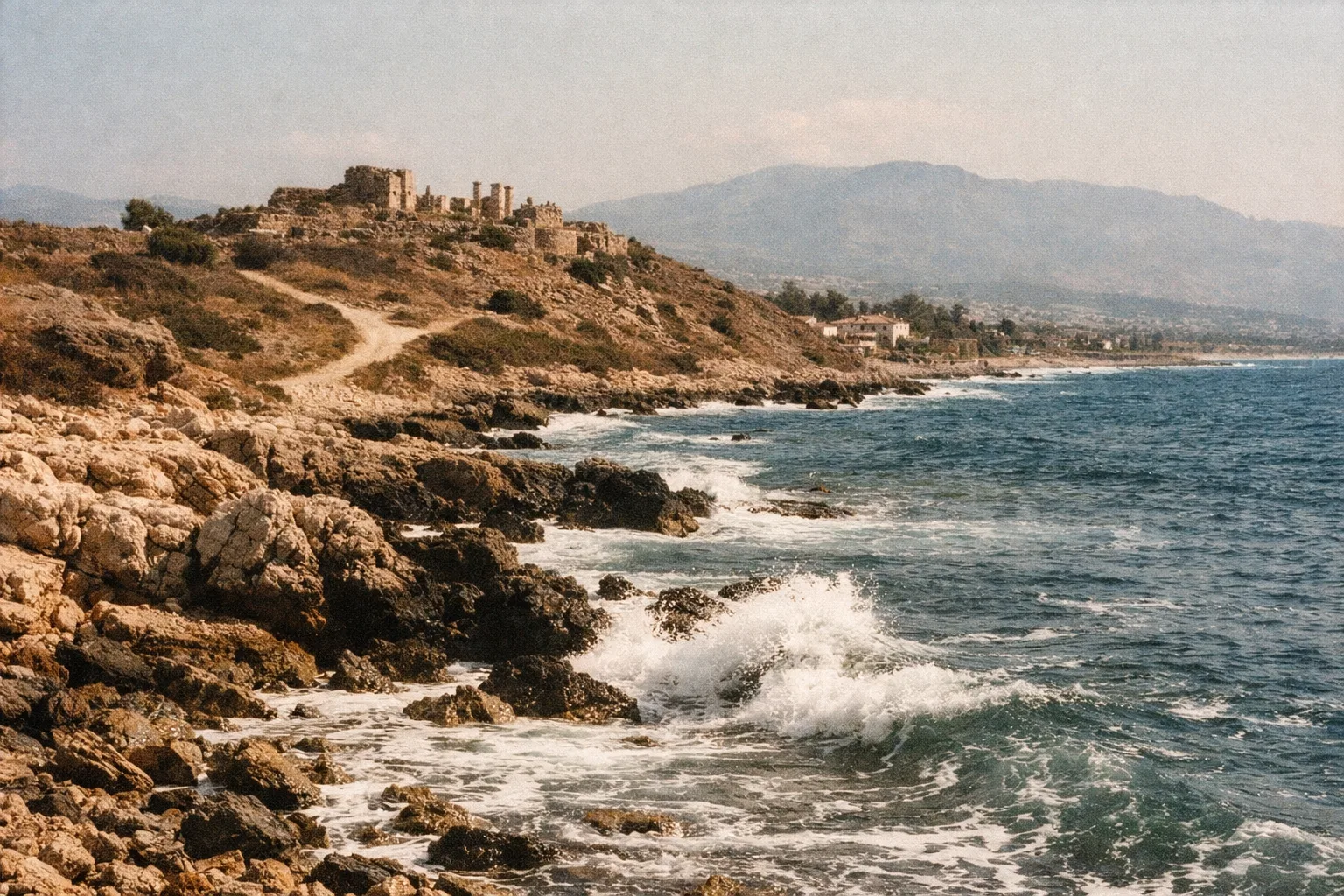
What makes Cyprus especially interesting is the way story attaches itself to place. Petra tou Romiou is both the “birthplace of Aphrodite” and, in another tradition, the rock hurled by the heroic Digenis Akritas against raiders. Paphos is both an archaeological World Heritage landscape and a living tourist mythology of love, beauty and sacred landscape. The same pattern appears in village customs: traditions are not just told, but performed at festivals, sung in public contests, acted through puppets, played in Easter games, or guarded in museums and archives.[Visit Cyprus]visitcyprus.comVisit Cyprus Petra tou Romiou (The Rock of the GreekVisit Cyprus Petra tou Romiou (The Rock of the Greek
Why Cyprus folklore feels older than one tradition
Cyprus sits between the Greek-speaking, Byzantine, Levantine and Ottoman worlds, so its folklore rarely belongs to a single neat category. Ancient religious myth, medieval frontier epic, Orthodox ritual life, Turkish Cypriot performance culture and modern national heritage all overlap. That does not mean every tradition is ancient in an unbroken line. Some are well-attested through archaeology or UNESCO heritage records; others survive through oral tradition, tourist retelling, local memory or recent cultural revival.
The strongest historical anchor is Paphos. UNESCO describes Paphos as a serial archaeological property that includes Kato Paphos, the Tombs of the Kings, and Kouklia, the ancient Palaepaphos associated with Aphrodite’s cult and legend. The site was inhabited from the Neolithic period, was a centre of worship for pre-Hellenic fertility deities, and later became one of the great centres of Aphrodite worship; the Temple of Aphrodite itself is dated by UNESCO to the 12th century BC.[UNESCO World Heritage Centre]whc.unesco.orgOpen source on unesco.org.
That matters for folklore because it gives the Aphrodite legend unusual depth. Many places claim mythic associations, but Paphos combines myth, sanctuary, ancient literary memory, archaeology and modern public identity. The official Cyprus tourism account presents Petra tou Romiou as the spot where Aphrodite rose from the sea foam, while the Sanctuary of Aphrodite at Palaipafos is presented as one of the most famous sanctuaries of the goddess, remaining a place of worship into late antiquity.[Visit Cyprus]visitcyprus.comVisit Cyprus Birthplace of AphroditeVisit Cyprus Birthplace of Aphrodite
Aphrodite: the island’s most famous mythic presence
The central Cypriot myth is simple and powerful: Aphrodite, goddess of love and beauty, rises from the sea and reaches the coast of Cyprus. In modern public storytelling, this moment is fixed above all at Petra tou Romiou, a dramatic rock formation on the south-west coast near Paphos. Official visitor material describes the place as Aphrodite’s mythical birthplace and says legend tells that she rose from the waves and was carried to that beach.[Visit Cyprus]visitcyprus.comVisit Cyprus Birthplace of AphroditeVisit Cyprus Birthplace of Aphrodite
The reason this story still carries weight is not merely that it is picturesque. Paphos was not just a backdrop for a myth; it was a major sacred landscape. UNESCO links the World Heritage value of Paphos directly to the cult and legend of Aphrodite, noting that the goddess’s legendary birthplace was on Cyprus and that her temple was erected by the Mycenaeans in the 12th century BC.[UNESCO World Heritage Centre]whc.unesco.orgOpen source on unesco.org.
At Palaipafos, the myth becomes even more concrete. The official Cyprus tourism page for the Sanctuary of Aphrodite says the site was one of Cyprus’s important city-kingdoms, the first Cypriot site included on the UNESCO World Heritage List, and a sanctuary whose ancient remains date back to the 12th century BC. It also preserves two legendary founding traditions: one involving Agapenor, king of Tegea returning from the Trojan War, and another involving Kinyras, a local legendary king and first high priest of the sanctuary.[Visit Cyprus]visitcyprus.comOpen source on visitcyprus.com.
For a folklore reader, the important point is that Aphrodite in Cyprus is not only a classical character from books. She is a place-making figure. Her story helps organise coastal tourism, museum interpretation, archaeological identity, wedding marketing, local routes and the island’s international image. That modern use does not make the myth false as folklore; it shows how an old sacred narrative can become a national cultural symbol while remaining attached to specific rocks, ruins and landscapes.

Digenis Akritas: the hero who shaped the landscape
Cyprus’s other great legendary figure is Digenis Akritas, the Byzantine frontier hero whose strength is so large that the landscape itself becomes evidence of his deeds. In the Cypriot version, he is associated with Petra tou Romiou and the Pentadaktylos mountain range: the rock by the sea is said to have been thrown against enemy ships, while the “five fingers” of the mountain are linked to the hero’s hand. Official Cyprus material explicitly connects Petra tou Romiou with Digenis, explaining that the Greek name means “Rock of the Greek man” and refers to the Byzantine hero who kept Saracen raiders away by hurling the rock into the sea.[Visit Cyprus]visitcyprus.comOpen source on visitcyprus.com.
The hero’s background is wider than Cyprus. Digenis Akritas belongs to the Byzantine heroic tradition of frontier warriors, and Harvard’s Hellenic studies account describes the epic as a hybrid of oral epic and literary romance from 12th-century Byzantium, with a hero whose parentage crosses boundaries: an Arab emir father and Byzantine noblewoman mother.[Ukrainian Research Institute]huri.harvard.edudigenis akritis border guard transcending bordersdigenis akritis border guard transcending borders
That mixed origin is part of the tradition’s power. Digenis is a border hero, but he is also a figure of cultural mixture. In Cyprus, his legend became localised in a particularly vivid way: the island’s mountains and rocks are treated as marks left by his body and weapons. This turns medieval conflict memory into landscape folklore. The story is not simply “a warrior defended Cyprus”; it is “this rock and that mountain prove the hero was here”.
Modern scholarship has also treated Cypriot heroic songs as a serious historical and mythic source. The book The Byzantine Warrior Hero: Cypriot Folk Songs as History and Myth, 965–1571 is specifically concerned with how Byzantine warrior heroes appear in Cypriot folk songs, and with how mythic structures survived within Christian and medieval material.[dokumen.pub]dokumen.pubOpen source on dokumen.pub.
Dragons, fairy tales and village storytelling
Cypriot folklore is not limited to famous gods and heroic epics. The island also has a rich body of folk tales: magical stories, realistic stories, comic tales, religious tales and animal tales. UNESCO Cyprus describes folk tales as orally transmitted narratives passed down from generation to generation, with origins that cannot be precisely determined, and notes that scholars classify them by type and content.[Unesco Cyprus]unesco.org.cyOpen source on unesco.org.cy.
One of the most memorable Cypriot tale patterns is the dragon story. The Heartland of Legends project describes dragons in Cypriot folklore as creatures usually imagined with wings and thorny tails, living in mountains, caves or towers. These dragon stories matter because they attach danger to the landscape: caves, remote slopes, springs and towers become places where a monster may block water, demand victims, or test a hero.[Heartland of Legends]heartlandoflegends.comOpen source on heartlandoflegends.com.
The same project is part of a wider modern effort to turn local legends into cultural routes. Visit Cyprus describes the Heartland of Legends route as a route through rural, mountainous and remote areas designed to bring visitors close to Cypriot nature, local traditions and the Cypriot way of life. This is a good example of modern folklore interpretation: old stories are no longer only told at home or in village gatherings, but mapped for visitors and used to support slow cultural tourism.[Visit Cyprus]visitcyprus.comOpen source on visitcyprus.com.
The Fairytale Museum in Nicosia shows another side of preservation. Visit Cyprus says the museum is housed in an old mansion in Lefkosia and aims to disseminate the cultural heritage of fairy tales, legends, myths and traditions from Cyprus and around the world. Cyprus Museums describes its mission as preserving and promoting cultural heritage including fairy tales, folklore tales, myths and traditions from Cyprus and Greece.[Visit Cyprus]visitcyprus.comOpen source on visitcyprus.com.
Christmas goblins and the dangerous days of winter
A distinctive supernatural tradition shared across Greek and wider south-eastern European folklore is the belief in Christmas goblins: mischievous beings that appear during the Twelve Days between Christmas and Epiphany. In Cyprus these figures belong to the same broad family as the kallikantzaroi, although local forms and names vary. General folklore accounts describe them as troublesome creatures that emerge during this midwinter period, enter homes, spoil food, frighten people and vanish again at Epiphany.[Wikipedia]WikipediaOpen source on wikipedia.org.
For Cyprus, the important point is not whether every detail is unique to the island. It is that the tradition fits a common Mediterranean and Balkan idea of a dangerous calendar threshold. The Twelve Days are a time when ordinary order is loosened: the year is turning, domestic space must be protected, and unruly beings can cross into the human world. Modern hotel and tourism accounts in Cyprus still explain the goblins as Christmas hobgoblins that surface once a year to play tricks, with the fireplace sometimes described as a protective defence.[Louis Hotels]louishotels.comOpen source on louishotels.com.
This is a useful example of how folklore survives in softened form. What may once have been a serious household belief can become a seasonal story for children, a festive curiosity, or a tourist-friendly explanation of local Christmas atmosphere. The supernatural claim is not treated today in one uniform way. Some people may tell it playfully; others remember it as something older relatives took more seriously; public-facing sources often present it as colourful custom rather than active fear.
Evil eye, magic and the things people half-believe
One of the most revealing areas of modern Cypriot folklore is not a monster at all, but the evil eye and everyday magic. Anthropological work on Cyprus argues that magic has not simply disappeared under modernity; rather, it often survives as partial knowledge, uncertainty and practice. In a study of contemporary Cyprus and Orkney, Theodoros Kyriakides and Richard Irvine describe how magic can persist through “not-knowing”: people may not claim detailed magical knowledge, yet still act as if certain protective objects or rituals matter in moments of stress.[St Andrews Research Repository]research-repository.st-andrews.ac.ukOpen source on st-andrews.ac.uk.
That point is especially helpful for understanding evil-eye amulets. One example from the research describes a woman glancing at an evil-eye amulet hanging from a car mirror when bad thoughts crossed her mind, while saying she did not really know much about how magic worked. This is modern folklore in action: the object may be decorative most of the time, but under anxiety it can become protective.[St Andrews Research Repository]research-repository.st-andrews.ac.ukOpen source on st-andrews.ac.uk.
Kyriakides’s later work on evil and magical disorder in Cyprus also argues that Christian narratives and institutions have tried to absorb or classify evil, but that magical ideas do not always fit neatly into official religious categories. The result is a world in which evil can be discussed through church language, folk diagnosis, family stories, amulets and everyday suspicion all at once.[ResearchGate]researchgate.netResearch Gate Evil, Cosmological Capture, and Magical Disorder in CyprusResearch Gate Evil, Cosmological Capture, and Magical Disorder in Cyprus
This makes Cyprus a strong example of a broader folklore truth: belief is not always a simple yes or no. People may laugh at a superstition, buy the charm anyway, deny belief in the evil eye, and still avoid tempting fate. For public readers, that ambiguity is often more accurate than pretending that modern folklore is either dead tradition or full literal belief.
Festivals where folklore is performed, not just remembered
Cypriot folklore often appears in public performance. Religious fairs, Easter games, poetic duels, dance, chant and shadow theatre all show how tradition becomes something people do together.
Religious fairs remain one of the most important forms of living local tradition. UNESCO Cyprus describes them as small or pan-Cyprian outdoor religious and social events that continue to preserve important features of Cypriot culture, character and lifestyle. They combine worship, gathering, trade, food, music and sociability, making them both religious observances and community memory events.[Unesco Cyprus]unesco.org.cyOpen source on unesco.org.cy.
Traditional Easter games are another example. UNESCO Cyprus says they were once played all over Cyprus and now survive especially in Paphos and villages of the Paphos district, as well as in other areas. These games matter because they make Easter more than church ritual: village squares, strength tests, laughter and competitive play turn the feast into a communal performance of belonging.[Unesco Cyprus]unesco.org.cyOpen source on unesco.org.cy.
Tsiattista, Cyprus’s improvised poetic duelling tradition, is one of the island’s best documented oral traditions. UNESCO describes it as lively, impromptu oral poetry, often accompanied by violin or lute, in which one poet-singer tries to outdo another with clever verses. UNESCO Cyprus stresses its role in identity and continuity, while a 2025 Associated Press report described younger performers keeping the tradition alive in Larnaca and compared its quick-witted verbal contest to battle rap.[unesco.org]ich.unesco.orgOpen source on unesco.org.
Shadow theatre adds a different kind of folk performance. UNESCO Cyprus says the art of Karagiozis, the most popular form of shadow theatre in Cyprus, first appeared on the island in the early 20th century through Greek shadow puppeteers and Cypriots who learned from them. In Turkish Cypriot culture, Karagöz shadow play is also recognised as an important heritage form, showing how a related puppet-theatre tradition crossed communities, languages and political boundaries.[Unesco Cyprus]unesco.org.cyUnesco Cyprus Shadow TheatreUnesco Cyprus Shadow Theatre
Greek Cypriot, Turkish Cypriot and minority voices
A country-level page on Cyprus folklore should not silently treat the island as culturally uniform. Greek Cypriot traditions are highly visible in official heritage listings, Orthodox seasonal customs, Aphrodite tourism and Byzantine hero songs, but Turkish Cypriot and minority oral cultures also belong to the island’s story.
Turkish Cypriot oral tradition includes folk tales, riddles and short verse forms, including the traditional oral form known as mani. Accounts of Turkish Cypriot culture describe winter nights as times when families exchanged manis, riddles and folk tales for entertainment before major social changes in the 20th century.[Wikipedia]WikipediaCulture of Northern CyprusCulture of Northern Cyprus
Karagöz shadow theatre is also important in Turkish Cypriot cultural memory. A study on the place of Karagöz within traditional Turkish Cypriot theatre describes it as the most popular shadow play among Turkish Cypriots and examines its themes and characters through contemporary texts.[ktoeos.org]ktoeos.orgOpen source on ktoeos.org.
Cyprus also contains smaller linguistic communities whose oral traditions are vulnerable because the language itself is endangered. In 2025, Associated Press reported on Cypriot Maronite Arabic, also known as Sanna, describing it as a critically endangered language with about 900 speakers and a revitalisation effort centred on Kormakitis. Because oral folklore depends heavily on language, the decline or revival of such speech communities affects more than vocabulary; it affects songs, jokes, prayers, memories and family storytelling.[AP News]apnews.comOpen source on apnews.com.
What is old, what is revived, and what is tourist retelling?
Cyprus folklore today is a mixture of different kinds of evidence. Some traditions are archaeologically deep, some are medieval and literary, some are documented oral traditions, some are active customs, and some are modern cultural packaging.
Aphrodite at Paphos is the clearest case where myth and archaeology strongly reinforce each other. The sea-birth story is mythic, but the sanctuary, long cult history and World Heritage status are historically grounded.[UNESCO World Heritage Centre]whc.unesco.orgOpen source on unesco.org.
Digenis Akritas sits between medieval literature, oral song and local legend. The wider epic tradition is medieval; the Cypriot landscape legends are localised forms that make the hero visible in rocks and mountains.[Ukrainian Research Institute]huri.harvard.edudigenis akritis border guard transcending bordersdigenis akritis border guard transcending borders
Folk tales and dragon stories are harder to date precisely because oral tradition changes as it is transmitted. UNESCO Cyprus is careful to say that folk tales were passed down orally and that their starting point cannot be determined. That uncertainty is not a weakness; it is part of how oral folklore works.[Unesco Cyprus]unesco.org.cyOpen source on unesco.org.cy.
Modern projects such as the Fairytale Museum, Heartland of Legends routes and animated series based on Cypriot myths are not “fake folklore”. They are reinterpretations. Their value lies in preservation, education and renewed public attention, but readers should distinguish them from older oral performance or archaeological evidence. Visit Cyprus presents the Heartland of Legends as a tourism route through rural and mountainous areas, while the Fairytale Museum frames stories as cultural heritage to be disseminated through exhibitions, events and performances.[Visit Cyprus]visitcyprus.comOpen source on visitcyprus.com.
Why Cyprus folklore still matters
Cyprus folklore matters because it gives the island a cultural map that is different from a political or archaeological map. Aphrodite explains why a coastline becomes sacred and romantic. Digenis explains why a rock or mountain can be imagined as a heroic mark. Dragons turn caves and water sources into story places. Evil-eye amulets show how uncertainty and protection still live in everyday objects. Tsiattista, Easter games, religious fairs and shadow theatre show that tradition survives best when people perform it together.[visitcyprus.com]visitcyprus.comVisit Cyprus Birthplace of AphroditeVisit Cyprus Birthplace of Aphrodite
The most honest way to read Cypriot folklore is not as a single ancient script, but as a living set of layers. Some stories are rooted in ancient cult, some in medieval border imagination, some in village oral tradition, some in Orthodox ritual time, some in Turkish Cypriot performance, and some in modern heritage revival. Together they make Cyprus feel like an island where myth is not sealed in the past, but continually reattached to places, festivals, objects and public memory.
Amazon book picks
Further Reading
Books and field guides related to Where Cyprus Turns Landscape Into Legend. Use these as the next step if you want deeper reading beyond the article.
Mythology
Rating: 2.5/5 from 14 Google Books ratings
Provides accessible background to the Greek myths that shape many Cypriot legends.
Bulfinch's Mythology
Covers the mythic tradition connected to Aphrodite and the wider Greek world.

The Penguin Book of Dragons
Connects with the dragon traditions and legendary creatures found in Cypriot storytelling.
eBay marketplace picks
Marketplace Samples
Live-tested eBay searches with available results related to this page.

Endnotes
1.
Source: whc.unesco.org
Link:https://whc.unesco.org/en/list/79/
2.
Source: huri.harvard.edu
Title: digenis akritis border guard transcending borders
Link:https://www.huri.harvard.edu/news/digenis-akritis-border-guard-transcending-borders
3.
Source: dokumen.pub
Link:https://dokumen.pub/the-byzantine-warrior-hero-cypriot-folk-songs-as-history-and-myth-9651571-2020946070-9781793621986-9781793621993.html
4.
Source: dokumen.pub
Link:https://dokumen.pub/the-byzantine-warrior-hero-cypriot-folk-songs-as-history-and-myth-965-1571.html
5.
Source: Wikipedia
Link:https://en.wikipedia.org/wiki/Kallikantzaros
6.
Source: researchgate.net
Link:https://www.researchgate.net/publication/337836250_Not-Knowing_Magic_Magical_Memory_and_Ineffability_in_Contemporary_Cyprus_and_Orkney
7.
Source: researchgate.net
Title: Research Gate Evil, Cosmological Capture, and Magical Disorder in Cyprus
Link:https://www.researchgate.net/publication/373127266_Evil_Cosmological_Capture_and_Magical_Disorder_in_Cyprus
8.
Source: ich.unesco.org
Link:https://ich.unesco.org/en/RL/tsiattista-poetic-duelling-00536
9.
Source: Wikipedia
Title: Culture of Northern Cyprus
Link:https://en.wikipedia.org/wiki/Culture_of_Northern_Cyprus
10.
Source: ktoeos.org
Link:https://www.ktoeos.org/wp-content/uploads/2023/03/THE-PLACE-AND-IMPORTANCE-OF-THE-KARAG%C3%96Z-SHADOW-PLAYS-WITHIN-THE-TRADITIONAL-TURKISH-CYPRIOT-THEATRE.pdf
11.
Source: ich.unesco.org
Link:https://ich.unesco.org/en/lists
12.
Source: ich.unesco.org
Title: cyprus CY
Link:https://ich.unesco.org/en/state/cyprus-CY
13.
Source: ich.unesco.org
Link:https://ich.unesco.org/en/convention
14.
Source: whc.unesco.org
Link:https://whc.unesco.org/en/documents/139264
15.
Source: ich.unesco.org
Link:https://ich.unesco.org/en/accredited-ngos/accredited-ong-00941
16.
Source: ich.unesco.org
Title: karagoz 00180
Link:https://ich.unesco.org/en/RL/karagoz-00180
17.
Source: unesco.org
Title: document 2204
Link:https://www.unesco.org/archives/multimedia/document-2204
18.
Source: ich.unesco.org
Link:https://ich.unesco.org/en/decisions/6.COM/13.12
19.
Source: ich.unesco.org
Link:https://ich.unesco.org/en/video/7920
20.
Source: dokumen.pub
Link:https://dokumen.pub/demons-and-the-devil-moral-imagination-in-modern-greek-culture-9781400884391.html
21.
Source: Wikipedia
Title: Doñas de fuera
Link:https://en.wikipedia.org/wiki/Do%C3%B1as_de_fuera
22.
Source: Wikipedia
Title: Vampire folklore by region
Link:https://en.wikipedia.org/wiki/Vampire_folklore_by_region
23.
Source: Wikipedia
Title: List of Intangible Cultural Heritage elements in Cyprus
Link:https://en.wikipedia.org/wiki/List_of_Intangible_Cultural_Heritage_elements_in_Cyprus
24.
Source: Wikipedia
Title: Digenes Akritas
Link:https://en.wikipedia.org/wiki/Digenes_Akritas
25.
Source: Wikipedia
Title: Sanctuary of Aphrodite Paphia
Link:https://en.wikipedia.org/wiki/Sanctuary_of_Aphrodite_Paphia
26.
Source: researchgate.net
Link:https://www.researchgate.net/profile/Eva-Pocs/publication/37070154_Fairies_and_Witches_at_the_Boundary_of_South-Eastern_and_Central_Europe/links/5ff4e39645851553a022833c/Fairies-and-Witches-at-the-Boundary-of-South-Eastern-and-Central-Europe.pdf
27.
Source: researchgate.net
Link:https://www.researchgate.net/publication/321276206_Small_Gods_Small_Demons_Remnants_of_an_Archaic_Fairy_Cult_in_Central_and_South-Eastern_Europe
28.
Source: researchgate.net
Link:https://www.researchgate.net/publication/37070154_Fairies_and_Witches_at_the_Boundary_of_South-Eastern_and_Central_Europe
29.
Source: researchgate.net
Link:https://www.researchgate.net/publication/330905410_Just_Out_of_Reach_An_Ethnographic_Theory_of_Magic_and_Rationalisation
30.
Source: researchgate.net
Link:https://www.researchgate.net/publication/319713277_Turkish_Cypriots%27_Language_Attitudes_The_case_of_Cypriot_Turkish_and_Standard_Turkish_in_Cyprus
31.
Source: folklore.ee
Link:https://www.folklore.ee/folklore/sites/default/files/2025-07/flore95web.pdf
32.
Source: folklore.ee
Link:https://folklore.ee/folklore/sites/default/files/2026-04/Folklore98_web.pdf
33.
Source: visitcyprus.com
Title: Visit Cyprus Birthplace of Aphrodite
Link:https://www.visitcyprus.com/discover-cyprus/culture/sites-and-monuments/birthplace-of-aphrodite-petra-tou-romiou/
34.
Source: unesco.org.cy
Link:https://www.unesco.org.cy/Programmes-Folk_Tales_of_Cyprus%2CEN-PROGRAMMES-04-02-03-29%2CEN
35.
Source: visitcyprus.com
Title: Visit Cyprus Petra tou Romiou (The Rock of the Greek)
Link:https://www.visitcyprus.com/wp-content/uploads/2016/03/Petra_tou_Romiou_afigisi_en.pdf
36.
Source: visitcyprus.com
Link:https://www.visitcyprus.com/wp-content/uploads/2026/02/Culture-Booklet_ENG_web.pdf
37.
Source: visitcyprus.com
Link:https://www.visitcyprus.com/discover-cyprus/culture/museums-galleries/fairytale-museum/
38.
Source: visitcyprus.com
Link:https://www.visitcyprus.com/discover-cyprus/rural/sites-monuments/sanctuary-of-aphrodite-at-palaipafos-2/
39.
Source: visitcyprus.com
Link:https://www.visitcyprus.com/wp-content/uploads/2016/05/cyprus_authentic_6000117_EN_route_5.pdf
40.
Source: heartlandoflegends.com
Link:https://heartlandoflegends.com/dragons-of-the-heartland-post/
41.
Source: visitcyprus.com
Link:https://www.visitcyprus.com/heartland-of-legends-routes/
42.
Source: louishotels.com
Link:https://louishotels.com/blog/en/did-you-knows-about-christmas-traditions-in-cyprus
43.
Source: research-repository.st-andrews.ac.uk
Link:https://research-repository.st-andrews.ac.uk/bitstream/handle/10023/23331/Ethnos_accepted.pdf?isAllowed=y&sequence=1
44.
Source: unesco.org.cy
Link:https://www.unesco.org.cy/Programmes-Religious_Fairs%2CEN-PROGRAMMES-04-02-03-23%2CEN
45.
Source: unesco.org.cy
Link:https://www.unesco.org.cy/Programmes-Traditional_Easter_Games_in_Cyprus%2CEN-PROGRAMMES-04-02-03-20%2CEN
46.
Source: unesco.org.cy
Link:https://www.unesco.org.cy/Programmes-Tsiattista_poetic_duelling%2CEN-PROGRAMMES-04-02-03-02%2CEN
47.
Source: apnews.com
Link:https://apnews.com/article/e6f71e849fb19a8b6cf98f8a46a73a72
48.
Source: unesco.org.cy
Title: Unesco Cyprus Shadow Theatre
Link:https://www.unesco.org.cy/Programmes-Shadow_Theatre_Karagiozis%2CEN-PROGRAMMES-04-02-03-13%2CEN
49.
Source: neu.edu.tr
Title: karagoz shadow play is an important cultural heritage of turkish cypriots
Link:https://neu.edu.tr/karagoz-shadow-play-is-an-important-cultural-heritage-of-turkish-cypriots/?lang=en
50.
Source: apnews.com
Link:https://apnews.com/article/bedb906529385881fc35db441b3718d2
51.
Source: cyprusdiscovery.com
Link:https://cyprusdiscovery.com/culture-and-traditions/customs/
52.
Source: heartlandoflegends.com
Link:https://heartlandoflegends.com/
53.
Source: heartlandoflegends.com
Link:https://heartlandoflegends.com/dragons-of-the-heartland/
54.
Source: heartlandoflegends.com
Link:https://heartlandoflegends.com/traditional-easter-games/
55.
Source: heartlandoflegends.com
Title: Shadow Theatre
Link:https://heartlandoflegends.com/shadow-theatre/
56.
Source: heartlandoflegends.com
Link:https://heartlandoflegends.com/panigyria-there-is-always-a-saint-to-celebrate/
57.
Source: unesco.org.cy
Link:https://www.unesco.org.cy/Programmes-Intangible_Cultural_Heritage_of_Cyprus%2CEN-PROGRAMMES-04-02-03%2CEN
58.
Source: unesco.org.cy
Link:https://www.unesco.org.cy/Programmes-Easter_Customs%2CEN-PROGRAMMES-04-02-03-30%2CEN
59.
Source: ucy.academia.edu
Title: Theodoros Kyriakides
Link:https://ucy.academia.edu/TheodorosKyriakides
60.
Source: visitcyprus.com
Link:https://www.visitcyprus.com/discover-cyprus/culture/intangible-cultural-heritage/
61.
Source: visitcyprus.com
Link:https://www.visitcyprus.com/wp-content/uploads/files/11000%20YEARS/11000_YEARS_ENG_WEB_15.01.20.pdf
62.
Source: visitcyprus.com
Title: Cyprus 10000 years of history 10 2015 EN
Link:https://www.visitcyprus.com/wp-content/uploads/files/Cyprus_10000_ebrochure/Cyprus_10000_years_of_history_10-2015_EN.pdf
63.
Source: visitcyprus.com
Title: Christos, Author at Visit Cyprus
Link:https://www.visitcyprus.com/author/christos/page/63/
64.
Source: visitcyprus.com
Link:https://www.visitcyprus.com/wp-content/uploads/files/weddings/WEB_version_2022Wedding-_English%281%29.pdf
65.
Source: visitcyprus.com
Link:https://www.visitcyprus.com/wp-content/uploads/files/rural/cyprus_authentic_6000116_EN.pdf
66.
Source: visitcyprus.com
Title: Pafos Map
Link:https://www.visitcyprus.com/wp-content/uploads/files/MAPS/CITY_TOUR_MAPS/Pafos_Map.pdf
67.
Source: visitcyprus.com
Link:https://www.visitcyprus.com/discover-cyprus/culture/sites-and-monuments/palaipafos-kouklia-archaeological-site/
68.
Source: cyprusthepodcast.podbean.com
Title: the byzantine warrior hero
Link:https://cyprusthepodcast.podbean.com/e/the-byzantine-warrior-hero/
69.
Source: culturespot.cy
Link:https://culturespot.cy/museums/paphos/palaipafos-kouklia-archaeological-site/
70.
Source: tripadvisor.com
Title: Sanctuary of Aphrodite at Palaipafos
Link:https://www.tripadvisor.com/Attraction_Review-g850702-d1930812-Reviews-Sanctuary_of_Aphrodite_at_Palaipafos-Kouklia_Paphos_District.html
71.
Source: whatsonintrnc.com
Link:https://www.whatsonintrnc.com/guides/folklore
72.
Source: whatsonintrnc.com
Link:https://www.whatsonintrnc.com/guides/theatre
73.
Source: usghostadventures.com
Link:https://usghostadventures.com/haunted-stories/25-days-of-christmas/kallikantzaros/
74.
Source: abookofcreatures.com
Link:https://abookofcreatures.com/category/cyprus/
Additional References
75.
Source: youtube.com
Title: Myths and Tales of Cyprus
Link:https://www.youtube.com/watch?v=mvTLZj8aF2M
Source snippet
St. Helena, the True Cross (and the 40 demons)...
76.
Source: facebook.com
Link:https://www.facebook.com/ec.cyprus/posts/-live-tsiattista-battles-this-friday-26-june-2026-at-1900-davila-bastion-lefkosi/1315412254116036/
77.
Source: linkedin.com
Link:https://www.linkedin.com/posts/christos-ellinides-380776223_europe-cyprus-multilingualism-activity-7476927725094711296-iqxi
78.
Source: instagram.com
Link:https://www.instagram.com/p/DZnCzx9OUEp/
79.
Source: reddit.com
Link:https://www.reddit.com/r/folklore/comments/q7e3mx/a_near_exhaustive_list_of_traits_that_define_the/
80.
Source: facebook.com
Link:https://www.facebook.com/CyprusMail/posts/by-george-christou-the-myths-and-tales-of-cyprus-series-the-press-and-informatio/1448113660654814/
81.
Source: hlw-lh.at
Link:https://www.hlw-lh.at/fileadmin/user_upload/Grafiken_und_Logos/Adventskalender/2022_12_21_Greece_Kallikantzaroi.pdf
82.
Source: cyprusdiscovery.com
Link:https://cyprusdiscovery.com/community-festivals-in-cyprus/
83.
Source: facebook.com
Link:https://www.facebook.com/groups/3426342250955214/posts/3458499931072779/
84.
Source: cyprusdiscovery.com
Link:https://cyprusdiscovery.com/cyprus-film-culture/
Topic Tree
Follow this branch
Related pages 192
- Afghan Folklore
- Albanian Folklore
- Algerian Folklore
- Australian Folklore
- Azerbaijan Folklore
- +187 more in sidebar