Within Greek Folklore
The Greek Vampire Was Never Just Dracula
The vrykolakas is not just a vampire but a restless dead figure tied to burial, disease, sin and community order.
On this page
- Bad death, burial and the restless body
- Revenants, disease and village fear
- How vampire labels changed the tradition
Page outline Jump by section
Introduction
The vrykolakas is often described as the Greek vampire, but that label can be misleading. In traditional Greek belief, the vrykolakas was not primarily a seductive blood-drinker in the style of Count Dracula. It was a revenant: a dead person who returned because something had gone wrong with death, burial, religion, or the moral order of the community. The figure stood at the intersection of Orthodox Christianity, local funeral customs, fears of disease, and anxieties about people who died in troubling circumstances.[Taylor & Francis Online]tandfonline.comTaylor & Francis OnlineVampire Stories in Greece and the Reinforcement of Socio-…by E Avdikos · 2013 · Cited by 16 — The Greek vampire…

For centuries, stories of vrykolakas appeared across mainland Greece and the islands. Travellers, clergy, folklorists and villagers described corpses that would not decay, dead neighbours who supposedly walked at night, and communities that responded by exhuming, examining or destroying bodies believed to be responsible for illness and misfortune. These traditions reveal less about supernatural monsters than about how Greek communities understood death, contagion, memory and social order.[wikipedia.org]WikipediaOpen source on wikipedia.org.
Bad Death, Burial and the Restless Body
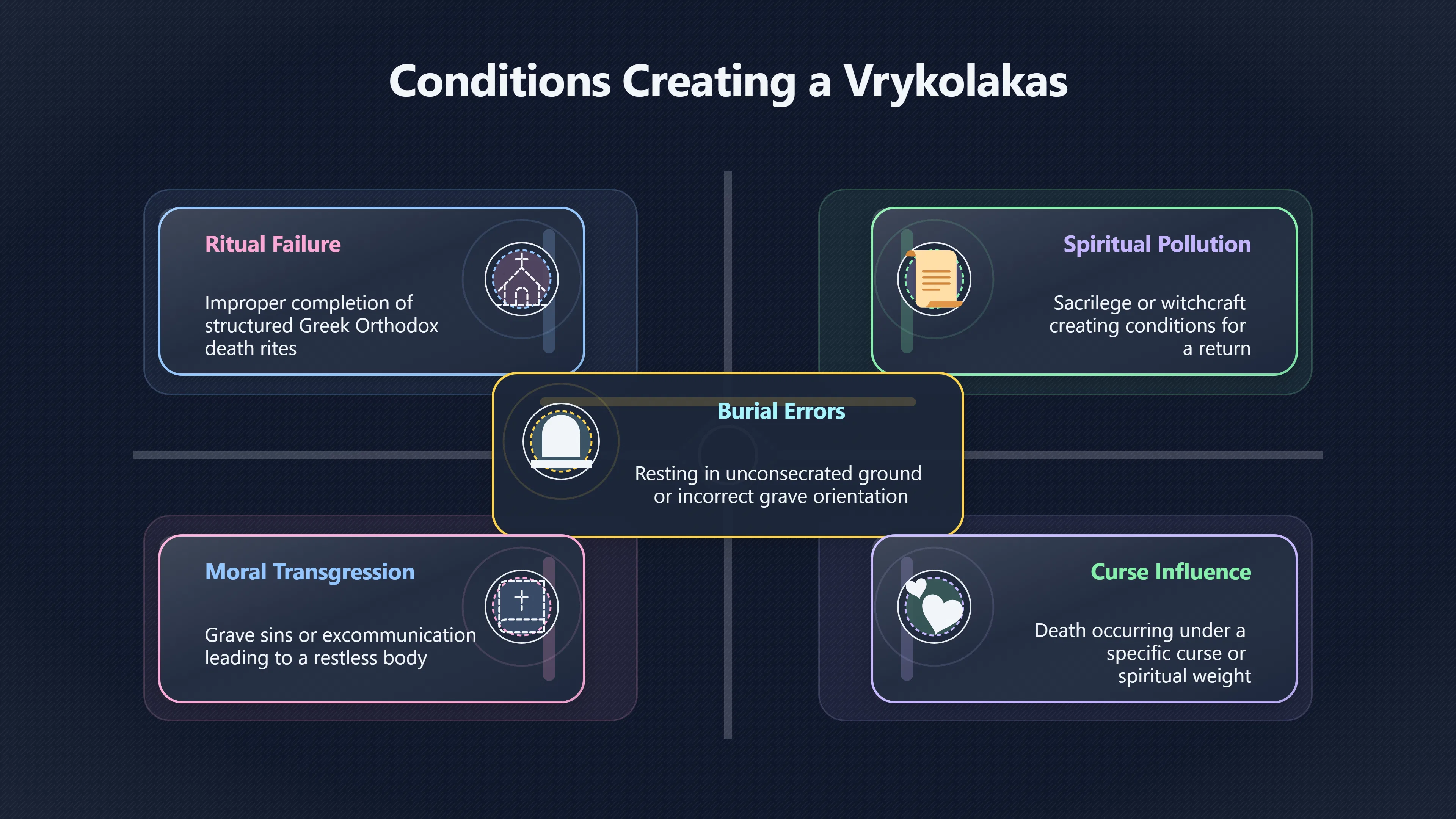
At the heart of vrykolakas belief was the idea that not every death ended properly. A person might return from the grave if they had committed grave sins, been excommunicated, died under a curse, been buried incorrectly, or rested in unconsecrated ground. In some traditions, suicide, sacrilege, witchcraft or other forms of spiritual pollution could also create the conditions for a return.[wikipedia.org]WikipediaOpen source on wikipedia.org.
The crucial issue was not simply whether a person had been good or bad. It was whether the transition from life to death had been completed correctly. Greek Orthodox customs surrounding death were highly structured, and the fate of the soul remained closely connected to the treatment of the body. Folklore linked disruption of these rituals with the possibility that the dead might remain trapped between worlds.[Taylor & Francis Online]tandfonline.comTaylor & Francis OnlineVampire Stories in Greece and the Reinforcement of Socio-…by E Avdikos · 2013 · Cited by 16 — The Greek vampire…
Unlike the pale aristocratic vampire of later fiction, the vrykolakas was usually imagined as a physical corpse. Witnesses and storytellers often described bodies that remained strangely intact, swollen, reddish, or apparently undecayed after burial. Modern scholars such as Paul Barber have argued that many such descriptions reflect ordinary post-mortem processes that pre-scientific communities interpreted as signs that the dead were still active.[Gwern]gwern.netPaul Barber Forensic Pathology and the European VampireThe modern reader might assume that the vampires of the eighteenth century were much like the ghosts of today, which exist in a rather mu…
Because the body itself was thought to be dangerous, communities developed protective measures. Reports describe corpses buried face down, graves supplied with protective objects, or bodies marked with religious symbols intended to prevent a return. Other traditions called for exhumation, dismemberment, burning, or other interventions if a corpse was suspected of becoming a revenant.[Wikipedia]WikipediaOpen source on wikipedia.org.
A striking feature of the tradition is that it focused on community responsibility. The dead person was not merely an individual monster. A failure in burial, ritual care or social obligations could threaten everyone.
Revenants, Disease and Village Fear
Many vrykolakas stories emerged during periods of illness, unexplained deaths or collective anxiety. Villagers might notice that several members of the same family died in quick succession and conclude that a recently deceased relative had returned from the grave to prey upon the living. Folklore often described the revenant visiting homes, suffocating sleepers, spreading sickness, or causing further deaths.[wikipedia.org]WikipediaOpen source on wikipedia.org.
This connection between revenants and epidemics helps explain why the figure became so important. Before modern medicine, communities lacked scientific explanations for contagious disease. When death seemed to spread outward from one household to another, the idea of a restless corpse offered a way to understand what was happening. Barber’s influential work on vampire traditions argues that many vampire panics can be read as attempts to interpret disease, decomposition and grief through the cultural knowledge available at the time.[Gwern]gwern.netPaul Barber Forensic Pathology and the European VampireThe modern reader might assume that the vampires of the eighteenth century were much like the ghosts of today, which exist in a rather mu…
One recurring Greek belief held that a vrykolakas would knock on doors and call out the names of residents. If someone answered too soon, they might die shortly afterwards and join the ranks of the undead themselves. The story reflects a broader concern about contamination and transmission: the revenant’s presence was not isolated but capable of drawing others into its condition.[Wikipedia]WikipediaOpen source on wikipedia.org.
The islands of the Aegean became especially famous for such stories. Secluded communities, strong local traditions and periodic outbreaks of disease created fertile ground for revenant narratives. Some of the best-known historical accounts come from island settings, where suspected vrykolakas cases occasionally triggered dramatic communal responses.[Wikipedia]WikipediaOpen source on wikipedia.org.
The Mykonos Case
One of the most frequently cited examples comes from Mykonos in the early eighteenth century. French traveller Joseph Pitton de Tournefort reported that islanders became convinced a recently dead man had returned as a vrykolakas and was responsible for a series of disturbances. Efforts to stop him reportedly escalated from exhumation to the eventual burning of the corpse. Whether the events occurred exactly as described is impossible to verify, but the account became one of the most influential descriptions of Greek revenant belief in European literature.[Wikipedia]WikipediaOpen source on wikipedia.org.
The significance of the story lies not in proving the existence of a revenant but in demonstrating how seriously such beliefs could be taken. Entire communities sometimes acted collectively when they believed the boundary between the living and the dead had broken down.
What Archaeology Reveals About Fear of the Returning Dead
Folklore is not the only evidence for concern about restless corpses. Archaeologists have uncovered burials in Greece that appear designed to restrain the dead physically. Some graves contain heavy stones, amphora fragments, spikes or other measures apparently intended to prevent a body from rising. Examples span different historical periods and regions.[Wikipedia]WikipediaOpen source on wikipedia.org.
These discoveries do not prove that the individuals buried in such ways were thought to be vrykolakas in the modern folkloric sense. However, they demonstrate a long-standing concern that certain dead people might remain dangerous after burial. Archaeological evidence therefore supports the broader cultural background from which later revenant traditions developed.[Wikipedia]WikipediaOpen source on wikipedia.org.
The continuity is not simple or unbroken. Ancient, Byzantine and modern Greek beliefs differed in important ways. Yet the recurring appearance of protective burial practices suggests that fears of the returning dead remained a persistent feature of Greek cultural history.
How Vampire Labels Changed the Tradition
Modern readers usually encounter the vrykolakas through the word “vampire”, but that classification emerged gradually. The term itself appears to have connections with neighbouring Balkan traditions, and Greek revenant beliefs interacted with Slavic ideas about vampires and werewolves over many centuries. The result was a shared regional world of undead folklore rather than a single, isolated Greek creature.[Wikipedia]WikipediaOpen source on wikipedia.org.
European writers of the seventeenth and eighteenth centuries increasingly treated the vrykolakas as the Greek equivalent of the vampire. During the great vampire controversies of the eighteenth century, reports from Greece were folded into a broader European discussion about the undead. This process helped standardise the figure as a “vampire” in Western imagination.[Wikipedia]WikipediaOpen source on wikipedia.org.
Yet important differences remained. The vrykolakas was often portrayed as a flesh-eating or disease-spreading revenant rather than a blood-drinker. It might behave like a ghostly intruder, a corpse animated by demonic influence, or a source of communal pollution. The emphasis was usually on improper death and social disorder rather than on immortality, seduction or aristocratic glamour.[Wikipedia]WikipediaOpen source on wikipedia.org.
The success of Bram Stoker’s Dracula and later vampire fiction further transformed public understanding. Many readers now approach the vrykolakas expecting fangs, capes and blood-drinking. Folklore scholars generally stress that this comparison can obscure the creature’s original role within Greek belief. The traditional vrykolakas was fundamentally a story about the dangers of unfinished death.[Taylor & Francis Online]tandfonline.comTaylor & Francis OnlineVampire Stories in Greece and the Reinforcement of Socio-…by E Avdikos · 2013 · Cited by 16 — The Greek vampire…
Why the Vrykolakas Still Matters
Today, few Greeks literally fear that a neighbour will return from the grave as a vrykolakas. The figure survives instead as a powerful cultural symbol. It appears in folklore collections, academic studies, horror fiction, tourism narratives and discussions of Balkan vampire traditions.[Academia]academia.edu***** 1 1.Read moreHaunted Communities: the Greek Vampire, or the Uncanny…January 1, 2014 — Key Words: Greece, vampires, revenants, vrykolakas, v…
More importantly, the vrykolakas offers a window into how communities once made sense of mortality. The stories reveal concerns about proper burial, religious belonging, family responsibility, epidemic disease and the fragile boundary separating the living from the dead. They show that what later generations called a vampire was, in Greece, often a much broader and more troubling figure: a sign that death had failed to stay in its proper place.[tandfonline.com]tandfonline.comTaylor & Francis OnlineVampire Stories in Greece and the Reinforcement of Socio-…by E Avdikos · 2013 · Cited by 16 — The Greek vampire…
Amazon book picks
Further Reading
Books and field guides related to The Greek Vampire Was Never Just Dracula. Use these as the next step if you want deeper reading beyond the article.
Vampires, Burial, and Death
Rating: 4.5/5 from 5 Google Books ratings
Directly explains revenant beliefs behind figures like the vrykolakas.
eBay marketplace picks
Marketplace Samples
Live-tested eBay searches with available results related to this page.
Endnotes
1.
Source: Wikipedia
Link:https://en.wikipedia.org/wiki/Vrykolakas
2.
Source: academia.edu
Link:https://www.academia.edu/5573700/The_Phenomenon_of_the_Greek_Revenant_Background_and_Annotated_Bibliography
Source snippet
r vampire. These legends did not start with Stoker's Dracula...
3.
Source: gwern.net
Title: Paul Barber Forensic Pathology and the European Vampire
Link:https://gwern.net/doc/biology/1987-barber.pdf
Source snippet
The modern reader might assume that the vampires of the eighteenth century were much like the ghosts of today, which exist in a rather mu...
4.
Source: greekreporter.com
Link:https://greekreporter.com/2023/06/03/vampires-in-greece-from-ancient-greek-creatures-to-the-vrykolakas/
Source snippet
Vampires in Greece: From Ancient Greek Creatures to the...Jun 3, 2023 — In many stories, a Vrykolakas is even described as bringing dise...
5.
Source: academia.edu
Title: ***** 1 1.Read more
Link:https://www.academia.edu/7320995/Haunted_Communities_the_Greek_Vampire_or_the_Uncanny_at_the_Core_of_Nation_Formation
Source snippet
Haunted Communities: the Greek Vampire, or the Uncanny...January 1, 2014 — Key Words: Greece, vampires, revenants, vrykolakas, v...
Published: January 1, 2014
6.
Source: vampires.com
Title: greece and vampires
Link:https://www.vampires.com/greece-and-vampires/
Source snippet
6 May 2010 — Then on the Adriatic and Aegean coast they were called vrykolakas (the most common of Greek vampires, also known as vrykolok...
Published: May 2010
7.
Source: tandfonline.com
Link:https://www.tandfonline.com/doi/full/10.1080/0015587X.2013.829666
Source snippet
Taylor & Francis OnlineVampire Stories in Greece and the Reinforcement of Socio-...by E Avdikos · 2013 · Cited by 16 — The Greek vampire...
8.
Source: vampires.fandom.com
Title: Revenant (Folklore)
Link:https://vampires.fandom.com/wiki/Revenant_%28Folklore%29
Source snippet
(Folklore) - Vampedia - FandomThe Greek revenant (also known as vrykólakas, broukolakos, or katakhánas (Crete)) is the reanimated corp...
9.
Source: vampires.fandom.com
Link:https://vampires.fandom.com/wiki/Vrykolakas
Source snippet
Vampedia - FandomThese creatures were believed to arise from improper burial rites, unfinished business, or the malevolent influence of...
10.
Source: cookie-pantheon.fandom.com
Link:https://cookie-pantheon.fandom.com/wiki/Vrykolakas
Source snippet
Cookie Pantheon Wiki - FandomThe Greeks traditionally believed that a person could become a Vrykolakas after death due to a sacrilegious...
Additional References
11.
Source: facebook.com
Link:https://www.facebook.com/groups/452346704924545/posts/873950149430863/
Source snippet
Greek vampire beliefs and the VrykolakasThe Greeks traditionally believed that a person could become a vrykolakas after death due to a sa...
12.
Source: researchgate.net
Link:https://www.researchgate.net/publication/288705643_Vampires_burial_and_death_Folklore_and_reality_with_a_new_preface
Source snippet
Vampires, burial, and death: Folklore and realityIn this engrossing book, Paul Barber surveys centuries of folklore about vampires and of...
13.
Source: undinegrimoires.com
Link:https://www.undinegrimoires.com/the-knowledge-library/the-legend-of-the-vrykolakas-greeces-undead-curse
Source snippet
The Legend of the Vrykolakas: Greece's Undead CurseUnlike the romanticized vampire, the Vrykolakas reminds us of what we truly fear—not e...
14.
Source: facebook.com
Link:https://www.facebook.com/sunday.roast.media/posts/the-vampire-myth-of-ancient-greece/1428293919302086/
Source snippet
The Vampire Myth of Ancient GreeceThe first Western accounts of belief in vrykolakas are from the mid 17th century, in compositions by au...
15.
Source: facebook.com
Link:https://www.facebook.com/groups/peloponneseliving/posts/728047822593098/
Source snippet
Vrykolakas: Ancient Greek Vampire Folk Tales ExplainedThe Greeks traditionally believed that a person could become a vrykolakas after dea...
16.
Source: brill.com
Link:https://brill.com/downloadpdf/book/9789047404651/B9789047404651_s011.pdf?srsltid=AfmBOopbm0pjWOnz_WdZfGorzOodP17cwsnVeQJ962EMtfv-BDzquEFR
17.
Source: brill.com
Link:https://brill.com/downloadpdf/book/9789047404651/B9789047404651_s011.pdf?srsltid=AfmBOophQ3C7N5ceO18BVPPHnA9tlrjEgWGPup7rUc93JOiVRfBxhXD2
18.
Source: origins.osu.edu
Title: revenants vampires ghosts european folklore supernatural
Link:https://origins.osu.edu/read/revenants-vampires-ghosts-european-folklore-supernatural
Source snippet
European Folklore...by M Chapman — Both revenants and vampires sustain their immortality by draining the life blood of their human victi...
19.
Source: d1rbsgppyrdqq4.cloudfront.net
Link:https://d1rbsgppyrdqq4.cloudfront.net/s3fs-public/c7/29427/Smith_asu_0010N_10213.pdf
Source snippet
supernatural instead of scientific view of the world, (Barber 108).... Barber, Paul. "...
20.
Source: jahernandez.com
Link:https://www.jahernandez.com/posts/the-vrykolakas-of-greek-folklore
Source snippet
The Vrykolakas of Greek Folklore | Into Horror History19 Apr 2022 — Be buried in unconsecrated ground; Eat meat from an animal...
Topic Tree