Where Nigeria's Spirits Enter Everyday Life
Nigeria’s folklore is not one single mythology but a crowded, living story-world shaped by hundreds of languages, local histories, religions and performance traditions.
Page outline Jump by section
Introduction
The most useful way to understand Nigerian folklore is to start with what it does. These stories entertain, but they also explain origins, warn against greed or arrogance, mark the farming year, authorise kingship, remember the dead, and make invisible forces visible through dance, masks, music and ritual speech. Some traditions are formally recognised by UNESCO, including the Ifa divination system, the oral heritage of Gelede, the Ijele masquerade and the Argungu International Fishing and Cultural Festival.[UNESCO Intangible Cultural Heritage]ich.unesco.orgUNESCO Intangible Cultural HeritageIfa divination systemThe Ifa divination system, which makes use of an extensive corpus of texts and ma…
Why Nigeria’s Folklore Is So Varied
Nigeria sits at a meeting point of forest, savannah, river delta, Atlantic coast and Sahelian trade routes. That geography helps explain why its folklore ranges from sacred groves in the south-west to fishing festivals in the north-west, from river deities and forest spirits to origin legends about desert-linked movement, city-states and dynastic memory. The country’s cultural map is also deeply multilingual: alongside major languages such as Hausa, Yoruba and Igbo, Nigeria contains hundreds of smaller language communities whose stories are often less visible in national summaries.[Ethnologue]ethnologue.comSome of these—Hausa, Igbo, and Yoruba—are official languages in parts of the country. Nigeria was also home…Read more…
This variety means that “Nigerian folklore” is best read as a set of overlapping traditions. Yoruba narratives often foreground deities, divination, sacred kingship, masks and ritual specialists. Igbo traditions are especially rich in ancestral masquerade, market-day cosmology, earth-related ritual ideas and spirit-child motifs. Hausa traditions include courtly origin legends, Islamic-era moral storytelling, praise poetry and animal tales. The Niger Delta and Cross River regions add further bodies of masquerade, water-spirit, witchcraft, initiation and festival traditions, many of which are underrepresented in popular English-language accounts.
A first-time reader should also be careful with labels. “Myth”, “legend”, “religion”, “festival”, “mask” and “story” are not always separate boxes in Nigerian settings. A tale may be told for entertainment in one context, used to explain ancestry in another, performed in a masquerade at a funeral, and later adapted into a novel or film. UNESCO’s description of oral traditions is helpful here: spoken forms such as myths, legends, tales, chants, songs and prayers pass on knowledge, values and collective memory, rather than simply preserving old entertainment.[UNESCO Intangible Cultural Heritage]ich.unesco.orgOpen source on unesco.org.
The Sacred Landscape: Rivers, Groves and Living Shrines
One of Nigeria’s clearest examples of folklore rooted in place is the Osun-Osogbo Sacred Grove in Osun State. UNESCO describes it as the largest, and perhaps the only remaining, example of the sacred groves that once stood near many Yoruba settlements, reflecting Yoruba cosmology through forest, shrines, sculptures and ritual pathways. The site was inscribed as a World Heritage Site in 2005, but its importance is not just architectural or scenic: it remains a sacred place whose meaning depends on continuing respect, worship and community practice.[UNESCO World Heritage Centre]whc.unesco.orgWorld Heritage Centre Osun-Osogbo Sacred GroveWorld Heritage Centre Osun-Osogbo Sacred Grove
The annual Osun-Osogbo festival makes that relationship visible. The grove is linked to Osun, a Yoruba river deity associated in many accounts with fertility, healing, beauty and protection. Devotees, pilgrims and visitors gather there each August, and Nigerian museum sources describe the festival as attracting worshippers, spectators and tourists from many backgrounds.[National Museum Commission]museum.ngOpen source on museum.ng.
What makes Osun-Osogbo especially useful for understanding Nigerian folklore is the way it joins old and new. UNESCO notes that twentieth-century sacred sculptures in the grove, associated with the New Sacred Art movement and the Austrian-born artist Susanne Wenger’s incorporation into the Yoruba community, helped revive the sacred character of the site rather than replacing it with a museum-like display. The grove is therefore not a frozen relic: it is a contested, managed, living landscape where tourism, conservation, ritual authority and artistic renewal all meet.[UNESCO World Heritage Centre]whc.unesco.orgWorld Heritage Centre Osun-Osogbo Sacred GroveWorld Heritage Centre Osun-Osogbo Sacred Grove
The grove also shows why folklore cannot always be separated from environmental rules. UNESCO records that traditional laws, myths, taboos and customs have forbidden fishing, hunting, tree-felling and farming within the grove. In other words, belief has helped protect a physical landscape, while the landscape has kept belief tangible.[UNESCO World Heritage Centre]whc.unesco.orgWorld Heritage Centre Osun-Osogbo Sacred GroveWorld Heritage Centre Osun-Osogbo Sacred Grove

Masquerade: When Spirits Enter the Street
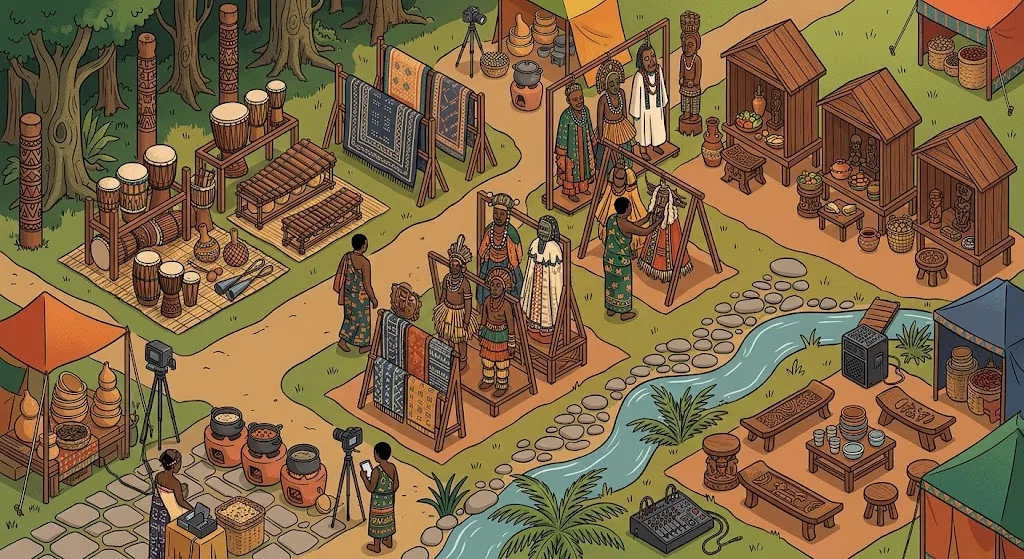
For many Nigerian communities, masquerade is not simply costume drama. It is a way of making the unseen public. Masks and full-body costumes may represent ancestors, spirits, moral authority, social satire, seasonal renewal or the power of a community to judge itself. Their meanings vary sharply by region, but the common thread is that the performer is not treated as an ordinary individual while the masquerade is active.
The Ijele masquerade of south-eastern Nigeria is one of the strongest examples. UNESCO describes Ijele as a towering Igbo masquerade built from colourful fabric over a bamboo framework, decorated with figures and images of life, and divided into upper and lower sections by a large python motif at the centre. It appears at major ceremonies and is protected by attendants, with a mirror that is said to draw in and punish evildoers.[UNESCO Intangible Cultural Heritage]ich.unesco.orgOpen source on unesco.org.
Igbo masquerade more broadly carries both theatrical and judicial force. The Pitt Rivers Museum’s discussion of Igbo masquerades explains that they are perceived as spiritual beings made physically present through masks, and that they have historically played roles in truth-testing, dispute settlement and social regulation. The point is not that every mask has the same function, but that masquerade can turn community values into a visible, moving authority.[prm.ox.ac.uk]prm.ox.ac.ukHeritage Behind Glass | Pitt Rivers MuseumHeritage Behind Glass | Pitt Rivers Museum
Yoruba masking has its own major forms. Gelede, performed among Yoruba-Nago communities in Benin, Nigeria and Togo, is described by UNESCO as a ceremony performed for more than a century in honour of the primordial mother and the social role of women. It combines carved masks, music, dance, satire and public performance, showing that a masquerade tradition can be both sacred and socially observant.[UNESCO Intangible Cultural Heritage]ich.unesco.orgUNESCO Intangible Cultural HeritageOral heritage of GeledeThe Gelede is performed by the Yoruba-Nago community that is spread over Benin…
Lagos has another distinctive example in the Eyo festival, also known as Adamu Orisa. UNESCO’s decision text describes it as a communal event in which the deity Adamu welcomes the recently departed into the spirit world, while other accounts emphasise its role in honouring deceased Lagos rulers or chiefs and marking renewal. The white-clad Eyo figures are now famous as a public image of Lagos culture, but the tradition is still bound to ancestry, ritual authority and local lineage structures rather than being only a tourist parade.[UNESCO Intangible Cultural Heritage]ich.unesco.orgOpen source on unesco.org.
Yoruba Worlds: Divination, Deities and Sacred Knowledge
Yoruba tradition is one of the most internationally visible parts of Nigerian folklore, partly because Yoruba religion and story travelled widely through the Atlantic slave trade and later diasporic religious networks. Within Nigeria, however, Yoruba folklore should not be reduced to a list of deities. It includes origin stories, sacred cities, praise poetry, festivals, divination verses, trickster tales, proverbs, healing traditions, royal myths and everyday moral storytelling.
Ifa is central here. UNESCO describes the Ifa divination system as a practice that uses an extensive corpus of texts and mathematical formulas and is practised among Yoruba communities and in the African diaspora. The word refers to Ifa or Orunmila, regarded in Yoruba tradition as a figure of wisdom and intellectual development.[UNESCO Intangible Cultural Heritage]ich.unesco.orgUNESCO Intangible Cultural HeritageIfa divination systemThe Ifa divination system, which makes use of an extensive corpus of texts and ma…
For a general reader, the key point is that Ifa is not just fortune-telling. It is a vast oral-literary system in which trained specialists interpret signs through memorised verses, narratives and ethical instruction. A consultation may address illness, marriage, conflict, misfortune or uncertainty, but its cultural force lies in the link between story, destiny and social order. UNESCO’s recognition of Ifa in 2008 placed it on the Representative List of the Intangible Cultural Heritage of Humanity, underlining its significance as oral knowledge as well as ritual practice.[UNESCO Intangible Cultural Heritage]ich.unesco.orgUNESCO Intangible Cultural HeritageIfa divination systemThe Ifa divination system, which makes use of an extensive corpus of texts and ma…
Yoruba sacred stories also centre on places. Ile-Ife is often treated in tradition as a place of origin, while Osogbo is inseparable from Osun devotion. These stories are not always historical claims in the modern documentary sense; they are cultural charters, explaining why certain towns, lineages, festivals and ritual offices matter. That is why a sacred grove, a divination tray, a festival chant and a kingship legend can all belong to the same folklore system.
Igbo Traditions: Ancestors, Earth and the Returning Child
Igbo folklore is often vivid because it places invisible forces inside everyday social life: the household, the marketplace, the farming year, the funeral, the child’s body, the mask that enters the village. Origin stories vary, but the Pitt Rivers Museum notes examples in which Chukwu creates or plants the Igbo in their own land, reflecting a strong tradition of indigeneity rather than a single migration story.[prm.ox.ac.uk]prm.ox.ac.ukHeritage Behind Glass | Pitt Rivers MuseumHeritage Behind Glass | Pitt Rivers Museum
Masquerade is one of the major Igbo forms because it allows the dead and the moral community to be represented in public. Some masquerades entertain, some frighten, some satirise, and some are associated with judgement or social control. The Ijele, with its enormous scale and symbolic density, is the most internationally recognised, but it is only one part of a broader masking world.[UNESCO Intangible Cultural Heritage]ich.unesco.orgOpen source on unesco.org.
Another powerful Igbo-linked motif is the spirit-child belief known in English-language scholarship through terms such as abiku and ogbanje. A widely cited medical humanities study describes these beliefs as referring to children believed to cycle repeatedly through birth and death in the same family, a cultural explanation historically linked to repeated infant loss.[Taylor & Francis Online]tandfonline.comOpen source on tandfonline.com.
This motif matters because it shows how folklore can hold grief, medicine, family pressure and metaphysics at once. In older settings, repeated infant deaths might be interpreted as the action of a spirit-child who returns again and again, sometimes requiring ritual intervention. In modern literature, the motif has become a way to explore trauma, identity and liminality rather than simply a “superstition”. It appears in Nigerian literary culture as a serious symbolic language for instability, vulnerability and survival.
The New Yam Festival adds a different Igbo angle: folklore tied to agriculture and gratitude. The festival, held in many Igbo communities at the end of the rainy season, marks the first eating of the new yam and is commonly associated with thanksgiving to deities, ancestors and the land before ordinary consumption begins. While details differ from town to town, the broad pattern links harvest, seniority, communal feasting, masquerade, dance and the renewal of social bonds.[Wikipedia]WikipediaNew Yam Festival of the IgboNew Yam Festival of the Igbo
Hausa Legends and Northern Story Worlds
Northern Nigerian folklore is often shaped by Hausa-language storytelling, Islamic learning, courtly history, praise poetry, animal fables and legends of origin. The most famous Hausa origin legend is the Bayajida story. In the version summarised by the African Union Library record for W. K. R. Hallam’s 1966 article, Bayajida is said to come from Baghdad, pass through Bornu, reach Daura, and become linked to the founders of the seven Hausa states.[AUC Library]library.au.intC Library The Bayajida legend in Hausa Folklore | AUC LibraryC Library The Bayajida legend in Hausa Folklore | AUC Library
The legend is important because it sits between folklore and political memory. It explains dynastic origins, the status of Daura, relations among Hausa states, and the role of outsiders, wells, snakes, marriage and kingship in imagining historical beginnings. Scholars have debated whether the legend preserves distant memories of tenth-century events, North African movements, Berber origin myths or later political storytelling. Hallam’s abstract explicitly presents the tale as a mixture of legendary material and possible historical memory, rather than a straightforward chronicle.[AUC Library]library.au.intC Library The Bayajida legend in Hausa Folklore | AUC LibraryC Library The Bayajida legend in Hausa Folklore | AUC Library
Northern Nigeria also has festival traditions that connect folklore to place and community identity. The Argungu International Fishing and Cultural Festival in Kebbi State is recognised by UNESCO as intangible cultural heritage. UNESCO describes it as a four-day event held between late February and March, featuring water competitions such as hand fishing, canoe racing and other cultural displays.[UNESCO Intangible Cultural Heritage]ich.unesco.orgOpen source on unesco.org.
Argungu’s modern history shows how tradition adapts under pressure. Associated Press reported that the festival returned in 2026 after interruptions linked to insecurity and infrastructure problems; thousands of fishermen entered the Matan Fadan river using traditional techniques such as hand-woven nets, calabash gourds and bare hands. The festival is not “mythology” in the narrow sense, but it belongs on a folklore page because it turns local memory, river knowledge, competition, emirate prestige and communal celebration into repeated public ritual.[AP News]apnews.comBeyond fishing, the festival included cultural activities like wrestling and music, reinforcing its role as a symbol of unity. The event…
Tricksters, Talking Animals and Moonlight Tales
Not all Nigerian folklore is solemn, sacred or ceremonial. Many of the most widely remembered stories are domestic, funny, sharp-edged tales told to children and adults in family settings. Trickster figures, especially the tortoise in many southern Nigerian and wider West African traditions, are famous for intelligence, greed, deception and comic punishment. Public collections of Nigerian folktales repeatedly present tortoise stories as moral entertainment: the trickster wins by cleverness, overreaches through selfishness, and often ends up explaining why something in the world looks the way it does.[Fairytalez]fairytalez.comOpen source on fairytalez.com.
These stories do several jobs at once. They teach children about greed, patience, hospitality, obedience and wit; they train listeners in memory and performance; and they preserve local images of animals, food, kinship, farming and authority. A tortoise story is rarely just “about a tortoise”. It is a compact social lesson disguised as mischief.
Older documentation also matters. The Re:Entanglements project notes that it recreates Nigerian folk stories originally recorded by Northcote W. Thomas during anthropological surveys between 1909 and 1915. That colonial-era collecting context is complicated: such records can preserve early versions of stories, but they also reflect the power relations and translation choices of the people who collected them.[Re-Entanglements]re-entanglements.netnigerian folktalesnigerian folktales
Modern media are extending this tradition in new forms. A 2015 computer animation study on a Yoruba folktale argued that local folktales could be adapted into animated videos for Nigerian audiences, showing how oral stories are being reworked through digital production rather than simply disappearing.[arXiv]arxiv.orgar Xiv3D-Computer Animation for a Yoruba Native Folktalear Xiv3D-Computer Animation for a Yoruba Native Folktale
Spirits, Witches and the Problem of Modern Fear
Nigeria’s supernatural folklore includes spirits, witches, water beings, ancestral forces, spirit-children and ritual specialists. These beliefs should be handled carefully. They are culturally important, but claims about witchcraft or spirit attack can have real social consequences when attached to living people, especially children, widows, elderly people or vulnerable families.
Nollywood has played a major role in reshaping popular images of the supernatural. Scholars and critics have noted that Nigerian films often use witchcraft, ritual power, spirits and occult conflict to dramatise moral disorder, family betrayal, ambition and hidden danger. A Nordic Journal of African Studies article on Yoruba films analyses how witchcraft signs are embedded in contemporary Nollywood storytelling, while media criticism has also warned that some screen portrayals can reinforce fear and stigma rather than simply reflecting tradition.[Nordic Journal of African Studies]njas.fiOpen source on njas.fi.
This does not mean Nollywood “invented” Nigerian supernatural belief. Older traditions already contained spirit worlds, protective medicines, divination, taboo, initiation and stories of harmful hidden power. What modern film has done is make those motifs portable, urban and spectacular. A village rumour, a family curse, a marine spirit, a witchcraft accusation or a ritual bargain can now circulate through cinema, streaming platforms, memes and social media.
The reader should therefore distinguish three things: inherited folklore, living religious belief, and entertainment convention. They overlap, but they are not identical. A film witch is a dramatic device; a local accusation may be socially dangerous; a festival spirit may be a respected ritual form; and a folktale monster may be a moral metaphor. Good folklore reading keeps those differences visible.
What Is Old, What Is Documented, and What Is Still Changing?
Nigeria’s folklore is well attested in some areas and thinly documented in others. UNESCO recognition gives strong evidence for traditions such as Ifa, Gelede, Ijele and Argungu, and the Osun-Osogbo Sacred Grove is supported by World Heritage documentation, museum records and continuing festival practice.[unesco.org]ich.unesco.orgUNESCO Intangible Cultural HeritageIfa divination systemThe Ifa divination system, which makes use of an extensive corpus of texts and ma…
Other traditions are documented through older ethnographic collections, museum catalogues, academic articles, oral-history projects, literature and local performance. These sources are valuable, but they must be read with care. A colonial collector’s transcription of a folktale may preserve rare material while also flattening tone, humour, language and context. A tourist article may accurately describe a festival’s spectacle but miss its ritual authority. A modern internet retelling may make a story accessible while blending regions, simplifying names or adding horror elements that were not central in older versions.
Nigeria’s heritage institutions also matter. The National Commission for Museums and Monuments says its functions include establishing and maintaining a museum system to preserve the nation’s tangible and intangible heritage, standardising the administration of museums and monuments, and promoting Nigerian cultural knowledge.[National Museum Commission]museum.ngOpen source on museum.ng.
At the same time, heritage protection remains uneven. A 2023 article on intangible cultural heritage protection argues that Nigeria’s heritage legislation has struggled to protect intangible heritage adequately, especially oral histories, traditional drama and other non-material practices. That gap matters because folklore often lives in performance, language and memory rather than in objects that can be locked in a museum case.[Ejournals]ejournals.euOpen source on ejournals.eu.
Nigeria’s Folklore Today
Nigerian folklore today is not fading into the past; it is changing medium. It appears in festivals, sacred groves, village masquerades, urban processions, schoolbooks, children’s animation, novels, music videos, Nollywood horror, diaspora religion, museum debates and online retellings. Some forms remain closely guarded by ritual communities. Others have become national symbols or tourist attractions. Others are being simplified into “African mythology” content for global audiences.
The most interesting tension is that folklore has to remain recognisable while continuing to move. If a masquerade becomes only a stage show, something is lost. If a sacred grove becomes only a tourist site, its ritual ecology weakens. If oral tales are preserved only in English prose, their performance style, humour and local language texture can disappear. But if traditions are never adapted, younger audiences may encounter them only as distant heritage.
Nigeria’s folklore is therefore best understood as a living negotiation between memory and reinvention. Its stories ask old questions in local forms: where did we come from, what do the dead want, why does power need restraint, how should a community thank the land, what happens when greed outruns wisdom, and how can the unseen be made visible without losing its force?

Amazon book picks
Further Reading
Books and field guides related to Where Nigeria's Spirits Enter Everyday Life. Use these as the next step if you want deeper reading beyond the article.
African Religions and Philosophy
Broad introduction to beliefs behind folklore and spirits.
eBay marketplace picks
Marketplace Samples
Live-tested eBay searches with available results related to this page.

Endnotes
1.
Source: ethnologue.com
Link:https://www.ethnologue.com/country/NG/
Source snippet
Some of these—Hausa, Igbo, and Yoruba—are official languages in parts of the country. Nigeria was also home...Read more...
2.
Source: ich.unesco.org
Link:https://ich.unesco.org/en/RL/ifa-divination-system-00146
Source snippet
UNESCO Intangible Cultural HeritageIfa divination systemThe Ifa divination system, which makes use of an extensive corpus of texts and ma...
3.
Source: ich.unesco.org
Link:https://ich.unesco.org/en/RL/oral-heritage-of-gelede-00002
Source snippet
UNESCO Intangible Cultural HeritageOral heritage of GeledeThe Gelede is performed by the Yoruba-Nago community that is spread over Benin...
4.
Source: ich.unesco.org
Link:https://ich.unesco.org/en/RL/ijele-masquerade-00194
5.
Source: ich.unesco.org
Link:https://ich.unesco.org/en/RL/argungu-international-fishing-and-cultural-festival-00901
6.
Source: arxiv.org
Link:https://arxiv.org/abs/2511.06531
7.
Source: ich.unesco.org
Link:https://ich.unesco.org/en/oral-traditions-and-expressions-00053
8.
Source: whc.unesco.org
Title: World Heritage Centre Osun-Osogbo Sacred Grove
Link:https://whc.unesco.org/en/list/1118/
9.
Source: museum.ng
Link:https://museum.ng/osun-osogbo-sacred-grove/
10.
Source: whc.unesco.org
Link:https://whc.unesco.org/document/224879
11.
Source: prm.ox.ac.uk
Title: Heritage Behind Glass | Pitt Rivers Museum
Link:https://www.prm.ox.ac.uk/heritage-behind-glass
12.
Source: ich.unesco.org
Link:https://ich.unesco.org/en/Decisions/10.COM/10.b.23
13.
Source: unesco.org
Title: document 3742
Link:https://www.unesco.org/archives/multimedia/document-3742
14.
Source: Wikipedia
Title: New Yam Festival of the Igbo
Link:https://en.wikipedia.org/wiki/New_Yam_Festival_of_the_Igbo
15.
Source: fairytalez.com
Link:https://fairytalez.com/region/nigerian/
16.
Source: re-entanglements.net
Title: nigerian folktales
Link:https://re-entanglements.net/nigerian-folktales/
17.
Source: arxiv.org
Title: ar Xiv3D-Computer Animation for a Yoruba Native Folktale
Link:https://arxiv.org/abs/1508.03840
18.
Source: museum.ng
Link:https://museum.ng/functions-of-ncmm/
19.
Source: ejournals.eu
Link:https://ejournals.eu/czasopismo/saaclr/artykul/intangible-cultural-heritage-protection-and-nigerias-heritage-legislation
20.
Source: Wikipedia
Title: Culture of Nigeria
Link:https://en.wikipedia.org/wiki/Culture_of_Nigeria
21.
Source: Wikipedia
Link:https://en.wikipedia.org/wiki/UNESCO
22.
Source: Wikipedia
Title: Ijele Masquerade
Link:https://en.wikipedia.org/wiki/Ijele_Masquerade
23.
Source: Wikipedia
Title: List of Intangible Cultural Heritage elements in Nigeria
Link:https://en.wikipedia.org/wiki/List_of_Intangible_Cultural_Heritage_elements_in_Nigeria
24.
Source: Wikipedia
Link:https://en.wikipedia.org/wiki/Orisha
25.
Source: Wikipedia
Link:https://en.wikipedia.org/wiki/Bayajidda
26.
Source: Wikipedia
Link:https://en.wikipedia.org/wiki/Mmanwu
27.
Source: Wikipedia
Title: Osun Osogbo
Link:https://en.wikipedia.org/wiki/Osun-Osogbo
28.
Source: Wikipedia
Title: Eyo festival
Link:https://en.wikipedia.org/wiki/Eyo_festival
29.
Source: Wikipedia
Link:https://en.wikipedia.org/wiki/If%C3%A1
30.
Source: Wikipedia
Title: Languages of Nigeria
Link:https://en.wikipedia.org/wiki/Languages_of_Nigeria
31.
Source: unesco.org
Link:https://www.unesco.org/en
32.
Source: unesco.org
Title: document 355
Link:https://www.unesco.org/archives/multimedia/document-355
33.
Source: ich.unesco.org
Title: nigeria NG
Link:https://ich.unesco.org/en/state/nigeria-NG?info=periodic-reporting
34.
Source: ich.unesco.org
Title: 10b representative list 00779
Link:https://ich.unesco.org/en/10b-representative-list-00779?id=01066&include=slideshow_inc.php
35.
Source: ich.unesco.org
Title: nigeria NG
Link:https://ich.unesco.org/en/state/nigeria-NG?call=film&id=01185&include=film_inc.php&width=700
36.
Source: ich.unesco.org
Link:https://ich.unesco.org/en/video/1185
37.
Source: ich.unesco.org
Title: search 00795
Link:https://ich.unesco.org/en/search-00795?call=film&id=01185&include=film_inc.php&width=700
38.
Source: ich.unesco.org
Title: nigeria NG
Link:https://ich.unesco.org/en/state/nigeria-NG
39.
Source: ich.unesco.org
Link:https://ich.unesco.org/en/decisions/11.COM/10.B.23
40.
Source: ich.unesco.org
Title: 10b representative list 00891
Link:https://ich.unesco.org/en/10b-representative-list-00891?id=00901&include=slideshow_inc.php
41.
Source: ich.unesco.org
Link:https://ich.unesco.org/en/events?call=film&id=38861&include=film_inc.php&width=700
42.
Source: ich.unesco.org
Link:https://ich.unesco.org/en/video/41723
43.
Source: ich.unesco.org
Title: open itadogun 00659
Link:https://ich.unesco.org/en/activities/open-itadogun-00659
44.
Source: museum.ng
Link:https://museum.ng/
45.
Source: youtube.com
Title: What REALLY Happened at the Beginning of Time? The Yoruba Creation Myth
Link:https://www.youtube.com/watch?v=1K3Bxtg5GRg
Source snippet
Ijele masquerade...
46.
Source: youtube.com
Title: Ijele masquerade
Link:https://www.youtube.com/watch?v=dpCPPiae4yU
Source snippet
Ifá Divination: The Ancient Science of Destiny [Full Guide]...
47.
Source: garlandmag.com
Link:https://garlandmag.com/article/eyo/
48.
Source: tandfonline.com
Link:https://www.tandfonline.com/doi/abs/10.1080/13694670600621795
49.
Source: library.au.int
Title: C Library The Bayajida legend in Hausa Folklore | AUC Library
Link:https://library.au.int/bayajida-legend-hausa-folklore-4
50.
Source: apnews.com
Link:https://apnews.com/article/e9c7577dc3aaabbfdd051343742b9acd
Source snippet
Beyond fishing, the festival included cultural activities like wrestling and music, reinforcing its role as a symbol of unity. The event...
51.
Source: njas.fi
Link:https://www.njas.fi/njas/article/download/774/565
52.
Source: oriire.com
Link:https://oriire.com/codex/new-yam-festival
53.
Source: oriire.com
Link:https://oriire.com/codex/eyo-festival
54.
Source: postcolonial.org
Link:https://www.postcolonial.org/index.php/pct/article/download/2968/2661
55.
Source: journals.ezenwaohaetorc.org
Link:https://journals.ezenwaohaetorc.org/index.php/UJOCC/article/download/3878/3989
56.
Source: journals.ezenwaohaetorc.org
Link:https://journals.ezenwaohaetorc.org/index.php/COOUJOFOCUS/article/download/3187/3324
57.
Source: acujoh.acu.edu.ng
Link:https://acujoh.acu.edu.ng/index.php/acujoh/article/download/118/62
Additional References
58.
Source: youtube.com
Title: Gizo: The Cunning Trickster of Hausa Legend | Mythlok
Link:https://www.youtube.com/watch?v=9elQX1G4y_k
Source snippet
The Three Visitors | A Nigerian Folktale About Patience & Blessings...
59.
Source: youtube.com
Title: Ifá Divination: The Ancient Science of Destiny [Full Guide]
Link:https://www.youtube.com/watch?v=3UXhk7H8gak
Source snippet
Gizo: The Cunning Trickster of Hausa Legend | Mythlok...
60.
Source: facebook.com
Link:https://www.facebook.com/NewsCentralAfrica/videos/nigeria-is-one-of-the-most-linguistically-diverse-countries-in-the-world-with-ov/1280285716738217/
61.
Source: academia.edu
Link:https://www.academia.edu/33312569/Media_Tradition_and_folktales_in_Nigeria
62.
Source: researchgate.net
Link:https://www.researchgate.net/publication/376553421_Intangible_Cultural_Heritage_Protection_and_Nigeria%27s_Heritage_Legislation
63.
Source: researchgate.net
Link:https://www.researchgate.net/publication/229053521_Ogbanjeabiku_and_cultural_conceptualizations_of_psychopathology_in_Nigeria
64.
Source: sav.sk
Link:https://www.sav.sk/journals/uploads/06281307Africans%20Concept%20of%20Masquerades%20and%20Their%20Role%20in%20Societal%20Control%20and%20Stability%20Some%20Notes%20on%20the%20%20Esan%20People%20of%20Southern%20Nigeria.pdf
65.
Source: researchgate.net
Link:https://www.researchgate.net/publication/352056511_Perception_of_the_Portrayal_of_Witchcraft_in_Nollywood_Movies_among_Benin_Residents
66.
Source: researchgate.net
Link:https://www.researchgate.net/publication/353447038_Language_Diversity_and_the_Problem_of_Ethnicity_in_Nigeria_Any_Solution_in_Sight
67.
Source: researchgate.net
Link:https://www.researchgate.net/publication/359736012_THE_TRANSFORMATION_AND_SIGNIFICANCE_OF_THE_NEW_YAM_FESTIVAL_IN_CONTEMPORARY_IGBO_SOCIETY_OF_NIGERIA
Topic Tree
Follow this branch
Related pages 192
- Afghan Folklore
- Albanian Folklore
- Algerian Folklore
- Australian Folklore
- Azerbaijan Folklore
- +187 more in sidebar