Where Costa Rica's Legends Still Walk
Costa Rica’s folklore is best understood as a living mix of Indigenous cosmology, Catholic devotion, colonial ghost stories, rural morality tales, regional legends and public festival culture.
Page outline Jump by section
Introduction
The country’s folklore also reaches beyond ghosts. Bribri and Cabécar traditions in Talamanca preserve creation stories centred on Sibö, while national customs such as masquerades, oxcart parades and the pilgrimage to Cartago show how story, craft, religion and public performance still shape Costa Rican cultural life. Costa Rican folklore is therefore not one single mythology, but a layered tradition: Indigenous, Spanish colonial, Catholic, Afro-Caribbean, rural, literary and modern all at once.[ucr.ac.cr]dipalicori.ucr.ac.crDipalicori Resources Available in DIPALICORI BribriDipalicori Resources Available in DIPALICORI Bribri
What makes Costa Rican folklore distinctive?
Costa Rican folklore often feels intimate rather than epic. Many of its most famous beings do not rule cosmic kingdoms or fight heroic wars. They wait on lonely roads, cry near rivers, rattle chains in the dark, cross village squares, appear at dances, or make a traveller think twice about going out at night. That scale matters. The legends are strongly tied to everyday settings: the path home, the riverbank, the church, the old capital of Cartago, the plains of Guanacaste, the family kitchen and the community festival.
A useful way to read these traditions is to see them as stories about thresholds. The characters appear when people cross a boundary: night and day, village and wilderness, sobriety and excess, devotion and irreverence, youth and adulthood, safety and danger. In the academic article “El Cadejos sí existe”, Alexánder Sánchez Mora criticises older dictionary traditions for reducing Costa Rican supernatural beings to “popular superstition” and instead proposes definitions that respect their role within shared community experience.[Revistas UCR]revistas.ucr.ac.crRevistas UCR
Costa Rican folklore is also strongly regional. Some legends circulate across Central America in recognisable forms, such as the Cegua, the weeping woman and the Cadejos. Others have especially Costa Rican or local emphasis: the witch Zárate and the enchanted stone of Aserrí, the Guanacastecan Mona, Cartago’s Virgin of the Angels, and the festive tradition of giant masks. University of Costa Rica material on Costa Rican legends notes that collections often group them into legends of land, religion and magic, with especially popular examples including the Cadejos, the Cegua and the weeping woman.[Revistas UCR]revistas.ucr.ac.crRevistas UCRla leyenda guanacasteca “la mona”: estrategia didácticaRevistas UCRla leyenda guanacasteca “la mona”: estrategia didáctica
The night-road legends readers usually meet first
The most familiar Costa Rican supernatural beings tend to be cautionary figures. They are frightening, but their fright is not random. They police behaviour, dramatise social fears and turn familiar landscapes into moral theatre.
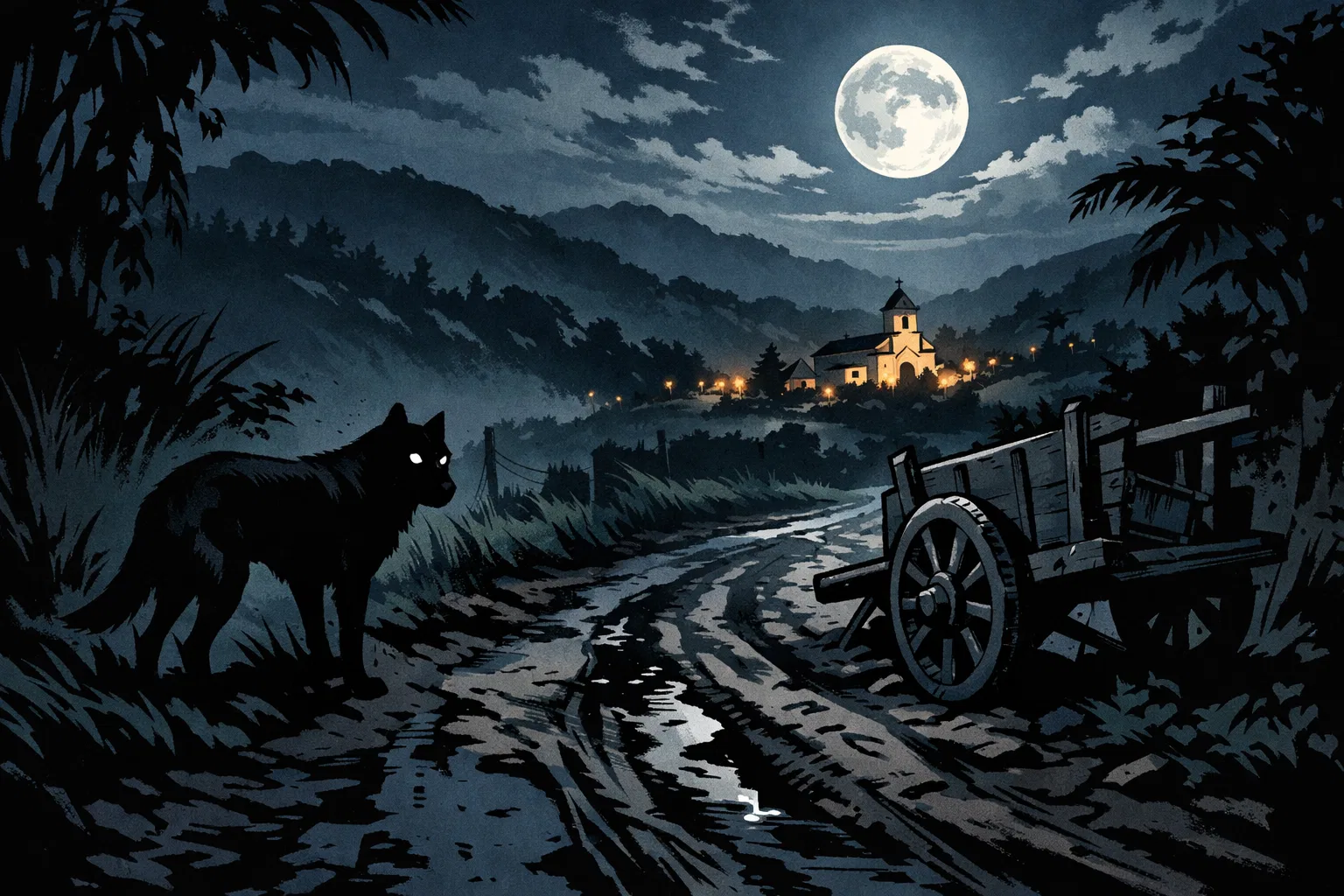
The Cadejos is usually described as a large black dog with glowing eyes, dragging chains, appearing at night in lonely places. Sánchez Mora’s proposed folkloric definition presents it as a being that appears to night revellers in order to frighten them and push them towards better conduct.[Revistas UCR]revistas.ucr.ac.crRevistas UCR This is why the Cadejos works so well as a rural road legend: it makes noise, darkness and the fear of being followed into a story about personal reform.
The Cegua, sometimes written as Segua, is another major Costa Rican figure. In the common form, she appears as a beautiful woman travelling by night. A man approaches her with romantic or sexual intent, and she transforms into a monstrous being with a mare’s head. Sánchez Mora’s definition stresses the lonely night setting, the seductive encounter and the sudden revelation of the horse-headed form.[Revistas UCR]revistas.ucr.ac.crRevistas UCR The story can be read as a warning against drunkenness, womanising or unsafe travel, but it also reflects older gendered anxieties about desire, appearance and punishment.
The weeping woman belongs to a wider Latin American family of stories, but Costa Rican versions attach her to rivers, roads and the grief of a mother searching for a dead or lost child. Educational research from the University of Costa Rica describes Costa Rican versions in which she wanders in search of a son who died in a river, while noting parallels across Latin America.[Revistas UCR]revistas.ucr.ac.crRevistas UCRBeneficios de la leyenda para la comprensión lectora, unRevistas UCRBeneficios de la leyenda para la comprensión lectora, un Her power lies in sound: the cry heard at night is often more important than any detailed visual encounter.
Other figures belong to the same night-world. The headless priest evokes religious fear and unresolved sin. The oxless cart turns a familiar rural vehicle into an uncanny sound moving without human or animal guidance. The Tulevieja, shared with neighbouring Panama in some tellings, appears as a frightening female figure linked to abandonment, maternity and wild places. These beings are part of a broader Costa Rican habit of placing the supernatural close to ordinary movement through the landscape.

Indigenous cosmology is not the same as colonial ghost lore
A serious account of Costa Rican folklore has to distinguish Indigenous cosmology from later Spanish-language ghost and morality legends. Costa Rica is home to eight Indigenous peoples, including Bribri, Cabécar, Maleku, Brunca, Ngäbe, Brörán, Huetar and Chorotega communities; recent Indigenous-rights reporting describes 24 Indigenous territories inhabited by eight peoples.[IWGIA]iwgia.org5381 iw 2024 costa rica5381 iw 2024 costa rica Their traditions are not merely “older versions” of the familiar ghost stories. They are religious, ecological, linguistic and social knowledge systems with their own structures.
For the Bribri and Cabécar of Talamanca, Sibö is a central creator and culture hero. University of Costa Rica’s DIPALICORI project documents Bribri language resources, including an oral corpus with annotated texts, translations and audio, showing that oral tradition remains tied to language preservation rather than just story collection.[Dipalicori]dipalicori.ucr.ac.crDipalicori Resources Available in DIPALICORI BribriDipalicori Resources Available in DIPALICORI Bribri Scholarly summaries of Bribri oral tradition describe Sibö as a major figure in narratives about the making of the world, the ordering of society and the origin of human beings.[LSU Scholarly Repository]repository.lsu.edugradschool dissthesesgradschool disstheses
These traditions often bind story to land, food, kinship and ritual. Bribri accounts associated with Sibö include themes of creation, instruction, agriculture and moral order. The point is not simply that Costa Rica has “myths” as well as “legends”, but that different communities preserve different kinds of sacred knowledge. A ghost story about a roadside apparition and a Bribri creation narrative do not operate in the same cultural register, even though both belong within the country’s wider traditional story culture.
Sacred places: Cartago, Aserrí and landscapes that remember
Costa Rican folklore is unusually place-conscious. A legend often answers the question “Why does this place matter?” rather than simply “What happened?” The landscape becomes readable through stories.
The most important national example is the devotion to the Virgin of the Angels in Cartago. According to the traditional account, a small dark image of the Virgin was found in 1635 by Juana Pereira; when removed, it returned to the place of discovery, leading the community to understand the site as chosen. Modern accounts of the annual pilgrimage describe people walking to Cartago each August to honour the country’s patron saint, with the story of the image at the centre of the devotion.[Tico Times]ticotimes.netla negrita faith unity and the heart of costa ricala negrita faith unity and the heart of costa rica This is folk religion rather than a ghost legend: its force comes from miracle, repetition, sacred geography and national identity.
Aserrí offers a different kind of landscape legend. The witch Zárate is associated with the famous stone of Aserrí, and University of Costa Rica scholarship notes her place in modern literary refashioning of Costa Rican folklore, where she appears alongside figures such as the Cadejos, the Tulevieja, the headless priest and the weeping woman.[Revistas UCR]revistas.ucr.ac.crRevistas UCR In such stories, a natural landmark becomes a container for memory, warning and enchantment.
Volcanoes, rivers and mountains also attract explanatory legends. These stories may be tourist-friendly today, but their older function is more interesting: they give personality to places. A river’s cry, a mountain’s name or a strange rock formation can become evidence of a past event, a moral rupture or an encounter with non-human power. The result is a folklore of landscape in which geography is never entirely silent.
Masquerades turn legends into public performance
Costa Rican folklore is not confined to storytelling. It is danced, worn, carved, painted and paraded. The traditional masquerade is one of the clearest examples: large masks and costumed figures appear in community festivities, often accompanied by lively local bands. Government cultural heritage material on masks and masquerades describes Costa Rica as a multi-ethnic country whose traditions draw on Indigenous, Spanish and other cultural inheritances.[patrimonio.go.cr]patrimonio.go.crOpen source on go.cr.
The masquerade tradition matters because it makes folklore social. Devils, giants, old women, animals, political caricatures and legendary figures can all become moving public images. Children may be frightened, amused or chased; adults recognise local jokes and inherited characters. A mask is therefore not just a prop. It is a portable story.
Costa Rica also marks 31 October as the National Day of the Traditional Costa Rican Masquerade, a date that gives a local cultural counterweight to imported Halloween imagery. Recent reporting quotes Costa Rica’s culture minister describing masquerades as a national symbol that unites communities, strengthens roots and passes cultural pride between generations.[Tico Times]ticotimes.netTico Times Costa Rica Masquerade Day Brings Communities TogetherTico Times Costa Rica Masquerade Day Brings Communities Together The date shows how folklore adapts: old forms survive partly because they can compete, combine and reappear in modern public calendars.
Oxcarts, sound and the folklore of rural life
The decorated oxcart is not a monster or a ghost, but it belongs in any serious account of Costa Rican traditional culture. UNESCO lists oxherding and oxcart traditions in Costa Rica as intangible cultural heritage, noting that the oxcart became the country’s best-known craft and dates from the mid-nineteenth-century coffee economy.[ICH UNESCO]ich.unesco.orgOpen source on unesco.org.
This matters for folklore because the oxcart links labour, sound, movement and identity. Historically, carts transported coffee from the Central Valley towards the Pacific coast, and their distinctive construction and decoration became symbols of rural Costa Rican life. UNESCO describes the carts’ use in coffee transport and their famous painted designs, showing how a practical object became a cultural emblem.[UNESCO]unesco.orgdocument 620document 620
The uncanny “oxless cart” legend draws power from that same familiarity. A cart heard moving without oxen is frightening because everyone knows what a real cart should sound like and how it should move. Folklore often works in exactly this way: it takes the most recognisable object in a community and removes one essential part.
Guanacaste and regional witch traditions
Guanacaste has a particularly strong regional flavour within Costa Rican folklore. The province is associated with plains, cattle culture, music, dance, borderland histories and stories with a distinct local identity. One of its most discussed legends is the Mona, a frightening female creature or transformed woman who appears at night, sometimes linked to witchcraft and attacks on people.
A University of Costa Rica article treats the Guanacastecan Mona as a teaching resource because legends can strengthen cultural memory, oral expression and critical thinking. It describes how such stories help students discuss old Costa Rican customs, values and beliefs rather than treating the legend merely as entertainment.[Revistas UCR]revistas.ucr.ac.crRevistas UCRla leyenda guanacasteca “la mona”: estrategia didácticaRevistas UCRla leyenda guanacasteca “la mona”: estrategia didáctica That is a useful clue for readers: the Mona is not only a monster story, but also a regional memory device.
The same article notes that legends are often told or read in ways that reinforce local identity, encourage discussion and connect listeners with historical and social context.[Revistas UCR]revistas.ucr.ac.crRevistas UCRla leyenda guanacasteca “la mona”: estrategia didácticaRevistas UCRla leyenda guanacasteca “la mona”: estrategia didáctica This is why regional legends matter. A national list of monsters can flatten Costa Rican folklore, while local tellings show how different provinces imagine danger, morality and belonging in their own voices.
Literature and popular culture keep the old beings moving
Costa Rican legends have long moved between oral tradition, newspapers, books, theatre, film, classrooms, comics and tourism. Sánchez Mora notes that beings from Costa Rican narrative folklore have appeared in national literature at least since the appearance of the weeping woman in early literary collections, and he discusses modern refashionings such as a 2008 novel that gathers the witch Zárate, the Cadejos, the Tulevieja, the headless priest, the weeping woman and other beings into a new adventure plot.[Revistas UCR]revistas.ucr.ac.crRevistas UCR
This movement is important because it prevents a false split between “authentic oral tradition” and “modern invention”. A legend can be old and still change. It can be collected in print, adapted for children, used in a film, turned into a school exercise, commercialised for tourism, or revived in a festival. Each new version may preserve something and distort something.
University of Costa Rica research on fantastic monsters in Costa Rican literature notes literary treatments of the Cadejos, the weeping woman, the oxless cart and the Cegua, including poetic and narrative uses that helped connect popular spectres with national literary identity.[Revistas UCR]revistas.ucr.ac.crRevistas UCRMonst RUos Fantásti Cos en La Lite Rat URa Costa RRi CenseRevistas UCRMonst RUos Fantásti Cos en La Lite Rat URa Costa RRi Cense This is one reason Costa Rican folklore remains visible: writers and artists repeatedly return to the same figures because they are instantly recognisable, emotionally flexible and culturally charged.
How old and well-attested are these traditions?
The evidence varies by tradition. Some Indigenous narratives have deep roots but are often documented through modern linguistic, ethnographic and community projects, such as Bribri oral texts and language resources.[Dipalicori]dipalicori.ucr.ac.crDipalicori Resources Available in DIPALICORI BribriDipalicori Resources Available in DIPALICORI Bribri Catholic folk traditions such as the Virgin of the Angels have a strong historical frame, with the 1635 discovery narrative and the August pilgrimage forming part of a long national devotion.[Tico Times]ticotimes.netla negrita faith unity and the heart of costa ricala negrita faith unity and the heart of costa rica
For the classic ghostly beings of Spanish-language Costa Rican folklore, printed evidence appears clearly in nineteenth- and twentieth-century collections, dictionaries and literary adaptations. Sánchez Mora notes that Carlos Gagini’s 1892 dictionary included several beings from Costa Rican narrative folklore, including the Cadejos and Cegua, although older lexicographic language often dismissed them as vulgar belief or superstition.[Revistas UCR]revistas.ucr.ac.crRevistas UCR The same article lists early twentieth-century newspaper and literary treatments of the oxless cart, Cadejos, Cegua and weeping woman.[Revistas UCR]revistas.ucr.ac.crRevistas UCR
That means readers should be careful with claims of exact antiquity. A legend may have oral roots older than its first printed version, but the printed record does not automatically prove how far back it goes. The safest statement is that Costa Rica’s best-known legends are well attested in modern oral, literary, educational and cultural heritage contexts, with some figures documented in national lexicography and literature from at least the late nineteenth and early twentieth centuries.
What is often misunderstood about Costa Rican folklore?
The first misunderstanding is that Costa Rican folklore is only a set of scary stories. The frightening beings are popular, but they sit beside sacred narratives, pilgrimage, craft traditions, Indigenous cosmology, festival performance and regional identity.
The second misunderstanding is that shared Central American legends are “not really Costa Rican”. Folklore does not obey modern borders neatly. The Cegua, the weeping woman and the Cadejos have relatives across Central America and Latin America, but Costa Rican versions still matter because they are adapted to Costa Rican settings, speech, moral concerns and literary history. Educational research explicitly notes that stories such as the weeping woman and Cadejo-type figures circulate with similarities and variations across Latin America and Central America.[Revistas UCR]revistas.ucr.ac.crRevistas UCRBeneficios de la leyenda para la comprensión lectora, unRevistas UCRBeneficios de la leyenda para la comprensión lectora, un
The third misunderstanding is that modern adaptation ruins folklore. In reality, adaptation is one of the signs that a tradition is alive. A being such as the Cegua can be an oral warning, a literary figure, a classroom text, a parade mask, a tourist reference and a pop-culture image. These versions are not all equally old or equally faithful, but they show how the figure continues to work.
The fourth misunderstanding is that “belief” must mean literal belief in a creature’s physical existence. Folklore is subtler than that. People may tell a story as warning, memory, humour, identity, sacred narrative, local pride, childhood fear or moral commentary. Sánchez Mora’s critique of dismissive dictionary definitions is useful here: the social reality of the legend lies in how communities transmit, experience and value it.[Revistas UCR]revistas.ucr.ac.crRevistas UCR
Why Costa Rican folklore still matters today
Costa Rican folklore matters because it gives the country a story-map. It tells people which roads are dangerous, which places are sacred, which behaviours are mocked or punished, which objects are symbols of national memory, and which communities preserve knowledge older than the republic itself.
It also matters because it offers a more complex cultural image than the usual tourist shorthand of beaches, rainforests and wildlife. The Costa Rica of folklore includes Bribri oral tradition, Cartago pilgrimage, Guanacaste witch legends, painted oxcarts, giant masks, literary monsters and ghostly roads. Some of these traditions are deeply local; others are national symbols; others are shared across borders. Together, they show a country whose supernatural imagination is grounded in land, movement, family, devotion and community performance.
The best way to approach Costa Rican folklore is therefore neither to over-believe nor to sneer. These are traditions, not laboratory claims. Their value lies in what they reveal about fear, morality, humour, memory, sacred geography and cultural continuity. Costa Rica’s legends endure because they are useful stories: they make the familiar strange, the landscape meaningful and the past audible in the present.
Amazon book picks
Further Reading
Books and field guides related to Where Costa Rica's Legends Still Walk. Use these as the next step if you want deeper reading beyond the article.
Costa Rican Folk Tales: Stories of La Mona, La Llorona and Ot...
Covers many of the country's best-known supernatural tales.
The Encyclopedia of Latin American Folklore and Popular Culture
Useful background on Costa Rican folk culture.
eBay marketplace picks
Marketplace Samples
Live-tested eBay searches with available results related to this page.
Endnotes
1.
Source: ich.unesco.org
Link:https://ich.unesco.org/en/RL/oxherding-and-oxcart-traditions-in-costa-rica-00103
2.
Source: revistas.ucr.ac.cr
Title: Revistas UCR
Link:https://revistas.ucr.ac.cr/index.php/kanina/article/download/2335/2294
3.
Source: revistas.ucr.ac.cr
Title: Revistas UCRBeneficios de la leyenda para la comprensión lectora, un
Link:https://revistas.ucr.ac.cr/index.php/educacion/article/download/51946/54288/231452
4.
Source: iwgia.org
Title: 5381 iw 2024 costa rica
Link:https://iwgia.org/en/costa-rica/5381-iw-2024-costa-rica.html
5.
Source: repository.lsu.edu
Title: gradschool disstheses
Link:https://repository.lsu.edu/gradschool_disstheses/6022/
6.
Source: patrimonio.go.cr
Link:https://www.patrimonio.go.cr/biblioteca_digital/publicaciones/2007/macaras_mascaradas_mascareros.pdf
7.
Source: unesco.org
Title: document 620
Link:https://www.unesco.org/archives/multimedia/document-620
8.
Source: revistas.ucr.ac.cr
Title: Revistas UCRMonst RUos Fantásti Cos en La Lite Rat URa Costa RRi Cense
Link:https://revistas.ucr.ac.cr/index.php/filyling/article/download/26466/26697
9.
Source: iwgia.org
Link:https://iwgia.org/en/costa-rica.html
10.
Source: iwgia.org
Title: 5984 iw 2026 costa rica
Link:https://iwgia.org/en/costa-rica/5984-iw-2026-costa-rica.html
11.
Source: iwgia.org
Link:https://iwgia.org/en/costa-rica.html?origin=11&start=6
12.
Source: costa.cl
Link:https://www.costa.cl/
13.
Source: patrimonio.go.cr
Link:https://www.patrimonio.go.cr/contentfilter/
14.
Source: patrimonio.go.cr
Link:https://www.patrimonio.go.cr/biblioteca_digital/publicaciones/2013/elaboracion_mascaras.pdf
15.
Source: patrimonio.go.cr
Link:https://www.patrimonio.go.cr/biblioteca_digital/publicaciones/2008/tradiciones_2006.pdf
16.
Source: patrimonio.go.cr
Link:https://www.patrimonio.go.cr/biblioteca_digital/publicaciones/2010/expresiones_culturales.pdf
17.
Source: patrimonio.go.cr
Link:https://www.patrimonio.go.cr/biblioteca_digital/publicaciones/2014/Creadores%20y%20Artistas%20Circuito%20Cultural%20Liberia.pdf
18.
Source: patrimonio.go.cr
Link:https://www.patrimonio.go.cr/biblioteca_digital/publicaciones/2023/LIBRO%20TOPE%20TOROS_2023%201.pdf
19.
Source: patrimonio.go.cr
Title: patrimonio cultural 02
Link:https://www.patrimonio.go.cr/biblioteca_digital/publicaciones/2010/patrimonio_cultural_02.pdf
20.
Source: patrimonio.go.cr
Title: Inventario Cultural del canton de Santa Cruz
Link:https://www.patrimonio.go.cr/biblioteca_digital/publicaciones/2020/Inventario%20Cultural%20del%20canton%20de%20Santa%20Cruz.pdf
21.
Source: patrimonio.go.cr
Link:https://www.patrimonio.go.cr/biblioteca_digital/publicaciones/2024/Cocina%20tradicional%20Los%20Santos_2020.pdf
22.
Source: folklore.earth
Link:https://www.folklore.earth/culture/bribri/
23.
Source: dipalicori.ucr.ac.cr
Title: Dipalicori Resources Available in DIPALICORI Bribri
Link:https://dipalicori.ucr.ac.cr/en/recursos-bribri/
24.
Source: ticotimes.net
Title: la negrita faith unity and the heart of costa rica
Link:https://ticotimes.net/2025/08/02/la-negrita-faith-unity-and-the-heart-of-costa-rica
25.
Source: revistas.ucr.ac.cr
Title: Revistas UCRla leyenda guanacasteca “la mona”: estrategia didáctica
Link:https://revistas.ucr.ac.cr/index.php/intersedes/article/download/41973/42268
26.
Source: ticotimes.net
Title: Tico Times Costa Rica Masquerade Day Brings Communities Together
Link:https://ticotimes.net/2025/10/29/costa-rica-celebrates-cultural-roots-with-masquerade-day-parade
27.
Source: revistas.ucr.ac.cr
Link:https://www.revistas.ucr.ac.cr/index.php/intersedes/article/download/41973/42373?inline=1
28.
Source: dipalicori.ucr.ac.cr
Title: ucr.ac.cr Description and documentation of Bribri
Link:https://dipalicori.ucr.ac.cr/en/descripcion-bribri/
29.
Source: Wikipedia
Link:https://en.wikipedia.org/wiki/Tulevieja
30.
Source: ticotimes.net
Link:https://ticotimes.net/2025/10/31/from-the-weeping-woman-to-the-naked-gringo-a-guide-to-costa-rica-s-spookiest-folklore
31.
Source: tourism.co.cr
Link:https://www.tourism.co.cr/costa-rica-art-and-culture/costa-rica-cultural-heritage/legends.html
32.
Source: monster.fandom.com
Link:https://monster.fandom.com/wiki/Tulevieja
33.
Source: myguidecostarica.com
Title: Costa Rica
Link:https://www.myguidecostarica.com/travel-articles/costa-rica—legend-of-la-segua
Additional References
34.
Source: youtube.com
Title: Ghostly Myths of Costa Rica
Link:https://www.youtube.com/watch?v=USmTA8ylJxU
Source snippet
"Costa Rica" legends folklore TOP 5 SCARY FOLKLORE STORIES FROM COSTA RICA Folklore Frights...
35.
Source: instagram.com
Link:https://www.instagram.com/p/DYkvtxZM3TT/
36.
Source: reddit.com
Link:https://www.reddit.com/r/mythology/comments/16hxfpi/a_traditional_bribri_poem_about_the_creation_of/
37.
Source: instagram.com
Link:https://www.instagram.com/reel/DRXeGwXjVsQ/?hl=en
38.
Source: sinabi.go.cr
Link:https://www.sinabi.go.cr/biblioteca%20digital/revistas/Brecha/Brecha%201959/Brecha_oct_1959.pdf
39.
Source: planetoneworld.org
Link:https://www.planetoneworld.org/our-world/bribri-culture
40.
Source: native-languages.org
Link:https://www.native-languages.org/bribristory.htm
41.
Source: native-languages.org
Link:https://www.native-languages.org/bribri-legends.htm
42.
Source: study.com
Link:https://study.com/academy/lesson/bribri-people-overview-history-culture.html
43.
Source: facebook.com
Link:https://www.facebook.com/groups/309294354192807/posts/1465204658601765/
Topic Tree
Follow this branch
Related pages 192
- Afghan Folklore
- Albanian Folklore
- Algerian Folklore
- Australian Folklore
- Azerbaijan Folklore
- +187 more in sidebar