Where Nicaragua's Ghost Stories Walk at Night
Nicaragua’s folklore is not a single mythology with one fixed canon. It is a living mix of Indigenous memory, Spanish colonial religion, African-Caribbean festivity, local ghost stories, public street theatre, family warnings, and modern cultural performance.
Page outline Jump by section
Introduction
The clearest national pattern is blend rather than purity. Nicaragua’s own tourism authorities describe national folklore as intangible cultural heritage born from the union of Indigenous and Spanish elements, while Masaya, León, Diriamba, Bluefields, Ometepe and the Caribbean Coast each add different textures to that inheritance.[Visita Nicaragua]visitanicaragua.comVisita NicaraguaCulture of NicaraguaNicaraguan folklore is an intangible cultural heritage of our peoples, originating from the union of…
Why Nicaraguan folklore feels so local
Nicaraguan legends are often attached to named towns, streets and landscapes. A story is rarely just “a ghost appears”; it is the cart heard in León, the woman linked with Sébaco or La Trinidad, the masked figures of Masaya, the old performance of Diriamba, or spirits tied to rivers and the Caribbean Coast. That local anchoring is one reason the same broad supernatural figures can feel distinctly Nicaraguan even when related stories also circulate elsewhere in Central America.
The country’s folklore is especially strong in the Pacific and central regions, where colonial towns, Catholic feast days and Indigenous communities shaped public performance. Masaya is repeatedly presented in tourism and cultural writing as a centre of national folklore, with Monimbó especially associated with masks, traditional crafts, dances and festival life.[Mapa Nacional de Turismo]mapanicaragua.comMapa Nacional de Turismo Municipality of MasayaMapa Nacional de Turismo Municipality of Masaya
At the same time, any honest country-level account has to include the Caribbean Coast. Bluefields and nearby communities preserve Afro-Caribbean traditions such as Maypole celebrations, calypso-linked music and Creole cultural expression. Scholarship on Indigenous and Black oral traditions in Central America notes that Maypole celebrations in Nicaragua move from patios into streets and from one neighbourhood to another, making public celebration part of Afro-descendant community identity.[SciELO Costa Rica]scielo.sa.crOpen source on sa.cr.
The haunted cart that turns history into a night sound
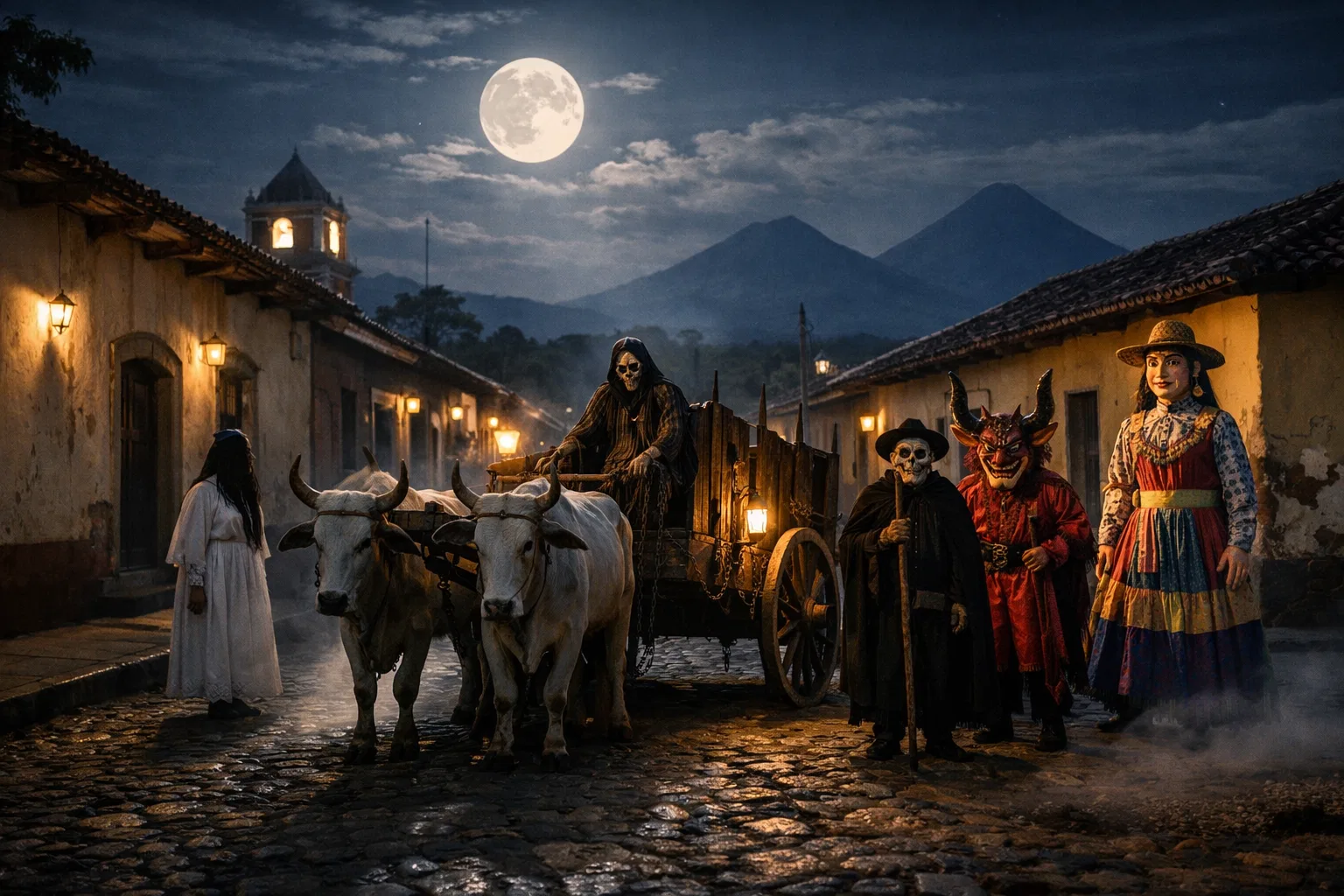
One of Nicaragua’s most memorable legends is the haunted cart known as the Nagua Cart or Nagua Carriage. In common retellings, it is heard at night before it is seen: wooden wheels creak, chains drag, and a spectral cart passes through dark streets or rural roads. It may be pulled by skeletal oxen, driven by Death, or guided by hooded figures carrying candles. Its arrival is usually treated as a bad omen, often a warning that someone nearby will die.[combonimissionaries.ie]combonimissionaries.ienicaragua journey into myths and legends in the land of volcanoesnicaragua journey into myths and legends in the land of volcanoes
What makes the legend more than a spooky vehicle story is its historical explanation. Several modern retellings connect the terrifying night cart to colonial violence: Indigenous communities hearing Spanish carts, raids, forced labour, or the sounds of an occupying power moving at night. One version preserved by a folklore-focused blog explicitly frames the legend as an “expression of the terror” of the Conquest, while a University of Southern California folklore collection records a similar interpretation in which carts were associated with colonisers seeking Indigenous captives.[stillwoods.blogspot.com]stillwoods.blogspot.comla carreta naguala carreta nagua
That does not mean the legend can be reduced to a single historical event. Its power comes from compression. It turns centuries of fear — soldiers, forced movement, death, bells, wheels, darkness — into one repeatable sound. In oral tradition, that is efficient storytelling: a noise in the night becomes a whole history passing by the door.

Women, betrayal and danger in the most famous spirit tales
Many of Nicaragua’s best-known legends centre on women who are wronged, feared, sexualised, or turned into warnings. These tales should not be read as simple supernatural “facts”; they are social stories about betrayal, desire, public behaviour and danger.
La Mocuana is often presented as a beautiful Indigenous woman, the daughter of a local chief, who becomes entangled with a Spaniard during the colonial period. In a common version, her father hides treasure from the Spanish; she reveals it to the man she loves; he betrays her, steals the treasure and traps her in a cave. She escapes, but becomes a wandering spirit who lures men towards caves, hills or rivers. Nicaragua’s official tourism site describes her as a beautiful Indigenous woman deceived and robbed by a Spaniard, then left to wander seeking revenge.[Visita Nicaragua]visitanicaragua.comVisita Nicaragua5 Nicaraguan myths and legendsVisita Nicaragua5 Nicaraguan myths and legends
The detail that matters is not only the treasure. The story carries the emotional logic of colonial betrayal: hospitality turns into conquest, love turns into extraction, and a woman becomes the place where political violence and intimate treachery meet. Some versions locate the tale around Sébaco; others mention La Trinidad or broader mountain regions. That shifting geography is typical of oral legend, where a story may be tied to more than one community without losing its recognisable centre.[stillwoods.blogspot.com]stillwoods.blogspot.comla mocuanala mocuana
La Cegua has a different tone. She is usually a beautiful woman who appears to men at night, especially men who are drunk, boastful, unfaithful or out too late. When the man draws close, her face is revealed as monstrous, often horse-like or skull-like. A USC folklore collection records a Nicaraguan version in which she seduces drunken men before revealing a terrifying horse-skull face.[USC Digital Folklore Archives]folklore.usc.eduDigital Folklore Archives La CeguaDigital Folklore Archives La Cegua
La Llorona, the weeping woman who mourns lost children, is shared across much of Latin America, but Nicaraguan retellings often place her near rivers, roads and night-time danger. Her story is less locally exclusive than La Mocuana, but it fits the same moral universe: water, motherhood, grief and fear become a warning that children and travellers understand quickly.[Scribd]scribd.comOpen source on scribd.com.
Spirits that police behaviour, roads and thresholds
Nicaraguan folklore often works as informal social regulation. It warns people not to wander, drink excessively, betray trust, disrespect sacred duties, mock the dead, or ignore the dangers of roads and water.
The Cadejo, a supernatural dog or pair of dogs, belongs to this borderland between protection and threat. In many Central American versions, a white dog protects travellers while a black dog brings harm, fear or punishment. Nicaragua shares this regional figure, but local versions connect it to night roads, moral behaviour and the feeling of being accompanied in darkness. Because the Cadejo is widespread across neighbouring countries, it is better understood as part of a shared Central American legend cycle rather than a uniquely Nicaraguan invention.[Wikipedia]WikipediaLeyendas de NicaraguaLeyendas de Nicaragua
The headless priest belongs to another shared regional pattern, but Nicaragua gives it powerful local settings in León and León Viejo. Modern accounts describe a ghostly priest wandering colonial streets, often carrying a lantern or appearing near churches. Some tellings link the figure with clerical wrongdoing, broken vows or unresolved violence. Other regional versions connect headless-priest stories more broadly with colonial-era religious authority and fear.[folktalesamerica.com]folktalesamerica.comEl Padre sin Cabeza | A Nicaraguan FolktaleEl Padre sin Cabeza | A Nicaraguan Folktale
In León Viejo, the legend gains extra force because the ruins themselves already carry a sense of abandonment, violence and buried colonial history. A headless priest in such a setting is not just a ghost; he is a way of imagining a religious past that is powerful, damaged and not fully at rest.
Masaya turns scary stories into public performance
Masaya’s great contribution to Nicaraguan folklore is that it does not leave monsters in whispers. It brings them into the street.
The Night of the Agüizotes in Masaya is a procession in which people wear masks and costumes representing frightening figures from Nicaraguan myth and legend. Nicaragua’s tourism site describes it as a “carnival of myths and legends” that gathers characters from ancestral scary stories, taking place in Masaya as part of festivities honouring San Jerónimo. The procession begins in Monimbó and passes through major streets and public spaces before returning to its starting point.[Visita Nicaragua]visitanicaragua.comVisita NicaraguaNight of the Agüizotes in NicaraguaThis carnival of myths and legends, which brings together most of the characters from…
This changes the function of folklore. A tale once used to frighten children or warn men on lonely roads becomes a shared civic spectacle. Death, witches, spirits, skeletons and legendary monsters are no longer only private fears; they become handmade masks, music, dancing, family attendance and local pride.
The same festive cycle also includes the Torovenado, a satirical street performance in Masaya. The National Tourism Map describes it as joy, satire, humour and mockery, with performers imitating or ridiculing local, national or foreign figures.[Mapa Nacional de Turismo]mapanicaragua.comMapa Nacional de Turismo Religious Festivities of MasayaMapa Nacional de Turismo Religious Festivities of Masaya This matters because Nicaraguan folklore is not only about fear. It is also about laughter, disguise and the pleasure of saying socially risky things through performance.
El Güegüense: folklore as satire, theatre and resistance
The most internationally recognised Nicaraguan folklore work is El Güegüense, also known as Macho Ratón. It is a satirical drama combining theatre, dance and music, performed during the feast of San Sebastián in Diriamba. UNESCO lists it as an element of the Representative List of the Intangible Cultural Heritage of Humanity and describes it as a well-known Nicaraguan satirical drama performed during that feast.[ICH UNESCO]ich.unesco.orgOpen source on unesco.org.
El Güegüense is not a ghost story, but it belongs firmly within the country’s traditional story culture. UNESCO’s multimedia archive describes it as a synthesis of Indigenous and Spanish cultures and an expression of protest against colonialism, blending theatre, dance and music.[UNESCO]unesco.orgdocument 637document 637 ReVista, published by Harvard’s David Rockefeller Center for Latin American Studies, notes that the dances have been kept alive as a popular tradition in Diriamba’s San Sebastián feast and are also performed by folkloric groups at civic and cultural events.[ReVista]revista.drclas.harvard.eduthe artistry of the gueguencethe artistry of the gueguence
Its central folkloric trick is disguise. The main figure uses humour, ambiguity and verbal slipperiness to deal with colonial authority. That makes the work useful far beyond the stage: it gives Nicaragua a national figure of cunning survival, not heroic conquest. It also shows how folklore can preserve political memory without sounding like a formal history lesson.

Sacred landscapes: volcanoes, lakes, caves and carved stone
Nicaragua’s geography almost demands mythic storytelling. Volcanoes, islands, lakes, caves and dramatic colonial ruins all invite explanations that are more emotional than geological.
Masaya Volcano is the clearest example. European colonial accounts famously associated the volcano with hellish imagery, and later writing has explored how volcanic activity fed legends, religious interpretation and fear. A volcanology-focused article on Masaya discusses the volcano’s reputation as the “Mouth of Hell” and points to work interpreting its myths, legends and anecdotes through volcanic science.[VolcanoCafe]volcanocafe.orgVolcano Cafe Masaya Volcano: the mouth of hellVolcano Cafe Masaya Volcano: the mouth of hell
Ometepe Island, formed by two volcanoes in Lake Nicaragua, offers an older and more archaeological kind of sacred landscape. Travel and heritage sources describe the island as rich in pre-Columbian rock carvings, statues, pottery and ceremonial remains. One Ometepe guide notes that ancient petroglyphs and stone statues are found across the island, while a UK government travel-cultural note describes pre-Columbian artefacts there, including a vessel dated to roughly 300 BC–500 AD.[ometepenicaragua.com]ometepenicaragua.comOpen source on ometepenicaragua.com.
Caution is needed here. Petroglyphs are not the same thing as written myths, and modern claims about what every spiral or animal “means” can easily outrun the evidence. Still, Ometepe shows how deep the relationship between landscape, sacred place and symbolic art is in Nicaragua. Later legends about caves, treasure, spirits and mountains sit on land that had already been marked with meaning long before colonial folklore took its present forms.
The Caribbean Coast adds music, water spirits and Afro-Indigenous memory
A country-level page on Nicaraguan folklore should not treat the Spanish-speaking Pacific as the whole country. The Caribbean Coast has different histories of Indigenous Miskitu, Creole, Garifuna and Afro-Caribbean life, and its traditions often centre on water, music, healing, spirit encounter and public celebration.
Maypole, especially associated with Bluefields and the Caribbean Coast, is one of the best-known Afro-Caribbean traditions. It is both a festival and a dance, tied to May celebrations, music, neighbourhood identity and public performance. The National Tourism Map identifies Bluefields with traditional Afro-Caribbean dances such as Palo de Mayo, calypso, reggae and contemporary expressions.[Mapa Nacional de Turismo]mapanicaragua.comMapa Nacional de Turismo Municipality of BluefieldsMapa Nacional de Turismo Municipality of Bluefields Scholarship on Central American oral traditions stresses that Maypole’s movement into streets helps make Blackness and Creole community visible in public space.[SciELO Costa Rica]scielo.sa.crOpen source on sa.cr.
Miskitu cosmology also includes supernatural beings tied to rivers, sea and forest. Research on Afro-Latin American religious expressions and representations discusses Miskitu figures such as the mermaid-like water spirit and the duende, both associated with seduction, illness, disappearance or danger around water and wild places.[ResearchGate]researchgate.netOpen source on researchgate.net.
These traditions are not simply “local colour”. They remind readers that Nicaragua’s folklore is multilingual, coastal as well as inland, African-influenced as well as Indigenous and Spanish, and shaped by different relations to land and water.
How old are these traditions, and how well attested are they?
Nicaraguan folklore has different kinds of evidence, and they should not be treated as equally old or equally fixed.
El Güegüense is the strongest case for internationally documented intangible heritage. It has UNESCO recognition, named performance contexts, scholarly commentary and a living festival setting.[ICH UNESCO]ich.unesco.orgOpen source on unesco.org. The Agüizotes and Torovenado are also well attested as contemporary public traditions in Masaya, supported by tourism documentation and photographic or journalistic coverage.[Visita Nicaragua]visitanicaragua.comVisita NicaraguaNight of the Agüizotes in NicaraguaThis carnival of myths and legends, which brings together most of the characters from…
Legends such as La Mocuana, La Carretanagua, La Cegua, the Cadejo and the headless priest are harder to date precisely. They are oral traditions with multiple versions, often written down later by folklorists, educators, travellers, local writers or digital culture sites. The best way to read them is not as fixed ancient texts but as story clusters: recognisable plots that adapt to family memory, school retelling, tourism, local pride and internet-era summaries.
Some stories clearly carry colonial themes, but that does not prove every detail dates directly from the sixteenth century. A tale can preserve historical trauma while also changing its characters, moral lessons and locations over generations. That flexibility is not a weakness; it is how oral tradition remains useful.
How Nicaragua’s folklore is understood today
Today, Nicaraguan folklore operates in several overlapping ways. It is family entertainment, moral warning, local identity, tourist attraction, political satire, school culture, craft economy and national heritage.
Official tourism pages present folklore as part of the country’s intangible cultural heritage and highlight dances, masks, festivals and local crafts.[Visita Nicaragua]visitanicaragua.comVisita NicaraguaCulture of NicaraguaNicaraguan folklore is an intangible cultural heritage of our peoples, originating from the union of… UNESCO recognition places El Güegüense in a global heritage frame, making a local performance legible to international audiences.[ICH UNESCO]ich.unesco.orgOpen source on unesco.org. Masaya’s Agüizotes turn frightening characters into public celebration, while Bluefields’ Maypole makes Afro-Caribbean community history visible through music and dance.[Visita Nicaragua]visitanicaragua.comVisita NicaraguaNight of the Agüizotes in NicaraguaThis carnival of myths and legends, which brings together most of the characters from…
The internet has also changed the tradition. Legends that once circulated mainly by speech, schoolbooks or local festivals now appear in blogs, classroom resources, travel pages, social media, video retellings and short horror summaries. That wider circulation can preserve interest, but it can also flatten local differences. A reader looking for the “real” version of a Nicaraguan legend will often find several. That is not necessarily a problem. In folklore, variation is often the evidence that a story is alive.
What to remember about Nicaragua’s folklore
Nicaraguan folklore is best understood as a map of felt history. The haunted cart remembers colonial terror as a sound. La Mocuana turns betrayal and conquest into a cave legend. La Cegua and the Cadejo police dangerous night-time behaviour. The headless priest gives religious authority a ghostly afterlife. Masaya’s masked festivals bring fear into the street and make it communal. El Güegüense transforms colonial tension into satire, music and dance. Ometepe and Masaya Volcano show how landscapes become sacred, frightening or symbolic. Bluefields and the Caribbean Coast widen the picture through Afro-Caribbean music and Miskitu spirit worlds.
The result is a folklore tradition that is not only about monsters. It is about how Nicaraguans have made sense of power, danger, humour, memory, grief and place — and how old stories keep changing while still sounding familiar when the wheels creak in the dark.
Amazon book picks
Further Reading
Books and field guides related to Where Nicaragua's Ghost Stories Walk at Night. Use these as the next step if you want deeper reading beyond the article.
Legends of Guatemala
Captures the regional storytelling tradition shared across Central America.
eBay marketplace picks
Marketplace Samples
Live-tested eBay searches with available results related to this page.
Endnotes
1.
Source: combonimissionaries.ie
Title: nicaragua journey into myths and legends in the land of volcanoes
Link:https://combonimissionaries.ie/2020/01/17/nicaragua-journey-into-myths-and-legends-in-the-land-of-volcanoes/
2.
Source: stillwoods.blogspot.com
Title: la carreta nagua
Link:https://stillwoods.blogspot.com/2008/07/la-carreta-nagua.html
3.
Source: folklore.usc.edu
Title: la carreta nagua 2
Link:https://folklore.usc.edu/la-carreta-nagua-2/
4.
Source: stillwoods.blogspot.com
Title: la mocuana
Link:https://stillwoods.blogspot.com/2008/07/la-mocuana.html
5.
Source: folklore.usc.edu
Title: Digital Folklore Archives La Cegua
Link:https://folklore.usc.edu/la-cegua/
6.
Source: scribd.com
Link:https://www.scribd.com/document/972255509/Nicaraguan-Myths-and-Legends
7.
Source: Wikipedia
Title: Leyendas de Nicaragua
Link:https://es.wikipedia.org/wiki/Leyendas_de_Nicaragua
8.
Source: folktalesamerica.com
Title: El Padre sin Cabeza | A Nicaraguan Folktale
Link:https://folktalesamerica.com/el-padre-sin-cabeza/
9.
Source: Wikipedia
Title: Headless priest
Link:https://en.wikipedia.org/wiki/Headless_priest
10.
Source: ich.unesco.org
Link:https://ich.unesco.org/en/RL/el-gueguense-00111
11.
Source: unesco.org
Title: document 637
Link:https://www.unesco.org/archives/multimedia/document-637
12.
Source: revista.drclas.harvard.edu
Title: the artistry of the gueguence
Link:https://revista.drclas.harvard.edu/the-artistry-of-the-gueguence/
13.
Source: volcanocafe.org
Title: Volcano Cafe Masaya Volcano: the mouth of hell
Link:https://www.volcanocafe.org/masaya-volcano-the-mouth-of-hell/
14.
Source: ometepenicaragua.com
Link:https://ometepenicaragua.com/petroglyphs/
15.
Source: researchgate.net
Link:https://www.researchgate.net/publication/49607134_Afro-Latin_American_Religious_Expressions_and_Representations
16.
Source: researchgate.net
Title: Research Gate(PDF)
Link:https://www.researchgate.net/publication/49607118_IntroductionIntroduccion
17.
Source: Wikipedia
Link:https://en.wikipedia.org/wiki/Nicaraguans
18.
Source: Wikipedia
Link:https://en.wikipedia.org/wiki/Nicaragua
19.
Source: Wikipedia
Title: Culture of Nicaragua
Link:https://en.wikipedia.org/wiki/Culture_of_Nicaragua
20.
Source: Wikipedia
Title: El Güegüense
Link:https://en.wikipedia.org/wiki/El_G%C3%BCeg%C3%BCense
21.
Source: Wikipedia
Title: Palo de Mayo
Link:https://en.wikipedia.org/wiki/Palo_de_Mayo
22.
Source: Wikipedia
Title: Ometepe (archaeological site)
Link:https://en.wikipedia.org/wiki/Ometepe_%28archaeological_site%29
23.
Source: scribd.com
Title: The Legend of El Cadejo
Link:https://www.scribd.com/document/979590634/The-Legend-of-El-Cadejo
24.
Source: es.scribd.com
Title: La Carretanagua
Link:https://es.scribd.com/document/401733946/La-Carretanagua
25.
Source: scribd.com
Link:https://www.scribd.com/document/957737628/Origin-of-the-[Aguizotes
26.
Source: scribd.com
Link:https://www.scribd.com/document/957671087/the-mocuana-of-sebaco-docx
27.
Source: scribd.com
Title: El Padre Sin Cabeza 2
Link:https://www.scribd.com/document/762270056/El-padre-sin-cabeza-2
28.
Source: scribd.com
Link:https://www.scribd.com/document/972294573/Nicaraguan-Tales-and-Legends-The-Mocuana
29.
Source: es.scribd.com
Title: The Carretanagua
Link:https://es.scribd.com/document/953549947/The-Carretanagua
30.
Source: ich.unesco.org
Title: nicaragua NI
Link:https://ich.unesco.org/en/state/nicaragua-NI
31.
Source: ich.unesco.org
Title: missing page 404 00404
Link:https://ich.unesco.org/en/missing-page-404-00404?call=film&id=41725&include=film_inc.php&width=700
32.
Source: ich.unesco.org
Title: action plan for the safeguarding of el gueguense 00034
Link:https://ich.unesco.org/en/projects/action-plan-for-the-safeguarding-of-el-gueguense-00034
33.
Source: folktalesamerica.com
Title: la mocuana the lost maiden of leon nicaraguan folktale of greed and betrayal
Link:https://folktalesamerica.com/la-mocuana-the-lost-maiden-of-leon-nicaraguan-folktale-of-greed-and-betrayal/
34.
Source: folktalesamerica.com
Title: la carreta nagua the ghostly cart of nicaragua
Link:https://folktalesamerica.com/la-carreta-nagua-the-ghostly-cart-of-nicaragua/
35.
Source: digitalcollections.sit.edu
Link:https://digitalcollections.sit.edu/cgi/viewcontent.cgi?article=3356&context=isp_collection&httpsredir=1&referer=
36.
Source: healthandhonduranindiansblacks.blogspot.com
Link:https://healthandhonduranindiansblacks.blogspot.com/2014/03/water-spirits-can-cause-illness-in.html
37.
Source: revista.drclas.harvard.edu
Title: dragons on the landscape
Link:https://revista.drclas.harvard.edu/dragons-on-the-landscape/
38.
Source: researchgate.net
Link:https://www.researchgate.net/publication/403296675_El_Duende_o_dueno_del_cerro_Un_simbolo_de_sostenibilidad_y_regulacion_sobre_el_territorio_en_La_Campa_2024
39.
Source: nicaragua.com
Link:https://www.nicaragua.com/culture/folklore/
40.
Source: leyendas-nicaraguenses.blogspot.com
Title: la carreta nagua
Link:https://leyendas-nicaraguenses.blogspot.com/2007/03/la-carreta-nagua.html
41.
Source: visitanicaragua.com
Link:https://www.visitanicaragua.com/en/culture/
Source snippet
Visita NicaraguaCulture of NicaraguaNicaraguan folklore is an intangible cultural heritage of our peoples, originating from the union of...
42.
Source: visitanicaragua.com
Link:https://www.visitanicaragua.com/en/night-of-aguizotes-in-nicaragua/
Source snippet
Visita NicaraguaNight of the Agüizotes in NicaraguaThis carnival of myths and legends, which brings together most of the characters from...
43.
Source: scielo.sa.cr
Link:https://www.scielo.sa.cr/scielo.php?pid=S1659-49402019000100001&script=sci_arttext
44.
Source: mapanicaragua.com
Title: Mapa Nacional de Turismo Municipality of Masaya
Link:https://www.mapanicaragua.com/en/municipality-of-masaya/
45.
Source: mapanicaragua.com
Title: Mapa Nacional de Turismo Religious Festivities of Masaya
Link:https://mapanicaragua.com/en/religious-festivities-of-masaya/
46.
Source: mapanicaragua.com
Title: Mapa Nacional de Turismo Municipality of Bluefields
Link:https://www.mapanicaragua.com/en/bluefields-township/
47.
Source: visitanicaragua.com
Title: Visita Nicaragua5 Nicaraguan myths and legends
Link:https://www.visitanicaragua.com/en/5-Nicaraguan-myths-and-legends/
48.
Source: villains.fandom.com
Title: La Cegua
Link:https://villains.fandom.com/wiki/La_Cegua
49.
Source: creepypasta.fandom.com
Title: La Carretanagua
Link:https://creepypasta.fandom.com/wiki/La_Carretanagua
50.
Source: revistaenvio.org
Link:https://www.revistaenvio.org/articulo/3150
51.
Source: youtube.com
Title: A Nicaraguan Legend
Link:https://www.youtube.com/watch?v=OujihKwiB3k
52.
Source: revistas.bicu.edu.ni
Link:https://revistas.bicu.edu.ni/index.php/wani/article/download/948/979
53.
Source: tooeleonline.com
Title: la mocuana
Link:https://www.tooeleonline.com/articles/tell-me-a-story/la-mocuana/
54.
Source: visitanicaragua.com
Link:https://www.visitanicaragua.com/en/maypole-ancestral-heritage/
55.
Source: kids.nationalgeographic.com
Link:https://kids.nationalgeographic.com/geography/countries/article/nicaragua
56.
Source: journeys.dartmouth.edu
Title: about nicaragua
Link:https://journeys.dartmouth.edu/ruiz_lacs20_fa16/about-nicaragua/
Additional References
57.
Source: youtube.com
Title: Latin America’s Nicaragua Mythical Creatures
Link:https://www.youtube.com/watch?v=MOqwETNdKhw
Source snippet
Nicaraguan folklore and legends El Cadejo La Llorona el cadejo - leyendas urbanas folklore nicaragüense.mp4 T. Prasse...
58.
Source: facebook.com
Link:https://www.facebook.com/canal11ni/posts/canal11nicaraguala-carreta-nagua-es-un-personaje-de-leyenda-que-fue-introducida-/4712026608850135/
59.
Source: academia.edu
Link:https://www.academia.edu/33889267/selves_and_identities_in_narrative_discourse
60.
Source: academia.edu
Link:https://www.academia.edu/10716408/_Interculturalidad_y_el_discurso_de_los_ni%C3%B1os_miskitos_en_Corn_Island_Wani_Revista_del_Caribe_Nicarag%C3%BCense
61.
Source: visitcentroamerica.com
Link:https://www.visitcentroamerica.com/en/visit/masaya-and-market-craft/
62.
Source: togetherwomenrise.org
Link:https://togetherwomenrise.org/customsandcuisine/customs-cuisine-of-nicaragua/
63.
Source: gettyimages.com
Link:https://www.gettyimages.com/photos/los-aguizotes
64.
Source: reddit.com
Link:https://www.reddit.com/r/mythology/comments/10aj9tr/history_lore_and_origin_of_the_cart_without_oxen/
65.
Source: facebook.com
Link:https://www.facebook.com/groups/269202760462518/posts/1184907398892045/
66.
Source: academia.edu
Link:https://www.academia.edu/35493165/Irmandades_e_devo%C3%A7%C3%B5es_de_africanos_e_crioulos_na_Bahia_setecentista_hist%C3%B3rias_e_experi%C3%AAncias_atl%C3%A2nticas
Topic Tree
Follow this branch
Related pages 192
- Afghan Folklore
- Albanian Folklore
- Algerian Folklore
- Australian Folklore
- Azerbaijan Folklore
- +187 more in sidebar