Within Bosnian Folklore
How Bosnian Places Become Legendary
Bosnian legends attach memory and danger to mountains, springs, old forts and stories of queens, dragons and serpents.
On this page
- Springs, mountains and old towns
- Queen Katarina in folk memory
- Dragons, serpents and weather fears
Page outline Jump by section
Introduction
In Bosnia and Herzegovina, many legends are attached not to isolated heroes or monsters but to the landscape itself. Springs, mountain passes, cliffs, ruined fortresses and deep river canyons become carriers of memory. A spring is not merely water; it may preserve the trace of a fleeing queen. A split rock may become evidence of a saintly prayer. A remote mountain gorge may be explained through stories of dragons and giant serpents. These traditions reveal a common mechanism in Bosnian folklore: places become legendary when history, religion, local memory and the natural environment merge into a single story.
Across the country, sacred and legendary landscapes help communities explain unusual natural features, remember traumatic historical events and express fears about drought, storms or the unpredictable power of nature. The result is a folklore map in which queens, springs and dragons remain visible long after the original events have passed.[spiritofbosnia.org]spiritofbosnia.orgOpen source on spiritofbosnia.org.
Springs, Mountains and Old Towns
Bosnian folklore repeatedly turns water sources into places of memory. Springs are essential in a mountainous country where access to fresh water could determine the survival of a settlement. It is therefore unsurprising that many legends explain springs through the actions of saints, rulers or supernatural beings.
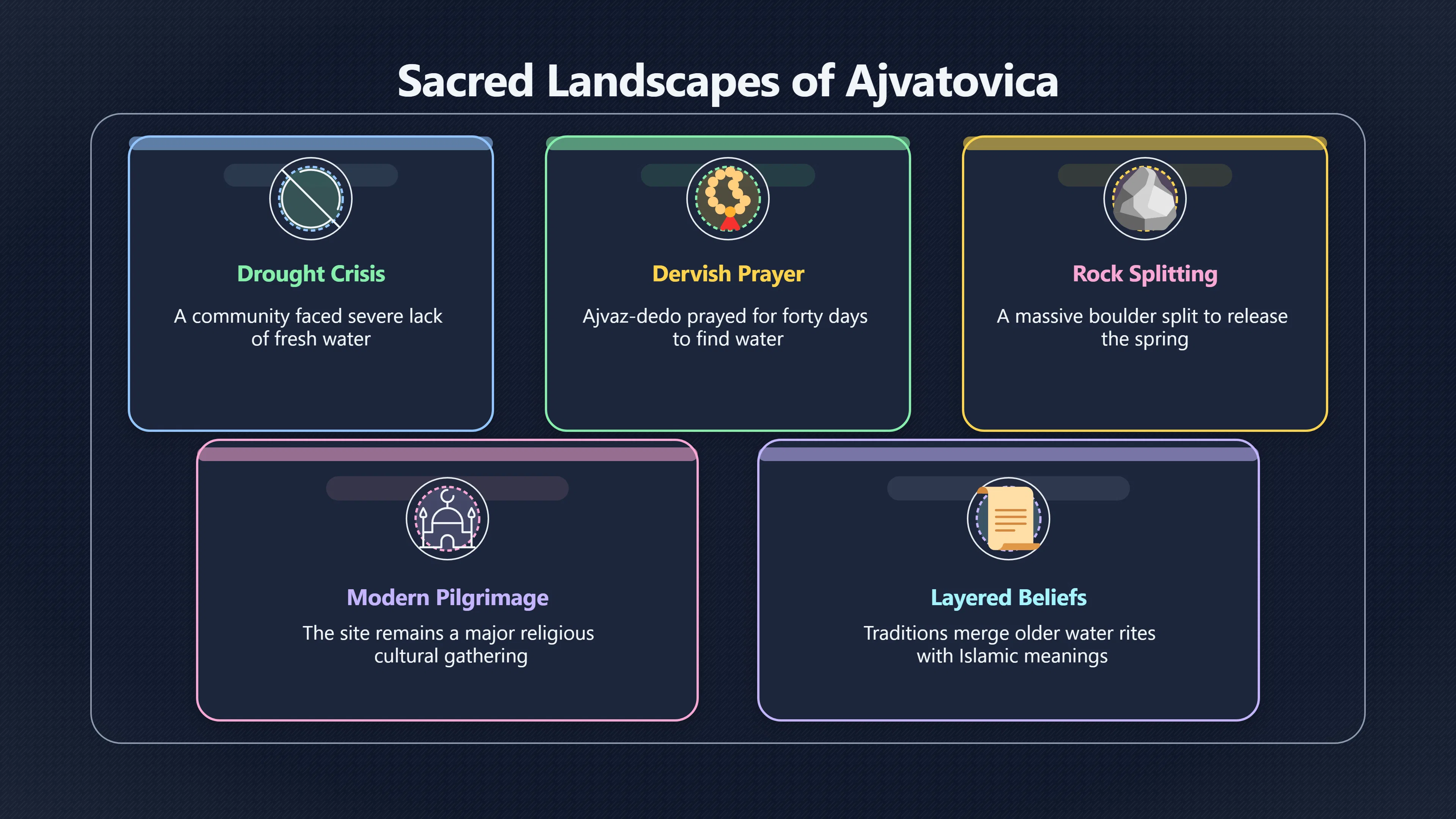
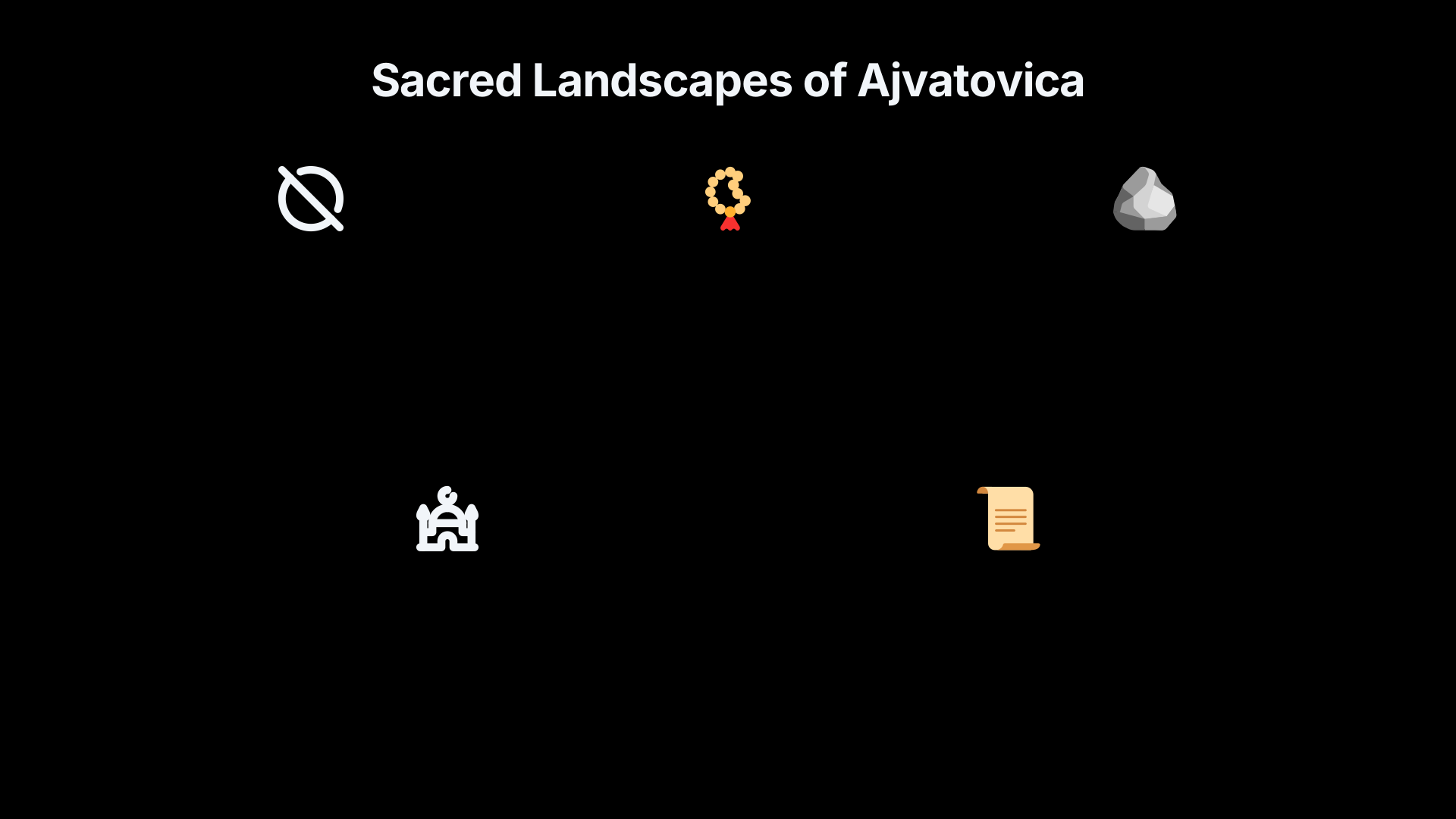
One of the best-known examples is the sacred landscape of Ajvatovica near Prusac. According to tradition, the dervish Ajvaz-dedo sought water for a drought-stricken community. A powerful spring existed nearby, but a huge rock blocked access. After forty days of prayer, he dreamed of two white rams colliding; when he awoke, the rock had split apart, allowing water to reach the settlement. Whether understood as miracle, symbolic tale or sacred memory, the story transformed a geological feature into one of the most important pilgrimage landscapes in Bosnia and Herzegovina. The annual gathering remains a major religious and cultural event, showing how folklore can permanently reshape the meaning of a place.[wikipedia.org]WikipediaOpen source on wikipedia.org.
What makes such stories particularly interesting is that they often combine older and newer layers of belief. Cultural heritage interpretations of Ajvatovica note that the pilgrimage preserves elements of older water-centred traditions while incorporating Islamic religious meanings. The landscape itself becomes a meeting point between folk memory, sacred practice and local identity.[Federalno Ministarstvo kulture i sporta]fmks.gov.baFederalno Ministarstvo kulture i sportaPilgrimage to Ajvatovica – PrusacTransformed into an Islamic ritual, enriched with the mystical le…
Old towns and mountain fortresses play a similar role. Ruins scattered across Bosnia frequently attract legends because abandoned walls invite explanation. A ruined fortress may become associated with a heroic defence, a hidden treasure, a cursed ruler or a supernatural guardian. Folklore often fills gaps left by incomplete historical memory, giving emotional meaning to locations whose original stories have been forgotten.
Queen Katarina in Folk Memory
No historical figure is more strongly attached to Bosnia’s legendary landscape than Queen Katarina of Bosnia. The fifteenth-century queen escaped during the Ottoman conquest of the Bosnian kingdom and later died in exile. Historical records tell part of the story, but folklore transformed her into a wandering, tragic figure whose journey left marks across the countryside.[Wikipedia]WikipediaCatherine of BosniaCatherine of Bosnia
In folk tradition, numerous locations became linked to her flight. Springs, roads, rocks and fortified towns were said to preserve traces of her passage. One enduring legend concerns a spring known as Katarina near Tarčin. According to local tradition, the queen stopped there to water her horse while fleeing with an escort of noblemen. The spring subsequently took her name, turning an ordinary water source into a monument of memory.[spiritofbosnia.org]spiritofbosnia.orgOpen source on spiritofbosnia.org.
The importance of these stories lies less in their literal accuracy than in what they reveal about cultural memory. Katarina became a symbol of loss, exile and the end of medieval Bosnian independence. Communities attached her story to visible landmarks because landscapes endure when political systems disappear. A traveller may forget a historical date, but a named spring or rock keeps the narrative alive.
Over time, Queen Katarina also acquired broader symbolic importance. Historians note that she occupies a unique place in Bosnian folk tradition and has become a figure claimed by multiple communities as part of a shared historical inheritance. Her legends therefore operate at several levels at once: local stories explaining specific places, regional traditions preserving memory and modern symbols of historical continuity.[Wikipedia]WikipediaCatherine of BosniaCatherine of Bosnia

Dragons, Serpents and Weather Fears
If queens explain the human history of landscapes, dragons and serpents often explain their dangers.
Dragon traditions in Bosnia and Herzegovina belong to a wider South Slavic folklore world, but local stories frequently connect these creatures to mountains, rivers, caves and storms. In some traditions, dragons inhabit remote wilderness areas beyond ordinary human control. Their presence explains sudden weather changes, destructive winds or unusual natural formations.[slideshare.net]slideshare.netThis dragon was considered an evilin bosnian tradition and mythology | PDFNovember 11, 2013 — 1) Bosnian mythology includes a dragon that was believed to devour the sun or…
Older beliefs associated dragons with cosmic threats. Folklore recorded in Bosnia preserved stories that linked eclipses with a dragon devouring the sun or moon. Such tales transformed frightening celestial events into understandable narratives. Communities responded through ritual actions intended to drive away the creature and restore order.[www.slideshare.net]slideshare.netThis dragon was considered an evilin bosnian tradition and mythology | PDFNovember 11, 2013 — 1) Bosnian mythology includes a dragon that was believed to devour the sun or…
Serpents occupy a similarly complex position. They can be dangerous, protective or sacred depending on the story. Across the Balkans, snakes were often regarded as guardians of particular places, households or hidden treasures. In Bosnian traditions, serpentine creatures frequently mark boundaries between the cultivated world and the wild landscape beyond it.[www.slideshare.net]slideshare.netThis dragon was considered an evilin bosnian tradition and mythology | PDFNovember 11, 2013 — 1) Bosnian mythology includes a dragon that was believed to devour the sun or…
Some local landscapes are still explained through dragon legends. The dramatic Rakitnica canyon near the high mountain village of Lukomir has been associated in local folklore with the origin of a dragon. Such stories give a mythic dimension to striking natural scenery, turning geological features into evidence of ancient supernatural events.[Wikipedia]WikipediaOpen source on wikipedia.org.
Weather fears are another recurring theme. Traditional South Slavic belief included supernatural defenders who battled destructive storms and hail. These ideas reflect the realities of agricultural life, where a single severe storm could destroy a year’s harvest. Dragons and dragon-like beings therefore became part of a symbolic language through which communities understood environmental uncertainty.[Wikipedia]WikipediaOpen source on wikipedia.org.
Why These Landscapes Remain Powerful
The recurring pattern behind Bosnian sacred landscapes is simple but remarkably durable. A natural feature attracts attention because it is useful, unusual or visually striking. A story becomes attached to it. The story is repeated across generations, reinforced by pilgrimage, local identity or family memory. Eventually the landscape and the legend become inseparable.
Queen Katarina’s springs, Ajvaz-dedo’s split rock and mountain dragon traditions all follow this pattern in different ways. One preserves historical memory, another expresses religious devotion, and the third explains the unpredictable forces of nature. Together they show how Bosnian folklore turns geography into narrative.
The result is a country where mountains, springs and ruined towns are rarely just scenery. They are remembered places: locations where history, belief and imagination meet, and where the landscape itself becomes a storyteller.

Amazon book picks
Further Reading
Books and field guides related to How Bosnian Places Become Legendary. Use these as the next step if you want deeper reading beyond the article.
Balkan Ghosts
Provides cultural and historical context for landscapes, memory and regional identity.
The Hero with a Thousand Faces
Helps explain how legendary narratives become attached to locations and cultural memory.
The Golden Bough
Explores sacred landscapes, ritual, myth and the relationship between belief and place.

The Penguin Book of Dragons
Connects with dragon and serpent traditions found in Bosnian legendary landscapes.
eBay marketplace picks
Marketplace Samples
Live-tested eBay searches with available results related to this page.
Endnotes
1.
Source: spiritofbosnia.org
Link:https://www.spiritofbosnia.org/en/volume-6-no-3-2011-july/legends-about-queen-katarina/
2.
Source: Wikipedia
Link:https://en.wikipedia.org/wiki/Lukomir
3.
Source: Wikipedia
Link:https://en.wikipedia.org/wiki/Ajvatovica
4.
Source: Wikipedia
Title: Catherine of Bosnia
Link:https://en.wikipedia.org/wiki/Catherine_of_Bosnia
5.
Source: slideshare.net
Title: This dragon was considered an evil
Link:https://www.slideshare.net/slideshow/dragon-in-bosnian-tradition-and-mythology/28126190
Source snippet
in bosnian tradition and mythology | PDFNovember 11, 2013 — 1) Bosnian mythology includes a dragon that was believed to devour the sun or...
Published: November 11, 2013
6.
Source: Wikipedia
Link:https://en.wikipedia.org/wiki/Bosniaks
7.
Source: Wikipedia
Link:https://en.wikipedia.org/wiki/Zduha%C4%87
8.
Source: fmks.gov.ba
Link:https://fmks.gov.ba/en/pilgrimage-to-ajvatovica-prusac/
Source snippet
Federalno Ministarstvo kulture i sportaPilgrimage to Ajvatovica – PrusacTransformed into an Islamic ritual, enriched with the mystical le...
9.
Source: novi.ba
Link:https://novi.ba/clanak/41800/ajvatovica
Source snippet
17 Nov 2015 — Ajvatovica is the largest Islamic traditional, religious and cultural event in Europe and one of the oldest pilgrimage of M...
Additional References
10.
Source: facebook.com
Link:https://www.facebook.com/groups/visitbosnia/posts/10163949969061037/
Source snippet
Ajvatovica: A Celebration of Prayer and Faith in BosniaWhen Prayer Splits the Rock – Ajvatovica Ajvatovica is a message about the power o...
11.
Source: sarakuehn.com
Link:https://www.sarakuehn.com/ajvatovica-pilgrimage-bosnia-herzegovina
Source snippet
Ajvatovica Pilgrimage, Bosnia-HerzegovinaLocated about eighty-five kilometers west of Sarajevo at the Ajvatovica plateau (the Šuljaga mou...
12.
Source: instagram.com
Link:https://www.instagram.com/reel/DZpwHhTJrLW/
Source snippet
ZmajLand on Instagram: " Bosnian Dragons & Kings A short...Bosnian Dragons & Kings A short journey through the legends, kings, and fortr...
13.
Source: sarajevotimes.com
Link:https://sarajevotimes.com/horsemen-departed-from-sarajevo-on-their-way-to-religious-event-509-days-of-ajvatovica/
Source snippet
Horsemen departed from Sarajevo on their Way to...26 Jun 2019 — According to legend Ajvaz-dedo, not far from Prusac, found a powerful sp...
14.
Source: sarajevotimes.com
Link:https://sarajevotimes.com/the-600th-anniversary-of-the-birth-of-queen-katarina-was-marked-in-kraljeva-sutjeska/
Source snippet
The 600th Anniversary of the Birth of Queen Katarina was...27 Oct 2024 — As part of the “Queen Katarina Days” event, which is celebrated...
15.
Source: konceptstation.ba
Title: Povijest Privalja – Koncept Station The Legend of Queen Katarina
Link:https://konceptstation.ba/en/privalj-history/
Source snippet
The Privalj area is also known as “Kraljica” in local folklore. According to local legend, during her escape from the Ottomans...Read more...
16.
Source: facebook.com
Title: I’ve never seen anything like this before in my life!!
Link:https://www.facebook.com/ellieandsenci/posts/ive-never-seen-anything-like-this-before-in-my-life-this-is-ajvatovica-the-large/955598567498968/
Source snippet
🤯 This is...The people named this spring after grandfather “Ajvatovica” and the rock “Ajvaz-grandfather's rock.”. Since then, seeing it...
17.
Source: facebook.com
Title: The wonder of nature 🏞 or the mythical dragon 🐉?
Link:https://www.facebook.com/groups/884561722299815/permalink/1038548600234459/
Source snippet
I want...The wonder of nature or the mythical dragon? I want to share with you one interesting legend about a Dragon from little mounta...
18.
Source: otkrivam.com
Title: Ajvatovica, Prusac, Bosnia and Herzegovina
Link:https://otkrivam.com/?id=520&l=2<r=1&p=25
Source snippet
IndexAjvatovica is the largest Islamic traditional, religious and cultural event in Europe. It is located near Prusac. It was named after...
19.
Source: europeanfolktales.com
Title: zmaj sa vodom the water dragon of bosnia
Link:https://europeanfolktales.com/zmaj-sa-vodom-the-water-dragon-of-bosnia/
Source snippet
Zmaj sa Vodom: The Water Dragon of Bosnia4 Dec 2025 — A powerful Bosnian folktale about courage and wisdom as a humble shepherd challenge...
Topic Tree