Why Estonia's Old Stories Still Feel Alive
Estonian folklore is not a single neat mythology with a fixed cast of gods. It is better understood as a living store of songs, legends, seasonal customs, sacred landscapes, household spirits, giants, witches, werewolves and local explanations for why a stone, spring, hill or island matters.
Page outline Jump by section
Why Estonian folklore feels so tied to place
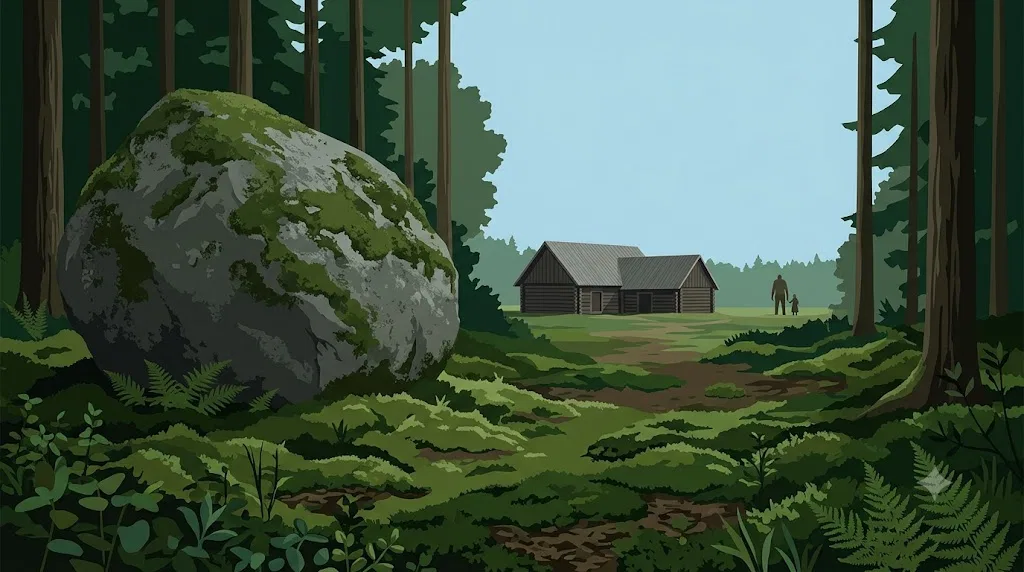
A striking feature of Estonian tradition is how often the supernatural is anchored in the landscape. Stones, groves, springs, bogs, farmsteads, lakes and seashores are not just scenery; they are memory devices. A boulder may be explained as the work of a giant, a spring may be linked with healing or sacrifice, and a grove may be treated as a place where ordinary economic behaviour is restricted. The Estonian Nature Folklore project describes the old folk calendar as an agrarian oral calendar shaped around the needs of farmers and cattle breeders, with work, weather, ritual and seasonal turning points bound together.[Folklore]folklore.eeOpen source on folklore.ee.
This landscape focus matters because it keeps folklore local. A reader coming to Estonia for “mythology” may expect something like Greek gods or Norse sagas, but many Estonian traditions work at a smaller scale: a village well, a family sauna, a forbidden tree, a coastal giant, a field protected by custom. The supernatural often marks boundaries between human use and non-human agency. Recent discussion of Estonia’s natural sacred sites makes the point clearly: some places were understood through older beliefs in supernatural forces, while others were reshaped by national romantic writing and modern heritage culture.[ERR]news.err.eeSacred natural sites in Estonia a mix of nationalSacred natural sites in Estonia a mix of national
The archive behind the stories
Estonia’s folklore is not merely a loose body of charming tales. It is one of the country’s major cultural archives. The Estonian Folklore Archives, founded in 1927, is the central institution for collecting and preserving folklore in Estonia, and its collections include manuscripts, photographs, sound recordings and video material. By the end of 2022, the Archives reported 31 manuscript folklore collections amounting to about 1,530,000 pages, alongside roughly 68,000 photographs, 188,000 audio pieces and nearly 2,000 video tapes and films.[Folklore]folklore.eeOpen source on folklore.ee.
This scale changes how readers should approach Estonian folklore. Many stories are not just late tourist inventions or internet summaries; they belong to a documented collecting history stretching through national awakening, scholarly classification and digital archiving. Jakob Hurt’s nineteenth-century collection work, Matthias Johann Eisen’s large-scale collecting and later professional archiving all helped turn oral tradition into a resource for scholarship and national culture.[Academia]academia.eduOpen source on academia.edu.
At the same time, archive evidence does not mean every modern retelling is ancient in its present form. Folklore is always edited, performed, moralised and reinterpreted. Estonia is a particularly good example of this because the same motifs can appear in village legend, nineteenth-century literary nationalism, children’s books, film, tourism and state branding.
Kalevipoeg: national epic, folk hero and literary construction
The best-known Estonian mythic figure is Kalevipoeg, the giant hero at the centre of Estonia’s national epic. The epic was composed by Friedrich Reinhold Kreutzwald from folklore material and published in an Estonian-German bilingual edition in six instalments between 1857 and 1861; it later became the Estonian national epic. Modern scholarship stresses that Kalevipoeg is a literary epic based on folklore motifs, not a simple transcription of a single ancient oral epic.[OAPEN]library.oapen.orgOpen source on oapen.org.
That distinction is important. Kalevipoeg belongs partly to old oral tradition, where giant figures explain features of the landscape, and partly to nineteenth-century European romantic nationalism, when small or politically subordinated peoples often sought epics that could stand beside the Kalevala, classical epics and other national literatures. Cambridge’s chapter on the Estonian national epic describes Kalevipoeg as an identity text of Estonian nationhood, while scholarship on its “core text” status connects it with the National Awakening of the nineteenth century.[Cambridge University Press & Assessment]cambridge.orgOpen source on cambridge.org.
For a general reader, the most useful way to understand Kalevipoeg is as a bridge. He is not simply “the Estonian Hercules”, nor merely a literary invention. He is a giant-shaped national memory: a figure assembled from oral legends, romantic ambition and the need for a cultural hero at a time when Estonian language and identity were gaining public force.
Kratt: the magical servant that became Estonia’s AI metaphor
If Kalevipoeg is the grand national hero, the kratt is the creature that best shows Estonia’s talent for turning folklore into modern metaphor. In traditional belief, a kratt is a supernatural helper or treasure-bearer, often imagined as a being made from household objects, straw or scrap materials, brought to life through dangerous magic and used to steal or fetch goods for its owner. The moral is rarely comforting: the helper may enrich you, but it must be controlled, kept busy and paid for.[Oral Tradition]journal.oraltradition.orgOral Tradition Estonian Folklore ArchivesOral Tradition Estonian Folklore Archives
That makes the kratt unusually adaptable. It has moved from oral legend into literature, visual culture, music and film. A study of folk tradition and multimedia in contemporary Estonian culture notes that kratt legends have long existed in lively oral tradition and have travelled into literary works, visual culture and music, creating a multimedial cultural text. Rainer Sarnet’s 2017 film November, based on Andrus Kivirähk’s novel, made the kratt internationally visible as a strange, improvised servant of greed, survival and village magic.[Academia]academia.eduOpen source on academia.edu.
The most surprising modern afterlife is political and technological. Estonia’s official AI communication uses the kratt as a metaphor for practical artificial intelligence: an autonomous software system that performs tasks traditionally done by humans. The government-facing explanation says the folklore character helps make complex AI easier to understand, while also reminding people that powerful helpers must be watched so they do not cause harm. Estonia’s national AI “Kratt” strategy was adopted in 2019, showing how an old treasure-fetching spirit became a public language for algorithmic tools.[Kratid]kratid.eeOpen source on kratid.ee.
Giants of the islands and the local scale of heroism
Estonia’s giant traditions are not limited to Kalevipoeg. Saaremaa has its own famous giant hero, Suur Tõll, often presented as a mighty but practical island protector. Local retellings describe him as a ruler of Saaremaa who could stride across the sea, help islanders and live with his strong wife Piret; Visit Saaremaa links him with Tõlluste, Hiiumaa and other island landscapes.[Visit Saaremaa]visitsaaremaa.eeVisit Saaremaa The legends and major figures of SaaremaaVisit Saaremaa The legends and major figures of Saaremaa
Suur Tõll matters because he shows how Estonian legendary heroes can be regional rather than purely national. He is not simply a smaller version of Kalevipoeg. He belongs to Saaremaa’s sense of itself: seafaring, tough, local, humorous and landscape-conscious. The giant’s feats explain distances, stones, cabbage patches, shorelines and family ties between islands. In modern culture he has also become a public symbol, appearing in sculpture, animation, tourism and even the names of ferries and ships.[Wikipedia]WikipediaToell the GreatToell the Great
These island legends make Estonian folklore feel intimate. The supernatural is large, but it is not remote. Giants farm, eat, marry, quarrel, go to the sauna and leave marks on places people can still visit.
Sacred groves, springs and the rules of not doing
Estonia’s sacred natural sites are among the most culturally important and contested parts of its folklore landscape. The term often associated with sacred groves and natural holy places is hiis. Academic work on these sites stresses both their importance and their complexity: they have been discussed as archaeological places, religious places, heritage sites, nationalist symbols and living memory sites.[Folklore]folklore.eeHIIS SITES IN THE RESEARCH HISTORY OF ESTONIANHIIS SITES IN THE RESEARCH HISTORY OF ESTONIAN
One reason these places are difficult to interpret is that their tradition often lies in restraint. A sacred grove may be defined not by a built temple or visible monument, but by what people should not do there: not cut, not plough, not disturb, not treat the place as ordinary economic land. ERR’s 2025 report on sacred natural sites quotes folklorist Ott Heinapuu emphasising that the tradition is partly about prohibitions and boundaries, and that older peasant worldviews did not draw a sharp modern line between nature, culture and the supernatural.[ERR]news.err.eeSacred natural sites in Estonia a mix of nationalSacred natural sites in Estonia a mix of national
Protection is a practical issue as well as a symbolic one. Estonia’s environmental information portal notes that hundreds of preserved sacred sites are under heritage or nature conservation, but many remain uncharted, and information about them is not always available to landowners or planning authorities. Heritage organisations have estimated that thousands of sacred natural sites are known from historical data, with many more possible through fieldwork, though numbers vary by source and method.[loodusveeb.ee]loodusveeb.eehistoric sacred natural siteshistoric sacred natural sites

Witches, werewolves and dangerous knowledge
Estonian supernatural tradition includes witches, werewolves, devils, healers and ambiguous magical specialists. These figures are not always simple villains. They often mark anxiety about hidden knowledge, social jealousy, illness, unexplained misfortune or the risk of crossing boundaries between human and animal, neighbour and enemy, healer and harmful magician.
The werewolf is a strong example. Research on Estonian werewolf history states that the richest source for studying belief in werewolves in Estonia is the body of texts stored in the Estonian Folklore Archives. A separate study of werewolf-related narrative in Estonian literature highlights August Kitzberg’s 1912 play The Werewolf, where the figure becomes a way to explore fear of the outsider and attachment to the familiar.[ResearchGate]researchgate.netEstonian Werewolf HistoryEstonian Werewolf History
Witchcraft also attaches itself to landscape. The Tuhala Witch’s Well is a famous example where a natural karst phenomenon has a folklore explanation. Visit Estonia describes it as a temporary spring in the Nabala-Tuhala Nature Reserve that can overflow dramatically during spring floods, while local lore says the well “boils” when witches are active below ground. This is a useful case because the scientific and legendary explanations do not cancel each other. The hydrology explains the water; the legend explains why the place became memorable.[Visit Estonia]visitestonia.comOpen source on visitestonia.com.
The folk calendar: when the dead, masks and midsummer matter
Estonian folklore is also organised by time. The folk calendar was traditionally agrarian, oral and cyclical, structuring work, fertility, protection, weather prediction and household blessing around the seasons. The Estonian Nature Folklore project notes that solstices and their surrounding periods were sacred times suited to fortune-telling and influencing the future, with winter and summer solstice celebrations among the most important points in the year.[Folklore]folklore.eeOpen source on folklore.ee.
Late autumn is especially rich in soul and masking traditions. Visit Estonia describes the period as associated with visiting departed souls and rituals for good luck, with local observances including All Souls’ Day, St Martin’s Day and St Catherine’s Day. These customs connect the household, the harvest’s end, the dead and masked visitors who move through the community.[Visit Estonia]visitestonia.comVisit Estonia Autumn's spiritual holidays in EstoniaVisit Estonia Autumn's spiritual holidays in Estonia
Midsummer is another major seasonal centre. In the folk calendar, St John’s Day and the summer solstice stand with Christmas as one of the biggest annual celebrations. For readers interested in folklore, the key point is that these festivals are not merely “old holidays” preserved unchanged. They have absorbed Christian calendar names, agrarian practice, national feeling, family custom, regional variation and modern public celebration.[Folklore]folklore.eeOpen source on folklore.ee.
Song as memory, identity and oral tradition
No account of Estonian folklore makes sense without song. Estonia’s older song tradition belongs to the wider Finnic runo-song world, a poetic-musical form based on repetition, parallelism, alliteration and shared performance. The Veljo Tormis Virtual Centre describes runosong as a singing tradition common to most Finnic peoples and, for centuries, the main musical-poetic mode of expression for those communities.[Veljo Tormis Virtual Centre]veljotormis.comVeljo Tormis Virtual Centre What is regilaulVeljo Tormis Virtual Centre What is regilaul
Seto leelo, the polyphonic singing tradition of the Seto people in south-eastern Estonia, is one of the clearest living examples of regional oral heritage. UNESCO inscribed Seto leelo on its Representative List of the Intangible Cultural Heritage of Humanity in 2009, describing a performance pattern in which a lead singer delivers a verse line and a choir joins in.[UNESCO ICH]ich.unesco.orgOpen source on unesco.org.
Song also links folklore to modern national identity. Estonia’s Song and Dance Celebration tradition dates to the nineteenth century and has been recognised by UNESCO as intangible cultural heritage within the Baltic song and dance celebration tradition. Recent reporting on the 2025 celebration described tens of thousands of singers and dancers taking part, and connected the tradition with national awakening, Soviet-era resilience and the Singing Revolution.[AP News]apnews.comOpen source on apnews.com.
This does not mean every choral song is “folklore” in the narrow sense. Rather, song is one of the main channels through which older oral forms, national feeling, regional language, public ritual and collective memory have met in Estonia.
Old belief, national romanticism and modern reinvention
A common misunderstanding is to treat Estonian folklore as either purely ancient or purely invented. The evidence points to something more interesting. Some traditions are deeply rooted in oral belief, local practice and landscape memory. Others were reshaped by nineteenth-century collectors and writers who wanted Estonians to have a national literature and mythic past. Still others are modern adaptations that use old motifs for new purposes.
Kalevipoeg is the classic case of literary nation-building from folklore material. Sacred natural sites show another pattern: some places carry older local restrictions and ritual memories, while others have been interpreted through later romantic or heritage frames. Kratt shows a third pattern, moving from household demon and treasure-bringer to ballet, novel, film and official AI metaphor.[keeljakirjandus.ee]keeljakirjandus.eeOpen source on keeljakirjandus.ee.
This layered quality should not be seen as a weakness. It is what makes Estonian folklore culturally powerful. Traditions survive not by staying frozen, but by being useful: for explaining landscapes, marking danger, giving dignity to a language community, teaching children, attracting visitors, making films, naming technologies and arguing about what should be protected.
What to remember about Estonian folklore
The centre of Estonian folklore is not a pantheon but a relationship: between people and place, household and forest, song and memory, old belief and modern identity. Its best-known figures are vivid enough to travel — Kalevipoeg the epic giant, Suur Tõll the island protector, the kratt the dangerous helper, the witch beneath the well, the werewolf at the edge of the village — but they make most sense when kept close to their local settings.
For curious readers, the most rewarding approach is to treat Estonian folklore as a layered cultural landscape. The archive gives it depth; the sacred sites give it geography; the folk calendar gives it rhythm; song gives it voice; modern literature, film and digital culture show that it is still being remade. That is why Estonia’s legendary tradition feels both old and unusually current: its monsters and spirits have not simply disappeared into museums, but continue to help Estonians think about land, memory, identity, technology and the risks of wanting too much from the helpers they create.
Amazon book picks
Further Reading
Books and field guides related to Why Estonia's Old Stories Still Feel Alive. Use these as the next step if you want deeper reading beyond the article.
The Hero with a Thousand Faces
Helps readers place Estonian myths within broader mythological patterns.
Mythology
Rating: 2.5/5 from 14 Google Books ratings
Provides useful comparative context for understanding folklore traditions.
The Golden Bough
Explores ritual, belief and sacred landscapes relevant to Estonian traditions.
Kalevipoeg: The Estonian National Epic
Central literary monument connecting many folklore themes discussed on the page.
eBay marketplace picks
Marketplace Samples
Live-tested eBay searches with available results related to this page.

Endnotes
1.
Source: folklore.ee
Link:https://www.folklore.ee/era/eng/
2.
Source: library.oapen.org
Link:https://library.oapen.org/handle/20.500.12657/32126
3.
Source: kratid.ee
Link:https://www.kratid.ee/en/mis-on-kratt
4.
Source: folklore.ee
Link:https://folklore.ee/loodus/en/kalender
5.
Source: news.err.ee
Title: Sacred natural sites in Estonia a mix of national
Link:https://news.err.ee/1609693895/sacred-natural-sites-in-estonia-a-mix-of-national-romanticism-and-old-folklore
6.
Source: academia.edu
Link:https://www.academia.edu/8449644/The_Estonian_National_Epic_Kalevipoeg_Its_Sources_and_Inception
7.
Source: cambridge.org
Link:https://www.cambridge.org/core/books/voice-of-the-people/estonian-national-epic-kalevipoeg-its-sources-and-inception/5BBB52F9F4FA1EB328C63E7B68210213
8.
Source: academia.edu
Link:https://www.academia.edu/47455037/Folk_Tradition_and_Multimedia_in_Contemporary_Estonian_Culture
9.
Source: Wikipedia
Title: November (2017 film)
Link:https://en.wikipedia.org/wiki/November_%282017_film%29
10.
Source: Wikipedia
Title: Toell the Great
Link:https://en.wikipedia.org/wiki/Toell_the_Great
11.
Source: folklore.ee
Title: HIIS SITES IN THE RESEARCH HISTORY OF ESTONIAN
Link:https://www.folklore.ee/folklore/vol42/jonuks.pdf
12.
Source: folklore.ee
Title: Sacred natural places of Estonia: regional perspectives
Link:https://www.folklore.ee/folklore/vol42/valk.pdf
13.
Source: loodusveeb.ee
Title: historic sacred natural sites
Link:https://loodusveeb.ee/en/themes/cultural-heritage/historic-sacred-natural-sites
14.
Source: researchgate.net
Title: Estonian Werewolf History
Link:https://www.researchgate.net/profile/Merili-Metsvahi/publication/286453441_Estonian_Werewolf_History/links/566a9b4b08aea0892c4a1a05/Estonian-Werewolf-History.pdf
15.
Source: folklore.ee
Title: field notes
Link:https://www.folklore.ee/folklore/vol65/berton-reilly.pdf
16.
Source: ich.unesco.org
Link:https://ich.unesco.org/en/RL/seto-leelo-seto-polyphonic-singing-tradition-00173
17.
Source: ich.unesco.org
Link:https://ich.unesco.org/en/decisions/4.COM/13.38
18.
Source: Wikipedia
Title: Estonian folklore
Link:https://en.wikipedia.org/wiki/Estonian_folklore
19.
Source: Wikipedia
Title: Estonian mythology
Link:https://en.wikipedia.org/wiki/Estonian_mythology
20.
Source: Wikipedia
Link:https://en.wikipedia.org/wiki/Kalevipoeg
21.
Source: Wikipedia
Title: Hiis (sacred site)
Link:https://en.wikipedia.org/wiki/Hiis_%28sacred_site%29
22.
Source: Wikipedia
Title: Estonian Folklore Archives
Link:https://en.wikipedia.org/wiki/Estonian_Folklore_Archives
23.
Source: Wikipedia
Title: Runic song
Link:https://en.wikipedia.org/wiki/Runic_song
24.
Source: Wikipedia
Title: Seto leelo
Link:https://en.wikipedia.org/wiki/Seto_leelo
25.
Source: Wikipedia
Title: Tuhala Witch’s Well
Link:https://en.wikipedia.org/wiki/Tuhala_Witch%27s_Well
26.
Source: Wikipedia
Link:https://en.wikipedia.org/wiki/Libahunt
27.
Source: archive.org
Title: oapen 20.500.12657 32126
Link:https://archive.org/details/oapen-20.500.12657-32126
28.
Source: researchgate.net
Link:https://www.researchgate.net/publication/337295375_Folkloristic_Contributions_towards_Religious_Studies_in_Estonia_A_Historical_Outline
29.
Source: researchgate.net
Title: 291928124 The Estonian national epic Kalevipoeg Its sources and inception
Link:https://www.researchgate.net/publication/291928124_The_Estonian_national_epic_Kalevipoeg_Its_sources_and_inception
30.
Source: researchgate.net
Link:https://www.researchgate.net/publication/338619663_Folk_Tradition_and_Multimedia_in_Contemporary_Estonian_Culture
31.
Source: researchgate.net
Title: 26851446 Sacred Natural Places of Estonia Regional Aspects
Link:https://www.researchgate.net/publication/26851446_Sacred_Natural_Places_of_Estonia_Regional_Aspects
32.
Source: researchgate.net
Title: 26851445 Hiis Sites in the Research History of Estonian Sacred Places
Link:https://www.researchgate.net/publication/26851445_Hiis_Sites_in_the_Research_History_of_Estonian_Sacred_Places
33.
Source: researchgate.net
Link:https://www.researchgate.net/profile/Risto-Jaerv
34.
Source: en.folklore.ee
Link:https://en.folklore.ee/
35.
Source: en.folklore.ee
Link:https://en.folklore.ee/rl/fo/hist/
36.
Source: folklore.ee
Link:https://www.folklore.ee/~taive/Estonian_folklore/folk_calendar.doc
37.
Source: folklore.ee
Link:https://www.folklore.ee/tagused/nr32/lihavote.pdf
38.
Source: folklore.ee
Link:https://folklore.ee/tagused/sites/default/files/2025-10/mt67x.pdf
39.
Source: folklore.ee
Link:https://www.folklore.ee/folklore/sites/default/files/2025-07/fl_ejf_88x.pdf
40.
Source: folklore.ee
Title: kulasalu sarv
Link:https://www.folklore.ee/dh/en/dhe_2013/kulasalu_sarv/
41.
Source: folklore.ee
Link:https://www.folklore.ee/UTfolkl/mj/eng/grant.htm
42.
Source: en.folklore.ee
Link:https://en.folklore.ee/rl/fo/projects/
43.
Source: folklore.ee
Link:https://www.folklore.ee/folklore/vol27/koivavesik.pdf
44.
Source: folklore.ee
Link:https://www.folklore.ee/UTfolkl/mj/eng/index.html
45.
Source: folklore.ee
Link:https://www.folklore.ee/regilaul/kogumik2014/summaries14.pdf
46.
Source: folklore.ee
Link:https://www.folklore.ee/folklore/vol64/giants.pdf
47.
Source: folklore.ee
Link:https://www.folklore.ee/balkan_baltic_yearbook/YBBS/article/download/190/219/848
48.
Source: hiis.ee
Link:https://hiis.ee/files/SNS_Plan_Estonia_2008-2012.pdf
49.
Source: hiis.ee
Link:https://hiis.ee/en/
50.
Source: hiis.ee
Link:https://hiis.ee/en/sacred-sites/sns2007
51.
Source: news.err.ee
Title: estonian nature folklore website publishes estonian heritage in translation
Link:https://news.err.ee/1609107746/estonian-nature-folklore-website-publishes-estonian-heritage-in-translation
52.
Source: news.err.ee
Title: toomas jurgenstein artificial intelligence as a modern kratt
Link:https://news.err.ee/1609995457/toomas-jurgenstein-artificial-intelligence-as-a-modern-kratt
53.
Source: resolve.cambridge.org
Title: estonian national epic kalevipoeg its sources and inception
Link:https://resolve.cambridge.org/core/services/aop-cambridge-core/content/view/5BBB52F9F4FA1EB328C63E7B68210213/9781843313533c8_p123-140_CBO.pdf/estonian_national_epic_kalevipoeg_its_sources_and_inception.pdf
54.
Source: academia.edu
Link:https://www.academia.edu/77917228/Estonian_Folklore_Archives
55.
Source: academia.edu
Link:https://www.academia.edu/15085422/Conceptions_of_soul_in_old_Estonian_religion
56.
Source: academia.edu
Link:https://www.academia.edu/3541285/Libahundiuskumused_arhailise_%C3%B5iguse_ja_moraali_kontekstis_The_werewolf_in_Estonian_folklore_in_light_of_archaic_law_and_morality
57.
Source: ich.unesco.org
Link:https://ich.unesco.org/en/13com?call=film&id=00971&include=film_inc.php&width=700
58.
Source: kratid.ee
Title: kratt visioon
Link:https://www.kratid.ee/en/kratt-visioon
59.
Source: journal.oraltradition.org
Title: Oral Tradition Estonian Folklore Archives
Link:https://journal.oraltradition.org/wp-content/uploads/files/articles/28ii/14_28.2.pdf
60.
Source: keeljakirjandus.ee
Link:https://www.keeljakirjandus.ee/en/archives/24632
61.
Source: visitsaaremaa.ee
Title: Visit Saaremaa The legends and major figures of Saaremaa
Link:https://www.visitsaaremaa.ee/en/inspiration/the-legends-and-major-figures-of-saaremaa/
62.
Source: visitestonia.com
Link:https://visitestonia.com/en/tuhala-witchs-well
63.
Source: visitestonia.com
Title: Visit Estonia Autumn’s spiritual holidays in Estonia
Link:https://visitestonia.com/en/what-to-do/autumns-spiritual-holidays-mardipaev-kadripaev
64.
Source: veljotormis.com
Title: Veljo Tormis Virtual Centre What is regilaul
Link:https://veljotormis.com/en/regilaul/what-is-regilaul/
65.
Source: apnews.com
Link:https://apnews.com/article/35fc3147b2edb44305efc3b12435c8b9
66.
Source: balther.net
Title: the estonian folklore archives
Link:https://www.balther.net/memory-institutions/estonia/archives/the-estonian-folklore-archives/
67.
Source: eestielu.ca
Title: kratid farm spirits and chilling images of the future
Link:https://eestielu.ca/et/kratid-farm-spirits-and-chilling-images-of-the-future/
68.
Source: traditionarchives.org
Link:https://www.traditionarchives.org/archives/estonia
Additional References
69.
Source: youtube.com
Title: Legends & Folklore of Tallinn: A Walking Tour of Estonia’s Capital
Link:https://www.youtube.com/watch?v=LLc8vDphMVo
Source snippet
There Will Always Be Monsters: The Estonian Kratt...
70.
Source: youtube.com
Title: Hämarik and Koit: Cosmic Lovers of Estonian Fairytale
Link:https://www.youtube.com/watch?v=srgwu6stH80
Source snippet
Legends & Folklore of Tallinn: A Walking Tour of Estonia's Capital...
71.
Source: investinestonia.com
Link:https://investinestonia.com/ai-and-the-kratt-momentum/
72.
Source: mindtitan.com
Link:https://mindtitan.com/resources/industry-use-cases/ai-use-cases-in-government/
73.
Source: facebook.com
Link:https://www.facebook.com/groups/baltictravelgroup/posts/1321304045821287/
74.
Source: anthropological.cloud
Link:https://anthropological.cloud/wau/wcaa/archive/downloads/wcaa/dejalu/march_2020/journalofethnologyandfolkloristics.pdf
75.
Source: eesti.ca
Link:https://www.eesti.ca/estonias-witchs-well-at-centre-of-environmental-battle/comprint28167
76.
Source: fairytalez.com
Link:https://fairytalez.com/region/estonian/
77.
Source: encyclopedia.pub
Link:https://encyclopedia.pub/entry/32989
78.
Source: rongabutiik.ee
Link:https://rongabutiik.ee/en/eesti-rahvaparimus-noidus-ja-maagilised-praktikad-taielik-ulevaade/?srsltid=AfmBOorjAz1zNTmFXyU0rbIf00AFFZ6cmbQLSSxbyAfb39VUPl0zwvHc
Topic Tree
Follow this branch
Related pages 192
- Afghan Folklore
- Albanian Folklore
- Algerian Folklore
- Australian Folklore
- Azerbaijan Folklore
- +187 more in sidebar