Where Stones, Songs and Spirits Still Speak
Bosnia and Herzegovina’s folklore is not a single tidy mythology but a layered living tradition: medieval tombstone legends, heroic oral epics, fairy and dragon stories, protective healing rites, pilgrimage legends, seasonal customs, and urban songs all sit beside one another.
Page outline Jump by section
Why Bosnia and Herzegovina’s folklore feels so layered
Bosnia and Herzegovina sits at a cultural crossroads where South Slavic oral tradition, medieval Christian landscapes, Ottoman Islamic influence, Catholic and Orthodox practice, urban song, village ritual and modern national heritage all overlap. That does not mean every tale is ancient or that every custom belongs neatly to one ethnic or religious group. In fact, one of the most important things about the country’s folklore is how often traditions cross boundaries: shared Balkan motifs appear in local forms, while Bosnian places and historical memories give them a distinct texture.
A useful starting point is the country’s institutional record. The Ethnology Department of the National Museum of Bosnia and Herzegovina says it collects, preserves, exhibits and studies the material, spiritual and social culture of the people of Bosnia and Herzegovina, including an Intangible Heritage Section. That matters because folklore here is not only a set of bedtime stories; it is also museum work, field documentation, song collecting, craft preservation and public cultural memory.[Zemaljski muzej BiH]zemaljskimuzej.baOpen source on zemaljskimuzej.ba.
UNESCO’s intangible heritage list shows the same breadth. Bosnia and Herzegovina’s recognised living traditions include Zmijanje embroidery, Konjic woodcarving, picking medicinal mountain grass on Ozren, the grass-mowing competition in Kupres, Lipizzan horse-breeding traditions, and, from 2024, sevdalinka, the traditional urban folk song. Not all of these are supernatural, but they show the wider cultural world in which legends live: household objects, ritual calendars, songs, mountain gatherings, skilled hands and inherited performance.[Intangible Cultural Heritage]ich.unesco.orgbosnia and herzegovina BAbosnia and herzegovina BA
Oral epics: heroes, fairies and the living art of performance
One of Bosnia and Herzegovina’s strongest contributions to world folklore is oral epic. In the 1930s, the Harvard classicist Milman Parry travelled through then-Yugoslavia to record living traditions of oral poetry, hoping to understand how long heroic poems such as Homer’s epics could be composed and transmitted by singers. Harvard’s Milman Parry Collection preserves songs recorded on phonograph discs and in notebooks, forming one of the great archives of South Slavic oral literature.[Harvard Library]library.harvard.eduOpen source on harvard.edu.
This archive matters for Bosnia because Bosnian and wider South Slavic epic singing helped scholars understand oral composition as an art of performance, memory and formula rather than simple recitation. A singer did not merely repeat a fixed text like a printed poem. He shaped a story in performance, drawing on inherited phrases, plot patterns, heroes and episodes. That is why Bosnian oral epic belongs both to local folklore and to the international study of oral tradition.[Oral Tradition]journal.oraltradition.orgOral Tradition The Milman Parry Collection of Oral LiteratureOral Tradition The Milman Parry Collection of Oral Literature
In Bosnian heroic poetry, supernatural help often arrives through mountain fairies. These beings may heal, guide, protect or strengthen heroes, especially in songs around frontier warriors and legendary figures such as Mujo Hrnjica or Alija Đerzelez. The point is not that the epic world is “pure fantasy”; rather, the supernatural raises the hero above ordinary life while still keeping him tied to recognisable places, battles, families and loyalties. The fairy is a sign that bravery, beauty, healing and destiny come from beyond the everyday world.[Wikipedia]WikipediaBosniak epic poetryBosniak epic poetry
The epic tradition also shows why folklore in Bosnia and Herzegovina is difficult to divide into sealed national boxes. Songs moved through regions, performers, manuscripts and later printed collections. Scholars of South Slavic oral tradition have warned that older folklore research was sometimes distorted by claims of ownership, ethnic simplification and the assumption that stories travel in one straight line from a single origin. For readers today, that is a useful caution: Bosnian folklore is local and distinctive, but it is also part of a wider Balkan oral world.[Oral Tradition]oraltradition.orgOral Tradition Back in the FoundationOral Tradition Back in the Foundation

Fairies, dragons and the supernatural landscape
Fairies are among the most recognisable supernatural beings in Bosnian tradition. They are commonly connected with mountains, forests, springs and heroic poetry. In epic narratives they can be dangerous, alluring or protective, but their most memorable role is often as helpers who heal wounded heroes or give them extraordinary qualities. The fairy in this tradition is not a delicate decorative figure; she belongs to wild terrain and moral risk.
Dragons and snake-like beings also appear in Bosnian and wider South Slavic belief. Some popular retellings link dragons with eclipses, storms, snakes, fertility and heroic ancestry, although the quality of evidence varies sharply from scholarly documentation to modern online summaries. The safer conclusion is that dragon and serpent imagery formed part of a wider symbolic field in which sky, weather, danger and power were imagined through animal or hybrid beings. Readers should be cautious with neat modern “Bosnian mythology” lists, because they often compress regional material into a single system that older oral tradition may never have had.[www.slideshare.net]slideshare.netdragon in bosnian tradition and mythologydragon in bosnian tradition and mythology
These beings make most sense when tied to landscape. Bosnia and Herzegovina’s folklore often clings to mountains, rivers, old forts, graveyards, springs and passes. A fairy is not just a creature; she is a way of saying that a mountain is inhabited by memory. A dragon is not just a monster; it can mark the terrifying force of weather or the sky. A spring is not just water; it can become a miracle site, a queen’s resting place or a cure.
Stećci: medieval stones with folk lives
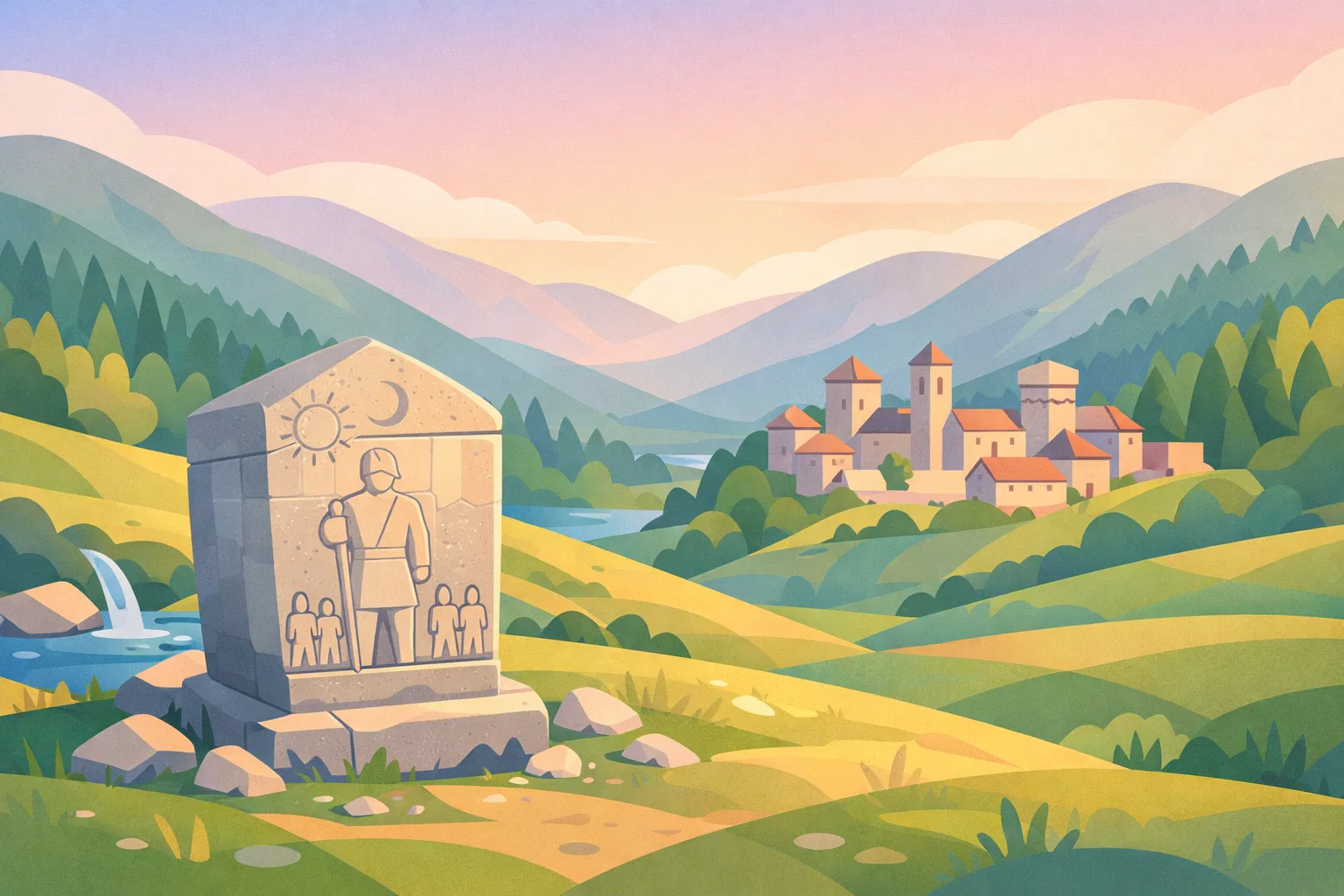
The medieval tombstones known as stećci are among the most powerful bridges between archaeology, art and folklore in Bosnia and Herzegovina. UNESCO describes these tombstone graveyards as deeply embedded in historical and continuing cultural traditions, with associations to local folk tales, fairy tales, superstitions and customs. Their carved reliefs and inscriptions have also influenced literature and other art forms across the region.[UNESCO World Heritage Centre]whc.unesco.orgOpen source on unesco.org.
The stones are historically medieval grave markers, not props from a fantasy landscape. They appear across Bosnia and Herzegovina and neighbouring countries, with many major sites in Bosnia and Herzegovina itself. Yet their later folk lives are just as important for understanding how people encountered them. Local legends have treated the stones as powerful, mysterious and sometimes medicinal. One heritage project records beliefs that dust from the stones could aid women who could not conceive, and that the stones could be beneficial for animals as well.[nekropola.ba]nekropola.baOpen source on nekropola.ba.
This is a classic example of how folklore grows around older material culture. Medieval people made the stones for the dead; later communities interpreted them through healing, danger, ancestry, marvel and sacred geography. The result is not one single “meaning” but a chain of meanings. A stećak can be an archaeological monument, a national symbol, a village landmark, an art object and a focus of folk belief all at once.
The stećci also show why Bosnia and Herzegovina’s folklore should not be reduced to supernatural creatures alone. Sometimes the most enduring “legendary beings” are stones: silent, carved, weathered objects that gather stories because nobody quite stops wondering who made them, what their symbols mean, and why they still feel present in the landscape.
Queen Katarina and the folklore of historical memory
Some Bosnian legends grow around documented historical figures. Queen Katarina Kosača-Kotromanić, the 15th-century Bosnian queen who died in exile in Rome, is one of the clearest examples. Historical accounts place her in the last decades of the medieval Bosnian kingdom, but folklore remembers her through routes of flight, springs, fortresses and acts of loss.[spiritofbosnia.org]spiritofbosnia.orgOpen source on spiritofbosnia.org.
A set of legends collected and discussed in Spirit of Bosnia links Queen Katarina to places such as Kreševo, Kozograd, Tarčin and Konjic. One story tells of a spring named after her because she stopped there while escaping, watering her horse and the horses of the noblemen with her. Another legend concerns her stay inside the Kreševo fortress at Bedem before the Ottoman arrival.[spiritofbosnia.org]spiritofbosnia.orgOpen source on spiritofbosnia.org.
These stories matter because they turn political collapse into local memory. Instead of explaining the end of medieval Bosnia only through armies, dynasties and diplomacy, folklore makes it intimate: a queen passes through a village; a spring receives a name; a fortress becomes a place where national, religious and family grief can be imagined. The legends do not have to be treated as literal travel records to be culturally important. Their value lies in how they preserve emotion around exile, loyalty and the lost kingdom.
Queen Katarina is also a good example of folklore’s modern afterlife. Commemorations, articles, tourism narratives and local cultural events continue to present her as a figure of memory. That modern attention can enrich the tradition, but it can also reshape it. A reader should distinguish between medieval history, older local legend, patriotic retelling and contemporary branding.
Ajvatovica: a miracle of water, rock and pilgrimage
Ajvatovica, near Prusac, is one of Bosnia and Herzegovina’s most important sacred-story landscapes. The central legend concerns Ajvaz-dedo, remembered as a pious Muslim figure associated with Prusac. In the traditional account, the settlement needed water, but a great rock blocked the spring. Ajvaz-dedo prayed for forty days; after a dream of two white rams colliding, the rock split, allowing water to be brought to the town.[Wikipedia]WikipediaOpen source on wikipedia.org.
The story has the structure of a miracle tale, but its power comes from a practical need: water. That makes it especially rooted. The miracle is not abstract; it solves a community problem. Rock, spring, prayer, dream and public procession all join into one local sacred geography.
Ajvatovica also shows how folklore can be interrupted and revived by politics. Public observance was restricted during communist Yugoslavia, and the tradition was renewed in 1990. Scholarly work on the pilgrimage has treated it not simply as a religious event but as a ritual frame for a sacred site, with questions of memory, public performance, gender and post-war identity around it.[Wikipedia]WikipediaOpen source on wikipedia.org.
For a folklore reader, Ajvatovica is important because it sits between legend and living practice. It is a story people tell, a place people visit, and a ritual calendar event that has changed under modern historical pressure. That makes it one of the clearest examples of Bosnian tradition as something performed, contested and renewed rather than merely preserved.
Witches, the evil eye and folk healing
Bosnian supernatural belief is not only about heroes and sacred places. It also appears in everyday fears about illness, envy, fertility, children, childbirth and misfortune. Traditional healing in Bosnia and Herzegovina drew on herbs, household substances, religious practice, written remedy books and ritual specialists. A medical-history review notes that folk explanations of illness could involve divine punishment, evil spirits, witches, demons, ghosts and other supernatural forces, while remedies included herbs, foods such as honey, garlic and vinegar, and collected remedy books known in local tradition as household medical manuscripts.[Materia Socio Medica]matersociomed.orgOpen source on matersociomed.org.
The evil eye is especially important because it links social emotion with bodily harm. In many Balkan and Mediterranean settings, envy or excessive admiration can be feared as damaging, especially for children, pregnant women, livestock or prized possessions. In Bosnian contexts, protective objects, prayers, amulets and household rituals have all been described as ways of guarding against such harm.[PubMed Central]pmc.ncbi.nlm.nih.govOpen source on nih.gov.
Witchcraft beliefs should be handled carefully. They are part of folklore, but they also reflect real social anxieties, especially around women, illness, infertility and blame. Studies of magic and witchcraft among Bosniaks stress that these practices sit inside layered historical and cultural worlds, rather than surviving unchanged from some ancient past. A living belief can contain older motifs, Islamic vocabulary, local custom, family practice and modern reinterpretation all at the same time.[rhizome.upol.cz]rhizome.upol.czMagic and Witchcraft among the BosniaksMagic and Witchcraft among the Bosniaks
That layered quality is the most honest way to understand Bosnian folk healing. It is not simply “superstition”, nor is it a substitute for modern medicine. Historically, it was a practical cultural system for making sense of fear, sickness and vulnerability when medical resources were limited or when illness seemed to exceed ordinary explanation.
Seasonal customs and living heritage
Many of Bosnia and Herzegovina’s strongest traditions are not supernatural stories in the narrow sense, but they belong to the same world of inherited belief and performance. Seasonal customs, healing plants, competitions, songs and crafts all show how communities turn ordinary labour into cultural memory.
The grass-mowing competition in Kupres is a good example. UNESCO describes it as an annual July event at a specific meadow in Kupres and identifies it as a major social event for the municipality. At first glance it may seem far from folklore, but it carries the classic features of living tradition: skilled performance, public gathering, local pride, inherited rules, and a landscape made meaningful through repetition.[Intangible Cultural Heritage]ich.unesco.orgOpen source on unesco.org.
The picking of medicinal mountain grass on Ozren is even closer to folk belief because it joins landscape, plants, health and ritualised gathering. UNESCO lists it as one of Bosnia and Herzegovina’s intangible heritage elements, and it belongs to a broader regional pattern in which mountains are not just scenery but sources of healing and blessing.[Intangible Cultural Heritage]ich.unesco.orgbosnia and herzegovina BAbosnia and herzegovina BA
Sevdalinka, recognised by UNESCO in 2024, adds the urban voice. UNESCO describes it as traditional urban singing in Bosnia and Herzegovina, born from a long process of acculturation in which South Slavic oral poetry merged with Ottoman musical influences; its main function is to tell a story. Reuters similarly describes it as a melancholic love-song form transmitted through family gatherings and renewed by younger musicians.[unesco.org]ich.unesco.orgOpen source on unesco.org.
For folklore, sevdalinka matters because it reminds us that oral tradition is not only rural, ancient or supernatural. A city song of longing can preserve memory as powerfully as a fairy legend. Its stories of love, separation, beauty and loss belong to the same cultural archive as heroic epics and sacred springs.
What is old, what is documented, and what is modern retelling?
Bosnia and Herzegovina’s folklore is rich, but not every attractive online claim has the same evidential weight. Some traditions are strongly documented through archives, UNESCO files, museum collections or scholarly study. Others survive mainly as local oral accounts, tourist retellings, popular articles or internet-era summaries. A good reader should not flatten these into one category.
The strongest evidence includes the oral epic recordings and scholarship associated with the Milman Parry Collection; UNESCO documentation for intangible heritage and the stećci; the National Museum’s ethnological work; and medical or ethnological studies of folk healing. These sources do not answer every question, but they provide firm ground for understanding performance, material culture and living tradition.[harvard.edu]library.harvard.eduOpen source on harvard.edu.
Local legends such as those of Queen Katarina and Ajvatovica are also valuable, but they need a slightly different reading. Their power lies in place-based memory. They may contain historical kernels, devotional meaning, symbolic geography and later embellishment. Asking only “did it happen exactly like that?” can miss what the legend is doing for the community.
The weakest category is the modern listicle-style “mythology” summary, especially when it presents Bosnia and Herzegovina as if it had a single ancient pantheon with fixed creatures and rules. Bosnia’s traditions are more interesting than that. They are mixed, regional, performed and historically layered. Fairies belong in epic songs and mountain lore; the evil eye belongs in social and healing practice; stećci belong in medieval archaeology and later folk belief; sevdalinka belongs in urban oral song. The country’s folklore is best understood as a web, not a catalogue.
What Bosnia and Herzegovi’s folklore preserves for later generations
Bosnia and Herzegovina’s folklore matters because it gives cultural form to experiences that ordinary history often leaves too abstract: migration, illness, grief, love, labour, exile, water, death, landscape and belonging. A medieval tombstone becomes a healing stone. A queen’s flight becomes a spring legend. A mountain plant becomes a ritual of health. A heroic singer becomes evidence for how oral poetry works across the world. A love song becomes a national and transnational emblem.
It also matters because Bosnia and Herzegovina’s cultural heritage has often had to survive political rupture, war, displacement and competing claims of ownership. Folklore can be misused when it is forced into narrow nationalist boxes, but it can also resist that narrowing. Many traditions in the country show mixture rather than purity: shared Balkan motifs, local Bosnian places, Islamic and Christian devotional worlds, urban and rural performance, and modern artists renewing old forms.
For curious readers, the most rewarding way into Bosnian folklore is through concrete places and performances: the stećci around Stolac and other necropolises; the National Museum in Sarajevo; the songs of sevdalinka; the epic tradition preserved in archives; the Ajvatovica pilgrimage landscape; the Kupres meadow; the Ozren mountain gathering; and the local legends of Queen Katarina’s routes. Together they show a country where folklore is not a vanished past, but a set of stories, skills and sacred landscapes still being interpreted today.
Amazon book picks
Further Reading
Books and field guides related to Where Stones, Songs and Spirits Still Speak. Use these as the next step if you want deeper reading beyond the article.
Bosnian, Croatian, Serbian, a Textbook
Helps readers engage with oral traditions and folk material.
The Bridge on the Drina
Captures centuries of Bosnian cultural memory and storytelling.
eBay marketplace picks
Marketplace Samples
Live-tested eBay searches with available results related to this page.

Endnotes
1.
Source: library.harvard.edu
Link:https://library.harvard.edu/collections/milman-parry-collection-oral-literature
2.
Source: whc.unesco.org
Link:https://whc.unesco.org/en/list/1504/
3.
Source: ich.unesco.org
Title: bosnia and herzegovina BA
Link:https://ich.unesco.org/en/state/bosnia-and-herzegovina-BA
4.
Source: ich.unesco.org
Link:https://ich.unesco.org/en/RL/sevdalinka-traditional-urban-folk-song-01872
5.
Source: Wikipedia
Title: Bosniak epic poetry
Link:https://en.wikipedia.org/wiki/Bosniak_epic_poetry
6.
Source: slideshare.net
Title: dragon in bosnian tradition and mythology
Link:https://www.slideshare.net/slideshow/dragon-in-bosnian-tradition-and-mythology/28126190
7.
Source: nekropola.ba
Link:https://www.nekropola.ba/en/narodne-predaje
8.
Source: spiritofbosnia.org
Link:https://www.spiritofbosnia.org/en/volume-6-no-3-2011-july/rome-the-life-of-katarina-vukcic-kosaca-the-bosnian-queen-1424-1478/
9.
Source: spiritofbosnia.org
Link:https://www.spiritofbosnia.org/en/volume-6-no-3-2011-july/legends-about-queen-katarina/
10.
Source: Wikipedia
Link:https://en.wikipedia.org/wiki/Ajvatovica
11.
Source: rhizome.upol.cz
Title: Magic and Witchcraft among the Bosniaks
Link:https://rhizome.upol.cz/pdfs/erh/2019/01/04.pdf
12.
Source: ich.unesco.org
Link:https://ich.unesco.org/en/RL/grass-mowing-competition-custom-in-kupres-01512
13.
Source: ich.unesco.org
Link:https://ich.unesco.org/en/video/44874
14.
Source: unesco.org
Title: document 6893
Link:https://www.unesco.org/archives/multimedia/document-6893
15.
Source: reuters.com
Link:https://www.reuters.com/lifestyle/bosnias-balkan-blues-earns-unesco-recognition-2024-12-27/
16.
Source: ich.unesco.org
Title: state folklore review uhakud u bih 00359
Link:https://ich.unesco.org/es/actividades/state-folklore-review-uhakud-u-bih-00359
17.
Source: ich.unesco.org
Link:https://ich.unesco.org/en/video/72405
18.
Source: ich.unesco.org
Link:https://ich.unesco.org/en/lists
19.
Source: ich.unesco.org
Link:https://ich.unesco.org/en/decisions/19.COM/7.B.24
20.
Source: ich.unesco.org
Title: photo pop up 00973
Link:https://ich.unesco.org/en/photo-pop-up-00973?photoID=16201
21.
Source: ich.unesco.org
Title: bosnia and herzegovina BA
Link:https://ich.unesco.org/en-state/bosnia-and-herzegovina-BA?info=periodic-reporting
22.
Source: unesdoc.unesco.org
Link:https://unesdoc.unesco.org/ark%3A/48223/pf0000046238
23.
Source: Wikipedia
Title: List of Intangible Cultural Heritage elements in Bosnia and Herzegovina
Link:https://en.wikipedia.org/wiki/List_of_Intangible_Cultural_Heritage_elements_in_Bosnia_and_Herzegovina
24.
Source: Wikipedia
Title: Milman Parry
Link:https://en.wikipedia.org/wiki/Milman_Parry
25.
Source: Wikipedia
Title: Catherine of Bosnia
Link:https://en.wikipedia.org/wiki/Catherine_of_Bosnia
26.
Source: Wikipedia
Link:https://en.wikipedia.org/wiki/Ste%C4%87ak
27.
Source: Wikipedia
Title: National Museum of Bosnia and Herzegovina
Link:https://en.wikipedia.org/wiki/National_Museum_of_Bosnia_and_Herzegovina
28.
Source: zemaljskimuzej.ba
Link:https://zemaljskimuzej.ba/en/departments/ethnology-department/
29.
Source: journal.oraltradition.org
Title: Oral Tradition The Milman Parry Collection of Oral Literature
Link:https://journal.oraltradition.org/wp-content/uploads/files/articles/28ii/20_28.2.pdf
30.
Source: oraltradition.org
Title: Oral Tradition Back in the Foundation
Link:https://oraltradition.org/back-in-the-foundation/
31.
Source: novi.ba
Link:https://novi.ba/clanak/41800/ajvatovica
32.
Source: matersociomed.org
Link:https://matersociomed.org/article/traditional-healing-in-treatment-of-diseasses-in-the-past-in-bosnia-and-herzegovina/
33.
Source: pmc.ncbi.nlm.nih.gov
Link:https://pmc.ncbi.nlm.nih.gov/articles/PMC9229282/
34.
Source: unesco-centerbg.org
Link:https://www.unesco-centerbg.org/en/inscribed-elements-en/bosnia-en/
35.
Source: scribd.com
Link:https://www.scribd.com/document/505347913/UNESCO
36.
Source: pmc.ncbi.nlm.nih.gov
Link:https://pmc.ncbi.nlm.nih.gov/articles/PMC5976692/
37.
Source: pmc.ncbi.nlm.nih.gov
Link:https://pmc.ncbi.nlm.nih.gov/articles/PMC11121784/
38.
Source: pmc.ncbi.nlm.nih.gov
Link:https://pmc.ncbi.nlm.nih.gov/articles/PMC3002800/
39.
Source: europeisnotdead.com
Title: Bosnia and Herzegovina
Link:https://europeisnotdead.com/bosnia-and-herzegovina-queen-katarina/
40.
Source: fmks.gov.ba
Link:https://fmks.gov.ba/en/information-on-the-updated-preliminary-open-list-of-intangible-cultural-heritage-of-the-federation-of-bosnia-and-herzegovina-in-2026/
41.
Source: fmks.gov.ba
Title: intangible and tangible cultural heritage
Link:https://fmks.gov.ba/en/intangible-and-tangible-cultural-heritage/
42.
Source: fmks.gov.ba
Link:https://fmks.gov.ba/en/anniversary-of-the-inscription-of-sevdalinka-on-unescos-list-of-intangible-cultural-heritage/
43.
Source: unescobih.mcp.gov.ba
Title: mcp.gov.ba Prelom 01.indd
Link:https://unescobih.mcp.gov.ba/wp-content/uploads/2025/08/25godina_clanstva.pdf
44.
Source: mcp.gov.ba
Link:https://www.mcp.gov.ba/en/portal/post/odrzana-sjednica-drzavnog-povjerenstva-za-unesco-novi-elementi-na-preliminarnoj-listi-nematerijalne-bastine-u-bih-638619088920000000
45.
Source: discoverbih.com
Link:https://discoverbih.com/experiences%26attractions/unesco-world-heritage/
46.
Source: zemaljskimuzej.ba
Link:https://zemaljskimuzej.ba/en/
Additional References
47.
Source: youtube.com
Title: Thousands of worshippers in Bosnia head to Ayvaz Dede memorial
Link:http://www.youtube.com/watch?v=fnzQogBONzM
Source snippet
Bosnia and Herzegovina folklore legends mythology What Mythical Creatures Appear In Bosnian Folklore? - TalkingSoutheastEurope Talking So...
48.
Source: youtube.com
Title: Avdo Međedović (Bošnjački Homer)
Link:http://www.youtube.com/watch?v=uA-xefa9jxo
Source snippet
Thousands of worshippers in Bosnia head to Ayvaz Dede memorial...
49.
Source: iaps.zrc-sazu.si
Link:https://iaps.zrc-sazu.si/en/programi-in-projekti/unde-venis-unravelling-the-enigma-of-the-[stecci
50.
Source: wildwitchherbs.com
Link:https://wildwitchherbs.com/balkan-witchy-herbs/
51.
Source: researchgate.net
Link:https://www.researchgate.net/publication/360015620_Traditional_Healing_in_Treatment_of_Diseasses_in_the_Past_in_Bosnia_and_Herzegovina
52.
Source: researchgate.net
Link:https://www.researchgate.net/publication/394168328_Tourismological_valorization_of_intangible_cultural_heritage_in_Bosnia_and_Herzegovina_according_to_the_Hilary_Du_Cros_methodology
53.
Source: reddit.com
Link:https://www.reddit.com/r/bosnia/comments/1b0h2ub/a_question_about_bosnian_mythology/
54.
Source: facebook.com
Link:https://www.facebook.com/groups/visitbosnia/posts/10163949969061037/
55.
Source: museums.eu
Link:https://museums.eu/exhibition/details/607
56.
Source: scribd.com
Link:https://www.scribd.com/document/238230340/Sorcery-and-Fortune-Telling
Topic Tree
Follow this branch
Related pages 192
- Afghan Folklore
- Albanian Folklore
- Algerian Folklore
- Australian Folklore
- Azerbaijan Folklore
- +187 more in sidebar