Within Sierra Leone Folklore
Why Does Spider Outsmart Everyone?
Spider tales reveal how Sierra Leonean folktales use wit, hunger and mischief to test social rules.
On this page
- Spider, Royal Antelope and animal worlds
- Moral lessons without simple heroes
- How collectors preserved oral tales
Page outline Jump by section
Introduction
Spider tales are one of the most memorable entry points into Sierra Leones oral storytelling traditions. In many stories told among the Mende and neighbouring peoples, Spider is not a noble hero, a wise elder, or a mighty warrior. He is hungry, ambitious, selfish, clever and endlessly inventive. He wins arguments he should lose, tricks stronger animals, and often creates trouble for himself. These stories survive because they are entertaining, but also because they offer a way to think about social rules, power, greed and intelligence without delivering simple moral lectures.

The best-known collections of Sierra Leonean animal tales show that Spider belongs to a wider West African trickster tradition while also having a distinct place within Mende storytelling. Alongside Spider stands another important figure, the Royal Antelope, whose behaviour often represents the social virtues that Spider lacks. Together they create a moral landscape in which listeners are invited to judge actions for themselves rather than being told exactly what to think.[JSTOR]jstor.orgSpider and Royal Antelope in Sierra Leoneby M Kilson 1984 Cited by 1 Royal Antelope and Spider in Mende tales exemplify such c…
Why Does Spider Outsmart Everyone?
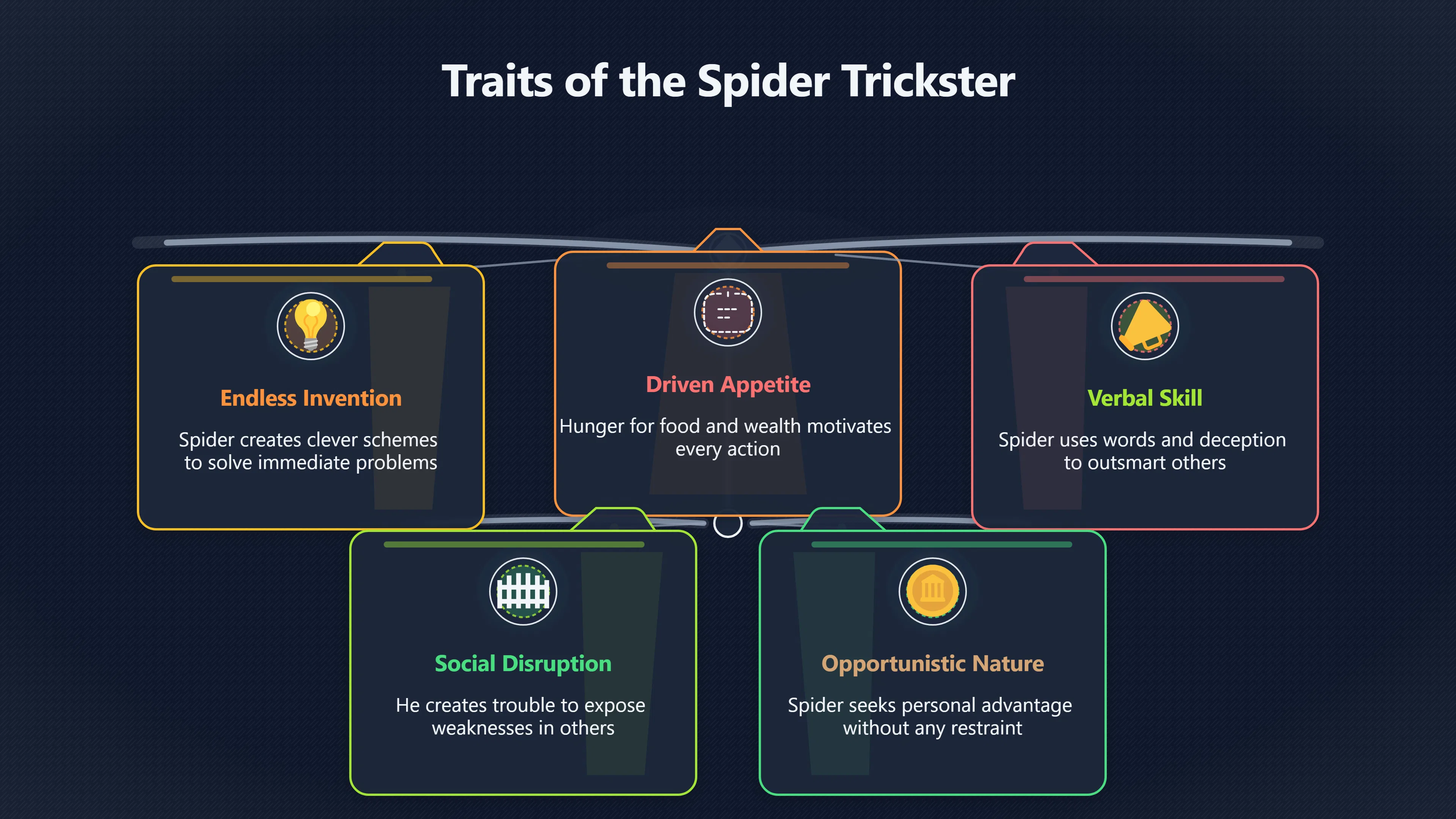
Spider succeeds because he uses words, deception and timing rather than physical strength. Across West African storytelling, the spider trickster appears in regions stretching from present-day Ghana to Sierra Leone. Scholars of African oral literature have noted that Spider is one of the dominant trickster figures in the forest regions of West Africa, including Sierra Leone.[OpenEdition Books]books.openedition.orgOpen Edition Books Oral Literature in AfricaProse NarrativesThe spider is the main character in most of the forest regions of West Africa, particularly in the westerly parts includi…
In Sierra Leonean stories, Spider is rarely admirable in a straightforward sense. He is often driven by appetite. Food, wealth, prestige and personal advantage motivate many of his schemes. This focus on hunger makes the stories immediately understandable. Spider wants what everyone wants, but he pursues it without restraint.
That does not mean listeners are expected simply to condemn him. Part of the tricksters appeal lies in his ability to expose weaknesses in others. A greedy chief, a boastful animal or a foolish neighbour may become the victim of Spiders tricks. The audience can enjoy the cleverness of the deception while also recognising that Spider himself is hardly a model citizen. The tension between admiration and criticism keeps the tales lively and unpredictable.[JSTOR]jstor.orgSpider and Royal Antelope in Sierra Leoneby M Kilson 1984 Cited by 1 Royal Antelope and Spider in Mende tales exemplify such c…
Spider, Royal Antelope and the Animal World
One of the most important published collections of Mende folklore is Marion Kilsons Royal Antelope and Spider: West African Mende Tales, first published in 1976. The volume gathered around one hundred Mende tales in both Mende and English, preserving stories that had long circulated orally.[Internet Archive]archive.orgInternet ArchiveRoyal antelope and spider: West African Mende tales12 Oct 2021 Royal antelope and spider: West African Mende tales. 3…
The title itself highlights a revealing contrast. According to analysis of Mende tales, Royal Antelope and Spider function as complementary figures. Royal Antelope typically displays socially approved behaviour, while Spider often embodies selfishness, cunning and disruption. Rather than presenting a world of purely good and purely evil characters, the stories place these different qualities in conversation with one another.[JSTOR]jstor.orgSpider and Royal Antelope in Sierra Leoneby M Kilson 1984 Cited by 1 Royal Antelope and Spider in Mende tales exemplify such c…
The animal world of Mende storytelling is therefore more than a collection of talking creatures. Animals become social actors who reflect human concerns:
- Spider represents cunning, opportunism and verbal skill.
- Royal Antelope often represents dignity, restraint and socially valued conduct.[resolve.cambridge.org]resolve.cambridge.orgfolktale and its extensionsSuch studies include Ruth Finnegan's work on storytelling among the Limba of Sierra Leone (Finnegan 1967) and…
- Other animals may stand for strength, foolishness, vanity or misplaced confidence.
- Conflicts between animals mirror tensions found in village life and human relationships.
Listeners are encouraged to compare behaviour and consequences rather than memorise a single moral formula.[JSTOR]jstor.orgSpider and Royal Antelope in Sierra Leoneby M Kilson 1984 Cited by 1 Royal Antelope and Spider in Mende tales exemplify such c…

Moral Lessons Without Simple Heroes
Readers encountering these tales for the first time sometimes expect them to work like Victorian moral stories, where virtue is rewarded and wrongdoing punished in a neat ending. Mende trickster tales are usually more complicated.
Spider may succeed through dishonesty. He may gain food, escape punishment or humiliate rivals. Sometimes his schemes collapse spectacularly. Sometimes they work. The point is not always that good behaviour wins. Instead, the stories explore how intelligence, desire, social obligations and luck interact in real life.
This ambiguity helps explain why trickster stories remain popular across generations. They acknowledge that people are not perfectly virtuous and that society contains competing interests. Spider becomes a safe way to discuss selfishness, envy and ambition. Audiences can laugh at him while recognising aspects of human behaviour in his actions.[OpenEdition Books]books.openedition.orgOpen Edition Books Oral Literature in AfricaProse NarrativesThe spider is the main character in most of the forest regions of West Africa, particularly in the westerly parts includi…
The tales also reward attentive listening. Because Spider frequently twists situations through language, listeners learn to watch for hidden motives, misleading promises and unintended consequences. In this sense, storytelling becomes a form of social education as well as entertainment.
How Mende Storytelling Worked
The stories were not originally created for books. They belonged to oral performance. Meaning emerged through the interaction between storyteller and audience, not simply through a fixed written text.
Research on African oral literature, including work connected to Sierra Leone, emphasises that storytelling was shaped by performance, audience reaction, repetition, memory and local context. A skilled storyteller could adapt details, emphasise humour, heighten suspense or draw attention to a particular lesson depending on the listeners present.[openbookpublishers.com]books.openbookpublishers.comOpen Book Publishers Ruth FinneganImplications for the study of oral literature. Oral art as literature. 2. The perception of African oral literature. 29.Read more…
This performance setting helps explain why Spider tales often feel vivid and conversational. The stories were designed to be heard. Humorous reversals, repeated phrases and clever exchanges are easier to appreciate when spoken aloud before a responsive audience.
Because oral storytelling allowed variation, there was never a single authoritative version of a Spider tale. Different narrators could preserve the same basic plot while changing details to suit local circumstances or personal style.[Open Book Publishers]books.openbookpublishers.comOpen Book Publishers Ruth FinneganImplications for the study of oral literature. Oral art as literature. 2. The perception of African oral literature. 29.Read more…

How Collectors Preserved Oral Tales
Much of what is known today about Sierra Leones older storytelling traditions comes from collectors, linguists and anthropologists who recorded tales before rapid social change transformed everyday storytelling environments.
Early twentieth-century researchers preserved examples of Mende oral literature in language studies and folklore collections. Later scholars undertook more systematic work. Marion Kilsons collection remains particularly important because it recorded Mende stories in the original language alongside English translations, helping preserve both narrative content and linguistic detail.[Wikipedia]WikipediaMende languageMende language
The broader study of Sierra Leonean oral tradition was also shaped by scholars such as Ruth Finnegan, whose work on storytelling and oral literature demonstrated that African narratives should be understood as sophisticated literary traditions rather than merely informal entertainment. Her research helped challenge older assumptions that cultures without extensive written records lacked complex literature.[openbookpublishers.com]books.openbookpublishers.comOpen Book Publishers Ruth FinneganImplications for the study of oral literature. Oral art as literature. 2. The perception of African oral literature. 29.Read more…
These collections matter because oral traditions are vulnerable to loss when languages decline, storytelling habits change or younger generations move away from traditional settings. The written records do not replace live storytelling, but they preserve evidence of how these narrative worlds operated.
Why Spider Still Matters
Spider remains one of the most recognisable figures in Sierra Leonean folklore because he embodies a question that never goes away: what happens when intelligence is used without restraint?
The answer changes from story to story. Sometimes Spider’s cleverness is admirable. Sometimes it is ridiculous. Sometimes it is dangerous. That flexibility is precisely why the character has endured. He can expose hypocrisy, challenge authority, entertain children and provoke discussion among adults all at once.
Within the wider landscape of Sierra Leonean folklore, Spider tales also reveal the richness of Mende storytelling. They show that oral tradition was not merely a vehicle for preserving old beliefs. It was a living art form that encouraged listeners to think critically about human behaviour. The enduring contrast between Spider and Royal Antelope reminds audiences that cleverness and virtue are not always the same thingand that the most memorable stories often emerge from the tension between them.[jstor.org]jstor.orgSpider and Royal Antelope in Sierra Leoneby M Kilson 1984 Cited by 1 Royal Antelope and Spider in Mende tales exemplify such c…
Amazon book picks
Further Reading
Books and field guides related to Why Does Spider Outsmart Everyone?. Use these as the next step if you want deeper reading beyond the article.
African Folktales
Contains themes, motifs and storytelling patterns relevant to Spider tales.
West African Folktales
Directly connects to trickster traditions and oral storytelling in West Africa.
African Myths of Origin
Introduces recurring narrative structures across African traditions.
eBay marketplace picks
Marketplace Samples
Live-tested eBay searches with available results related to this page.

Endnotes
1.
Source: jstor.org
Link:https://www.jstor.org/stable/40460803
Source snippet
Spider and Royal Antelope in Sierra Leoneby M Kilson 1984 Cited by 1 Royal Antelope and Spider in Mende tales exemplify such c...
2.
Source: books.openedition.org
Title: Open Edition Books Oral Literature in Africa
Link:https://books.openedition.org/obp/1201?lang=en
Source snippet
Prose NarrativesThe spider is the main character in most of the forest regions of West Africa, particularly in the westerly parts includi...
3.
Source: archive.org
Link:https://archive.org/details/royalantelopespi0000unse
Source snippet
Internet ArchiveRoyal antelope and spider: West African Mende tales12 Oct 2021 Royal antelope and spider: West African Mende tales. 3...
4.
Source: Wikipedia
Title: Mende language
Link:https://en.wikipedia.org/wiki/Mende_language
5.
Source: library.oapen.org
Link:https://library.oapen.org/handle/20.500.12657/31251
Source snippet
Literature in Africaby R Finnegan 2012 Cited by 4525 Ruth Finnegan s Oral Literature in Africa was first published in 1970, and si...
6.
Source: archive.org
Title: Oral Literature In Africa
Link:https://archive.org/details/OralLiteratureInAfrica
Source snippet
Internet ArchiveOral Literature in Africa: Ruth Finnegan: Free Download...10 Sept 2012 Ruth Finnegan's Oral Literature in Africa was...
7.
Source: Wikipedia
Title: Ruth Finnegan
Link:https://en.wikipedia.org/wiki/Ruth_Finnegan
8.
Source: Wikipedia
Link:https://en.wikipedia.org/wiki/Anansi
Source snippet
AnansiTaking the role of a trickster, he is also one of the most important characters of West African, African-American and Caribbean...
9.
Source: books.openbookpublishers.com
Title: Open Book Publishers Ruth Finnegan
Link:https://books.openbookpublishers.com/10.11647/obp.0025.pdf
Source snippet
Implications for the study of oral literature. Oral art as literature. 2. The perception of African oral literature. 29.Read more...
10.
Source: openlibrary.org
Title: Royal antelope and spider
Link:https://openlibrary.org/works/OL18865144W/Royal_antelope_and_spider
Source snippet
by Marion KilsonAn edition of Royal antelope and spider (1976) Royal antelope and spider West African Mende tales by Marion Kilson. Tales...
11.
Source: abebooks.co.uk
Link:https://www.abebooks.co.uk/first-edition/Royal-Antelope-Spider-West-African-Mende/31817065176/bd
Source snippet
Royal Antelope and Spider - West African Mende TalesFirst and only edition of this scarce collection of West African tales, with text in...
Additional References
12.
Source: amazon.com
Link:https://www.amazon.com/Royal-antelope-spider-African-Mende/dp/0916704017?tag=searcht-20
Source snippet
Royal antelope and spider: West African Mende talesRoyal antelope and spider: West African Mende tales. Inside of book is near mint. Prin...
13.
Source: folktales.africa
Link:https://folktales.africa/category/african-folktales/west-african-folktales/sierra-leonean-folktales/
Source snippet
Sierra Leonean Folktales | FolktalesAfrica.comTraditional folktales from Sierra Leonean (Sierra Leone), passed down through generations i...
14.
Source: resolve.cambridge.org
Link:https://resolve.cambridge.org/core/services/aop-cambridge-core/content/view/7C335FC17392D4F963575C9478FE103A/9781139054638c2_p19-34_CBO.pdf/the-folktale-and-its-extensions.pdf
Source snippet
folktale and its extensionsSuch studies include Ruth Finnegan's work on storytelling among the Limba of Sierra Leone (Finnegan 1967) and...
15.
Source: dokumen.pub
Link:https://dokumen.pub/the-african-storyteller-stories-from-african-oral-traditions-9780787255381-0787255386.html
Source snippet
The Mende live in Sierra Leone. 234. MEN AND WOMEN Once there was a young woman. She was barren, she bore no child. She and herRead more...
16.
Source: app.discoveryeducation.ca
Link:https://app.discoveryeducation.ca/learn/videos/bf1637bc-4403-4361-807c-59567689512f/
Source snippet
The second story is about what happens when everyday objects begin to talk and the third is in the Br’er...
17.
Source: teachersinstitute.yale.edu
Title: edu98.02.04: Three African Trickster Myths/Tales – Primary Style1
Link:https://teachersinstitute.yale.edu/curriculum/units/1998/2/98.02.04/3
Source snippet
Gizo the spider trickster of the Hausa tribe of West Africa. 2. Anansi/ Kwaku (Uncle) Anansi the spider, who behaves like a man, of...
18.
Source: pressbooks.pub
Link:https://pressbooks.pub/bibliography1/chapter/chapter-1/
Source snippet
1960s, along with riddles and proverbs plus an overview of Limba storytelling...Read more...
19.
Source: researchgate.net
Link:https://www.researchgate.net/profile/Anastacia-Motsei/publication/368396230_The_Palgrave_Handbook_of_African_Oral_Traditions_and_Folklore_ebook/links/63e63c016425237563a23126/The-Palgrave-Handbook-of-African-Oral-Traditions-and-Folklore-ebook.pdf
Source snippet
However, she has earned her pre-eminence not totally because she authored a...Read more...
20.
Source: amazon.co.uk
Link:https://www.amazon.co.uk/Royal-antelope-spider-African-Mende/dp/0916704017?tag=searcht-20
Source snippet
Royal antelope and spider: West African Mende talesRoyal antelope and spider: West African Mende tales; 82.96; Shipper / Seller...
21.
Source: dltk-kids.com
Link:https://www.dltk-kids.com/world/africa/m-story-anansi.htm
Source snippet
DLTK's Folktales Anansi the Spider's Great AdventureOnce upon a time, in a lush, green forest, there lived a little spider named Anansi...
Topic Tree