Where Namibia's Stories Live in the Land
Namibian folklore is not a single national mythology with one fixed cast of gods and monsters. It is a living patchwork of San, Nama, Damara, Herero, Himba, Ovambo, Kavango and other regional traditions, shaped by desert travel, cattle herding, water scarcity, ancestral ritual, colonial disruption and modern heritage work.
Page outline Jump by section
Introduction
The result is a folklore landscape that feels unusually physical. In Namibia, stories often cling to a spring, a mountain, a grave-like heap of stones, a fire, a pan, a road or an animal. That makes the country’s legendary culture especially rewarding, but it also requires care: many stories have been translated, filtered through missionaries, colonial observers, tourism writing or modern internet retellings. The best reading treats these traditions as cultural memory and belief, not as spooky entertainment detached from the communities that keep them meaningful.
Why Namibian folklore is so tied to landscape
Namibia’s best-known traditional stories often begin with landforms because land is not merely a backdrop. In dry country, a reliable spring, a salt pan, a mountain or a place to hunt can become a moral and spiritual landmark. UNESCO’s account of Twyfelfontein stresses that the rock engravings and paintings show links between ritual practices and the economic importance of reliable water sources for hunter-gatherer communities. The same official account identifies the works in the core area as the authentic work of San hunter-gatherers who lived there before later Damara herders and European colonists.[UNESCO World Heritage Centre]whc.unesco.orgWorld Heritage Centre Twyfelfontein or /Ui-//aesUNESCO World Heritage CentreTwyfelfontein or /Ui-//aes - UNESCO World Heritage Centre…
This is why a reader should be cautious about approaching Namibian folklore as if it were only a list of “creatures”. Monsters and spirits matter, but the deeper pattern is relationship: people, animals, water, ancestors and places are bound together. Recent work on the former world of the Haiom in Etosha describes a dense web of land, kinship, animals, plants and spirit beings, arguing that these relations should be recognised in conservation thinking rather than treated as a forgotten past.[Open Book Publishers]openbookpublishers.comOpen source on openbookpublishers.com.
That landscape-centred quality also explains why Namibian folklore is often preserved outside obvious “mythology” books. It appears in rock-art interpretation, oral-history projects, living museums, religious practice, local place legends, field recordings, mission archives and community memory. UNESCO’s broader definition of oral traditions emphasises that they pass on knowledge, social values and collective memory, which fits Namibia’s story culture better than a narrow search for fairy-tale plots alone.[ICH UNESCO]ich.unesco.orgOpen source on unesco.org.
San rock art and the story-world of Twyfelfontein
Twyfelfontein, also known by its local heritage name, is the clearest nationally recognised meeting point between archaeology, ritual and folklore. It was inscribed as a UNESCO World Heritage Site in 2007, and UNESCO describes its engravings and paintings as a coherent, extensive and high-quality record of hunter-gatherer ritual practices in southern Africa. The site is not simply ancient art on stone; it is evidence for a way of understanding animals, water and seasonal survival through ritual action.[UNESCO World Heritage Centre]whc.unesco.orgWorld Heritage Centre Twyfelfontein or /Ui-//aesUNESCO World Heritage CentreTwyfelfontein or /Ui-//aes - UNESCO World Heritage Centre…
For folklore readers, the important point is that rock art is not the same as a written myth. It rarely says, “Here is the story, in full.” Instead, it preserves symbolic traces of a world in which animals, human figures, tracks and sacred places were part of ritual knowledge. This is why responsible interpretation avoids overconfident claims such as “this exact engraving means this exact god”. The evidence supports a broader and more interesting point: Namibian story culture has long connected survival knowledge with spiritual imagination.
Twyfelfontein also shows how folklore can become heritage, tourism and contested public history. UNESCO notes that a lodge built in the buffer zone compromised the integrity of engravings in one area, while also recording improvements in visitor management and legal protection. This matters because folklore sites can be loved to death: the more famous they become, the more they need careful interpretation and protection.[UNESCO World Heritage Centre]whc.unesco.orgWorld Heritage Centre Twyfelfontein or /Ui-//aesUNESCO World Heritage CentreTwyfelfontein or /Ui-//aes - UNESCO World Heritage Centre…
The nearby Damara Living Museum adds another layer. UNESCO’s 2026 national outlook on Indigenous and local knowledge describes it as Namibia’s first and only traditional Damara cultural project, where community members reconstruct aspects of traditional life through demonstrations of skills, routines and customs. That is not the same thing as untouched antiquity; it is a modern form of cultural preservation that openly works with memory, reconstruction and visitor education.[UNESCO Digital Library]unesdoc.unesco.orgOpen source on unesco.org.
Heitsi-Eibeb and the roadside cairns
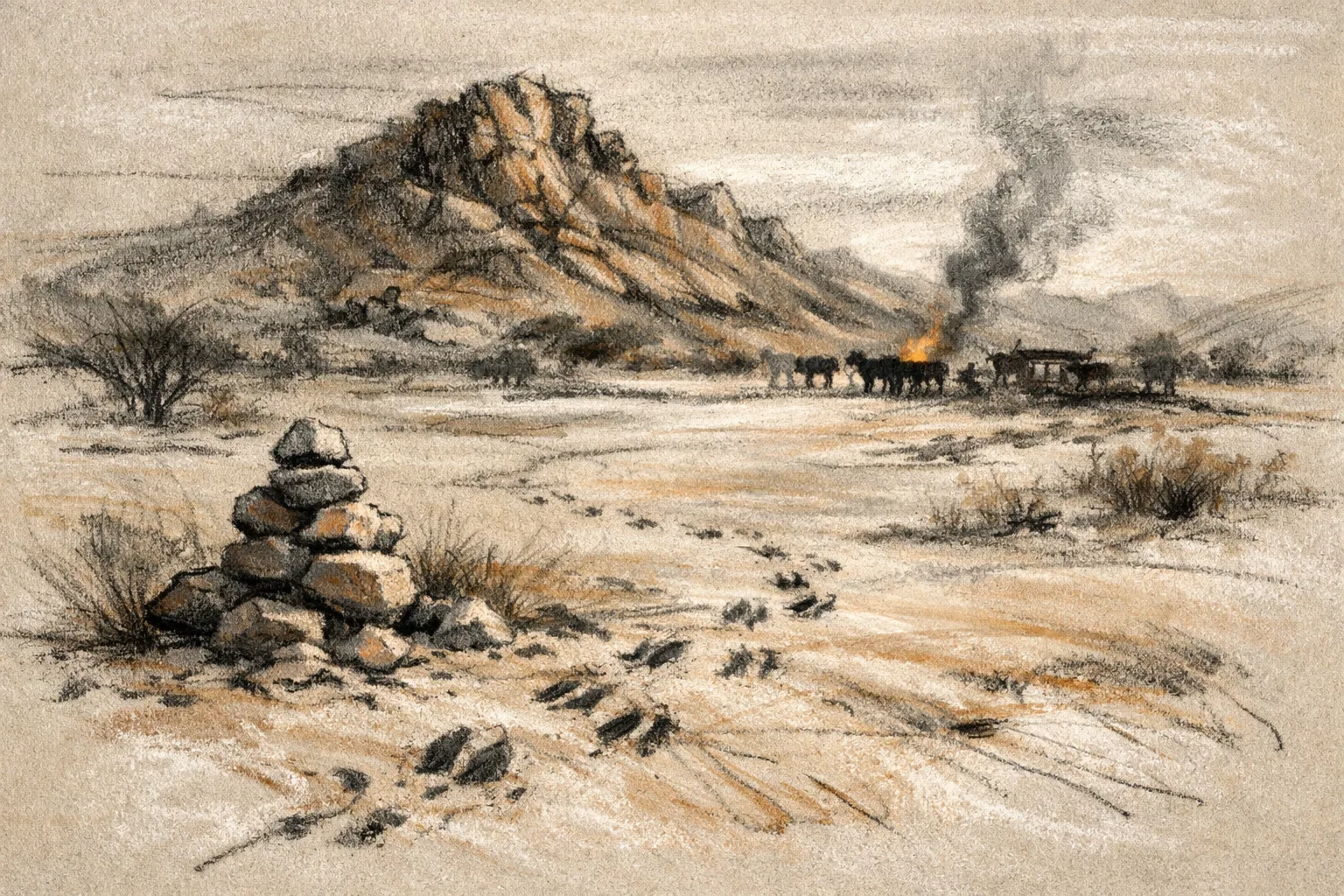
One of Namibia’s most distinctive legendary figures is Heitsi-Eibeb, often associated with Nama and wider Khoekhoe tradition. He is difficult to reduce to one role: in different retellings he appears as a culture hero, trickster, hunter, ancestral figure or deity-like being. The most concrete Namibian trace of the tradition is the roadside cairn, a heap of stones or branches treated with reverence by passers-by. Sigrid Schmidt’s study of the so-called Heitsi-Eibeb graves notes that early European settlers and travellers did not find temples or formal altars, but did observe Khoekhoe and San people adding stones or branches to certain cairns as they passed.[namibiadigitalrepository.com]namibiadigitalrepository.comOpen source on namibiadigitalrepository.com.
The key detail is that these “graves” are not ordinary graves in the modern sense. Schmidt records that by the nineteenth century such cairns were explained as graves of a deity, although the existence of many such graves meant he was not thought to be physically buried in each one. In Namibia, these heaps were still called Heitsi-Eibeb graves, and they became a major clue for scholars trying to understand older Khoe and San religious ideas.[namibiadigitalrepository.com]namibiadigitalrepository.comOpen source on namibiadigitalrepository.com.
For a general reader, this is one of the most memorable features of Namibian folklore: a mythic figure marked not by a temple, statue or scripture, but by repeated gestures at the roadside. A traveller adds a stone; the heap grows; the story remains active because people keep acting towards the place. That makes the cairn both a legendary marker and a ritual habit.
It is also a good example of why colonial-era descriptions need careful handling. Outsiders often labelled Indigenous religion by what it lacked according to their expectations: no church, no altar, no written doctrine. The cairns show the opposite lesson. Sacred practice can be small, repeated, mobile and embedded in travel.
Tricksters, mantises and animal signs
Animal folklore is central to Namibia’s oral traditions, but it is not always about “animal characters” in the children’s-story sense. Animals may be omens, tricksters, ritual signs, teachers or beings with special knowledge. Schmidt’s article on the praying mantis in Namibian folklore analyses interviews with Nama and Damara people recorded between 1972 and 1997, and discusses the insect’s role as an omen, its connection with rain, and debates about older Khoisan religion.[sahumanities.org]sahumanities.orgThe praying mantis in Namibian folklore | Southern African Humanities…
The mantis is especially interesting because it sits at the boundary between everyday observation and mythic reading. A small insect can become a sign through which weather, luck or danger is interpreted. Schmidt’s work also tries to correct misunderstandings around older names and colonial-era interpretations, which is important because southern African folklore was often recorded through prejudiced or careless terminology.[sahumanities.org]sahumanities.orgThe praying mantis in Namibian folklore | Southern African Humanities…
This is not only a Nama or Damara matter. San and wider Khoisan storytelling across southern Africa is rich in animal tricksters, transformations and stories where behaviour in the natural world carries social meaning. Namibia’s version of this tradition should be read locally, but not as isolated from neighbouring Botswana and South Africa. Borders are modern; story regions are older, and oral traditions have moved with families, trade, migration, labour and colonial displacement.
A useful rule for readers is to distinguish three things: an animal as a biological creature, an animal as a sign in lived belief, and an animal as a character in a narrated tale. Namibian folklore often moves between all three.
Monsters, ogres and frightening beings
Namibia does have frightening beings, but the evidence is uneven. Some names are well known in broader Khoekhoe or southern African mythology, while others circulate mostly through secondary summaries, tourism writing or internet lists. The safest way to treat them is as regional narrative figures rather than as a single official Namibian monster catalogue.
The strongest older collector-based evidence points to a rich field of Nama and Damara ogre, magic, mythical-time and animal tales. A bibliographic record for Schmidt’s work on Nama and Damara oral traditions describes “The Treasure of Namibian Oral Traditions” as covering ogre and magic tales, mythical-time tales and animal tales.[Africabib]africabib.orgOpen source on africabib.org. Schmidt’s wider career is also relevant: she recorded many hundreds of oral texts from Khoisan-speaking Nama, Damara and San communities in southern Africa and developed a large catalogue of Khoisan folktale types.[Namibiana]namibiana.deSigrid Schmidt erklärt im Namibiana BuchdepotSigrid Schmidt erklärt im Namibiana Buchdepot
One widely retold southern African figure is Ga-Gorib, a dangerous being associated in many summaries with a pit and a deadly challenge. Heitsi-Eibeb is often said to defeat him by refusing the trap and turning the monster’s own trick against him. The story is popular in modern folklore summaries, but readers should note that many easily found online versions are tertiary retellings rather than direct field texts.[Wikipedia]WikipediaOpen source on wikipedia.org.
Another frequently mentioned figure in Khoekhoe-related online material is a one-sided or half-visible man-eating being, but here caution is even more necessary. The motif is striking and may derive from older southern African material, yet much online content repeats it without clear Namibian sourcing. It is better to say that Namibia’s Nama and Damara story worlds include ogres and dangerous beings than to overstate a thinly sourced monster profile.
Etosha: a salt pan explained through grief
Etosha Pan is one of Namibia’s most famous landscapes, and it also has a widely repeated origin legend. In common retellings, a village is attacked, almost everyone is killed, and a grieving woman cries so much that her tears form a lake; when the water dries, the salt remains. A site dedicated to Etosha National Park presents this as a San legend explaining the formation of the pan.[Etosha National Park]etoshanationalpark.orgOpen source on etoshanationalpark.org.
The story is powerful because it does not merely explain geology in story form. It turns a white salt pan into a memorial landscape: grief becomes water, and salt becomes the residue of tears. That is the kind of image that survives because it makes a place emotionally legible.
At the same time, modern readers should separate legend from geology. UNESCO’s tentative listing for Etosha Pan describes it as a vast salt pan in northern Namibia, the central feature of Etosha National Park and the terminal playa of the Cuvelai drainage system. Scientific debate about its formation belongs to geomorphology; the legend belongs to cultural memory and moral imagination.[UNESCO World Heritage Centre]whc.unesco.orgOpen source on unesco.org.
Etosha also demonstrates why folklore and land rights cannot be neatly separated. Scholarship on Haiom history states that the area was inhabited for centuries by Haiom people, that Etosha was proclaimed a game reserve in 1907, and that Haiom residents were expelled in the 1950s under fortress-conservation thinking.[Etosha-Kunene]etosha-kunene-histories.netEtosha-Kunene PUBLICATIONS | Etosha-KuneneEtosha-Kunene PUBLICATIONS | Etosha-Kunene When a place is marketed mainly as wilderness, folklore can restore the missing human story: Etosha was also a lived, named and remembered homeland.

Sacred fires, ancestors and the living household
Not all Namibian folklore is a story told for entertainment. Some of the country’s most important supernatural traditions are ritual practices centred on ancestors, cattle, household order and sacred fire. Among Herero communities, sources gathered by the Immigration and Refugee Board of Canada describe a supreme being, ancestor-focused worship, and a holy fire used for rituals such as weddings, burials, name-giving and rites of passage. The same account reports that rising smoke symbolises a link between living people, ancestors and God.[ecoi.net]ecoi.netOpen source on ecoi.net.
This is folklore in the broader sense: inherited belief, ritual action, sacred symbolism and collective memory. It may not look like a “myth” because it is practised rather than merely narrated. For Herero communities, the sacred fire is not a campfire with a spooky story attached; it is a religious and social institution.
Similar themes appear in Himba life. UNESCO’s national outlook describes the OvaHimba Living Museum in Kunene Region as a traditional school for visitors and local children, where people learn about the holy fire, the significance of cattle and key elements of OvaHimba spirituality and social life.[UNESCO Digital Library]unesdoc.unesco.orgOpen source on unesco.org. The Living Culture Foundation’s ethnographic page on the OvaHimba likewise describes the holy fire as a sacred connection between ancestors and the living, placed between the main hut and cattle enclosure.[Living Culture Foundation Namibia]lcfn.infoOpen source on lcfn.info.
These traditions are sometimes simplified in travel writing as “ancestor worship”, but that phrase can flatten the complexity. The more useful reading is that the living household, cattle, graves, fire, smoke, names and obligations form one moral system. The supernatural is not distant; it is built into the layout of the homestead and the duties of kinship.
Witchcraft, healing and the problem of labels
Witchcraft is part of Namibian belief culture, but the word can mislead. It has been used by missionaries, colonial writers, anthropologists, courts, journalists and local communities in different ways. In some contexts it refers to feared harm caused by hidden human agency; in others, outsiders have used it carelessly to dismiss healing, divination or protective rites.
A Namibia Digital Repository entry for Maija Hiltunen’s work on Ovambo traditions says Finnish missionaries in northern Namibia preserved a rich collection of material on Ovambo traditions, and that Hiltunen’s volume focuses on witchcraft and sorcery among the Ovambo at the turn of the nineteenth and twentieth centuries.[namibiadigitalrepository.com]namibiadigitalrepository.comWitchcraft and Sorcery in Ovambo · Namibia Digital RepositoryWitchcraft and Sorcery in Ovambo · Namibia Digital Repository Another source in the Human Relations Area Files describes Ovambo “good magic” as protective spells and divinations believed to guard individuals, households and communities against witches, malevolent ancestral spirits and other evil forces, especially during seasonal rituals and life-cycle events.[eHRAF World Cultures]ehrafworldcultures.yale.edue HRAF World Cultures Good Magic In Ovamboe HRAF World Cultures Good Magic In Ovambo
The Herero evidence shows why careful wording matters. One source in the Immigration and Refugee Board report says traditional Herero religion does not include witchcraft and separates traditional healing from witchcraft; another academic informant says some contemporary healing practices have been influenced by other cultures and may now include witchcraft in some cases.[ecoi.net]ecoi.netOpen source on ecoi.net. That is not a contradiction to be sensationalised. It shows that “witchcraft” is a contested label, not a tidy category.
For readers interested in strange traditions, the temptation is to hunt for the most frightening version. A better question is: what problem does the belief address? Often it is illness, death, envy, misfortune, family conflict or danger during rites of passage. In that sense, witchcraft beliefs are part of a moral explanation system as much as a supernatural one.
Oral storytelling today: preservation, performance and change
Namibian folklore survives because people keep telling, teaching, recording, performing and reworking it. That process is not frozen in the past. A paper on Indigenous storytelling in Namibia argues that oral storytelling predates writing and computer code, and that even stories which appear like fairy tales to outsiders may be functional and foundational for the communities in which they are told. It also discusses the digitisation of Indigenous intangible cultural heritage and the risks that technology can impose its own assumptions on local storytelling.[ResearchGate]researchgate.netOpen source on researchgate.net.
Living museums are one modern answer to this challenge. UNESCO’s national outlook lists several Namibian living museums, including Khwe, Mafwe, Mbunza, OvaHimba and Damara projects, where storytelling, fire-making, craft, dance, fishing knowledge, pastoral practices and daily routines are demonstrated for visitors and younger generations.[UNESCO Digital Library]unesdoc.unesco.orgOpen source on unesco.org. These institutions can help communities earn income and preserve knowledge, but they also raise a familiar heritage question: when culture is staged for visitors, what is being protected, what is being simplified, and who controls the story?
This matters especially for folklore. A story told at home at night, a story recorded by a scholar, a story performed in a museum, and a story rewritten online are not identical cultural events. Each version has a different audience and purpose. Namibia’s folklore today lives across all of these forms.
What is old tradition, and what is modern retelling?
A good Namibia folklore page needs to be honest about evidence. Some traditions are strongly attested through fieldwork, heritage records or living ritual practice. Others are familiar from travel websites, popular mythology pages or social media, where older motifs may be mixed with invention.
The more strongly grounded traditions include:
- Twyfelfontein’s San rock art and its ritual association with water, hunting and landscape, supported by UNESCO’s World Heritage documentation.[UNESCO World Heritage Centre]whc.unesco.orgWorld Heritage Centre Twyfelfontein or /Ui-//aesUNESCO World Heritage CentreTwyfelfontein or /Ui-//aes - UNESCO World Heritage Centre…
- Heitsi-Eibeb roadside cairns in Namibia, supported by Schmidt’s dedicated study and repository record.[namibiadigitalrepository.com]namibiadigitalrepository.comOpen source on namibiadigitalrepository.com.
- Nama and Damara oral traditions recorded by Schmidt across decades of fieldwork.[Namibiana]namibiana.deSigrid Schmidt erklärt im Namibiana BuchdepotSigrid Schmidt erklärt im Namibiana Buchdepot
- The praying mantis as a significant figure or sign in Namibian Khoisan folklore, supported by Schmidt’s article based on interviews from 1972 to 1997.[sahumanities.org]sahumanities.orgThe praying mantis in Namibian folklore | Southern African Humanities…
- Herero and Himba sacred-fire traditions, supported by ethnographic and institutional sources.[ecoi.net]ecoi.netOpen source on ecoi.net.
- Haiom connections to Etosha as a lived and spiritually relational landscape, supported by oral-history and cultural-mapping scholarship.[Open Book Publishers]openbookpublishers.comOpen source on openbookpublishers.com.
Thinner material includes many internet lists of Namibian monsters. These can be useful as clues, but not as final authorities. If a creature is known mainly from repeated blog summaries with no collector, community, text or place attached, it should be presented as a modern retelling or regional motif rather than as a firmly documented national tradition.
Why Namibia’s folklore still matters
Namibian folklore matters because it changes how the country is seen. Without it, Namibia can be reduced to scenery: dunes, wildlife, salt pans, empty roads and photogenic villages. Folklore restores relationship. A pan can be grief. A mountain can hold ancestors. A road cairn can mark reverence. A fire can connect the living and the dead. An insect can be an omen. A rock engraving can carry ritual knowledge across centuries.
It also challenges the idea that folklore is merely “old stories”. In Namibia, folklore overlaps with land rights, conservation, tourism, education, religion and cultural survival. Etosha is not only a wildlife destination; it is also tied to Haiom memory and displacement. Twyfelfontein is not only a visitor attraction; it is a protected ritual landscape whose interpretation affects how San heritage is understood. Living museums are not only performances; they are attempts to preserve knowledge under modern economic pressure.[openbookpublishers.com]openbookpublishers.comOpen source on openbookpublishers.com.
The most respectful way to read Namibian folklore is therefore not to ask, “Which monsters are real?” but “What relationships do these stories protect?” Again and again, the answer is land, water, animals, ancestors, kinship, memory and survival.
Amazon book picks
Further Reading
Books and field guides related to Where Namibia's Stories Live in the Land. Use these as the next step if you want deeper reading beyond the article.
African Myths of Origin
Includes southern African traditions useful for understanding Namibian folklore.
Specimens of Bushman Folklore
One of the most important records of southern African oral traditions.
eBay marketplace picks
Marketplace Samples
Live-tested eBay searches with available results related to this page.
Endnotes
1.
Source: whc.unesco.org
Title: World Heritage Centre Twyfelfontein or /Ui-//aes
Link:https://whc.unesco.org/en/list/1255/
Source snippet
UNESCO World Heritage CentreTwyfelfontein or /Ui-//aes - UNESCO World Heritage Centre...
2.
Source: ich.unesco.org
Link:https://ich.unesco.org/en/oral-traditions-and-expressions-00053
3.
Source: unesdoc.unesco.org
Link:https://unesdoc.unesco.org/ark%3A/48223/pf0000397800
4.
Source: namibiadigitalrepository.com
Link:https://namibiadigitalrepository.com/items/show/362
5.
Source: sahumanities.org
Link:https://www.sahumanities.org/index.php/sah/article/view/429
Source snippet
The praying mantis in Namibian folklore | Southern African Humanities...
6.
Source: africabib.org
Link:https://www.africabib.org/rec.php?RID=118892266
7.
Source: namibiana.de
Title: Sigrid Schmidt erklärt im Namibiana Buchdepot
Link:https://www.namibiana.de/namibia-information/lexikon/begriff/sigrid-schmidt.html
8.
Source: Wikipedia
Link:https://en.wikipedia.org/wiki/Heitsi-eibib
9.
Source: whc.unesco.org
Link:https://whc.unesco.org/en/tentativelists/6095/
10.
Source: ecoi.net
Link:https://www.ecoi.net/en/document/2011485.html
11.
Source: namibiadigitalrepository.com
Title: Witchcraft and Sorcery in Ovambo · Namibia Digital Repository
Link:https://www.namibiadigitalrepository.com/items/show/136
12.
Source: researchgate.net
Link:https://www.researchgate.net/publication/300410472_Indigenous_Storytelling_in_Namibia_Sketching_Concepts_for_Digitization
13.
Source: ich.unesco.org
Link:https://ich.unesco.org/en/lists
14.
Source: ich.unesco.org
Title: what is intangible heritage 00003
Link:https://ich.unesco.org/en/what-is-intangible-heritage-00003
15.
Source: ich.unesco.org
Title: namibia NA
Link:https://ich.unesco.org/en/state/namibia-NA
16.
Source: namibiadigitalrepository.com
Link:https://namibiadigitalrepository.com/items/browse?output=dcmes-xml&tags=Basel
17.
Source: researchgate.net
Link:https://www.researchgate.net/publication/392903922_The_Mediterranean_moment_of_Namibian_rock_art_or_the_legitimisation_of_colonial_presence_through_heritage-making
18.
Source: researchgate.net
Link:https://www.researchgate.net/publication/341597660_Understanding_Damara_Nukhoen_and_Ubun_indigeneity_and_marginalisation_in_Namibia
19.
Source: researchgate.net
Title: The past of the Etosha National Park
Link:https://www.researchgate.net/publication/267209876The_past_of_the_Etosha_National_Park-_oral_history_and_archaeological_evidence
20.
Source: researchgate.net
Link:https://www.researchgate.net/publication/27485553_The_development_and_evolution_of_Etosha_Pan_Namibia
21.
Source: researchgate.net
Link:https://www.researchgate.net/publication/313653223_Madness_Eemwengu_and_Its_Sources_Conceptualizing_Mental_Illness_in_Namibian_Ovambo_Culture
22.
Source: researchgate.net
Link:https://www.researchgate.net/publication/226930843_Kinship_Ritual_and_Landscape_among_the_Himba_of_Northwest_Namibia
23.
Source: Wikipedia
Link:https://en.wikipedia.org/wiki/Khoekhoe
24.
Source: Wikipedia
Title: West African mythology
Link:https://en.wikipedia.org/wiki/West_African_mythology
25.
Source: Wikipedia
Title: Mythologies of the Indigenous peoples of the Americas
Link:https://en.wikipedia.org/wiki/Mythologies_of_the_Indigenous_peoples_of_the_Americas
26.
Source: Wikipedia
Title: Intangible cultural heritage
Link:https://en.wikipedia.org/wiki/Intangible_cultural_heritage
27.
Source: Wikipedia
Title: Ovambo people
Link:https://en.wikipedia.org/wiki/Ovambo_people
28.
Source: Wikipedia
Title: Himba people
Link:https://en.wikipedia.org/wiki/Himba_people
29.
Source: journals.pan.pl
Link:https://journals.pan.pl/Content/110993/PDF/7_PATRYCJA%20KOZIE%C5%81_ROrient%2071%20z.%202-18%20druk.pdf?handler=pdf
30.
Source: namibiana.de
Link:https://www.namibiana.de/namibia-information/lexikon/begriff/journal-62-2014-namibia-scientific-society-namibia-wissenschaftliche-gesellschaft-sigrid-schmidt-9789994576296-978-99945-76-29-6.html
31.
Source: namibian.org
Link:https://namibian.org/park/?hsLang=en&park_name=etosha-national-park
32.
Source: africabib.org
Link:https://www.africabib.org/rec.php?RID=241591929
33.
Source: openbookpublishers.com
Link:https://www.openbookpublishers.com/books/10.11647/obp.0402/chapters/10.11647/obp.0402.15
34.
Source: etoshanationalpark.org
Link:https://www.etoshanationalpark.org/etosha-pan
35.
Source: etosha-kunene-histories.net
Title: Etosha-Kunene PUBLICATIONS | Etosha-Kunene
Link:https://www.etosha-kunene-histories.net/publications-outputs
36.
Source: lcfn.info
Link:https://www.lcfn.info/ovahimba/information/ethnology
37.
Source: ehrafworldcultures.yale.edu
Title: e HRAF World Cultures Good Magic In Ovambo
Link:https://ehrafworldcultures.yale.edu/cultures/fx08/documents/014
38.
Source: repository.unam.edu.na
Link:https://repository.unam.edu.na/bitstreams/c77b8947-d923-48d3-8ad7-72b91768cbe9/download
39.
Source: lcfn.info
Link:https://www.lcfn.info/damara
40.
Source: travel.africageographic.com
Title: etosha national park
Link:https://travel.africageographic.com/destinations/namibia/etosha-national-park
Additional References
41.
Source: youtube.com
Title: Fairy Circles Of Namibia
Link:https://www.youtube.com/watch?v=WDrHU5LGBjk
Source snippet
Namibian Filmmaker Explores Herero Mythology...
42.
Source: instagram.com
Link:https://www.instagram.com/p/DaVnBb6o3up/?hl=hr
43.
Source: instagram.com
Link:https://www.instagram.com/p/DYKGiU4jPP_/
44.
Source: academia.edu
Link:https://www.academia.edu/127163130/Preserving_Namibias_Cultural_Identity_Through_Oral_Traditions_and_Indigenous_Languages_Insights_from_Linguistic_and_Literary_Perspectives
45.
Source: facebook.com
Link:https://www.facebook.com/4x4rentals/posts/africa-is-renowned-for-its-rich-and-profound-myths-and-namibia-is-no-differentle/1458442285917962/
46.
Source: study.com
Link:https://study.com/academy/lesson/african-mythological-creatures.html
47.
Source: facebook.com
Link:https://www.facebook.com/africanvibes/posts/among-the-himba-of-namibia-spiritual-life-revolves-around-a-sacred-fire-known-as/1292092516265055/
48.
Source: jstor.org
Link:https://www.jstor.org/stable/jj.16971622.11
49.
Source: the-eis.com
Link:https://the-eis.com/elibrary/sites/default/files/downloads/literature/Cultural%20heritage%20and%20histories%20of%20the%20Northern%20Namib%20historical%20and%20oral%20history%20observations%20for%20the%20Draft%20Management%20Plan_Skeleton%20Coast%20National%20Park.pdf
50.
Source: travelnam.com
Link:https://travelnam.com/category/news/stories/culture/
Topic Tree
Follow this branch
Related pages 192
- Afghan Folklore
- Albanian Folklore
- Algerian Folklore
- Australian Folklore
- Azerbaijan Folklore
- +187 more in sidebar