Within Nepal Folklore
Was Kathmandu Once a Sacred Lake?
The Manjushri lake-draining legend shows how Nepalese folklore gives sacred meaning to real hills, gorges and city landscapes.
On this page
- Manjushri and the draining of the valley
- Swayambhu, lotus light and sacred emergence
- Where geology and legend meet
Page outline Jump by section
Introduction
Was Kathmandu once a sacred lake? According to one of Nepal’s most enduring creation legends, the answer is yes. The story tells of a vast lake filling the Kathmandu Valley, a miraculous lotus radiating divine light from its centre, and the wisdom figure Manjushri cutting a gorge through the surrounding hills so the waters could drain away. The lotus then became the sacred hill of Swayambhu, one of Nepal’s most important religious sites. For many Nepalese people, this is more than an origin tale. It is a way of understanding why particular hills, shrines, rivers and passes matter, turning the valley itself into a living sacred landscape. Remarkably, modern geology has also shown that the Kathmandu Valley really was once occupied by a large lake, creating one of the most striking meetings of folklore and physical geography in South Asia.[wikipedia.org]WikipediaOpen source on wikipedia.org.

Manjushri and the Draining of the Valley
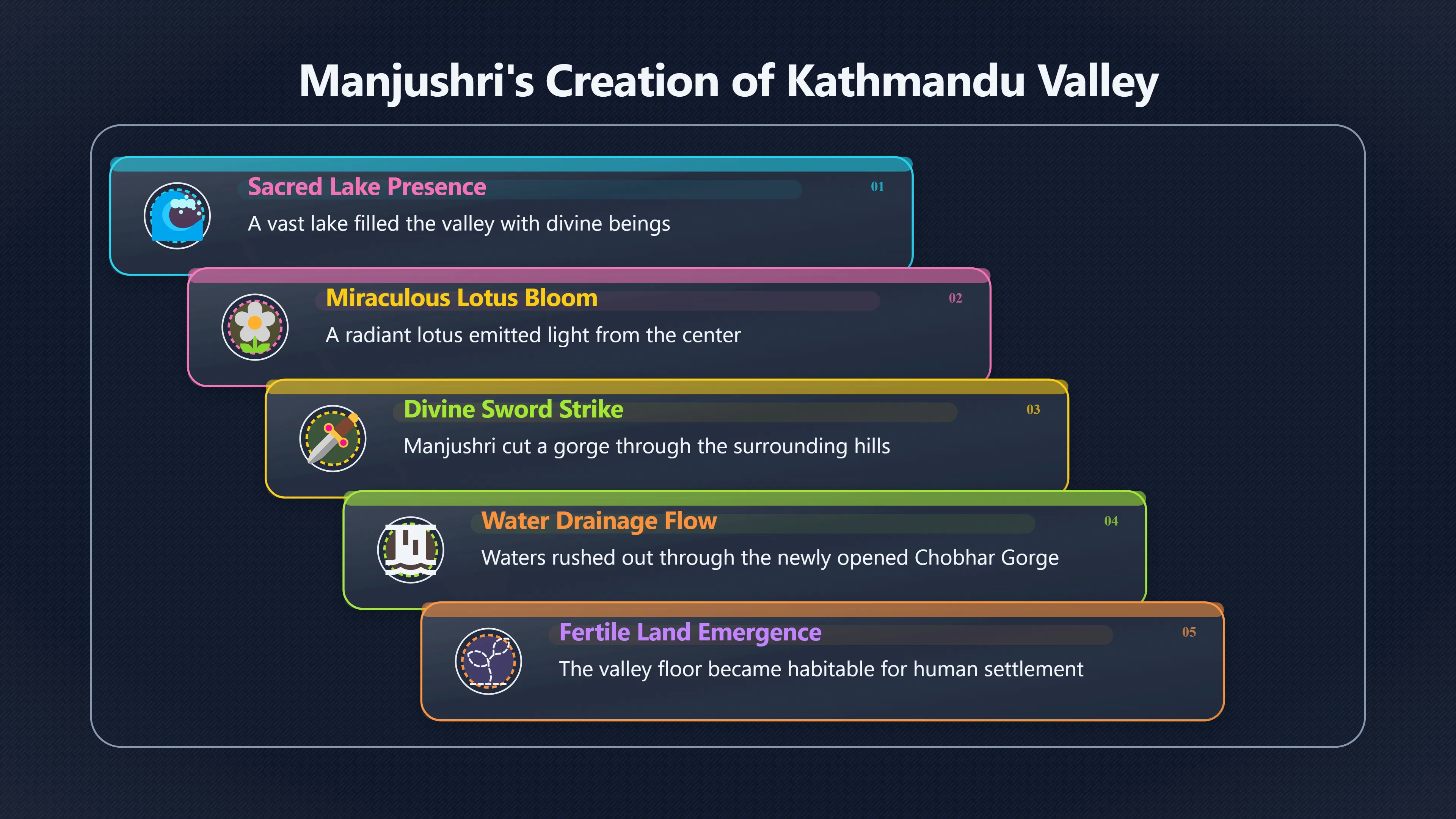
The best-known version of the valley’s creation story comes from Buddhist tradition, especially the Swayambhu Purana, a text that explains the sacred origins of the Swayambhu shrine. In this account, the valley was once a great lake inhabited by powerful serpent beings and visited by Buddhas, sages and divine figures. At its centre grew a lotus emitting an extraordinary light visible from great distances.[Wikipedia]WikipediaOpen source on wikipedia.org.
Manjushri, the bodhisattva associated with wisdom, saw this miraculous light and travelled to the valley to worship it. Realising that ordinary people could not easily reach the sacred lotus while it remained surrounded by water, he cut through the hills at what is now Chobhar Gorge. The waters rushed out, exposing fertile land and making human settlement possible. The valley floor where Kathmandu, Patan and Bhaktapur now stand emerged from the former lakebed.[Wikipedia]WikipediaOpen source on wikipedia.org.
In many retellings, the act is not merely engineering on a mythic scale. It is an expression of wisdom transforming chaos into a habitable world. The sword that cuts the gorge is often described as a sword of wisdom, linking geography directly to Buddhist ideas about enlightenment and insight. The landscape itself becomes evidence of a sacred act.[Nepali Times]nepalitimes.comthe hill of the flaming lotusNepali TimesThe hill of the flaming lotus4 May 2001 — The lotus settled on a low hill and there Manjushri worshipped and caused a shrine…
The legend also explains specific places. Chobhar Gorge is remembered as the point where the lake drained. Some traditions associate the earliest settlement after the draining with a city founded by Manjushri near Swayambhu. In this way, natural features and human history become woven into a single sacred narrative.[HoneyGuide Apps]honeyguideapps.comchobar gorge in kathmandu nepalHoneyGuide AppsChobar Gorge in Kathmandu, Nepal10 Jun 2015 — Manjushri main motive was to reach the top of the hill with divine lotus, Sw…
Swayambhu, Lotus Light and Sacred Emergence
At the heart of the creation story stands Swayambhu, today crowned by the famous stupa often called the Monkey Temple by visitors. The name derives from a term meaning “self-created” or “self-arisen”, reflecting the belief that the sacred light appeared spontaneously rather than being made by human hands.[Wikipedia]WikipediaOpen source on wikipedia.org.
The Swayambhu Purana describes the miraculous lotus as the visible manifestation of sacred truth. The lotus did not merely mark a holy place; it was itself a revelation. Pilgrims, Buddhas and celestial beings were said to visit the lake to honour the radiant phenomenon long before human settlement existed in the valley.[Wikipedia]WikipediaOpen source on wikipedia.org.
After the waters drained, the lotus became associated with the hill on which the Swayambhu stupa now stands. The hill therefore functions as a physical reminder of the valley’s sacred beginning. Looking across Kathmandu today, residents and pilgrims can still see the landmark that folklore identifies as the centre of the original miracle.[Wikipedia]WikipediaOpen source on wikipedia.org.
This connection between sacred revelation and visible geography helps explain the story’s longevity. Unlike many myths that take place in distant or vanished worlds, the Kathmandu creation legend points to places that people can still visit. The valley’s residents live inside the landscape described by the narrative.
How Sacred Memory Maps the Landscape
The creation legend is not simply a story about the distant past. It acts as a map of meaning.
Across the Kathmandu Valley, physical features acquire significance through their place in the narrative:
- Chobhar Gorge becomes the site of liberation, where the waters escaped.
- Swayambhu Hill marks the location of the miraculous lotus and sacred light.
- The valley floor becomes the former lakebed transformed into fertile human territory.
- Surrounding hills and passes become witnesses to a cosmic event that made civilisation possible.[Wikipedia]WikipediaOpen source on wikipedia.org.
Folklorists often describe such traditions as forms of landscape memory. Instead of preserving the past through written records alone, communities remember through places. A hill, gorge or shrine becomes a mnemonic device carrying stories across generations.
In Nepal, this process is especially powerful because religious practice remains tied to particular sites. Pilgrimage, festivals and everyday acts of worship continually reconnect people with locations associated with the valley’s sacred origins. The legend therefore survives not only in books and oral tradition but also in movement through the landscape itself.[Wikipedia]WikipediaOpen source on wikipedia.org.
Where Geology and Legend Meet
One reason the Kathmandu Valley creation story fascinates modern readers is that geology partly echoes the folklore.
Scientific studies have found that the valley was indeed occupied by a large ancient lake. Geological and fossil evidence indicates that water filled the basin for a very long period before natural drainage processes eventually transformed it into the landscape seen today. Research on sediments, fossils and ancient lake deposits supports the existence of what geologists often call the Paleo-Kathmandu Lake.[nasa.gov]science.nasa.govNASA ScienceKathmandu, NepalGeological and fossil evidence indicates that the Kathmandu Valley was covered by a large lake between approx…
Of course, geology does not support the supernatural elements of the legend. Scientists explain the disappearance of the lake through natural geological processes rather than a divine sword strike. Yet the broad memory of “a valley that was once a lake” proved surprisingly close to physical reality.[Nepali Times]nepalitimes.comthe lake that was once kathmanduNepali TimesThe lake that was once KathmanduAug 6, 2010 — The former holds that the Tibetan saint, Manjushree, flew down to Kathmandu. Up…
This does not mean the legend functioned as science. Rather, it shows how traditional narratives can preserve cultural memories of landscapes in ways that resonate with later discoveries. The folklore supplies meaning and sacred purpose; geology supplies physical explanation. Many Nepalese discussions of the valley’s origins comfortably place the two side by side rather than treating them as enemies.[Nepali Times]nepalitimes.comthe lake that was once kathmanduNepali TimesThe lake that was once KathmanduAug 6, 2010 — The former holds that the Tibetan saint, Manjushree, flew down to Kathmandu. Up…
How Sacred Valley survived in retelling
The story of the sacred lake remains one of Nepal’s most recognisable origin narratives because it links religion, history, place and identity in a single memorable image. It explains why Swayambhu is sacred, why Chobhar matters, and why the valley itself is seen as a specially blessed landscape.[Wikipedia]WikipediaOpen source on wikipedia.org.
For modern visitors, the legend offers a different way of seeing Kathmandu. The crowded city becomes the floor of a vanished lake. The gorge at Chobhar becomes the opening through which a mythical flood escaped. The stupa of Swayambhu becomes the transformed lotus at the centre of creation. Whether understood as religious truth, cultural memory or symbolic folklore, the narrative continues to shape how people imagine the valley.
Among Nepal’s many myths and sacred traditions, few are so closely tied to visible geography. The Kathmandu Valley creation legend is not merely told about the landscape; it is written onto the landscape itself.[wikipedia.org]WikipediaOpen source on wikipedia.org.
Amazon book picks
Further Reading
Books and field guides related to Was Kathmandu Once a Sacred Lake?. Use these as the next step if you want deeper reading beyond the article.
The Snow Leopard
Captures the spiritual and cultural atmosphere that informs many mountain legends.
Nepal Mandala
Directly explores the valley, its sacred sites, origin traditions and religious geography.
Myths and Legends of Nepal
Includes traditional narratives connected to Nepal’s sacred origins.
eBay marketplace picks
Marketplace Samples
Live-tested eBay searches with available results related to this page.


Endnotes
1.
Source: Wikipedia
Link:https://en.wikipedia.org/wiki/Manjushri
2.
Source: science.nasa.gov
Link:https://science.nasa.gov/earth/earth-observatory/kathmandu-nepal-47287/
Source snippet
NASA ScienceKathmandu, NepalGeological and fossil evidence indicates that the Kathmandu Valley was covered by a large lake between approx...
3.
Source: Wikipedia
Link:https://en.wikipedia.org/wiki/Swayambhunath
4.
Source: Wikipedia
Link:https://en.wikipedia.org/wiki/Svayambhu
Source snippet
SvayambhuSvayambhu is a Sanskrit word that means "self-born", "self-manifested", "self-existing", or "that that is created by its own...
5.
Source: researchgate.net
Link:https://www.researchgate.net/publication/248352548_Changes_in_the_depositional_system_of_the_Paleo-Kathmandu_Lake_caused_by_uplift_of_the_Nepal_Lesser_Himalayas
Source snippet
2002; Paudyal et al. 2012). The average elevation of the...Read more...
6.
Source: Wikipedia
Link:https://en.wikipedia.org/wiki/Kathmandu
Source snippet
KathmanduKathmandu is the capital and largest city of Nepal, situated in the central part of the country within the Kathmandu Valley...
7.
Source: researchgate.net
Title: Geology of Kathmandu Valley After Dhital 2015 fig3 312551704
Link:https://www.researchgate.net/figure/Geology-of-Kathmandu-Valley-After-Dhital-2015_fig3_312551704
Source snippet
Geology of Kathmandu Valley (After Dhital, 2015).Hydrogeological study of Nagdhunga tunnel project is conducted in order to get the infor...
8.
Source: researchgate.net
Link:https://www.researchgate.net/publication/313053040_Danuwargaun_Fault_as_a_trigger_for_draining_of_the_Palaeo-Kathmandu_Lake_central_Nepal
Source snippet
The fault is trending NE-SW and dipping 80 to...
9.
Source: researchgate.net
Link:https://www.researchgate.net/publication/228661080_Expansion_of_an_ancient_lake_in_the_Kathmandu_basin_of_Nepal_during_the_Late_Pleistocene_evidenced_by_lacustrine_sediment_underlying_piedmont_slope
Source snippet
Expansion of an ancient lake in the Kathmandu basin of...The drainage of the lake was accompanied by the Bagmati river after 30,000 year...
10.
Source: nepalitimes.com
Title: the lake that was once kathmandu
Link:https://nepalitimes.com/the-lake-that-was-once-kathmandu
Source snippet
Nepali TimesThe lake that was once KathmanduAug 6, 2010 — The former holds that the Tibetan saint, Manjushree, flew down to Kathmandu. Up...
11.
Source: nepalitimes.com
Title: the hill of the flaming lotus
Link:https://nepalitimes.com/the-hill-of-the-flaming-lotus
Source snippet
Nepali TimesThe hill of the flaming lotus4 May 2001 — The lotus settled on a low hill and there Manjushri worshipped and caused a shrine...
Published: May 2001
12.
Source: honeyguideapps.com
Title: chobar gorge in kathmandu nepal
Link:https://honeyguideapps.com/blog/chobar-gorge-in-kathmandu-nepal
Source snippet
HoneyGuide AppsChobar Gorge in Kathmandu, Nepal10 Jun 2015 — Manjushri main motive was to reach the top of the hill with divine lotus, Sw...
13.
Source: ntb.gov.np
Link:https://ntb.gov.np/kathmandu
Source snippet
Nepal Tourism BoardKathmandu Capital of NepalKathmandu, the largest city of Nepal, is the political as well as cultural capital of the co...
Additional References
14.
Source: worldexpeditions.com
Link:https://worldexpeditions.com/Blog/10-things-to-do-in-kathmandu
Source snippet
10 Things To Do in KathmanduHemmed by Himalayan foothills, the vibrant city is packed full of history, palaces, temples and bazaars. Home...
15.
Source: scispace.com
Link:https://scispace.com/pdf/expansion-of-an-ancient-lake-in-the-kathmandu-basin-of-nepal-2wl0tg194f.pdf
Source snippet
to local legend, Kathmandu basin once held a large lake; the god Man...
16.
Source: swoyambhustupa.com
Link:https://swoyambhustupa.com/history-of-swoyambhu-stupa/
Source snippet
History of Swoyambhu Stupa.Swoyambhu Purana legend, speaks of a miraculous lotus, planted by a past Buddha, which blossomed from the lake...
17.
Source: swoyambhustupa.com
Link:https://swoyambhustupa.com/manjushree-dharmadhatu-baagishwora/
Source snippet
Manjushree Dharmadhatu BaagishworaManjushree was credited as the founder of Kathmandu valley by cutting open the southern side of hill by...
18.
Source: mona.com.np
Link:https://www.mona.com.np/art/v/the-birth-of-kathmandu
Source snippet
The Birth of KathmanduLegendary history says Kathmandu Valley was created by Bodhisattva Manjushri who conceived the idea of draining the...
19.
Source: medium.com
Link:https://medium.com/%40himalayan360nepal/the-origin-story-of-kathmandu-valley-from-a-lake-e6d0b157b1a9
Source snippet
The Origin Story of Kathmandu Valley from a LakeAccording to ancient legends, the Kathmandu Valley was once a vast lake surrounded by gen...
20.
Source: aviskara.com.np
Link:https://aviskara.com.np/samskriti/can-you-hear-the-gods-whispering-the-origins-of-kathmandu-valley/
Source snippet
The Origins of Kathmandu Valley – AviskaraSome sources cite Manjushree as being of Chinese descent, and it is stated in the Newari-Buddhi...
21.
Source: bajracharya.org
Link:https://bajracharya.org/swayambhu-purana/chapter-4-vishwabhu-tathagata-manjushri-and-birth-of-nepal-valley/
Source snippet
Vishwabhu Tathagata: Manjushri and Birth of Nepal ValleyDiscover the prophecy of Vishwabhu Tathagata and Manjushri draining the lake, cre...
22.
Source: sherpaadventuregear.com
Link:https://www.sherpaadventuregear.com/blogs/journal/visiting-swayambhu-mahachaitya-the-monkey-temple
Source snippet
Visiting Swayambhu Mahachaitya, the Monkey TempleThis holy shrine is located on the Swayambhunath Stupa above the Kathmandu Valley and is...
23.
Source: dpnet.org.np
Title: Kathmandu Valley as a prehistoric lake, drained through the Chobhar. September
Link:https://www.dpnet.org.np/news/detail/dpnet-carries-out-observation-visit-to-chobhar-gorge
Source snippet
DPNet Carries Out Observation Visit to Chobhar GorgeJul 11, 2025 — One of such devastating flood occurred on 28 September, 2024...
Topic Tree