What Survives of Nauru's Old Stories?
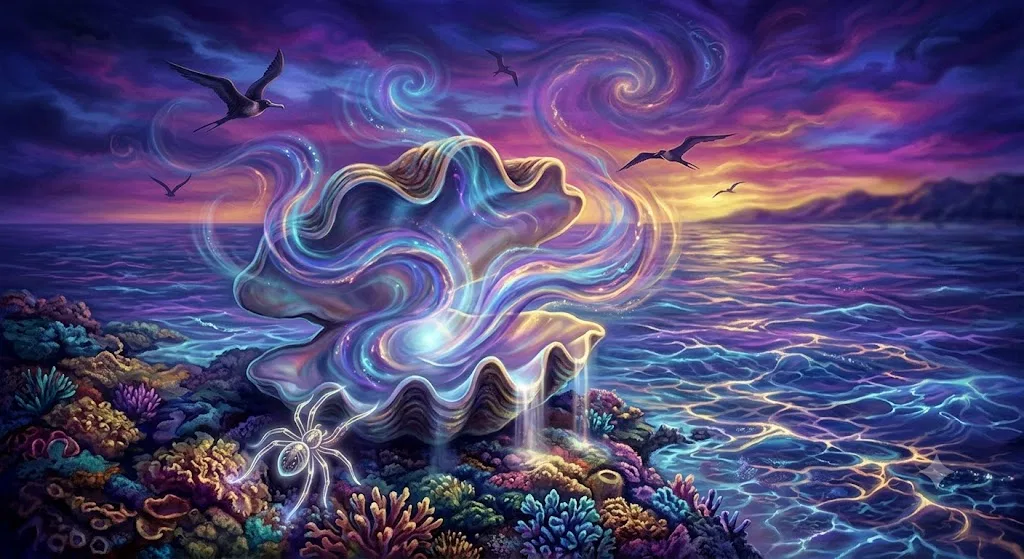
Nauru’s folklore is unusually compact, like the island itself: a small body of recorded myths, oral histories and tales, with one creation story standing out above all others. At its centre is Areop-Enap, the spider creator who opens a vast shell and makes the sky, earth, sea, moon, sun and living world.
Page outline Jump by section
The spider who opened the world
The best-known Nauruan myth begins in darkness, with only the sea and Areop-Enap, a great spider. In the widely repeated version, Areop-Enap enters, or is trapped inside, a huge clam-like shell. Within it are smaller beings, including snails and a worm or caterpillar often named Rigi or Riki. The shell is eventually forced open, and its parts become the ordered cosmos: earth below, sky above, sea, heavenly bodies and living places. Later retellings often describe the smaller snail becoming the moon, the larger snail becoming the sun, and Rigi’s great exertion helping to open the shell.[Wikipedia]WikipediaOpen source on wikipedia.org.
What makes the story memorable is not just the spider. It is the intensely island-based imagery. Creation is not pictured as a palace in the clouds or a battlefield of gods, but as a marine world: shell, sea, salt water, small creatures, darkness and sudden light. That gives the myth a local texture. Nauru is a single raised coral island in the Pacific, with a narrow coastal strip and a reef that shaped older fishing, travel and settlement; a creation story that begins inside a shell belongs to a culture for which the sea is not scenery but the surrounding condition of life.[Guampedia]guampedia.comPOP Cultures: NauruPOP Cultures: Nauru
The story also sits close to neighbouring Micronesian and Kiribati traditions. A review of Jay Dobbin and Francis Hezel’s work on Micronesian traditional religions notes that Kiribati and Nauru both preserve myths in which a primordial clam is opened and the separation of sky and earth establishes the world. In the Nauruan form, Areop-Enap opens the shell with the help of Riki, creating the heavens and earth and separating light from dark, order from chaos. The same review stresses that the Nauruan version has its own moral turn, in which a once-good creation becomes sullied and evil is released.[uog.edu]uog.eduMicrosoft Word12 BR Sellmann Dobbin FORMAT 150-158…
How much of old Nauruan religion survives?
The short answer is: less than readers might expect, but enough to show a distinctive worldview. Nauru’s older religious life included creator beings, spirits of the dead, ritual specialists, offerings, healing, charms and links between supernatural beings and family lineages. In the regional summary of Micronesian religion, Nauruan specialists included figures who made offerings, healed with plants and chants, or worked with spirits and curses. The dead became spirits and undertook a journey, with a frigate bird described as an intermediary and guide for the departed.[uog.edu]uog.eduMicrosoft Word12 BR Sellmann Dobbin FORMAT 150-158…
This does not mean that old Nauruan religion exists today as a large organised faith. Contemporary Nauru is predominantly Christian. The 2021 census data listed the largest affiliations as Nauru Congregational, Catholic and Assemblies of God, while the government-oriented PALM country sheet also summarises Christianity as the main religion and notes that few old customs have been preserved because of colonial and contemporary Western influences.[microdata.pacificdata.org]microdata.pacificdata.orgOpen source on pacificdata.org.
That shift matters when reading Nauruan folklore. Many stories now reach outside readers through books, databases, summaries and retellings, not through a living public ritual calendar. Some traditional arts and practices still continue, especially rhythmic singing, dance, fishing and crafts, but the old cosmology is now mostly encountered as heritage, literature, cultural memory or comparative mythology rather than as mainstream everyday religion.[palmscheme.gov.au]palmscheme.gov.auPALM scheme country fact sheet NauruPALM scheme country fact sheet Nauru
The Nauruan record: small, late and precious
The most important named Nauruan preservation figure is Timothy Detudamo, who was Head Chief of Nauru and helped preserve oral material before the middle of the twentieth century. Open Library describes Legends, Traditions and Tales of Nauru as “a transcript of a series of lectures delivered by native teachers” and records that Detudamo transcribed and translated lectures on Nauru’s legends, customs and tales in 1938. The published edition appeared through IPS Publications at the University of the South Pacific and runs to fewer than 100 pages.[Open Library]openlibrary.orgOpen Library Legends, traditions and tales of Nauru | Open LibraryOpen Library Legends, traditions and tales of Nauru | Open Library
That source is valuable for two reasons. First, it is Nauruan-led, not only an outside ethnographer’s notebook. Second, it shows that Nauruan folklore was never just a set of gods. Its subjects included legends, social customs, animal tales, fishing, childbirth, death, warriors, birds and local explanations of how things came to be. A contemporary reader of the book notes its division into legends, traditions and tales, with the “traditions” section describing customs and rituals, and the “tales” section preserving animal-rich folk narratives.[Around the World in 2000 Books]aroundtheworldin2000books.comlegends traditions and tales of naurulegends traditions and tales of nauru
The other major early source base comes from outside ethnography, especially Paul Hambruch’s work from the Hamburg South Seas Expedition. The regional literature repeatedly treats Hambruch’s Nauru volumes as central evidence for older Nauruan religion, while also reminding readers that they are products of a short colonial-era research encounter. Dobbin and Hezel’s later synthesis, as reviewed in Pacific Asia Inquiry, explicitly places Hambruch alongside British colonial and missionary sources and warns that the material is diverse, conflicting and inconsistent across islands and lineages.[uog.edu]uog.eduMicrosoft Word12 BR Sellmann Dobbin FORMAT 150-158…
Spirits, lineages and the moral shape of myth
Nauruan myth is not only about where the universe came from. It also explains social order. In the wider Kiribati-Nauru material discussed by Dobbin and Hezel, oral histories connect present people to gods and forebears through genealogy. This matters because legends could support clan identity, chiefly lines and relationships between living families and ancestral powers.[uog.edu]uog.eduMicrosoft Word12 BR Sellmann Dobbin FORMAT 150-158…
The afterlife material is especially striking. The review of Summoning the Powers Beyond describes a Nauruan belief that after death a person became a spirit and travelled towards a judging or testing point before sailing away in an outrigger canoe led by a frigate bird. The same account describes offerings at stone pillars, healing with herbs and chants, and different intermediaries who dealt with supernatural forces. These details make Nauruan folklore feel less like a detached storybook and more like a practical system for handling illness, death, danger, inheritance and uncertainty.[uog.edu]uog.eduMicrosoft Word12 BR Sellmann Dobbin FORMAT 150-158…
There is also a moral emphasis. The Nauruan creation story has been interpreted as unusually concerned with the movement from goodness into pollution or evil. That does not mean the myth should be flattened into a simple “fall” story borrowed from Christianity. The better reading is more careful: the surviving sources show that Nauruan cosmology could explain not only creation but also why the world contains disorder, danger and moral consequence.[uog.edu]uog.eduMicrosoft Word12 BR Sellmann Dobbin FORMAT 150-158…
Birds, fishing and the folklore of daily life
One of the easiest mistakes is to look only for named gods and miss the more everyday folklore of Nauru. Birds, fish, pandanus, coconuts, shells and the reef world were all part of the cultural imagination because they were part of daily survival. Guampedia’s cultural profile describes traditional bird-catching, in which men used a weighted lasso to catch birds returning from the sea at sunset; captured birds could also be kept as pets. The same profile notes that rhythmic singing, dance, pandanus mats, coconut-leaf fans and geometric designs remained important cultural expressions even as older culture changed.[Guampedia]guampedia.comPOP Cultures: NauruPOP Cultures: Nauru
The frigate bird is particularly important because it appears both in practical life and in spiritual symbolism. In the religious summary discussed above, the frigate bird guides the departed, while in modern cultural description it is tied to traditional bird-catching skill. That overlap is exactly what makes folklore worth reading: the same creature may be food-related, skilled-labour-related, status-related and spiritually meaningful, depending on context.[uog.edu]uog.eduMicrosoft Word12 BR Sellmann Dobbin FORMAT 150-158…
Fishing likewise belongs to more than one category. It is practical knowledge, but it also carries ritual and narrative weight. Nauruan cultural summaries still identify fishing as one of the older practices that survives in some form, while Detudamo’s preserved material is repeatedly described as covering customs as well as legends and tales.[palmscheme.gov.au]palmscheme.gov.auPALM scheme country fact sheet NauruPALM scheme country fact sheet Nauru
Sacred landscape on a mined island
Nauru’s folklore cannot be separated from the island’s damaged landscape. Phosphate mining transformed much of the interior, and modern heritage work now has to reckon with both cultural preservation and environmental repair. Guampedia notes Nauru’s heavy phosphate history and the need for rehabilitation, while UNESCO reported in 2025 that Nauru had begun a national World Heritage consultation process after ratifying the World Heritage Convention in 2024. That consultation brought together heritage, museum, tourism, environment, land and rehabilitation bodies to discuss how to identify, document, preserve and promote cultural and natural heritage.[Guampedia]guampedia.comPOP Cultures: NauruPOP Cultures: Nauru
This matters for folklore because stories are not only words. They attach to places, stones, reefs, paths, house sites, fishing grounds, birds, plants and remembered districts. When mining removes or transforms landscape features, it can also make old story geography harder to recognise. The UNESCO process is not a folklore project in the narrow sense, but it shows that Nauru is now treating heritage as an urgent national issue, especially under climate pressure and after long environmental disruption.[UNESCO World Heritage Centre]whc.unesco.orgOpen source on unesco.org.
What to be careful about in modern retellings
Modern internet summaries of Nauruan mythology often repeat the Areop-Enap creation story, but not all retellings are equally careful. Some simplify the spider into a “god of creation” with tidy powers and attributes, as if Nauru had a neatly catalogued pantheon like a fantasy role-playing sourcebook. The older evidence is messier. It contains variant names, shell-creatures, overlapping Micronesian parallels, missionary and colonial filters, Nauruan preservation work, and stories whose meanings may differ by lineage or local telling. The Pacific Asia Inquiry review explicitly notes diverse and conflicting stories in the regional source material, which is a useful warning against over-smoothing the tradition.[uog.edu]uog.eduMicrosoft Word12 BR Sellmann Dobbin FORMAT 150-158…
It is also worth separating folklore from modern popular culture. Areop-Enap sometimes appears in online myth databases and fandom-adjacent settings, where the figure may be adapted into fantasy, horror or game-like categories. Those adaptations can introduce new readers to Nauru, but they should not be mistaken for old oral tradition unless they are clearly tied back to Nauruan or scholarly sources. The safest approach is to treat Areop-Enap, Riki, the clam-shell creation, the spirit journey and bird symbolism as the best-attested core, and to treat elaborate modern personality profiles or invented pantheon details with caution.[Open Library]openlibrary.orgOpen Library Legends, traditions and tales of Nauru | Open LibraryOpen Library Legends, traditions and tales of Nauru | Open Library
Why Nauru’s folklore still matters
Nauru’s folklore matters partly because it is rare. A small island country with a small population cannot rely on the sheer quantity of books, museums and media that preserve larger traditions. Detudamo’s 1938 work is important precisely because it was an attempt to keep group histories, traditions and memories from being lost; later publication by the University of the South Pacific made that material more accessible beyond Nauru.[Open Library]openlibrary.orgOpen Library Legends, traditions and tales of Nauru | Open LibraryOpen Library Legends, traditions and tales of Nauru | Open Library
It also matters because the stories offer a different mental map of the world. Creation begins inside a shell. A spider brings order from darkness. A worm’s labour helps open the universe. The sea is not a border but the beginning. A bird can be both caught by skilled hands and imagined as a guide for the dead. These are not curiosities from an isolated island; they are compressed ways of thinking about ecology, kinship, morality and survival in a small ocean world.
The honest conclusion is that Nauruan folklore is not exhaustively documented, and much of what survives comes through a limited number of early and mid-twentieth-century records. But that does not make it minor. It makes each preserved story more valuable. For modern readers, Nauru’s mythic tradition is best approached with curiosity and restraint: vivid enough to remember, fragile enough not to overstate, and deeply tied to an island whose cultural heritage is still being documented, protected and reinterpreted today.
Amazon book picks
Further Reading
Books and field guides related to What Survives of Nauru's Old Stories?. Use these as the next step if you want deeper reading beyond the article.
Myths and Legends of the Pacific
Places Nauruan stories within a broader Pacific framework.
The Book of Mythical Beasts & Magical Creatures
Includes Pacific mythological themes that help frame Nauruan stories.
eBay marketplace picks
Marketplace Samples
Live-tested eBay searches with available results related to this page.


Endnotes
1.
Source: uog.edu
Title: Microsoft Word
Link:https://www.uog.edu/_resources/files/schools-and-colleges/college-of-liberal-arts-and-social-sciences/pai/pai5-sellmann-book-review-dobbin.pdf
Source snippet
12 BR Sellmann Dobbin FORMAT 150-158...
2.
Source: palmscheme.gov.au
Title: PALM scheme country fact sheet Nauru
Link:https://www.palmscheme.gov.au/sites/default/files/2022-04/PALM%20scheme%20country%20fact%20sheet%20-%20Nauru.pdf
3.
Source: Wikipedia
Link:https://en.wikipedia.org/wiki/Areop-Enap
4.
Source: guampedia.com
Title: POP Cultures: Nauru
Link:https://www.guampedia.com/pop-cultures-nauru/
5.
Source: microdata.pacificdata.org
Link:https://microdata.pacificdata.org/index.php/catalog/816/variable/F5/V902?name=religion
6.
Source: aroundtheworldin2000books.com
Title: legends traditions and tales of nauru
Link:https://aroundtheworldin2000books.com/2017/07/21/legends-traditions-and-tales-of-nauru/
7.
Source: Wikipedia
Title: Paul Hambruch
Link:https://en.wikipedia.org/wiki/Paul_Hambruch
8.
Source: whc.unesco.org
Link:https://whc.unesco.org/en/news/2777
9.
Source: usp.ac.fj
Title: The University of the South Pacific
Link:https://www.usp.ac.fj/library/wp-content/uploads/sites/33/2021/05/Pacifika_September_20091.pdf
10.
Source: ich.unesco.org
Title: nauru NR
Link:https://ich.unesco.org/en/state/nauru-NR
11.
Source: ich.unesco.org
Link:https://ich.unesco.org/
12.
Source: Wikipedia
Link:https://en.wikipedia.org/wiki/Nauru
13.
Source: Wikipedia
Title: Nauruan indigenous religion
Link:https://en.wikipedia.org/wiki/Nauruan_indigenous_religion
14.
Source: Wikipedia
Title: Literatur Ozeaniens
Link:https://de.wikipedia.org/wiki/Literatur_Ozeaniens
15.
Source: Wikipedia
Title: Demographics of Nauru
Link:https://en.wikipedia.org/wiki/Demographics_of_Nauru
16.
Source: Wikipedia
Title: Religion in Nauru
Link:https://en.wikipedia.org/wiki/Religion_in_Nauru
17.
Source: microdata.pacificdata.org
Title: study description
Link:https://microdata.pacificdata.org/index.php/catalog/816/study-description
18.
Source: nauru.gov.nr
Title: The Government of the Republic of Nauru
Link:https://www.nauru.gov.nr/
19.
Source: nauru.gov.nr
Title: gazette 141 26
Link:https://www.nauru.gov.nr/media/220538/gazette_141-26.pdf
20.
Source: pantheon.org
Title: areop enap
Link:https://pantheon.org/articles/a/areop-enap.html
21.
Source: stats.gov.nr
Title: nauru 2021 population and housing census report available
Link:https://stats.gov.nr/2023/09/06/nauru-2021-population-and-housing-census-report-available/
22.
Source: secretsnicholasflamel.fandom.com
Title: Areop Enap
Link:https://secretsnicholasflamel.fandom.com/wiki/Areop-Enap
23.
Source: openlibrary.org
Title: Open Library Legends, traditions and tales of Nauru | Open Library
Link:https://openlibrary.org/books/OL23738686M/Legends_traditions_and_tales_of_Nauru
24.
Source: omnika.org
Link:https://omnika.org/deities/areop-enap
25.
Source: earth.northwestern.edu
Link:https://www.earth.northwestern.edu/people/emile/nauru.html
26.
Source: relief.unboundmedicine.com
Link:https://relief.unboundmedicine.com/relief/view/The-World-Factbook/563170/all/Nauru
27.
Source: 2021-2025.state.gov
Link:https://2021-2025.state.gov/reports/2021-report-on-international-religious-freedom/nauru/
28.
Source: openfactbook.org
Link:https://openfactbook.org/countries/nauru/
29.
Source: worldbooktour.wordpress.com
Link:https://worldbooktour.wordpress.com/2017/03/26/nauru/
30.
Source: youtube.com
Link:https://www.youtube.com/shorts/6cZCJaILX1Y
31.
Source: ebsco.com
Link:https://www.ebsco.com/research-starters/geography-and-cartography/nauru
32.
Source: en.wikisource.org
Link:https://en.wikisource.org/wiki/CIA_World_Fact_Book%2C_2004/Nauru
33.
Source: geofactbook.com
Link:https://geofactbook.com/countries/nauru
Additional References
34.
Source: youtube.com
Title: Nauru Explained in 14 Minutes | History, Geography, Culture
Link:https://www.youtube.com/watch?v=v8TLTcXoZX0
Source snippet
Nauru Travel: The Pacific's Least-Visited Island Nation (History, Fishing, Culture)...
35.
Source: youtube.com
Title: NAURU Traditional Folk Music: “Epo Epo Anabar”
Link:https://www.youtube.com/watch?v=bUxbnhkY9cY
Source snippet
Nareau: The Micronesian Spider God Who Wove the Universe...
36.
Source: instagram.com
Link:https://www.instagram.com/naurutravelguide/
37.
Source: isa.org.jm
Link:https://www.isa.org.jm/wp-content/uploads/2024/07/Nauru-Intervention_19.07-Underwater_Cultural_Heritage-Item_10.pdf
38.
Source: themuralman.com
Link:https://www.themuralman.com/nauru/nauru_folk_tale.htm
39.
Source: nationalmuseumpublications.co.za
Link:https://nationalmuseumpublications.co.za/arachnids-in-folklore-and-myths/
40.
Source: mythlok.com
Link:https://mythlok.com/areop-enap/
41.
Source: tumblr.com
Link:https://www.tumblr.com/reading-the-fantastic/76947155352/areop-enap
42.
Source: degruyterbrill.com
Link:https://www.degruyterbrill.com/document/doi/10.1515/9780824860110-009/html?srsltid=AfmBOop92Sn4jJG1lBLB_gNJ4c3aRwTYmb3RmG_6FgoJqeDx4wx7yM17
43.
Source: academia.edu
Link:https://www.academia.edu/98427454/The_Vengeful_Spirit_Chudail_Oral_Traditions_and_the_Archaeology_of_Folklore
Topic Tree
Follow this branch
Related pages 192
- Afghan Folklore
- Albanian Folklore
- Algerian Folklore
- Australian Folklore
- Azerbaijan Folklore
- +187 more in sidebar