Within Korean Folklore
Why Does the Dangun Myth Still Matter?
The Dangun myth explains how sky, mountain, animal transformation and nationhood became joined in Korea's best-known origin story.
On this page
- The Samguk yusa source trail
- The bear, tiger and heavenly descent
- Modern identity and National Foundation Day
Page outline Jump by section
Introduction
The Dangun myth is Korea’s best-known origin story: a tale in which heaven descends to earth, a bear becomes human, and a legendary founder establishes the first Korean kingdom. More than a simple creation story, it links sacred mountains, animal transformation, divine ancestry and the beginnings of nationhood into a single narrative that has shaped Korean cultural memory for centuries. The story survives most famously in a medieval text called the Samguk yusa, yet its influence extends far beyond literature. It appears in public holidays, school education, museums, political symbolism and modern popular culture. For many Koreans, the Dangun story is not read as literal history but as a foundational narrative that explains where the Korean people came from and what values they imagine at the beginning of their civilisation.[wikipedia.org]WikipediaSamguk yusaSamguk yusa

Why Does the Dangun Myth Still Matter?
Few national foundation legends remain as visible in public life as the Dangun story. It occupies a unique place because it is simultaneously folklore, mythology, historical tradition and a symbol of cultural continuity. The tale presents the founding of the ancient kingdom of Gojoseon and places that foundation in a sacred landscape shaped by heavenly authority and earthly transformation.[World History Encyclopedia]worldhistory.orgWorld History EncyclopediaDangun20 Oct 2016 — Dangun Wanggeom (or Tangun) was the legendary founder of Gojoseon (Gochoson or Old Choson)…
The myth also offers an origin that is distinctly Korean. Although the surviving version was written down centuries after the events it describes, generations of scholars, writers and political leaders treated it as a statement of cultural identity. During periods of foreign domination and political upheaval, the story was often invoked as evidence of a long and independent Korean heritage.[wikipedia.org]WikipediaOpen source on wikipedia.org.
What makes the tale memorable to modern readers is its unusual combination of themes. Instead of beginning with a conquering hero, it centres on a patient bear, a disappointed tiger, a heavenly prince and a child born from the meeting of divine and earthly forces. That combination has given the myth an enduring symbolic power that continues to inspire interpretation.
The Samguk yusa Source Trail
The best-known version of the Dangun myth appears at the beginning of the Samguk yusa (“Memorabilia of the Three Kingdoms”), a collection of legends, historical traditions and religious narratives compiled in the late thirteenth century by the Buddhist monk Iryeon. The work is one of the most important surviving sources for early Korean myths and folklore, and it preserves traditions that might otherwise have been lost.[wikipedia.org]WikipediaSamguk yusaSamguk yusa
The text was written more than a millennium after the legendary founding of Gojoseon. For that reason, historians do not treat the story as a factual account of events in the third millennium BCE. Instead, they view it as evidence of how medieval Koreans understood their distant past and how older oral traditions were remembered and reshaped over time.[Wikipedia]WikipediaSamguk yusaSamguk yusa
Other medieval works also preserve versions of the legend, including the Jewang Ungi and later historical compilations. The existence of multiple retellings suggests that the story was already deeply established in Korean cultural memory before it was written down in its surviving forms.[Wikipedia]WikipediaMay 2, 2026 — The earliest recorded version of the Tan'gun legend appears in the 13th-century Samguk yusa, which purportedly cites Korea'…
The Bear, Tiger and Heavenly Descent
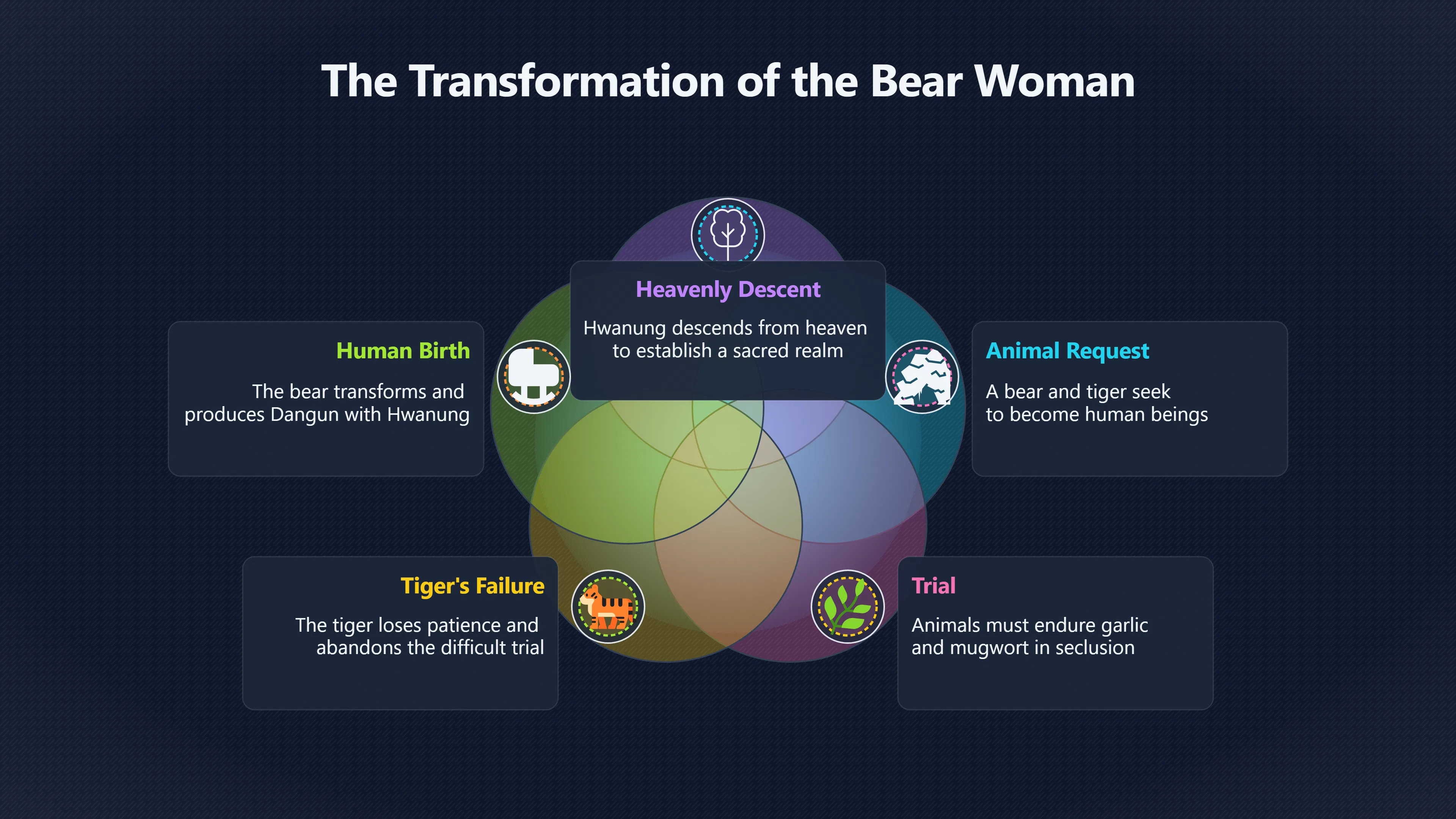
At the centre of the myth stands Hwanung, the son of a heavenly ruler. Desiring to govern the human world, he descends from heaven with followers and establishes a sacred realm beneath a holy tree on a mountain. His stated purpose is to benefit humanity, making his descent an act of order and civilisation rather than conquest.[Korea.Net]korea.netDangun, Father of Korea: Korea's foundation tale lends…Aug 14, 2014 — The Dangun story begins with Hwanung, son of Hwanin, a god who l…
Soon after, a bear and a tiger approach Hwanung with an unusual request: they wish to become human. He gives them a test. They must remain in seclusion, avoid sunlight and survive on mugwort and garlic for a fixed period. The tiger loses patience and abandons the trial. The bear endures and is transformed into a woman.[go.kr]folkency.nfm.go.krMyth of Dangun한국민속대백과사전At this time, a bear and a tiger that lived in the same cave prayed and prayed to Hwanung for their wish to become human. Hwaung…
The newly transformed woman, often called the Bear Woman in English, later prays for a child. Hwanung answers her plea, and their union produces Dangun, who goes on to found Gojoseon. Through Dangun, the heavenly lineage of Hwanung and the earthly lineage of the bear become joined.[wikipedia.org]WikipediaOpen source on wikipedia.org.
The story is striking because the tiger does not become the ancestor. In later Korean folklore, tigers are everywhere: they appear in folk paintings, mountain traditions, humour, cautionary tales and guardian imagery. Yet in the foundation myth, the tiger fails while the bear succeeds. This contrast has inspired centuries of interpretation.[Korea.Net]korea.netWhy the tiger is prominent in Korean cultureJan 6, 2022 — The Dangun myth of the foundation of Korea's first nation said the tiger vied w…
What Do the Bear and Tiger Symbolise?
Modern readers often ask whether the bear and tiger were meant to be real animals. Many scholars instead view them as symbolic figures connected to older religious beliefs, clan identities or animal totems. In this interpretation, the story may preserve memories of ancient groups that identified themselves with particular animals and later became incorporated into a shared cultural tradition.[Wikipedia]WikipediaOpen source on wikipedia.org.
The bear has attracted particular attention. Researchers have noted that bear worship appears in parts of Northeast Asia, including regions north of the Korean Peninsula. Some scholars therefore see the bear woman as a mythic reflection of older spiritual traditions linked to fertility, land and ancestry.[MDPI]mdpi.comThe area in which the Dangun myth originated isThinking Through the Tiger: Korean Cultural Identity…by E Yi · 2025 · Cited by 2 — Scholars have questioned and studied the Dangu…
The tiger, meanwhile, remained one of the most important symbolic animals in Korean culture. Mountain spirits were frequently associated with tigers, and the animal came to represent power, protection and the wild landscape. The tiger’s failure in the Dangun story did not diminish its cultural importance; if anything, later folklore made it one of Korea’s most recognisable creatures.[nfm.go.kr]nfm.go.krSymbolism of Animal FolkloreThe Tiger is regarded as the king of the mountain and is worshiped as a mountain deity. It often appears in d…
Another common interpretation focuses on values rather than tribal origins. The bear succeeds through patience, endurance and self-discipline. The tiger fails because it cannot complete the trial. In that reading, the myth becomes a lesson about perseverance and transformation rather than ancestry alone.[folkency.nfm.go.kr]folkency.nfm.go.krMyth of Dangun한국민속대백과사전At this time, a bear and a tiger that lived in the same cave prayed and prayed to Hwanung for their wish to become human. Hwaung…
A Sacred Landscape of Mountains and Heaven
The Dangun myth is inseparable from the Korean landscape. Mountains occupy a sacred role throughout the story, and many versions place key events around the great northern mountain region associated with Baekdu or Taebaek. The descent from heaven occurs not in a city but in a mountain setting beneath a sacred tree.[Korea.Net]korea.netDangun, Father of Korea: Korea's foundation tale lends…Aug 14, 2014 — The Dangun story begins with Hwanung, son of Hwanin, a god who l…
This emphasis reflects a wider pattern in Korean folklore and folk religion, where mountains are often viewed as places of spiritual power. Mountain gods, sacred peaks and landscape spirits appear throughout traditional narratives. The Dangun myth therefore does more than explain political origins; it places the birth of the nation within a spiritually charged natural world.[nfm.go.kr]nfm.go.krSymbolism of Animal FolkloreThe Tiger is regarded as the king of the mountain and is worshiped as a mountain deity. It often appears in d…
The final stage of the legend reinforces this connection. Some versions describe Dangun eventually becoming a mountain spirit after a long reign, returning symbolically to the sacred landscape from which the story began.[My study of Korea… From Afar]pclar09.wordpress.comMy study of KoreaFrom AfarThe Story of Dangun Wanggeom - My study of Korea… From Afar7 Oct 2012 — The myth states that Dangun ruled for 1500 years befor…
Modern Identity and National Foundation Day
The Dangun myth remains visible in contemporary South Korea through National Foundation Day, celebrated on 3 October. The holiday commemorates the legendary founding of the Korean nation and reflects the continuing symbolic importance of the story in public life.[worldhistory.org]worldhistory.orgSamguk YusaWorld History EncyclopediaSamguk YusaOct 26, 2016 — The Samguk yusa is an important source for two foundation myths. There is the story o…
Modern Koreans encounter the myth in many forms. School textbooks introduce it as a foundational cultural narrative. Museums present it as part of Korea’s mythic heritage. Artists, novelists, animators and television producers continue to reinterpret its characters and themes for new audiences. The bear, tiger and heavenly descent regularly appear in illustrations, educational materials and cultural exhibitions.[go.kr]folkency.nfm.go.krMyth of Dangun한국민속대백과사전At this time, a bear and a tiger that lived in the same cave prayed and prayed to Hwanung for their wish to become human. Hwaung…
The story also occupies an unusual position because it has significance beyond South Korea alone. Both North and South Korea have drawn upon Dangun as a symbol of ancient Korean origins, even while presenting the legend through different political and historical frameworks. The myth’s role as a shared ancestral narrative helps explain why it remains culturally powerful despite modern debates about history, archaeology and national identity.[Wikipedia]WikipediaOpen source on wikipedia.org.
From Foundation Legend to Living Folklore
The enduring appeal of the Dangun myth lies in its ability to combine several layers of meaning at once. It is a story about origins, but also about transformation. It explains the founding of a kingdom, yet it begins with animals in a cave and a descent from heaven. It contains echoes of ancient belief systems while remaining familiar to modern audiences through holidays, education and popular culture.[go.kr]folkency.nfm.go.krMyth of Dangun한국민속대백과사전At this time, a bear and a tiger that lived in the same cave prayed and prayed to Hwanung for their wish to become human. Hwaung…
For readers interested in South Korean folklore, the myth offers a gateway into larger themes that appear throughout Korean tradition: sacred mountains, animal symbolism, encounters between the human and supernatural worlds, and the use of legendary stories to explain collective identity. More than seven centuries after its most famous written recording, the tale of Dangun remains the narrative against which many other Korean myths and legends are measured.[wikipedia.org]WikipediaSamguk yusaSamguk yusa

eBay marketplace picks
Marketplace Samples
Live-tested eBay searches with available results related to this page.



Endnotes
1.
Source: Wikipedia
Title: Samguk yusa
Link:https://en.wikipedia.org/wiki/Samguk_yusa
2.
Source: folkency.nfm.go.kr
Title: Myth of Dangun
Link:https://folkency.nfm.go.kr/en/topic/detail/5336
Source snippet
한국민속대백과사전At this time, a bear and a tiger that lived in the same cave prayed and prayed to Hwanung for their wish to become human. Hwaung...
3.
Source: aks.ac.kr
Link:https://www.aks.ac.kr/cefia/webzine/2206/focus_eng.html
Source snippet
Korea's Representative MythsThe myth of Dangun is the oldest form, and perhaps the best-known, of all the myths of Korea. Its content can...
4.
Source: korea.net
Link:https://www.korea.net/NewsFocus/Culture/view?articleId=121092
Source snippet
Dangun, Father of Korea: Korea's foundation tale lends...Aug 14, 2014 — The Dangun story begins with Hwanung, son of Hwanin, a god who l...
5.
Source: Wikipedia
Link:https://en.wikipedia.org/wiki/Ungnyeo
6.
Source: mowcapunesco.org
Link:https://www.mowcapunesco.org/wp-content/uploads/Korea-Samguk-yusa-4.pdf
Source snippet
Samguk yusaSamguk yusa is the historic source based on which Koreans usually date the start of Korean history as one ethnic group to 4,50...
7.
Source: english.khs.go.kr
Link:https://english.khs.go.kr/chaen/search/selectGeneralSearchDetail.do%3Bjsessionid%3DzXSWPixATno5SamnwHtecyPcIi3f8XoRf1e6vwvL1xLHHTuPlRz2N2Lbgy84QoT3.cha-was02_servlet_engine4?canAsset=&canceled=&ccebAsno=0003060000200&ccebCtcd=&ccebKdcd=&ccebPcd1=&enCcebAsdt=&endNum=&mn=EN_02_02&pageIndex=32®ion=&sCcebCtcd=11&sCcebKdcd=11&searchWrd=&stCcebAsdt=&startNum=
Source snippet
ent Korean history, geography, literature, religion, language...
8.
Source: Wikipedia
Link:https://en.wikipedia.org/wiki/Tan%27gun
Source snippet
May 2, 2026 — The earliest recorded version of the Tan'gun legend appears in the 13th-century Samguk yusa, which purportedly cites Korea'...
Published: May 2, 2026
9.
Source: accesson.kr
Link:https://accesson.kr/rks/assets/pdf/7674/journal-12-3-177.pdf
Source snippet
The Concept of God in the Idea of Hongik inganby 최문형 · 2009 · Cited by 9 — Dangun, the founder of Korea, was born from the union...
10.
Source: korea.net
Link:https://www.korea.net/NewsFocus/HonoraryReporters/view?articleId=209070
Source snippet
Why the tiger is prominent in Korean cultureJan 6, 2022 — The Dangun myth of the foundation of Korea's first nation said the tiger vied w...
11.
Source: nfm.go.kr
Link:https://nfm.go.kr/english/subIndex/1002.do
Source snippet
Symbolism of Animal FolkloreThe Tiger is regarded as the king of the mountain and is worshiped as a mountain deity. It often appears in d...
12.
Source: mdpi.com
Title: The area in which the Dangun myth originated is
Link:https://www.mdpi.com/2076-0787/14/2/19
Source snippet
Thinking Through the Tiger: Korean Cultural Identity...by E Yi · 2025 · Cited by 2 — Scholars have questioned and studied the Dangu...
13.
Source: honoraryreporters.korea.net
Link:https://honoraryreporters.korea.net/board/detail.do?articlecate=1&board_no=27822&tpln=1
Source snippet
Divine Foundation of Korea: Dangun WanggeomOct 3, 2025 — In a cave at Mount Taebaek, a tiger and a bear prayed to Hwanung, asking him to...
14.
Source: pclar09.wordpress.com
Title: My study of Korea
Link:https://pclar09.wordpress.com/2012/10/07/the-myth-of-dangun-wanggeom/
Source snippet
From AfarThe Story of Dangun Wanggeom - My study of Korea... From Afar7 Oct 2012 — The myth states that Dangun ruled for 1500 years befor...
15.
Source: medium.com
Link:https://medium.com/story-of-eggbun-education/the-myth-of-korea-dangun-%EB%8B%A8%EA%B5%B0-%EC%8B%A0%ED%99%94-1c609d25ea15
Source snippet
The Myth of Korea: Dangun (단군 신화) | by Miri ChoiThe legend of Dangun (단군), who was the founder of Gojoseon, begins by introducing his fat...
16.
Source: Wikipedia
Title: Korean language
Link:https://en.wikipedia.org/wiki/Korean_language
Source snippet
Korean languageKorean is the native language for about 81 million people, mostly of Korean descent. [a] It is the national language of...
17.
Source: Wikipedia
Title: Korean mythology
Link:https://en.wikipedia.org/wiki/Korean_mythology
Source snippet
Korean mythologyThe Dangun myth is of the northern type, featuring the founder's birth from a celestial father (Hwanung) and an earthl...
18.
Source: encyclopedia.com
Link:https://www.encyclopedia.com/
Source snippet
Free Online EncyclopediaThe World's #1 Online Encyclopedia. Search over 200 individual encyclopedias and reference books from the worlds...
19.
Source: youtube.com
Title: The First Korean
Link:https://www.youtube.com/watch?v=wTzIK9z1ZYM
Source snippet
The Korean Legend of Hwanin, Hwanung, and Dangun...
20.
Source: worldhistory.org
Link:https://www.worldhistory.org/Dangun/
Source snippet
World History EncyclopediaDangun20 Oct 2016 — Dangun Wanggeom (or Tangun) was the legendary founder of Gojoseon (Gochoson or Old Choson)...
21.
Source: library.ltikorea.or.kr
Link:https://library.ltikorea.or.kr/originalworks/101451
Source snippet
himself as he traveled around the country, based on various materials that had survived until...Read more...
22.
Source: worldhistory.org
Title: Samguk Yusa
Link:https://www.worldhistory.org/Samguk_Yusa/
Source snippet
World History EncyclopediaSamguk YusaOct 26, 2016 — The Samguk yusa is an important source for two foundation myths. There is the story o...
23.
Source: hojukoreadiaries.wordpress.com
Title: the legend of dangun
Link:https://hojukoreadiaries.wordpress.com/2020/09/13/the-legend-of-dangun/
Source snippet
Legend of Dangun - Hoju Korean Diaries - WordPress.comSep 13, 2020 — Part of this myth maintains that all Koreans descend from Dangun and...
24.
Source: facebook.com
Link:https://www.facebook.com/groups/290129349137313/posts/412313313585582/
Source snippet
One day, a tiger and a bear came to Hwangung and told him that they wanted to become human...
Additional References
25.
Source: korean.go.kr
Link:https://www.korean.go.kr/front_eng/main.do
Source snippet
National Institute of Korean LanguagePractical Korean Expressions for Learners of Korean · ENGLISH Download · FRENCH Download · CHINESE D...
26.
Source: tota.world
Link:https://www.tota.world/article/152/
Source snippet
Origins of Korean CultureThe traditional Korean origin story begins in the third millennium BCE. A tiger and a bear shared a cave togethe...
27.
Source: facebook.com
Link:https://www.facebook.com/koreanembassyinnorway/posts/article-written-by-our-citizen-journalistkorean-mythology-dangun-and-the-origin-/3924148057614869/
Source snippet
[Article written by our Citizen Journalist] <<Korean mythologyThe tiger and the bear as narrated in the Myth of Dangun approached him ask...
28.
Source: reddit.com
Link:https://www.reddit.com/r/HistoryMemes/comments/11c4lsd/realized_that_there_is_a_surge_of_mythology_meme/
Source snippet
worshiped tiger eventually failed assimilating with other korean...Read more...
29.
Source: deliciouskorean.com
Title: Delicious Korean Did Koreans Descend from a Bear?
Link:https://deliciouskorean.com/blog/did-koreans-descend-from-a-bear-the-legend-of-dangun
Source snippet
🐻 – The Legend of...Mar 6, 2025 — From a bear-turned-human to the founder of Korea's first kingdom, the Dangun myth remains one of the m...
30.
Source: koreaetour.com
Title: They both wished to become human. So Hwanung gave them a test:.Read more
Link:https://www.koreaetour.com/korean-culture-the-korean-legend-of-the-tiger-and-the-bear/
Source snippet
Etourism Korea DMCThe Korean Legend of the Tiger and the BearJan 16, 2025 — A tiger and a bear came to Hwanung, praying beneath the sacre...
31.
Source: likemyth.com
Link:https://likemyth.com/asian-mythology/dangun-korean-foundation-myth
Source snippet
man form, the bear becoming Ungnyeo, and Ungnyeo giving...
32.
Source: academia.edu
Title: Logie 2015 Coalescence of Dangun
Link:https://www.academia.edu/35181865/Logie_2015_Coalescence_of_Dangun
Source snippet
(PDF) Logie 2015 Coalescence of DangunThis paper explores the complex narrative surrounding the figure of Dangun in Korean mythology, foc...
33.
Source: researchgate.net
Title: of Bear and Tiger in Dangun Myth
Link:https://www.researchgate.net/publication/388376333_Thinking_Through_the_Tiger_Korean_Cultural_Identity_Space_and_Time
Source snippet
(PDF) Thinking Through the Tiger: Korean Cultural Identity...16 Jan 2025 — This study first connects the image of tigers in Korean crea...
34.
Source: koreanlii.or.kr
Link:https://www.koreanlii.or.kr/w/index.php?action=edit&oldid=25610&title=Samguk_Yusa
Source snippet
official history of the Three...Read more...
Topic Tree