Why Laos Folklore Still Lives Beside the Mekong
Laos has one of Southeast Asia’s richest folklore landscapes: river serpents, ancestor spirits, Buddhist epics, royal foundation myths, sacred caves, rain-making festivals and village rites all sit beside one another rather than replacing one another.
Page outline Jump by section
Why Lao folklore feels both Buddhist and older than Buddhism
A first-time reader may expect Lao folklore to divide neatly into “Buddhist stories” and “pre-Buddhist spirits”. In practice, the two are deeply entangled. Theravada Buddhism is central to Lao public culture, temple life and moral storytelling, but many local beliefs concern spirits of place, ancestors, rivers, forests, fields, illness and household protection. Scholars of Lao religion often describe this as an interaction between Buddhism and spirit religion rather than a simple survival of one system under another.[englishkyoto-seas.org]englishkyoto-seas.orgSpirits of the Place: Buddhism and Lao Religious CultureSpirits of the Place: Buddhism and Lao Religious Culture
This matters because it changes how the stories work. A serpent on a temple staircase is not only decoration; it may recall a water guardian, a Buddhist protector and a local claim that a city or riverbank is sacred. A New Year procession may include Buddhist merit-making, water blessing, masked ancestor figures and royal symbolism in the same public ritual. A healing ceremony may use Buddhist language, spirit-calling logic and family obligation together. Lao folklore is therefore best read as a layered tradition: old territorial powers, village spirits, royal foundation stories and Buddhist ethics have been repeatedly reinterpreted rather than cleanly separated.[unesco.org]ich.unesco.orgOpen source on unesco.org.
The naga: Laos’s great river guardian
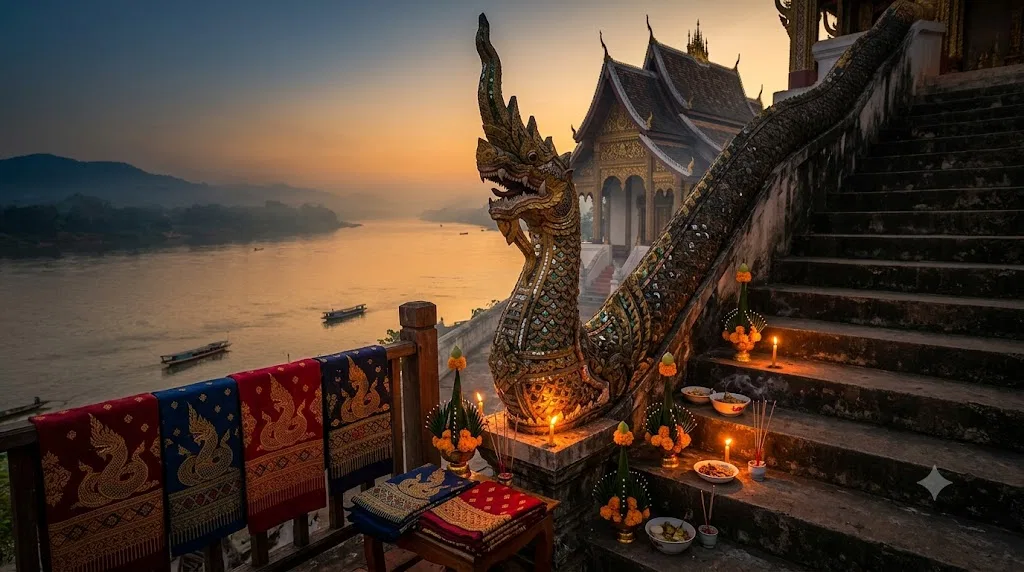
The most recognisable legendary being in Laos is the naga, a serpent-like water spirit associated with rivers, rain, protection, fertility and Buddhist sacred space. UNESCO’s inscription of the traditional craft of naga motif weaving in Lao communities describes the naga as a mythical serpent-like creature believed to live in rivers and to watch over people as an ancestral protector. This is a rare case where a mythic figure is not only preserved in stories, but formally recognised through a living craft tradition.[UNESCO Intangible Cultural Heritage]ich.unesco.orgOpen source on unesco.org.
The naga appears across temple architecture, woven textiles, ritual art and river legends. In Luang Prabang, UNESCO’s World Heritage description explicitly links the town’s sacred geography to the Mekong, the Nam Khan and the “domain of the mythical naga”, noting that ceremonies to appease nagas and other spirits continue alongside Buddhist practices. That is a strong official signal that naga belief is not a minor decorative motif, but part of how the sacred landscape of a major Lao heritage city is understood.[UNESCO World Heritage Centre]whc.unesco.orgOpen source on unesco.org.
There is also a useful distinction between benevolent serpent guardians and more dangerous water beings. Local Luang Prabang cultural material describes nagas and related water spirits as living in rivers, ponds and underground places; nagas are generally framed as protective if respected, while more dangerous water spirits may be linked with drownings and require propitiation. This is typical of river folklore: water gives life, transport and rice-growing fertility, but it also threatens sudden death.[LUANG PRABANG CULTURE]luangprabangculture.comOpen source on luangprabangculture.com.
Modern readers often meet naga lore through the famous Mekong fireball stories, especially around the end of Buddhist Lent. These lights are usually associated more with the Lao-Thai border region than with Laos alone, and explanations remain contested: believers connect them to naga celebration, while sceptical accounts have proposed tracer fire, flares or natural gas explanations. The important folklore point is not to prove a supernatural cause, but to see how a recurring river spectacle has become a modern public ritual, tourist attraction and identity marker around an older serpent tradition.[researchgate.net]researchgate.netResearch Gate(PDF) The "Postmodernization" of a Mythical Event: NagaResearch Gate(PDF) The "Postmodernization" of a Mythical Event: Naga

Origin myths: gourds, kings and the making of Lao identity
One of the most important Lao origin traditions is the story of Khun Borom, a legendary ancestor and ruler linked to the beginnings of Lao and wider Tai-speaking peoples. In common summaries of the myth, humanity emerges after a flood, a buffalo helps prepare the land for cultivation, and people come from gourds; Khun Borom then becomes a founding ruler whose sons are sent to govern different realms.[seasite.niu.edu]seasite.niu.eduOpen source on niu.edu.
The story is not simply a charming creation tale. It explains rice agriculture, social order, migration, kingship and the relationship between different peoples. It also has a political afterlife. Historian Ryan Wolfson-Ford argues that from the 1920s onward Lao writers and historians reworked older Khun Borom narratives into modern accounts of Lao racial and national origins. That makes the myth doubly important: it belongs to older oral and manuscript tradition, but it also helped modern elites imagine the nation.[Cambridge University Press & Assessment]cambridge.orgOpen source on cambridge.org.
For readers, the key is to avoid treating Khun Borom as straightforward history. The tale preserves remembered geography, political ideals and origin claims, but it is a mythic genealogy rather than a neutral chronicle. Its power lies in how it turns landscape and ancestry into a shared story: people are not just living in Laos; they are imagined as descendants of a world remade after catastrophe, taught to cultivate rice, organise settlements and recognise sacred authority.[CrossAsia Digital]digital.crossasia.orgOpen source on crossasia.org.
Phra Lak Phra Lam: the Lao Ramayana becomes a Buddhist-Lao epic
Laos also has a major literary folklore tradition in Phra Lak Phra Lam, the Lao adaptation of the Indian Ramayana. In Laos, the story is not merely an imported Hindu epic. It has been localised through Buddhist interpretation, Lao geography, performance, temple art and manuscript culture. Sources on the tradition describe it as the Lao version of the Ramayana, but also as a story that became embedded in Lao moral and cultural life.[LUANG PRABANG CULTURE]luangprabangculture.comOpen source on luangprabangculture.com.
Manuscript evidence is especially important here. A Digital Library of Lao Manuscripts record lists a Phra Lak Phra Lam manuscript in Lao and Pali, written in Tham Lao script, dated to 1933 in the Buddhist Era 2476 record. Research in the Journal of Lao Studies notes that important versions were preserved in palm-leaf manuscript form and that the work has been studied for how it represents relationships between humans, nature and the supernatural in Lao society.[iiif.crossasia.org]iiif.crossasia.orgDigital Library of Lao ManuscriptsDigital Library of Lao Manuscripts
This epic also shows how folklore moves between court, monastery and stage. Luang Prabang cultural sources present Phra Lak Phra Lam as a tradition performed through dance and theatre, and it remains closely associated with ritual and heritage performance in the former royal capital. The result is not a single fixed “book”, but a tradition that has lived as manuscript, sermon, performance, temple image and national cultural symbol.[LUANG PRABANG CULTURE]luangprabangculture.comOpen source on luangprabangculture.com.
Spirits, souls and the everyday supernatural
Lao supernatural belief is not only about grand serpents and royal epics. Much of it is intimate: the well-being of a person, household, village or field may depend on maintaining good relations with spirits and keeping life-forces in balance. Scholars and cultural sources commonly discuss local spirit belief as predating Buddhism but continuing within Buddhist society.[LUANG PRABANG CULTURE]luangprabangculture.comOpen source on luangprabangculture.com.
The baci, or soul-calling ceremony, is one of the clearest examples. Academic work on the ritual explains that offerings attract and feed spirits, while white strings tied around the wrist help keep a person’s vital essence close. It may be performed for weddings, travel, recovery from illness, welcome ceremonies or other life transitions. Its emotional force comes from a simple idea: people can become spiritually scattered by change, danger or misfortune, and the community gathers to call wholeness back.[archium.ateneo.edu]archium.ateneo.eduOpen source on ateneo.edu.
Spirit belief can also have sharper social consequences. Recent research by Ian G. Baird on malevolent “ravenous spirit” beliefs among ethnic Lao communities describes how accusations and healing practices can become ways of handling illness, misfortune and social tension. That does not mean such beliefs should be dismissed as superstition; it means folklore can be socially powerful, shaping who is trusted, feared, healed or excluded.[englishkyoto-seas.org]englishkyoto-seas.orgVol. 13, No. 1, Ian G. BairdVol. 13, No. 1, Ian G. Baird
Luang Prabang: a city where landscape becomes legend
Luang Prabang is essential to any account of Lao folklore because it concentrates so many traditions in one place: royal memory, Buddhist ritual, naga geography, ancestor spirits, sacred hills, temple art and annual festivals. UNESCO describes the town as a preserved fusion of Lao urban structures, traditional architecture and French colonial buildings, but its heritage value is not only architectural. The official description also emphasises the sacred Mount Phousi, the Mekong and Nam Khan setting, naga associations and continuing rituals.[UNESCO World Heritage Centre]whc.unesco.orgOpen source on unesco.org.
The city’s New Year traditions show this vividly. Luang Prabang cultural sources describe Lao New Year as the town’s biggest annual celebration, usually falling around mid-April, with water rituals, processions and temple activities. Official tourism material also highlights the carrying of the Prabang Buddha image, sand stupa merit-making, parades and other public ceremonies. A 2026 report from the Lao News Agency described the Phra Bang procession as a revered New Year tradition tied to spiritual protection and national identity.[luangprabangculture.com]luangprabangculture.comLUANG PRABANG CULTURELao New Year Nagas and Phra Lak Phra Lam · Lao New YearLUANG PRABANG CULTURELao New Year Nagas and Phra Lak Phra Lam · Lao New Year
One of Luang Prabang’s most distinctive folklore figures is the pair of ancestor guardians often represented during New Year festivities. A Journal of Lao Studies article argues that these figures are not just festive characters, but ancestor spirits, cultural heroes and guardian symbols through which people in Luang Prabang define local identity. Their modern visibility has grown alongside the city’s World Heritage status, showing how heritage tourism can amplify old ritual figures in new ways.[laostudies.org]laostudies.orgOpen source on laostudies.org.
Sacred caves, jars and places where archaeology meets legend
Laos has several places where folklore and material evidence sit side by side. The Pak Ou caves near Luang Prabang are famous for thousands of Buddha images placed in a cave system overlooking the Mekong. Travel and heritage sources describe the caves as a long-venerated shrine, while research on rock art at the “cave of a thousand Buddhas” notes folk tradition associating the site with a powerful river spirit before or alongside its Buddhist use.[Discover Laos]discoverlaos.todayOpen source on discoverlaos.today.
The Plain of Jars is a different kind of sacred mystery. UNESCO identifies it as a megalithic archaeological landscape in Xiengkhuang, with more than 2,100 stone jars and associated funerary material dating broadly from 500 BCE to 500 CE. Archaeologically, the jars are tied to Iron Age mortuary practices, not to giants brewing rice wine. Yet local legend famously connects the jars with giant beings and victory feasts.[UNESCO World Heritage Centre]whc.unesco.orgOpen source on unesco.org.
This contrast is useful rather than embarrassing. Folklore often gives visible ruins a human story when their original makers are long gone. The giant-jar legend answers questions that archaeology answers differently: who made these objects, why are they so large, and why do they stand in the landscape? A good folklore reading does not force the legend to replace archaeology; it asks why the landscape invited such a story and how communities made sense of ancient remains before modern excavation.[UNESCO World Heritage Centre]whc.unesco.orgOpen source on unesco.org.
Rain, rice and the ritual calendar
Many Lao traditions make most sense in an agrarian setting where rain, river levels and rice cultivation were matters of survival. The rocket festival is the clearest example. It is traditionally held around the sixth lunar month, near the start of the rainy season, and involves launching rockets to call for rain and fertility. Educational and cultural sources describe it as both a village ceremony and a rain-requesting event, often linked to older fertility rites and later Buddhist merit-making.[seasite.niu.edu]seasite.niu.eduOpen source on niu.edu.
The festival’s folklore links earth, sky and agriculture. Stories associated with the festival often involve communication with a rain deity or serpent power, and the rockets themselves dramatise a message sent upward. Its processions, music, humour and competition make it communal entertainment, but the ritual logic is serious: rice fields need rain at the right time, and the community acts together to ask the unseen world for balance.[Wikipedia]WikipediaRocket FestivalRocket Festival
Lao New Year also carries seasonal meaning. It falls in the hot season before the rains, and water rituals become both blessing and relief. In Luang Prabang, the festival’s public face includes playful water throwing, but its deeper structure includes bathing sacred images, making merit, building sand stupas and renewing social bonds.[LUANG PRABANG CULTURE]luangprabangculture.comLUANG PRABANG CULTURELao New Year Nagas and Phra Lak Phra Lam · Lao New YearLUANG PRABANG CULTURELao New Year Nagas and Phra Lak Phra Lam · Lao New Year
Minority traditions and why “Lao folklore” is not one single voice
A country-level page on Laos should not imply that all folklore belongs only to the lowland Lao majority. Laos is one of mainland Southeast Asia’s most ethnically diverse countries. Official and development sources describe 50 recognised ethnic groups and 160 ethnic subgroups, with major language families including Lao-Tai, Mon-Khmer, Hmong-Mien and Sino-Tibetan communities.[IWGIA]iwgia.orgOpen source on iwgia.org.
That diversity means folklore varies sharply by region, language and ritual system. Hmong communities, for example, have rich shamanic and spirit traditions. Ethnographic research on Hmong communities in central Laos and the United States shows that Hmong healing rituals continue across national borders, while studies of Hmong religion describe a world inhabited by natural, ancestral and supernatural spirits.[sagepub.com]journals.sagepub.comOpen source on sagepub.com.
Khmu and other Mon-Khmer-speaking communities also have oral histories, spirit traditions and ritual practices that do not simply fit lowland Buddhist templates. Research on ethnic minority cultures in Laos notes the importance of oral stories among Kmhmu’, Tai Dam and Hmong communities, while material from Phongsaly ethnic museum sources describes Khmu spirit worship and New Year traditions. These traditions should be treated as part of Laos’s folklore map, not as side notes.[Hal Science]hal.scienceOpen source on hal.science.
How Lao folklore is changing today
Lao folklore is still alive, but it is changing through heritage recognition, tourism, migration, state cultural policy and the internet. UNESCO recognition of naga motif weaving gives a traditional symbol international visibility, while Luang Prabang’s World Heritage status has made local rituals more visible to visitors and more carefully managed. This can protect traditions, but it can also turn flexible local practices into staged heritage events.[unesco.org]ich.unesco.orgOpen source on unesco.org.
Tourism also affects sacred places. Luang Prabang’s alms-giving, temple festivals and New Year processions are now public attractions as well as religious practices. The same is true of the Plain of Jars, where visitors encounter a mixture of archaeological interpretation, local legend and the modern memory of war. UNESCO’s Plain of Jars listing stresses the funerary importance of the site, while travel writing often foregrounds the mystery and giant legends.[UNESCO World Heritage Centre]whc.unesco.orgOpen source on unesco.org.
Migration has created another kind of change. Hmong religious and healing practices, for instance, now operate across Laos and diaspora communities, adapting to new legal, medical and social settings while retaining links to older spirit worlds. That transnational continuity is one of the clearest examples of Lao-region folklore surviving outside its original village landscape.[Sage Journals]journals.sagepub.comOpen source on sagepub.com.

What to remember about folklore in Laos
The heart of Lao folklore is relationship: between people and rivers, villages and spirits, kings and ancestors, Buddhism and older sacred powers, farmers and rain, migrants and memory. The naga protects and threatens; ancestor guardians turn a city into a moral community; the baci gathers scattered life-force back into the body; the rocket festival sends a village’s hopes into the sky; and the Plain of Jars shows how legend grows around ancient things whose first meanings are partly lost.
The strongest evidence for Lao folklore is not one single book or archive. It is distributed across palm-leaf manuscripts, temple performance, village ritual, UNESCO heritage files, ethnographic research, textiles, sacred landscapes and living annual festivals. That is why Laos rewards a layered reading: its folklore is not merely a set of old stories, but a way of seeing land, water, illness, identity, protection and belonging.
Amazon book picks
Further Reading
Books and field guides related to Why Laos Folklore Still Lives Beside the Mekong. Use these as the next step if you want deeper reading beyond the article.
The Golden Road
Explains cultural and religious influences that shaped mainland Southeast Asia.

The Penguin Book of Dragons
Connects to naga and serpent traditions discussed across Lao folklore.
eBay marketplace picks
Marketplace Samples
Live-tested eBay searches with available results related to this page.

Endnotes
1.
Source: iwgia.org
Link:https://iwgia.org/en/laos/5971-iw-2026-laos.html
2.
Source: ifad.org
Title: laos ctn pdf
Link:https://www.ifad.org/documents/d/new-ifad.org/laos_ctn-pdf
3.
Source: whc.unesco.org
Link:https://whc.unesco.org/en/list/479/
4.
Source: englishkyoto-seas.org
Title: Spirits of the Place: Buddhism and Lao Religious Culture
Link:https://englishkyoto-seas.org/wp-content/uploads/SEAS_0201_Tumura.pdf
5.
Source: researchgate.net
Link:https://www.researchgate.net/publication/293087190_Spirits_of_the_place_Buddhism_and_Lao_religious_culture
6.
Source: ich.unesco.org
Link:https://ich.unesco.org/en/RL/traditional-craft-of-naga-motif-weaving-in-lao-communities-01973
7.
Source: laostudies.org
Link:https://www.laostudies.org/sites/default/files/public/Hongsuwan.pdf
8.
Source: archium.ateneo.edu
Link:https://archium.ateneo.edu/cgi/viewcontent.cgi?article=1098&context=loyola
9.
Source: luangprabangculture.com
Link:https://www.luangprabangculture.com/nagas-and-ngeuak.html
10.
Source: researchgate.net
Title: Research Gate(PDF) The “Postmodernization” of a Mythical Event: Naga
Link:https://www.researchgate.net/publication/233486379_The_Postmodernization_of_a_Mythical_Event_Naga_Fireballs_on_the_Mekong_River
11.
Source: Wikipedia
Title: Naga fireball
Link:https://en.wikipedia.org/wiki/Naga_fireball
12.
Source: time.com
Title: behind the secret of the nagas fire
Link:https://time.com/archive/6893606/behind-the-secret-of-the-nagas-fire/
13.
Source: seasite.niu.edu
Link:https://seasite.niu.edu/lao/culture/LuangPrabang/KB.htm
14.
Source: cambridge.org
Link:https://www.cambridge.org/core/journals/journal-of-southeast-asian-studies/article/sons-of-khun-bulom-the-discovery-by-modern-lao-historians-of-the-birth-of-the-lao-race/14D655A25F243F0FBF8EB37299A1DCF7
15.
Source: digital.crossasia.org
Link:https://digital.crossasia.org/wp-content/uploads/2021/10/literaryheritageoflaos31_raendchen_en.pdf
16.
Source: luangprabangculture.com
Link:https://www.luangprabangculture.com/phra-lak-phra-lam.html
17.
Source: iiif.crossasia.org
Title: Digital Library of Lao Manuscripts
Link:https://iiif.crossasia.org/s/dllm/manifests/21898
18.
Source: laostudies.org
Link:https://www.laostudies.org/system/files/subscription/JLS-v5-i1-Aug2014-Wannaudorn-Hongsuwan.pdf
19.
Source: luangprabangculture.com
Title: LUANG PRABANG CULTURENagas and Phra Lak Phra Lam
Link:https://www.luangprabangculture.com/nagas-and-phra-lak-phra-lam.html
20.
Source: luangprabangculture.com
Link:https://www.luangprabangculture.com/spirits.html
21.
Source: englishkyoto-seas.org
Title: Vol. 13, No. 1, Ian G. Baird
Link:https://englishkyoto-seas.org/2024/04/vol-13-no-1-ian-g-baird/
22.
Source: luangprabangculture.com
Title: LUANG PRABANG CULTURELao New Year Nagas and Phra Lak Phra Lam · Lao New Year
Link:https://www.luangprabangculture.com/lao-new-year.html
23.
Source: researchgate.net
Link:https://www.researchgate.net/publication/322336261_Rock_art_at_the_cave_of_a_thousand_Buddhas_Luang_Prabang_Lao_PDR
24.
Source: whc.unesco.org
Link:https://whc.unesco.org/en/list/1587/
25.
Source: ritualsandrites.anu.edu.au
Title: Rituals & Rites The mysterious megalithic jars of Laos
Link:https://ritualsandrites.anu.edu.au/project-gallery/the-mysterious-megalithic-jars-of-laos/
26.
Source: seasite.niu.edu
Link:https://seasite.niu.edu/lao/Lao_Folklore/rocket_festival/rocket_festival.htm
27.
Source: Wikipedia
Title: Rocket Festival
Link:https://en.wikipedia.org/wiki/Rocket_Festival
28.
Source: hal.science
Link:https://hal.science/hal-03628203v1/file/Laos%2520and%2520ethnic%2520minority%2520cultures%2520promoting%2520heritage.pdf
29.
Source: Wikipedia
Link:https://en.wikipedia.org/wiki/N%C4%81ga
30.
Source: Wikipedia
Title: Phra Lak Phra Ram
Link:https://en.wikipedia.org/wiki/Phra_Lak_Phra_Ram
31.
Source: Wikipedia
Title: Khun Borom
Link:https://en.wikipedia.org/wiki/Khun_Borom
32.
Source: Wikipedia
Title: Culture of Laos
Link:https://en.wikipedia.org/wiki/Culture_of_Laos
33.
Source: Wikipedia
Title: Phi Pu Ya
Link:https://en.wikipedia.org/wiki/Phi_Pu_Ya
34.
Source: Wikipedia
Title: Plain of Jars
Link:https://en.wikipedia.org/wiki/Plain_of_Jars
35.
Source: Wikipedia
Title: Hmong people
Link:https://en.wikipedia.org/wiki/Hmong_people
36.
Source: Wikipedia
Title: Demographics of Laos
Link:https://en.wikipedia.org/wiki/Demographics_of_Laos
37.
Source: Wikipedia
Title: List of ethnic groups in Laos
Link:https://en.wikipedia.org/wiki/List_of_ethnic_groups_in_Laos
38.
Source: ich.unesco.org
Title: celebration events in laos 00423
Link:https://ich.unesco.org/en/activities/celebration-events-in-laos-00423
39.
Source: ich.unesco.org
Title: lao people s democratic republic LA
Link:https://ich.unesco.org/en/state/lao-people-s-democratic-republic-LA
40.
Source: ich.unesco.org
Title: lao people s democratic republic LA
Link:https://ich.unesco.org/en/state/lao-people-s-democratic-republic-LA?call=film&id=72536&include=film_inc.php&width=700
41.
Source: unesdoc.unesco.org
Link:https://unesdoc.unesco.org/ark%3A/48223/pf0000131080
42.
Source: iwgia.org
Link:https://iwgia.org/en/laos.html
43.
Source: researchgate.net
Link:https://www.researchgate.net/publication/382965230_Trees_in_Lao_Myths_and_Beliefs_Roles_and_Symbolic_Ecological_Meanings_through_the_Aspects_of_Folklore
44.
Source: researchgate.net
Link:https://www.researchgate.net/publication/301741264Sons_of_Khun_Bulom_The_discovery_by_modern_Lao_historians_of_the%27birth_of_the_Lao_race%27
45.
Source: researchgate.net
Link:https://www.researchgate.net/publication/319064636_Re-connecting_the_Ancestors_Buddhism_and_Animism_on_the_Boloven_Plateau_Laos
46.
Source: researchgate.net
Title: 373606282 Hmong Spirituality Nature and Place
Link:https://www.researchgate.net/publication/373606282_Hmong_Spirituality_Nature_and_Place
47.
Source: researchgate.net
Link:https://www.researchgate.net/publication/353363601_Obtaining_the_Nha_Heun_Culture_from_the_King_Considering_a_Sacred_Script_and_Oral_History_in_Southern_Laos
48.
Source: researchgate.net
Link:https://www.researchgate.net/figure/The-most-prevalent-ethnic-groups-living-in-Laos-CIA-World-Factbook-2016-Groups_fig4_339458418
49.
Source: laostudies.org
Link:https://www.laostudies.org/system/files/subscription/JLS-v5-i1-Aug2014-Klangprapan.pdf
50.
Source: plain-of-jars.org
Link:https://www.plain-of-jars.org/
51.
Source: archaeology.lk
Link:https://www.archaeology.lk/sinhalese-influence-on-laos-from-its-beginning-to-consolidation-part-i-sources/
52.
Source: hal.science
Title: G. Schlemmer 2017 Ethnic Belonging in Laos
Link:https://hal.science/hal-01853834/file/G.%20Schlemmer%202017%20Ethnic%20Belonging%20in%20Laos.pdf
53.
Source: jstage.jst.go.jp
Link:https://www.jstage.jst.go.jp/article/seas/13/1/13_109/_pdf
54.
Source: luangprabangculture.com
Title: unesco documents
Link:https://www.luangprabangculture.com/unesco-documents.html
55.
Source: tourismluangprabang.org
Link:https://tourismluangprabang.org/all-articles/festivals/
56.
Source: discoverlaos.today
Link:https://discoverlaos.today/luangprabang/thing-to-do/pak-ou-cave
57.
Source: journals.sagepub.com
Link:https://journals.sagepub.com/doi/10.1177/1466138119839086
58.
Source: asianethnology.org
Link:https://asianethnology.org/article/148615-hmong-religion/attachment/312525.pdf
59.
Source: luangprabangculture.com
Title: unesco heritage
Link:https://www.luangprabangculture.com/unesco-heritage.html
60.
Source: catalog.hathitrust.org
Link:https://catalog.hathitrust.org/Record/001355785
61.
Source: tripadvisor.com
Title: Mount Phousi
Link:https://www.tripadvisor.com/Attraction_Review-g295415-d546038-Reviews-Mount_Phousi-Luang_Prabang_Luang_Prabang_Province.html
62.
Source: relief.unboundmedicine.com
Link:https://relief.unboundmedicine.com/relief/view/The-World-Factbook/563131/all/Laos
63.
Source: miumiu-unesco-cities.com
Title: Luang Prabang (ຫຼວງພະບາງ)
Link:https://www.miumiu-unesco-cities.com/post/luang-prabang-%E0%BA%AB-%E0%BA%A7%E0%BA%87%E0%BA%9E%E0%BA%B0%E0%BA%9A%E0%BA%B2%E0%BA%87
64.
Source: topmekongcruises.com
Title: Pak Ou
Link:https://topmekongcruises.com/pak-ou-caves-laos
65.
Source: llmpedia.net
Title: Phra Lak Phra Lam
Link:https://www.llmpedia.net/deepseek/Phra_Lak_Phra_Lam.html
66.
Source: roowanders.com
Title: pak ou caves
Link:https://www.roowanders.com/pak-ou-caves/
67.
Source: en.wikisource.org
Link:https://en.wikisource.org/wiki/CIA_World_Fact_Book%2C_2004/Laos
68.
Source: digital.car.chula.ac.th
Link:https://digital.car.chula.ac.th/cgi/viewcontent.cgi?article=1044&context=manusya
69.
Source: luxevoyageasia.com
Title: plain of jars
Link:https://luxevoyageasia.com/plain-of-jars/
Additional References
70.
Source: youtube.com
Title: Mysteries of the Plain of Jars: Uncovering Laos’ Ancient Secrets
Link:https://www.youtube.com/watch?v=G2JvfowtyQ4
Source snippet
Boun Lai Heua Fai - Luang Prabang Festival of the boats of light...
71.
Source: youtube.com
Title: The Baci Ritual: A Centrepiece of Lao traditions
Link:https://www.youtube.com/watch?v=gLZh-daSrZI
Source snippet
Mysteries of the Plain of Jars: Uncovering Laos' Ancient Secrets...
72.
Source: academia.edu
Link:https://www.academia.edu/38896872/The_Thai_Lao_Thailands_Largest_Unrecognized_Transboundary_National_Ethnicity
73.
Source: factsanddetails.com
Link:https://factsanddetails.com/southeast-asia/Laos/sub5_3a/entry-2933.html
74.
Source: facebook.com
Link:https://www.facebook.com/aseansecretariat/posts/and-the-answer-is-the-plain-of-jars-in-lao-pdrthis-ancient-archaeological-site-i/942954034526531/
75.
Source: factsanddetails.com
Link:https://factsanddetails.com/southeast-asia/Laos/sub5_3b/entry-2950.html
76.
Source: hmongstudiesjournal.org
Link:https://www.hmongstudiesjournal.org/uploads/4/5/8/7/4587788/lemoinehsj12.pdf
77.
Source: reddit.com
Link:https://www.reddit.com/r/laos/comments/1lv8r7m/does_anyone_elses_family_have_stories_about_the/
78.
Source: taistudiescenter.org
Link:https://www.taistudiescenter.org/early-history/
79.
Source: tourismlaos.org
Link:https://www.tourismlaos.org/welcome/authentic-culture/ethnic-diversity/
Topic Tree
Follow this branch
Related pages 192
- Afghan Folklore
- Albanian Folklore
- Algerian Folklore
- Australian Folklore
- Azerbaijan Folklore
- +187 more in sidebar