Where Myth Meets State Legend
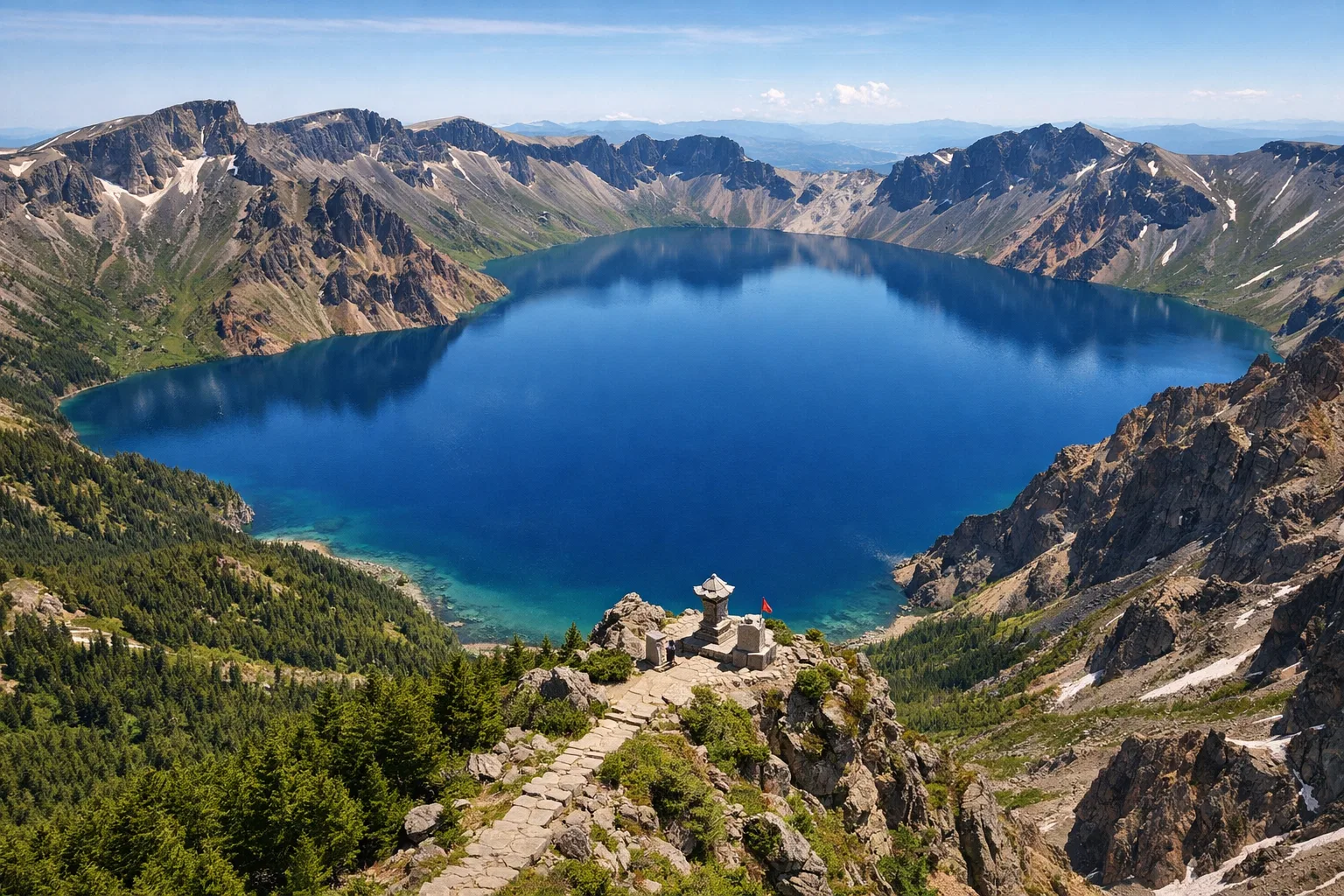
North Korea’s folklore is best understood as Korean folklore preserved, reframed and politically curated within the northern half of the peninsula. Its most important legendary landscape is Mount Paektu: a sacred volcano tied to Korean origin stories, mountain-spirit traditions, anti-colonial memory and modern North Korean state mythology.
Page outline Jump by section
Why Mount Paektu sits at the centre
Mount Paektu is the clearest starting point because it is not only a place in North Korea; it is a symbolic engine. UNESCO’s 2025 Global Geopark material describes it as a volcanic landscape shaped by eruptions and glacial erosion, with Lake Chon formed by the great Millennium Eruption, hot springs, volcanic rocks and continuing geophysical monitoring. The same UNESCO account also notes its long status as an ancestral mountain with spiritual and cultural significance, reflected in poetry and travel writing over several centuries.[UNESCO]unesco.orgMt Paektu UNESCO Global GeoparkMt Paektu UNESCO Global Geopark
In Korean tradition more broadly, Paektu belongs to a world of sacred mountains and mountain spirits. A scholarly study of Paektu myths argues that mountain worship and mountain-god legends are intrinsic to Korean culture, and that Paektu became important not only in older sacred geography but also in North Korean anti-colonial narratives and modern state policy. The mountain’s power, in other words, comes from a rare combination: it is physically dramatic, mythically charged and politically useful.[SNKH]snkh.orgOpen source on snkh.org.
For North Korea, Paektu has also been folded into the mythology of the ruling family. Reuters notes that official North Korean narratives present Paektu as the “sacred mountain of revolution” and claim Kim Jong Il was born on its slopes, while many historians place his birth in the former Soviet Union. This is a good example of how North Korean folklore pages need careful wording: the Paektu tradition is old and pan-Korean, but some of its modern details are state narratives rather than ancient folk belief.[Reuters]reuters.comOpen source on reuters.com.
The Dangun myth and North Korea’s claim to ancient origins
The best-known Korean foundation myth is the story of Dangun. In a standard version summarised by the Academy of Korean Studies, a heavenly figure descends to earth with followers, governs human affairs, and meets a bear and a tiger who wish to become human. The bear succeeds, becomes a woman, bears Dangun, and Dangun founds the first Korean kingdom, with Pyongyang named in the mythic geography of the story. At the end of the tale, Dangun becomes a mountain god.[aks.ac.kr]aks.ac.krToward Globalization of Korean StudiesToward Globalization of Korean Studies
This matters especially for North Korea because Pyongyang and the northern landscape can be presented as the deep cradle of Korean nationhood. North Korea announced in the 1990s that it had found Dangun’s tomb near Pyongyang and reconstructed a monumental mausoleum, but outside scholars have treated the claim with strong scepticism. Reuters quotes historians and archaeologists stressing that Dangun is a mythic figure, even while explaining why both Koreas have used him to express Korean antiquity, unity and distinctiveness.[Reuters]reuters.comOpen source on reuters.com.
For a folklore reader, the useful distinction is this: Dangun is not simply “fake history” and not simply “history”. He is a mythic ancestor whose story has been repeatedly reinterpreted. In North Korea, that reinterpretation helps connect the modern state to an imagined ancient line stretching from sacred mountain, to first kingdom, to Pyongyang, to present rule.[aks.ac.kr]aks.ac.krToward Globalization of Korean StudiesToward Globalization of Korean Studies

Shamanic stories of death, rescue and the otherworld
North Korean folklore is not limited to state origin stories. Older Korean shamanic mythology includes powerful ritual narratives about gods, death, healing and the passage between worlds. The most accessible example is Princess Bari, a tale sung in rites for consoling the dead and sending them to the afterlife. In the common version, a king abandons his seventh daughter because she is not a son; later, she journeys through the otherworld to obtain life-giving water for the parents who rejected her, revives them, and becomes a deity associated with guiding the dead.[aks.ac.kr]aks.ac.krToward Globalization of Korean StudiesToward Globalization of Korean Studies
Princess Bari is pan-Korean rather than uniquely North Korean, but northern versions matter. The National Folk Museum of Korea’s folklore materials note that the tale has many regional forms, and that the northern tradition is represented by versions from South Hamgyong. Those northern versions differ strikingly from many southern ones: Bari may not reach the divine realm by her own effort, may die at the end, and her funerary role may be replaced by a more local goddess.[folkency.nfm.go.kr]folkency.nfm.go.krShamanic MythologyShamanic Mythology
South Hamgyong is especially important because scholarship identifies it as one of the richest and most archaic zones of Korean shamanic mythology. Yet the same evidence also warns us not to overstate what can be known: the northern tradition is poorly understood today because the relevant regions are inside North Korea, where fieldwork is difficult. This is why older transcriptions, refugee testimony and comparative Korean scholarship remain so important.[Wikipedia]WikipediaKorean mythologyKorean mythology
Spirits, goblins and household belief
Many of the spirits associated with North Korea belong to wider Korean tradition. Korean folklore includes ghosts, goblin-like beings, household gods, mountain spirits, dragons, fox spirits and local deities, but the distribution of specific tales depended heavily on region, ritual specialist and village custom. A country page on North Korea should therefore avoid pretending that every famous Korean creature has a uniquely North Korean version. Some probably circulated in the North; others are better documented in southern sources.[ia800409.us.archive.org]ia800409.us.archive.org한국민속문학사전 본문 최종 opt한국민속문학사전 본문 최종 opt
The most important point is that these beings were not originally “monsters” in the modern horror sense. Spirits could be ancestors, unsettled dead, household powers, mountain guardians or troublesome presences requiring ritual attention. Goblin-like figures in Korean tradition often behave as tricksters or uncanny forces rather than simple demons. Their stories sit close to everyday life: roads, houses, latrines, kitchens, graves, mountain paths and village boundaries.[ia800409.us.archive.org]ia800409.us.archive.org한국민속문학사전 본문 최종 opt한국민속문학사전 본문 최종 opt
In North Korea today, open discussion of shamanism is complicated by official ideology. One summary of northern shamanic mythology reports that, according to a North Korean shaman who defected in 2008, shamanism remained widespread and tacitly tolerated in practice, but older songs and chants were no longer being transmitted in the same way. That suggests a living but damaged tradition: belief and ritual may persist privately, while long-form oral literature becomes harder to preserve.[Wikipedia]WikipediaKorean mythologyKorean mythology
Arirang, wrestling and seasonal customs as living heritage
Not all folklore is supernatural. Songs, games, food customs and seasonal practices are also part of North Korea’s traditional culture. Arirang is the best-known example: UNESCO describes the North Korean Arirang tradition as an orally transmitted and recreated lyrical singing genre, existing in multiple traditional, symphonic and modern forms. Its themes of parting, reunion, sorrow and happiness help explain why it has become a shared Korean cultural symbol across the divided peninsula.[Intangible Cultural Heritage]ich.unesco.orgOpen source on unesco.org.
Food customs also carry folk meaning. UNESCO’s material on the Mount Paektu geopark notes local food traditions based on potato starch, shaped by adaptation to the cold mountain climate, while North Korea’s kimchi-making tradition was separately inscribed by UNESCO in 2015. These traditions are not “myths”, but they belong to the same cultural field: seasonal preparation, family labour, memory, survival and identity.[UNESCO]unesco.orgMt Paektu UNESCO Global GeoparkMt Paektu UNESCO Global Geopark
Traditional wrestling offers another instructive case. In 2018, UNESCO accepted the first joint North-South Korean inscription of Korean wrestling, called ssireum in the South and ssirum in the North. Yonhap reported that it was played on holidays and festivals, involved two belt-gripping wrestlers trying to topple each other in a sand pit, and remained popular in North Korea, with a major Pyongyang competition at Chuseok whose winner received a bull.[Yonhap News]en.yna.co.krOpen source on yna.co.kr.
Museums, heritage and the state’s version of folklore
North Korea has institutions devoted to folk culture, but their displays must be read in context. KBS World describes the Korean Folklore Museum as part of the museum landscape around central Pyongyang and notes that North Korean museums often serve ideological and educational purposes, with exhibits shaped by what the state wants viewers to understand. The same report says North Korea has used museums and heritage to stress historical legitimacy, especially links to ancient kingdoms such as Gojoseon, Goguryeo and Goryeo.[KBS World Radio]world.kbs.co.krKBS World Radio Museums in N. Korea l KBS WORLDKBS World Radio Museums in N. Korea l KBS WORLD
This does not make the objects or traditions meaningless. It means that preservation and political storytelling are intertwined. A costume, farming tool, song, foundation myth or sacred site can be both a genuine piece of Korean tradition and part of a curated national narrative. In North Korea, heritage is often presented as proof of cultural superiority, antiquity and continuity.[KBS World Radio]world.kbs.co.krKBS World Radio Museums in N. Korea l KBS WORLDKBS World Radio Museums in N. Korea l KBS WORLD
Since Kim Jong Un came to power, North Korea has also placed greater emphasis on intangible cultural heritage and UNESCO recognition, according to KBS World. Arirang, kimchi-making and wrestling all fit that pattern: they are public-facing, culturally legible traditions that allow North Korea to claim continuity with older Korean life while also appearing on an international heritage stage.[KBS World Radio]world.kbs.co.krKBS World Radio Museums in N. Korea l KBS WORLDKBS World Radio Museums in N. Korea l KBS WORLD
What is old, what is shared and what is modern invention?
A reader coming to North Korean folklore should keep three categories in mind.[Wikipedia]WikipediaKorean folkloreKorean folklore
Old and shared Korean tradition: Dangun, Princess Bari, mountain spirits, ghosts, household deities, folk songs and seasonal customs belong to a broader Korean cultural world. The Korean Peninsula was divided only in the twentieth century, while many of these traditions are much older.[aks.ac.kr]aks.ac.krToward Globalization of Korean StudiesToward Globalization of Korean Studies
Northern regional tradition: Some material is specifically tied to northern provinces, especially South Hamgyong shamanic narratives and Pyongyang-centred claims around ancient kingdoms. This is the most valuable North Korea-specific folklore layer, but also the hardest to document fully because modern fieldwork is restricted.[Wikipedia]WikipediaKorean mythologyKorean mythology
Modern state myth and heritage politics: Paektu’s revolutionary aura, the claimed Dangun mausoleum, official museum narratives and UNESCO heritage campaigns show how folklore can be repurposed by the state. These stories matter culturally, but they should not be treated as neutral survivals of ancient oral tradition.[reuters.com]reuters.comOpen source on reuters.com.
Why North Korean folklore still matters
North Korean folklore matters because it reveals a culture deeper and more complicated than headlines about the state. It preserves traces of sacred mountains, ancestral founders, shamanic journeys, village games, seasonal foods, songs of separation and hopes of reunion. At the same time, it shows how folklore can be used to build legitimacy, teach ideology and connect a modern regime to an imagined ancient past.[aks.ac.kr]aks.ac.krToward Globalization of Korean StudiesToward Globalization of Korean Studies
The most honest way to read it is neither to dismiss it as propaganda nor to romanticise it as untouched tradition. North Korea’s folklore is a layered field: pan-Korean inheritance, northern regional memory, interrupted oral transmission, curated museum heritage and modern political myth all occupy the same landscape. Mount Paektu makes that visible in one place: volcano, sacred mountain, origin symbol, tourist landscape, scientific site and revolutionary emblem at once.[UNESCO]unesco.orgnames 16 new Global Geoparks | UNESCOnames 16 new Global Geoparks | UNESCO
Amazon book picks
Further Reading
Books and field guides related to Where Myth Meets State Legend. Use these as the next step if you want deeper reading beyond the article.
Korea: the Impossible Country
Provides broad context for understanding how myth, nationhood and modern Korean narratives interact.

Korea : The Impossible Country : South Korea's Amazing Rise f...
First published 2018. Subjects: Economic development, Korea, civilization, Civilization.
eBay marketplace picks
Marketplace Samples
Example marketplace items related to this page. Use the search link to explore similar finds on eBay.

Endnotes
1.
Source: snkh.org
Link:https://www.snkh.org/include/download_files/v2/1_151-179.pdf
2.
Source: unesco.org
Title: names 16 new Global Geoparks | UNESCO
Link:https://www.unesco.org/en/articles/unesco-names-16-new-global-geoparks
3.
Source: unesco.org
Title: Mt Paektu UNESCO Global Geopark
Link:https://www.unesco.org/en/iggp/mt-paektu-unesco-global-geopark
4.
Source: reuters.com
Link:https://www.reuters.com/article/world/north-koreas-box-of-bones-a-mythical-king-and-the-dream-of-korean-unification-idUSKCN1MV020/
5.
Source: aks.ac.kr
Title: Toward Globalization of Korean Studies
Link:https://www.aks.ac.kr/cefia/webzine/2206/focus_eng.html
6.
Source: aks.ac.kr
Title: Toward Globalization of Korean Studies
Link:https://www.aks.ac.kr/cefia/webzine/2207/focus_eng.html
7.
Source: folkency.nfm.go.kr
Title: Shamanic Mythology
Link:https://folkency.nfm.go.kr/en/topic/detail/5349
8.
Source: folkency.nfm.go.kr
Title: Abandoned Princess Bari
Link:https://folkency.nfm.go.kr/en/topic/detail/5353
9.
Source: Wikipedia
Title: Korean mythology
Link:https://en.wikipedia.org/wiki/Korean_mythology
10.
Source: ia800409.us.archive.org
Title: 한국민속문학사전 본문 최종 opt
Link:https://ia800409.us.archive.org/5/items/opt_20230726/%ED%95%9C%EA%B5%AD%EB%AF%BC%EC%86%8D%EB%AC%B8%ED%95%99%EC%82%AC%EC%A0%84-%EB%B3%B8%EB%AC%B8-%EC%B5%9C%EC%A2%85_opt.pdf
11.
Source: Wikipedia
Title: Korean folklore
Link:https://en.wikipedia.org/wiki/Korean_folklore
12.
Source: ich.unesco.org
Link:https://ich.unesco.org/en/RL/arirang-folk-song-in-the-democratic-people-s-republic-of-korea-00914
13.
Source: unesco.org
Title: document 3695
Link:https://www.unesco.org/archives/multimedia/document-3695
14.
Source: ich.unesco.org
Link:https://ich.unesco.org/en/state/democratic-people-s-republic-of-korea-KP
15.
Source: Wikipedia
Title: Mount Paektu
Link:https://en.wikipedia.org/wiki/Mount_Paektu
16.
Source: Wikipedia
Link:https://en.wikipedia.org/wiki/North
17.
Source: Wikipedia
Title: North Korean cult of personality
Link:https://en.wikipedia.org/wiki/North_Korean_cult_of_personality
18.
Source: Wikipedia
Title: Kim Kardashian
Link:https://en.wikipedia.org/wiki/Kim_Kardashian
19.
Source: Wikipedia
Title: Kim (novel)
Link:https://en.wikipedia.org/wiki/Kim_%28novel%29
20.
Source: Wikipedia
Title: Korean Folklore Museum
Link:https://en.wikipedia.org/wiki/Korean_Folklore_Museum
21.
Source: Wikipedia
Title: Mausoleum of Tangun
Link:https://en.wikipedia.org/wiki/Mausoleum_of_Tangun
22.
Source: Wikipedia
Title: Life replacement narratives
Link:https://en.wikipedia.org/wiki/Life_replacement_narratives
23.
Source: Wikipedia
Title: Seng gut narrative
Link:https://en.wikipedia.org/wiki/Seng-gut_narrative
24.
Source: ich.unesco.org
Link:https://ich.unesco.org/en/decisions/9.COM/10.14
25.
Source: ich.unesco.org
Title: republic of korea KR
Link:https://ich.unesco.org/en/state/republic-of-korea-KR
26.
Source: ich.unesco.org
Link:https://ich.unesco.org/en/video/29709
27.
Source: ich.unesco.org
Title: arirang lyrical folk song in the republic of korea 00445
Link:https://ich.unesco.org/en/RL/arirang-lyrical-folk-song-in-the-republic-of-korea-00445
28.
Source: ich.unesco.org
Link:https://ich.unesco.org/en/video/31784
29.
Source: unesdoc.unesco.org
Link:https://unesdoc.unesco.org/ark%3A/48223/pf0000395152
30.
Source: unesco.org
Link:https://www.unesco.org/en/iggp/geoparks
31.
Source: korea.net
Link:https://www.korea.net/NewsFocus/Culture/view?articleId=121092
32.
Source: korea.net
Link:https://www.korea.net/NewsFocus/Culture/view?articleId=140971
33.
Source: arirang.com
Link:https://www.arirang.com/news/view?id=291724
34.
Source: nfm.go.kr
Title: National Folk Museum of Korea
Link:https://www.nfm.go.kr/english/index.do
35.
Source: nfm.go.kr
Title: National Folk Museum of Korea
Link:https://www.nfm.go.kr/user/bbs/english/17/469/bbsDataView/22864.do?bbsDataCategory=&column=&page=3&search=&searchEDate=&searchSDate=
36.
Source: folkency.nfm.go.kr
Title: nfm.go.kr Myth of Dangun
Link:https://folkency.nfm.go.kr/en/topic/detail/5336
37.
Source: youtube.com
Title: The First Korean
Link:https://www.youtube.com/watch?v=wTzIK9z1ZYM
Source snippet
The Korean Legend of Hwanin, Hwanung, and Dangun...
38.
Source: world.kbs.co.kr
Title: KBS World Radio Museums in N. Korea l KBS WORLD
Link:https://world.kbs.co.kr/service/contents_view.htm?board_seq=422207&id=&lang=e&menu_cate=northkorea
39.
Source: en.yna.co.kr
Link:https://en.yna.co.kr/view/AEN20181126007151315
40.
Source: scribd.com
Link:https://www.scribd.com/document/659683598/01043
41.
Source: traveltomorrow.com
Title: unesco designates mount paektu in north korea as a global geopark
Link:https://traveltomorrow.com/unesco-designates-mount-paektu-in-north-korea-as-a-global-geopark/
42.
Source: worldhistory.org
Link:https://www.worldhistory.org/Dangun/
43.
Source: worldlist.vision
Title: Korean Folklore Museum
Link:https://worldlist.vision/eurasia/north_korea/korean-folklore-museum.phtml
44.
Source: blog.oup.com
Link:https://blog.oup.com/2011/10/dangun/
45.
Source: illuminem.com
Title: unesco has designated a global geopark in this unexpected country
Link:https://illuminem.com/illuminemvoices/unesco-has-designated-a-global-geopark-in-this-unexpected-country
46.
Source: unesco.or.kr
Title: Intangible Cultural Heritage
Link:https://unesco.or.kr/eng/ich/
47.
Source: e-flux.com
Title: Princess Bari
Link:https://www.e-flux.com/journal/156/6776764/princess-bari
48.
Source: ijkh.khistory.org
Link:https://ijkh.khistory.org/journal/view.php?number=599
49.
Source: koreatimes.co.kr
Link:https://www.koreatimes.co.kr/southkorea/society/20250416/unesco-global-geoparks-danyang-scenic-coastal-area-and-mount-paektu-shine-as-natural-treasures
50.
Source: en.as.com
Link:https://en.as.com/latest_news/unesco-honors-a-hidden-gem-in-north-korea-the-breathtaking-volcanic-lake-youll-never-see-in-person-n/
51.
Source: gerontology.fandom.com
Link:https://gerontology.fandom.com/wiki/Dangun
Additional References
52.
Source: youtube.com
Title: The Korean Legend of Hwanin, Hwanung, and Dangun
Link:https://www.youtube.com/watch?v=RRk1kownfU4
Source snippet
3 Goddesses from Korean Mythology - Tales from Korea Ep.80...
53.
Source: facebook.com
Link:https://www.facebook.com/koryotours/posts/according-to-legend-the-korean-people-trace-their-origins-to-the-wild-rugged-lan/989895553174570/
54.
Source: mythlok.com
Link:https://mythlok.com/bari-gongju/
55.
Source: facebook.com
Link:https://www.facebook.com/groups/267318025149102/posts/299812551899649/
56.
Source: scribd.com
Link:https://www.scribd.com/document/736936425/01-Dangun
57.
Source: facebook.com
Link:https://www.facebook.com/thesoulofseoulblog/posts/dive-into-the-eerie-world-of-korean-folklore-where-vengeful-gwishin-spirits-and-/1140785314718581/
58.
Source: mapcarta.com
Link:https://mapcarta.com/W289986468
59.
Source: facebook.com
Link:https://www.facebook.com/willripleycnn/posts/i-wrote-about-our-visit-to-north-koreas-mount-paektu-which-just-received-unesco-/1208585463966889/
60.
Source: imdb.com
Link:https://www.imdb.com/name/nm2578007/
61.
Source: kass.org.kp
Link:https://www.kass.org.kp/index.php/lang/cookie/eng/L2luZGV4LnBocC9rb3JlYS92aWV3LzUyNj9sYW5nPWVuZw
Topic Tree
Follow this branch
Related pages 192
- Afghan Folklore
- Albanian Folklore
- Algerian Folklore
- Australian Folklore
- Azerbaijan Folklore
- +187 more in sidebar