What Lives in Gabon's Forest Stories?
Gabon’s folklore is best understood as a living forest-and-river tradition rather than as a single, fixed national mythology. Its best-attested legendary culture includes Fang epic storytelling, ancestor veneration, masks that embody the dead or enforce moral order, and Bwiti initiation traditions centred on the sacred use of iboga.
Page outline Jump by section
Introduction
For a general reader, the key point is this: Gabon’s most important folklore is not mainly about isolated “monsters”. It is about relationships between the living and the dead, between forest knowledge and social order, and between sung memory and present-day identity. Some traditions are old and well documented in museums and scholarship; others are still practised but guarded, adapted, or contested in a modern setting shaped by Christianity, urbanisation, tourism, the global art market, and international interest in iboga.[metmuseum.org]metmuseum.orgThe Metropolitan Museum of Art Okak-Fang artistThe Metropolitan Museum of Art Okak-Fang artist
What makes Gabonese folklore distinctive?
Gabon sits on the Atlantic coast of Central Africa, with dense rainforest, river systems, and long histories of Bantu-speaking communities living beside Indigenous forest peoples. That setting is important because many Gabonese traditions imagine power as something rooted in ancestry, land, forest plants, initiation, and the ability of ritual specialists to move between ordinary life and hidden realms. The country’s population is often described as including around 40 to 50 ethnic groups, among them Fang, Myènè, Punu, Nzebi, Teke, Kota, Obamba and Indigenous forest communities such as Bongo and Baka.[IWGIA]iwgia.orgOpen source on iwgia.org.
This diversity makes Gabon different from countries where a single epic, god, or royal myth dominates the national story. In Gabon, folklore is better approached through several strong cultural strands. Fang traditions are especially visible in oral epic and ancestral reliquary art. Punu and related southern Gabonese traditions are famous for white-faced masks linked to female ancestors and funerary performance. Kota and Fang reliquary figures preserve evidence of ancestor-focused ritual systems. Bwiti, practised in several forms by different communities, brings together initiation, music, healing, visions, moral instruction, and communication with ancestors.[metmuseum.org]metmuseum.orgThe Metropolitan Museum of Art Okak-Fang artistThe Metropolitan Museum of Art Okak-Fang artist
The result is a folklore landscape where performance matters as much as plot. A story may be sung with an instrument, a mask may appear in dance, a carved figure may guard ancestral remains, and a ritual may unfold overnight through music, plant knowledge, and carefully controlled secrecy. The “text” of Gabonese folklore is therefore often not a written tale alone, but a whole event: sound, costume, carved image, kinship memory, and communal interpretation.[Cambridge University Press & Assessment]cambridge.orgUniversity Press & AssessmentUniversity Press & Assessment
The Fang mvet: Gabon’s great epic tradition
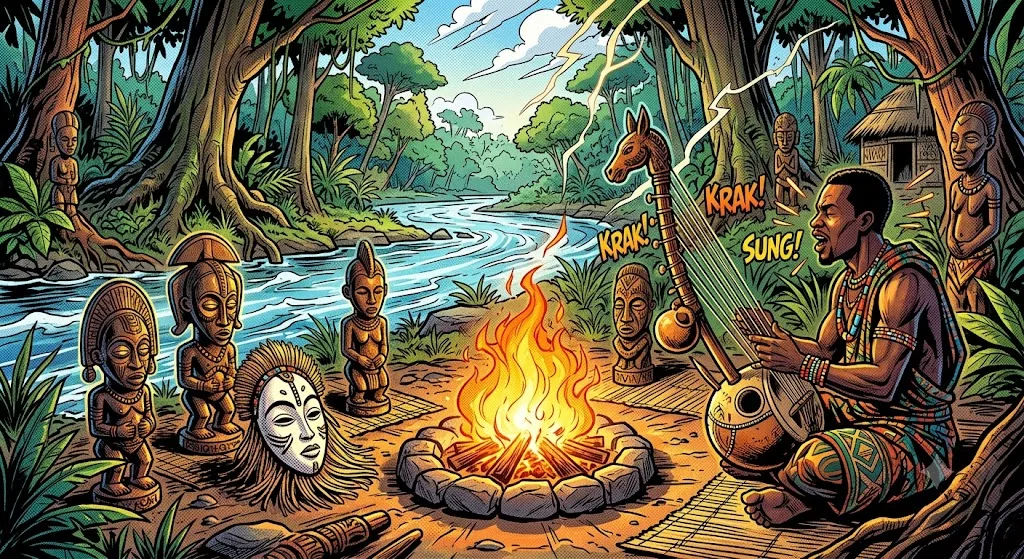
One of the clearest entry points into Gabonese folklore is the Fang mvet, a word used both for a stringed musical instrument and for the oral literature performed with it. Pierre Alexandre’s classic study describes mvet as a term covering the instrument and the special genres of oral literature delivered to its accompaniment; the instrument is a chordophone with resonators, traditionally made with a palm-frond stem, raised strings, and calabashes tied beneath.[Cambridge University Press & Assessment]cambridge.orgUniversity Press & AssessmentUniversity Press & Assessment
The mvet is not simply “music” in the modern entertainment sense. It can carry epic narrative, battle song, philosophy, history, satire, and ritual knowledge. Scholarly summaries describe Fang mvet traditions as long, lyrical epics involving conflicts between mortals and immortals, while also preserving memories of Fang migration across what is now Gabon, Cameroon, and Equatorial Guinea.[PagePlace]api.pageplace.dePage Place Wisdom and Initiation in GabonPage Place Wisdom and Initiation in Gabon
A major cycle concerns the Ekang, heroic or immortal figures associated with the land of Engong in Fang epic imagination. Modern scholarship has treated the Ekang saga not merely as fantasy but as a coded way of remembering historical pressures, including violence and displacement linked to the Atlantic slave trade. This does not mean every episode should be read as literal history; rather, it shows how oral epic can preserve social memory through legendary settings, heroic conflict, and symbolic geography.[AUC Library]library.au.intOpen source on au.int.
The mvet also matters because it is formally recognised beyond local performance circles. UNESCO lists “Mvet Oyeng, musical art, practices and skills associated with the Ekang community” as a cultural tradition of Gabon, Cameroon and Congo, describing it as the singing of epic stories accompanied by dancing. That recognition places a Gabon-linked oral art on the world heritage stage, but the living tradition still depends on trained performers, community transmission, and audiences who understand the cultural codes of the performance.[Intangible Cultural Heritage]ich.unesco.orgOpen source on unesco.org.
Ancestors are not background characters
In Gabonese folklore and ritual art, ancestors are often active presences. They are remembered, consulted, guarded, invoked, and represented through objects that are much more than decoration. The Fang bieri tradition is one of the best documented examples. The Metropolitan Museum of Art describes Fang bieri as an ancestral cult through which Fang peoples derive continuity with the past and communal cohesion in the present. Wooden heads or figures were placed on bark containers holding relics of important clan ancestors.[The Metropolitan Museum of Art]metmuseum.orgThe Metropolitan Museum of Art Okak-Fang artistThe Metropolitan Museum of Art Okak-Fang artist
The British Museum gives a particularly concrete sense of how these figures functioned. Its Fang reliquary guardian figure, made in Gabon around 1900–1920, is described as one of the ritual objects of bieri, an association devoted to honouring ancestors and ensuring continuity between past and present. Such figures were placed on bark boxes containing remains of influential people and were cared for through repeated applications of palm oil and resin.[British Museum]britishmuseum.orgBritish Museumfigure | British MuseumBritish Museumfigure | British Museum
The same British Museum record notes that these objects could be consulted during male initiation ceremonies and before important decisions about war, planting crops, hunting, fishing, or relocating a village. That detail is crucial: ancestor folklore here was practical, not merely commemorative. The dead were imagined as tied to prosperity, protection, fertility, and judgement.[British Museum]britishmuseum.orgBritish Museumfigure | British MuseumBritish Museumfigure | British Museum
The famous Fang reliquary figures now displayed in Western museums also raise a modern issue: many were separated from their original containers and ritual settings before entering collections. A museum visitor may see a sculpture as “African art”, while its original community meaning involved kinship, secrecy, relics, ritual authority, and the dangerous power of looking at what one was not authorised to see.[The Metropolitan Museum of Art]metmuseum.orgThe Metropolitan Museum of Art Okak-Fang artistThe Metropolitan Museum of Art Okak-Fang artist
Masks, spirits and social order
Gabon’s masks are among the country’s most visible contributions to world art history, but in folklore terms they are better understood as performed presences. A mask may represent an ancestor, a spirit, an idealised person, a moral force, or a being whose authority comes alive only through dance, costume, music, and ritual setting.
The Punu mukudj or Okuyi mask is a clear example. The Brooklyn Museum identifies one late nineteenth-century mask as Punu, made in Gabon, and notes that such masks are believed to resemble a beautiful Punu woman, with heart-shaped face, high cheekbones, delicate features, and a hairstyle that may reflect a specific woman known to the carver.[Brooklyn Museum]brooklynmuseum.orgBrooklyn Museum Mask for the Okuyi Society (Mukudj) · Brooklyn MuseumBrooklyn Museum Mask for the Okuyi Society (Mukudj) · Brooklyn Museum
Other museum and collection accounts describe Punu maiden-spirit masks as linked to female ancestors and public masquerade, often performed by trained male dancers, sometimes on stilts. The white surface is commonly associated with the spirit world or the dead, while the refined features express ideals of beauty, composure, and ancestral presence.[albanymuseum.com]albanymuseum.compunu maiden spirit maskpunu maiden spirit mask
Fang mask traditions include more troubling and dramatic material. The Ngil society, remembered through long white masks with elongated faces, is often described as a male association concerned with initiation, social control, and the pursuit of witchcraft accusations. Some accounts stress its role in community regulation; others highlight its capacity for intimidation and punishment. Sources generally agree that Ngil practices declined or were suppressed under colonial and missionary pressure in the early twentieth century, which means present-day masks in museums and the art market are often traces of a discontinued or transformed institution rather than evidence of an unchanged living practice.[davidmalikarts.com]davidmalikarts.comfang ngil maskfang ngil mask
This is one place where a folklore page needs caution. It is tempting to describe Ngil simply as a “witch-hunting monster mask”, but that flattens the tradition. The mask belonged to a social and ritual system that tried to deal with fear, wrongdoing, hidden harm, and communal suspicion. It was frightening, but it was also embedded in law, initiation, secrecy, gendered authority, and colonial disruption.[davidmalikarts.com]davidmalikarts.comfang ngil maskfang ngil mask
Bwiti and iboga: initiation, healing and the forest
For many outside readers, Bwiti is the Gabonese tradition they are most likely to have heard of, mainly because of international interest in iboga and ibogaine. Within Gabon, however, Bwiti is not just a “psychedelic ceremony”. It is a set of initiatory and religious traditions, with different branches and local forms, in which music, night-long ceremony, ancestor veneration, moral teaching, healing, and forest knowledge are deeply connected. Recent research on iboga cults describes traditional Bwiti as widespread among at least twenty ethnic groups in Gabon, with the Mitsogho form among the most studied.[Antrocom]antrocom.netsamorini iboga cults vii traditional bwitisamorini iboga cults vii traditional bwiti
Scholarly and ethnographic sources often distinguish between older, non-Christian or less syncretic forms and later forms influenced by Christianity, especially among Fang communities. Studies of iboga and Bwiti mythology note that Fang Bwiti includes origin stories such as the “story of Banzioku”, preserved in multiple versions by different branches. That variation is important: oral and ritual traditions do not usually have one authorised script, and local lineages may preserve different accounts of how the tradition began and what its symbols mean.[Antrocom]antrocom.netOpen source on antrocom.net.
A central feature of Bwiti is the ritual use of iboga root bark, but careful writing should avoid reducing the religion to a drug experience. Sources describe iboga as a sacrament or sacred plant within initiation and healing, while music, dance, instruction, confession, fasting, purification, and the authority of ritual leaders all shape the event. Some ceremonies are oriented towards initiation; others may address illness, moral crisis, family disorder, or the need to reconnect with ancestors.[kumakonda.com]kumakonda.comThe night of the Bwiti in Gabon, a world that does not sleepThe night of the Bwiti in Gabon, a world that does not sleep
Bwiti also shows how Gabonese folklore changes over time. It has interacted with Christianity, colonial history, urban life, and global wellness tourism. Recent journalism has reported rising international attention to iboga and concerns in Gabon about commercial exploitation, poaching, illegal exports, and the risk of separating the plant from its cultural and spiritual roots. That modern tension is now part of the folklore story: a forest tradition once guarded by initiation is increasingly discussed in the language of medicine, investment, regulation, and intellectual property.[The Times]thetimes.comThe Times Can psychedelic endorsed by Joe Rogan transform Gabon's fortunes?Bwiti House, a prominent Gabonese iboga retreat, has treated numerous Western celebrities and executives, charging up to $15,000 per pers…
Forests, rivers and sacred landscapes
Gabonese folklore is strongly shaped by ecology. The country is widely associated with rainforest, rivers, and Atlantic-facing coastal worlds, and those landscapes recur in ritual imagination. Ancestors may be imagined in relation to water, the dead, distant lands, or forest spaces; ritual art may use white pigment to evoke the dead; and initiation traditions often treat the forest not as scenery but as a place of knowledge, danger, medicine, and revelation.[The Metropolitan Museum of Art]metmuseum.orgThe Metropolitan Museum of Art Tsogho artistThe Metropolitan Museum of Art Tsogho artist
The Met’s record for a Tsogho door from the Ogooué River region is a useful concrete example. It links carved motifs on religious architecture to Bwiti spiritual beliefs, moral philosophy, and initiation. The museum notes that geometric forms may refer to vessels carrying initiates’ souls from birth to death, while white pigment alludes to ancestors imagined as pale figures in the land of the dead beyond the ocean.[The Metropolitan Museum of Art]metmuseum.orgThe Metropolitan Museum of Art Tsogho artistThe Metropolitan Museum of Art Tsogho artist
That detail helps explain why Gabonese folklore should not be separated too sharply into “stories”, “religion”, “art”, and “landscape”. A carved door, a mask, a reliquary figure, an initiation house, a river journey, and a sung epic can all carry related ideas about passage, death, memory, and moral transformation. The sacred is often material and performative: wood, pigment, resin, oil, music, bark, bone, costume, and movement make invisible relationships visible.[Horizon Documentation]horizon.documentation.ird.frHorizon Documentationancestral art ofgabonHorizon Documentationancestral art ofgabon

Animal tales and everyday wisdom
Not all Gabonese folklore is grand epic or secret ritual. Like many Central and West African storytelling traditions, Gabon also has animal tales, trickster-like episodes, moral stories, and everyday narratives in which animals model cleverness, greed, danger, obligation, and social intelligence. Online collections of Gabonese and Fang tales include stories involving elephant, rabbit, fox, frog, chameleon and other figures, often with a focus on wit, deception, rivalry, or the consequences of foolish behaviour.[Mythopia]mythopia.ioGabonese Folklore & TalesGabonese Folklore & Tales
These tales should be handled with care because many publicly available versions are translations, retellings, or modern web presentations rather than direct field transcripts. Still, the pattern is consistent with broader research on animal folktales, which argues that animal stories often transmit practical knowledge about ecological relationships, risk, and social behaviour through memorable narrative forms.[arXiv]arxiv.orgOpen source on arxiv.org.
For readers used to European fairy tales, Gabonese animal tales may feel less interested in enchanted castles and more interested in relational intelligence: how the smaller creature survives, how boasting is punished, how hunger tests morality, and how one being’s strength can be undone by another’s cunning. This makes them a useful counterweight to the more spectacular traditions of masks and initiation. Folklore here is also family instruction, humour, memory, and verbal skill.[Mythopia]mythopia.ioGabonese Folklore & TalesGabonese Folklore & Tales
What is old, what is changing, and what is modern invention?
A responsible Gabon folklore page has to separate several layers. Some traditions are old oral or ritual systems documented by early ethnographers, museum collections, and community memory. Fang bieri reliquary figures, Punu masks, Kota reliquary forms, and the mvet epic all have strong historical documentation, even though many objects are now displaced from their original communities.[metmuseum.org]metmuseum.orgThe Metropolitan Museum of Art Okak-Fang artistThe Metropolitan Museum of Art Okak-Fang artist
Other traditions are living but not fully public. Bwiti is practised, adapted, and discussed today, yet important knowledge may remain restricted to initiates. Public tourism pages, retreat websites, and popular explainers can be useful for seeing how the tradition is presented today, but they should not be treated as complete accounts of ritual knowledge. Academic work and community accounts both show that different branches vary, and that secrecy, lineage, and initiation shape what can be known from the outside.[antrocom.net]antrocom.netsamorini iboga cults vii traditional bwitisamorini iboga cults vii traditional bwiti
There is also a modern internet layer. Search results for “Gabon monsters” or “African spirits” often mix Gabonese material with pan-African water spirits, invented bestiary entries, commercial art descriptions, or generic paranormal language. Some of that material may be inspired by real traditions, but it can blur countries, ethnic groups, and ritual contexts. For Gabon, the strongest evidence usually comes not from creepypasta-style monster lists but from oral literature studies, museum records, heritage listings, and careful ethnographic writing.[metmuseum.org]metmuseum.orgThe Metropolitan Museum of Art Okak-Fang artistThe Metropolitan Museum of Art Okak-Fang artist
The most interesting modern development is not that Gabonese folklore is “vanishing” in a simple way. It is being reframed. Mvet performance can be heritage; Bwiti can be religion, healing practice, tourist encounter, and subject of global pharmaceutical interest; masks can be ritual presences, museum objects, auction commodities, and symbols of national culture. Each setting changes what the tradition means and who gets to interpret it.[unesco.org]ich.unesco.orgOpen source on unesco.org.
How to read Gabonese folklore today
The best way to approach Gabonese folklore is to ask what a tradition is doing in its own setting. A Fang epic is not only a fantasy story; it is sung knowledge, social memory, and performance. A reliquary figure is not only sculpture; it once guarded ancestral remains and helped mediate decisions. A Punu mask is not merely a beautiful face; it appears from a world of ancestors, gendered performance, funeral display, and ideals of social beauty. Bwiti is not simply a plant ceremony; it is initiation, ethics, music, forest medicine, ancestry, and a changing religious field.[cambridge.org]cambridge.orgUniversity Press & AssessmentUniversity Press & Assessment
For a curious reader, Gabon’s folklore is therefore less like a catalogue of mythical creatures and more like a set of doors. One opens onto sung heroic worlds of mortals and immortals. Another opens onto family ancestors whose power is preserved in relics and carved guardians. Another opens onto masked performance, where the dead, the beautiful, the feared, and the morally dangerous become visible. Another opens onto the forest at night, where initiation traditions seek knowledge through ordeal, music, and ancestral encounter.[pageplace.de]api.pageplace.dePage Place Wisdom and Initiation in GabonPage Place Wisdom and Initiation in Gabon
That is why Gabon deserves attention in any country-by-country folklore project. Its traditions show how myth can be performed, carved, sung, danced, hidden, commercialised, protected, and renewed. The most reliable picture is not a single national myth, but a living cultural field in which oral art, ritual authority, sacred ecology, and modern heritage politics continue to meet.
Amazon book picks
Further Reading
Books and field guides related to What Lives in Gabon's Forest Stories?. Use these as the next step if you want deeper reading beyond the article.
African Religions and Philosophy
Explains ancestor belief, ritual life, and cosmology relevant to Gabon.
African Myths of Origin
Provides broad context for Central African myth, epic, and ancestral traditions.
African Art
Covers the artistic and ritual background behind Gabonese masks and figures.
Mythology:Timeless Tales of Gods and Heroes
Appeals to readers exploring world mythologies beyond Europe.
eBay marketplace picks
Marketplace Samples
Live-tested eBay searches with available results related to this page.

Endnotes
1.
Source: iwgia.org
Link:https://iwgia.org/en/gabon.html
2.
Source: cambridge.org
Title: University Press & Assessment
Link:https://www.cambridge.org/core/journals/bulletin-of-the-school-of-oriental-and-african-studies/article/introduction-to-a-fang-oral-art-genre-gabon-and-cameroon-mvet/25624212622F59837E9ED0B8E1C76DE4
3.
Source: ich.unesco.org
Link:https://ich.unesco.org/en/RL/mvet-oyeng-musical-art-practices-and-skills-associated-with-the-ekang-community-02253
4.
Source: antrocom.net
Title: samorini iboga cults vii traditional bwiti
Link:https://antrocom.net/wp/wp-content/uploads/2025/11/samorini-iboga-cults-vii-traditional-bwiti.pdf
5.
Source: api.pageplace.de
Title: Page Place Wisdom and Initiation in Gabon
Link:https://api.pageplace.de/preview/DT0400.9798216217930_A63004055/preview-9798216217930_A63004055.pdf
6.
Source: resolve.cambridge.org
Link:https://resolve.cambridge.org/core/services/aop-cambridge-core/content/view/7DE9B7A7283F326E1F364CCD9D78B451/9781139054638c6_p98-116_CBO.pdf/african_oral_epics.pdf
7.
Source: ich.unesco.org
Link:https://ich.unesco.org/en/decisions/20.COM/7.B.19
8.
Source: albanymuseum.com
Title: punu maiden spirit mask
Link:https://www.albanymuseum.com/punu-maiden-spirit-mask/
9.
Source: davidmalikarts.com
Title: fang ngil mask
Link:https://www.davidmalikarts.com/arte/fang-ngil-mask
10.
Source: antrocom.net
Link:https://antrocom.net/archives/2024/volume-20-number-2/studies-on-the-iboga-cults-iii-iboga-and-bwiti-mythology/
11.
Source: kumakonda.com
Title: The night of the Bwiti in Gabon, a world that does not sleep
Link:https://kumakonda.com/bwiti-gabon-iboga-travel/
12.
Source: bwitiroots.org
Link:https://bwitiroots.org/bwiti-culture/
13.
Source: mythopia.io
Title: Gabonese Folklore & Tales
Link:https://mythopia.io/tagged/403/gabon-folklore
14.
Source: mythopia.io
Title: Fang Legends
Link:https://mythopia.io/tagged/402/fang-tales
15.
Source: arxiv.org
Link:https://arxiv.org/abs/1907.03969
16.
Source: ich.unesco.org
Title: gabon GA
Link:https://ich.unesco.org/en/state/gabon-GA
17.
Source: ich.unesco.org
Link:https://ich.unesco.org/en/lists
18.
Source: bwitiroots.org
Title: Bwiti Branches
Link:https://bwitiroots.org/bwiti-branches-a-comprehensive-guide/
19.
Source: metmuseum.org
Title: The Metropolitan Museum of Art Okak-Fang artist
Link:https://www.metmuseum.org/art/collection/search/310870
20.
Source: britishmuseum.org
Title: British Museumfigure | British Museum
Link:https://www.britishmuseum.org/collection/object/E
21.
Source: brooklynmuseum.org
Title: Brooklyn Museum Mask for the Okuyi Society (Mukudj) · Brooklyn Museum
Link:https://www.brooklynmuseum.org/objects/2907
22.
Source: metmuseum.org
Title: The Metropolitan Museum of Art Tsogho artist
Link:https://www.metmuseum.org/art/collection/search/844671
23.
Source: library.au.int
Link:https://library.au.int/memories-and-mechanisms-resistance-atlantic-slave-trade-ekang-saga-west-central-africas-epic-tale
24.
Source: thetimes.com
Title: The Times Can psychedelic endorsed by Joe Rogan transform Gabon’s fortunes?
Link:https://www.thetimes.com/world/africa/article/psychedelic-endorsed-joe-rogan-transform-gabons-fortunes-dfq82n3w7
Source snippet
Bwiti House, a prominent Gabonese iboga retreat, has treated numerous Western celebrities and executives, charging up to $15,000 per pers...
25.
Source: horizon.documentation.ird.fr
Title: Horizon Documentationancestral art ofgabon
Link:https://horizon.documentation.ird.fr/exl-doc/pleins_textes/divers18-08/23103.pdf
26.
Source: metmuseum.org
Title: african influences in modern art
Link:https://www.metmuseum.org/essays/african-influences-in-modern-art
27.
Source: beastsoflegend.com
Link:https://beastsoflegend.com/bestiary/africa/central/
28.
Source: metmuseum.org
Title: Male Reliquary Figure (Nlo Bieri)
Link:https://www.metmuseum.org/art/collection/search/312334
29.
Source: metmuseum.org
Title: Betsi-Fang artist
Link:https://www.metmuseum.org/art/collection/search/312429
30.
Source: metmuseum.org
Link:https://www.metmuseum.org/art/collection/search/310984
31.
Source: metmuseum.org
Link:https://www.metmuseum.org/exhibitions/listings/2007/eternal-ancestors/photo-gallery
32.
Source: metmuseum.org
Title: Reliquary Figure
Link:https://www.metmuseum.org/art/collection/search/312344
33.
Source: metmuseum.org
Title: Betsi-Fang artist
Link:https://www.metmuseum.org/art/collection/search/312196
34.
Source: metmuseum.org
Link:https://www.metmuseum.org/-/media/files/learn/for-educators/publications-for-educators/the-art-of-africa.pdf
35.
Source: arthitparade.net
Link:https://www.arthitparade.net/gabon.html
36.
Source: Wikipedia
Link:https://en.wikipedia.org/wiki/Bwiti
37.
Source: Wikipedia
Link:https://en.wikipedia.org/wiki/Gabon
38.
Source: Wikipedia
Link:https://en.wikipedia.org/wiki/Mvet
39.
Source: ebsco.com
Link:https://www.ebsco.com/research-starters/geography-and-cartography/gabon
40.
Source: african-arts-gallery.com
Title: Fang Mask
Link:https://www.african-arts-gallery.com/african-art/African-mask/Fang-Mask/19779
41.
Source: everyculture.com
Link:https://www.everyculture.com/wc/Costa-Rica-to-Georgia/Gabonese.html
42.
Source: tribal-art-gallery.com
Title: Fang Mask
Link:https://www.tribal-art-gallery.com/tribal-art/African-mask/Fang-Mask/17393
43.
Source: samorini.it
Title: bui int
Link:https://www.samorini.it/doc1/sam/bui_int.htm
Additional References
44.
Source: youtube.com
Link:https://www.youtube.com/watch?v=K0kI4zIqUhc
Source snippet
Historic Gathering in Gabon Traditional Rites Associations Unite to Preserve Cultural Heritage...
45.
Source: youtube.com
Title: Chantres de l’épopée: Chant épique du Mvet
Link:https://www.youtube.com/watch?v=9640zoG6304
Source snippet
Rare wooden Fang mask fetches $4.6 million in an auction, Gabonese protest the sale of the mask...
46.
Source: researchgate.net
Link:https://www.researchgate.net/publication/265833436_Mvett_Performance_Retention_Reinvention_and_Exaggeration_in_Remembering_the_Past
47.
Source: researchgate.net
Link:https://www.researchgate.net/publication/365964412_The_Holy_Spirit_of_Iboga_and_a_Contemporary_Perspective_on_Africa%27s_Spiritual_Renaissance_Focus_on_Gabonese_Bwiti_Tradition
48.
Source: 101lasttribes.com
Link:https://www.101lasttribes.com/tribes/bwiti.html
49.
Source: instagram.com
Link:https://www.instagram.com/reel/DTeiicFAnHI/?hl=en
50.
Source: researchgate.net
Link:https://www.researchgate.net/publication/389235832_Wisdom_and_Initiation_in_Gabon_A_Philosophical_Analysis_of_Fang_Tales_Myths_and_Legends
51.
Source: christies.com
Link:https://www.christies.com/en/lot/lot-4070064
52.
Source: mamaaline.com
Link:https://www.mamaaline.com/about-bwiti.html
53.
Source: facebook.com
Link:https://www.facebook.com/groups/275114380263865/posts/777185543390077/
Topic Tree
Follow this branch
Related pages 192
- Afghan Folklore
- Albanian Folklore
- Algerian Folklore
- Australian Folklore
- Azerbaijan Folklore
- +187 more in sidebar