Where Luxembourg's Legends Still Live
Luxembourg’s folklore is compact but unusually vivid: a founding mermaid beneath the capital, a river bogeyman who kept children away from dangerous water, bonfires that chase out winter, beetroots carved against the dark, saints whose feast days still shape local custom, and a nineteenth-century printed treasure-house of legends that preserved many tales...
Page outline Jump by section
Why Luxembourg’s folklore feels so place-specific
Luxembourg is small, multilingual and historically connected to surrounding Germanic, French and Low Countries traditions, so its folklore is best understood as local rather than isolated. Many stories are attached to a rock, river, castle, chapel, market, saint’s day or village custom. That makes the tradition feel intimate: the supernatural is not usually a distant pantheon but something heard in an valley, glimpsed at ruins, avoided near a well, or revived each year in a public procession. The nineteenth-century collector Nicolas Gredt helped fix this local texture in print through Sagenschatz des Luxemburger Landes, a large collection of Luxembourg legends and tales published in the 1880s and now digitised from Harvard’s copy by the Internet Archive.[Internet Archive]archive.orgOpen source on archive.org.
That printed collecting matters because it marks a transition. Many tales that once lived in household warning, village memory and local performance became literary and antiquarian material, then later tourist material, school culture, municipal branding or heritage programming. A reader should therefore treat Luxembourgish legends as layered: some are old oral motifs, some are nineteenth-century collected versions, some are devotional customs, and some are modern retellings designed for visitors or festivals. That does not make them “fake”; it means their cultural life has changed.[zeno.org]zeno.orgOpen source on zeno.org.
Melusina: the mermaid at the heart of Luxembourg City
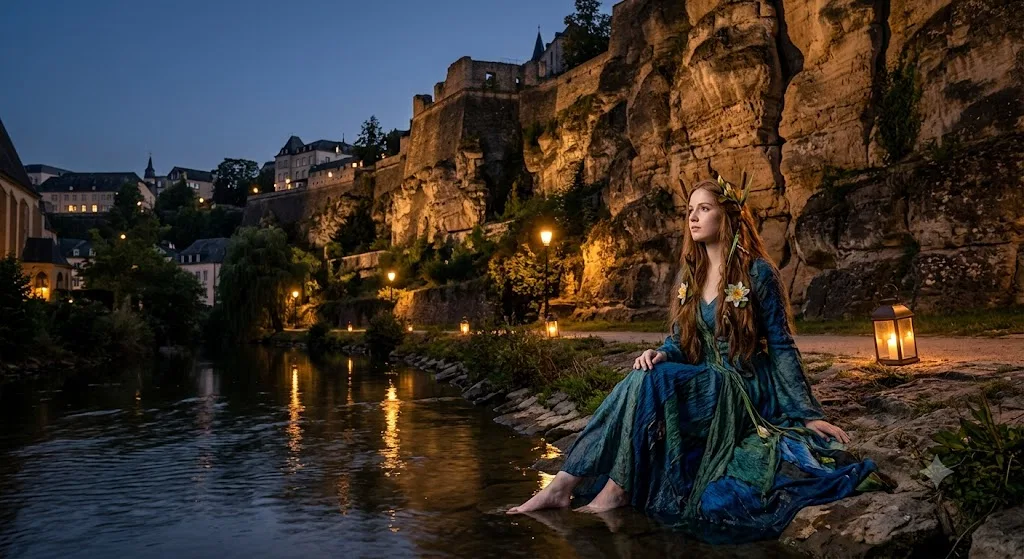
The central national legend is Melusina, the mysterious woman who marries Count Siegfried, the founder figure associated with Luxembourg City. The historical anchor is clear enough: in 963 Siegfried acquired the Bock promontory above the Alzette valley and built a castle there, with the name “Lucilinburhuc”, or little castle, appearing in that context. Folklore then turns this founding landscape into a supernatural marriage story. In one common version, Siegfried hears beautiful singing in the Alzette valley, meets Melusina, marries her, and promises not to look at her on Saturdays. When he breaks the vow, he discovers she is half woman and half mermaid; she vanishes into the waters of the Alzette.[Luxembourg City]luxembourg-city.comLuxembourg City Melusina and Siegfried: A Luxembourgish Love StoryLuxembourg CityMelusina and Siegfried: A Luxembourgish Love Story - Visit Luxembourg City…
The story survives because it does several jobs at once. It gives Luxembourg City a romantic founding myth, explains the emotional charge of the Bock and Alzette landscape, and places secrecy, trust and the boundary between human and supernatural worlds at the centre of the city’s imagination. Modern tourist retellings keep the story close to real landmarks: the Alzette valley, the Bock promontory, the fortifications and the Melusina statue. Luxembourg City Tourist Office explicitly presents these places as “where history and legend meet”, which is a useful phrase for the whole tradition.[Luxembourg City]luxembourg-city.comLuxembourg City Melusina and Siegfried: A Luxembourgish Love StoryLuxembourg CityMelusina and Siegfried: A Luxembourgish Love Story - Visit Luxembourg City…
Melusina is also not merely a local oddity. Across Europe, Melusine-type legends often concern a supernatural bride whose hidden body or taboo condition is exposed by a human husband. Luxembourg’s version is distinctive because it is tied so closely to the capital’s origin story. Modern versions even say she appears every seven years above the Bock promontory, still seeking release, before disappearing again into the rock or water. That seven-year return gives the tale the feel of a living urban haunting rather than a finished medieval romance.[Luxembourg City]luxembourg-city.comLuxembourg City Melusina and Siegfried: A Luxembourgish Love StoryLuxembourg CityMelusina and Siegfried: A Luxembourgish Love Story - Visit Luxembourg City…

The Kropemann: a water monster turned ecological mascot
If Melusina is Luxembourg’s romantic water spirit, the Kropemann is its cautionary one. In Redange-sur-Attert, in western Luxembourg, the Kropemann is described as a hooked water figure who lurks near the Attert and drags children into the depths if they come too close. Regional tourism material calls him a legendary villain who pulls children from the shore with his long hook, while contemporary reporting explains the tale as a warning used to keep children away from dangerous water, wells and marshes.[Visit Guttland]visitguttland.luOpen source on visitguttland.lu.
What makes the Kropemann especially interesting is the way a frightening child-safety figure has been reimagined. Older versions present him as a bogeyman: small, shaggy, ragged, algae-covered and armed with a hooked pole. Today, Redange has turned him into a local emblem. There is a monument, a wooden sculpture and an annual Kropemannsfest on the last Sunday of September, where the mythical creature appears as part of a family folk festival. Visit Luxembourg describes the festival as organised in honour of the creature, while the Luxembourg Times has noted the newer idea of the Kropemann as a protector of nature and the Attert valley landscape.[visitluxembourg.com]visitluxembourg.comOpen source on visitluxembourg.com.
That transformation is a textbook example of modern folklore in action. The monster has not disappeared; he has changed social function. Once, he warned children not to drown. Now, he also gives a municipality a recognisable symbol, supports a local festival, and expresses concern for rivers and preserved landscapes. The dark edge remains, but it is domesticated into civic identity.[Chronicle.lu]chronicle.lu51255 luxembourg myths kropemann51255 luxembourg myths kropemann
Haunted places, castle legends and the nineteenth-century legend book
Luxembourg’s castle landscapes are natural hosts for ghost stories. Ruins, chapels and old noble sites provide the perfect setting for white ladies, cursed figures, buried treasure, phantom riders and restless spirits. A modern article on Luxembourgish legends points back to Gredt’s Sagenschatz des Luxemburger Landes as a standard work for old folk tales and gives the example of the white-clad lady linked with Mont Saint-Jean, who in one version appears every seven years in May to wash and comb her hair while lamenting unhappy love.[Lëtzebuerger Journal]journal.lulegends small countryLëtzebuerger JournalLegends from a small country21 Jan 2022 — It is considered a standard work for old folk tales: The Sagenschatz des Lu…
The importance of Gredt’s collection is not that every tale in it should be read as ancient fact. Its value is that it captured a wide range of story-types circulating in Luxembourg: little spirits, goblins, nightmares, wild women, water beings, ghosts, haunted things, the Wild Hunt, devils, witches, werewolves, saints’ legends, buried treasures and local origin tales. The online table of contents shows how broad this material was, and the Internet Archive record confirms the work’s nineteenth-century publication, folklore subject matter, German language and public-domain status.[Zeno.org]zeno.orgOpen source on zeno.org.
These stories sit in a wider central and western European world, but their Luxembourgish force comes from localisation. A white lady becomes memorable because she belongs to a particular ruin; a water spirit becomes memorable because children know the river; a saint’s legend becomes durable because it is tied to a feast, market or procession. For readers, this is the best way into Luxembourg’s folklore: follow the place, then the story.[Lëtzebuerger Journal]journal.lulegends small countryLëtzebuerger JournalLegends from a small country21 Jan 2022 — It is considered a standard work for old folk tales: The Sagenschatz des Lu…
Saints, processions and folk religion
Luxembourg’s folklore is strongly marked by Catholic time. Many customs are not “mythology” in the narrow sense but folk religion: saints’ days, blessings, processions, seasonal reversals and household rituals. The Hopping Procession of Echternach is the clearest example. UNESCO describes it as taking place each Whit Tuesday in Echternach, the oldest city in Luxembourg, and says it has been documented since the year 1100. The procession is founded on the cult of Saint Willibrord, the missionary and founder of Echternach Abbey, who was venerated for kindness, missionary work and healing.[Intangible Cultural Heritage UNESCO]ich.unesco.orgOpen source on unesco.org.
The procession matters because it is both religious and theatrical. Public Luxembourg material describes participants lining up in rows, holding white handkerchiefs and moving through town with small hopping steps to a traditional melody. It is a living ritual, not just a museum object, and it has international recognition as intangible cultural heritage. That makes it a rare case where an old devotional practice, local identity and global heritage language overlap.[Luxembourg]luxembourg.public.luechternach hopping processionechternach hopping procession
Other saint-linked traditions show how practical life, fear and blessing merge. On Saint Hubertus’ Day, the patron saint of hunters is remembered through a legend in which Hubert sees a stag carrying a crucifix between its antlers while hunting in the Ardennes. Saint Barbara’s Day belongs especially to mining communities; Barbara is invoked against sudden death, fire, storms and danger, and Luxembourg’s mining localities have held parades with miners and firefighters carrying her statue. These are religious customs, but they also preserve local occupational folklore: hunters, miners, farmers and families each find their risks and hopes translated into ritual.[Luxembourg]luxembourg.public.luOpen source on public.lu.
Fire, darkness and the seasonal year
Some of Luxembourg’s most memorable traditions are about managing the turning of the year. On the first Sunday of Lent, the Buergbrennen fires symbolically drive out winter and its evil spirits while welcoming spring. The government’s festival guide says the custom has ancient roots, was later adopted by Christian preachers, and today involves large wooden crosses wrapped in straw and brushwood being burned while people gather with food and drink. In some tradition-conscious municipalities, the fire is lit by the most recently married couple or the couple next due to marry.[Luxembourg]luxembourg.public.luOpen source on public.lu.
At the darker end of the year comes the Trauliicht custom around All Saints’ and All Souls’ days. Long before commercial Halloween imagery returned from North America, the Luxembourg Ardennes had a practice of hollowing out beetroots, cutting faces into them, placing candles inside and carrying them through villages. The stated aim in the government account is strikingly folkloric: to protect oneself from souls of the dead and resist the darkness of the approaching winter.[Luxembourg]luxembourg.public.luOpen source on public.lu.
Assumption Day adds a gentler but equally old-feeling seasonal custom. The herb blessing associated with Léiffrawëschdag is described as a harvest festival with pre-Christian origins; priests blessed bunches of herbs, especially plants thought to have medicinal properties or strong smell, and the practice became linked with devotion to the Virgin Mary after she was appointed patron saint of Luxembourg in 1678. The custom is now carried out only in some localities, which shows how older ritual knowledge can shrink geographically while remaining symbolically important.[Luxembourg]luxembourg.public.luOpen source on public.lu.
Saint Nicholas, the sinister companion and children’s folklore
Luxembourg’s Saint Nicholas custom is one of the clearest examples of how children experience folklore as expectation, reward and threat. In early December, children place a shoe or slipper in the hallway in the hope of receiving a gift from Kleeschen, the Luxembourgish Saint Nicholas. But the tradition also includes Housecker, the darker servant figure who may punish children who have been naughty, lazy at school or disobedient. The gift-giving takes place during the night of 5 to 6 December, when plates are filled with sweets, toys and other presents.[Luxembourg]luxembourg.public.luOpen source on public.lu.
This custom should not be blurred into generic Santa Claus. Luxembourg’s official festival guide specifically warns that Kleeschen should not be confused with the American Santa Claus or the French Father Christmas, and notes the distinctive school holiday on 6 December for children in fundamental school. Folklorically, that distinction matters: Saint Nicholas is part of a local moral calendar, not merely a Christmas retail figure.[Luxembourg]luxembourg.public.luOpen source on public.lu.
Children’s folklore often works through controlled fear. The Kropemann threatens water danger; Housecker threatens punishment; carved beetroots and winter ghost customs let children and young people play with darkness; carnival reverses order before Lent. These are not random quaint details. They teach boundaries, dramatise seasonal change and make moral ideas visible through characters and performances.[rtl.lu]today.rtl.lukropemannsfest set to thrill redange on sunday 2235949kropemannsfest set to thrill redange on sunday 2235949

Fairs, food and public custom
Not all folklore is ghostly. Luxembourg’s public customs also include markets, food rituals and festive processions that carry older social meanings into modern entertainment. The Schueberfouer, the country’s major fair, can be traced to a deed signed on 20 October 1340 by John the Blind, authorising an annual market around Saint Bartholomew’s Day. Over time, especially after the French Revolution, the trade fair became the large entertainment fair now held at the Glacis in Luxembourg City, with rides, stalls, food and the opening Hämmelsmarsch parade.[Luxembourg]luxembourg.public.luOpen source on public.lu.
Food customs show a similar mixture of older belief and modern pleasure. The public auction of smoked pig-jaw portions at Boevange-sur-Attert is explained in the government festival guide through older sacrificial associations with saints invoked against toothache and pig disease. Bretzelsonndeg, or Pretzel Sunday, is connected with courtship: traditionally, men gave decorated pretzels to their sweethearts and received Easter eggs in return, with roles reversed in leap years. Even where exact origins are uncertain, the customs remain valuable because they show how religion, courtship, trade and appetite became part of the same social calendar.[Luxembourg]luxembourg.public.luOpen source on public.lu.
These traditions are folklore in the public-facing sense: repeated, locally meaningful, socially shared and recognisable. They may not involve monsters, but they preserve ritual timing, symbolic exchange and communal memory. For a small country, that calendar gives folklore a visible annual rhythm.[Luxembourg]luxembourg.public.luOpen source on public.lu.
Old tradition, tourist retelling and modern invention
Luxembourg’s folklore is healthiest when readers accept its layers rather than demanding a single pure origin. The Hopping Procession has exceptionally strong documentation and UNESCO recognition. The Schueberfouer has a clear medieval market charter behind it. Gredt’s legend collection gives nineteenth-century evidence for a wide oral and local story tradition. Melusina’s modern tourist form is rooted in older legend but presented today through guided tours, statues and civic storytelling. The Kropemann has moved from child-frightening river spirit to municipal emblem and environmental mascot.[unesco.org]ich.unesco.orgOpen source on unesco.org.
That layered history is not a weakness. It is how folklore normally survives. A tale may begin as oral warning, become a printed legend, turn into a school story, appear on a stamp or tourist trail, and then re-emerge as a festival figure or film subject. What matters is being honest about the layer being discussed. A medieval charter is not the same kind of evidence as a village ghost story. A UNESCO file is not the same as a child’s warning by a river. A modern festival is not proof that every detail is ancient, but it is proof that the figure still has cultural use.[archive.org]archive.orgOpen source on archive.org.
For Luxembourg, this makes the folklore especially readable. The major traditions are not scattered abstractions; they can be followed through places: the Bock and Alzette for Melusina, Redange and the Attert for the Kropemann, Echternach for the Hopping Procession, village heights for Buergbrennen, northern communities for carved beetroot lights, and mining towns for Saint Barbara. The country’s legendary culture is small in scale but dense in local meaning.
Amazon book picks
Further Reading
Books and field guides related to Where Luxembourg's Legends Still Live. Use these as the next step if you want deeper reading beyond the article.
The Lore of the Land
Fits place-based legends such as Melusina and local folklore sites.

eBay marketplace picks
Marketplace Samples
Live-tested eBay searches with available results related to this page.

Endnotes
1.
Source: luxembourg-city.com
Title: Luxembourg City Melusina and Siegfried: A Luxembourgish Love Story
Link:https://www.luxembourg-city.com/en/about-luxembourg-city/meng-stad-my-city/details/melusina-and-siegfried
Source snippet
Luxembourg CityMelusina and Siegfried: A Luxembourgish Love Story - Visit Luxembourg City...
2.
Source: archive.org
Link:https://archive.org/details/bub_gb_5pYVAAAAYAAJ
3.
Source: luxembourg.public.lu
Link:https://luxembourg.public.lu/dam-assets/publications/a-propos-des-fetes-et-traditions-au-luxembourg/a-propos-des-fetes-et-traditions-au-luxembourg-en.pdf
4.
Source: zeno.org
Link:https://www.zeno.org/M%C3%A4rchen/M/Luxemburg/Nikolaus%2BGredt%3A%2BSagenschatz%2Bdes%2BLuxemburger%2BLandes
5.
Source: luxembourg.public.lu
Title: intangible cultural heritage luxembourg
Link:https://luxembourg.public.lu/en/society-and-culture/festivals-and-traditions/intangible-cultural-heritage-luxembourg.html
6.
Source: today.rtl.lu
Title: kropemannsfest set to thrill redange on sunday 2235949
Link:https://today.rtl.lu/news/luxembourg/kropemannsfest-set-to-thrill-redange-on-sunday-2235949
7.
Source: chronicle.lu
Title: 51255 luxembourg myths kropemann
Link:https://chronicle.lu/category/at-home/51255-luxembourg-myths-kropemann
8.
Source: ich.unesco.org
Link:https://ich.unesco.org/en/RL/hopping-procession-of-echternach-00392
9.
Source: unesco.org
Title: document 1682
Link:https://www.unesco.org/archives/multimedia/document-1682
10.
Source: luxembourg.public.lu
Title: echternach hopping procession
Link:https://luxembourg.public.lu/en/society-and-culture/festivals-and-traditions/echternach-hopping-procession.html
11.
Source: ich.unesco.org
Link:https://ich.unesco.org/en/video/4046
12.
Source: ich.unesco.org
Title: 07486 EN
Link:https://ich.unesco.org/doc/src/07486-EN.pdf
13.
Source: ich.unesco.org
Title: luxembourg LU
Link:https://ich.unesco.org/en/state/luxembourg-LU
14.
Source: ich.unesco.org
Title: 6 representative list 00335
Link:https://ich.unesco.org/en/6-representative-list-00335?id=00392&include=slideshow_inc.php
15.
Source: ich.unesco.org
Title: luxembourg LU
Link:https://ich.unesco.org/en/state/luxembourg-LU?info=periodic-reporting
16.
Source: luxembourg.public.lu
Link:https://luxembourg.public.lu/en/emoxies/melusina.html
17.
Source: luxembourg.public.lu
Link:https://luxembourg.public.lu/en.html
18.
Source: luxembourg.public.lu
Title: lu Society and culture
Link:https://luxembourg.public.lu/en/society-and-culture.html
19.
Source: luxembourg.public.lu
Link:https://luxembourg.public.lu/dam-assets/publications/a-propos-des-fetes-et-traditions-au-luxembourg/a-propos-des-fetes-et-traditions-au-luxembourg-fr.pdf
20.
Source: luxembourg.public.lu
Title: lu Feste und traditionen
Link:https://luxembourg.public.lu/dam-assets/publications/a-propos-des-fetes-et-traditions-au-luxembourg/a-propos-des-fetes-et-traditions-au-luxembourg-de.pdf
21.
Source: luxembourg.public.lu
Title: lu Just Arrived
Link:https://luxembourg.public.lu/dam-assets/publications/just-arrived/just-arrived-en.pdf
22.
Source: chronicle.lu
Link:https://chronicle.lu/category/culture/57416-luxembourg-adds-5-traditions-to-national-intangible-cultural-heritage-inventory
23.
Source: chronicle.lu
Title: 58672 intangible cultural heritage liichten
Link:https://chronicle.lu/category/culture/58672-intangible-cultural-heritage-liichten
24.
Source: chronicle.lu
Title: 13968 kropemannsfest
Link:https://www.chronicle.lu/event/13968-kropemannsfest
25.
Source: today.rtl.lu
Link:https://today.rtl.lu/luxembourg-insider/events-and-traditions/the-hopping-procession-returns-to-echternach-828868808
26.
Source: today.rtl.lu
Link:https://today.rtl.lu/news/luxembourg/thousands-of-pilgrims-gather-for-echternachs-hopping-procession-on-whit-tuesday-2067971064
27.
Source: today.rtl.lu
Title: luxembourg traditions gain unesco recognition as intangible heritage 2145939
Link:https://today.rtl.lu/news/luxembourg/luxembourg-traditions-gain-unesco-recognition-as-intangible-heritage-2145939
28.
Source: today.rtl.lu
Title: grieselmannchen the sinister tale of luxembourgs black knight 2098987
Link:https://today.rtl.lu/luxembourg-insider/history/grieselmannchen-the-sinister-tale-of-luxembourgs-black-knight-2098987
29.
Source: today.rtl.lu
Title: lu Child, beware! Is the Kropemann Luxembourg’s most terrifying
Link:https://today.rtl.lu/luxembourg-insider/history/child-beware-is-the-kropemann-luxembourgs-most-terrifying-mythical-creature-1376167
30.
Source: today.rtl.lu
Title: old tradition of kropemannsfest in redange sur attert 2340839
Link:https://today.rtl.lu/news/luxembourg/old-tradition-of-kropemannsfest-in-redange-sur-attert-2340839
31.
Source: today.rtl.lu
Title: tales of luxembourgish witches and wizards 2098986
Link:https://today.rtl.lu/luxembourg-insider/history/tales-of-luxembourgish-witches-and-wizards-2098986
32.
Source: archive.org
Link:https://archive.org/details/sagenschatzdesl00gredgoog
33.
Source: luxembourg-city.com
Link:https://www.luxembourg-city.com/en
34.
Source: luxembourg-city.com
Link:https://www.luxembourg-city.com/en/place/monument/melusina-statue
35.
Source: museum.wales
Link:https://museum.wales/collections/folktales/?action=background
36.
Source: journal.lu
Title: legends small country
Link:https://journal.lu/en/legends-small-country
Source snippet
Lëtzebuerger JournalLegends from a small country21 Jan 2022 — It is considered a standard work for old folk tales: The Sagenschatz des Lu...
37.
Source: visitluxembourg.com
Link:https://www.visitluxembourg.com/guided-tour/siegfried-melusina
38.
Source: luxtimes.lu
Link:https://www.luxtimes.lu/luxembourg/do-you-know-luxembourg-s-melusina-myth/1208844.html
39.
Source: visitguttland.lu
Link:https://www.visitguttland.lu/place/redange-sur-attert
40.
Source: visitluxembourg.com
Link:https://www.visitluxembourg.com/event/kropemannsfest
41.
Source: luxtimes.lu
Link:https://www.luxtimes.lu/luxembourg/kropemann-rises-from-river-attert-for-celebration/1199792.html
42.
Source: visitluxembourg.com
Link:https://www.visitluxembourg.com/place/bourscheid-hougeriicht-high-justice
43.
Source: mchabocka.com
Title: luxembourg myth of melusina and reality of rest
Link:https://mchabocka.com/blog/luxembourg-myth-of-melusina-and-reality-of-rest/
44.
Source: facebook.com
Title: Lu Xembourg
Link:https://www.facebook.com/LuxembourgLetsMakeItHappen/posts/-have-you-heard-of-the-legend-of-the-kropemann-in-luxembourg-luxembourg-is-a-cou/866504932338908/
45.
Source: Wikipedia
Link:https://en.wikipedia.org/wiki/Luxembourg
46.
Source: Wikipedia
Title: Luxembourg City
Link:https://en.wikipedia.org/wiki/Luxembourg_City
47.
Source: Wikipedia
Title: Luxembourg (Belgium)
Link:https://en.wikipedia.org/wiki/Luxembourg_%28Belgium%29
48.
Source: Wikipedia
Link:https://de.wikipedia.org/wiki/Kropemann
49.
Source: Wikipedia
Link:https://lb.wikipedia.org/wiki/Kropemann
50.
Source: Wikipedia
Title: White Lady
Link:https://en.wikipedia.org/wiki/White_Lady
51.
Source: fr.linkedin.com
Link:https://fr.linkedin.com/posts/luxembourg-let-s-make-it-happen_luxembourg-letsmakeithappen-folklore-activity-7377930111100014592-0elZ
52.
Source: visitluxembourg.com
Link:https://www.visitluxembourg.com/
53.
Source: visitluxembourg.com
Link:https://www.visitluxembourg.com/event/dancing-procession-echternach
54.
Source: vimeo.com
Link:https://vimeo.com/181808257
55.
Source: climate-laws.org
Title: luxembourg national inventory report nir 2025 0a2a
Link:https://climate-laws.org/document/luxembourg-national-inventory-report-nir-2025_0a2a
56.
Source: youtube.com
Link:https://www.youtube.com/watch?v=Ypou4lqS-ng
57.
Source: youtube.com
Link:https://www.youtube.com/watch?v=9FSUen_aAY4
58.
Source: visitatertwark.lu
Link:https://www.visitatertwark.lu/fr/a-voir-a-faire/agenda/evenements/2026/09/27/kropemannsfest
59.
Source: strasbourg-europe.eu
Link:https://www.strasbourg-europe.eu/luxembourg-en/
Additional References
60.
Source: youtube.com
Title: Grand Duke Henri’s Abdication, Guillaume’s Accession & the History of Luxembourg
Link:https://www.youtube.com/watch?v=MfnLYmHCAkI
Source snippet
1928 RELIGION/ LUXEMBOURG: Dancing procession of Echternach...
61.
Source: youtube.com
Title: Why is Luxembourg a country?
Link:https://www.youtube.com/watch?v=kWMw8g4sK5M
Source snippet
Grand Duke Henri's Abdication, Guillaume's Accession & the History of Luxembourg...
62.
Source: youtube.com
Title: The Luxembourg Curse: The Dynasty of Four Emperors That Left No Heirs
Link:https://www.youtube.com/watch?v=2yZvkuN2dQg
Source snippet
Why is Luxembourg a country? - History of Luxembourg in 11 Minutes...
63.
Source: instagram.com
Link:https://www.instagram.com/p/DBdELIMNggQ/?hl=en
64.
Source: instagram.com
Link:https://www.instagram.com/p/DPIiY-ojAPv/
65.
Source: londonlibrary.co.uk
Link:https://www.londonlibrary.co.uk/folklore
66.
Source: amazon.co.uk
Link:https://www.amazon.co.uk/Highland-Fairy-Legends-Collected-Tradition/dp/0859910385?tag=searcht-20
67.
Source: facebook.com
Link:https://www.facebook.com/groups/113480959325980/posts/1901043577236367/
68.
Source: henleyglobal.com
Link:https://www.henleyglobal.com/countries/luxembourg
69.
Source: instagram.com
Link:https://www.instagram.com/reel/DOiEfyaDWNC/
Topic Tree
Follow this branch
Related pages 192
- Afghan Folklore
- Albanian Folklore
- Algerian Folklore
- Australian Folklore
- Azerbaijan Folklore
- +187 more in sidebar