Where Montenegro's Legends Meet the Mountains
Montenegro’s folklore is best understood as a mountain-and-coast tradition: heroic songs performed with a one-stringed instrument, saints and monasteries set into dramatic landscapes, fairy and lake legends attached to wild places, and older South Slavic beliefs in witches, vampires, wolves and restless dead.
Page outline Jump by section
Introduction
The result is a folklore tradition where the boundary between history, memory and legend is especially thin. A battle song may treat a local warrior as a near-mythic hero; a lake may be explained through a saint’s curse; a monastery may be surrounded by healing stories; and a fairy tale may be less about escaping reality than about making the landscape morally meaningful.[oraltradition.org]journal.oraltradition.orgOral Tradition The Montenegrin Oral Epic in a New PerspectiveOral Tradition The Montenegrin Oral Epic in a New Perspective
Why Montenegro’s folklore feels so tied to place
Montenegro’s terrain helps explain the tone of its folklore. The country is small, but its cultural map is steep: Adriatic towns and maritime confraternities on the coast, old royal and monastic centres around Cetinje and Lovćen, lake country around Skadar, and highland zones such as Durmitor where oral epic, pastoral life and landscape legend have long overlapped. UNESCO’s description of Durmitor stresses its dramatic geological setting and biodiversity, while its Kotor listing highlights a bay landscape where settlements, fortifications, churches and mountains form one interdependent cultural scene.[UNESCO World Heritage Centre]whc.unesco.orgOpen source on unesco.org.
That matters for folklore because many Montenegrin traditions are not simply “stories” detached from life. They are attached to a route, a feast, a shrine, a family memory, a village, a peak or a lake. The Ethnographic Museum of Montenegro, founded in 1951 and now housed in Cetinje, presents material from the Montenegrin area as evidence of both material and spiritual culture, which is a useful reminder that folklore here includes dress, ritual objects, song, domestic life and seasonal customs as well as supernatural tales.[en.narodnimuzej.me]en.narodnimuzej.mepo0sjeta etnografski muzejpo0sjeta etnografski muzej
Montenegro also sits inside a wider South Slavic and Balkan cultural region. Some creatures and story-types are shared with Serbia, Bosnia and Herzegovina, Croatia, Albania and other neighbours; some are strongly localised through Montenegrin places and historical memory. A careful reader should therefore avoid two opposite mistakes: treating every South Slavic legend as uniquely Montenegrin, or assuming Montenegro has no distinctive folklore because many motifs cross borders.
Oral epic is the backbone of Montenegrin legend
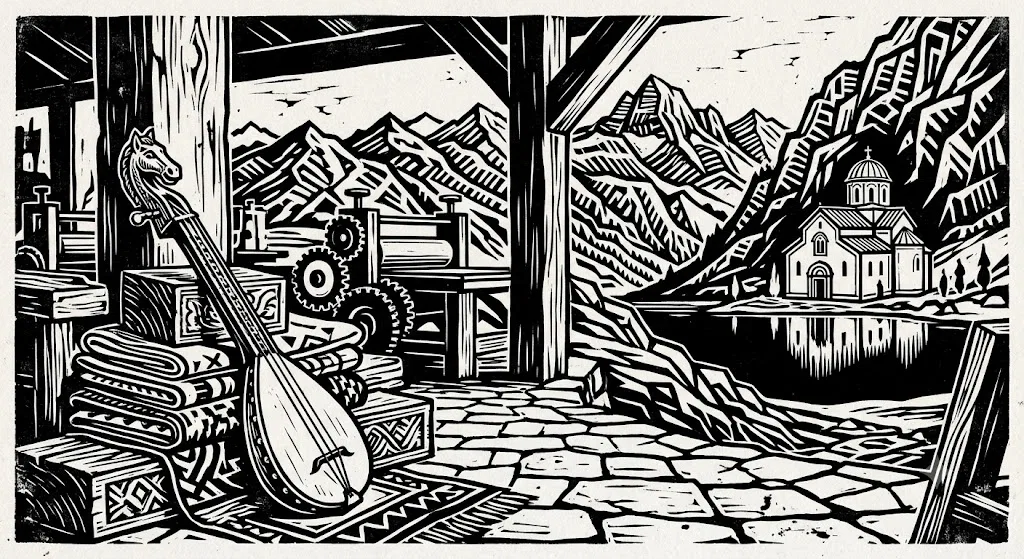
The most important folkloric form in Montenegro is arguably not the fairy tale but the heroic oral epic. These songs were traditionally performed by a singer accompanying himself on the gusle, a simple bowed string instrument. UNESCO describes singing to the accompaniment of the gusle as an ancient art of performing primarily heroic epics, practised for centuries as a form of historical memory and cultural identity.[ICH UNESCO]ich.unesco.orgOpen source on unesco.org.
In Montenegro, this tradition matters because it turned history into memorable story. Battles, clan loyalties, resistance, betrayal, sacrifice and honour were not only recorded in writing; they were sung, reshaped and remembered in performance. Harvard’s Milman Parry Collection is central to the modern study of such South Slavic oral poetry: Parry travelled in then-Yugoslavia in the early 1930s to observe living oral composition, and the songs he recorded on discs and in notebooks became a landmark archive for understanding how epic poetry can be composed and transmitted without a fixed written text.[Harvard Library]library.harvard.eduOpen source on harvard.edu.
For Montenegrin folklore, the crucial point is that oral epic is creative, not merely repetitive. A skilled singer could adapt inherited themes to local heroes and recent events. The article “The Montenegrin Oral Epic in a New Perspective” notes that Montenegrin bards could draw from a rich older poetic storehouse, including supernatural motifs such as the fairy, while adapting them to more realistic heroic material.[Oral Tradition]journal.oraltradition.orgOral Tradition The Montenegrin Oral Epic in a New PerspectiveOral Tradition The Montenegrin Oral Epic in a New Perspective
This is why Montenegrin folklore often sounds historical even when it behaves mythically. A horse may be given almost supernatural qualities; a warrior may be remembered in a way that exceeds documentary biography; a battle may become a moral theatre. The point was not always to preserve a fact-checkable account, but to make communal values memorable.

Njegoš turned oral tradition into national literature
No figure shows the relationship between folklore, literature and identity more clearly than Petar II Petrović-Njegoš, the nineteenth-century prince-bishop and poet of Montenegro. His best-known work, The Mountain Wreath, published in 1847, is not a folk song in the simple sense, but it draws heavily on the world of Montenegrin oral epic. Project Rastko’s English presentation identifies Njegoš as a major poet and ruler in the first half of the nineteenth century, while Central European University Press describes him as born in Njeguši in 1813 and becoming prince-bishop and ruler of Montenegro in 1830.[Rastko]rastko.rsOpen source on rastko.rs.
The key folklore issue is that Njegoš did not simply copy oral material. Scholarship on the poem argues that The Mountain Wreath comes from a Montenegrin oral epic background but changes the story into a national epic, giving it a literary and ideological form beyond ordinary performance.[SciSpace]scispace.comOpen source on scispace.com.
That transformation matters today because many readers encounter Montenegrin legendary culture through literary retellings rather than direct oral performance. The Mountain Wreath is admired as a literary monument, but it is also debated because of its representation of religious and political conflict. Srdja Pavlović argues that it should be read as an important literary drama that questions morality, action, religion and human nature, rather than simply as a poeticised record of a historical event.[York University]yorku.caOpen source on yorku.ca.
For a folklore page, the useful distinction is this: Njegoš is not “ancient mythology”. He is a nineteenth-century literary author working with older oral forms. His importance lies in how he helped turn sung memory, heroic values and mountain identity into a written national classic.
Fairies, dragons, witches and vampires in the Montenegrin imagination
Montenegro shares many supernatural beings with the wider South Slavic world. The best-known include fairies, dragons or serpent-like monsters, witches, night spirits, werewolf-vampire figures and the dangerous restless dead. These beings are not always well documented in Montenegro as separate from neighbouring traditions, so the safest approach is to treat them as regional belief figures with Montenegrin variants rather than as isolated national inventions.
The fairy is especially important in South Slavic epic and landscape lore. In epic songs, fairies may live in mountains, clouds, forests or near waters; they can help heroes, punish offence, or mark the wild places outside ordinary human control. In the Montenegrin oral epic study cited above, the fairy appears as a preternatural being from the older poetic storehouse, even in songs that otherwise move towards realistic heroic narrative.[Oral Tradition]journal.oraltradition.orgOral Tradition The Montenegrin Oral Epic in a New PerspectiveOral Tradition The Montenegrin Oral Epic in a New Perspective
Vampire and werewolf beliefs are more complex than modern horror fans may expect. In much South Slavic folklore, the categories of vampire, werewolf and wolf-like revenant overlap. A useful specialist summary of Slavic werewolf belief notes that in Montenegro, Boka, Herzegovina and Dalmatia, a vampire could even be called simply “wolf”, and that the South Slavic term often rendered as “werewolf” may refer to a walking corpse rather than a Hollywood-style shapeshifter.[Wikipedia]WikipediaWerewolf in Slavic mythologyWerewolf in Slavic mythology
This overlap tells us something important about older belief. The fear was not necessarily of a glamorous blood-drinker in a cape, but of a disturbed boundary: the dead who would not remain dead, the human who crossed into animal or demonic form, the household threatened by an unseen night visitor, or a community trying to explain illness, misfortune or sudden death. When modern websites present a neat “Montenegrin vampire”, they often tidy up a messier regional belief-world.
Witches and night spirits sit in the same broad field. They belong to a folk universe where harmful magic, envy, illness and the vulnerability of children, animals and sleepers could be explained through invisible agency. These beliefs should be presented as traditions and social narratives, not as proof of supernatural events. Their value lies in what they reveal about fear, morality and protection in rural life.
Sacred places where legend and pilgrimage meet
Montenegro’s religious folklore is especially visible in its sacred landscapes. Ostrog Monastery is the strongest example. Built dramatically into the rock near Nikšić and associated with Saint Basil of Ostrog, it is a major pilgrimage site, and popular accounts of the monastery are full of healing stories, dream visitations and vows. A Montenegro travel source records stories of people reporting spiritual change, dreams of Saint Basil and healings after visiting Ostrog; another guide notes that pilgrims still associate the monastery with miracles attributed to the saint.[Visit Montenegro]visit-montenegro.comOpen source on visit-montenegro.com.
The point is not to ask a folklore article to verify miracles. The point is to recognise that miracle stories are a living form of folk religion. They are told by pilgrims, repeated by guides, attached to feast days, and reinforced by the physical drama of the white monastery against the cliff. Ostrog is not merely an architectural site; it is a place where belief, testimony, travel and national religious identity meet.
Lovćen works differently. It is less a miracle shrine than a symbolic mountain. Njegoš chose a peak on Lovćen as his resting place, and the later mausoleum became a powerful and sometimes politically contested monument. Radio Free Europe’s reporting notes that Njegoš oversaw construction of a chapel on Mount Lovćen in 1845 and that the later mausoleum remains a divisive symbol for some Montenegrins.[RadioFreeEurope/RadioLiberty]rferl.orgOpen source on rferl.org.
For folklore, Lovćen matters because a mountain can become a national story-machine. It gathers songs, ruler memory, burial tradition, pilgrimage-like visitation, political symbolism and tourist spectacle. Claims that its peaks were once imagined as places of fairies or witches should be treated carefully unless they are tied to strong local evidence, but the broader pattern is clear: Montenegro’s mountains are often read as moral and ancestral landscapes, not just scenery.
Lake legends: curses, fairies and the moral landscape
Montenegrin lake legends often explain a striking landscape through moral drama. The Black Lake in Durmitor is a good example. Modern retellings say that Saint Sava was falsely accused by monks who hid a slaughtered rooster in his bag; after exposing the trick, the saint cursed the place, the ground opened, and a monastery or settlement sank, leaving the Black Lake behind.[Total Montenegro News]total-montenegro-news.com1420 the myth and the truth behind the black lake1420 the myth and the truth behind the black lake
This is classic legend logic. The lake is not simply water in a glacial basin; it becomes a visible moral consequence. False accusation, failed hospitality and disrespect for holiness are transformed into geography. At the same time, Durmitor’s real landscape is not imaginary: UNESCO describes the national park as a place of exceptional landscape and geological value, while Black Lake is widely presented today as one of the park’s most recognisable visitor sites.[UNESCO World Heritage Centre]whc.unesco.orgOpen source on unesco.org.
Lake Skadar has its own modern legend cycle, especially around love, fairies and tears. One tourist-facing retelling describes the lake as formed by the tears of a fairy after forbidden love, explaining reeds, water lilies and wildlife as products of grief and imagination.[Kingfisher Boat & Kayak - Lake Skadar]skadarlakeboatcruise.comKingfisher Boat & KayakKingfisher Boat & Kayak
Here the distinction between old oral tradition and modern tourism retelling matters. The Skadar story may preserve older motifs, but the available online form is a polished visitor narrative from a tour operator, not a critical folklore archive. That does not make it worthless. It shows how Montenegrin folklore is now repackaged for travellers: landscape becomes story, story becomes experience, and experience becomes part of the place’s public identity.
Kotor and the Boka Navy show folklore as public performance
Folklore in Montenegro is not only about supernatural beings. It also includes public ceremony, dance, costume and collective memory. The Boka Navy of Kotor is the clearest example. UNESCO inscribed the Cultural Heritage of Boka Navy Kotor in 2021 as a festive representation of memory and cultural identity. The external festivities include a traditional circle dance followed by a procession carrying the relics of Saint Tryphon through Kotor.[ICH UNESCO]ich.unesco.orgOpen source on unesco.org.
This tradition is rooted in the maritime culture of the Bay of Kotor. The Organization of World Heritage Cities notes that the Boka Navy is a traditional maritime organisation in Kotor, with origins linked to the arrival of Saint Tryphon’s relics and a claimed foundation date of 809.[Organization of World Heritage Cities]ovpm.orgOrganization of World Heritage Cities Kotor (MontenegroOrganization of World Heritage Cities Kotor (Montenegro
For readers interested mainly in monsters and legends, Boka Navy may seem like a different subject. It is not. It shows how folklore survives publicly: through repeated gestures, uniforms, music, dance, processions, patron saints and civic memory. It also reminds us that Montenegro’s folklore is not only highland and Orthodox. Coastal Catholic, maritime and urban traditions are part of the country’s belief culture too.
Kotor’s wider setting deepens this point. UNESCO describes the Kotor World Heritage property as the best-preserved part of the Boka Kotorska Bay, with two interrelated bays surrounded by mountains rising rapidly to nearly 1,500 metres.[UNESCO World Heritage Centre]whc.unesco.orgOpen source on unesco.org. In such a landscape, folklore is inseparable from the built environment: walls, churches, processions, harbour routes and mountain backdrops all help carry memory.
Folk customs, museums and the evidence problem
One challenge in writing about Montenegrin folklore is that the most visible material online is uneven. Some sources are institutional and reliable; others are tourist blogs, social media snippets or modern retellings with unclear origins. That is why museums and cultural heritage bodies matter. The National Museum of Montenegro describes its Ethnographic Museum as preserving valuable materials from the Montenegrin area that illustrate the richness of the material and spiritual culture of the people who inhabit the country.[en.narodnimuzej.me]en.narodnimuzej.mepo0sjeta etnografski muzejpo0sjeta etnografski muzej
The Council of Europe’s cultural heritage profile for Montenegro notes that the country recognises both tangible and intangible cultural heritage, with protection mechanisms involving the Directorate for Cultural Heritage Protection and other institutions.[Portal]coe.intPortal MontenegroPortal Montenegro This matters because folklore is often fragile: a song can vanish when singers die; a ritual can become a stage performance; a legend can be replaced by a simplified tourist version.
Collectors are another part of the evidence. Vuk Stefanović Karadžić, the major nineteenth-century collector and language reformer, collected poems and customs in Montenegro and Dalmatia from 1834, and his work helped shape the wider South Slavic record of folk poetry and tales.[ernie.uva.nl]ernie.uva.nlOpen source on uva.nl. Later scholarship and anthologies continue to treat oral literature as central to Montenegrin identity; a 2025 report in Vijesti quotes Matica Crnogorska representatives describing anthologies that cover the ethnogeographical space of Montenegro and its oral literature.[vijesti.me]en.vijesti.meme Oral literature as the foundation of identityme Oral literature as the foundation of identity
The evidence problem is therefore not that Montenegro lacks folklore. It is that folklore appears in many forms: epic songs, ethnographic collections, sacred testimony, UNESCO dossiers, literary classics, local memory, regional comparative studies and tourist storytelling. A good reader should ask: is this an old oral motif, a recorded custom, a literary adaptation, a living festival, or a modern place-branding tale?
Modern Montenegro: folklore between heritage, tourism and reinvention
Today, Montenegrin folklore lives in at least three public forms. First, it survives as heritage: museum displays, national and UNESCO listings, cultural policy, festivals and staged performances. The Boka Navy inscription and the official Ethnographic Museum are examples of this heritage frame.[ICH UNESCO]ich.unesco.orgOpen source on unesco.org.
Second, it survives through tourism. Ostrog miracle stories, Black Lake legends, Lake Skadar fairy tales and Lovćen symbolism are often presented to visitors as part of the experience of Montenegro. This can keep stories visible, but it can also flatten them into attractive summaries. A legend retold on a boat-tour blog may be memorable and culturally meaningful, but it should not be mistaken for a critically edited archive text.[Kingfisher Boat & Kayak - Lake Skadar]skadarlakeboatcruise.comKingfisher Boat & KayakKingfisher Boat & Kayak
Third, folklore survives through reinterpretation. Films, novels, online travel writing, social media captions and local cultural projects continue to use forests, mountains, fairies, saints and heroic memory as raw material. A modern Montenegrin “fairy tale” may be inspired by old motifs without being traditional in the strict sense. That is not a failure of folklore; it is how folklore often works. Traditions become durable because they can be retold.
The main risk is overclaiming. Montenegro’s folklore is fascinating without needing invented certainties. It is enough to say that the country has a strong oral epic tradition, deep sacred-place storytelling, a living calendar of public customs, shared South Slavic supernatural beings, and distinctive landscape legends that continue to shape how Montenegrins and visitors imagine the country.
What to remember about Montenegrin folklore
Montenegro’s folklore is not a tidy pantheon of gods. It is a culture of remembered voices and charged places. The gusle singer, the saint at Ostrog, the fairy near the water, the restless dead of South Slavic belief, the procession in Kotor, the cursed lake beneath Durmitor and the mountain tomb of Njegoš all belong to the same broad field: stories and practices that make landscape, morality and identity speak.
The oldest and best-attested material is strongest around oral epic, ritual performance and collected folk literature. Supernatural creatures such as fairies, witches, vampires and wolf-like revenants are real parts of the wider regional belief-world, but their Montenegrin forms should be handled with care because the evidence often crosses modern national borders. The most vivid modern folklore often appears at the meeting point of old belief and public retelling: a guide recounting a lake legend, a pilgrim describing a miracle, a festival restaging civic memory, or a literary classic turning oral epic into national art.
Amazon book picks
Further Reading
Books and field guides related to Where Montenegro's Legends Meet the Mountains. Use these as the next step if you want deeper reading beyond the article.
Slavic Folklore
Covers South Slavic folklore themes that underpin Montenegrin legends, fairies, saints and oral traditions.
Balkan Ghosts
Provides cultural and historical context for the folklore landscapes of Montenegro and the wider Balkans.
The Singer of Tales (Harvard Studies in Comparative Literature)
First published 1981. Subjects: Oral tradition, Folk poetry.
The Singer of Tales
Explains the South Slavic oral epic tradition central to Montenegrin storytelling.
eBay marketplace picks
Marketplace Samples
Live-tested eBay searches with available results related to this page.
Endnotes
1.
Source: en.narodnimuzej.me
Title: po0sjeta etnografski muzej
Link:https://en.narodnimuzej.me/po0sjeta-etnografski-muzej/
2.
Source: ich.unesco.org
Link:https://ich.unesco.org/en/RL/singing-to-the-accompaniment-of-the-gusle-01377
3.
Source: ich.unesco.org
Link:https://ich.unesco.org/en/RL/cultural-heritage-of-boka-navy-kotor-a-festive-representation-of-a-memory-and-cultural-identity-01727
4.
Source: ernie.uva.nl
Link:https://ernie.uva.nl/viewer.p/21/56/object/131-158707
5.
Source: total-montenegro-news.com
Title: 1420 the myth and the truth behind the black lake
Link:https://www.total-montenegro-news.com/travel/1420-the-myth-and-the-truth-behind-the-black-lake
6.
Source: visit-montenegro.com
Link:https://www.visit-montenegro.com/monastery-ostrog/stories/
7.
Source: whc.unesco.org
Link:https://whc.unesco.org/en/list/100/
8.
Source: whc.unesco.org
Link:https://whc.unesco.org/en/list/125/
9.
Source: library.harvard.edu
Link:https://library.harvard.edu/collections/milman-parry-collection-oral-literature
10.
Source: rastko.rs
Link:https://www.rastko.rs/knjizevnost/umetnicka/njegos/mountain_wreath.html
11.
Source: scispace.com
Link:https://scispace.com/pdf/petar-ii-petrovic-njegos-and-gjergj-fishta-composers-of-1rrp9vcmi8.pdf
12.
Source: Wikipedia
Title: Werewolf in Slavic mythology
Link:https://en.wikipedia.org/wiki/Werewolf_in_Slavic_mythology
13.
Source: skadarlakeboatcruise.com
Title: Kingfisher Boat & Kayak
Link:https://skadarlakeboatcruise.com/blog/the-creation-of-lake-skadar/
14.
Source: en.vijesti.me
Title: me Oral literature as the foundation of identity
Link:https://en.vijesti.me/amp/755908/oral-literature-as-the-foundation-of-identity
15.
Source: ich.unesco.org
Title: epic art of gorogly 01028
Link:https://ich.unesco.org/en/RL/epic-art-of-gorogly-01028
16.
Source: ich.unesco.org
Link:https://ich.unesco.org/en/lists
17.
Source: ich.unesco.org
Title: montenegro ME
Link:https://ich.unesco.org/en/state/montenegro-ME
18.
Source: ich.unesco.org
Link:https://ich.unesco.org/en/video/58168
19.
Source: ich.unesco.org
Link:https://ich.unesco.org/en/decisions/16.COM/8.B.25
20.
Source: ich.unesco.org
Title: photo pop up 00973
Link:https://ich.unesco.org/en/photo-pop-up-00973?photoID=15100
21.
Source: ich.unesco.org
Link:https://ich.unesco.org/
22.
Source: ich.unesco.org
Link:https://ich.unesco.org/en/video/63930
23.
Source: ich.unesco.org
Link:https://ich.unesco.org/en/Decisions/14.COM/10.b.25
24.
Source: ich.unesco.org
Title: montenegro ME
Link:https://ich.unesco.org/en-state/montenegro-ME?info=periodic-reporting
25.
Source: ich.unesco.org
Link:https://ich.unesco.org/doc/src/49405.pdf
26.
Source: whc.unesco.org
Link:https://whc.unesco.org/en/statesparties/me
27.
Source: whc.unesco.org
Link:https://whc.unesco.org/en/list/125/gallery/
28.
Source: Wikipedia
Title: Vampire folklore by region
Link:https://en.wikipedia.org/wiki/Vampire_folklore_by_region
29.
Source: Wikipedia
Title: Culture of Montenegro
Link:https://en.wikipedia.org/wiki/Culture_of_Montenegro
30.
Source: Wikipedia
Title: The Mountain Wreath
Link:https://en.wikipedia.org/wiki/The_Mountain_Wreath
31.
Source: Wikipedia
Link:https://en.wikipedia.org/wiki/Gusle
32.
Source: Wikipedia
Title: Prince Marko
Link:https://en.wikipedia.org/wiki/Prince_Marko
33.
Source: Wikipedia
Title: Lists of Intangible Cultural Heritage elements
Link:https://en.wikipedia.org/wiki/Lists_of_Intangible_Cultural_Heritage_elements
34.
Source: Wikipedia
Title: Ostrog Monastery
Link:https://en.wikipedia.org/wiki/Ostrog_Monastery
35.
Source: Wikipedia
Title: Vuk Karadžić
Link:https://en.wikipedia.org/wiki/Vuk_Karad%C5%BEi%C4%87
36.
Source: Wikipedia
Link:https://en.wikipedia.org/wiki/Vrykolakas
37.
Source: Wikipedia
Title: Natural and Culturo Historical Region of Kotor
Link:https://en.wikipedia.org/wiki/Natural_and_Culturo-Historical_Region_of_Kotor
38.
Source: Wikipedia
Title: List of World Heritage Sites in Montenegro
Link:https://en.wikipedia.org/wiki/List_of_World_Heritage_Sites_in_Montenegro
39.
Source: archive.org
Link:https://archive.org/details/danishfairyfolkt00bayj
40.
Source: en.narodnimuzej.me
Link:https://en.narodnimuzej.me/
41.
Source: montenegro.travel
Link:https://www.montenegro.travel/en/explore-montenegro/culture-and-tours/intangible-cultural-treasures
42.
Source: total-montenegro-news.com
Title: 2733 gusle heritage
Link:https://www.total-montenegro-news.com/lifestyle/2733-gusle-heritage
43.
Source: en.vijesti.me
Title: exceptional editorial pregnuce
Link:https://en.vijesti.me/fun/87913/exceptional-editorial-pregnuce
44.
Source: youtube.com
Title: 2,000 Years of Secrets: The Venetian Fortress Town of Kotor I 4K
Link:https://www.youtube.com/watch?v=km3unN-m__c
Source snippet
Montenegro - history, culture, and natural beauty | what to visit, and interesting facts...
45.
Source: youtube.com
Link:https://www.youtube.com/watch?v=RXXBXsY0oa4
46.
Source: journal.oraltradition.org
Title: Oral Tradition The Montenegrin Oral Epic in a New Perspective
Link:https://journal.oraltradition.org/wp-content/uploads/files/articles/6ii-iii/13_kilibarda.pdf
47.
Source: yorku.ca
Link:https://www.yorku.ca/soi/Vol_4/_HTML/pavlovic.html
48.
Source: rferl.org
Link:https://www.rferl.org/a/lovcen-njegos-montenegro-mausoleum-division/32162628.html
49.
Source: ovpm.org
Title: Organization of World Heritage Cities Kotor (Montenegro)
Link:https://www.ovpm.org/city/kotor-montenegro-2/
50.
Source: coe.int
Title: Portal Montenegro
Link:https://www.coe.int/en/web/herein-system/montenegro
51.
Source: tripadvisor.com
Title: Ethnographic Museum of Montenegro
Link:https://www.tripadvisor.com/Attraction_Review-g304076-d7262974-Reviews-Ethnographic_Museum_of_Montenegro-Cetinje.html
52.
Source: sites.pitt.edu
Link:https://sites.pitt.edu/~dash/slavic.html
53.
Source: serbianfairytales.com
Link:https://www.serbianfairytales.com/book
54.
Source: kuscholarworks.ku.edu
Link:https://kuscholarworks.ku.edu/server/api/core/bitstreams/623c9c1c-17c4-4b8c-a118-cb131cc492c5/content
55.
Source: kotorcablecar.me
Link:https://www.kotorcablecar.me/article/kotor-unesco
56.
Source: montenegrohostel.com
Link:https://www.montenegrohostel.com/lovcen?njegos-house=
57.
Source: guides.library.duke.edu
Title: fairy tales
Link:https://guides.library.duke.edu/fairy_tales
58.
Source: oraltradition.org
Title: 08 Zabel final
Link:https://oraltradition.org/wp-content/uploads/08-Zabel-final.pdf
Additional References
59.
Source: youtube.com
Link:https://www.youtube.com/watch?v=WikfntTbLFE
Source snippet
2,000 Years of Secrets: The Venetian Fortress Town of Kotor I 4K...
60.
Source: youtube.com
Title: The Miracle of Our Lady of The Rocks in Montenegro
Link:https://www.youtube.com/watch?v=uqc0WsAb_QI
Source snippet
Podgorica Folklore Festival | Traditional Music and Dance in Montenegro 2026...
61.
Source: youtube.com
Title: Montenegrin Traditional Dance – Oro (Eagle Dance)
Link:https://www.youtube.com/watch?v=UMOVjeJh1_o
Source snippet
The Miracle of Our Lady of The Rocks in Montenegro...
62.
Source: researchgate.net
Link:https://www.researchgate.net/publication/379664445THE_VAMPIRE_AS_THE_MYTHOLOGICAL_CREATURE_IN_THE_CINEMATOGRAPHY_OF_SOUTH_SLAVIC_COUNTRIES_VAMPIRE_IN_FILMS_LEPTIRICA_AND_HOLY_PLACE-FOLKLORIC_JUXTAPOSITION
63.
Source: academia.edu
Link:https://www.academia.edu/9625984/Witch_or_Demon_Fairies_Vampires_and_Nightmares_in_Early_Modern_Spain_Acta_Ethnographica_Hungarica_An_International_Journal_of_Ethnography_53_2_Hungarian_Academy_of_Sciences_Budapest_2008_pp_381_410_Akad%C3%A9miai_Kiad%C3%B3_ISSN_1216_9803
64.
Source: instagram.com
Link:https://www.instagram.com/p/DC9C8hbt9n0/
65.
Source: researchgate.net
Link:https://www.researchgate.net/publication/274280686_Milovan_Vojicic%27s_epic_songs_about_the_Kosovo_battle_1389_in_the_Milman_Parry_collection_of_oral_literature
66.
Source: medium.com
Link:https://medium.com/lessons-from-history/a-place-where-miracles-happen-dcd5bec94478
67.
Source: peek.com
Link:https://www.peek.com/dabovii-optina-danilovgrad-montenegro/r0dz3xw/mystical-montenegro-a-rainy-day-adventure-to-ostrog-monastery-and-black-lake/ar0rgzg4
68.
Source: undiscoveredmontenegro.com
Link:https://undiscoveredmontenegro.com/about-lake-skadar/
Topic Tree
Follow this branch
Related pages 192
- Afghan Folklore
- Albanian Folklore
- Algerian Folklore
- Australian Folklore
- Azerbaijan Folklore
- +187 more in sidebar