Where Spirits Move Through Sea and Stone
Solomon Islands folklore is not a single national mythology with one fixed cast of gods and monsters.
Page outline Jump by section
Why Solomon Islands folklore is so local
The first thing to understand is scale. Solomon Islands is an archipelagic country, and its folklore follows that geography. Traditions recorded from Makira, Malaita, New Georgia, Roviana Lagoon, Marovo Lagoon, Santa Ana, Santa Catalina, Rennell and Bellona should not be flattened into one uniform “Solomon Islands myth”. Stories travel, overlap and change, but their authority is usually strongest where a family, lineage or community connects them to a named place.
This is why many Solomon Islands traditions look different from the neat mythologies found in modern retellings. A story may explain how a canoe form began, why a lake is sacred, why a shark should be fed or feared, or why a particular ancestral site matters. Recent archaeological writing on Solomon Islands stresses that kastom knowledge about sites, place names, oral histories, genealogies and land claims is usually passed through family, village or clan lines rather than as public, standardised national folklore.[Wiley Online Library]onlinelibrary.wiley.comOpen source on wiley.com.
That does not make the stories vague or “unhistorical”. In Roviana Lagoon, researchers comparing archaeology and oral tradition argued that the strongest account of the last thousand years came from moving between the two kinds of evidence rather than treating either one alone as complete. Their case study found that Roviana oral history could be used carefully alongside archaeology, while warning against assuming that all oral traditions everywhere work in the same way.[ResearchGate]researchgate.netResearch Gate Oral tradition and the creation of Late Prehistory in RovianaResearch Gate Oral tradition and the creation of Late Prehistory in Roviana
For ordinary readers, the useful takeaway is simple: Solomon Islands folklore is best read as a landscape of local traditions. The same broad themes — ancestors, sea power, spirit danger, sacred objects, origin stories — recur across islands, but the details often belong to particular communities.
Ancestors, spirits and the living landscape
Many older Solomon Islands traditions describe a world in which ancestors and spirits remain active in land, sea, animals, weather and sacred objects. Early missionary and ethnographic sources must be read critically, because they were written by outsiders working in colonial settings. Even so, they preserve valuable records of beliefs that later museum collections, oral histories and local retellings help to interpret.
One important distinction appears in early accounts from San Cristoval, now usually called Makira. Fox and Drew’s 1915 study distinguished between ghosts and other kinds of spirit beings, noting that local terms did not map neatly onto English categories. The same source records charms used for protection against harmful spirit forces, showing that these were not merely decorative tales but part of practical ritual life.[Internet Archive]archive.orgOpen source on archive.org.
The sea is especially important. British Museum teaching material on Solomon Islands material culture describes sea spirits, ancestors who became sharks, and fish-shaped skull coffins kept with ceremonial bonito canoes in canoe houses that also functioned as shrines. On Makira, important ancestors’ skulls could be kept in fish-shaped coffins, and people prayed to ancestral ghosts associated with them.[British Museum]britishmuseum.orgBritish Museum
This helps explain why Solomon Islands folklore often feels inseparable from objects. A canoe prow figure, a skull coffin, a ceremonial bowl or a carved post may not simply “illustrate” a myth. It can be part of the relationship between the living, the dead, the sea, enemies, food and protection. The Solomon Islands National Museum’s stated mission includes collecting, preserving, safeguarding and promoting both tangible and intangible cultural heritage, an important reminder that stories, objects and performance belong together.[Solomon Islands Government]solomons.gov.sbOpen source on solomons.gov.sb.

Canoes, sea power and the figure at the prow
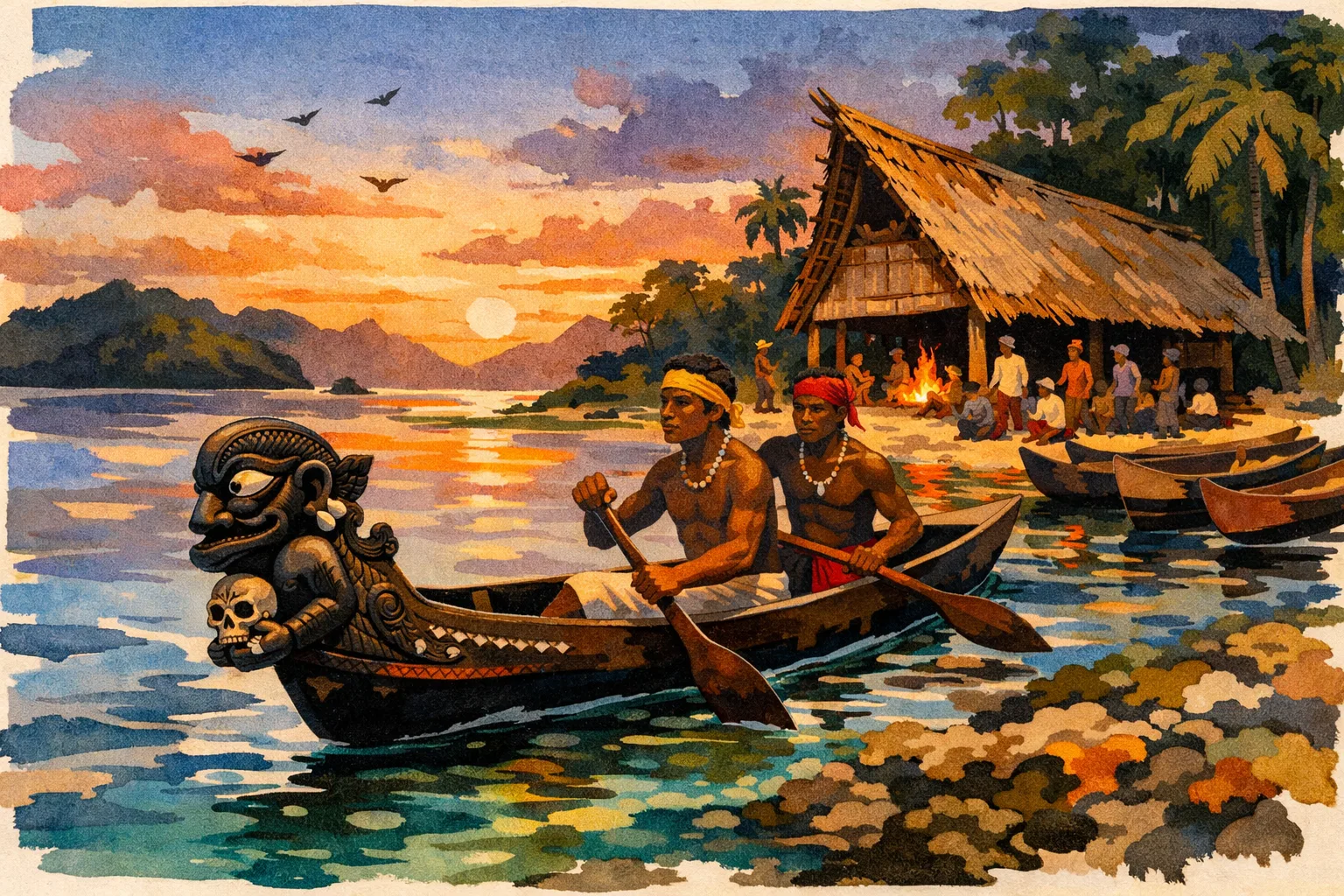
The most internationally recognisable Solomon Islands folklore image is probably the carved canoe prow figure known in the Roviana Lagoon area as nguzunguzu and in the Marovo Lagoon area as toto isu. These small head-and-arms figures were lashed near the waterline of large western Solomon Islands war canoes, where they skimmed the sea ahead of the vessel. Museum descriptions connect them to protection, spiritual power, warfare and ancestral presence.[The Metropolitan Museum of Art]metmuseum.orgThe Metropolitan Museum of Art Nguzunguzu (canoe prow ornamentThe Metropolitan Museum of Art Nguzunguzu (canoe prow ornament
The stories explaining these figures vary, which is part of their importance. The Metropolitan Museum of Art notes that one Roviana origin story links the figure to Tiola, a mythological ancestor who took the form of a dog and taught the people of Roviana to build the first large war canoe. Other accounts connect the figure with Kesoko, a water spirit acting as pilot or protector of the vessel.[The Metropolitan Museum of Art]metmuseum.orgThe Metropolitan Museum of Art Nguzunguzu (canoe prow ornamentThe Metropolitan Museum of Art Nguzunguzu (canoe prow ornament
Te Papa’s published version of the Tiola story is especially valuable because it identifies its chain of transmission: it is based on a 1997 interview with Silas Oka in Roviana Lagoon, translated and transcribed by Kenneth Roga and Peter Sheppard, then lightly edited for publication. The story presents Tiola not as a generic fantasy character but as a chiefly ancestral figure whose story moves through cave origin, sacred sites, ritual power, death and transformation into stone.[Te Papa’s Blog]blog.tepapa.govt.nzOpen source on govt.nz.
The canoe figure’s later history also matters. Smarthistory notes that these figures were once tied to cycles of ritual warfare and headhunting, but in modern Solomon Islands they have also become cultural icons of national pride and identity. The Met similarly observes that, after independence in 1978, the prow figure took on an iconic role as a national and cultural symbol, while retaining ancestral associations for descendants.[Smarthistory]smarthistory.orgnguzunguzu prow figureheadNguzunguzu (canoe prow figurehead)…
That shift is a good example of folklore changing without simply disappearing. A figure once tied to dangerous sea travel, warfare and spiritual protection can become a museum object, an art-history subject, a national emblem and a source for contemporary artists — all while older local meanings remain important.
Sharks, bonito and sea spirits
Sharks occupy a striking place in Solomon Islands belief culture. Some stories describe ancestral or ghostly connections with sharks; some rituals involve feeding or calling sharks; some museum objects show shark-human or sea-spirit imagery. The point is not that every Solomon Islander shared one “shark cult”, but that sharks recur as powerful beings at the boundary between human society, ancestry and the sea.
The Solomon Islands Encyclopaedia records shark calling at Aoke Island in Langalanga Lagoon, Malaita. It describes a priest calling sharks to be fed with pig meat, with colonial district officers observing the practice in 1910 and 1938. Later, in the 1960s, anthropologist Matthew Cooper recorded two types of sharks in the lagoon, red and black, believed to contain spirits and understood as guardians and protectors rather than as ancestral spirits.[Solomon Islands Encyclopaedia]solomonencyclopaedia.netSolomon Islands Encyclopaedia Shark CallingSolomon Islands Encyclopaedia Shark Calling
In eastern Solomon Islands traditions, shark-human beings also appear in myth and art. The Penn Museum’s account of Santa Ana material describes a part-shark, part-human figure named Karemanua, with versions of the myth known throughout the eastern Solomon Islands. Carved depictions of Karemanua were found in sacred canoe houses, and the article links these myths to objects such as caskets formerly used to hold the bones of important men.[Penn Museum]penn.museumMuseum Expedition Magazine | Vengeful Spirits and Guardian DietiesMuseum Expedition Magazine | Vengeful Spirits and Guardian Dieties
These examples show why sea folklore in Solomon Islands is more than a list of monsters. Bonito fishing, canoe houses, ancestral remains, sharks, canoes and ritual specialists all form one cultural world. The sea is dangerous and productive, but also relational: people must know how to behave towards beings, places and powers that are not simply “natural resources”.
Bush beings and the famous Kakamora
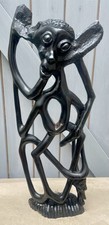
The most widely internet-famous Solomon Islands creature today is the Kakamora, often described in modern popular culture as a small forest or cave-dwelling being. Older sources are more varied and more interesting than the simplified online version. Fox and Drew’s early twentieth-century account from San Cristoval treats the Kakamora as neither fully spirit nor fully human. Their informants described them as small cave people, sometimes mischievous, sometimes dangerous, with many local names across San Cristoval, Malaita and Guadalcanal.[Internet Archive]archive.orgOpen source on archive.org.
The same source gives a revealing range of details: some Kakamora were said to lure people into the bush, steal ornaments, count the fingers and toes of sleeping people, or live in inaccessible caves. Some accounts make them tiny and fairy-like; others make them larger and ogre-like. Fox and Drew speculated that some stories might preserve memories of earlier peoples, but they also recognised exaggeration and imaginative variation in the traditions.[Internet Archive]archive.orgOpen source on archive.org.
This is a useful caution for readers who meet the Kakamora first through modern entertainment or internet creature lists. The older record is not a single fixed monster profile. It is a cluster of local stories about strange, marginal beings associated with caves, forest, trickery, fear and difference. Modern retellings tend to standardise them into cute or spooky “little people”, but the source tradition is messier and more local.
Sacred places and stories that manage the world
In Solomon Islands, a sacred place may be a shrine, a canoe house, a lake, a cave, a reef passage, a stone, a former settlement or a named landscape feature. Folklore often explains why such places matter and how people should behave there.
East Rennell is a strong modern example because it brings together oral tradition, sacred landscape and environmental stewardship. UNESCO’s account of East Rennell tells the story of Kaitu’u arriving at Rennell Island, following birds inland, discovering and naming Lake Tegano, then continuing to Bellona. The same account describes Indigenous knowledge being passed down through oral traditions, songs and daily practice, including ecological knowledge about biodiversity, weather and seasonal cues.[UNESCO]unesco.orgIndigenous knowledge, a legacy of environmental stewardship in EastIndigenous knowledge, a legacy of environmental stewardship in East
Lake Tegano is not just a scenic setting. UNESCO’s article describes the land and waters of Tegano as sacred, with chants, dances and ceremonies honouring spirits believed to reside in the forests and lake. It also records community concern that younger generations may be becoming more disconnected from land and traditional practice, prompting cultural revitalisation work.[UNESCO]unesco.orgIndigenous knowledge, a legacy of environmental stewardship in EastIndigenous knowledge, a legacy of environmental stewardship in East
The World Heritage context adds another layer. IUCN describes East Rennell as the southern third of Rennell Island, the largest raised coral atoll in the world, with Lake Tegano as a major feature and the site under customary ownership and management. A Solomon Islands Government report notes that East Rennell was inscribed on the World Heritage List in 1998 as the first natural World Heritage site under customary management and ownership, and that it was placed on the List of World Heritage in Danger in 2013 because of threats including logging, invasive species and management challenges.[World Heritage Outlook]worldheritageoutlook.iucn.orgWorld Heritage Outlook East Rennell | World Heritage OutlookWorld Heritage Outlook East Rennell | World Heritage Outlook
For a folklore page, the key point is not simply conservation status. It is that story, sacredness and practical environmental knowledge can be part of the same system. A tale about first arrival, a dance about ancestors, and observations of birds, crabs and plants can all help keep a place meaningful and governable.
Oral tradition, song and modern change
Solomon Islands traditions have not survived only by staying unchanged. They have also survived by being retold in schools, churches, towns, museums, family gatherings, cultural festivals and diaspora contexts. This means modern folklore sometimes blends old local material with new genres, new audiences and new claims about identity.
A McGill thesis on Solomon Islands kastom stories in transition examined stories told by students in urban settings and argued that these narratives became a space where tradition was both stated and created. That is an important insight: when young people tell “traditional” stories in town, they may be preserving remembered material, but they may also be reshaping it for new social circumstances.[eScholarship at McGill]escholarship.mcgill.caOpen source on mcgill.ca.
Songs are another major carrier of memory. A 2025 article on Solomon Islands song as history describes local perspectives on preserving and transforming music, and notes that songs can engage family members in stories of their past and present. For folklore readers, this widens the field beyond prose tales. A myth may live as a sung history, a dance performance, a children’s story, a museum label, a church-era memory or a national cultural symbol.[Taylor & Francis Online]tandfonline.comOpen source on tandfonline.com.
Christianity also changed the setting in which many older traditions were told. The Penn Museum account of Santa Ana notes that myths were still being told and retold by Christians and non-Christians alike because they were regarded as part of Indigenous culture, even as some ritual practices and canoe-house traditions had ceased or were fading.[Penn Museum]penn.museumMuseum Expedition Magazine | Vengeful Spirits and Guardian DietiesMuseum Expedition Magazine | Vengeful Spirits and Guardian Dieties
That pattern is common across many parts of the Pacific: conversion, schooling, urbanisation and colonial disruption did not simply erase folklore. They changed who told stories, where they were told, what was emphasised, and how people explained the relationship between old powers and present life.
What is well attested, and what should be treated carefully
Solomon Islands folklore is well attested in some areas and thinly documented in others. The strongest evidence usually appears where several kinds of source meet: oral testimony, museum objects, early ethnographic recording, archaeological context and living community practice.
The canoe prow figures of western Solomon Islands are strongly documented because they survive in museum collections, appear in photographs and are tied to multiple recorded origin stories and art-historical studies. The Tiola story is especially clear because Te Papa identifies the informant, interview setting and publication process.[govt.nz]blog.tepapa.govt.nzOpen source on govt.nz.
Shark calling and shark-spirit traditions are also fairly well anchored, though local meanings differ. The Malaita shark-calling account includes observed events and later anthropological notes, while Makira and eastern Solomon Islands material links shark imagery to ancestral ghosts, canoe houses and ritual objects.[solomonencyclopaedia.net]solomonencyclopaedia.netSolomon Islands Encyclopaedia Shark CallingSolomon Islands Encyclopaedia Shark Calling
Kakamora traditions are documented in early ethnographic texts, but modern readers should be careful. The old accounts themselves show variation, speculation and outsider interpretation. Later internet versions often compress that variation into a single creature type. The safest reading is that Kakamora stories form a broad family of local bush-being traditions rather than one standardised monster biography.[Internet Archive]archive.orgOpen source on archive.org.
Claims about “Solomon Islands giants” deserve even more caution. They circulate widely in modern cryptid and paranormal spaces, but the stronger folklore evidence for Solomon Islands points instead towards local traditions of small cave people, sea spirits, shark beings, ancestors and sacred canoe culture. Where giant claims are based mainly on modern speculative websites rather than community-grounded oral history, museum documentation or careful fieldwork, they should be treated as internet-era folklore or cryptozoological retelling rather than as a central, well-attested national tradition.
How Solomon Islands folklore is understood today
Today, Solomon Islands folklore sits between living heritage, local authority, museum display, academic study, cultural tourism, school storytelling and online reinvention. That can create tension, but also energy. A canoe figure can be a sacred ancestral form, a museum object in New York or Wellington, a national symbol, and a design inspiration. A lake-origin story can be a tradition about first settlement, a heritage-management tool and a way of teaching climate resilience. A small cave being can be a frightening bush figure in older accounts and a playful pop-culture creature in modern retellings.
The most respectful way to approach Solomon Islands folklore is to keep its local roots visible. Ask where the story is from, who tells it, what place or practice it explains, and whether the version comes from oral testimony, museum interpretation, early colonial writing, modern fiction or the internet. That approach avoids turning a living, diverse set of traditions into a flat catalogue of monsters.
The reward is a richer picture. Solomon Islands folklore is full of vivid beings — sea spirits, shark ancestors, cave people, canoe guardians and ancestral presences — but its deeper power lies in the relationships those beings express: people with land, clans with origin places, voyagers with the sea, descendants with the dead, and modern communities with traditions that continue to change while remaining recognisably their own.
Amazon book picks
Further Reading
Books and field guides related to Where Spirits Move Through Sea and Stone. Use these as the next step if you want deeper reading beyond the article.
The Pacific Islands
Provides broad background for Solomon Islands history and traditions.
We, the Navigators
Explains oceanic worldviews closely related to Solomon Islands storytelling cultures.
Vaka Moana, Voyages of the Ancestors
First published 2007. Subjects: Polynesians, Navigation, Migrations, Discovery and exploration, Entdeckung.
eBay marketplace picks
Marketplace Samples
Live-tested eBay searches with available results related to this page.
Endnotes
1.
Source: escholarship.mcgill.ca
Link:https://escholarship.mcgill.ca/concern/theses/nc580p59v
2.
Source: unesco.org
Title: Indigenous knowledge, a legacy of environmental stewardship in East
Link:https://www.unesco.org/en/articles/indigenous-knowledge-legacy-environmental-stewardship-east-rennell
3.
Source: onlinelibrary.wiley.com
Link:https://onlinelibrary.wiley.com/doi/full/10.1002/arco.5334
4.
Source: researchgate.net
Title: Research Gate Oral tradition and the creation of Late Prehistory in Roviana
Link:https://www.researchgate.net/publication/250277765_Oral_tradition_and_the_creation_of_Late_Prehistory_in_Roviana_Lagoon_Solomon_Islands_In_A_Pacific_Odyssey_Archaeology_and_Anthropology_in_the_Western_Pacific_Papers_in_Honour_of_Jim_Specht
5.
Source: archive.org
Link:https://archive.org/stream/in.ernet.dli.2015.106132/2015.106132.Journal-Of-The-Anthropological-Institute-Of-Great-Britain-And-Ireland-Vol45_djvu.txt
6.
Source: britishmuseum.org
Title: British Museum
Link:https://www.britishmuseum.org/sites/default/files/2020-08/R24_Solomon_LPG.pdf
7.
Source: smarthistory.org
Title: nguzunguzu prow figurehead
Link:https://smarthistory.org/nguzunguzu-prow-figurehead/
Source snippet
Nguzunguzu (canoe prow figurehead)...
8.
Source: penn.museum
Title: Museum Expedition Magazine | Vengeful Spirits and Guardian Dieties
Link:https://www.penn.museum/sites/expedition/vengeful-spirits-and-guardian-dieties/
9.
Source: worldheritageoutlook.iucn.org
Title: World Heritage Outlook East Rennell | World Heritage Outlook
Link:https://worldheritageoutlook.iucn.org/node/1087
10.
Source: onlinelibrary.wiley.com
Link:https://onlinelibrary.wiley.com/doi/full/10.1002/ocea.5286
11.
Source: rai.onlinelibrary.wiley.com
Title: 1467 9655.12442
Link:https://rai.onlinelibrary.wiley.com/doi/10.1111/1467-9655.12442
12.
Source: archive.org
Link:https://archive.org/details/thresholdofpacif00foxc
13.
Source: archive.org
Link:https://archive.org/download/b21936171/b21936171.pdf
14.
Source: ia801501.us.archive.org
Title: 2015.221601.Psychology And text
Link:https://ia801501.us.archive.org/0/items/in.ernet.dli.2015.221601/2015.221601.Psychology-And_text.pdf
15.
Source: researchgate.net
Link:https://www.researchgate.net/publication/228865138_Oral_tradition_and_the_creation_of_Late_Prehistory_in_Roviana_Lagoon_Solomon_Islands
16.
Source: researchgate.net
Link:https://www.researchgate.net/publication/353209916_Content_and_Context_Connecting_Oral_History_and_Social_History_in_Solomon_Islands
17.
Source: researchgate.net
Link:https://www.researchgate.net/publication/326526610_Protecting_the_East_Rennell_World_Heritage_Site_Legislation_The_Case_of_Solomon_Islands
18.
Source: researchgate.net
Title: 3 Pacific Ocean Reader 2022 Volume 3
Link:https://www.researchgate.net/profile/Nicolas-Vernicos/publication/371950751_3-Pacific_Ocean-Reader_2022_Volume_3/data/649db90c95bbbe0c6e00af87/3-Pacific-Ocean-Reader-2022-Volume-3.pdf
19.
Source: researchgate.net
Title: 366227538 How People Compare
Link:https://www.researchgate.net/publication/366227538_How_People_Compare
20.
Source: unesco.org
Title: document 1351
Link:https://www.unesco.org/archives/multimedia/document-1351
21.
Source: escholarship.org
Title: qt89s702ss noSplash af9f679b086980ce0843842d7e23ea37
Link:https://escholarship.org/content/qt89s702ss/qt89s702ss_noSplash_af9f679b086980ce0843842d7e23ea37.pdf
22.
Source: escholarship.org
Title: qt30n0g8qw noSplash 5181b83c48e4093176148bd1f32fac4e
Link:https://escholarship.org/content/qt30n0g8qw/qt30n0g8qw_noSplash_5181b83c48e4093176148bd1f32fac4e.pdf
23.
Source: blog.tepapa.govt.nz
Link:https://blog.tepapa.govt.nz/2021/07/09/the-solomon-islands-myth-of-tiola-and-the-origin-story-of-nguzunguzu/
24.
Source: solomons.gov.sb
Link:https://solomons.gov.sb/ministry-of-culture-and-tourism/solomon-islands-national-museum/
25.
Source: metmuseum.org
Title: The Metropolitan Museum of Art Nguzunguzu (canoe prow ornament)
Link:https://www.metmuseum.org/art/collection/search/309868
26.
Source: solomonencyclopaedia.net
Title: Solomon Islands Encyclopaedia Shark Calling
Link:https://www.solomonencyclopaedia.net/biogs/E000275b.htm
27.
Source: solomons.gov.sb
Link:https://solomons.gov.sb/east-rennell-world-heritage-site-stakeholder-dialogue-successfully-held-in-honiara/
28.
Source: tandfonline.com
Link:https://www.tandfonline.com/doi/full/10.1080/00223344.2025.2454398
29.
Source: natlib.govt.nz
Link:https://natlib.govt.nz/records/20631300
30.
Source: api.taylorfrancis.com
Link:https://api.taylorfrancis.com/content/chapters/oa-edit/download?identifierName=doi&identifierValue=10.4324%2F9781003283669-5&type=chapterpdf
31.
Source: tepapa.govt.nz
Link:https://tepapa.govt.nz/discover-collections/read-watch-play/solomon-islands
32.
Source: science.howstuffworks.com
Title: solomon islands giants
Link:https://science.howstuffworks.com/science-vs-myth/strange-creatures/solomon-islands-giants.htm
33.
Source: apo.org.au
Link:https://apo.org.au/node/110781
Additional References
34.
Source: youtube.com
Title: Unveiling the Traditional Culture of Solomon Islands
Link:https://www.youtube.com/watch?v=cxR6D0z-7b4
Source snippet
The 'mythical' vanished island scientists think is real | ABC News...
35.
Source: youtube.com
Title: Malaita: Preserving Kastom Culture in the Solomon Islands
Link:https://www.youtube.com/watch?v=gHof8qWVZNw
Source snippet
Unveiling the Traditional Culture of Solomon Islands...
36.
Source: instagram.com
Link:https://www.instagram.com/p/DTgkTpxEXLg/
37.
Source: academia.edu
Link:https://www.academia.edu/26294987/Oral_Tradition_and_the_Creation_of_Late_Prehistory_in_Roviana_Lagoon_Solomon_Islands
38.
Source: academia.edu
Link:https://www.academia.edu/143355364/Young_Men_and_the_State_in_Honiara_Solomon_Islands
39.
Source: facebook.com
Link:https://www.facebook.com/ABCPacific/posts/a-prominent-myth-in-central-solomon-islands-says-a-jealous-husband-used-a-wave-c/836722148490125/
40.
Source: justapedia.org
Link:https://justapedia.org/Adaro_%28mythology%29
41.
Source: nightbringer.se
Link:https://nightbringer.se/myths-and-legends/mythic-adaro/
42.
Source: mythosjourney.com
Link:https://www.mythosjourney.com/encyclopedia/pages/adaro/
43.
Source: nightbringer.se
Link:https://nightbringer.se/nightbringer/lair_adaro.html
Topic Tree
Follow this branch
Related pages 192
- Afghan Folklore
- Albanian Folklore
- Algerian Folklore
- Australian Folklore
- Azerbaijan Folklore
- +187 more in sidebar