Within Afghan Folklore
Where Do Afghan Legends Live on the Map?
Mountains, ruins, shrines and old cities in Afghanistan often carry history, devotion and legend in the same place.
On this page
- Shrines, ruins and local sacred geography
- Bamiyan, Balkh and legend haunted places
- How war, memory and tourism reshape place stories
Page outline Jump by section
Introduction
Afghan legends are often attached to real places. Mountains, lakes, ruined cities and pilgrimage shrines are not simply backdrops for stories; they are where memory, religion, history and folklore meet. Across Afghanistan, people have long connected remarkable landscapes with saints, prophets, heroes, miracles and vanished civilisations. In many cases the same site can be understood simultaneously as an archaeological monument, a place of devotion and the setting for a local legend.
This overlap is especially important in a country whose history has been shaped by repeated religious change, conquest and migration. Ancient Buddhist centres, Islamic shrines, pre-Islamic memories and modern national heritage sites frequently occupy the same physical landscape. The result is a sacred geography in which stories help explain why a place matters, while the place itself keeps the story alive.[Oxford University Research Archive]ora.ox.ac.ukIntroduction: The Discourse of Landscape, Balkh and its HistoryJuly 21, 2025 — by A Azad · 2013 · Cited by 71 — The chapter introduces th…
Shrines, Ruins and Local Sacred Geography
Many Afghan sacred sites are linked to traditions about holy figures rather than to verifiable historical events. That does not make them unimportant. Folklore often works by attaching meaning to a landscape, turning a hill, spring or tomb into a place where people feel connected to the past.
In northern Afghanistan, the region around Balkh provides one of the clearest examples. Medieval texts described Balkh not merely as a city but as a sacred landscape filled with shrines, tombs and places associated with revered figures. Modern historians studying these texts argue that networks of holy sites helped shape how people understood the region and contributed to its religious identity over centuries.[Oxford University Research Archive]ora.ox.ac.ukIntroduction: The Discourse of Landscape, Balkh and its HistoryJuly 21, 2025 — by A Azad · 2013 · Cited by 71 — The chapter introduces th…
Shrines are often surrounded by local traditions that blend devotion and folklore. Stories explain why a saint chose a particular location, how a miracle occurred there, or why visitors continue to seek blessings. Such traditions are rarely static. New stories emerge, old ones fade, and political change can alter how sacred places are interpreted.[Oxford University Research Archive]ora.ox.ac.ukIntroduction: The Discourse of Landscape, Balkh and its HistoryJuly 21, 2025 — by A Azad · 2013 · Cited by 71 — The chapter introduces th…
The landscape itself plays a role. Isolated valleys, dramatic cliffs and ancient ruins encourage storytelling because they seem to demand explanation. A ruined wall becomes the work of a legendary king. An unusual rock formation becomes evidence of a saint’s miracle. A forgotten tomb becomes associated with a famous historical figure.
Bamiyan and the Geography of Wonder
No Afghan landscape combines history and legend more dramatically than Bamiyan.
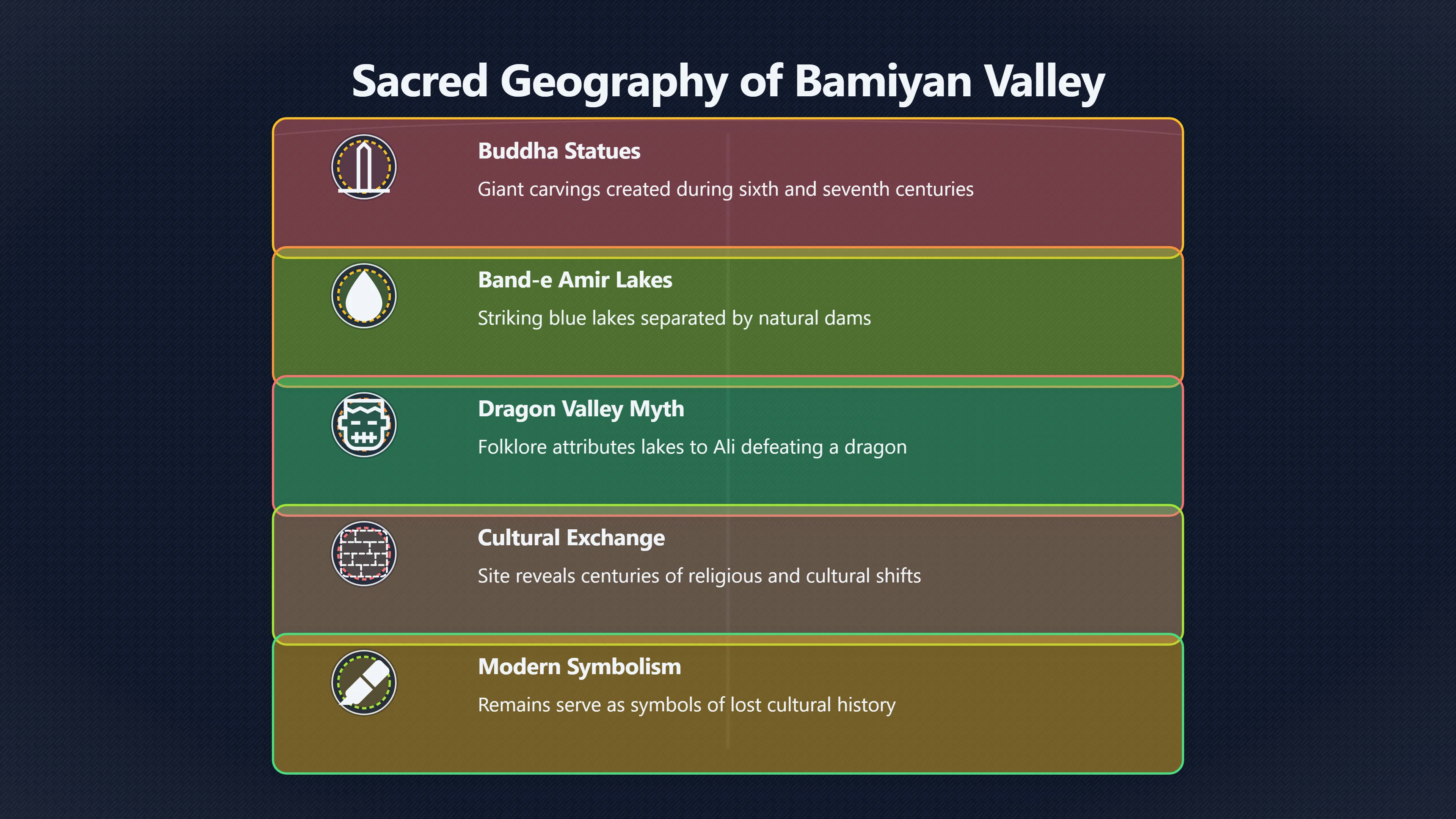
Today Bamiyan is known internationally for the giant Buddha statues carved into cliff faces during the sixth and seventh centuries and destroyed by the Taliban in 2001. Yet the wider valley has long been a landscape of stories as well as monuments. UNESCO describes the area as a cultural landscape where Buddhist monasteries, sanctuaries and later Islamic sites reveal centuries of religious and cultural exchange.[UNESCO World Heritage Centre]whc.unesco.orgUNESCO World Heritage CentreCultural Landscape and Archaeological Remains of the…The cultural landscape and archaeological remains of…
The cliffs themselves inspired generations of travellers. Even after the destruction of the statues, the empty niches remain powerful landmarks in local memory. For many Afghans, they are not merely archaeological remains but symbols of a lost chapter of the country’s cultural history.[Wikipedia]WikipediaBuddhas of BamiyanBuddhas of Bamiyan
Band-e Amir and the Dragon Valley
The most famous legendary landscape near Bamiyan is Band-e Amir, a chain of striking blue lakes separated by natural dams. While geologists can explain their formation, local folklore offers a different account.
One widely repeated tradition attributes the lakes to the miraculous intervention of Ali, the cousin and son-in-law of the Prophet Muhammad. In popular versions of the story, Ali defeated a destructive dragon or monstrous creature that terrorised the region. The scars left by the battle supposedly created dramatic features in the landscape, including valleys, cliffs and the lakes themselves. Variants of the tale connect nearby formations with the monster’s body or the marks of Ali’s sword.[Geoscience World]pubs.geoscienceworld.orgOpen source on geoscienceworld.org.
The legend is significant not because it provides a geological explanation, but because it links a spectacular natural site to a sacred figure familiar across the Islamic world. The landscape becomes both a natural wonder and a place charged with religious meaning.
The Buddhas and Changing Meanings
The Bamiyan Buddhas show how the meaning of a place can change over time. Originally Buddhist monuments, they later became part of a predominantly Islamic cultural landscape. In modern Afghanistan they have been interpreted variously as archaeological treasures, symbols of national heritage, reminders of destruction and attractions for visitors.[Wikipedia]WikipediaBuddhas of BamiyanBuddhas of Bamiyan
The stories surrounding Bamiyan therefore continue to evolve. Folklore does not stop when history changes; it adapts to new circumstances and new audiences.

Balkh: The City of Saints and Legends
Balkh is among the oldest continuously inhabited regions in Central Asia and has accumulated centuries of sacred associations. Medieval writers portrayed it as a city of exceptional spiritual importance, filled with shrines and holy memories. Modern scholarship on Balkh’s sacred landscape shows how these traditions helped transform the city into a centre of pilgrimage and religious imagination.[Oxford University Research Archive]ora.ox.ac.ukIntroduction: The Discourse of Landscape, Balkh and its HistoryJuly 21, 2025 — by A Azad · 2013 · Cited by 71 — The chapter introduces th…
The city’s ruined walls also generated folklore. Historical texts sometimes attributed ancient structures to legendary rulers and heroes rather than to known builders. Such stories connected visible ruins to a deeper mythical past and helped explain monuments whose true origins had long been forgotten.[Academia]academia.eduLocated in the north of today's Afghanistan, along the silk road.Read moreSacred Landscape in Medieval Afghanistan: Revisiting the…This book is about a sacred place called Balkh, known to the ancient…
Balkh’s significance extends beyond formal religion. It has become a place where stories about poets, saints, scholars and rulers overlap. Shrines attributed to famous figures often serve as focal points for local identity even when historians debate the details of the attribution. The continued veneration of sites associated with the poet Rabi’a Balkhi illustrates how memory and place can reinforce one another across centuries.[Cambridge University Press & Assessment]cambridge.orgCambridge University Press & AssessmentUnearthing Rabiʿa's Grave: Placemaking, Shrines, and…by S Homayun · 2023 · Cited by 3 — In the…
The Blue Mosque and the Legend of Ali’s Tomb
One of Afghanistan’s most famous sacred places stands in Mazar-i-Sharif: the Shrine of Hazrat Ali, often called the Blue Mosque.
According to local tradition, the body of Ali was secretly transported from Iraq and buried in northern Afghanistan. The city’s name, which means “Noble Shrine”, reflects the importance of this belief. Historians generally regard the tradition as legendary rather than historically proven, but that has not diminished its influence. The shrine remains one of the country’s most revered pilgrimage destinations.[Wikipedia]WikipediaMausoleum of Imam AliMausoleum of Imam Ali
The site is surrounded by stories. White pigeons that gather around the shrine are sometimes said to possess special qualities, and generations of pilgrims have associated visits with blessing, protection and good fortune. Annual celebrations connected with the spring New Year have historically drawn large crowds, blending religious devotion with communal festivity.[Wikipedia]WikipediaMausoleum of Imam AliMausoleum of Imam Ali
The importance of the shrine demonstrates a common feature of Afghan sacred geography: historical certainty is often less important than cultural meaning. The power of the place comes from centuries of belief, pilgrimage and storytelling rather than from archaeological proof alone.
Why Place Legends Survive
Afghan place legends endure because landscapes preserve memory in ways that written texts cannot. A shrine remains visible even when archives disappear. A mountain or lake survives political upheaval. A ruined city can continue generating stories long after its original inhabitants are gone.
These traditions also help communities interpret difficult histories. Sacred places provide continuity across periods of conquest, religious change and displacement. Legends explain why a place matters and why it deserves protection, remembrance or pilgrimage.[Oxford University Research Archive]ora.ox.ac.ukIntroduction: The Discourse of Landscape, Balkh and its HistoryJuly 21, 2025 — by A Azad · 2013 · Cited by 71 — The chapter introduces th…
In Afghanistan, where oral tradition has long played a central cultural role, landscapes often function as storytellers in their own right. Cliffs, lakes, tombs and ruins become physical reminders of narratives passed from one generation to the next.
How War, Memory and Tourism Reshape Place Stories
Modern conflicts have transformed many of Afghanistan’s legendary landscapes. The destruction of the Bamiyan Buddhas in 2001 altered how people understand the valley, turning it into a global symbol of cultural loss as well as a historic sacred landscape. UNESCO now treats the Bamiyan Valley as a site of outstanding cultural importance whose preservation remains a major concern.[Wikipedia]WikipediaBuddhas of BamiyanBuddhas of Bamiyan
At the same time, tourism and heritage projects have encouraged renewed interest in legendary places. Improved access and security have periodically increased visits to sites such as Band-e Amir, bringing new audiences to old stories.[سلام تایمز]afghanistan.asia-news.comسلام تایمزImproved security at Band-e-Amir triggers surge in BamiyanAugust 23, 2019 — 23 Aug 2019 — The area, once known as where the Taliban blew up ancient Buddha statues, is now enjoying peace and a flo…
Sacred places are also vulnerable to natural disasters and political change. Recent damage to the Blue Mosque from a powerful earthquake prompted renewed public discussion about preserving one of Afghanistan’s most important religious landmarks. The debate showed that such sites are valued not only for faith but also for their role in cultural memory and national identity.[Reuters]reuters.comAfghans call for Taliban government to help repair Blue Mosque after quakeThe revered 15th-century mosque sustained visible damage, including broken tiles and cracked minarets. Residents describe the shrine as a…
The legends attached to Afghanistan’s landscapes therefore continue to evolve. Ancient stories, pilgrimage traditions, archaeology, conservation efforts and modern tourism all contribute new layers of meaning. What remains constant is the connection between story and place. Across Afghanistan, some of the country’s most enduring legends still live not in books but in valleys, shrines, lakes and ruins scattered across the map.
eBay marketplace picks
Marketplace Samples
Live-tested eBay searches with available results related to this page.




Endnotes
1.
Source: academia.edu
Title: Located in the north of today’s Afghanistan, along the silk road.Read more
Link:https://www.academia.edu/38623958/Sacred_Landscape_in_Medieval_Afghanistan_Revisiting_the_Fadail_i_Balkh
Source snippet
Sacred Landscape in Medieval Afghanistan: Revisiting the...This book is about a sacred place called Balkh, known to the ancient...
2.
Source: whc.unesco.org
Link:https://whc.unesco.org/en/list/208/
Source snippet
UNESCO World Heritage CentreCultural Landscape and Archaeological Remains of the...The cultural landscape and archaeological remains of...
3.
Source: Wikipedia
Title: Buddhas of Bamiyan
Link:https://en.wikipedia.org/wiki/Buddhas_of_Bamiyan
4.
Source: Wikipedia
Link:https://en.wikipedia.org/wiki/Balkh
Source snippet
BalkhBalkh is a city in northern Afghanistan, with an estimated population of 148,972 people. It is within the jurisdiction of Balkh D...
5.
Source: cambridge.org
Link:https://www.cambridge.org/core/journals/international-journal-of-middle-east-studies/article/unearthing-rabias-grave-placemaking-shrines-and-contested-traditions-in-balkh-afghanistan/C60CAA3E6681F3233D0F8211212C7CA5
Source snippet
Cambridge University Press & AssessmentUnearthing Rabiʿa's Grave: Placemaking, Shrines, and...by S Homayun · 2023 · Cited by 3 — In the...
6.
Source: Wikipedia
Title: Mausoleum of Imam Ali
Link:https://en.wikipedia.org/wiki/Mausoleum_of_Imam_Ali
7.
Source: reuters.com
Title: Afghans call for Taliban government to help repair Blue Mosque after quake
Link:https://www.reuters.com/world/asia-pacific/afghans-call-taliban-government-help-repair-blue-mosque-after-quake-2025-11-05/
Source snippet
The revered 15th-century mosque sustained visible damage, including broken tiles and cracked minarets. Residents describe the shrine as a...
8.
Source: academia.edu
Link:https://www.academia.edu/88411154/Blue_Mosque_in_Mazar_Sharif_Afghanistan_A_Shrine_of_Renowned_Beauty
Source snippet
l is the Blue Mosque, often known as the Shrine of Ali in Mazar Sharif.Read more...
9.
Source: ora.ox.ac.uk
Title: Oxford University Research Archive
Link:https://ora.ox.ac.uk/objects/uuid%3Aecb9e8f4-932e-4dee-bd60-4c5b6bc55967/files/r2f75r986v
Source snippet
Introduction: The Discourse of Landscape, Balkh and its HistoryJuly 21, 2025 — by A Azad · 2013 · Cited by 71 — The chapter introduces th...
Published: July 21, 2025
10.
Source: pubs.geoscienceworld.org
Link:https://pubs.geoscienceworld.org/gsl/books/edited-volume/1643/chapter/107451326/Band-e-Amir-Lakes-and-Dragon-Valley-Bamiyan-myths
11.
Source: afghanistan.asia-news.com
Title: سلام تایمزImproved security at Band-e-Amir triggers surge in Bamiyan
Link:https://afghanistan.asia-news.com/en_GB/articles/cnmi_st/features/2019/08/23/feature-01
Source snippet
August 23, 2019 — 23 Aug 2019 — The area, once known as where the Taliban blew up ancient Buddha statues, is now enjoying peace and a flo...
Published: August 23, 2019
Additional References
12.
Source: apnews.com
Link:https://apnews.com/article/699b73baa4229caee834179c91444c65
Source snippet
The epicenter was 22 kilometers from the town of Khulm at a depth of 28 kilometers. Hundreds of mud-brick homes were destroyed, and in Ba...
13.
Source: facebook.com
Link:https://www.facebook.com/channelsarwari/posts/hello-everyonejoin-me-on-an-unforgettable-journey-to-band-e-amir-in-bamyan-afgha/719389057526917/
Source snippet
Channel SarwariThe journey to Band-e Amir often starts from Bamyan city, which itself is rich in history and culture, including the famou...
14.
Source: daryaexpeditions.com
Link:https://www.daryaexpeditions.com/blue-mosque-shrine-of-ali-mazar-i-sharif-afghanistan/
Source snippet
Blue Mosque Shrine of Ali, Mazar-i-Sharif, AfghanistanMazar-i-Sharif's dazzling Blue Mosque — the Shrine of Hazrat Ali, encircled by whit...
15.
Source: architectuul.com
Link:https://architectuul.com/architecture/shrine-of-ali
Source snippet
Shrine of AliThe Shrine of Hazrat Ali, also known as the Blue Mosque, is a mosque located in the heart of Mazar-i-Sharif, Afghanistan. It...
16.
Source: instagram.com
Link:https://www.instagram.com/reel/DLiQOZ3olAG/
Source snippet
the stunning Band-e-Amir lakes, Bamiyan offers a rare blend of natural serenity and...
17.
Source: facebook.com
Link:https://www.facebook.com/onestep4ward/posts/the-buddhas-of-bamiyan-afghanistan-the-largest-statue-in-the-world-once-lived-in/952756856206173/
Source snippet
in central Afghanistan, once stood as remarkable examples of...Read more...
18.
Source: facebook.com
Link:https://www.facebook.com/koryotours/posts/a-look-into-the-blue-mosque-in-mazar-afghanistan-the-shrine-of-hazrat-ali-the-mo/1170181935145930/
Source snippet
final resting place of Hazrat Ali ibn Abi Talib (RA), the...Read more...
19.
Source: youtube.com
Title: Mes Aynak
Link:http://www.youtube.com/watch?v=EiOi0KMzNRQ
Source snippet
Afghanistan’s Impossible Places | Hidden Worlds Revealed | 4K Documentary Secret Planet · 37 views...
20.
Source: medium.com
Link:https://medium.com/%40soniahshah/from-dragons-to-the-red-city-adventures-across-bamiyans-hidden-gems-d73a2089e23d
Source snippet
showed up with his trusty sword, Zulfiqar, to deal with...
21.
Source: beglobality.com
Title: Mausoleum of Imam Ali (Blue Mosque)
Link:https://beglobality.com/locations/mausoleum-of-imam-ali/
Source snippet
Mausoleum of Imam Ali, also known as the Blue Mosque, is a magnificent shrine and mosque complex located in Mazar-i-Sharif, in northern A...
Topic Tree