Where Swiss Legends Meet the Mountains
Swiss folklore is not one single mythology so much as a mountain-and-valley mosaic: foundation legends about freedom, Alpine tales of devils and dragons, winter mask customs, ghost stories, saintly miracles, witchcraft fears, and literary reinventions that turned local landscapes into national symbols.
Page outline Jump by section
Why Swiss folklore feels local before it feels national
Switzerland’s folklore reflects the country’s geography and its multilingual culture. Traditions in German-speaking, French-speaking, Italian-speaking and Romansh-speaking regions overlap, but they are not interchangeable. Many legends are tied to particular valleys or cantons, and customs often belong to a specific town, parish, mountain community or ritual calendar rather than to the whole country. The Federal Office of Culture’s inventory of “living traditions” makes this visible by presenting Swiss intangible heritage as a broad map of local practices rather than as a single national canon.[Lebendige Traditionen]lebendige-traditionen.chOpen source on lebendige-traditionen.ch.
The Alps matter because they make stories concrete. Avalanches, storms, ravines, glaciers, high pastures and dangerous crossings become narrative engines. A demon builds a bridge. A dragon lives in a cave. A wronged mountain pasture becomes a cursed place. A masked winter figure chases people through a village street. These stories are not simply decorative; they express old anxieties about survival, weather, social order, isolation, religious danger and the limits of human control in a difficult landscape. The National Museum Zurich’s exhibition on Alpine tales highlighted this range, including William Tell, the Devil’s Bridge, Blüemlisalp and other legends involving ghosts, witches, dragons and the devil.[landesmuseum.ch]landesmuseum.chZürich Traditional tales from the AlpsZürich Traditional tales from the Alps
Swiss folklore is also unusually entangled with political identity. In many countries, national myths sit beside local supernatural traditions. In Switzerland, the two constantly touch. The same landscape that produces dragon caves and haunted bridges also produces the Rütli meadow, the Tell story and the memory of early confederate resistance. This does not mean every legend is historically factual. It means legends have helped Swiss communities imagine freedom, danger, justice and belonging in memorable story form.[SGG]sgg-ssup.chSGGHistory and storiesSGGHistory and stories
William Tell: the legend everyone knows, and the evidence behind it
William Tell is the central national legend of Switzerland. In the familiar version, Tell refuses to bow before the symbol of a tyrannical official, is forced to shoot an apple from his son’s head with a crossbow, escapes captivity, and becomes a trigger for rebellion against oppressive rule. The story’s power is obvious: it turns independence into a family drama, a test of courage, and a moral confrontation between local dignity and foreign authority.[About Switzerland]aboutswitzerland.eda.admin.chwilliam tell a symbol of switzerland known throughout the worldwilliam tell a symbol of switzerland known throughout the world
The historical evidence is much less simple. The earliest surviving written reference to Tell appears not from the supposed time of the events, but in the White Book of Sarnen, a manuscript associated with Obwalden and dated to the later fifteenth century. The Swiss National Museum describes this manuscript as the place where Tell “came into being” in written tradition; Swissinfo likewise notes the early 1470s White Book reference and the related Tellenlied of 1477, which includes the apple shot and escape but not every later element of the story.[Swiss History Blog]blog.nationalmuseum.chSwiss History Blog The White Book of SarnenSwiss History Blog The White Book of Sarnen
That gap matters. Tell is traditionally set in the early fourteenth century, but the record that gives him literary shape appears more than a century later, when the Swiss Confederacy was already becoming a stronger political and military force. Later chroniclers and writers developed the story further, including Petermann Etterlin and Aegidius Tschudi, and Friedrich Schiller’s 1804 play helped make Tell an international symbol of freedom. Switzerland’s official cultural presentation now describes Tell as a myth around the creation of the Confederation rather than as a securely documented historical person.[admin.ch]aboutswitzerland.eda.admin.chwilliam tell a symbol of switzerland known throughout the worldwilliam tell a symbol of switzerland known throughout the world
For folklore, that uncertainty is not a weakness; it is the point. Tell shows how a local liberation story can become a national myth. The Rütli meadow, the oath, the apple, the crossbow and the defiance of unjust power form a symbolic grammar of Swiss independence. Many people still treat the Charter of 1291, the Rütli Oath and Tell as part of one founding story, even though historians distinguish between documentary history, later chronicle tradition and patriotic myth-making.[SGG]sgg-ssup.chSGGHistory and storiesSGGHistory and stories

Devils, bridges and the moral geography of the Alps
Swiss legends often explain difficult places by imagining a bargain with the supernatural. The Devil’s Bridge in the Schöllenen Gorge, in canton Uri, is one of the best examples. In the popular tale, local people need a bridge across a dangerous gorge. The devil offers to build it, demanding the first soul to cross. The villagers trick him by sending a goat, and the furious devil throws a rock to destroy the bridge but misses.[SWI swissinfo.ch]swissinfo.chthe stuff of legends in zurichthe stuff of legends in zurich
This kind of story does several things at once. It explains an impressive piece of engineering in a terrifying landscape. It warns that shortcuts and bargains have moral costs. It lets ordinary villagers defeat a cosmic adversary by wit rather than strength. And, because the bridge is a real place, it turns travel through the Alps into an encounter with narrative memory.
Swiss legend collections are full of this place-based logic. The Alpine world is not a blank scenic backdrop; it is morally charged. Gorges, passes and glaciers become sites where human cleverness, greed, holiness, fear or disobedience leave a mark. The National Museum’s framing of Alpine legends stresses that such tales often refer to specific places, people, events or times and were traditionally presented as stories with a claim to local truth, unlike fairy tales set in a more general “once upon a time” world.[Forum of Swiss History Schwyz]forumschwyz.chthe alps in legend 23771the alps in legend 23771
The tale of Blüemlisalp follows a related pattern. In broad outline, versions of the legend connect an Alpine pasture or mountain region with moral failure and transformation, turning landscape into judgement. Such stories are useful not because they are geological explanations, but because they show how communities made mountains meaningful: prosperity could be lost, pride could be punished, and the visible environment could be read as a memory of human behaviour.[Landesmuseum Zürich]landesmuseum.chZürich Traditional tales from the AlpsZürich Traditional tales from the Alps
Dragons, cave creatures and the mountain imagination
Dragons are among Switzerland’s most vivid supernatural creatures, especially in Alpine legend. They are not always the grand, treasure-hoarding dragons of courtly romance. Swiss Alpine dragons can be cave-dwellers, storm creatures, serpent-like monsters or ambiguous beings attached to dangerous terrain. Older sources and later retellings connect dragons with Mount Pilatus, the Drachenloch cave, valleys, gorges and rocky places across the mountains.[Pitt Sites]sites.pitt.eduOpen source on pitt.edu.
Mount Pilatus near Lucerne is particularly rich in legend. One strand links the mountain to Pontius Pilate and stormy supernatural danger; another presents it as dragon-haunted. An American Alpine Club account records the legend of a farmer in 1421 who saw a dragon fly from the Rigi to Pilatus and drop a “dragon-stone”, later treated as a healing object and understood in modern terms as probably a meteorite.[AAC Publications]publications.americanalpineclub.orgAAC Publications Legends of Mount PilatusAAC Publications Legends of Mount Pilatus
The smaller Alpine dragon or worm often called the Tatzelwurm in broader Alpine folklore has Swiss relatives too, especially in traditions of the Stollenwurm or similar serpent-like beings. Accounts describe a squat, lizard- or serpent-like creature, sometimes with a cat-like head, short legs, poisonous qualities or a hissing cry. Such stories sit on the border between folklore, misidentified animals, traveller’s reports and early natural history. The creature is interesting precisely because it shows how pre-modern natural observation and supernatural imagination were not always neatly separated.[Wikipedia]WikipediaOpen source on wikipedia.org.
Dragons also reveal a useful caution about folklore on the internet. Modern travel pages sometimes present these beings as if there were one tidy national dragon myth. The older evidence is messier: there are local names, local sightings, local caves, scholarly scepticism and overlapping Alpine traditions shared with neighbouring regions. A strong Swiss folklore page should therefore treat dragons as a family of regional mountain beliefs, not as a single standardised monster.[Wikipedia]WikipediaOpen source on wikipedia.org.
Witches, injustice and the memory of Anna Göldi
Witchcraft in Swiss folklore cannot be separated from real persecution. Switzerland was not merely a country with tales about witches; parts of the Swiss region were important to the wider European history of witch trials. The Valais witch trials, beginning in 1428, are often identified as among the earliest large systematic witch-hunts in Europe, and the phenomenon spread through western Alpine and Swiss regions including Vaud, Fribourg and Neuchâtel.[Wikipedia]WikipediaValais witch trialsValais witch trials
The most famous individual case is Anna Göldi of Glarus, often remembered as Europe’s “last witch”. She was executed by the sword in 1782, long after the height of early modern witch-hunting. The modern Anna Göldi Museum centres not only the accusation but the power structures around it: court records, torture protocols, networks of influence, Enlightenment publicity, remembrance and rehabilitation.[Glarnerland]glarnerland.chOpen source on glarnerland.ch.
Göldi’s case is important because it changes how readers should understand “witch folklore”. In some contexts, witches are carnival figures, fairy-tale villains or mountain legends. In others, the word points to real women and men caught in legal, religious and social violence. Switzerland’s official living-traditions material notes that the Göldi case helped popularise the term “judicial murder”, and that her story was revived in modern memory through Eveline Hasler’s 1982 novel, a museum, official rehabilitation in 2008 and a human-rights prize created by the Anna Göldi Foundation.[Lebendige Traditionen]lebendige-traditionen.channa goeldianna goeldi
This is one of the clearest examples of folklore becoming ethical memory. Anna Göldi is no longer only a figure in a “last witch” story. She has become a symbol of wrongful prosecution, abuse of power and the danger of turning social panic into legal certainty. That modern interpretation does not erase the supernatural language around the accusation; it explains why the story still matters.
Masks, winter and living tradition
Some of Switzerland’s most striking folklore is not mainly told in books. It is worn, sounded and performed in public. Winter and carnival customs are especially important because they preserve older patterns of masking, noise, inversion, satire and seasonal transition while constantly adapting to modern life.
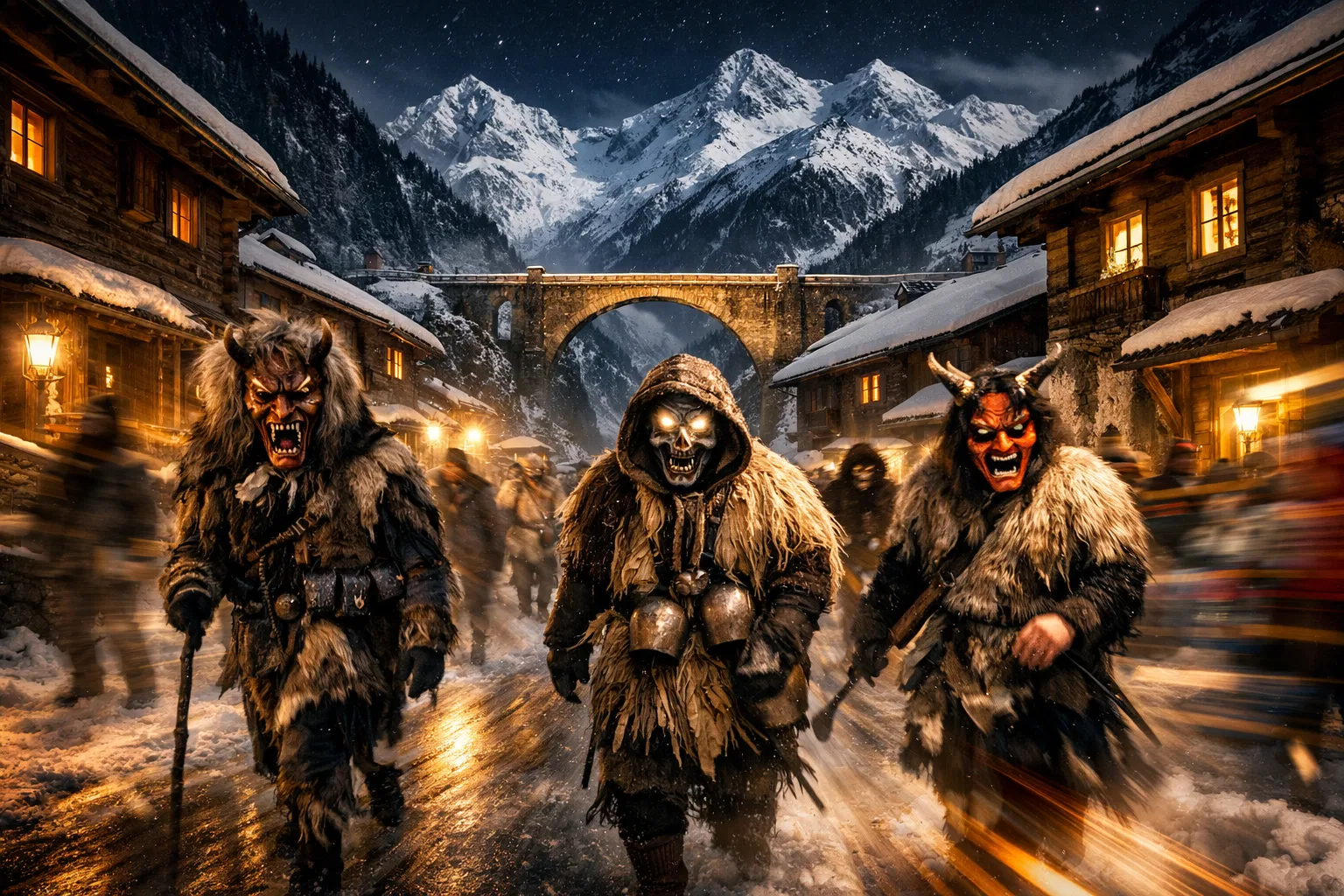
The Tschäggättä of the Lötschental in Valais are among the most visually memorable figures. The Federal Office of Culture describes them as carnival figures with carved wooden masks, usually made from Swiss pine, animal pelts and bells. From the day after Candlemas until midnight on Shrove Tuesday, they run through village streets, chasing women and children and rubbing icy gloves on the faces of those they catch.[Lebendige Traditionen]lebendige-traditionen.chOpen source on lebendige-traditionen.ch.
That description sounds ancient, but the modern custom is not frozen in time. Switzerland’s official cultural material notes that the tradition has changed since the 1950s, including shifts in who participates and how tourism has promoted the spectacle. The Lötschental museum presentation also treats the masks as creative objects whose style changes by era, asking how each generation produces and judges its own mask forms.[About Switzerland]aboutswitzerland.eda.admin.ch5 winter traditions you wont find outside of switzerland5 winter traditions you wont find outside of switzerland
Basel Carnival is a different kind of masked tradition: urban, satirical, highly organised and internationally recognised. UNESCO describes it as the largest carnival in Switzerland, beginning on the Monday after Ash Wednesday and lasting exactly 72 hours. It features lanterns, drums, pipes, masks and sharply topical satire, and was inscribed on UNESCO’s Representative List of the Intangible Cultural Heritage of Humanity in 2017.[UNESCO Intangible Cultural Heritage]ich.unesco.orgOpen source on unesco.org.
These customs show why “folklore” should not be mistaken for dead survivals. In Switzerland, living tradition is often a negotiation between inherited forms and present-day creativity: mask-carvers innovate, carnival groups respond to current affairs, tourists arrive, local people debate authenticity, and communities decide what counts as continuity.

Heidi, literary folklore and the Swiss Alps as a global dream
Heidi is not an old oral legend in the same sense as William Tell or the Devil’s Bridge. Johanna Spyri’s novels were published in 1880 and 1881, and the character is a literary creation. Yet Heidi has become one of Switzerland’s most powerful modern myths because she turned the Alps into a global image of health, innocence, homecoming and moral renewal. UNESCO’s Memory of the World register describes the Heidi and Johanna Spyri archives in Zurich as documentary collections connected to one of the most widely read, translated and adapted literary classics of the last 140 years.[UNESCO]unesco.orgHeidi- and Johanna Spyri ArchivesHeidi- and Johanna Spyri Archives
That makes Heidi a useful boundary case. She is not “folk belief” in origin, but she now functions in folk-cultural ways: tourists visit landscapes associated with her, adaptations retell her story for new audiences, and the image of the Alpine child shapes what many outsiders imagine Switzerland to be. The official Swiss cultural account notes that the Heidi archives were added to UNESCO’s Memory of the World register in 2023, recognising the global history and impact of the novels.[About Switzerland]aboutswitzerland.eda.admin.chheidi in the footsteps of a swiss mythheidi in the footsteps of a swiss myth
Heidi also shows how folklore and tourism feed one another. Places associated with Spyri’s Alpine world are marketed through the Heidi image, while readers and visitors bring expectations formed by books, films and television. This is not the same as preserving an old oral tale, but it is part of Switzerland’s modern legendary culture: a fictional child becomes a national emblem, and a literary mountain landscape becomes emotionally real to millions of people.[Graubünden Ferien]graubuenden.chOpen source on graubuenden.ch.
Collectors, archives and how Swiss folklore was preserved
Much of what is now called Swiss folklore was shaped by nineteenth- and twentieth-century collecting. Folklorists, antiquarians, local historians, museums and archives recorded tales, customs, songs, objects and regional practices. This means readers should always ask not only “How old is this story?” but also “Who recorded it, when, and why?”
Eduard Hoffmann-Krayer is a key figure in the scholarly development of Swiss folklore studies. The Historical Dictionary of Switzerland identifies him as an important folklorist, and other institutional sources describe him as the “father of Swiss folklore”. He founded the Swiss folklore society in 1896 and helped establish folklore as a field of study in Switzerland.[HLS-DHS-DSS]hls-dhs-dss.chOpen source on hls-dhs-dss.ch.
The Atlas of Swiss Folklore is another major landmark. The Everyday Cultures research archive describes it as a large long-term scientific project intended to map everyday practices and cultural forms in Switzerland. It drew on responses from around 1,200 people in 400 municipalities, producing roughly 80,000 answer slips, 4,000 photographs and 320 large-format maps.[EKWS]ekws.chOpen source on ekws.ch.
This archival background matters because it protects against two opposite mistakes. One mistake is to treat every colourful story as timeless ancient paganism. The other is to dismiss folklore as invented because it was written down late. Swiss folklore often sits between those extremes: old local beliefs may be preserved only through modern collection, while some traditions have been reshaped by print, nationalism, museums, festivals, novels and tourism.
What Swiss folklore means today
Swiss folklore today is both heritage and argument. It is heritage because communities still perform, collect, exhibit and retell it. It is argument because people continually debate what counts as authentic, what should be commercialised, what should be mourned, and what should be reinterpreted.
The strongest Swiss traditions are not simply the oldest ones. They are the ones that still help people make sense of place. William Tell remains powerful because he gives political independence a human face. The Devil’s Bridge remains memorable because it turns a dangerous crossing into a moral trickster tale. The Tschäggättä remain compelling because they bring winter fear, craft and performance into the streets. Anna Göldi remains urgent because her story turns witch-memory into a warning about injustice. Heidi remains globally alive because she translates the Swiss Alps into longing, childhood and return.[admin.ch]aboutswitzerland.eda.admin.chwilliam tell a symbol of switzerland known throughout the worldwilliam tell a symbol of switzerland known throughout the world
For readers approaching Switzerland through folklore, the best route is not to look for a single pantheon or master myth. Look instead for layers: oral legend, chronicle, court record, ritual, mask, museum, novel, tourist trail and modern reinterpretation. Switzerland’s folklore is richest when seen as a living landscape of stories, where a bridge, cave, meadow or village procession can carry centuries of fear, humour, pride and memory.
Amazon book picks
Further Reading
Books and field guides related to Where Swiss Legends Meet the Mountains. Use these as the next step if you want deeper reading beyond the article.
The Oxford Companion to Fairy Tales
Places Swiss folklore within wider European storytelling traditions.
eBay marketplace picks
Marketplace Samples
Live-tested eBay searches with available results related to this page.

Endnotes
1.
Source: swissinfo.ch
Title: the stuff of legends in zurich
Link:https://www.swissinfo.ch/eng/history/the-stuff-of-legends-in-zurich/48197018
2.
Source: lebendige-traditionen.ch
Link:https://www.lebendige-traditionen.ch/tradition/en/home/traditions/tschaeggaettae.html
3.
Source: lebendige-traditionen.ch
Title: anna goeldi
Link:https://www.lebendige-traditionen.ch/tradition/en/home/traditions/anna-goeldi.html
4.
Source: lebendige-traditionen.ch
Link:https://www.lebendige-traditionen.ch/tradition/en/home.html
5.
Source: landesmuseum.ch
Title: Zürich Traditional tales from the Alps
Link:https://www.landesmuseum.ch/en/exhibitions/temporary/2022/traditional-tales-from-the-alps/traditional-tales-from-the-alps
6.
Source: sgg-ssup.ch
Title: SGGHistory and stories
Link:https://sgg-ssup.ch/en/social-cohesion/rutli/history-and-stories/
7.
Source: swissinfo.ch
Title: land of myth and glory why william tell is so important for switzerland
Link:https://www.swissinfo.ch/eng/business/land-of-myth-and-glory-why-william-tell-is-so-important-for-switzerland/47789096
8.
Source: swissinfo.ch
Title: william tell killer or freedom fighter
Link:https://www.swissinfo.ch/eng/culture/william-tell-killer-or-freedom-fighter/31244332
9.
Source: sites.pitt.edu
Link:https://sites.pitt.edu/~dash/alpinedragons.html
10.
Source: Wikipedia
Link:https://en.wikipedia.org/wiki/Tatzelwurm
11.
Source: Wikipedia
Title: Valais witch trials
Link:https://en.wikipedia.org/wiki/Valais_witch_trials
12.
Source: swissinfo.ch
Title: the swiss origins of the european witch craze
Link:https://www.swissinfo.ch/eng/swiss-oddities/the-swiss-origins-of-the-european-witch-craze/88856908
13.
Source: glarnerland.ch
Link:https://glarnerland.ch/en/map/detail-poi/anna-goldi-museum–id–civ_s9t_gtrvbvee-beuc-eqcb-qihq-fafuhhtffvdu.html
14.
Source: ich.unesco.org
Link:https://ich.unesco.org/en/RL/basel-carnival-01262
15.
Source: basel.com
Link:https://www.basel.com/en/events/carnival
16.
Source: unesco.org
Title: Heidi- and Johanna Spyri Archives
Link:https://www.unesco.org/en/memory-world/heidi-and-johanna-spyri-archives
17.
Source: hls-dhs-dss.ch
Link:https://hls-dhs-dss.ch/de/articles/011661/
18.
Source: ekws.ch
Link:https://www.ekws.ch/de/archiv/sammlungen/SGV_05
19.
Source: Wikipedia
Title: Swiss folklore
Link:https://en.wikipedia.org/wiki/Swiss_folklore
20.
Source: Wikipedia
Title: William Tell
Link:https://en.wikipedia.org/wiki/William_Tell
21.
Source: Wikipedia
Title: White Book of Sarnen
Link:https://en.wikipedia.org/wiki/White_Book_of_Sarnen
22.
Source: Wikipedia
Title: Rütli Oath
Link:https://en.wikipedia.org/wiki/R%C3%BCtli_Oath
23.
Source: Wikipedia
Title: Anna Göldi
Link:https://en.wikipedia.org/wiki/Anna_G%C3%B6ldi
24.
Source: Wikipedia
Link:https://en.wikipedia.org/wiki/Heidi
25.
Source: Wikipedia
Title: Carnival of Basel
Link:https://en.wikipedia.org/wiki/Carnival_of_Basel
26.
Source: landesmuseum.ch
Title: traditional tales from the alps 25268
Link:https://www.landesmuseum.ch/en/about-us/media/traditional-tales-from-the-alps-25268
27.
Source: landesmuseum.ch
Link:https://www.landesmuseum.ch/en
28.
Source: swissinfo.ch
Title: unesco heritage swiss traditions echo beyond the tangible
Link:https://www.swissinfo.ch/eng/life-aging/unesco-heritage-swiss-traditions-echo-beyond-the-tangible/75614130
29.
Source: swissinfo.ch
Title: heidi looks back on a life less ordinary
Link:https://www.swissinfo.ch/eng/culture/heidi-looks-back-on-a-life-less-ordinary/6536244
30.
Source: ia801500.us.archive.org
Title: 2015.117096.Dictionary Of Folklore Mythology And Legend A 1 text
Link:https://ia801500.us.archive.org/1/items/in.ernet.dli.2015.117096/2015.117096.Dictionary-Of-Folklore-Mythology-And-Legend-A-1_text.pdf
31.
Source: ich.unesco.org
Title: 36278 EN.docx
Link:https://ich.unesco.org/doc/src/36278-EN.docx
32.
Source: ich.unesco.org
Link:https://ich.unesco.org/en/video/41065
33.
Source: unesco.org
Title: document 4651
Link:https://www.unesco.org/archives/multimedia/document-4651
34.
Source: ich.unesco.org
Link:https://ich.unesco.org/en/decisions/12.COM/11.B.31
35.
Source: sites.pitt.edu
Link:https://sites.pitt.edu/~dash/folktexts2.html
36.
Source: youtube.com
Link:https://www.youtube.com/watch?v=Jhkx8w4FkWM
Source snippet
William Tell - The Arrow That Sparked A Nation...
37.
Source: youtube.com
Title: William Tell
Link:https://www.youtube.com/watch?v=3fae5Y3twNU
Source snippet
Pilatus: Dragon Mountain | Switzerland | Documentary (2018)...
38.
Source: aboutswitzerland.eda.admin.ch
Title: william tell a symbol of switzerland known throughout the world
Link:https://www.aboutswitzerland.eda.admin.ch/en/william-tell-a-symbol-of-switzerland-known-throughout-the-world
39.
Source: aboutswitzerland.eda.admin.ch
Link:https://www.aboutswitzerland.eda.admin.ch/en/traditions
40.
Source: zuercher-museen.ch
Link:https://zuercher-museen.ch/en/museums/national-museum-zurich/archiv/traditional-tales-from-the-alps
41.
Source: forumschwyz.ch
Title: the alps in legend 23771
Link:https://www.forumschwyz.ch/en/about-us/media/the-alps-in-legend-23771
42.
Source: houseofswitzerland.org
Title: myths and legends switzerland
Link:https://houseofswitzerland.org/swissstories/history/myths-and-legends-switzerland
43.
Source: blog.nationalmuseum.ch
Title: Swiss History Blog The White Book of Sarnen
Link:https://blog.nationalmuseum.ch/en/2019/04/tells-birth-in-the-white-book-of-sarnen/
44.
Source: blog.nationalmuseum.ch
Title: the swiss foundation legend
Link:https://blog.nationalmuseum.ch/en/2017/08/the-swiss-foundation-legend/
45.
Source: publications.americanalpineclub.org
Title: AAC Publications Legends of Mount Pilatus
Link:https://publications.americanalpineclub.org/articles/12194928200/Legends-of-Mount-Pilatus
46.
Source: aboutswitzerland.eda.admin.ch
Title: 5 winter traditions you wont find outside of switzerland
Link:https://www.aboutswitzerland.eda.admin.ch/en/5-winter-traditions-you-wont-find-outside-of-switzerland
47.
Source: aboutswitzerland.eda.admin.ch
Title: heidi in the footsteps of a swiss myth
Link:https://www.aboutswitzerland.eda.admin.ch/en/heidi-in-the-footsteps-of-a-swiss-myth
48.
Source: graubuenden.ch
Link:https://www.graubuenden.ch/en/heidi
49.
Source: facebook.com
Link:https://www.facebook.com/groups/1572893699951268/posts/1998342244073076/
50.
Source: facebook.com
Link:https://www.facebook.com/historyoasis/photos/the-valais-witch-trials-began-in-1428-in-the-region-of-valais-located-in-what-is/873013582499583/
51.
Source: aboutswitzerland.eda.admin.ch
Title: ten swiss traditions from unescos list of intangible cultural heritage
Link:https://www.aboutswitzerland.eda.admin.ch/en/ten-swiss-traditions-from-unescos-list-of-intangible-cultural-heritage
52.
Source: aboutswitzerland.eda.admin.ch
Title: basel and lucerne when carnival becomes art
Link:https://www.aboutswitzerland.eda.admin.ch/en/basel-and-lucerne-when-carnival-becomes-art
53.
Source: amden-weesen.ch
Title: Anna Göldi Museum
Link:https://amden-weesen.ch/en/poi/detail/anna-goeldi-museum-7dd306476d
54.
Source: catalog.hathitrust.org
Link:https://catalog.hathitrust.org/Record/012311535
55.
Source: myswitzerland.com
Link:https://www.myswitzerland.com/en/planning/about-switzerland/custom-and-tradition/heidi-a-story-goes-around-the-world/
56.
Source: cryptidz.fandom.com
Link:https://cryptidz.fandom.com/wiki/Tatzelwurm
57.
Source: baslerfasnacht.info
Title: The Monday
Link:https://www.baslerfasnacht.info/basel-fasnacht/monday/morgenstreich/index.php
Additional References
58.
Source: youtube.com
Title: The Legend of Devil’s Bridge
Link:https://www.youtube.com/watch?v=KvGEi8yO6lA
Source snippet
The Woman Executed as a Witch in Switzerland — What Historians Found 226 Years Later...
59.
Source: facebook.com
Link:https://www.facebook.com/SwissEmbassyBangkok/posts/swissmyths-2-the-witch-of-belalpthe-witch-of-belalp-is-said-to-have-been-burnt-a/1978456935811267/
60.
Source: academia.edu
Link:https://www.academia.edu/108548890/Mount_Pilatus_AKA_Dragon_Mountain_Switzerland
61.
Source: researchgate.net
Link:https://www.researchgate.net/publication/331473121_Hasler_Eveline_Anna_Goeldin-The_Last_Witch_Translated_from_the_German_by_Mary_Bryant_edited_with_Historical_Background_by_Waltraud_Maierhofer_Savage_MN_Lighthouse_Christian_Publishing_2013
62.
Source: kinderregion.ch
Link:https://kinderregion.ch/en/visit/anna-goeldi-museum/
63.
Source: abebooks.com
Link:https://www.abebooks.com/book-search/title/atlas-folklore-suisse/
64.
Source: biblio.com
Link:https://www.biblio.com/book/atlas-schweizerischen-volkskunde-atlas-folklore-suisse/d/1562136273?srsltid=AfmBOoo6cpn91mZQS4PfIZcEC4QKMZalP4gD7WE7tK1i-j57RdU1libf
65.
Source: anitasfeast.com
Link:https://www.anitasfeast.com/blog/2015/02/basel-fasnacht-a-lexicon/
66.
Source: facebook.com
Link:https://www.facebook.com/impressive.switzerland/posts/basler-fasnacht-the-largest-carnival-in-switzerland-so-unique-and-high-in-qualit/10232209262359663/
67.
Source: showcaves.com
Link:https://www.showcaves.com/english/ch/caves/Drachenloch.html
Topic Tree
Follow this branch
Related pages 192
- Afghan Folklore
- Albanian Folklore
- Algerian Folklore
- Australian Folklore
- Azerbaijan Folklore
- +187 more in sidebar