Where Malaysia's Legends Still Haunt the Landscape
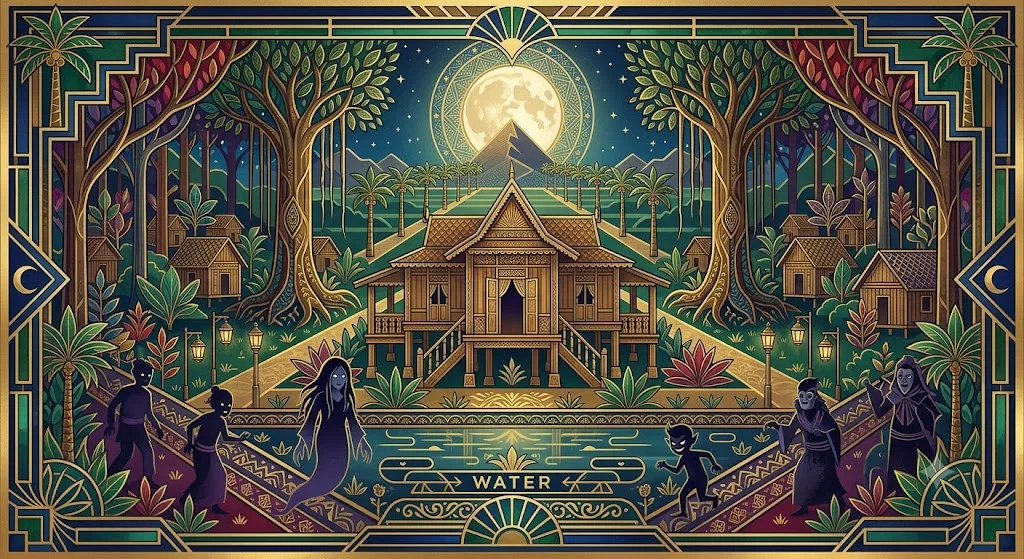
Malaysia’s folklore is not one single myth system. It is a layered story-world shaped by Malay court literature, village ghost belief, Islamic and older spirit traditions, Indigenous forest cosmologies, Bornean harvest myths, Chinese and Indian Malaysian ritual life, colonial-era print, schoolbooks, stage performance, tourism, and horror cinema.
Page outline Jump by section
Why Malaysian folklore feels so varied
Malaysia’s folklore is best understood as a meeting point. Peninsular Malaysia carries a strong Malay-language literary and oral tradition, especially around Melaka, Kelantan, Kedah, Johor and Langkawi. East Malaysia, in Sabah and Sarawak on Borneo, has its own rich Indigenous traditions, including Kadazandusun, Iban, Orang Ulu and many other communities. Indigenous Orang Asli communities in Peninsular Malaysia also preserve oral traditions, ritual arts and forest-related beliefs that cannot be reduced to mainstream Malay folklore.[coac.org.my]coac.org.myOpen source on coac.org.my.
This variety matters because a “Malaysian monster” or “Malaysian legend” often belongs to a particular language, region, community or performance setting. A Pontianak story told in a Malay-speaking village, a Mak Yong healing performance in Kelantan, an Iban folktale in Sarawak, and a Kaamatan harvest narrative in Sabah may all sit under the broad umbrella of Malaysian folklore, but they do not come from the same social world. Good folklore reading therefore asks not only “what is the creature?” but “who tells the story, where, and for what purpose?”
The country’s official heritage record reflects this mixture. Malaysia’s recent UNESCO intangible heritage reporting lists Mak Yong, Dondang Sayang, Silat, Wangkang ceremony, Pantun and Songket among inscribed elements, and it also notes the role of institutions, schools, community workshops and cultural centres in transmitting such traditions. The same report describes Mak Yong and Wangkang rituals as connected with nature and celestial events, and Pantun and Dondang Sayang as carriers of folklore and mythology related to nature and the universe.[Heritage 2026]heritage.gov.myOpen source on heritage.gov.my.
The great legendary figures: loyalty, injustice and impossible desire
The best-known Malaysian legends often survive because they turn a moral problem into a memorable story. They are not simply “hero tales”; they ask questions about loyalty, power, innocence, gender and the limits of royal authority.
Hang Tuah is the central heroic figure of the Malay literary imagination. UNESCO’s Memory of the World page describes Hikayat Hang Tuah as a Malay literary classic and traditional epic, a folk tale recounted through generations and known across the Malay Archipelago.[UNESCO]unesco.orgHikayat Hang TuahHikayat Hang Tuah In the best-known storyline, Hang Tuah is the loyal warrior of Melaka, while his companion Hang Jebat becomes the figure of rebellion after believing that Hang Tuah has been unjustly condemned. The legend is powerful because it does not offer a simple moral answer: is the highest virtue loyalty to the ruler, or justice for a wronged friend?
The historical status of Hang Tuah remains contested. Modern discussions often distinguish between the literary hero, the possible historical figure, and later nationalist uses of his image. The National Library Board of Singapore records a manuscript of Hikayat Hang Tuah copied in Kedah and brought to Penang during the period of Governor Bruce in 1810, which shows the story’s manuscript life in the region rather than proving every episode as literal history.[NLB]nlb.gov.sgNLBHikayat Hang TuahNLBHikayat Hang Tuah Academic discussion of Hang Tuah has also noted how oral Malay narratives and later literary compilation blur the line between history, memory and heroic myth.[ptsldigital.ukm.my]ptsldigital.ukm.myukmvital 75590+Source01+Source010ukmvital 75590+Source01+Source010
Mahsuri of Langkawi is a different kind of national legend: not a warrior tale, but a story of accusation, execution and a curse. Langkawi tourism material describes Mahsuri as a beautiful woman said to have lived between 1762 and 1800, falsely accused and remembered through the island’s best-known legend.[naturallylangkawi.my]naturallylangkawi.mymyth and legendsmyth and legends Kota Mahsuri, the memorial and cultural complex on Langkawi, presents her resting place through a tomb, diorama museum, traditional theatre and reconstructed Kedah-style house, showing how a local oral tradition has become heritage tourism.[kotamahsuri.com]kotamahsuri.comKota MahsuriKota Mahsuri The story’s emotional force lies in its claim that innocence was recognised only too late: in many tellings, white blood proves Mahsuri’s purity as she dies, and her curse explains Langkawi’s later misfortunes.
The princess of Gunung Ledang, associated with Johor’s Mount Ledang, belongs to the folklore of impossible desire. Tourism Johor summarises the most famous version as one recorded in Sejarah Melayu, in which the princess rejects the Sultan of Melaka by setting seven impossible conditions for marriage.[Tourism Johor]tourism.johor.gov.myTourism Johor Gunung Ledang | Mountain of legendsTourism Johor Gunung Ledang | Mountain of legends This tale is often read as a graceful refusal disguised as obedience. Rather than directly reject a ruler, the princess asks for bridges of gold and silver and other impossible gifts, exposing the excess of royal desire. The mountain itself adds power to the story: Gunung Ledang is not just a backdrop, but a landscape made legendary.
Spirits, ghosts and the everyday supernatural
Malaysian ghost lore is among the country’s most visible folklore today, partly because it moves easily between oral storytelling, tabloid anecdotes, cinema, television, podcasts, tourist attractions and internet-era retellings. These stories should be treated as traditions and narratives, not as proof of supernatural events. Their real cultural value lies in what they reveal about fear, taboo, childbirth, death, sexuality, the forest, the household and social boundaries.
The Pontianak is the most internationally recognisable figure in Malay ghost lore. Academic work on Malaysian folk horror describes the Pontianak as a female monster from Malaysia’s animistic past, repeatedly reimagined in Malaysian cinema from 1957 onwards.[Cambridge University Press & Assessment]cambridge.orgUniversity Press & Assessment8University Press & Assessment8 Another study calls the Pontianak one of the most dreaded supernatural beings in Malay folklore and notes familiar cinematic features such as fangs, shrieks, long hair and a nail used to subdue her.[eprints.usm.my]eprints.usm.myOpen source on usm.my. These details vary by teller, but the recurring pattern is clear: the Pontianak is linked with female death, childbirth, vengeance, seduction and fear of the uncontrolled female body.
The Pontianak’s modern life is especially important. She is not a fossil from the past. Film studies trace how the 1957 film Pontianak and later Malaysian and Singaporean productions turned the figure into a continuing folk-horror icon.[Cambridge University Press & Assessment]cambridge.orgUniversity Press & Assessment8University Press & Assessment8 In newer interpretations, the Pontianak can become more than a monster: she may be read as a figure of gendered anger, environmental disturbance or cultural memory. That does not mean every village ghost story is secretly a political essay, but it does show why the creature remains adaptable.
Other Malay ghost figures include the Toyol, the Penanggalan, the Orang Minyak and many named forms of spirit or ghost. The Orang Minyak, often described as an oily night intruder, is a good example of how folklore can absorb modern anxieties. The figure appears in urban legend, crime panic and film, and later versions sometimes shift the “oil” imagery in ways that reflect modern industrial materials rather than older substances.[Wikipedia]WikipediaOrang MinyakOrang Minyak The Toyol, often imagined as a small child-spirit used for theft, and the Penanggalan, a horrifying severed-head figure associated with blood and night flight, similarly show how moral warning, household fear and body horror meet in popular tradition.
Malaysia’s public culture has also turned ghost lore into display. A 2002 report on a Malaysian museum exhibition noted huge visitor numbers for a show exploring supernatural folklore, a reminder that ghost belief can be frightening, entertaining and commercially powerful at the same time.[Winnipeg Free Press]winnipegfreepress.comghosts goblins breathe life into malaysian museum showghosts goblins breathe life into malaysian museum show More recent attractions such as Penang’s Ghost Museum similarly present local and regional spirits for visitors, blending folklore, theatre, horror fandom and tourism.[Klook Travel]klook.comOpen source on klook.com.
Oral performance keeps folklore alive
Many Malaysian traditions are not best understood as “stories” on a page. They live in performance: sung, danced, improvised, ritualised or staged. This is where folklore becomes social action.
Mak Yong, associated especially with Kelantan, is one of the clearest examples. UNESCO describes it as an ancient theatre form created by Malaysia’s Malay communities, combining acting, vocal and instrumental music, gestures and elaborate costumes, and performed for entertainment as well as ritual purposes connected with healing.[UNESCO Intangible Cultural Heritage]ich.unesco.orgOpen source on unesco.org. Malaysia’s UNESCO periodic reporting describes Mak Yong as a folk tradition of dance, music, acting, singing and storytelling, with origins linked to the Kelantan-Pattani cultural world and a repertoire of main narratives. It also records modern safeguarding tensions, including religious concerns, gender restrictions, staged adaptations and the role of bodies such as the National Department for Culture and Arts, the Department of National Heritage, ASWARA and PUSAKA.[Heritage 2026]heritage.gov.myOpen source on heritage.gov.my.
That tension is crucial. When a ritual theatre becomes a national heritage object, it may gain funding, school visibility and international recognition, but it can also be reshaped to fit modern religious, bureaucratic or tourist expectations. Mak Yong therefore helps readers see a central problem in folklore preservation: keeping a tradition alive can involve change, yet too much change can weaken the very thing being preserved.
Dondang Sayang, rooted in Melaka, shows a more social and improvisational side of oral tradition. UNESCO describes it as a traditional Malay art still practised in Melaka by Malay, Baba Nyonya, Chitty and Portuguese communities.[UNESCO Intangible Cultural Heritage]ich.unesco.orgOpen source on unesco.org. It combines music, song and poetic exchange, with performers using quatrains to share feelings of love, joy and sorrow and to strengthen community bonds.[UNESCO]unesco.orgdocument 4750document 4750 This makes it especially valuable as multicultural Malaysian folklore: it is Malay-language art, but not the possession of only one ethnic community.
Pantun, the Malay oral poetic form, is another foundation of Malaysian expressive culture. UNESCO describes Pantun as a form of Malay verse used to express intricate ideas and emotions, widespread in maritime Southeast Asia and marked by a clear rhyme scheme.[UNESCO Intangible Cultural Heritage]ich.unesco.orgOpen source on unesco.org. A UNESCO archive page states that Pantun has been used in the region for at least 500 years and may be transmitted through music, song and writing.[UNESCO]unesco.orgdocument 4752document 4752 In everyday terms, Pantun matters because it turns wit, courtesy and indirect speech into art. It appears in weddings, song, friendly verbal play and formal performance.
Sabah and Sarawak: Borneo’s living myth landscapes
East Malaysia adds a major dimension to Malaysian folklore. Sabah and Sarawak are not simply extensions of Peninsular Malay tradition; they contain many Indigenous traditions with their own origin stories, ritual specialists, festivals and oral literatures.
In Sabah, the story of Huminodun sits at the heart of Kaamatan, the harvest festival associated especially with Kadazan-Dusun communities. Sabah Tourism explains that the Unduk Ngadau, or Harvest Queen, symbolises the legend of Huminodun and the virtues associated with her.[Sabah Tourism Board]sabahtourism.comkaamatan a celebration of culturekaamatan a celebration of culture The Sabah State Library describes Kaamatan as commemorating the sacrifice of Huminodun in response to drought and famine, with the new rice harvest understood through that sacred narrative.[Sabah State Library]library.sabah.gov.mySabah State Library Kaamatan FestivalSabah State Library Kaamatan Festival Another Sabah State Library article lists key festival elements such as the Magavau ritual to call upon the rice spirit, the Unduk Ngadau pageant, cultural performances, traditional games, the Sumazau dance and local foods.[Sabah State Library]library.sabah.gov.myOpen source on sabah.gov.my.
For a general reader, the key point is that Huminodun is not just a “myth character” in the abstract. Her story is embedded in annual festival practice, public holidays, pageantry, ritual memory and Indigenous identity. Modern Kaamatan is open to visitors and often presented as cultural celebration, but its deeper meaning rests on gratitude, rice, sacrifice and continuity.
Sarawak’s Iban traditions show another kind of oral richness. The Sarawak Museum Department describes Iban as the largest ethnic group in Sarawak, about 30% of the state population, and notes that Iban communities historically relied on oral tradition rather than an earlier writing system. It identifies ensera, Iban folktales, as part of Indigenous knowledge transmitted orally and as an expressive art of Iban oral literature.[Sarawak Museum]museum.sarawak.gov.myOpen source on sarawak.gov.my. Research on Iban oral literature likewise stresses that myths, legends, fables and folklore reveal Iban cosmology and traditional life, while warning that such oral literature is fragile when held mainly by older generations under modernising pressures.[ResearchGate]researchgate.net332131801 THE ORAL LITERATURE OF THE IBAN IN BORNEO332131801 THE ORAL LITERATURE OF THE IBAN IN BORNEO
Bornean folklore is also closely tied to animals, omens and landscape. Sarawak cultural writing often links hornbills with Indigenous symbolism, ritual and identity, while conservation reporting notes that hornbills in Sarawak are deeply connected with Indigenous culture and history.[New Sarawak Tribune]sarawaktribune.comNew Sarawak Tribune Hornbills: Endangered Spiritual SymbolsNew Sarawak Tribune Hornbills: Endangered Spiritual Symbols Such examples show how folklore can overlap with ecology: animals are not only biological species, but signs, ancestors, messengers or emblems within cultural memory.

Orang Asli forest traditions and the limits of mainstream retelling
The Orang Asli, the Indigenous peoples of Peninsular Malaysia, are essential to any country-level account of Malaysian folklore, but they are often underrepresented in mainstream summaries. Their traditions are diverse, and it is misleading to speak as though all Orang Asli communities share one belief system.
The Centre for Orang Asli Concerns describes Orang Asli oral tradition as varied and multi-functional: it can amuse, teach, record, remind and explain, and is transmitted through storytelling, mythmaking, ritual and symbolic art.[Center for Orang Asli Concerns]coac.org.myOpen source on coac.org.my. Research on Orang Asli forest relationships emphasises that Indigenous communities in Peninsular Malaysia are not a homogeneous group, and that their human-environment relationships differ across communities.[Frontiers]frontiersin.orgOpen source on frontiersin.org.
Some traditions are strongly tied to forest spirits, dreams, healing and ritual performance. Work on Temiar knowledge describes songs and dances used to communicate with forefathers and forest spirits, while Smithsonian Folkways material on Temiar “dreamsongs” links them to engagement with spirits in a rainforest landscape.[Kuey]kuey.netOpen source on kuey.net. The Museum of Asian Art at the University of Malaya, discussing Orang Asli masks, notes that stories may be represented through ancestral spirit figures, including human, animal and semi-human forms.[Museum of Asian Art]museum.um.edu.myMuseum of Asian Art The MaskMuseum of Asian Art The Mask
These traditions require care from outsiders. They are not simply a quarry of exotic monsters. They are part of living communities, land relationships, ritual knowledge and Indigenous rights. In a folklore page for general readers, the most respectful approach is to recognise their importance without flattening them into decorative “tribal myths”.
Sacred places, haunted places and landscape memory
Malaysian folklore is unusually place-rich. Certain stories are almost inseparable from a mountain, island, fort, tomb, forest, field or village. This makes the country’s folklore easy to visit, but also easy to oversimplify into tourist legend.
Langkawi is the clearest example. UNESCO describes Langkawi as Malaysia’s first UNESCO Global Geopark, an archipelago of ninety-nine islands with beaches, mangroves, limestone formations and forested peaks.[UNESCO]unesco.orgOpen source on unesco.org. Local tourism presents the islands not only as geological and ecological heritage, but also as a landscape of myths, especially Mahsuri’s curse.[naturallylangkawi.my]naturallylangkawi.mymyth and legendsmyth and legends In this case, folklore and geology sit side by side: one explains moral memory, the other explains deep time.
Gunung Ledang works in a similar way. The mountain is a real landscape in Johor, but its folklore identity is dominated by the princess who refuses the Sultan of Melaka. Tourism Johor’s account links the famous tale to Sejarah Melayu and also notes older names and associations with gold, trade and “Mount Ophir”.[Tourism Johor]tourism.johor.gov.myTourism Johor Gunung Ledang | Mountain of legendsTourism Johor Gunung Ledang | Mountain of legends The result is a mountain that exists at once as hiking destination, historical landmark and legendary courtly space.
Haunted sites belong to another category of landscape memory. Penang’s war-related ghost tourism, museum displays and ghost attractions show how modern Malaysians and visitors consume haunted history through a mix of wartime memory, local storytelling and entertainment.[Ex Utopia]exutopia.compenang war museumpenang war museum These sites should be approached carefully: they can preserve local stories, but they can also blur documented history, performance and commercial spookiness.
Animal tales and moral intelligence
Not all Malaysian folklore is dark. Animal tales, especially mousedeer stories, are among the most widely remembered forms of traditional storytelling. The mousedeer is usually small, clever and verbally agile, defeating stronger animals through wit rather than force. Such stories are often told to children, but their lessons are not childish: they teach that intelligence, timing and social awareness can overcome brute power.
The mousedeer sits comfortably beside Pantun and other verbal arts because Malaysian folklore often values indirectness, quick thinking and elegant speech. In this sense, a trickster animal and a poetic quatrain belong to the same broad moral universe: both reward mental agility. Contemporary Malaysian media still treats the mousedeer, Hang Tuah, Mahsuri and Raja Bersiong as familiar folklore references, showing that these figures remain part of common cultural memory rather than specialist knowledge.[The Star]thestar.com.mymalaysian legends and myths lore and beholdmalaysian legends and myths lore and behold
Raja Bersiong, the “fanged king” associated with Kedah tradition, represents a darker moral tale about appetite and corrupted rule. Like many royal legends, it turns political fear into bodily image: the ruler’s abnormal teeth and hunger signal that kingship itself has gone wrong. Such stories are useful because they encode criticism in memorable form. A child may remember the frightening king; an adult may notice the warning about power.
Folklore in modern Malaysia: heritage, horror and reinvention
Modern Malaysia has not left folklore behind. It has moved it into school curricula, cultural festivals, museums, films, comics, stage shows, tourism campaigns and online storytelling. The question is no longer whether folklore survives, but what form it takes when it is preserved, adapted or commercialised.
UNESCO and Malaysian cultural agencies have helped make oral and performance traditions visible, especially Mak Yong, Dondang Sayang and Pantun. This recognition can protect traditions by giving them prestige, documentation and funding. It can also reshape them, because staged heritage often needs fixed scripts, formal venues, acceptable costumes and clear explanations for outsiders. Malaysia’s UNESCO reporting openly records such pressures in relation to Mak Yong, including the difficulty of transmitting ritual elements and concerns over religious compatibility and authenticity.[Heritage 2026]heritage.gov.myOpen source on heritage.gov.my.
Horror cinema has done something different. It has kept ghost lore emotionally alive by making old figures frightening in new ways. The Pontianak’s repeated reappearance in film from the late 1950s onwards shows how a traditional female ghost can become a national and regional screen icon.[Cambridge University Press & Assessment]cambridge.orgUniversity Press & Assessment8University Press & Assessment8 The creature’s meaning changes with the era: she can be a warning about death in childbirth, a punished woman, a seductive threat, a symbol of male fear, a voice of revenge, or a spirit tied to the disturbed forest.
Tourism creates another kind of reinvention. Kota Mahsuri, Gunung Ledang, Langkawi’s legend parks and ghost museums make folklore visitable. This can help visitors remember stories, but it can also simplify them into photo opportunities. The useful distinction is not “authentic versus fake” in a crude sense. It is better to ask what layer is being presented: old oral tradition, literary text, ritual practice, state heritage, local pride, commercial attraction, horror entertainment or internet retelling.
How to read Malaysian folklore well
The best way to approach Malaysian folklore is to resist treating it as a list of monsters. The country’s traditions are more interesting than that. They include heroic epics, courtly legends, women’s curse narratives, harvest myths, forest spirit beliefs, poetic duelling, ritual theatre, trickster tales and modern horror.
A few reading habits help. First, place the story geographically. A Langkawi curse tale, a Kelantan theatre tradition, a Sabah rice myth and a Sarawak longhouse folktale belong to different worlds. Second, notice the medium. A manuscript epic, a whispered ghost story, a ritual chant, a schoolbook tale and a cinema monster all behave differently. Third, ask what the story is doing. Is it explaining a landscape, teaching manners, warning against injustice, marking a festival, protecting a taboo, entertaining children, attracting tourists or expressing modern anxiety?
Malaysia’s folklore matters because it keeps many forms of memory in circulation at once. It remembers Melaka as a heroic and moral world through Hang Tuah. It turns Langkawi into a landscape of innocence and curse through Mahsuri. It makes Gunung Ledang a mountain of refusal and impossible demands. It gives the Pontianak new life in horror cinema. It ties Sabah’s harvest festival to Huminodun’s sacrifice. It preserves Orang Asli and Iban oral knowledge through story, ritual, song and place. The result is a folklore landscape that is not frozen in the past, but continuously retold, argued over and reimagined.
Amazon book picks
Further Reading
Books and field guides related to Where Malaysia's Legends Still Haunt the Landscape. Use these as the next step if you want deeper reading beyond the article.
Malay Magic
Strong foundation for understanding the breadth of Malaysian folk traditions.
The encyclopedia of Malaysia
Covers performance traditions that preserve folklore and oral heritage.
Malaysian Folktales
Introduces many of the legends and story types discussed on the page.
eBay marketplace picks
Marketplace Samples
Live-tested eBay searches with available results related to this page.
Endnotes
1.
Source: ich.unesco.org
Link:https://ich.unesco.org/en/RL/mak-yong-theatre-00167
2.
Source: ich.unesco.org
Link:https://ich.unesco.org/en/RL/dondang-sayang-01410
3.
Source: ich.unesco.org
Link:https://ich.unesco.org/en/RL/pantun-02274
4.
Source: unesco.org
Title: Hikayat Hang Tuah
Link:https://www.unesco.org/en/memory-world/hikayat-hang-tuah
5.
Source: nlb.gov.sg
Title: NLBHikayat Hang Tuah
Link:https://www.nlb.gov.sg/main/book-detail?cmsuuid=f602232f-59ee-4008-8da6-9ce87533a380
6.
Source: ptsldigital.ukm.my
Title: ukmvital 75590+Source01+Source010
Link:https://ptsldigital.ukm.my/bitstream/123456789/577788/1/ukmvital_75590%2BSource01%2BSource010.PDF
7.
Source: naturallylangkawi.my
Title: myth and legends
Link:https://naturallylangkawi.my/about-langkawi/myth-and-legends/
8.
Source: kotamahsuri.com
Title: Kota Mahsuri
Link:https://kotamahsuri.com/
9.
Source: cambridge.org
Title: University Press & Assessment8
Link:https://www.cambridge.org/core/books/monstrous-beings-and-media-cultures/reimagining-the-pontianak-myth-in-malaysian-folk-horror-flexible-tradition-cinema-and-cultural-memory/5DC7CCDBF43B025C8B94C1F25099EFA1
10.
Source: eprints.usm.my
Link:https://eprints.usm.my/38723/1/The_Villainous_Pontianak._Examining_Gender%2C_Culture_and_Power_in_Malaysian_Horror_Films.pdf
11.
Source: Wikipedia
Title: Orang Minyak
Link:https://en.wikipedia.org/wiki/Orang_Minyak
12.
Source: klook.com
Link:https://www.klook.com/en-MY/destination/p50232830-ghost-museum-penang/
13.
Source: unesco.org
Title: document 4750
Link:https://www.unesco.org/archives/multimedia/document-4750
14.
Source: unesco.org
Title: document 4752
Link:https://www.unesco.org/archives/multimedia/document-4752
15.
Source: researchgate.net
Title: 332131801 THE ORAL LITERATURE OF THE IBAN IN BORNEO
Link:https://www.researchgate.net/publication/332131801_THE_ORAL_LITERATURE_OF_THE_IBAN_IN_BORNEO
16.
Source: kuey.net
Link:https://kuey.net/index.php/kuey/article/download/5051/3475/10696
17.
Source: unesco.org
Link:https://www.unesco.org/en/iggp/langkawi-unesco-global-geopark
18.
Source: ich.unesco.org
Title: wayang puppet theatre 00063
Link:https://ich.unesco.org/en/RL/wayang-puppet-theatre-00063
19.
Source: unesco.org
Title: Mak Yong Theatre | Intangible Heritage
Link:https://www.unesco.org/archives/multimedia/document-633
20.
Source: ich.unesco.org
Title: files 2026 under process 01395
Link:https://ich.unesco.org/en/files-2026-under-process-01395?call=slideshow&id=02432&include=slideshow_inc.php&mode=scroll&width=620
21.
Source: ich.unesco.org
Link:https://ich.unesco.org/en/lists
22.
Source: ich.unesco.org
Link:https://ich.unesco.org/doc/src/41961.pdf
23.
Source: ich.unesco.org
Title: LHE 20 15.CO M 5 EN.docx
Link:https://ich.unesco.org/doc/src/LHE-20-15.COM-5-EN.docx
24.
Source: ich.unesco.org
Link:https://ich.unesco.org/en/video/46656
25.
Source: ich.unesco.org
Link:https://ich.unesco.org/en/decisions/13.COM/10.B.16
26.
Source: ich.unesco.org
Link:https://ich.unesco.org/en/decisions/20.COM/7.B.49
27.
Source: ich.unesco.org
Title: malaysia MY
Link:https://ich.unesco.org/en-state/malaysia-MY?call=film&id=81491&include=film_inc.php&width=700
28.
Source: ich.unesco.org
Link:https://ich.unesco.org/en/decisions/15.COM/8.B.30
29.
Source: ich.unesco.org
Title: 10b representative list 01013
Link:https://ich.unesco.org/en/10b-representative-list-01013?id=01407&include=slideshow_inc.php
30.
Source: ich.unesco.org
Title: 39050 EN.doc
Link:https://ich.unesco.org/doc/src/39050-EN.doc
31.
Source: Wikipedia
Title: Malay folklore
Link:https://en.wikipedia.org/wiki/Malay_folklore
32.
Source: Wikipedia
Link:https://en.wikipedia.org/wiki/Malaysia
33.
Source: Wikipedia
Title: Ghosts in Malay culture
Link:https://en.wikipedia.org/wiki/Ghosts_in_Malay_culture
34.
Source: Wikipedia
Title: Folklore of Malaysia
Link:https://en.wikipedia.org/wiki/Folklore_of_Malaysia
35.
Source: Wikipedia
Title: Mak yong
Link:https://en.wikipedia.org/wiki/Mak_yong
36.
Source: Wikipedia
Title: Hang Tuah
Link:https://en.wikipedia.org/wiki/Hang_Tuah
37.
Source: Wikipedia
Title: Hikayat Hang Tuah
Link:https://en.wikipedia.org/wiki/Hikayat_Hang_Tuah
38.
Source: Wikipedia
Link:https://en.wikipedia.org/wiki/Mahsuri
39.
Source: Wikipedia
Link:https://en.wikipedia.org/wiki/Huminodun
40.
Source: Wikipedia
Title: Iban culture
Link:https://en.wikipedia.org/wiki/Iban_culture
41.
Source: Wikipedia
Link:https://en.wikipedia.org/wiki/Kaamatan
42.
Source: Wikipedia
Link:https://en.wikipedia.org/wiki/Kuntilanak
43.
Source: Wikipedia
Title: Dondang Sayang
Link:https://en.wikipedia.org/wiki/Dondang_Sayang
44.
Source: researchgate.net
Title: (PDF) Exploring Intangible Cultural Heritage (ICH
Link:https://www.researchgate.net/publication/373914899_Exploring_Intangible_Cultural_Heritage_ICH_Documentation_of_the_Untold_Stories_of_Mak_Yong_Performing_Art_A_conceptual_framework
45.
Source: researchgate.net
Title: 348618241 The Mak Yong Dance Theatre as Spiritual Heritage Some Insights
Link:https://www.researchgate.net/publication/348618241_The_Mak_Yong_Dance_Theatre_as_Spiritual_Heritage_Some_Insights
46.
Source: researchgate.net
Link:https://www.researchgate.net/publication/334790082_A_Malaysian_Folklore_Game_Design_As_A_Tool_Of_Culture_Preservation_And_Entertainment_Toyol
47.
Source: researchgate.net
Title: 355121154 Hang Tuah A Malay Icon Transcending Time
Link:https://www.researchgate.net/publication/355121154_Hang_Tuah_A_Malay_Icon_Transcending_Time
48.
Source: researchgate.net
Title: 279281851 Oral traditions in Malaysia A discussion of shamanism
Link:https://www.researchgate.net/publication/279281851_Oral_traditions_in_Malaysia_A_discussion_of_shamanism
49.
Source: researchgate.net
Title: 312222819 Indigenous Orang Asli Folktales Bah Luj and the Evil Spirit
Link:https://www.researchgate.net/publication/312222819_Indigenous_Orang_Asli_Folktales_Bah_Luj_and_the_Evil_Spirit
50.
Source: researchgate.net
Link:https://www.researchgate.net/publication/311960165_Thematic_Analysis_as_a_Basis_in_Giving_Meanings_to_Myths_of_Nunuk_Ragang_and_Huminodun_Folktales_of_Kadazandusun_Tribe_in_Sabah
51.
Source: researchgate.net
Link:https://www.researchgate.net/publication/342149370_Kuntilanak_Ghost_Narratives_and_Malay_Modernity_in_Pontianak_Indonesia
52.
Source: researchgate.net
Link:https://www.researchgate.net/publication/374087056_The_Corporeal_and_Monstrosity_of_Supernatural_Entities_Towards_a_Socio-Functional_Illustration_of_Pontianak_In_Tunku_Halim%27s_Horror_Stories
53.
Source: researchgate.net
Link:https://www.researchgate.net/publication/381055313_Orthographic_and_Phonological_Integration_of_Malay_Words_of_the_Pantun_in_the_Dondang_Sayang
54.
Source: resolve.cambridge.org
Title: org8 Reimagining the Pontianak Myth in Malaysian Folk Horror
Link:https://resolve.cambridge.org/core/services/aop-cambridge-core/content/view/5DC7CCDBF43B025C8B94C1F25099EFA1/9789048552832c8_p191-216_CBO.pdf/reimagining_the_pontianak_myth_in_malaysian_folk_horror_flexible_tradition_cinema_and_cultural_memory.pdf
55.
Source: naturallylangkawi.my
Link:https://naturallylangkawi.my/wp-content/uploads/2022/09/Langkawi.GDC_.Booklet.pdf
56.
Source: malaysia.travel
Title: travel: Malaysia Truly Asia
Link:https://www.malaysia.travel/
57.
Source: genies.fandom.com
Title: Hantu Raya
Link:https://genies.fandom.com/wiki/Hantu_Raya
58.
Source: youtube.com
Title: The Legend Of Mahsuri | Langkawi Folklore | Epic Malay Folktale Animated in 4K
Link:https://www.youtube.com/watch?v=S1qrIoB6rT8
Source snippet
Mak Yong Theatre...
59.
Source: youtube.com
Title: Mak Yong Theatre
Link:https://www.youtube.com/watch?v=RLlvYFvRU9M
Source snippet
The Legend of Hang Tuah: A History Made Up by the British? | Secrets of the Past...
60.
Source: coac.org.my
Link:https://coac.org.my/stories-of-a-people-asserting-place-and-presence-via-orang-asli-oral-tradition/
61.
Source: museum.sarawak.gov.my
Link:https://museum.sarawak.gov.my/web/subpage/webpage_view/284
62.
Source: sabahtourism.com
Title: kaamatan a celebration of culture
Link:https://sabahtourism.com/article/kaamatan-a-celebration-of-culture/
63.
Source: heritage.gov.my
Link:https://www.heritage.gov.my/images/04_wtk/ICICH/ICHPeriodicReport2020.pdf
64.
Source: tourism.johor.gov.my
Title: Tourism Johor Gunung Ledang | Mountain of legends
Link:https://tourism.johor.gov.my/gunung-ledang-mountain-of-legends/
65.
Source: winnipegfreepress.com
Title: ghosts goblins breathe life into malaysian museum show
Link:https://www.winnipegfreepress.com/historic/2002/08/10/ghosts-goblins-breathe-life-into-malaysian-museum-show
66.
Source: library.sabah.gov.my
Title: Sabah State Library Kaamatan Festival
Link:https://library.sabah.gov.my/index.php/en/our-links/featured-articles/kaamatan-festival
67.
Source: library.sabah.gov.my
Link:https://library.sabah.gov.my/index.php/en/our-links/featured-articles/kaamatan-festival-a-celebration-of-gratitude-and-cultural-heritage
68.
Source: sarawaktribune.com
Title: New Sarawak Tribune Hornbills: Endangered Spiritual Symbols
Link:https://www.sarawaktribune.com/hornbills-endangered-spiritual-symbols/
69.
Source: frontiersin.org
Link:https://www.frontiersin.org/journals/forests-and-global-change/articles/10.3389/ffgc.2022.1019994/full
70.
Source: museum.um.edu.my
Title: Museum of Asian Art The Mask
Link:https://museum.um.edu.my/the-mask
71.
Source: exutopia.com
Title: penang war museum
Link:https://www.exutopia.com/penang-war-museum/
72.
Source: thestar.com.my
Title: malaysian legends and myths lore and behold
Link:https://www.thestar.com.my/news/focus/2025/03/16/malaysian-legends-and-myths-lore-and-behold
73.
Source: facebook.com
Title: SABA H,
Link:https://www.facebook.com/SabahMalaysianBorneo/photos/every-year-the-kadazan-dusun-people-will-pay-nunuk-ragang-a-visit-as-a-remembran/10157672288071204/
74.
Source: sabahtourism.com
Link:https://sabahtourism.com/article/harvest-festival-pesta-kaamatan/
75.
Source: dash.harvard.edu
Link:https://dash.harvard.edu/bitstreams/8e95b5fb-ba4d-4122-adc6-eaf4fb8473b4/download
76.
Source: setkab.go.id
Title: unesco designated indonesian malaysian pantun as intangible cultural heritage
Link:https://setkab.go.id/en/unesco-designated-indonesian-malaysian-pantun-as-intangible-cultural-heritage/
77.
Source: unesco.org.my
Title: Dondang Sayang
Link:https://unesco.org.my/unesco-recognition/culture/intangible-cultural-heritage-ich/dondang-sayang
78.
Source: asianitinerary.com
Link:https://asianitinerary.com/langkawi-the-legend-of-mahsuri/
79.
Source: pemetaanbudaya.jkkn.gov.my
Link:https://pemetaanbudaya.jkkn.gov.my/en/senibudaya/detail/836
80.
Source: pemetaanbudaya.jkkn.gov.my
Link:https://pemetaanbudaya.jkkn.gov.my/en/senibudaya/detail/1247
81.
Source: lada.gov.my
Title: langkawi unesco global geopark
Link:https://www.lada.gov.my/en/langkawi-unesco-global-geopark/
82.
Source: journals-jd.upm.edu.my
Link:https://www.journals-jd.upm.edu.my/resources/files/Pertanika%20PAPERS/JSSH%20Vol.%2024%20%284%29%20Dec.%202016/11%20JSSH-1425-2015.pdf
83.
Source: jurcon.ums.edu.my
Link:https://jurcon.ums.edu.my/ojums/index.php/JBA/article/download/4133/2607
84.
Source: johornationalparks.gov.my
Link:https://johornationalparks.gov.my/gunung-ledang-waterfall/
85.
Source: tripadvisor.com
Title: Kota Mahsuri
Link:https://www.tripadvisor.com/Attraction_Review-g298283-d14172962-Reviews-Kota_Mahsuri-Langkawi_Langkawi_District_Kedah.html
86.
Source: scienceopen.com
Link:https://www.scienceopen.com/book?vid=7ae31dde-3b63-4352-bb57-d42b43d62ddd
87.
Source: thestar.com.my
Title: kaamatan festival kicks off with traditional fanfare in sabah
Link:https://www.thestar.com.my/news/nation/2024/05/30/kaamatan-festival-kicks-off-with-traditional-fanfare-in-sabah
88.
Source: ir.uitm.edu.my
Link:https://ir.uitm.edu.my/35725/1/35725.pdf
89.
Source: malaysia.gov.my
Title: My Government
Link:https://www.malaysia.gov.my/en
90.
Source: tourism.gov.my
Link:https://www.tourism.gov.my/
91.
Source: sandinmycurls.com
Title: malaysian legends
Link:https://sandinmycurls.com/malaysian-legends/
92.
Source: kln.gov.my
Title: Ministry of Foreign Affairs, Malaysia
Link:https://www.kln.gov.my/
93.
Source: eyeonasia.gov.sg
Link:https://www.eyeonasia.gov.sg/asean-countries/know/overview-of-asean-countries/malaysia-a-country-profile/
Additional References
94.
Source: youtube.com
Link:https://www.youtube.com/watch?v=1c3C3kuVgyM
Source snippet
PONTIANAK: The MOST Disturbing Ghost in Asia...
95.
Source: youtube.com
Title: PONTIANAK: The MOST Disturbing Ghost in Asia
Link:https://www.youtube.com/watch?v=kkOXpbxMf64
Source snippet
The Legend Of Mahsuri | Langkawi Folklore | Epic Malay Folktale Animated in 4K...
96.
Source: facebook.com
Link:https://www.facebook.com/sgheritage/posts/the-story-of-hang-tuah-the-legendary-16th-century-malay-warrior-is-well-known-in/2260874910621863/
97.
Source: academia.edu
Link:https://www.academia.edu/78193203/Hang_Tuah_A_Malay_Icon_Transcending_Time
98.
Source: tripadvisor.co.uk
Link:https://www.tripadvisor.co.uk/Attraction_Review-g298303-d8549113-Reviews-Ghost_Museum_Penang-George_Town_Penang_Island_Penang.html
99.
Source: facebook.com
Link:https://www.facebook.com/aseansecretariat/posts/congratulations-to-malaysia-for-having-dondang-sayang-inscribed-in-unescos-repre/10156990999228854/
100.
Source: facebook.com
Link:https://www.facebook.com/deadpudds/videos/do-you-know-about-the-kadazan-dusuns-origin-story-this-video-took-soooo-long-to-/843266238626455/
101.
Source: facebook.com
Link:https://www.facebook.com/TheStarOnline/posts/drawing-heavily-from-malaysias-rich-folklore-the-series-features-many-recognisab/1496083715887482/
102.
Source: factsanddetails.com
Link:https://factsanddetails.com/southeast-asia/Malaysia/sub5_4c/entry-3636.html
103.
Source: sci-cult.net
Link:https://sci-cult.net/index.php/cult/article/download/364/796/7970
Topic Tree
Follow this branch
Related pages 192
- Afghan Folklore
- Albanian Folklore
- Algerian Folklore
- Australian Folklore
- Azerbaijan Folklore
- +187 more in sidebar