Where Spirits, Cattle and Kings Shape Memory
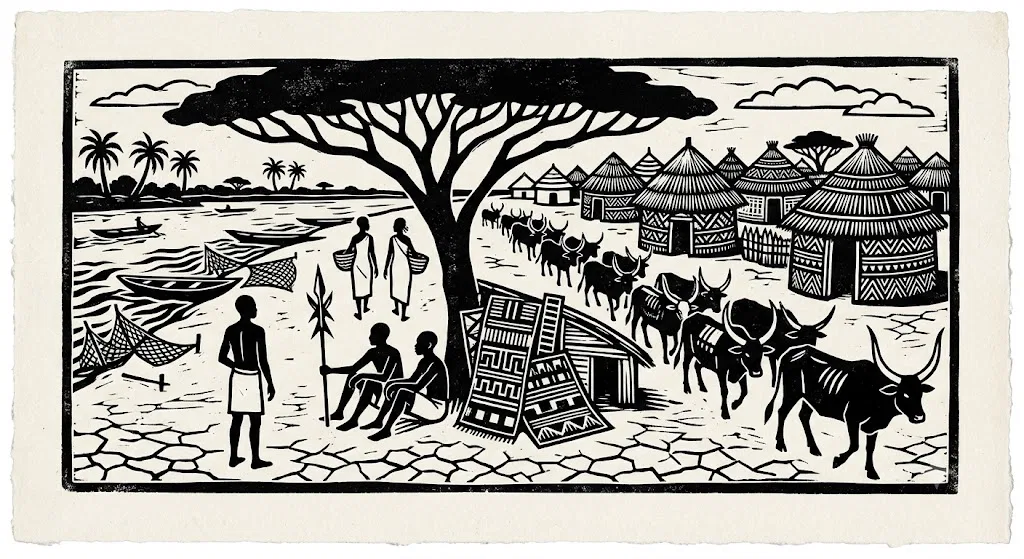
South Sudan’s folklore is not a single national mythology with one fixed cast of gods and monsters. It is a living patchwork of oral traditions, ritual memories, clan stories, prophetic songs, cattle lore, river landscapes, sacred kingship, witchcraft beliefs and Christian or Islamic reinterpretations, shaped by dozens of communities and languages.
Page outline Jump by section
Introduction
For readers interested in myth and legend, the most important point is this: South Sudanese traditions are often tied to land, cattle, rain, ancestors, rivers, moral order and political authority. A creation story may explain hunger and death; a royal ritual may make a king more than a politician; a prophet’s relic may become a national controversy; an oracle may reveal why misfortune has struck. These traditions are not frozen relics. They have been recorded, debated, damaged by war, revived through cultural work, and reshaped in diaspora and online spaces.
Why South Sudanese folklore is hard to reduce to one story
South Sudan became independent in 2011, but the oral traditions within its borders are far older than the state. A country-level folklore page therefore has to be careful: “South Sudanese folklore” is a useful umbrella, not a single unified canon. It includes Nilotic traditions of the Dinka, Nuer and Shilluk, Zande traditions in the south-west, and many other local bodies of song, story, ritual and belief. Minority Rights Group describes South Sudan’s population as deeply diverse, with Western Nilotic communities prominent in the north and east and other groups concentrated in Equatoria.[Minority Rights Group]minorityrights.orgMinority Rights GroupSouth SudanWestern Nilotes – Anuak, Dinka, Murle, Nuer and Shilluk – are the largest linguistic group. They traditio…
That diversity also explains why reliable evidence is uneven. Some traditions are unusually well documented because colonial-era anthropologists studied them in detail: Dinka religion through Godfrey Lienhardt, Nuer religion and prophecy through E. E. Evans-Pritchard and later scholars, and Zande witchcraft through Evans-Pritchard’s famous work. Other communities’ oral literatures are less accessible in English or survive mainly in local performance, family memory, churches, courts, songs, or community publications. The National Archive of South Sudan preserves administrative records from roughly the early twentieth century to the 1980s, but many folklore traditions live outside written archives.[Rift Valley Institute]riftvalley.netnational archive south sudanRift Valley InstituteNational Archive of South SudanThe contents of the archive range from the 1900s to the 1980s; they are often the onl…
This does not make the traditions weak. It means they should be read as living oral culture rather than as a tidy mythology handbook. South Sudanese folklore is often embedded in practical questions: when rain will come, why cattle matter, how a death should be understood, who has moral authority, whether a leader is legitimate, and how communities remember migration, conflict and peace.
Creation, cattle and the sky in Dinka tradition
Among the Dinka, one of the best-attested religious and mythic traditions centres on a supreme creator associated with the sky, rain and life. Godfrey Lienhardt’s Divinity and Experience: The Religion of the Dinka, first published by Oxford University Press in 1961, remains a foundational study of Dinka religion. Bibliographic records identify the book as a 338-page study of Dinka religion and experience, and later summaries of the tradition describe the creator figure as distant yet central to the ordering of life.[Google Books]books.google.comOpen source on google.com.
One widely discussed Dinka creation pattern tells of first humans, often named Garang and Abuk in English-language accounts, and of a broken connection between heaven and earth. In some versions, human disobedience, scarcity and death enter the world through a story about food, planting, hunger and the severing of a rope or link between the human world and the sky. The exact wording varies by narrator and source, but the story’s power is clear: it explains not only where people came from, but why life is limited, why food must be worked for, and why the divine is no longer effortlessly close.[Wikipedia]WikipediaDinka religionDinka religion
Cattle are not just background scenery in these traditions. In Dinka and Nuer worlds alike, cattle can be wealth, beauty, sacrifice, bridewealth, poetry, memory and moral relationship. Dinka prayers and sacrifices are reported as being made for rain, harvest, protection, cattle health and hunting; ritual speech, cattle sacrifice and the fishing spear all carry symbolic weight.[Wikipedia]WikipediaDinka religionDinka religion
For folklore readers, this changes how “myth” should be understood. These are not simply stories about gods. They are story-worlds in which cattle, rain, kinship and divine distance explain the ordinary conditions of survival. A drought, a sick animal, a failed harvest or a death may be interpreted through a moral and ritual universe, not merely through impersonal bad luck.
Nuer prophecy and the dangerous afterlife of sacred authority
Nuer tradition is especially important for understanding how South Sudanese folklore can remain politically active. Nuer religion has long included ideas of a supreme being, spirits, prophets and ritual specialists. Brill’s reference entry on Nuer and Dinka religion notes that both peoples recognise a supreme being, known in Dinka as Nhialic and in Nuer as Kwoth or related forms.[Brill Reference Works]referenceworks.brill.comOpen source on brill.com.
The most famous Nuer prophetic figure is Ngundeng Bong, who died in 1906 and whose prophecies have continued to circulate in songs, memory and political interpretation. A 1995 review of Douglas H. Johnson’s Nuer Prophets notes that the book contrasts Nuer perceptions of Ngundeng with colonial officials’ views, underlining a recurring problem in the evidence: outsiders often treated prophecy as disorder or rebellion, while local audiences could treat it as moral and spiritual authority.[JSTOR]jstor.orgNuer Prophets and ProphecyNuer Prophets and Prophecy
The most striking modern example is Ngundeng’s sacred stick, often called the dang. In 2026, Associated Press reported that the relic, linked to Ngundeng and returned to South Sudan in 2009, still carried political and spiritual significance amid tensions around Riek Machar and Nuer opposition politics. The report describes the stick as a sacred object associated with prophecy, authority and fear, and quotes researchers cautioning that the point is not whether a relic has supernatural force in an objective sense, but how powerfully people perceive it.[AP News]apnews.comThe rivalry between Kiir and Machar, rooted in ethnic divisions, sparked a civil war in 2013 that killed an estimated 400,000 people. Alt…
This is where folklore becomes more than “old stories”. Prophetic songs and relics can shape expectations about leadership, war, peace and destiny. They can be interpreted differently by supporters, opponents, historians and state officials. That makes them culturally potent but also politically risky. A careful folklore account should not claim that a prophecy “came true”; it should explain how prophecy functions as a language of legitimacy, grievance and hope.
Shilluk kingship, Nyikang and the sacred Nile
The Shilluk, who live along the Nile and Sobat rivers, preserve one of the region’s most famous traditions of sacred kingship. Minority Rights Group describes the Shilluk as a Nilotic people with a hereditary king, the reth.[Refworld]refworld.orgOpen source on refworld.org. In Shilluk tradition, royal authority is bound to Nyikang, the founding ancestor and culture hero whose presence is ritually renewed through kingship.
Scholarly discussions of Shilluk kingship describe the king as embodying Nyikang or being linked to him in a way that makes royal power more than ordinary rule. David Graeber’s study of Shilluk divine kingship states that the Shilluk king was said to embody a divine being or demi-god in the person of Nyikang, the legendary founder. Evans-Pritchard’s classic discussion similarly treats Nyikang as a mythological personification of kingship and moral order.[Chicago Journals]journals.uchicago.eduOpen source on uchicago.edu.
Fashoda is central to this sacred geography. UNESCO documentation describes Fashoda as the holy land of the Shilluk and a place of rituals and ceremonies. It also records a Shilluk oral tradition that Fashoda was established by a Shilluk king in the late seventeenth or early eighteenth century.[Intangible Cultural Heritage]ich.unesco.orgOpen source on unesco.org.
The folklore interest here is not just the story of a founding hero. It is the way a river landscape, a royal institution and an ancestor-spirit form a single cultural system. Nyikang is remembered through migration traditions, royal ritual, sacred places and ideas of continuity. For a first-time reader, the closest comparison might be a founding king whose spirit never entirely leaves the throne — but Shilluk tradition has its own local logic, tied to the Nile and to the history of the Shilluk kingdom.
Zande witchcraft, oracles and the logic of misfortune
The Azande of South Sudan, the Democratic Republic of Congo and the Central African Republic are central to one of anthropology’s best-known studies of witchcraft. E. E. Evans-Pritchard’s Witchcraft, Oracles and Magic among the Azande was based on fieldwork in what was then southern Sudan in the late 1920s and early 1930s, and Oxford University Press records later editions and abridgements of the work.[Google Books]books.google.comOpen source on google.com.
What made the study famous was not the claim that Zande witchcraft was “strange”, but almost the opposite: Evans-Pritchard showed that Zande explanations of misfortune formed a coherent system within their own premises. Witchcraft did not replace ordinary cause and effect. It answered the social and moral question of why this misfortune happened to this person at this time.[Wikipedia]WikipediaWitchcraft, Oracles and Magic Among the AzandeWitchcraft, Oracles and Magic Among the Azande
Classic accounts describe several forms of oracle, including the poison oracle, termite oracle and rubbing-board oracle. These were used to seek answers about illness, danger, accusations and decisions. Modern readers should be careful with the word “witchcraft” here. It is an English translation that carries European baggage. In Zande contexts, the older literature points to a structured way of reasoning about harm, envy, danger and uncertainty, not simply to Halloween-style witches.[Wikipedia]WikipediaAzande witchcraftAzande witchcraft
Recent research also shows that these traditions have changed. A 2024 article on witchcraft, disputes and trials among the South Sudanese Azande argues that the form of witchcraft Evans-Pritchard translated as “mangu” has disappeared among South Sudanese Azande, while other forms of witchcraft and magic continue to arise in courts, disputes and local social life.[HAU Journal]haujournal.orgOpen source on haujournal.org. This is a valuable corrective: folklore is not a museum object. Belief systems adapt, vanish in some forms, reappear in others, and move into new legal, Christian, political or community settings.
Sacred places and ritual landscapes
South Sudanese folklore is strongly place-based. Rivers, cattle camps, shrines, royal centres, graves, mounds and borderlands can hold memory in ways that written texts do not. Fashoda is the clearest example because it is both a historic royal centre and a sacred Shilluk landscape. UNESCO’s documentation of Fashoda as a cultural space highlights its ritual importance and its role in Shilluk identity.[Intangible Cultural Heritage]ich.unesco.orgOpen source on unesco.org.
Dinka tradition also includes sacred and commemorative landscapes. English-language summaries based on ethnographic work describe shrines, mounds and cattle-sacrifice sites associated with important religious figures and divinities. One example often mentioned is the Pyramid of Luak Deng, associated in Dinka and Nuer memory with Deng or Deng Dit, though claims about such sites should be handled cautiously because online summaries often compress complex local traditions.[Wikipedia]WikipediaDinka peopleDinka people
The Sudd, the vast wetland region of the White Nile system, also matters as more than a map feature. Nuer communities have long lived in swamp and savanna environments around the Nile and its tributaries, and eHRAF’s Nuer summary places them in South Sudan’s swamps and open savanna on both sides of the Nile south of the Sobat junction.[eHRAF World Cultures]ehrafworldcultures.yale.edue HRAF World Cultures Nuere HRAF World Cultures Nuer In such landscapes, folklore grows out of seasonal movement, cattle grazing, flood, drought, fishing, danger and refuge.
For visitors and readers, the lesson is simple: South Sudanese folklore is often attached to lived geography. A shrine, a riverbank or a cattle camp is not merely a backdrop for a tale; it can be the reason the tale exists.

Storytelling, songs and the problem of preservation
Oral storytelling in South Sudan is not limited to myths of origin or sacred kingship. It includes animal tales, clan histories, praise songs, children’s stories, riddles, proverbs, war memories, migration accounts and moral tales. Community and educational retellings increasingly present Dinka and other South Sudanese folktales in written or online form, although these sources vary greatly in reliability and often reshape oral material for modern readers. PaanLuel Wël Media Ltd - South Sudan[paanluelwel.com]paanluelwel.comPaan Luel Wël Media LtdPaan Luel Wël Media Ltd
Preservation is a major issue because war, displacement, urbanisation and language shift can interrupt the ordinary pathways by which stories pass from elders to children. UNESCO records South Sudan’s work on developing an inventory of intangible cultural heritage, a project running from 2022 to 2025, and notes that South Sudan ratified the 2003 Convention for the Safeguarding of Intangible Cultural Heritage in 2016.[Intangible Cultural Heritage]ich.unesco.orgsouth sudan SSsouth sudan SS
Archives matter too, but they are incomplete by nature. The Rift Valley Institute describes the National Archive of South Sudan as containing records from the 1900s to the 1980s and often preserving the only detailed records of previous local Southern administrations. Sudan Memory describes the South Sudan National Archive Project as a conservation, cataloguing and digitisation effort.[Rift Valley Institute]riftvalley.netnational archive south sudanRift Valley InstituteNational Archive of South SudanThe contents of the archive range from the 1900s to the 1980s; they are often the onl… These records can support historical context, but they cannot replace living performance.
The most fragile folklore is often the least visible online: a grandmother’s story in a local language, a cattle song known only in a family line, a ritual phrase remembered by specialists, or a place-name whose meaning is obvious only to people who grew up with it.
How Christianity, war and the internet have changed the traditions
South Sudanese folklore today exists alongside Christianity, Islam, local religious practice and secular political life. The South Sudanese embassy in Washington describes the population as including Christians, Muslims and followers of traditional African religions, while other country profiles list English, Arabic varieties and major ethnic languages including Dinka, Nuer, Bari, Zande and Shilluk.[Embassy of South Sudan]ssembassydc.orgOpen source on ssembassydc.org.
Christianity has not simply erased older traditions. In many places, older ideas about spirits, ancestors, prophecy, witchcraft, sacrifice, pollution or blessing may be rejected, reinterpreted, moralised or quietly retained. This is especially visible in discussions of peace and authority. Naomi Pendle’s open-access study of peace-making in South Sudan argues that religious authorities, including chiefs, priests, prophets and churches, have shaped claims about violence, peace and moral legitimacy.[JSTOR]jstor.orgOpen source on jstor.org.
War has also changed folklore. Conflict can destroy archives, scatter elders, politicise ethnic memory and turn prophetic traditions into dangerous symbols. The modern controversy around Ngundeng’s dang shows how a sacred object can become entangled with civil war, leadership and ethnic fear.[AP News]apnews.comThe rivalry between Kiir and Machar, rooted in ethnic divisions, sparked a civil war in 2013 that killed an estimated 400,000 people. Alt…
The internet adds another layer. Prophetic songs, simplified folktales, community pride pages and diaspora retellings now circulate online. This can preserve memory, but it can also flatten local variation, invent certainty, or turn sacred material into viral content. For readers, the safest approach is to ask: is this an old oral tradition, a scholarly recording, a community retelling, a political interpretation, a children’s adaptation, or an internet-era invention?
What readers should remember
South Sudan’s folklore is best understood through several strong anchors rather than a single master myth. Dinka traditions offer creation stories, cattle-centred ritual life and a sky-linked creator. Nuer traditions show the enduring force of prophecy, sacred relics and spiritual authority. Shilluk tradition gives South Sudan one of Africa’s most remarkable examples of sacred kingship through Nyikang and the holy landscape of Fashoda. Zande traditions reveal a sophisticated system of witchcraft and oracles for explaining misfortune, while recent research shows how those beliefs have changed rather than simply survived unchanged.
The common thread is not a shared monster or one national pantheon. It is the deep connection between story and social life. South Sudanese folklore explains hunger, rain, death, cattle, kingship, illness, migration, peace, violence and belonging. Its most important traditions are not merely tales told after dark; they are ways communities have interpreted the visible and invisible forces that shape life.
Amazon book picks
Further Reading
Books and field guides related to Where Spirits, Cattle and Kings Shape Memory. Use these as the next step if you want deeper reading beyond the article.
African Myths of Origin
Provides context for creation stories, kingship and oral traditions across Africa.
The Hero with an African Face
Connects African storytelling traditions and mythic structures.
eBay marketplace picks
Marketplace Samples
Live-tested eBay searches with available results related to this page.

Endnotes
1.
Source: books.google.com
Link:https://books.google.com/books/about/Divinity_and_Experience_The_Religion_of.html?id=z7Y4X9kHeU8C
2.
Source: Wikipedia
Title: Dinka religion
Link:https://en.wikipedia.org/wiki/Dinka_religion
3.
Source: books.google.com
Link:https://books.google.com/books/about/Divinity_and_Experience.html?hl=id&id=gdUlAQAAMAAJ
4.
Source: Wikipedia
Title: Dinka people
Link:https://en.wikipedia.org/wiki/Dinka_people
5.
Source: referenceworks.brill.com
Link:https://referenceworks.brill.com/display/entries/RPPO/SIM-124137.xml?language=en
6.
Source: jstor.org
Title: Nuer Prophets and Prophecy
Link:https://www.jstor.org/stable/182485
7.
Source: refworld.org
Link:https://www.refworld.org/type%2CCOUNTRYREP%2C%2CSSD%2C5ba20bb07%2C0.html
8.
Source: ich.unesco.org
Link:https://ich.unesco.org/doc/src/00153-EN.pdf
9.
Source: books.google.com
Link:https://books.google.com/books/about/Witchcraft_Oracles_and_Magic_Among_the_A.html?id=z7dFEAAAQBAJ
10.
Source: Wikipedia
Title: Witchcraft, Oracles and Magic Among the Azande
Link:https://en.wikipedia.org/wiki/Witchcraft%2C_Oracles_and_Magic_Among_the_Azande
11.
Source: Wikipedia
Title: Azande witchcraft
Link:https://en.wikipedia.org/wiki/Azande_witchcraft
12.
Source: Wikipedia
Link:https://en.wikipedia.org/wiki/Benge
13.
Source: folktales.africa
Link:https://folktales.africa/category/african-folktales/east-african-folktales/south-sudanese-folktales/
14.
Source: ich.unesco.org
Title: south sudan SS
Link:https://ich.unesco.org/en/state/south-sudan-SS
15.
Source: ich.unesco.org
Link:https://ich.unesco.org/en/news/building-peace-and-social-cohesion-through-safeguarding-the-living-cultural-heritage-of-south-sudan-s-diverse-ethnic-communities-00289
16.
Source: jstor.org
Link:https://www.jstor.org/content/pdf/oa_book_monograph/10.2307/jj.9192210.pdf
17.
Source: Wikipedia
Link:https://en.wikipedia.org/wiki/South
18.
Source: Wikipedia
Title: Shilluk Kingdom
Link:https://en.wikipedia.org/wiki/Shilluk_Kingdom
19.
Source: Wikipedia
Title: National Archives of South Sudan
Link:https://en.wikipedia.org/wiki/National_Archives_of_South_Sudan
20.
Source: Wikipedia
Title: Demographics of South Sudan
Link:https://en.wikipedia.org/wiki/Demographics_of_South_Sudan
21.
Source: ich.unesco.org
Title: digitization of sudan folklore and traditional music archives 00046
Link:https://ich.unesco.org/en/news/digitization-of-sudan-folklore-and-traditional-music-archives-00046
22.
Source: unesco.org
Title: communities unite eastern equatoria celebrate south sudans cultural diversity
Link:https://www.unesco.org/en/articles/communities-unite-eastern-equatoria-celebrate-south-sudans-cultural-diversity
23.
Source: unesco.org
Title: celebrating south sudans cultural mosaic peace and social unity
Link:https://www.unesco.org/en/articles/celebrating-south-sudans-cultural-mosaic-peace-and-social-unity
24.
Source: ich.unesco.org
Title: south sudan SS
Link:https://ich.unesco.org/en/state/south-sudan-SS?info=projects
25.
Source: jstor.org
Link:https://www.jstor.org/stable/40459228
26.
Source: jstor.org
Link:https://www.jstor.org/stable/2800433
27.
Source: jstor.org
Link:https://www.jstor.org/stable/43660252
28.
Source: jstor.org
Link:https://www.jstor.org/stable/pdf/41716309.pdf
29.
Source: folktales.africa
Title: nyikang the spirit king of the shilluk
Link:https://folktales.africa/nyikang-the-spirit-king-of-the-shilluk/
30.
Source: minorityrights.org
Link:https://minorityrights.org/country/south-sudan/
Source snippet
Minority Rights GroupSouth SudanWestern Nilotes – Anuak, Dinka, Murle, Nuer and Shilluk – are the largest linguistic group. They traditio...
31.
Source: riftvalley.net
Title: national archive south sudan
Link:https://riftvalley.net/projects/sudan-and-south-sudan/national-archive-south-sudan/
Source snippet
Rift Valley InstituteNational Archive of South SudanThe contents of the archive range from the 1900s to the 1980s; they are often the onl...
32.
Source: apnews.com
Link:https://apnews.com/article/e2300925846a694731e7627bb7a2f04e
Source snippet
The rivalry between Kiir and Machar, rooted in ethnic divisions, sparked a civil war in 2013 that killed an estimated 400,000 people. Alt...
33.
Source: journals.uchicago.edu
Link:https://www.journals.uchicago.edu/doi/full/10.14318/hau1.1.002
34.
Source: journals.uchicago.edu
Link:https://www.journals.uchicago.edu/doi/full/10.14318/hau1.1.016
35.
Source: haujournal.org
Link:https://www.haujournal.org/index.php/hau/article/view/1896
36.
Source: ehrafworldcultures.yale.edu
Title: e HRAF World Cultures Nuer
Link:https://ehrafworldcultures.yale.edu/cultures/fj22/summary
37.
Source: paanluelwel.com
Title: Paan Luel Wël Media Ltd
Link:https://paanluelwel.com/2021/06/27/the-dinka-folktales-a-collection-of-dinkas-short-stories-and-mythologies/
38.
Source: ssembassydc.org
Link:https://www.ssembassydc.org/the-people/
39.
Source: openresearch-repository.anu.edu.au
Link:https://openresearch-repository.anu.edu.au/server/api/core/bitstreams/2246f87b-8e11-47f9-9e48-f0bd89999795/content
40.
Source: worldfactbook.co
Title: South Sudan
Link:https://www.worldfactbook.co/country.php?slug=south-sudan
41.
Source: ehrafworldcultures.yale.edu
Link:https://ehrafworldcultures.yale.edu/cultures/fj23/summary
42.
Source: study.com
Link:https://study.com/academy/lesson/south-sudan-ethnic-groups.html
43.
Source: relief.unboundmedicine.com
Title: South Sudan
Link:https://relief.unboundmedicine.com/relief/view/The-World-Factbook/563275/all/South_Sudan?q=15-24+ages+unemployment%2C+youth
44.
Source: ojs.globalmissiology.org
Link:https://ojs.globalmissiology.org/index.php/english/article/view/400/1036
45.
Source: geofactbook.com
Title: south sudan
Link:https://geofactbook.com/countries/south-sudan
Additional References
46.
Source: youtube.com
Title: Nuer Spiritual World | Traditional Religion, Ceremonies, and Culture
Link:https://www.youtube.com/watch?v=mwDFM-WHWnI
Source snippet
Nyikang – The Immortal King of the Shilluk | A True African Legend...
47.
Source: youtube.com
Title: Dinka Mythology World Creation Story Explained
Link:https://www.youtube.com/watch?v=2JJMUwEl59U
Source snippet
Nuer Spiritual World | Traditional Religion, Ceremonies, and Culture...
48.
Source: worldfactbookarchive.org
Link:https://worldfactbookarchive.org/archive/2025/SS
Source snippet
World Factbook ArchiveSouth Sudan (2025) — ArchiveLanguages [time series]. English (official), Arabic (includes Juba and Sudanese variant...
49.
Source: researchgate.net
Link:https://www.researchgate.net/publication/341967740_Ethnic_Groups_And_The_Emergence_Of_South_Sudan_A_Study_In_Socio-Political_Geography
50.
Source: southwest.com
Link:https://www.southwest.com/
51.
Source: africansecuritynetwork.org
Link:https://www.africansecuritynetwork.org/HSGO50/ss_communities.html
52.
Source: climate-diplomacy.org
Link:https://climate-diplomacy.org/case-studies/conflict-between-dinka-and-nuer-south-sudan
53.
Source: southsudanembassy.be
Link:https://southsudanembassy.be/en/products/south-sudan/culture/cultural-practices-in-south-sudan
54.
Source: mcmnh.gov.ss
Link:https://mcmnh.gov.ss/
55.
Source: southsudanembassyuganda.com
Link:https://www.southsudanembassyuganda.com/south-sudan/culture-people
Topic Tree
Follow this branch
Related pages 192
- Afghan Folklore
- Albanian Folklore
- Algerian Folklore
- Australian Folklore
- Azerbaijan Folklore
- +187 more in sidebar