Where Nepal's Legends Still Walk the Streets
Nepal’s folklore is not a single mythology with one neat canon. It is a living mixture of mountain legends, valley festivals, household spirits, sacred geography, masked dances, oral tales, healer traditions and modern media retellings.
Page outline Jump by section
Introduction
The key to understanding Nepalese folklore is geography. The Kathmandu Valley has dense urban ritual traditions shaped by Newar Hindu-Buddhist culture; the Himalayan north preserves Sherpa, Tibetan Buddhist and mountain-spirit stories; the hills and plains carry many local oral traditions, healer practices and witchcraft beliefs. Nepal’s 2021 census recorded 142 caste and ethnic groups and 124 mother tongues, so any “folklore of Nepal” is really a country-level doorway into many local traditions rather than a single national storybook.[censusresults.nsonepal.gov.np]censusresults.nsonepal.gov.npOpen source on nsonepal.gov.np.
Why Nepal’s folklore feels unusually alive
Nepal is one of the clearest places in South Asia where myth is not only told but also walked, danced, paraded and negotiated in public space. Kathmandu Valley’s World Heritage listing covers seven monument zones, including the Durbar Squares of Kathmandu, Patan and Bhaktapur, Swayambhu, Bauddhanath, Pashupati and Changu Narayan; UNESCO describes the valley as displaying a wide range of historic and artistic achievement, but its importance is also that many of these sites are still active religious and civic spaces.[UNESCO World Heritage Centre]whc.unesco.orgWorld Heritage Centre Kathmandu ValleyWorld Heritage Centre Kathmandu Valley
That matters because Nepalese folklore is often embedded in repeated action. A reader looking only for “myths” may miss the point: in Nepal, a legend may be maintained by a yearly chariot procession, a mask that is worshipped before being worn, a child-goddess appearing at a window, a healer beating a drum, or a place-name tied to a supernatural event. UNESCO’s material on Nepal’s intangible cultural heritage stresses festivals, rituals, performing arts, oral tradition and community memory as central forms of preservation.[UNESCO Digital Library]unesdoc.unesco.orgOpen source on unesco.org.
The result is a folklore landscape where old and new coexist. A festival may have a medieval court history, a popular origin legend, a modern tourism page, an academic interpretation and a smartphone-era audience all at once. That does not make the tradition fake; it means the tradition is still being used. Nepalese folklore is often less like a fossil and more like a public performance whose meaning changes as kings disappear, republics form, tourism grows and local communities argue over heritage, authenticity and rights.[AP News]apnews.comOpen source on apnews.com.
The Kathmandu Valley as a mythic map
One of Nepal’s most memorable creation legends says that the Kathmandu Valley was once a lake. In Buddhist versions, the bodhisattva Manjushri saw the sacred potential of the valley and cut through the hills at Chobhar with his sword, draining the water and making the land habitable. Modern geology does support the broad idea that Kathmandu Valley was once a lake basin, although the legendary sword-cut belongs to sacred story rather than geological explanation.[Nepali Times]nepalitimes.comNepali Times The lake that was once KathmanduNepali Times The lake that was once Kathmandu
This is a good example of how Nepalese folklore often works: it does not simply invent a fantasy landscape; it gives moral and sacred meaning to a visible one. The Chobhar gorge, Swayambhu hill and the valley floor become part of a story about wisdom, settlement and sacred emergence. A Nepali Times account puts the myth and geology side by side, noting the legend of Manjushri draining the lake while also discussing scientific evidence for the valley’s lacustrine past.[Nepali Times]nepalitimes.comNepali Times The lake that was once KathmanduNepali Times The lake that was once Kathmandu
The Swayambhu tradition adds another layer. In popular retellings, a radiant lotus or self-arisen light appeared on the ancient lake, and after the waters drained the sacred hill became a centre of worship. These stories matter because they turn Kathmandu from a city with temples into a valley whose very shape is remembered as sacred. For folklore readers, the lesson is simple: in Nepal, a place may be “haunted” or “holy” not only because something happened there once, but because ritual memory keeps happening there.[Nepali Times]nepalitimes.comNepali Times The hill of the flaming lotusNepali Times The hill of the flaming lotus
Living goddesses and the power of embodied tradition
The Kumari tradition is one of Nepal’s most striking living religious customs. In Kathmandu, a young girl from the Newar community is selected and revered as a living goddess, associated with the goddess Taleju and venerated by both Hindus and Buddhists. Nepal Tourism Board describes the Kumari Ghar in Kathmandu Durbar Square as the residence of the Living Goddess, built by King Jaya Prakash Malla in 1757.[Nepal Tourism Board]ntb.gov.npliving goddess kumariliving goddess kumari
For folklore, the Kumari matters because she sits between story, ritual and state symbolism. She is not a fictional character in a tale; she is a child placed into a sacred role through selection, seclusion, public appearances and festival duties. Associated Press coverage of Indra Jatra in 2025 described the Kumari being carried from her palace and placed in a wooden chariot, with devotees gathering to receive blessings; the report also notes that Kumaris are chosen from Buddhist Newar families and revered by both Hindus and Buddhists.[AP News]apnews.comOpen source on apnews.com.
The tradition also shows how folklore can become ethically contested. Modern discussions often focus on childhood, education, seclusion, gender and the transition back to ordinary life after puberty. Recent scholarship and journalism both frame the Kumari tradition as centuries old and culturally central, while also noting reforms and criticism related to children’s rights and modern schooling.[Seventh Sense Research Group]internationaljournalssrg.orgSeventh Sense Research Group A Critical Study of the Kumari Tradition in NepalSeventh Sense Research Group A Critical Study of the Kumari Tradition in Nepal
The most useful way to read the Kumari tradition is neither as exotic spectacle nor as a simple relic of the past. It is a living ritual system in which Nepal’s religious pluralism, royal history, urban festival culture and modern rights debates all meet in one highly visible figure.
Demons that protect, frighten and join the festival crowd
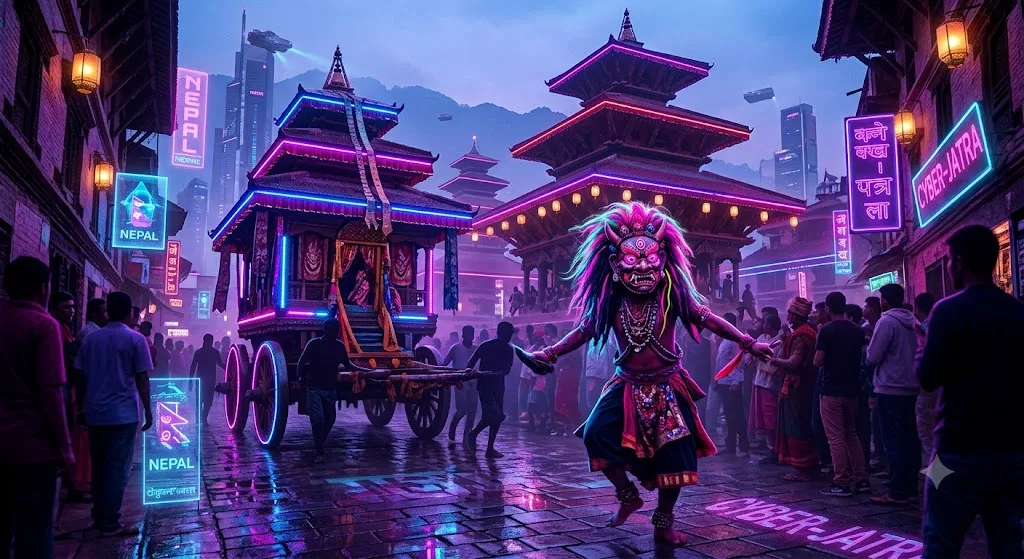
Nepalese demon lore is not always about evil beings that must simply be destroyed. Some figures are dangerous, but others become protectors once ritually contained, honoured or incorporated into public celebration. The Lakhe dance of the Kathmandu Valley is one of the clearest examples. Cultural Survival describes the Lakhe as part of Newar festival culture, especially associated with Indra Jatra, while Google Arts & Culture’s ICHCAP feature explains that the Majipa Lakhe mask is worshipped and prepared before public performance.[Cultural Survival]culturalsurvival.orgdemon among deitiesdemon among deities
The Lakhe is often described as a demon-like figure with a fierce mask, wild hair and powerful dancing movements. In popular understanding, the figure is frightening but also protective: the mask is not just costume but a ritual presence that must be fed, honoured and kept favourable. The ICHCAP account says offerings are made in the belief that the Lakhe will bless and protect villagers from epidemics.[Google Arts & Culture]artsandculture.google.comOpen source on google.com.
Ghode Jatra, the horse festival of Kathmandu, gives another version of the demon-as-ritual-memory pattern. Nepal Tourism Board presents the festival through the legend of a demon buried beneath Tundikhel, the large parade ground; horses are galloped over the ground to keep the evil spirit from rising again. Recent Kathmandu Post coverage similarly links the festival to local mythology about a child-threatening demon and the belief that horse-hooves keep his spirit down.[Nepal Tourism Board]ntb.gov.npOpen source on ntb.gov.np.
These traditions show that Nepalese folklore is often civic. The monster is not hidden in a forest waiting for one hero. It is remembered by a city, managed by ritual, and turned into public rhythm: drums, masks, chariots, horses, crowds and annual repetition.
Rain, chariots and seasonal danger
Many Nepalese festivals carry folk explanations for weather, agriculture and seasonal turning-points. Indra Jatra, one of Kathmandu’s major festivals, is associated with the deity Indra, rain, harvest anxiety and the public appearance of the Kumari. The festival comes at a sensitive seasonal moment around the retreat of the monsoon, when rain has nourished crops but can also threaten them if it continues too heavily.[Wikipedia]WikipediaIndra JatraIndra Jatra
Rato Machhindranath Jatra in Patan is another famous rain-linked chariot festival. Although popular tourism sources often simplify Machhindranath as a “rain god”, the tradition is more layered, connecting Buddhist, Hindu and Newar ritual worlds. Nepalese heritage commentary regularly treats it as one of the great living festivals of the Kathmandu Valley and a key example of intangible cultural heritage.[OnlineKhabar News]english.onlinekhabar.comOnline Khabar News Preserving Nepal's intangible cultural heritageOnline Khabar News Preserving Nepal's intangible cultural heritage
Bhaktapur’s Bisket Jatra shows how a festival can combine civic New Year celebration, deity processions and serpent legends. Popular accounts often connect the festival with stories of snakes or serpents killed, while more historically cautious sources note that the oldest ritual elements may relate to banners and solar New Year symbolism rather than the later serpent explanations. This is exactly where folklore becomes interesting: the popular story and the historical reconstruction are not identical, but both shape how people understand the festival today.[The Himalayan Times]thehimalayantimes.comThe Himalayan Times Bisket Jatra: Legends behind itThe Himalayan Times Bisket Jatra: Legends behind it
For readers, the important point is that Nepal’s festival folklore is not merely decorative. These stories help communities explain rain, fertility, urban protection, kingship, luck, danger and the turning of the year. They also provide natural internal links across Nepalese folklore: the Kumari, Indra Jatra, Lakhe dance, Newar chariot festivals, Bhaktapur legends and sacred urban spaces all belong to one wider ritual ecology.
The Yeti: Nepal’s world-famous mountain legend
The Yeti is the Nepalese and Himalayan folklore figure most familiar to international readers, often called the “Abominable Snowman” in Western popular culture. It is usually imagined as a large, wild, human-like or ape-like being of the high Himalaya, especially associated with Sherpa and wider Himalayan mountain lore. Its global fame grew through mountaineering reports, newspaper coverage and photographs of alleged footprints during the twentieth century.[alpinejournal.org.uk]alpinejournal.org.ukAJ 1999 81 87 Ward FootprintsAJ 1999 81 87 Ward Footprints
The famous 1951 Eric Shipton footprint photographs became central to modern Yeti mythology. The Alpine Journal article “The Yeti Footprints: Myth and Reality” discusses the 1951 Everest reconnaissance context and the later scrutiny of the prints. National Geographic’s account of Daniel Taylor’s long investigation also identifies Shipton’s photograph as one of the iconic images that helped turn a local mountain being into a global cryptid.[alpinejournal.org.uk]alpinejournal.org.ukAJ 1999 81 87 Ward FootprintsAJ 1999 81 87 Ward Footprints
The Yeti is especially useful for separating folklore from cryptozoology. As folklore, it is real: people have told stories, interpreted tracks, warned children, mapped danger and imagined the high mountains through this figure. As zoological evidence, the case is much weaker. A 2017 genetic study reported in Time analysed samples attributed to the Yeti and found that they came from local bears or, in one case, a dog, strongly supporting the view that many “Yeti” remains are misidentified animal material.[Time]time.comAre Yetis Real? They're Probably Just Himalayan Brown Bears, Scientists SayAre Yetis Real? They're Probably Just Himalayan Brown Bears, Scientists Say
The most curious official document in Yeti history may be the 1959 United States State Department memo summarising Nepal’s rules for Yeti expeditions. The US National Archives notes that expeditions had to pay the Nepalese government for a permit, could photograph or capture the creature but not kill it, and had to turn over evidence to Nepalese officials. This does not prove the Yeti existed; it proves the legend had become diplomatically and commercially significant enough to require rules.[National Archives Foundation]archivesfoundation.orgyeti sightings rules circa 1959yeti sightings rules circa 1959

Spirits, healers and household explanations of misfortune
Not all Nepalese supernatural tradition is spectacular. Much of it belongs to everyday explanations of illness, envy, misfortune, possession and social tension. Anthropological work on spirit possession in central Nepal describes how witches, spirits, ghosts of the dead and local deities may be invoked to explain suffering, especially when unresolved social relationships or ritual obligations are thought to disturb the living.[DigitalCommons]digitalcommons.macalester.eduOpen source on macalester.edu.
Shamanic and traditional healing practices vary widely across Nepal, but many involve ritual specialists who use drums, costumes, bells, chants and relationships with tutelary spirits to diagnose or treat affliction. Cultural Survival’s account of diverse shamanisms in Nepal describes equipment such as the drum, special costume, head-dress and bells, used to engage spirits, ghosts and witches. A 2021 scoping review on traditional healers and mental health in Nepal also shows that traditional healing remains part of the wider health-seeking landscape, especially where biomedical care is limited, costly or culturally distant.[Cultural Survival]culturalsurvival.orgamong spirits and dietiesdiverse shamanisms nepalamong spirits and dietiesdiverse shamanisms nepal
For folklore readers, this is where “belief” becomes practical. A ghost story may not be just entertainment; it may frame grief. A spirit diagnosis may not be just superstition; it may express conflict, fear, inheritance pressure, sickness, jealousy or trauma. That does not mean all such explanations are harmless. It means they should be read as social systems as well as supernatural narratives.
Witchcraft belief and the danger of accusation
Nepalese witchcraft belief must be handled carefully because it is not only folklore; it has also been linked to real violence. Public health and human rights sources describe witchcraft accusations in Nepal as a continuing form of violence, especially against women. A PubMed-indexed article calls witchcraft accusations and witch-hunting activities serious problems in Nepal, with women subjected to violence and torture.[PubMed]pubmed.ncbi.nlm.nih.govOpen source on nih.gov.
The social pattern is important. Comparative research on Ghana and Nepal notes that suspected witches are often poor, elderly, female or widowed, and that accusations can reflect deeper tensions around gender, status, illness, poverty and local conflict. Other Nepal-focused reports and legal discussions connect accusations with marginalisation, lack of education, property disputes and community pressure.[Academic Journals]academicjournals.orgOpen source on academicjournals.org.
Nepal has taken legal action against such practices. The Kathmandu Post reported in 2015 that Nepal’s Witchcraft Act prohibited accusing or assaulting a woman on charges of practising witchcraft and introduced prison terms and fines. Later legal provisions under Nepal’s criminal code also addressed inhuman treatment linked to witchcraft accusations.[The Kathmandu Post]kathmandupost.comrights groups laud witchcraft actrights groups laud witchcraft act
This is one of the places where a folklore article should not romanticise the supernatural. Stories of witches, spirits and harmful magic may be culturally significant, but accusations against living people can become abuse. A responsible reading distinguishes the study of belief from endorsement of persecution.
Oral tales, riddles and everyday moral storytelling
Beyond famous festivals and supernatural beings, Nepal has a deep oral storytelling culture: animal tales, trickster stories, moral fables, riddles, songs and local legends. Open Library records Kesar Lall’s Folk Tales from the Himalayan Kingdom of Nepal: Black Rice and Other Stories, published in Kathmandu in 1993, as a collection of retold Nepalese folk tales. Other accessible collections and educational retellings show common South Asian tale-patterns adapted into Nepalese settings, such as clever animals, foolish kings, greedy villagers, magical objects and encounters with death.[Open Library]openlibrary.orgOpen source on openlibrary.org.
Recent Nepalese scholarship on folktales has emphasised their moral and educational role. A study on folktales in Nepali communities describes them as a way of conveying folk wisdom, interpreting human behaviour and supporting classroom learning. This helps explain why many folk tales feel simple on the surface: they are often designed to be remembered, repeated and applied.[ResearchGate]researchgate.netResearch Gate Folktales: A Moral Message from the Past to the FutureResearch Gate Folktales: A Moral Message from the Past to the Future
Folk songs and dances also carry story. Research on Nepalese folk music describes folk songs as oral tradition rather than written composition, representing the expressions of ordinary people in social life, ritual and festival settings. This means the “text” of Nepalese folklore is often not a text at all: it may be a tune, a dance, a riddle, a proverb, a mask, a route or a seasonal performance.[nepjol.info]nepjol.infoOpen source on nepjol.info.
What changed in modern Nepal
Modern Nepal has changed the setting in which folklore is performed and interpreted. The monarchy ended in 2008, yet traditions once tied to royal power, such as the Kumari’s national role, have adapted to the republic. Associated Press coverage of Indra Jatra shows the Kumari tradition continuing in front of large crowds and cameras, while modern commentary notes education, technology and children’s rights debates around former and current Kumaris.[AP News]apnews.comOpen source on apnews.com.
Tourism has also changed the audience. The Yeti became an international brand as much as a local mountain being; Kathmandu’s sacred squares became heritage destinations; festivals became photographic spectacles. That can help preserve visibility and income, but it can also flatten complex traditions into quick labels: “living goddess”, “demon dance”, “snake festival”, “Yeti scalp”. Good folklore writing should resist that flattening by asking what the tradition means locally, how it is performed, and what evidence supports each claim.[National Archives Museum]visit.archives.govOpen source on archives.gov.
Digital media adds another layer. YouTube retellings, tourism blogs, social media reels and AI-era language projects are now part of how Nepalese stories circulate. Recent work on low-resource Nepalese languages, including Nepal Bhasa, Tharu and Tamang, shows how digitisation can support cultural preservation but also risks simplifying dialects, oral nuance and community authority if handled carelessly.[arXiv]arxiv.orgOpen source on arxiv.org.
How to read Nepalese folklore without flattening it
The safest way to approach Nepalese folklore is to keep four distinctions in mind.
First, distinguish living ritual from old story. The Kumari, Lakhe dance, Indra Jatra and Ghode Jatra are not just narratives; they are performed traditions with communities, rules, bodies and places attached.[apnews.com]apnews.comOpen source on apnews.com.
Second, distinguish local belief from tourist shorthand. “Rain god”, “demon”, “living goddess” and “Yeti” are useful entry points, but each term can hide a more complex local history involving Hindu, Buddhist, Newar, Sherpa, royal, civic or regional meanings.[OnlineKhabar News]english.onlinekhabar.comOnline Khabar News Preserving Nepal's intangible cultural heritageOnline Khabar News Preserving Nepal's intangible cultural heritage
Third, distinguish folklore from proof claims. The Yeti is a powerful folklore figure even if alleged biological evidence is better explained by bears. The Kathmandu lake legend remains culturally meaningful even though geology explains the ancient lake through natural processes.[Time]time.comAre Yetis Real? They're Probably Just Himalayan Brown Bears, Scientists SayAre Yetis Real? They're Probably Just Himalayan Brown Bears, Scientists Say
Finally, distinguish cultural study from harm. Spirit and witchcraft beliefs are part of Nepal’s supernatural imagination, but accusations against real people can lead to violence and have been addressed by law.[PubMed]pubmed.ncbi.nlm.nih.govOpen source on nih.gov.
Nepal’s folklore is therefore best understood as a living cultural field: sacred landscapes, public festivals, oral tales, frightening beings, protective masks, healing practices and contested modern meanings. Its strongest traditions are not simply “ancient survivals”; they are old stories still being tested in modern streets, courts, classrooms, museums, monasteries, trekking routes and family memory.
Amazon book picks
Further Reading
Books and field guides related to Where Nepal's Legends Still Walk the Streets. Use these as the next step if you want deeper reading beyond the article.
The Snow Leopard
Captures the spiritual and cultural atmosphere that informs many mountain legends.
Nepal Mandala
Explains the ritual world, sacred geography and traditions behind many Nepalese legends.
Myths and Legends of Nepal
Directly covers the myths, spirits, legends and traditional stories that underpin Nepalese folklore.
From the Sacred Mountain: A Journey Among the Peoples of the...
Provides rich cultural context for Himalayan religious traditions, legends and sacred landscapes.
eBay marketplace picks
Marketplace Samples
Live-tested eBay searches with available results related to this page.
Endnotes
1.
Source: unesdoc.unesco.org
Link:https://unesdoc.unesco.org/ark%3A/48223/pf0000156786
2.
Source: whc.unesco.org
Title: World Heritage Centre Kathmandu Valley
Link:https://whc.unesco.org/en/list/121/
3.
Source: censusresults.nsonepal.gov.np
Link:https://censusresults.nsonepal.gov.np/downloads/caste-ethnicity?type=report
4.
Source: giwmscdnone.gov.np
Link:https://giwmscdnone.gov.np/media/pdf_upload/Language%20in%20Nepal%20for%20website%20final_1khyn42.pdf
5.
Source: artsandculture.google.com
Link:https://artsandculture.google.com/story/infamous-but-captivating-lakhe-dance-of-nepal-ichcap/7wVxVo4jDR4cLA?hl=en
6.
Source: nepjol.info
Link:https://www.nepjol.info/index.php/batuk/article/download/90047/68533/258250
7.
Source: ntb.gov.np
Title: living goddess kumari
Link:https://ntb.gov.np/living-goddess-kumari
8.
Source: ntb.gov.np
Link:https://ntb.gov.np/en/ghode-jatra
9.
Source: Wikipedia
Title: Indra Jatra
Link:https://en.wikipedia.org/wiki/Indra_Jatra
10.
Source: english.onlinekhabar.com
Title: Online Khabar News Preserving Nepal’s intangible cultural heritage
Link:https://english.onlinekhabar.com/preserving-nepals-intangible-cultural-heritage.html
11.
Source: Wikipedia
Title: Bisket Jatra
Link:https://en.wikipedia.org/wiki/Bisket_Jatra
12.
Source: alpinejournal.org.uk
Title: AJ 1999 81 87 Ward Footprints
Link:https://www.alpinejournal.org.uk/Contents/Contents_1999_files/AJ%201999%2081-87%20Ward%20Footprints.pdf
13.
Source: time.com
Title: Are Yetis Real? They’re Probably Just Himalayan Brown Bears, Scientists Say
Link:https://time.com/5040754/yeti-bear-study/
14.
Source: visit.archives.gov
Link:https://visit.archives.gov/whats-on/explore-exhibits/want-hunt-yeti
15.
Source: Wikipedia
Title: Witch hunts in Nepal
Link:https://en.wikipedia.org/wiki/Witch_hunts_in_Nepal
16.
Source: researchgate.net
Title: Research Gate Folktales: A Moral Message from the Past to the Future
Link:https://www.researchgate.net/publication/391453355_Folktales_A_Moral_Message_from_the_Past_to_the_Future_Generation
17.
Source: nepjol.info
Link:https://www.nepjol.info/index.php/rainbowj/article/download/44251/33422/129962
18.
Source: arxiv.org
Link:https://arxiv.org/abs/2603.07554
19.
Source: arxiv.org
Link:https://arxiv.org/abs/2603.17220
20.
Source: arxiv.org
Link:https://arxiv.org/abs/2603.14053
21.
Source: Wikipedia
Link:https://en.wikipedia.org/wiki/Nepal
22.
Source: Wikipedia
Title: Rato Machindranath Jatra
Link:https://en.wikipedia.org/wiki/Rato_Machindranath_Jatra
23.
Source: Wikipedia
Link:https://en.wikipedia.org/wiki/Yeti
24.
Source: Wikipedia
Title: Eric Shipton
Link:https://en.wikipedia.org/wiki/Eric_Shipton
25.
Source: Wikipedia
Link:https://en.wikipedia.org/wiki/Lakhey
26.
Source: Wikipedia
Title: Ethnic groups in Nepal
Link:https://en.wikipedia.org/wiki/Ethnic_groups_in_Nepal
27.
Source: Wikipedia
Title: Languages of Nepal
Link:https://en.wikipedia.org/wiki/Languages_of_Nepal
28.
Source: researchgate.net
Title: 393435528 Kathmandu Valley A Living Cultural Heritage City of Nepal
Link:https://www.researchgate.net/publication/393435528_Kathmandu_Valley_A_Living_Cultural_Heritage_City_of_Nepal
29.
Source: researchgate.net
Link:https://www.researchgate.net/publication/227728687_A_Shaman%27s_Cure_The_Relationship_Between_Altered_States_of_Consciousness_and_Shamanic_Healing1
30.
Source: researchgate.net
Link:https://www.researchgate.net/publication/322519965_Imagining_the_Wild_Man_Yeti_Sightings_in_Folktales_and_Newspapers_of_the_Darjeeling_and_Kalimpong_Hills
31.
Source: researchgate.net
Link:https://www.researchgate.net/publication/324847901_A_Study_of_Living_Godess_Kumari_The_Source_of_Cultural_Tourism_in_Nepal
32.
Source: researchgate.net
Title: 394849545 Trends in Nepal’s Linguistic Demography Insights from the 2021 Census
Link:https://www.researchgate.net/publication/394849545_Trends_in_Nepal%27s_Linguistic_Demography_Insights_from_the_2021_Census
33.
Source: researchgate.net
Link:https://www.researchgate.net/publication/385930503_Language_Data_in_National_Population_and_Housing_Census_of_Nepal_2021_Acritical_Analysis
34.
Source: researchgate.net
Link:https://www.researchgate.net/publication/277774465_Gendered_injustice_A_comparative_analysis_of_witchcraft_beliefs_and_witchcraft-related_violence_in_Ghana_and_Nepal
35.
Source: researchgate.net
Title: 337705425 Witchcraft Accusation and Persecution of Women in Nepal
Link:https://www.researchgate.net/publication/337705425_Witchcraft_Accusation_and_Persecution_of_Women_in_Nepal
36.
Source: researchgate.net
Title: 400190581 Manjusri in Nepali Context A Case of Chobhar
Link:https://www.researchgate.net/publication/400190581_Manjusri_in_Nepali_Context_A_Case_of_Chobhar
37.
Source: unesco.org
Link:https://www.unesco.org/en
38.
Source: whc.unesco.org
Link:https://whc.unesco.org/document/167760
39.
Source: whc.unesco.org
Link:https://whc.unesco.org/archive/advisory_body_evaluation/121bis.pdf
40.
Source: whc.unesco.org
Link:https://whc.unesco.org/document/4968
41.
Source: whc.unesco.org
Link:https://whc.unesco.org/document/135321
42.
Source: whc.unesco.org
Title: mis121 2007
Link:https://whc.unesco.org/archive/2007/mis121-2007.pdf
43.
Source: whc.unesco.org
Link:https://whc.unesco.org/fr/activites/901/
44.
Source: whc.unesco.org
Link:https://whc.unesco.org/en/tentativelists/5893/
45.
Source: whc.unesco.org
Link:https://whc.unesco.org/en/list/
46.
Source: whc.unesco.org
Link:https://whc.unesco.org/archive/2016/whc16-40com-7BAdd-en.pdf
47.
Source: unesdoc.unesco.org
Link:https://unesdoc.unesco.org/ark%3A/48223/pf0000079729
48.
Source: giwmscdnone.gov.np
Link:https://giwmscdnone.gov.np/media/pdf_upload/NFDIN%20Encyclopedia%20of%20Indigenous%20Nationalities%20of%20Nepal%20-%20Vol%201%20%28English%29_ixzxr6z.pdf
49.
Source: giwmscdnone.gov.np
Link:https://giwmscdnone.gov.np/media/pdf_upload/Nepal_Atlas_Caste_and_Ethnic_Groups_mkuqof1.pdf
50.
Source: books.google.com
Title: National Report on Caste ethnicity Langu
Link:https://books.google.com/books/about/National_Report_on_Caste_ethnicity_Langu.html?id=k7iy0AEACAAJ
51.
Source: nepjol.info
Link:https://nepjol.info/index.php/TUJ/article/view/25966/21632
52.
Source: nepjol.info
Link:https://www.nepjol.info/index.php/DSAJ/article/view/55720/41611
53.
Source: nepjol.info
Link:https://www.nepjol.info/index.php/jj/article/view/83296
54.
Source: nepjol.info
Link:https://www.nepjol.info/index.php/njs2/article/download/81322/62383/234134
55.
Source: youtube.com
Link:https://www.youtube.com/watch?v=aYJ5veT7N68
56.
Source: youtube.com
Link:https://www.youtube.com/c/nepalifolktales
57.
Source: youtube.com
Link:https://www.youtube.com/watch?v=zcpSz27VHv4
58.
Source: ntb.gov.np
Link:https://ntb.gov.np/
59.
Source: ntb.gov.np
Link:https://ntb.gov.np/indra-jatra
60.
Source: un.info.np
Link:https://un.info.np/Net/NeoDocs/View/History/Default.aspx?RefId=1464
61.
Source: kms.pri.gov.np
Link:https://kms.pri.gov.np/libcat/opac_css/index.php?id=1768&lvl=notice_display
62.
Source: dfat.gov.au
Link:https://www.dfat.gov.au/geo/nepal/nepal-country-brief
63.
Source: youtube.com
Title: The Legend of Gurumapa
Link:https://www.youtube.com/watch?v=PUQJQqdHNP0
Source snippet
The Tale Of Punkhu Maicha | Magic of Dhon Cholecha & the Yomari Tree...
64.
Source: youtube.com
Title: The Tale Of Punkhu Maicha | Magic of Dhon Cholecha & the Yomari Tree
Link:https://www.youtube.com/watch?v=khrQEHgArDk
Source snippet
The Lord of Rain and Grain | Karunamaya - Rato Machhindranath Jatra...
65.
Source: youtube.com
Title: The Lord of Rain and Grain | Karunamaya
Link:https://www.youtube.com/watch?v=OOu-cYwFlzE
Source snippet
Goddess of Swayambhunath - Legend of Harati Ajima...
66.
Source: youtube.com
Title: Goddess of Swayambhunath
Link:https://www.youtube.com/watch?v=0ztUutqdmX0
Source snippet
Yeti - The Mythical Creature | The Tales of Nepal...
67.
Source: youtube.com
Link:https://www.youtube.com/watch?v=uCDa526bqdU
68.
Source: apnews.com
Link:https://apnews.com/article/2c38435573fb934dc10c5a9d1f4b6e99
69.
Source: nepalitimes.com
Title: Nepali Times The lake that was once Kathmandu
Link:https://nepalitimes.com/the-lake-that-was-once-kathmandu
70.
Source: nepalitimes.com
Title: Nepali Times The hill of the flaming lotus
Link:https://nepalitimes.com/the-hill-of-the-flaming-lotus
71.
Source: internationaljournalssrg.org
Title: Seventh Sense Research Group A Critical Study of the Kumari Tradition in Nepal
Link:https://www.internationaljournalssrg.org/IJHSS/2025/Volume12-Issue2/IJHSS-V12I2P107.pdf
72.
Source: culturalsurvival.org
Title: demon among deities
Link:https://www.culturalsurvival.org/publications/cultural-survival-quarterly/demon-among-deities
73.
Source: kathmandupost.com
Title: ghode jatra marked with grandeur at tundikhel
Link:https://kathmandupost.com/visual-stories/2026/03/18/ghode-jatra-marked-with-grandeur-at-tundikhel
74.
Source: thehimalayantimes.com
Title: The Himalayan Times Bisket Jatra: Legends behind it
Link:https://thehimalayantimes.com/ampArticle/194926
75.
Source: archivesfoundation.org
Title: yeti sightings rules circa 1959
Link:https://archivesfoundation.org/documents/yeti-sightings-rules-circa-1959/
76.
Source: digitalcommons.macalester.edu
Link:https://digitalcommons.macalester.edu/cgi/viewcontent.cgi?article=1216&context=himalaya
77.
Source: culturalsurvival.org
Title: among spirits and dietiesdiverse shamanisms nepal
Link:https://www.culturalsurvival.org/pt-br/publications/cultural-survival-quarterly/among-spirits-and-dietiesdiverse-shamanisms-nepal
78.
Source: pmc.ncbi.nlm.nih.gov
Link:https://pmc.ncbi.nlm.nih.gov/articles/PMC7680349/
79.
Source: pubmed.ncbi.nlm.nih.gov
Link:https://pubmed.ncbi.nlm.nih.gov/33632014/
80.
Source: academicjournals.org
Link:https://academicjournals.org/journal/IJSA/article-full-text-pdf/E405B8747740
81.
Source: kathmandupost.com
Title: rights groups laud witchcraft act
Link:https://kathmandupost.com/national/2015/08/01/rights-groups-laud-witchcraft-act
82.
Source: openlibrary.org
Link:https://openlibrary.org/works/OL38835263W/Folk_tales_from_the_Himalayan_kingdom_of_Nepal
83.
Source: nepalitimes.com
Title: decoding diversity
Link:https://nepalitimes.com/decoding-diversity
84.
Source: nepalitimes.com
Title: census or consensus
Link:https://nepalitimes.com/census-or-consensus
85.
Source: kathmandupost.com
Title: taking indra jatra to the world
Link:https://kathmandupost.com/columns/2022/09/13/taking-indra-jatra-to-the-world
86.
Source: kathmandupost.com
Title: number of caste ethnicity in nepal increases to 142
Link:https://kathmandupost.com/national/2023/06/03/number-of-caste-ethnicity-in-nepal-increases-to-142
87.
Source: kids.nationalgeographic.com
Link:https://kids.nationalgeographic.com/geography/countries/article/nepal
88.
Source: opac.tucl.edu.np
Title: opac ISBDdetail.pl
Link:https://opac.tucl.edu.np/cgi-bin/koha/opac-ISBDdetail.pl?biblionumber=110795
89.
Source: elibrary.tucl.edu.np
Title: tucl.edu.np CHAPTE R I
Link:https://elibrary.tucl.edu.np/bitstreams/84e3e5b5-b0ba-45cf-bbd3-76b739a9b7eb/download
90.
Source: elibrary.tucl.edu.np
Link:https://elibrary.tucl.edu.np/bitstreams/111882ca-131d-4dc6-a041-2f617ee960ce/download
91.
Source: alpineluxurytreks.com
Title: rato machhindranath jatra
Link:https://alpineluxurytreks.com/blog/rato-machhindranath-jatra
92.
Source: scholarspace.manoa.hawaii.edu
Link:https://scholarspace.manoa.hawaii.edu/bitstreams/a045272f-76de-4cd8-b806-096b06696107/download
93.
Source: trekmenepal.com
Title: kumari tradition
Link:https://trekmenepal.com/blog/2025/kumari-tradition/
94.
Source: unwomen.org
Link:https://www.unwomen.org/sites/default/files/Headquarters/Attachments/Sections/CSW/64/National-reviews/Nepal.pdf
95.
Source: vajraadventure.com
Link:https://www.vajraadventure.com/blog/yeti
96.
Source: theannapurnaexpress.com
Link:https://theannapurnaexpress.com/story/62992/
97.
Source: arjunlimbu.wordpress.com
Link:https://arjunlimbu.wordpress.com/2018/09/25/swayambhu/
98.
Source: worldbank.org
Link:https://www.worldbank.org/ext/en/country/nepal
99.
Source: globaledge.msu.edu
Link:https://globaledge.msu.edu/countries/nepal
Additional References
100.
Source: thetimes.co.uk
Link:https://www.thetimes.co.uk/article/daughter-living-goddess-deity-kumari-lvmvts8v5
Source snippet
Installed in the Kumari Ghar in Kathmandu’s Durbar Square, Aryatara is now revered by thousands who gather to glimpse her from her temple...
101.
Source: academia.edu
Link:https://www.academia.edu/13710400/Kum%C4%81r%C4%AB_Nepal_s_Eternally_Living_Goddess
102.
Source: academia.edu
Link:https://www.academia.edu/105046956/The_Transformation_of_Evil_in_Nepal
103.
Source: lahurnip.org
Link:https://www.lahurnip.org/uploads/resource/file/caste-ethnicity-report-nphc-2021.pdf
104.
Source: academia.edu
Link:https://www.academia.edu/127363020/Rhetorics_of_Nepali_Folklore
105.
Source: academia.edu
Link:https://www.academia.edu/14151611/2013_The_Indrajatra_festival_of_Kathmandu_Nepal_In_Contemporary_Hinduism_ed_P_Pratap_Kumar_Durham_Acumen
106.
Source: instagram.com
Link:https://www.instagram.com/reel/DN-q_8FkwKF/
107.
Source: facebook.com
Link:https://www.facebook.com/NepalTravellerDigital/posts/according-to-folklore-the-valley-was-drained-by-the-bodhisattva-manjushree-and-t/1376428324506493/
108.
Source: scribd.com
Link:https://www.scribd.com/document/466120543/Folk-Tales-of-Nepal-Karunakar-Vaidya-Compressed-pdf
109.
Source: instagram.com
Link:https://www.instagram.com/p/DW8FCrGCN-l/
Topic Tree
Follow this branch
Related pages 192
- Afghan Folklore
- Albanian Folklore
- Algerian Folklore
- Australian Folklore
- Azerbaijan Folklore
- +187 more in sidebar