Living Folklore of Liberia
Liberian folklore is best understood as a living mix of oral storytelling, masked performance, initiation traditions, sacred landscapes and regional West African spirit beliefs rather than as one single national mythology.
Page outline Jump by section
Why Liberia’s folklore is more than a list of tales
A useful starting point is that Liberia’s story culture sits inside the wider Upper Guinean forest region, where ethnic, linguistic and ritual traditions cross modern borders. Kpelle, Bassa, Gola, Vai, Grebo, Kru, Loma, Mano, Mende and other Liberian communities have their own histories and local forms, but many story patterns travel across communities. A Liberian folktale collection may therefore be organised by ethnic origin, by genre, or by recurring characters such as the trickster, depending on what the editor wants readers to notice.[patricksplace.org]patricksplace.orgOpen source on patricksplace.org.
This is why a country-level page on Liberia should not pretend that every tale belongs neatly to a single tribe, nor that folklore stopped changing once it was written down. Patrick’s Place, a Liberia-focused historical and cultural site, notes that Legends of Liberia was first a limited-circulation mimeographed collection, later reissued by the Society of Liberian Authors in 1973, and that its tales can be read through genres such as historical accounts, trickster tales, wonder tales, dilemma stories and morality tales.[patricksplace.org]patricksplace.orgOpen source on patricksplace.org.
The best reading, then, is layered. A tale may be a children’s story, a comic performance, a moral lesson, a memory of migration, a warning about greed, or a display of verbal artistry. In Bandi oral narrative research published in the Liberian Studies Journal, Patricia O’Connell distinguishes between “history”, treated as an account of real people and events, and folktale, understood as story shaped by archetypal characters, formulae, song and performance.[ScholarWorks]scholarworks.iu.eduScholar WorksScholar Works
The spider: Liberia’s clever, greedy and dangerous trickster
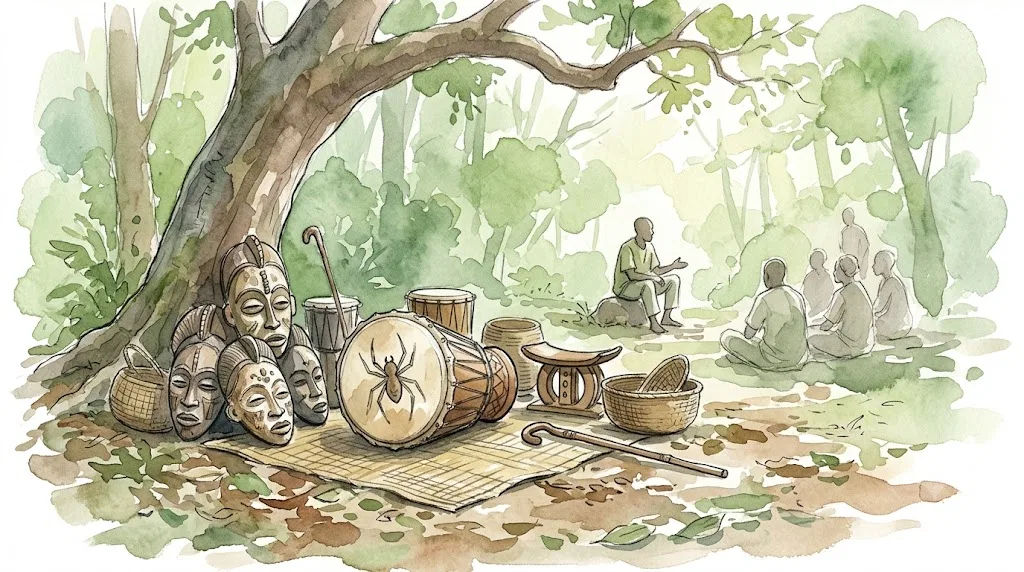
The most recognisable Liberian folktale figure for many readers is the spider. In wider West African and Atlantic folklore, spider figures often appear as tricksters: small, hungry, socially slippery characters who survive through intelligence, deception and comic nerve. Liberia’s spider is not simply a local copy of Ghana’s Anansi, but the family resemblance is strong enough that Liberia-focused folktale commentary explicitly notes the connection between the Kpelle spider figure and Anansi traditions known elsewhere in West Africa and the Caribbean.[patricksplace.org]patricksplace.orgOpen source on patricksplace.org.
That comparison is useful, but it should not flatten Liberia’s local stories. In the Bandi example described by O’Connell, a performer tells of Spider killing a baboon and turning the head into a drum; the point is not just the plot but the performance. The storyteller crouches, changes his voice, imitates Spider playing the drum, and lets the audience enjoy the trickster’s self-satisfaction before the danger catches up with him.[ScholarWorks]scholarworks.iu.eduScholar WorksScholar Works
Spider tales work because they are morally unstable. Spider can be admirable when wit defeats strength, but repellent when cleverness becomes cruelty, greed or betrayal. That instability is exactly what makes trickster folklore memorable: the listener is invited to laugh, but also to judge. In Liberian storytelling, as in many West African tale traditions, animals are not just decorative characters. They let communities talk about appetite, status, foolishness, work, kinship and social rules at a safe imaginative distance.[patricksplace.org]patricksplace.orgOpen source on patricksplace.org.

Masks, spirits and the public face of restricted traditions
For many outsiders, Liberia’s most visually striking folklore is not a fireside tale but a mask in motion. Masking traditions are closely tied to rites of passage and to institutions such as the men’s Poro society and the women’s Sande society. The Liberia National Tourism Authority explains that masks communicate history, moral values and communal discipline, and that in these traditions a mask is not treated merely as an individual’s costume but as a recognised presence bearing authority, wisdom and responsibility.[Liberia National Tourism Authority]lnta.gov.lrLiberia National Tourism Authority16 Tribal MasksLiberia National Tourism Authority16 Tribal Masks
Museum sources help show the same point from the material-culture side. SFO Museum’s exhibition on Liberian helmet masks explains that Sande masks, often called by names such as sowei or zogbe in the literature, play a central role in Sande ritual activity and embody the spirit and ideals of the society. It also notes Poro-associated helmet masks among Vai, Mende, Gola, De and Southern Kpelle communities, including forms known as gbetu or bowu.[sfomuseum.org]sfomuseum.orgOpen source on sfomuseum.org.
This is where public folklore writing must be careful. These masks are often displayed in museums, tourism pages or educational contexts, but the societies around them include restricted knowledge, initiation practices and sacred obligations. A public article can discuss what museums, scholars and Liberian cultural institutions have made available, but it should not pretend to reveal private ritual meanings. The most respectful framing is to say that mask traditions stand at the boundary between art, social education, spiritual presence and community authority.[sfomuseum.org]sfomuseum.orgOpen source on sfomuseum.org.
There is also a modern layer. The Liberia National Tourism Authority notes that displays of the “Sixteen Tribal Masks” may be symbolic, modern or standardised carvings made for education and tourism, even when they draw inspiration from older masking traditions. That distinction matters: a souvenir or official display can introduce visitors to Liberia’s cultural identity, but it is not the same thing as a living ritual performance in its own setting.[Liberia National Tourism Authority]lnta.gov.lrLiberia National Tourism Authority16 Tribal MasksLiberia National Tourism Authority16 Tribal Masks
Sande, Poro and the forest as a place of transformation
Liberian folklore is deeply connected to place, especially the forest. In many accounts of Poro and Sande initiation, the “bush” or forest is not merely a backdrop. It is a controlled social and spiritual space where young people are separated from ordinary life, taught, disciplined and returned with a changed status. Cambridge-published archaeological work on Providence Island notes that Liberian colleagues and historical sources have associated the island’s landscape, including cotton trees and mangroves, with older Indigenous practices, possibly including Poro and Sande coming-of-age rituals before the site became best known for settler heritage narratives.[Cambridge University Press & Assessment]cambridge.orgOpen source on cambridge.org.
This gives Liberia’s sacred landscapes a double life in public memory. Providence Island, for example, is often discussed through the 1822 arrival of Black Americans and the formation of settler Liberia, but current archaeology argues for a broader story that includes Indigenous histories and uses of the place. For folklore readers, that is an important correction: sacred or story-rich places may be overwritten by national history, tourism or politics without losing their older local meanings.[Cambridge University Press & Assessment]cambridge.orgOpen source on cambridge.org.
The forest also explains why some traditions are hard to document. Folklore here is not always a text waiting to be collected. It can be a path, a grove, a seasonal gathering, a mask’s appearance, a rule about who may look, or a silence maintained because secrecy itself is part of the tradition. That makes Liberia’s folklore both rich and difficult for outsiders to summarise without distortion.
Legends of Liberia and the written afterlife of oral tales
One of the most important landmarks in the public preservation of Liberian folktales is Legends of Liberia. According to the European External Action Service, the book was produced after President William V. S. Tubman asked Peter Pinney to compile and write down oral stories from Liberia in order to preserve the country’s cultural heritage. A 2017 EU-supported re-edition presented the book as a collection of stories from Liberia’s 15 counties and 15 Indigenous groups, traditionally passed from parents to children in unwritten form.[European External Action Service]eeas.europa.euOpen source on europa.eu.
This written afterlife is valuable but complicated. Once oral tales enter books, school projects, audio versions or online databases, they become easier to share but also easier to detach from their original performance settings. A story that once depended on call-and-response, song, gesture, night-time atmosphere and a known community of listeners may appear on the page as a simple plot summary.[European External Action Service]eeas.europa.euOpen source on europa.eu.
The online folktale project at Patrick’s Place tries to address this by not only collecting tales but also drawing attention to genre patterns and cross-community similarities. Its categories include trickster tales, historical accounts, fantasy and wonder tales, dilemma stories and morality tales. That is useful for modern readers because it shows that Liberian folklore is not just a pile of charming old stories; it is a patterned body of oral literature with recurring social functions.[patricksplace.org]patricksplace.orgOpen source on patricksplace.org.

Storytelling as performance, not just plot
A common mistake is to read Liberian folktales as if the written words are the whole tradition. O’Connell’s Bandi research shows why that misses the point. Folktales were often told at night, especially during moonlit dry-season nights when people could gather after farm work. Sessions could include many stories told quickly back and forth, and songs were often essential to the tale rather than decorative extras.[ScholarWorks]scholarworks.iu.eduScholar WorksScholar Works
This changes how a reader should imagine a Liberian tale. The story is not simply “Spider tricks Baboon” or “a greedy person loses a blessing”. It is a social event: someone begins with a recognised opening, others respond, the performer shifts voice and posture, the audience laughs, and the song carries part of the meaning. In this form, folklore teaches through pleasure. It does not lecture; it lets listeners feel the consequences of foolishness, envy, laziness, disrespect or excessive cleverness.
The performance setting also helps explain why older people are often described as especially important storytellers. In O’Connell’s account, almost anyone might tell a story, but middle-aged and older people were usually considered the best because they had enough experience and a large enough store of tales. That does not mean young people were passive; it means storytelling was one of the ways age, memory and authority were made visible in ordinary life.[ScholarWorks]scholarworks.iu.eduScholar WorksScholar Works
Water spirits, mermaids and the Mami Wata connection
Liberia also belongs to a wider West African world of water-spirit traditions. The figure often called Mami Wata appears across much of Africa and the African Atlantic world, usually associated with water, beauty, danger, wealth, healing, seduction or spiritual obligation. Smithsonian material describes Mami Wata as a powerful water spirit recognised by diverse African communities, with modern imagery shaped in part by late nineteenth-century global visual circulation.[National Museum of African Art]africa.si.eduOpen source on si.edu.
For Liberia, the safest way to discuss Mami Wata is as a regional tradition that may appear in coastal and riverine West African contexts rather than as a single, uniform Liberian deity. National Museum Scotland’s overview notes that trading routes expanded Mami Wata’s influence across a wide region from Senegal to Zambia, while Fowler Museum material presents her as part of a broad complex of water-spirit arts in Africa and its diasporas.[National Museums Scotland]nms.ac.ukOpen source on nms.ac.uk.
That regional framing matters because internet folklore often turns Mami Wata into a generic “African mermaid”. In actual belief and art traditions, she is more complicated: sometimes beautiful, sometimes dangerous, sometimes connected with snakes, wealth or healing, and often adapted through local religious worlds. For Liberian folklore, she is best treated as part of the country’s wider coastal West African spirit environment, not as the sole or defining figure of Liberian supernatural tradition.
What is old, what is modern, and what is tourist-friendly?
Liberian folklore today reaches readers through several channels, and they do not all carry the same kind of evidence. Old oral tradition survives in families, performances, initiation institutions and local memory. Published collections such as Legends of Liberia preserve versions of tales but also freeze them into edited English-language forms. Museums display masks as works of art and cultural history, while tourism pages use masks and tribal symbolism to introduce national heritage to visitors.[europa.eu]eeas.europa.euOpen source on europa.eu.
A practical way to read modern Liberian folklore is to ask four questions:
- Is this a performed tradition or a written retelling? A folktale in a book may be authentic in origin but still missing song, gesture, language and audience response.
- Is the source local, scholarly, museum-based or tourist-facing? Each can be useful, but each frames the material differently.
- Is the tradition public or restricted? Masking and initiation traditions may have public aspects and private meanings.
- Is the claim Liberia-specific or regionally West African? Spider tricksters and water spirits cross borders, but local names, settings and uses matter.
This approach avoids two common errors: treating every online retelling as ancient tradition, and dismissing modern versions as fake simply because they have been adapted. Folklore changes by being retold. The real task is to notice what kind of retelling is in front of you.
Why Liberia’s folklore still matters
Liberia’s folklore matters because it keeps together forms of knowledge that modern categories often separate. A spider story may be comedy, ethics and social criticism at once. A mask may be art, spirit presence, public discipline and initiation memory. A sacred landscape may be an archaeological site, a national symbol and an older Indigenous place of transformation.[iu.edu]scholarworks.iu.eduScholar WorksScholar Works
It also matters because Liberia’s recent history has repeatedly disrupted communities, archives and cultural transmission. The 2017 re-edition of Legends of Liberia was explicitly framed as cultural preservation and school engagement, while Patrick’s Place describes its folktale project as a way to bring Liberian stories to more readers, including children affected by decades of violence and exile.[European External Action Service]eeas.europa.euOpen source on europa.eu.
The strongest picture, then, is not of a vanished folklore but of a living and partly guarded tradition. Some of it is available in books, museums, recordings and school projects. Some of it remains local, performative or restricted. Together, these forms show Liberia as a country where story, spirit, forest, mask and memory continue to shape how people explain danger, authority, cleverness, adulthood and belonging.
Amazon book picks
Further Reading
Books and field guides related to What Makes Liberian Folklore So Alive?. Use these as the next step if you want deeper reading beyond the article.
A treasury of African folklore
Includes themes and narrative forms found across West Africa.
West African Folktales
Connects Liberian traditions with neighboring storytelling cultures.
eBay marketplace picks
Marketplace Samples
Live-tested eBay searches with available results related to this page.


Endnotes
1.
Source: patricksplace.org
Link:https://patricksplace.org/folktales/
2.
Source: sfomuseum.org
Link:https://www.sfomuseum.org/exhibitions/liberian-helmet-masks-sande-and-poro-societies-collections-phoebe-hearst-museum
3.
Source: cambridge.org
Link:https://www.cambridge.org/core/journals/american-antiquity/article/archaeology-of-providence-island-liberian-heritage-beyond-settlement/28001A6069DF99E95DCE38E14FB12967
4.
Source: sfomuseum.org
Title: liberian helmet masks sande and poro societies collections phoebe hearst
Link:https://www.sfomuseum.org/about/press-releases/liberian-helmet-masks-sande-and-poro-societies-collections-phoebe-hearst
5.
Source: patricksplace.org
Title: Our “Cinderella” and Our Iliad
Link:https://patricksplace.org/our-cinderella-and-our-iliad/
6.
Source: folktales.africa
Title: the chiefs son and the magic rice
Link:https://folktales.africa/the-chiefs-son-and-the-magic-rice/
7.
Source: eeas.europa.eu
Link:https://www.eeas.europa.eu/node/27720_en
8.
Source: scholarworks.iu.edu
Title: Scholar Works
Link:https://scholarworks.iu.edu/journals/index.php/lsj/article/download/4109/3736/13182
9.
Source: lnta.gov.lr
Title: Liberia National Tourism Authority16 Tribal Masks
Link:https://lnta.gov.lr/16-tribal-masks/
10.
Source: africa.si.edu
Link:https://africa.si.edu/exhibitions/artful-animals
11.
Source: nms.ac.uk
Link:https://www.nms.ac.uk/discover-catalogue/the-african-spiritual-tradition-of-mami-wata
12.
Source: Wikipedia
Title: Mami Wata
Link:https://en.wikipedia.org/wiki/Mami_Wata
13.
Source: Wikipedia
Title: Sande society
Link:https://en.wikipedia.org/wiki/Sande_society
14.
Source: lnmm.gov.lv
Link:https://lnmm.gov.lv/en/latvian-national-museum-of-art/learn/explore-yourself/tukku-magi-rhythms/helmet-masks
15.
Source: joegbaba.wordpress.com
Link:https://joegbaba.wordpress.com/folktales/
16.
Source: catalogue.nla.gov.au
Link:https://catalogue.nla.gov.au/catalog/100855
17.
Source: ehrafworldcultures.yale.edu
Link:https://ehrafworldcultures.yale.edu/cultures/fd06/summary
18.
Source: houseofgoodfortune.org
Title: mami wata
Link:https://www.houseofgoodfortune.org/bonheur-blog/mami-wata
19.
Source: swordsandsceptres.co.uk
Title: Mami Wata
Link:https://www.swordsandsceptres.co.uk/mythical-legendary-women-28/mami-wata
Additional References
20.
Source: youtube.com
Link:https://www.youtube.com/watch?v=r9M8-t6mSHI
Source snippet
Liberian Culture: Gola Masked Poro Dancers (Masquerade/Country Devil) Gbètú, Yááví, Náfài dancers...
21.
Source: youtube.com
Link:https://www.youtube.com/watch?v=kQOsswOcuGc
Source snippet
Traditional Liberian Gola Masquerade Performance in Kpakla Town, Bomi County...
22.
Source: arxiv.org
Link:https://arxiv.org/abs/1907.03969
23.
Source: youtube.com
Title: Inside the Secret Society of the Sande Women | Untold Traditions of West Africa
Link:https://www.youtube.com/watch?v=l3Bi2OBM9YQ
Source snippet
Landmarks Where Liberia's Story Still Speaks...
24.
Source: youtube.com
Title: Landmarks Where Liberia’s Story Still Speaks
Link:https://www.youtube.com/watch?v=7IHjtzPoXTg
Source snippet
Ananse Stories Ep. 7 | Why Ananse the Spider Has a Thin Waist | African Folktale Animation...
25.
Source: facebook.com
Link:https://www.facebook.com/gullahgeecheenha/posts/mami-wata-is-one-of-the-most-familiar-of-the-west-african-indigenous-water-spiri/3093620174096702/
26.
Source: academia.edu
Link:https://www.academia.edu/8304081/Comparative_Native_Terminology_of_Poro_Groups
27.
Source: academia.edu
Link:https://www.academia.edu/44677563/Folklore_in_African_Society
28.
Source: jisforjourney.com
Link:https://jisforjourney.com/175-bundu-mask-sande-society-mende-peoples-west-african-forests-of-sierra-leone-and-liberia-19th-to-20th-century-ce-wood-cloth-and-fiber/
29.
Source: pressbooks.pub
Link:https://pressbooks.pub/africanguide/chapter/chapter-1/
Topic Tree
Follow this branch
Related pages 192
- Afghan Folklore
- Albanian Folklore
- Algerian Folklore
- Australian Folklore
- Azerbaijan Folklore
- +187 more in sidebar