Why Mexico's Legends Still Feel Alive
Mexican folklore is not one single mythology but a living mix of Indigenous oral traditions, Catholic ritual, colonial storytelling, regional legends, family warnings, songs, theatre, craft, cinema and tourism.
Page outline Jump by section
Why Mexican folklore feels so layered
Mexican legend is often built from overlap rather than replacement. Indigenous stories about sacred mountains, caves, water, death, animal doubles and powerful beings did not simply disappear after the Spanish conquest. Many were reinterpreted through Catholic ideas of saints, souls, devils, penance and purgatory; others continued in Indigenous communities with local names, languages and ritual settings. INAH, Mexico’s national anthropology and history institute, describes Indigenous mythic traditions as sources later taken up by Mexican literature and popular culture, including stories of the Weeping Woman, witches, animal-shifters and small nature beings.[Museo Nacional de Antropología]mna.inah.gob.mxagenda detalle v3agenda detalle v3
This is why the same figure can look different depending on where it is told. A frightening night cry near water may be a family warning, a colonial ghost story, a memory of conquest, a song, a school project, a film character or a feminist symbol. A creature described as a demon in one setting may be understood elsewhere as a guardian of springs, caves or forest animals. Mexican folklore is therefore less like a sealed museum case and more like a set of stories repeatedly adapted to new audiences.
The country’s linguistic and cultural diversity is central to this. INALI, the national Indigenous languages institute, classifies Mexico’s Indigenous languages into 68 living linguistic groups and hundreds of variants; researchers of Mexican oral tradition stress that storytelling travels through songs, proverbs, riddles, jokes, family narratives and migration routes, not only through printed folktale collections.[Wikipedia]WikipediaInstituto Nacional de Lenguas IndígenasInstituto Nacional de Lenguas Indígenas
The Weeping Woman: Mexico’s most travelled ghost
The Weeping Woman is probably Mexico’s most famous ghostly legend. In common versions, she is heard crying at night for her children; in many tellings she has lost, killed or been separated from them, and her wandering becomes a punishment, a warning or a haunting. The Library of Congress’s American Folklife Centre describes her as a spirit haunting Mexican and wider Latin American folklore, with versions in which she is a ghost, an immortal wanderer, a danger to children, a warning to men, or a terrifying presence by water.[The Library of Congress]blogs.loc.govla llorona storytelling for halloween and da de muertosla llorona storytelling for halloween and da de muertos
The legend’s power lies in its flexibility. Folklorists have long noted that it is told across Mexico and beyond, especially through Mexican and Mexican American oral tradition. A classic 1960 study described the Weeping Woman as a tale told in all parts of Mexico and carried into neighbouring regions by migration; later scholarship and the Library of Congress series emphasise that there is no single “true” version.[JSTOR]jstor.orgLa Llorona" and Related ThemesLa Llorona" and Related Themes
One reason the figure is so rich is that she can be linked to several older or neighbouring story-patterns. Some scholars have connected her to Indigenous female powers associated with childbirth, warning cries and death; others stress Spanish and wider European ghost-story motifs; still others interpret her as a post-conquest symbol of motherhood, betrayal, colonial violence or social guilt. INAH’s discussion of Mexica omens notes a night-walking woman crying “my children” as a prelude to the later Weeping Woman legend, while a 2025 INAH feature links her symbolic world to older female figures connected with maternity, death and ambivalence.[mexicograndezaydiversidad.inah.gob.mx]mexicograndezaydiversidad.inah.gob.mxLos mexicasLos mexicas
Modern Mexico keeps remaking her. She appears in children’s warnings, songs, school materials, films, museum displays and political art. A recent Mexican public-school textbook treats her as a centuries-old popular legend with regional oral variants and with influence on prose, poetry, song, painting, cinema and other artistic forms. That is a useful clue: the Weeping Woman is not just a scary story but one of Mexico’s most adaptable cultural mirrors.[conocetuslibros.sep.gob.mx]conocetuslibros.sep.gob.mxNota del adaptador: Para que la lectura de tu libro sea laNota del adaptador: Para que la lectura de tu libro sea la
Day of the Dead is tradition, family practice and national symbol
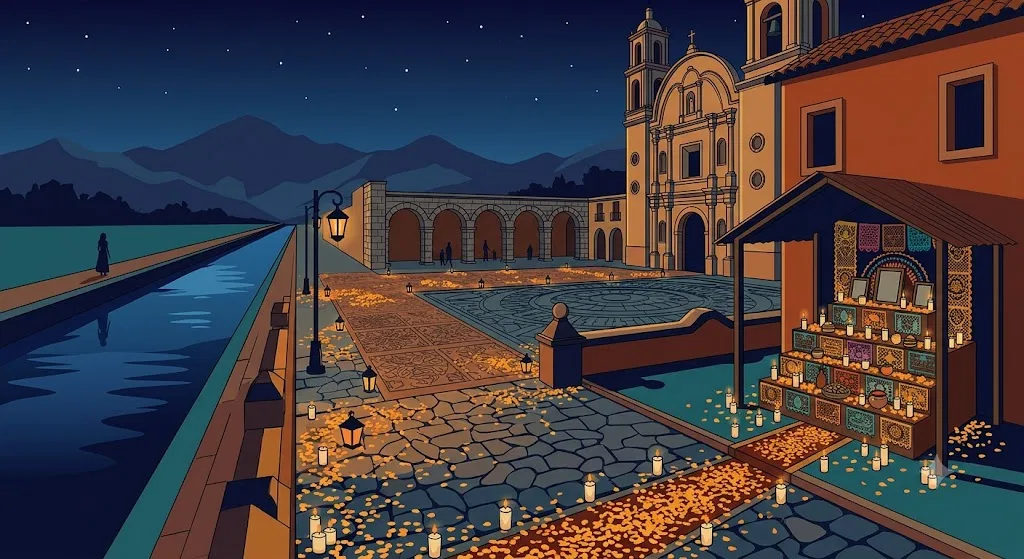
The Day of the Dead is often described outside Mexico as if it were simply “Mexican Halloween”, but that misses almost everything that matters. It is a ritual calendar of remembrance in which families, towns and communities welcome, feed, honour and speak with the dead through altars, flowers, candles, food, photographs, cemetery visits and prayer. UNESCO inscribed Mexico’s Indigenous festivity dedicated to the dead on the Representative List of the Intangible Cultural Heritage of Humanity, describing it as a major expression of Mexico’s Indigenous communities and as a fusion of pre-Hispanic rites with Catholic elements.[ICH UNESCO]ich.unesco.orgOpen source on unesco.org.
The celebration is not identical everywhere. Smithsonian folklife writing stresses that it has many variants depending on region, class and belief, while INAH materials describe petals, candles, offerings, altars, tombs, symbolic objects and paper cut-outs as part of local practice. In many communities the point is not horror but relationship: the dead remain part of family and community memory.[Smithsonian Folklife]folklife.si.edualtered altars changing traditions dia de los muertosaltered altars changing traditions dia de los muertos
At the same time, the Day of the Dead has become a national and global symbol. This has brought visibility, but also tension. INAH-linked scholarship has warned that urban tourism, commercialisation and simplified “national” versions can blur local Indigenous practices, especially in Mexico City. Recent public celebrations, museum offerings and monumental displays show how the tradition now moves between home altar, cemetery, Indigenous community, museum, parade, tourism campaign and global pop culture.[gob.mx]revistas.inah.gob.mxRevistas INAHDía de Muertos en la ciudad de México. ¿Parte deRevistas INAHDía de Muertos en la ciudad de México. ¿Parte de
The most honest way to understand the Day of the Dead is therefore double-sided. It is a deeply rooted ritual complex shaped by Indigenous and Catholic practice, and it is also a modern national symbol continually staged, debated and adapted.
Shape-shifters, witches and animal doubles
One of the most distinctive Mexican supernatural ideas is the animal double or shape-shifting person often called a nahual in scholarship and popular discussion. INAH-published work describes the concept as emerging from pre-Hispanic Mexico and links the word to hiding or concealment; the same article argues that older Indigenous religious elements can persist even in urban communities, using a Mexico City case study to show how belief in the animal-shifter could work as a form of social control.[Revistas INAH]revistas.inah.gob.mxOpen source on gob.mx.
In popular retellings, the animal-shifter may become an owl, dog, turkey, coyote, jaguar or other creature. In community belief, however, the idea is often more complex than “a werewolf, but Mexican”. It may involve a person’s spiritual force, their bond with an animal, their hidden night identity, their role as healer or sorcerer, or the fear that someone has used secret power to harm neighbours. INAH sources on contemporary shamanism and animal-shifter traditions show that the subject remains ethnographically active rather than merely antiquarian.[Revistas INAH]revistas.inah.gob.mxOpen source on gob.mx.
Witches and ritual specialists sit in a similarly blurred zone. In Mexican tradition they may be feared as harmful magic-users, respected as healers, folded into Catholic imagery of the devil, or understood through Indigenous ideas of dream, body, illness and soul-loss. The key point for readers is that these figures are not just monsters. They belong to local moral worlds: accusations, cures, envy, illness, neighbourly conflict and community discipline often matter as much as supernatural spectacle.
Small beings of water, forest and dangerous places
Mexican folklore has many small or hidden beings associated with caves, springs, woods, fields, hills and water. One widely discussed group is the chaneque tradition of Veracruz and other regions. INAH’s repository includes work specifically on these beings in the imaginary world of the Los Tuxtlas region, while INAH ethnographic material describes related beings in communities such as Pajapan and Soteapan as socially organised, dangerous and connected with misfortune, soul-loss and illness.[repositorio.inah.gob.mx]repositorio.inah.gob.mxOpen source on gob.mx.
These beings are sometimes flattened in English as “elves” or “goblins”, but that can be misleading. In local tradition they are often owners or guardians of places, especially water and wild land. Some stories describe them as mischievous childlike beings who lead people astray; others connect them with older powers of the landscape, offerings, sickness or the need to behave properly in non-human territory. A recent INAH-linked discussion of ranching cosmology in Tierra Caliente describes chaneques as old owners of bodies of water who can grant abilities through offerings or cause harm and illness.[Revistas INAH]revistas.inah.gob.mxRevistas INAH¿Existe una cosmovisión ranchera? Aproximación a laRevistas INAH¿Existe una cosmovisión ranchera? Aproximación a la
This kind of folklore teaches a practical lesson as well as a supernatural one: the landscape is not empty. Springs, caves, forests and hills are places of ownership, memory and risk. A person who enters carelessly may become lost, sick or “taken”, which is a narrative way of expressing respect for land, water and community boundaries.
Sacred landscapes: volcanoes, caves, islands and haunted streets
Mexican folklore is strongly tied to place. Two of the most famous legendary landscapes are the volcanoes Popocatépetl and Iztaccíhuatl near Mexico City and Puebla. Popular legend often tells of two lovers transformed into mountains: the sleeping woman and the smoking warrior who still watches over her. The story is widely repeated in art, tourism and Mexican American visual culture, even though researchers debate how particular versions developed from Indigenous, colonial and modern sources.[Wikipedia]WikipediaPopocatépetl and IztaccíhuatlPopocatépetl and Iztaccíhuatl
The appeal is obvious: the land itself seems to tell the story. Iztaccíhuatl’s outline is read as a reclining woman, while active Popocatépetl appears to breathe smoke. Modern scientific reporting reminds us that Popocatépetl is not merely symbolic; it is an active volcano whose behaviour matters to millions of people in central Mexico. The folklore and the hazard science are not the same thing, but both show why the mountain is culturally impossible to ignore.[AP News]apnews.comPreviously, Popocatépetl lacked a high-resolution internal map despite its proximity to some 25 million people. This breakthrough will he…
Haunted and legendary places also cluster in colonial cities, cemeteries, canals, mines and old streets. Guanajuato, for instance, is marketed through its tunnels, historic buildings, student serenades and eerie urban atmosphere as well as through its UNESCO-recognised built heritage. Such places show how folklore and tourism can reinforce one another: a narrow alley, underground road, abandoned house or cemetery becomes memorable because the architecture gives the story somewhere to live.[isseg.gob.mx]isseg.gob.mxGuia turisticaGuia turistica
Folk creatures made by artists: the case of alebrijes
Not everything that looks ancient in Mexican popular culture is ancient. Alebrijes — brightly coloured fantastical creatures made from paper, card or carved wood — are a good example. They are now widely associated with Mexican folk art and with imagined spirit animals in global pop culture, but museum sources trace their named origin to the Mexico City artist Pedro Linares López, a twentieth-century maker of paper-and-card figures.[Muzeum Narodowe w Szczecinie]muzeum.szczecin.plOpen source on szczecin.pl.
That does not make them fake. It makes them modern folklore and modern craft tradition. They show how a personal artistic invention can become collective culture, especially when workshops, parades, tourism, museums and family craft lineages take it up. Recent reporting on Mexico City’s monumental alebrije parade describes giant fantastical creatures moving through the capital, with artisans spending months on works that mix tradition and modernity.[El País]elpais.comOpen source on elpais.com.
The alebrije is therefore useful for separating three things readers often confuse: an ancient Indigenous being, a colonial or rural legend, and a modern folk-art creature. Mexican folklore contains all three, and each can be culturally meaningful in a different way.
How old are these traditions?
Some Mexican folklore has deep pre-Hispanic roots; some is colonial; some is nineteenth- or twentieth-century literary reshaping; some is modern media. The mistake is to demand that every famous story be either “ancient and authentic” or “recent and fake”. Folklore rarely behaves that neatly.
The Weeping Woman, for example, may carry older Indigenous motifs, colonial anxieties and later literary interpretations at once. The Library of Congress discussion of the legend reviews older scholarly claims about Indigenous roots while also stressing the many branches and missing links in the story’s development.[The Library of Congress]blogs.loc.govla llorona roots branches and the missing link from spainla llorona roots branches and the missing link from spain
The Day of the Dead is similarly layered. UNESCO and Smithsonian sources describe it as rooted in Indigenous and Catholic ritual customs, while INAH-linked scholarship also notes modern nationalisation, urban transformation and commercial pressure. A local cemetery offering and a city parade may both be “Day of the Dead”, but they are not the same kind of evidence for the same kind of tradition.[unesco.org]ich.unesco.orgOpen source on unesco.org.
Animal-shifters and small place-beings are better understood through regional ethnography than through one universal monster profile. INAH studies on animal-shifter belief, contemporary shamanism, chaneques and Indigenous community cosmologies show that these ideas persist in specific social settings, often tied to illness, water, dreams, morality and local land.[Revistas INAH]revistas.inah.gob.mxOpen source on gob.mx.
How Mexican folklore is retold today
Today Mexican folklore circulates through at least five overlapping channels.
Family and community storytelling remains central. Children may hear warnings about the Weeping Woman, dangerous water, witches, night roads or beings who carry people away. These stories can discipline behaviour, explain fear, transmit local memory or simply entertain.
Ritual and seasonal practice keeps folklore embodied. Day of the Dead altars, cemetery visits, food offerings, flowers and candles are not just stories about the dead; they are repeated actions that make the dead present in family and community life.[Lugares INAH]lugares.inah.gob.mxOpen source on gob.mx.
Museums and schools turn folklore into heritage. INAH museums and Mexican school materials present legends, offerings and mythic figures as cultural inheritance, but they also interpret them for modern publics.[INAH]inah.gob.mxOpen source on gob.mx.
Tourism and festivals amplify selected images. The Day of the Dead, alebrijes, haunted cities and volcano legends are especially visible because they are colourful, place-based and easy to stage. This can support artisans and local economies, but it can also simplify or commercialise traditions.[Revistas INAH]revistas.inah.gob.mxRevistas INAHDía de Muertos en la ciudad de México. ¿Parte deRevistas INAHDía de Muertos en la ciudad de México. ¿Parte de
Popular culture keeps changing the canon. Films, cartoons, horror media, songs and internet posts make figures such as the Weeping Woman and alebrijes globally recognisable, sometimes at the cost of local specificity. The result is not the death of folklore but a new phase of it: stories become portable, remixable and sometimes detached from the communities that shaped them.
What readers should remember
The most important thing about Mexican folklore is its doubleness. It is old and new, Indigenous and Catholic, local and national, oral and cinematic, sacred and commercial, frightening and healing. A ghost may be a warning to children, a memory of conquest, a song and a horror-film character. A little being of water may be a goblin in tourist shorthand but a guardian, owner or sickness-bringer in local belief. A national festival may be both intimate family remembrance and a public symbol marketed around the world.
That is why the strongest approach is not to ask, “Is this legend real?” or even “Is this legend ancient?” The better questions are: who tells it, where, in what language or performance setting, for what purpose, and what changed when it moved into books, museums, parades, classrooms, cinema or the internet? In Mexico, folklore is not merely a collection of monsters and myths. It is one of the ways people explain land, death, danger, memory and belonging.
Amazon book picks
Further Reading
Books and field guides related to Why Mexico's Legends Still Feel Alive. Use these as the next step if you want deeper reading beyond the article.
Gods of Jade and Shadow
Draws heavily on Mesoamerican mythological themes and Mexican storytelling traditions.
Mexican Gothic
Introduces readers to Mexican cultural motifs, legends and haunting traditions.
The Mythology of Mexico and Central America
Provides broad coverage of Mexican mythic traditions and legendary figures.
Aztec Thought and Culture
Explains Indigenous ideas that underpin many later Mexican legends.
eBay marketplace picks
Marketplace Samples
Live-tested eBay searches with available results related to this page.
Endnotes
1.
Source: iwgia.org
Link:https://iwgia.org/en/mexico/4232-iw-2021-mexico.html
Source snippet
The Indigenous World 2021: Mexico18 Mar 2021 — Mexico is home to 68 Indigenous Peoples, each speaking their own native language and...
2.
Source: Wikipedia
Title: Instituto Nacional de Lenguas Indígenas
Link:https://en.wikipedia.org/wiki/Instituto_Nacional_de_Lenguas_Ind%C3%ADgenas
3.
Source: mna.inah.gob.mx
Title: agenda detalle v3
Link:https://mna.inah.gob.mx/agenda_detalle_v3.php?pl=Curso_sabatino_Mitos_y_leyendas_de_tradicion_indigena
4.
Source: jstor.org
Title: “[La Llorona]({{ ‘la-llorona/’ | relative_url }})” and Related Themes
Link:https://www.jstor.org/stable/1496370
5.
Source: mexicograndezaydiversidad.inah.gob.mx
Title: Los mexicas
Link:https://mexicograndezaydiversidad.inah.gob.mx/publicacion/capitulo-06.html
6.
Source: inah.gob.mx
Title: 20251031 Dia De Muertos
Link:https://inah.gob.mx/images/interactivos/20251031_Dia_De_Muertos/
7.
Source: conocetuslibros.sep.gob.mx
Title: Nota del adaptador: Para que la lectura de tu libro sea la
Link:https://conocetuslibros.sep.gob.mx/storage/recursos/Recursos_FA_2026/WyVlCOhDCJ-Formato%20Accesible_Projects%20and%20reading_Second%20Grade%20Secondary.pdf
8.
Source: ich.unesco.org
Link:https://ich.unesco.org/en/RL/indigenous-festivity-dedicated-to-the-dead-00054
9.
Source: lugares.inah.gob.mx
Link:https://lugares.inah.gob.mx/es/node/6394
10.
Source: revistas.inah.gob.mx
Title: Revistas INAHDía de Muertos en la ciudad de México. ¿Parte de
Link:https://revistas.inah.gob.mx/index.php/vitabrevis/article/download/5547/6427/10557
11.
Source: inah.gob.mx
Link:https://inah.gob.mx/boletines/el-museo-del-templo-mayor-en-el-festival-de-ofrendas-y-arreglos-florales-del-centro-historico
12.
Source: revistas.inah.gob.mx
Link:https://revistas.inah.gob.mx/index.php/antropologia/article/download/19202/20547
13.
Source: revistas.inah.gob.mx
Link:https://revistas.inah.gob.mx/index.php/antropologia/article/view/19202
14.
Source: revistas.inah.gob.mx
Link:https://revistas.inah.gob.mx/index.php/cuicuilco/user/setLocale/en?source=%2Findex.php%2Fcuicuilco%2Farticle%2Fview%2F6233
15.
Source: revistas.inah.gob.mx
Link:https://revistas.inah.gob.mx/index.php/narrativasantropologicas/article/view/24083
16.
Source: revistas.inah.gob.mx
Link:https://revistas.inah.gob.mx/index.php/cuicuilco/article/view/21801
17.
Source: repositorio.inah.gob.mx
Link:https://repositorio.inah.gob.mx/node/2445
18.
Source: revistas.inah.gob.mx
Link:https://revistas.inah.gob.mx/index.php/rutasdecampo/article/download/9382/10161/17721
19.
Source: revistas.inah.gob.mx
Title: Revistas INAH¿Existe una cosmovisión ranchera? Aproximación a la
Link:https://www.revistas.inah.gob.mx/index.php/cuicuilco/article/download/18171/20667
20.
Source: Wikipedia
Title: Popocatépetl and Iztaccíhuatl
Link:https://en.wikipedia.org/wiki/Popocat%C3%A9petl_and_Iztacc%C3%ADhuatl
21.
Source: isseg.gob.mx
Title: Guia turistica
Link:https://isseg.gob.mx/wp-content/uploads/2022/08/Gui%CC%81a-Turi%CC%81stica.pdf
22.
Source: inah.gob.mx
Link:https://www.inah.gob.mx/boletines/cihuacoatl-y-mictecacihuatl-participan-de-la-tradicion-del-dia-de-muertos-en-el-museo-nacional-de-antropologia
23.
Source: Wikipedia
Title: La Llorona
Link:https://en.wikipedia.org/wiki/La_Llorona
24.
Source: Wikipedia
Link:https://en.wikipedia.org/wiki/Mexicans
25.
Source: Wikipedia
Title: Day of the Dead
Link:https://en.wikipedia.org/wiki/Day_of_the_Dead
26.
Source: Wikipedia
Title: Ghosts in Mexican culture
Link:https://en.wikipedia.org/wiki/Ghosts_in_Mexican_culture
27.
Source: Wikipedia
Link:https://en.wikipedia.org/wiki/Chaneque
28.
Source: Wikipedia
Link:https://en.wikipedia.org/wiki/Nagual
29.
Source: Wikipedia
Link:https://en.wikipedia.org/wiki/Curandero
30.
Source: Wikipedia
Title: Linares family
Link:https://en.wikipedia.org/wiki/Linares_family
31.
Source: Wikipedia
Title: Indigenous peoples of Mexico
Link:https://en.wikipedia.org/wiki/Indigenous_peoples_of_Mexico
32.
Source: Wikipedia
Title: Languages of Mexico
Link:https://en.wikipedia.org/wiki/Languages_of_Mexico
33.
Source: revistas.inah.gob.mx
Link:https://revistas.inah.gob.mx/index.php/diariodecampo/article/download/5599/6444
34.
Source: repositorio.inah.gob.mx
Link:https://repositorio.inah.gob.mx/o-49255
35.
Source: inah.gob.mx
Title: el origen del dia de muertos
Link:https://inah.gob.mx/especiales-inah/articulos/el-origen-del-dia-de-muertos
36.
Source: revistas.inah.gob.mx
Link:https://revistas.inah.gob.mx/index.php/historias/article/view/12942/14050
37.
Source: inah.gob.mx
Link:https://inah.gob.mx/boletines/la-tradicion-de-dia-de-muertos-llega-a-museos-y-zonas-arqueologicas-del-inah-en-el-interior-de-la-republica
38.
Source: estudioshistoricos.inah.gob.mx
Link:https://www.estudioshistoricos.inah.gob.mx/revistaHistorias/wp-content/uploads/historias_57_131-133.pdf
39.
Source: revistas.inah.gob.mx
Link:https://revistas.inah.gob.mx/index.php/diariodecampo/article/view/8072
40.
Source: bibliotecadigital.inah.gob.mx
Link:https://bibliotecadigital.inah.gob.mx/janium/Documentos/TSER/000F02509.pdf
41.
Source: repositorio.inah.gob.mx
Link:https://repositorio.inah.gob.mx/_flysystem/fedora/2023-11/tesis_2747.pdf
42.
Source: revistas.inah.gob.mx
Link:https://revistas.inah.gob.mx/index.php/antropologia/article/view/19202/20547
43.
Source: repositorio.inah.gob.mx
Title: issue 1198
Link:https://repositorio.inah.gob.mx/_flysystem/fedora/2023-12/issue_1198.pdf
44.
Source: inah.gob.mx
Title: 20251031 Tlacuache 1202
Link:https://inah.gob.mx/images/suplementos/tlacuache/1202/web/20251031_Tlacuache_1202.pdf
45.
Source: revistas.inah.gob.mx
Link:https://revistas.inah.gob.mx/index.php/cuicuilco/article/download/24302/25647/53337
46.
Source: revistas.inah.gob.mx
Link:https://revistas.inah.gob.mx/index.php/dimension/article/download/15706/16720/32852
47.
Source: revistas.inah.gob.mx
Link:https://revistas.inah.gob.mx/index.php/arqueologia/article/download/12576/13701/25107
48.
Source: revistas.inah.gob.mx
Link:https://www.revistas.inah.gob.mx/index.php/antropologia/article/download/4962/4988
49.
Source: lugares.inah.gob.mx
Link:https://lugares.inah.gob.mx/es/node/6399
50.
Source: revistas.inah.gob.mx
Link:https://revistas.inah.gob.mx/index.php/dimension/article/view/1473
51.
Source: inah.gob.mx
Link:https://www.inah.gob.mx/boletines/el-museo-nacional-de-las-intervenciones-conmemora-el-dia-de-muertos-con-playmobil
52.
Source: inah.gob.mx
Link:https://inah.gob.mx/boletines/la-ofrenda-monumental-de-la-zona-arqueologica-de-los-toriles-nayarit-mostrara-mas-de-cinco-mil-calaveras-de-barro
53.
Source: revistas.inah.gob.mx
Link:https://revistas.inah.gob.mx/index.php/eltlacuache/issue/download/issue%201740/issue%201740
54.
Source: lugares.inah.gob.mx
Link:https://lugares.inah.gob.mx/es/pagina-de-elemento/1547
55.
Source: revistas.inah.gob.mx
Link:https://revistas.inah.gob.mx/index.php/rutasdecampo/article/download/13620/14707
56.
Source: repositorio.inah.gob.mx
Link:https://repositorio.inah.gob.mx/search?f%5B0%5D=naturaleza%3A42253&f%5B1%5D=naturaleza%3A42259&f%5B2%5D=naturaleza%3A42786&f%5B3%5D=naturaleza%3A43033&f%5B4%5D=naturaleza%3A71272&page=1
57.
Source: imcine.gob.mx
Link:https://imcine.gob.mx/pdf/anuarios/c12aa62e05c790af.pdf
58.
Source: imcine.gob.mx
Link:https://imcine.gob.mx/pdf/anuarios/6d0c2c560a71c58d.pdf
59.
Source: imcine.gob.mx
Link:https://imcine.gob.mx/pdf/anuarios/bbf093980f29f793.pdf
60.
Source: imcine.gob.mx
Link:https://www.imcine.gob.mx/pdf/anuarios/5cae1be6509bf7b2.pdf
61.
Source: gob.mx
Title: Semana Global 2021
Link:https://www.gob.mx/cms/uploads/attachment/file/678678/Semana_Global_2021.pdf
62.
Source: gob.mx
Link:https://www.gob.mx/sre/articulos/mexico-s-indigenous-peoples-enrich-the-nation-ebrard
63.
Source: jstor.org
Link:https://www.jstor.org/stable/10.7560/718111
64.
Source: jstor.org
Link:https://www.jstor.org/stable/1498101
65.
Source: jstor.org
Link:https://www.jstor.org/stable/3346922
66.
Source: jstor.org
Link:https://www.jstor.org/stable/j.ctv11hprsn
67.
Source: jstor.org
Link:https://www.jstor.org/stable/jj.10782312
68.
Source: cultura.cdmx.gob.mx
Title: cdmx.gob.mx Untitled
Link:https://www.cultura.cdmx.gob.mx/storage/app/media/shortsmxcatalogo-2021digital29sept21.pdf
69.
Source: iwgia.org
Link:https://iwgia.org/en/mexico/4670-iw-2022-mexico.html
70.
Source: unesco.org
Title: document 3743
Link:https://www.unesco.org/archives/multimedia/document-3743
71.
Source: ich.unesco.org
Link:https://ich.unesco.org/en/video/41645
72.
Source: ich.unesco.org
Link:https://ich.unesco.org/en/activities/day-of-the-dead-night-of-the-souls-a-parade-and-musical-homage-to-those-who-have-left-us-00469
73.
Source: blogs.loc.gov
Title: la llorona storytelling for halloween and da de muertos
Link:https://blogs.loc.gov/folklife/2021/10/la-llorona-storytelling-for-halloween-and-da-de-muertos/
74.
Source: blogs.loc.gov
Link:https://blogs.loc.gov/folklife/2021/10/la-llorona-an-introduction-to-the-weeping-woman/
75.
Source: blogs.loc.gov
Title: la llorona roots branches and the missing link from spain
Link:https://blogs.loc.gov/folklife/2021/10/la-llorona-roots-branches-and-the-missing-link-from-spain/
76.
Source: folklife.si.edu
Title: altered altars changing traditions dia de los muertos
Link:https://folklife.si.edu/magazine/altered-altars-changing-traditions-dia-de-los-muertos
77.
Source: apnews.com
Link:https://apnews.com/article/f26337bd6503a40d282c57d67d988613
Source snippet
Previously, Popocatépetl lacked a high-resolution internal map despite its proximity to some 25 million people. This breakthrough will he...
78.
Source: muzeum.szczecin.pl
Link:https://muzeum.szczecin.pl/en/exhibitions/temporary/1913-alebrijes-alebrijes-fantastic-creatures-from-the-collection-of-embassy-of-mexico-in-poland.html
79.
Source: elpais.com
Link:https://elpais.com/mexico/2024-10-19/como-nacen-los-alebrijes-las-fantasticas-criaturas-mexicanas-que-desfilan-sobre-paseo-de-la-reforma.html
80.
Source: latino.si.edu
Link:https://latino.si.edu/learn/teaching-and-learning-resources/day-dead-resources
81.
Source: si.edu
Link:https://www.si.edu/object/siris_sil_7011
82.
Source: mythus.fandom.com
Link:https://mythus.fandom.com/wiki/Chaneque
83.
Source: folklore.usc.edu
Link:https://folklore.usc.edu/chaneques/
84.
Source: volcano.oregonstate.edu
Link:https://volcano.oregonstate.edu/mexico
85.
Source: mayancopal.com
Link:https://mayancopal.com/blogs/news/alebrije-a-brief-history
86.
Source: slideshare.net
Link:https://www.slideshare.net/slideshow/nahual-12677322/12677322
Additional References
87.
Source: youtube.com
Title: The Myth of La Llorona in Mexican Folklore
Link:https://www.youtube.com/watch?v=K75dMGtsb64
Source snippet
2 La Llorona: From Aztec Omen to Modern Ghost Story (500 Years of the Weeping Woman)...
88.
Source: youtube.com
Title: Aztec Mythology, Folklore & Legends
Link:https://www.youtube.com/watch?v=6dwCRpfif-I
Source snippet
5 The Origins of Dia de los Muertos: From Aztec Rituals to Modern Altars...
89.
Source: youtube.com
Link:https://www.youtube.com/watch?v=alSYpf3r-34
Source snippet
3 La Lechuza: The Shape-Shifting Witch-Owl | Monstrum...
90.
Source: youtube.com
Title: La Lechuza: The Shape-Shifting Witch-Owl | Monstrum
Link:https://www.youtube.com/watch?v=_qDuo1TDUFk
Source snippet
4 Aztec Mythology, Folklore & Legends - Complete 4k Historical Documentary...
91.
Source: arteamericas.org
Link:https://arteamericas.org/exhibition/alebrijes-y-[nahuales
92.
Source: yerbabuenagardens.org
Link:https://yerbabuenagardens.org/events/alebrijes-and-nahuales/
93.
Source: dayofthedeadsa.com
Link:https://dayofthedeadsa.com/alebrijes/
94.
Source: dokumen.pub
Link:https://dokumen.pub/download/americo-paredes-culture-and-critique-9780292738782.html
95.
Source: facebook.com
Link:https://www.facebook.com/terrifyingearth/posts/chaneques-also-known-as-chanekeh-or-ohuican-chaneque-were-creatures-in-mexican-s/406023062176864/
96.
Source: ebsco.com
Link:https://www.ebsco.com/research-starters/sports-and-leisure/day-dead-dia-de-los-muertos
Topic Tree
Follow this branch
Related pages 192
- Afghan Folklore
- Albanian Folklore
- Algerian Folklore
- Australian Folklore
- Azerbaijan Folklore
- +187 more in sidebar