Within Zimbabwe Folklore
Why Matobo Is More Than Sacred Rock
Matobo's shrines, rocks and rainmaking traditions show how Zimbabwean folklore is tied to land, ancestors and ritual authority.
On this page
- The Mwari tradition and ancestral power
- Njelele shrine, rainmaking and ritual rules
- Tourism, custodianship and living sacred places
Page outline Jump by section
Introduction
The Matobo Hills in south-western Zimbabwe are far more than a striking landscape of balancing granite boulders. For many communities they form a living sacred landscape where oral tradition, ritual practice, ancestral authority and the worship of Mwari, the supreme deity in one of southern Africa’s oldest religious traditions, continue to shape cultural life. Unlike many famous archaeological sites that survive only as historical monuments, Matobo remains a place where spiritual customs are still observed, sacred places are respected, and traditional custodians maintain rules governing access and ritual behaviour. UNESCO recognises these living religious traditions as one of the reasons the hills were inscribed as a World Heritage Site, alongside their exceptional rock art and archaeological importance.[UNESCO World Heritage Centre]whc.unesco.orgWorld Heritage Centre Matobo HillsUNESCO World Heritage CentreMatobo Hills - UNESCO World Heritage Centre…
Understanding Matobo helps explain an important feature of Zimbabwean folklore: stories, sacred places and ritual authority are inseparable from the landscape itself. The hills are not simply the setting for legends. They are understood in tradition as places where communication with ancestors and the divine becomes possible, giving the landscape an active role in religious life rather than serving as a passive backdrop.[UNESCO World Heritage Centre]whc.unesco.orgWorld Heritage Centre Matobo HillsUNESCO World Heritage CentreMatobo Hills - UNESCO World Heritage Centre…
The Mwari tradition and ancestral power
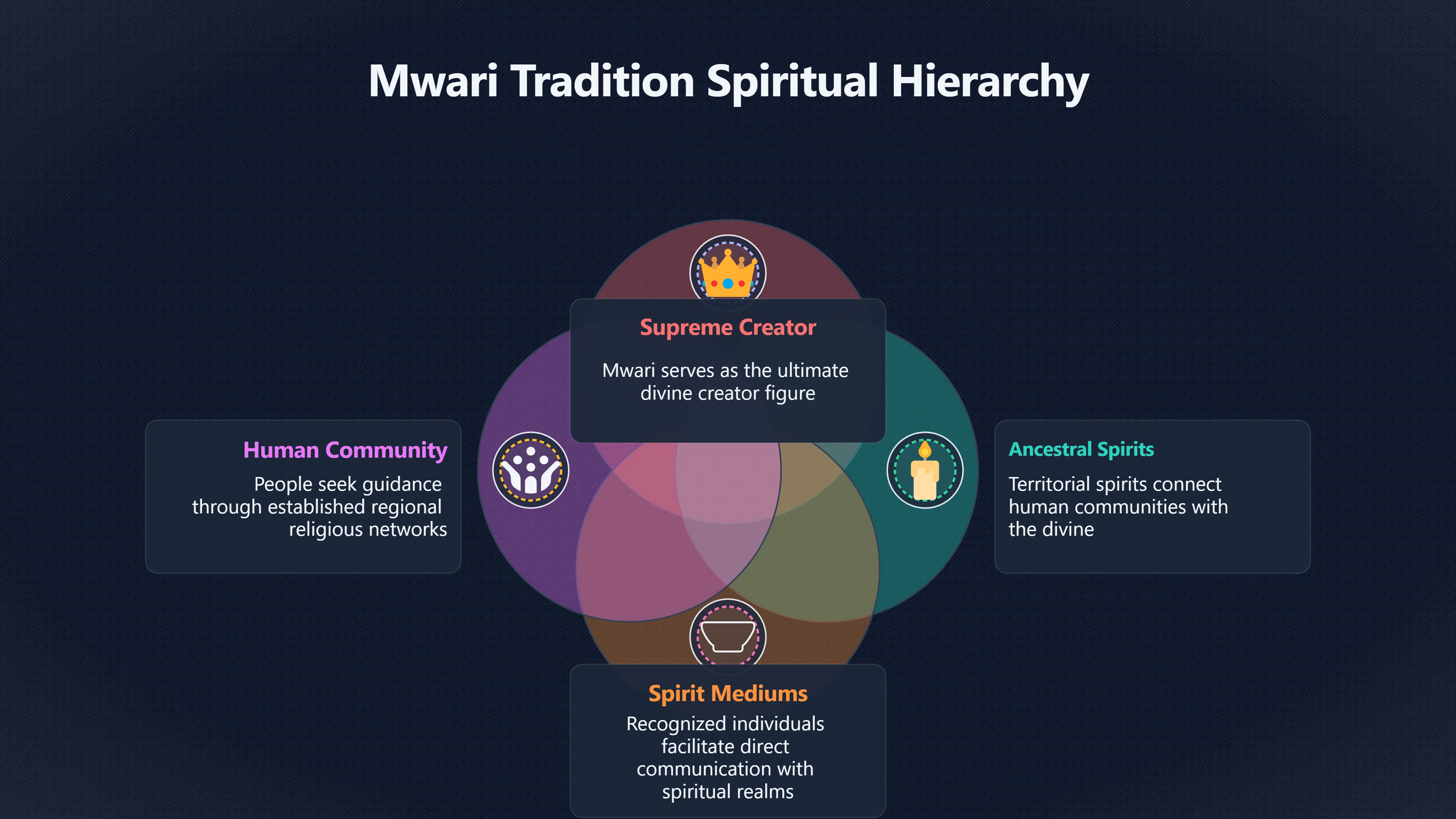
The Mwari tradition is one of the best-known indigenous religious systems in southern Africa. Although beliefs and practices have evolved over many centuries, Mwari is generally understood as the supreme creator rather than an ancestor or local spirit. People traditionally approached Mwari indirectly through recognised shrines, spirit mediums and custodians rather than through private worship alone. This emphasis on mediation reflects a wider Zimbabwean understanding that ancestors and territorial spirits help connect human communities with the divine.[UNESCO World Heritage Centre]whc.unesco.orgWorld Heritage Centre Matobo HillsUNESCO World Heritage CentreMatobo Hills - UNESCO World Heritage Centre…
Matobo became the spiritual heart of this tradition because its distinctive granite hills were regarded as the dwelling place of divine power. According to UNESCO, the rocks themselves are seen as the seat of God and of ancestral spirits, while shrines within the hills provide places where communication with the spiritual world is believed to occur. This relationship between geology and belief is central to the area’s folklore. The dramatic landscape is not merely impressive scenery but part of the sacred order itself.[UNESCO World Heritage Centre]whc.unesco.orgWorld Heritage Centre Matobo HillsUNESCO World Heritage CentreMatobo Hills - UNESCO World Heritage Centre…
Oral traditions associate the wider Matobo region with long-standing oracular authority. Pilgrims, chiefs and community representatives historically travelled to the shrines seeking guidance on matters ranging from drought and warfare to disease and social conflict. Rather than functioning as isolated temples, the shrines formed part of a regional religious network that linked communities across what is now Zimbabwe and neighbouring areas. UNESCO notes that this oracular tradition may date back to the Iron Age and remains one of the most influential indigenous religious traditions in southern Africa.[UNESCO World Heritage Centre]whc.unesco.orgWorld Heritage Centre Matobo HillsUNESCO World Heritage CentreMatobo Hills - UNESCO World Heritage Centre…
Njelele shrine, rainmaking and ritual rules
Among Matobo’s sacred places, the Njelele shrine is the best known. It has long been associated with rainmaking ceremonies, seasonal rituals and consultation with Mwari. Traditional accounts describe delegations travelling to the shrine before the onset of the rainy season to seek favourable rainfall, agricultural success and relief from drought.
Rainmaking should not be understood simply as an attempt to influence the weather through ritual. In local tradition it also expresses the moral relationship between people, ancestors and the land. Ritual specialists have long taught that harmony within the community, respect for sacred places and the correction of wrongdoing are linked with the wellbeing of both people and the environment. Ceremonies therefore often combine prayers for rain with acts of reconciliation, confession or communal renewal. Research based on oral testimony also records requests for healing from disease affecting both people and livestock.[UNESCO World Heritage Centre]whc.unesco.orgWorld Heritage Centre Matobo HillsUNESCO World Heritage CentreMatobo Hills - UNESCO World Heritage Centre…
Access to Njelele has traditionally been governed by strict customs rather than by ordinary public visitation. Certain areas are entered only with permission from recognised custodians, while ritual purity, appropriate behaviour and respect for local taboos are regarded as essential. UNESCO notes that physical boundaries around some shrines are deliberately minimal because authority depends on customary law and spiritual protocol rather than permanent structures. The absence of modern buildings reinforces the understanding that the sacred character of the place comes from tradition rather than architecture.[UNESCO World Heritage Centre]whc.unesco.orgWorld Heritage Centre Matobo HillsUNESCO World Heritage CentreMatobo Hills - UNESCO World Heritage Centre…
These rules also help explain why Matobo folklore remains a living tradition. Stories about the shrine are not simply historical narratives repeated for visitors; they continue to influence how many local people behave within the landscape today.
Why the landscape itself is sacred
Many sacred traditions elsewhere focus on a particular temple or shrine. Matobo differs because the sacred landscape extends across hills, caves, valleys, pools and rock formations. The entire environment is woven into religious memory.
Several features contribute to this distinctive character:
- Granite hills are regarded as places where divine and ancestral presence is especially strong.
- Caves combine archaeological importance with continuing ritual significance.
- Rock art sites connect present-day communities with thousands of years of human occupation.
- Natural features such as pools and hills often possess their own local traditions and ritual restrictions.
- Pilgrimage routes reinforce the idea that movement through the landscape itself forms part of religious practice.[UNESCO World Heritage Centre]whc.unesco.orgWorld Heritage Centre Matobo HillsUNESCO World Heritage CentreMatobo Hills - UNESCO World Heritage Centre…
This broad understanding of sacred geography reflects a wider Zimbabwean pattern in which land, memory and spiritual authority cannot easily be separated.
Tourism, custodianship and living sacred places
The Matobo Hills attract visitors because of their scenery, wildlife, rock art and historical associations, yet tourism exists alongside continuing religious use. This creates an ongoing balance between public access and respect for communities that continue to regard parts of the landscape as sacred.
UNESCO’s recognition deliberately includes both tangible heritage, such as rock paintings and archaeological remains, and intangible heritage, including religious traditions, oral knowledge and ritual practice. This reflects an important principle: preserving Matobo does not simply mean protecting ancient rocks but also supporting the cultural practices that give those places meaning.[UNESCO World Heritage Centre]whc.unesco.orgWorld Heritage Centre Matobo HillsUNESCO World Heritage CentreMatobo Hills - UNESCO World Heritage Centre…
Traditional custodians continue to play an important role in managing sacred areas, while conservation organisations have noted that customary restrictions often contribute to protecting culturally significant places from disturbance. At the same time, increased tourism, vegetation loss, fires, vandalism and changing land use present continuing challenges for both cultural and environmental conservation.[Matobo.org]matobo.orgMC S NEWSLETTER 101 | Matobo.orgMC S NEWSLETTER 101 | Matobo.org

How Matobo is understood today
Modern Zimbabwe contains many different religious traditions, including Christianity, African Independent Churches and indigenous religious practices. As a result, people understand the Mwari tradition in different ways. Some communities continue traditional observances at sacred shrines, others interpret Mwari through Christian belief, while many recognise the Matobo Hills primarily as an important heritage landscape.
Despite these different perspectives, Matobo retains a remarkable continuity. It remains one of the clearest examples in Zimbabwe of a landscape where folklore, religious belief, oral history and cultural identity continue to coexist. Rather than surviving only in books or museum collections, the stories and rituals associated with the hills remain embedded in the places where they first developed, making Matobo one of southern Africa’s most significant living sacred landscapes.[UNESCO World Heritage Centre]whc.unesco.orgWorld Heritage Centre Matobo HillsUNESCO World Heritage CentreMatobo Hills - UNESCO World Heritage Centre…
Amazon book picks
Further Reading
Books and field guides related to Why Matobo Is More Than Sacred Rock. Use these as the next step if you want deeper reading beyond the article.
Voices from the Rocks
Directly addresses the hills, shrines, religious traditions and cultural history.
African Religions and Philosophy
Provides framework for understanding Mwari worship, sacred authority and ritual practice.
African Traditional Religion
Offers broader background for understanding sacred sites and religious mediation.
eBay marketplace picks
Marketplace Samples
Live-tested eBay searches with available results related to this page.


Endnotes
1.
Source: whc.unesco.org
Title: World Heritage Centre Matobo Hills
Link:https://whc.unesco.org/en/list/306/
Source snippet
UNESCO World Heritage CentreMatobo Hills - UNESCO World Heritage Centre...
2.
Source: whc.unesco.org
Title: World Heritage Centre UNESCO World Heritage Centre
Link:https://whc.unesco.org/en/decisions/733
Source snippet
Inscribes the Matobo Hills, Zimbabwe, on the World Heritage List on the basis of cultural criteria (iii), (v) and (vi...
3.
Source: matobo.org
Title: MC S NEWSLETTER 101 | Matobo.org
Link:https://matobo.org/mcs-newsletter-101/
4.
Source: matobo.org
Title: World Heritage Site | Matobo.org
Link:https://matobo.org/world-heritage-site/
Source snippet
WORLD HERITAGE SITE MATOBO HILLS (CULTURAL LANDSCAPE) WORLD HERITAGE SITE On the 5th July 2003, at the 27th Session of the World Heritage...
Published: July 2003
5.
Source: matobo.org
Title: MC S NEWSLETTER 124 | Matobo.org
Link:https://matobo.org/mcs-newsletter-124/
Source snippet
It included a screening of our Matopos promotional video, and a short Matopos Heritage MTB Challenge video which a...
6.
Source: matobo.org
Title: MC S NEWSLETTER 104 | Matobo.org
Link:https://matobo.org/mcs-newsletter-104/
Source snippet
MCS NEWSLETTER 104 | Matobo.orgAugust 26, 2018 — MCS NEWSLETTER 104 Aug 26, 2018 1 – NJELELE SHRINE BOMBED The sacred Njelele rainmaking...
Published: August 26, 2018
8.
Source: whc.unesco.org
Link:https://whc.unesco.org/en/list/306/documents/
Source snippet
Hills - Documents - UNESCO World Heritage CentreMATOBO HILLS Nomination 306rev (inscribed) --- 2003 | Nomination file 306rev (19 MB) Advi...
9.
Source: youtube.com
Title: The Cost of Survival: Why Zimbabwe Dehorns Its Last Rhinos
Link:https://www.youtube.com/watch?v=ktxKCkd4VAg
Source snippet
Zimbabwe | Matopo Hills Cave Paintings | Bulawayo Zim Vlog...
10.
Source: youtube.com
Title: Zimbabwe | Matopo Hills Cave Paintings | Bulawayo Zim Vlog
Link:https://www.youtube.com/watch?v=V7LcmMxEEfU
Additional References
11.
Source: researchgate.net
Link:https://www.researchgate.net/publication/336439186_Understanding_the_Traditional_and_Contemporary_Purpose_of_the_Njelele_Rainmaking_Shrine_through_the_Oral_Testimonies_of_Local_People_in_Matobo
Source snippet
atobo | Request PDFOctober 1, 2019 — Article UNDERSTANDING THE TRADITIONAL AND CONTEMPORARY PURPOSE OF THE NJELELE RAINMAKING SHRINE THRO...
Published: October 1, 2019
12.
Source: tandfonline.com
Link:https://www.tandfonline.com/doi/abs/10.1179/hma.2008.1.2.163
Source snippet
ement: Vol 1, No 2June 17, 2014 — Heritage Management Volume 1, 2008 - Issue 2 Journal homepage Free access 9,060 Views 8 CrossRef citati...
Published: June 17, 2014
13.
Source: researchoutput.csu.edu.au
Link:https://researchoutput.csu.edu.au/en/publications/understanding-the-traditional-and-contemporary-purpose-of-the-nje/
Source snippet
the traditional and contemporary purpose of the Njelele rainmaking shrine through the oral testimonies of local people in Matobo - Charle...
14.
Source: youtube.com
Title: The Untold History of Christianity in Zimbabwe Before the Missionaries Arrived
Link:https://www.youtube.com/watch?v=6hacmkBa5uk
Source snippet
The Cost of Survival: Why Zimbabwe Dehorns Its Last Rhinos...
15.
Source: youtube.com
Title: In Zimbabwe Sacred Caves Hold Secrets! | The Shona Peoples
Link:https://www.youtube.com/watch?v=AVmi1_yIAfA
Source snippet
The Untold History of Christianity in Zimbabwe Before the Missionaries Arrived...
16.
Source: youtube.com
Title: The Rich Spiritual & Cultural Traditions of The Matobo Hills
Link:https://www.youtube.com/watch?v=2SpFlUtBl3E
Source snippet
In Zimbabwe Sacred Caves Hold Secrets! | The Shona Peoples...
17.
Source: ecolex.org
Title: The acc
Link:https://www.ecolex.org/details/decision/matobo-hills-zimbabwe-f885a549-c138-4dab-a19a-9830d2a43a4b/
Source snippet
Matobo Hills (Zimbabwe)June 29, 2003 — Search results » Treaty decision Information on this section of ECOLEX comes from the InforMEA Por...
Published: June 29, 2003
Topic Tree