Where Volcanoes, Jinn and Island Memory Meet
Comorian folklore is best understood as island storytelling shaped by the sea: African, Arab, Malagasy, Islamic and western Indian Ocean influences meeting on volcanic islands between East Africa and Madagascar.
Page outline Jump by section
Introduction
Comorian folklore is best understood as island storytelling shaped by the sea: African, Arab, Malagasy, Islamic and western Indian Ocean influences meeting on volcanic islands between East Africa and Madagascar. Its most memorable traditions include stories of jinn, tales explaining Mount Karthala and the birth of Grande Comore, oral narratives carried through evening storytelling, wedding processions, sacred-looking townscapes, and modern literary retellings that preserve older voices in print. The evidence is uneven: some traditions are well documented by scholars and heritage bodies, while others survive mainly through later retellings, travel writing or family memory. That makes Comoros especially interesting. Its folklore is not a single ancient “mythology” frozen in time, but a living culture where Islamic learning, island history, family rank, women’s storytelling, migration and memory all shape what people tell, perform and preserve.[jstor.org]jstor.orgOpen source on jstor.org.
Why Comorian folklore feels different
Comoros sits in the northern Mozambique Channel, and its folklore reflects a long history of maritime contact rather than isolation. World Factbook-derived country data lists Comorian, Arabic and French among the country’s official languages, while the islands’ society is overwhelmingly Muslim, with Sunni Islam identified as the state religion. Those facts matter for folklore because stories, blessings, wedding customs, moral tales and supernatural beliefs often move through religious teaching, Arabic literacy, village performance and family transmission rather than through one separate category called “mythology”.[World Factbook]worldfactbook.coWorld Factbook Comoros — World FactbookWorld Factbook Comoros — World Factbook
At the same time, Comorian identity is not simply “Arab” or “Islamic”. Cultural summaries describe Comorians as shaped by ancient African social organisation, Arabian Islam and later French influence; they also note matrilineal features in social life, which helps explain why stories about marriage, mothers, daughters, rank and household authority carry so much weight. Built environments add another layer: mosques, palaces, public squares, coral-stone monuments, tombs, carved wood and Quranic calligraphy all create a landscape where religion, status and memory are visible in everyday places.[Every Culture]everyculture.comOpen source on everyculture.com.
For a folklore reader, the key point is this: Comorian tradition is not mainly a bestiary of monsters. It is a web of stories, ceremonies, social rules and sacred or semi-sacred places. The supernatural appears, especially through jinn and spirit beliefs, but often in ways tied to healing, protection, volcanic landscape, family prestige or moral instruction rather than in the horror-story style common on the internet.[Every Culture]everyculture.comOpen source on everyculture.com.
Jinn, spirits and the Islamic shape of the invisible world
The best-known supernatural beings in Comorian belief are jinn. Accessible cultural references describe belief in jinn and other earth spirits as part of Comorian life, deriving from Arab, African and Madagascan traditions rather than from one single source. This mixed origin fits the islands’ history: Comoros has long been linked to the Swahili coast, Arabian Sea routes and Madagascar, so its invisible world is also culturally layered.[Every Culture]everyculture.comOpen source on everyculture.com.
In Comorian settings, jinn should not be treated as “genies” in the lamp-and-wishes sense. They belong to Islamic and Islamicate folk culture, where they are unseen beings that can appear in stories, protection practices, healing traditions and explanations of misfortune. A scholarly listing of Comorian folklore genres specifically notes legends of Quranic figures and djinn alongside heroic recitations, historical material and place legends, which suggests that supernatural narrative sits beside history and moral memory rather than outside them.[JSTOR]jstor.orgOpen source on jstor.org.
This is also where careful wording matters. A public article can say that many Comorians have traditions concerning jinn; it should not claim that jinn are universally feared, believed in by every person, or understood in the same way on every island. Comoros is a living Muslim society, and beliefs vary by family, education, island, religious outlook and generation. The strongest evidence points to jinn as a recurring part of local belief culture and storytelling, not as a single fixed monster with a standard description.[Every Culture]everyculture.comOpen source on everyculture.com.
Mount Karthala and the story of an island born from fire
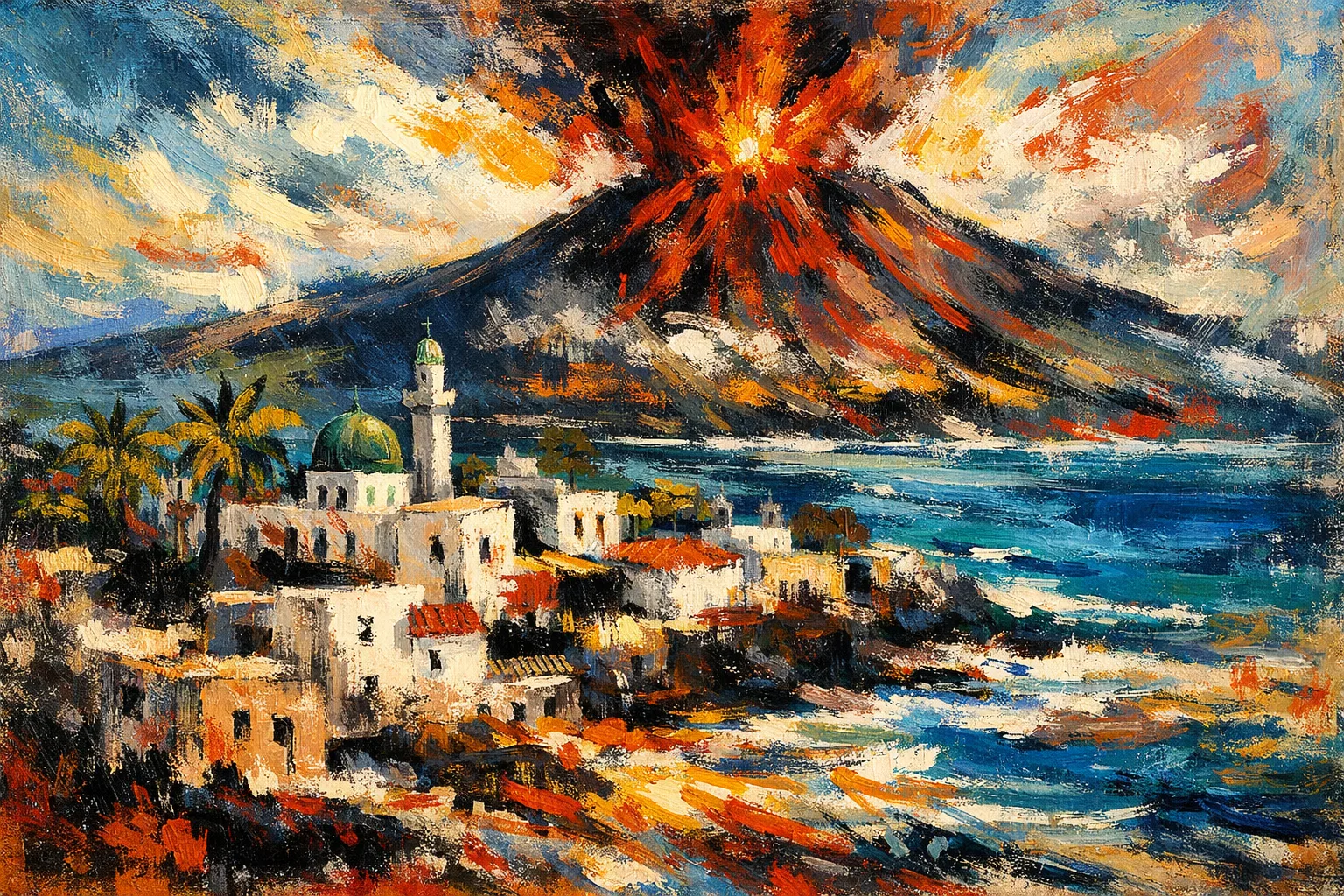
The most vivid Comorian origin legend centres on Mount Karthala, the active volcano on Grande Comore. One widely repeated account says that Solomon, who in Islamic and wider Middle Eastern tradition has authority over jinn, sent a jinni with a precious ring for the Queen of Sheba. The jinni dropped it; the ring became a fiery circle, then Mount Karthala, and from that fire Grande Comore was born. Another connected tale places the Queen of Sheba’s hidden throne in Karthala’s hot crater.[AramcoWorld]archive.aramcoworld.comAramco World Saudi Aramco WorldThe Islands of the Moon…
The story works because it joins three powerful things: the Islamic prestige of Solomon, the Indian Ocean memory of long-distance trade, and the physical reality of the volcano. Karthala is not just decorative scenery. Smithsonian Global Volcanism reporting describes the November 2005 eruption, notes that Moroni lies west of the summit complex, and records ash, evacuations, water contamination concerns and a lava lake forming within the crater. In other words, the mountain is a real force in Comorian life, not merely a mythic backdrop.[Smithsonian Global Volcanism Program]volcano.si.eduOpen source on si.edu.
That does not mean the legend is a geological explanation in a modern scientific sense. It is better read as a traditional way of making a dangerous landscape meaningful. The volcano becomes a place where sacred history, royal romance, jinn power and island origins meet. For readers comparing Comoros with neighbouring folklore, this is one of the clearest examples of a wider Indian Ocean pattern: trade routes carry religious figures and story motifs, but local geography gives them a new home.[AramcoWorld]archive.aramcoworld.comAramco World Saudi Aramco WorldThe Islands of the Moon…
Oral tales, night storytelling and the work of memory
Comorian folklore has been strongly oral. Salim Hatubou, one of the best-known modern Comorian literary figures associated with traditional tales, is described by the City of Marseille as having discovered oral tales through his maternal grandmother during village evening gatherings. The same biographical account says he later spent around fifteen years travelling through the Comoros to collect traditional stories from older people, then helped carry that oral heritage into written French-language literature.[Marseille]marseille.frSalim Hatubou: le passeur de mémoire | Ville de MarseilleSalim Hatubou: le passeur de mémoire | Ville de Marseille
Hatubou’s Contes et légendes des Comores is presented by OverDrive as a collection of myths, tales and legends that enters the Comorian imagination. Its publisher’s description frames the book as a way to discover traditional stories of the world that explain origins and everyday phenomena. That is important because it shows a modern preservation route: stories once performed in family or village settings are repackaged for schools, libraries, diaspora readers and international audiences.[OverDrive]overdrive.comOpen source on overdrive.com.
This shift changes the folklore. A tale told at night by a grandmother is not identical to a printed tale in a children’s series. Performance has voice, timing, audience response and local references; print gives durability, circulation and translation. Comorian folklore today therefore lives in two forms at once: as remembered oral tradition and as literature curated by writers, publishers, libraries and heritage institutions.[Marseille]marseille.frSalim Hatubou: le passeur de mémoire | Ville de MarseilleSalim Hatubou: le passeur de mémoire | Ville de Marseille
What kinds of stories are documented?
The most useful scholarly clue is the classification of Comorian folklore genres. The JSTOR-listed article “Genres of Comoran Folklore” identifies a range that includes heroic recitations by royal reciters, legends of Quranic figures and djinn, historical material and place legends. That range is broader than fairy tales. It includes prestige history, sacred narrative, supernatural belief and explanations attached to particular landscapes.[JSTOR]jstor.orgOpen source on jstor.org.
Several themes stand out from available scholarship and literary retellings:
Origins and explanation. Stories explain how things began, why places matter, or how everyday features of the world gained meaning. Karthala is the obvious example, but printed Comorian tale collections also frame stories as explanations of origins and common phenomena.[AramcoWorld]archive.aramcoworld.comAramco World Saudi Aramco WorldThe Islands of the Moon…
Marriage and social rank. Comorian society gives major cultural importance to marriage, status and public ceremony. This makes tales about spouses, mothers, daughters, household honour and social recognition especially resonant. Academic work on Ngazidja describes a matrilineal and matrilocal Muslim society negotiating gender and family relations through both matrilineal and Islamic norms.[Cambridge University Press & Assessment]cambridge.orgOpen source on cambridge.org.
Trickery, danger and moral testing. Indian Ocean folktales often use animals, ogres, magical objects, dangerous spouses or impossible tasks to test intelligence and social values. In Comorian contexts, these motifs should be read locally: they are not just imported fairy-tale furniture, but ways of thinking through family duty, village reputation and survival.[Academia]academia.eduOpen source on academia.edu.
Place memory. A place legend can turn a crater, town, tomb, palace, square or old settlement into a story-bearing site. Comorian heritage work increasingly recognises that buildings and performances belong together: UNESCO’s 2026 account of a workshop in Moroni explicitly connected visits to the Museum of Comoros and historic town centre with living heritage practices.[UNESCO]unesco.orgOpen source on unesco.org.
Weddings, processions and living heritage
Not all folklore is a spoken tale. In Comoros, ceremonial performance is central to how tradition is seen and remembered. UNESCO reported that in 2025 the zaffa in the traditional wedding became the first Comorian element inscribed on the Representative List of the Intangible Cultural Heritage of Humanity, as part of a multinational nomination. UNESCO describes the zaffa as a bridal procession marking the transition from single to married life, involving ritual, music, dance and festive performance.[UNESCO]unesco.orgOpen source on unesco.org.
This matters for a folklore page because wedding ceremony is where belief, status, music, dress, movement, family memory and public storytelling all meet. A procession can tell a social story without being a “myth”: it marks who belongs, who is honoured, which families are connected, and how a couple’s new life is recognised by the community.[ICH UNESCO]ich.unesco.orgOpen source on unesco.org.
Comorian heritage work is also becoming more formalised. UNESCO states that Comoros ratified the 2003 Convention for the Safeguarding of the Intangible Cultural Heritage in 2013, and that a National Committee of Intangible Cultural Heritage was created after awareness-raising work in Moroni. Its mission includes legal and institutional safeguarding, inventories, education, research funding and transmission to future generations.[UNESCO]unesco.orgComoros establishes a National Committee for Intangible CulturalComoros establishes a National Committee for Intangible Cultural
The 2026 UNESCO workshop also highlighted embroidery of the Kofia, a finely embroidered Islamic cap worn by men in Comoros, as an example of identity, social harmony, craft knowledge and women’s transmission of skills. Although this is craft rather than legend, it belongs in the same cultural field: living heritage is carried by hands, ceremonies and social practice as much as by story texts.[UNESCO]unesco.orgOpen source on unesco.org.
Sacred-looking places, haunted readings and what evidence can actually support
Comoros has the kind of landscape that easily attracts “haunted island” language: volcanoes, old coral-stone towns, tombs, mosques, royal sites, coastal ruins and stories of jinn. But the evidence supports a grounded interpretation rather than a sensational one. Cultural descriptions of Comorian settlements mention fortified villages, mosques, palaces, public squares, coral-stone archways, domed tombs, carved decoration and Quranic calligraphy. These places are charged with memory and religious meaning, but that is not the same as proving a haunted tradition at every site.[Every Culture]everyculture.comOpen source on everyculture.com.
Moroni and the historic urban fabric matter because they show how story, status and sacred text are built into public space. UNESCO’s workshop account describes participants visiting the Museum of Comoros and the historic town centre of Moroni while reflecting on the connection between tangible heritage and living practices. For folklore readers, that connection is useful: a tale about a royal figure, a saintly memory, a wedding route or a jinn-haunted place often gains force because people can point to a landscape and say, “there”.[UNESCO]unesco.orgOpen source on unesco.org.
The more cautious conclusion is also the more interesting one. Comoros does not need invented ghost stories to feel folklorically rich. Its cultural landscape already carries origin legends, Islamic symbolism, jinn traditions, wedding performance, family rank, oral memory and volcanic danger. The mystery is not a cheap scare; it is the way everyday places gather layers of history and belief.[AramcoWorld]archive.aramcoworld.comAramco World Saudi Aramco WorldThe Islands of the Moon…
How Comorian folklore has changed over time
Older Comorian traditions were transmitted through performance, family memory, religious learning and local specialists. Modern Comorian folklore is also shaped by books, schools, diaspora communities, cultural policy, UNESCO programmes and online summaries. Hatubou’s career shows this transition clearly: childhood tales heard from a grandmother became written collections, school texts, public storytelling and a way of asserting memory and identity across Comoros and Marseille.[Marseille]marseille.frSalim Hatubou: le passeur de mémoire | Ville de MarseilleSalim Hatubou: le passeur de mémoire | Ville de Marseille
There is also a political edge to preservation. When a small island country formalises intangible heritage work, it is not simply archiving quaint customs. UNESCO’s reporting presents Comorian heritage safeguarding as tied to identity, social cohesion, local livelihoods, education and national responsibility. The first UNESCO inscription connected to Comoros in 2025 gave international visibility to a wedding tradition, while the 2026 workshop encouraged inventory work on practices ranging from ritual dances to food traditions.[UNESCO]unesco.orgOpen source on unesco.org.
At the same time, modern retellings can smooth out local variation. A printed “Comorian legend” may combine versions from different islands, translate culturally loaded words, or reshape adult oral material for young readers. A tourism article may turn a complex jinn belief into a picturesque anecdote. A heritage nomination may emphasise community pride and safeguarding rather than conflict or social cost. Good reading therefore asks not only “What is the story?” but also “Who is telling it, for whom, and in what form?”[marseille.fr]marseille.frSalim Hatubou: le passeur de mémoire | Ville de MarseilleSalim Hatubou: le passeur de mémoire | Ville de Marseille

What to remember about folklore in Comoros
Comorian folklore is strongest when read as a living island system rather than a catalogue of creatures. Its centre includes jinn traditions, Islamic sacred narrative, volcanic origin legend, oral tales, marriage performance, matrilineal family tensions, craft heritage and memory-rich places. Some material is old and orally rooted; some is literary preservation; some is modern heritage work; and some popular retelling is thinner than it first appears.[jstor.org]jstor.orgOpen source on jstor.org.
The legend of Karthala gives the country’s folklore its most dramatic image: a jinn, a lost ring, Solomon, the Queen of Sheba and an island born from fire. Yet the quieter traditions are just as important: a grandmother telling stories at night, a wedding procession turning marriage into public theatre, a cap embroidered with religious and social meaning, a stone town where memory and ritual meet. Together, they make Comoros a folklore landscape of fire, faith, family and the sea.
Amazon book picks
Further Reading
Books and field guides related to Where Volcanoes, Jinn and Island Memory Meet. Use these as the next step if you want deeper reading beyond the article.
The Arabian Nights
Reflects Islamic and Indian Ocean storytelling influences relevant to Comorian culture.
Myths and Legends of the World
Places Comorian traditions within global myth and folklore patterns.
African Myths of Origin
Provides regional context for origin legends and oral traditions.
eBay marketplace picks
Marketplace Samples
Live-tested eBay searches with available results related to this page.

Endnotes
1.
Source: jstor.org
Link:https://www.jstor.org/stable/3814699
2.
Source: marseille.fr
Title: Salim Hatubou: le passeur de mémoire | Ville de Marseille
Link:https://www.marseille.fr/culture/actualites/salim-hatubou-le-passeur-de-memoire
3.
Source: cambridge.org
Link:https://www.cambridge.org/core/journals/africa/article/matrilineal-and-matrilocal-muslim-society-in-flux-negotiating-gender-and-family-relations-in-the-comoros/69BDB5E95481296C32063B8D056E4992
4.
Source: archive.aramcoworld.com
Title: Aramco World Saudi Aramco World
Link:https://archive.aramcoworld.com/issue/199604/the.islands.of.the.moon.htm
Source snippet
The Islands of the Moon...
5.
Source: overdrive.com
Link:https://www.overdrive.com/media/2204067/contes-et-legendes-des-comores
6.
Source: academia.edu
Link:https://www.academia.edu/38156779/Seven_Comoran_folktales_docx
7.
Source: unesco.org
Link:https://www.unesco.org/en/articles/stitching-heritage-unesco-supports-safeguarding-living-heritage-comoros
8.
Source: ich.unesco.org
Link:https://ich.unesco.org/en/Decisions/20.COM/7.b.15
9.
Source: unesco.org
Title: Comoros establishes a National Committee for Intangible Cultural
Link:https://www.unesco.org/en/articles/comoros-establishes-national-committee-intangible-cultural-heritage
10.
Source: unesdoc.unesco.org
Link:https://unesdoc.unesco.org/ark%3A/48223/pf0000244385
11.
Source: ich.unesco.org
Title: comoros KM
Link:https://ich.unesco.org/en/state/comoros-KM
12.
Source: ich.unesco.org
Title: comoros KM
Link:https://ich.unesco.org/en/state/comoros-KM?call=film&id=81502&include=film_inc.php&width=700
13.
Source: ich.unesco.org
Link:https://ich.unesco.org/en/video/76489
14.
Source: ich.unesco.org
Link:https://ich.unesco.org/es/noticias/00299
15.
Source: ich.unesco.org
Link:https://ich.unesco.org/en/projects/strengthening-capacities-in-the-comoros-for-safeguarding-intangible-cultural-heritage-for-sustainable-development-00384
16.
Source: 2021-2025.state.gov
Link:https://2021-2025.state.gov/reports/2023-report-on-international-religious-freedom/comoros/
17.
Source: academia.edu
Link:https://www.academia.edu/78422166/An_Ethnographic_Discussion_of_Fairy_Tales_and_Folktales_from_Southern_Oman
18.
Source: academia.edu
Link:https://www.academia.edu/21076790/Ordinary_Household_Chores_Ritual_and_Power_in_a_Nineteenth_Century_Swahili_Womens_Spirit_Possession_Cult
19.
Source: africa.com
Link:https://africa.com/countries-of-africa/east-africa/comoros
20.
Source: everyculture.com
Link:https://www.everyculture.com/Bo-Co/Comoros.html
21.
Source: worldfactbook.co
Title: World Factbook Comoros — World Factbook
Link:https://www.worldfactbook.co/country.php?slug=comoros
22.
Source: volcano.si.edu
Link:https://volcano.si.edu/showreport.cfm?doi=10.5479%2Fsi.GVP.BGVN200511-233010
23.
Source: Wikipedia
Link:https://en.wikipedia.org/wiki/Comoros
24.
Source: Wikipedia
Link:https://en.wikipedia.org/wiki/Jinn
25.
Source: Wikipedia
Title: Salim Hatubou
Link:https://fr.wikipedia.org/wiki/Salim_Hatubou
26.
Source: zenodo.org
Link:https://zenodo.org/records/18873273
27.
Source: ebsco.com
Link:https://www.ebsco.com/research-starters/geography-and-cartography/comoros
28.
Source: openfactbook.org
Link:https://openfactbook.org/countries/comoros/
29.
Source: volcano.si.edu
Link:https://volcano.si.edu/showreport.cfm?doi=10.5479%2Fsi.GVP.BGVN200701-233010
30.
Source: worldfactbookarchive.org
Title: Comoros — Intelligence Dossier
Link:https://worldfactbookarchive.org/analysis/dossier/KM
31.
Source: qiraatafrican.com
Link:https://qiraatafrican.com/en/14425/comoros/
32.
Source: fnac.com
Title: Contes et légendes des Comores
Link:https://www.fnac.com/a1507504/Salim-Hatubou-Contes-et-legendes-des-Comores
33.
Source: musicafricawakemedia.wordpress.com
Link:https://musicafricawakemedia.wordpress.com/2018/04/24/comoros/
34.
Source: beingafrican.org
Link:https://beingafrican.org/comoros/
35.
Source: exploringafrica.matrix.msu.edu
Link:https://exploringafrica.matrix.msu.edu/country-overview/comoros/
36.
Source: wanderlustmagazine.com
Title: unesco intangible cultural heritage
Link:https://www.wanderlustmagazine.com/news/unesco-intangible-cultural-heritage/
37.
Source: geofactbook.com
Link:https://geofactbook.com/countries/comoros
38.
Source: beastsoflegend.com
Title: East Africa
Link:https://beastsoflegend.com/bestiary/africa/east-africa/
Additional References
39.
Source: youtube.com
Title: Lavish ‘Grand Marriage’ Weddings Celebrate Comoros Tradition, Society
Link:https://www.youtube.com/watch?v=GcwBZBO52S4
Source snippet
Everyday life in a small village: Traditional comorean beauty mask and marriage dress...
40.
Source: loc.gov
Link:https://www.loc.gov/aba/publications/Archived-LCC01/KL-KWX-text.pdf
41.
Source: loc.gov
Link:https://loc.gov/aba/publications/Archived-LCSH42/K.pdf
42.
Source: loc.gov
Link:https://www.loc.gov/aba/publications/Archived-LCSH34/P.pdf
43.
Source: loc.gov
Link:https://www.loc.gov/aba/publications/Archived-LCC2019/LCC_KL-KWX2019TEXT.pdf
44.
Source: youtube.com
Title: The incredible history of the Comoros explained simply
Link:https://www.youtube.com/watch?v=Ji_W2j2V6Jk
Source snippet
Lavish 'Grand Marriage' Weddings Celebrate Comoros Tradition, Society...
45.
Source: researchgate.net
Link:https://www.researchgate.net/publication/372347223_Folktales_of_Mayotte_an_African_Island
46.
Source: researchgate.net
Link:https://www.researchgate.net/publication/234033594_Monogenetic_Basaltic_Volcanoes_Genetic_Classification_Growth_Geomorphology_and_Degradation
47.
Source: researchgate.net
Link:https://www.researchgate.net/publication/405714383Whispers_Beyond_the_Mountains-_Mysterious_Indigenous_Legends_Sacred_Spirits_and_Forbidden_Lands_Across_the_World
48.
Source: aljazeera.com
Link:https://www.aljazeera.com/video/al-jazeera-world/2016/6/7/comoros-the-grand-marriage
Topic Tree
Follow this branch
Related pages 192
- Afghan Folklore
- Albanian Folklore
- Algerian Folklore
- Australian Folklore
- Azerbaijan Folklore
- +187 more in sidebar