Where Portugal's Legends Still Haunt the Landscape
Portugal’s folklore is not a single mythology with one official cast of gods. It is a layered country-wide tradition made from village tales, Catholic miracle legends, pre-Christian-looking landscape stories, seafaring imagination, winter masking customs, oral fairy tales, witchcraft beliefs, and literary retellings.
Page outline Jump by section
Introduction
What makes Portuguese folklore especially rich is its closeness to place. A ruined castle, a dolmen, a spring, a mountain road, a Carnival mask or a blue-green lake may carry a story that explains why the place feels charged. Some traditions are old oral lore collected by nineteenth-century scholars; others are ritual practices still performed today and recognised through heritage systems; others are tourist-friendly retellings that simplify a more tangled local tradition. Portugal’s folklore is therefore best understood not as fantasy detached from life, but as a way communities have made memory, danger, faith, landscape and identity speak.[archive.org]archive.orgOpen source on archive.org.
What Portuguese folklore is really about
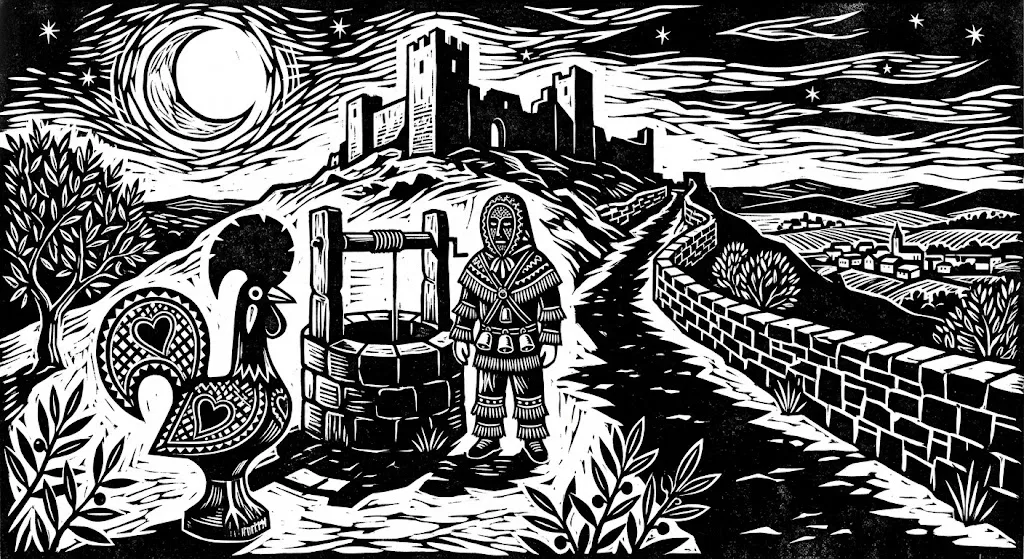
Portuguese folklore often begins with the ordinary world: a shepherd, a pilgrim, a washerwoman, a child warned away from wells, a farmer passing an ancient stone, a sailor looking into Atlantic mist. The supernatural enters through a limit point. That may be a crossroads, a spring, a cave, a ruined fort, a burial mound, the edge of the sea, the night before a feast day, or the loud disorder of Carnival. In these stories, the boundary between daily life and the unseen world is not far away; it is just behind the rock, under the ground, beyond the fog or inside a ritual moment.
This is why Portuguese folklore does not fit neatly into one category. It includes fairy-tale narratives collected in print, local legends tied to named places, ritual performance, saints’ legends, miracle stories, protective prayers, folk medicine, seasonal customs and literary nationalism. The UNESCO framework for intangible cultural heritage is useful here because it recognises living culture as including oral traditions, performing arts, rituals, festive events, knowledge about nature and traditional craft. Portugal has used that framework for practices such as Fado, Alentejo polyphonic singing, Estremoz clay figures, the Carnival of Podence and the Campo Maior community festivities.[ICH UNESCO]ich.unesco.orgOpen source on unesco.org.
That does not mean every ghost story or fairy legend is UNESCO-listed heritage. It means Portugal’s story culture sits in the same broad field as living song, craft, ritual and festival. The country’s National Inventory of Intangible Cultural Heritage was launched in 2011 as the digital Matriz PCI database, after Portugal ratified the UNESCO convention in 2008; official inventory processes ask for documentation, community context and expert methods rather than treating folklore as a loose collection of curiosities.[dspace.uevora.pt]dspace.uevora.ptCarvalho Intangible cultural heritage and public policies in Portugal 2022Carvalho Intangible cultural heritage and public policies in Portugal 2022
Enchanted women, hidden treasure and the ancient landscape
One of the most distinctive figures in Portuguese legend is the enchanted female guardian associated with treasure, stones, water and underground places. In many accounts she appears as a beautiful young woman, sometimes combing her hair, sometimes guarding wealth, sometimes waiting for someone brave or pure enough to break an enchantment. The same wider family of stories links supernatural “Moors” or enchanted people to caves, castles, wells, rivers, bridges, dolmens and hillforts.[Wikipedia]WikipediaEnchanted mouraEnchanted moura
The word “Moor” can mislead modern readers. In historical Portugal it could refer to Muslim North Africans and Iberian Muslims, but in folklore the enchanted “Moor” is often not a realistic memory of medieval Islam. These beings can behave more like fairies, spirits of the dead, treasure-keepers, builders of megaliths or inhabitants of an underground otherworld. A recent study of the “Moorish tradition” in Portuguese archaeology describes the theme as a mixture of archaeological remains, place-names, legends and popular belief rather than as a simple survival of one historical period.[ojs.zrc-sazu.si]ojs.zrc-sazu.siThe Moorish Tradition in Portuguese ArchaeologyThe Moorish Tradition in Portuguese Archaeology
The association with prehistoric monuments is especially important. In northern and rural Portugal, old stone structures could be explained through stories of supernatural builders or women who carried great stones while spinning. Scholarly and antiquarian sources note that dolmens and other funerary monuments were popularly linked with these enchanted figures, and a modern study on dolmens in Portuguese archaeology and folklore describes enchanted women as living in megalithic tombs and guarding entrances to a world beyond.[Academia]academia.eduCasas das Mouras Encantadas – A Study of dolmens in …Mouras Encantadas are supernatural beings in Portuguese folklore. They live in megCasas das Mouras Encantadas – A Study of dolmens in …Mouras Encantadas are supernatural beings in Portuguese folklore. They live in meg
These legends matter because they show how oral tradition made very old, mysterious places understandable. Before archaeology gave technical names to dolmens, mounds and hillforts, local stories gave them owners, builders and dangers. A stone was not just a stone; it might be a door, a house, a warning or a treasure chamber. That is why Portuguese landscape folklore is often less about “monsters” in the modern fantasy sense and more about charged places where memory and fear gather.
The Cockerel of Barcelos and the making of a national symbol
The Cockerel of Barcelos is probably Portugal’s most recognisable folk image. The familiar painted rooster sold as a souvenir comes from a legend centred on Barcelos, in northern Portugal. In the common version, a Galician pilgrim travelling to Santiago de Compostela is wrongly accused of a crime and condemned to hang. He insists on his innocence and says that a roasted rooster on the judge’s table will crow as surely as he is innocent. When the execution takes place, the dead rooster rises and crows; the judge rushes to the gallows and finds the pilgrim alive because the knot has failed.[Visit Portugal]visitportugal.comOpen source on visitportugal.com.
The story is a miracle legend rather than a pagan myth. Its moral centre is justice: the powerless traveller is saved when human judgement fails and a sign from beyond the ordinary world intervenes. It is also a pilgrimage story, tied to the wider Camino route to Santiago de Compostela. The legend is associated with a wayside cross or calvary kept in the Archaeological Museum at the old palace in Barcelos, which gives the tale a local material anchor rather than leaving it as a free-floating anecdote.[Visit Portugal]visitportugal.comOpen source on visitportugal.com.
The modern rooster shows how folklore changes when it becomes national branding. The colourful ceramic bird is now a symbol of Portugal, good luck, honesty and cheerful craft identity, far beyond the original courtroom-and-gallows story. That transformation is not fake folklore; it is folklore moving through craft, tourism and national self-image. A recent scholarly article on the Barcelos rooster describes the legend’s cultural transformation through both local narrative and contemporary visual identity.[Nature]nature.comOpen source on nature.com.
King Sebastian, the hidden king who would return
Few Portuguese legends have had as much cultural and political force as the belief surrounding King Sebastian. Sebastian disappeared in 1578 at the Battle of Alcácer Quibir in Morocco, a catastrophe that helped lead to a succession crisis and the loss of Portuguese independence to the Spanish Habsburgs in 1580. Rumour and hope turned the missing king into a messianic figure: the hidden one who had not truly died and would return in Portugal’s hour of need.[OpenEdition Journals]journals.openedition.orgOpen source on openedition.org.
This belief is often called Sebastianism. It drew on prophecy, apocalyptic interpretation and national longing. The prophetic verses associated with the shoemaker Bandarra were later read as foretelling a Portuguese king who would bring restoration and universal peace; after Sebastian’s disappearance, those expectations attached powerfully to him.[OpenEdition Journals]journals.openedition.orgOpen source on openedition.org.
For folklore readers, Sebastianism is important because it shows that legend is not only village entertainment. It can become a political emotion. The “hidden king” is Portugal’s version of a wider European motif: the sleeping or absent ruler who will return, like Arthur in British tradition or Barbarossa in German lore. In Portuguese culture, however, the legend was shaped by very specific national wounds: defeat, lost independence, imperial anxiety and the longing for restoration.[Brewminate]brewminate.comKing Sebastian of Portugal and the Beginning of a LegendKing Sebastian of Portugal and the Beginning of a Legend
The tradition also crossed from popular belief into literature. Fernando Pessoa’s work drew on the idea of the hidden one and the future spiritual destiny of Portugal, showing how a folk-political myth could be reworked by modern writers. In the Azores, local tales have also imagined Sebastian appearing on holy nights or full-moon nights, sometimes as an enchanted king on a white horse who vanishes when the wrong answer is given.[Wikipedia]WikipediaOpen source on wikipedia.org.
Monsters, witches and household fear
Portuguese supernatural tradition includes many smaller, more intimate figures: witches, bogeymen, werewolf-like beings, goblin-like mischief-makers, night terrors and child-warning creatures. These are often harder to document neatly than famous legends because they lived in domestic speech, local memory and cautionary tales rather than in a single canonical story.
The child-frightening figure often translated as the bogeyman appears in old Portuguese tradition under names such as the child-eating or frightening “papão” and related “coco” figures. José Leite de Vasconcelos’s work on popular traditions records formulae used to send the frightening being away, showing that this was part of everyday household language as well as story.[Wikimedia Commons]upload.wikimedia.orgOpen source on wikimedia.org.
Witches occupy a similarly complicated place. Portuguese tradition distinguishes between feared harmful magic, everyday protective practices, folk healing and later romantic or feminist reworkings of the witch figure. Modern scholarship on Portuguese women identifying with witchcraft notes that the word has been reshaped in contemporary contexts as a symbol of resistance and empowerment, but that is not the same thing as older village fear of harmful magic.[Repositório]run.unl.ptOpen source on unl.pt.
This distinction matters. A tourist list might put “witches”, “werewolves” and “goblins” side by side as colourful creatures, but in lived tradition they did different kinds of work. The bogeyman kept children away from danger. Witchcraft explained illness, envy, misfortune or social conflict. Werewolf stories dramatised transformation, curse and marginality. Mischievous house or field spirits gave a face to disorder. Portuguese folklore is strongest when these figures are read in their social setting, not just as entries in a monster catalogue.
Carnival masks and living ritual
Some of Portugal’s most visually striking folklore is not mainly a story told beside the fire, but a tradition performed in the street. The winter festivities and Carnival of Podence, in Trás-os-Montes, centre on masked figures known as Caretos. UNESCO describes the Caretos as traditional masked characters who dance around women with cowbells, moving rhythmically as part of the performance.[ICH UNESCO]ich.unesco.orgOpen source on unesco.org.
This tradition belongs to the wider world of winter masquerade in north-eastern Portugal, where masks, noise, inversion and controlled disorder mark the seasonal turn. The costumes are not just decorative. Their rattles, masks and movements create a temporary world in which ordinary village rules loosen. Younger boys imitate the Caretos, helping carry the practice forward.[Visit Europe]visiteurope.comOpen source on visiteurope.com.
For a folklore page, Podence is valuable because it shows living tradition rather than archived legend. It is not simply “ancient paganism” in a direct, provable line; claims of great antiquity are often hard to verify. What can be said with confidence is that the practice is locally rooted, publicly performed, transmitted across generations and now recognised internationally as intangible cultural heritage. Its power lies in continuity and renewal, not in a simplistic claim that nothing has changed since pre-Christian times.[ICH UNESCO]ich.unesco.orgOpen source on unesco.org.
Songs, craft and community customs as folklore
Folklore is sometimes narrowed to supernatural tales, but Portugal’s belief culture is also carried through song, craft and communal celebration. Fado, Alentejo polyphonic singing, Estremoz clay figures and Campo Maior’s community festivities all show how memory is performed, shaped and handed on. Portugal’s UNESCO-listed intangible heritage includes these practices alongside the Carnival of Podence, while cowbell manufacturing and the black pottery of Bisalhães are listed as needing urgent safeguarding.[unesco.missaoportugal.mne.gov.pt]unesco.missaoportugal.mne.gov.ptOpen source on mne.gov.pt.
Alentejo singing is a good example of folklore without a monster. UNESCO describes it as traditional two-part singing by amateur choral groups in southern Portugal, marked by distinctive melodies and performance without instruments. This kind of practice preserves rural soundscapes, work memory and local identity as surely as a legend preserves a haunted well.[ICH UNESCO]ich.unesco.orgOpen source on unesco.org.
Madeira’s official tourism material similarly presents folklore as living performance: the island’s hallmark is the “Bailinho”, accompanied by traditional regional voices and musical instruments. This is not supernatural folklore in the narrow sense, but it belongs to the same cultural field of inherited performance, local identity and public display.[Visit Madeira]visitmadeira.comOpen source on visitmadeira.com.
The important point is that Portuguese folklore is not only what people once believed in fear. It is also what communities sing, dance, make, display and repeat because it tells them who they are.
Islands, sea mist and enchanted places
Portugal’s Atlantic islands add another layer to the country’s legendary imagination. In the Azores, the Sete Cidades lakes on São Miguel are tied to one of the best-known island legends: the blue and green lakes were formed, according to the tale, from the tears of a princess and a shepherd whose love was forbidden. The official Azores tourism site presents the protected landscape as one of Portugal’s natural wonders and includes the legend as part of the place’s identity.[Visit Azores]visitazores.comOpen source on visitazores.com.
This is a classic landscape-origin legend. It does not try to explain volcanic geology scientifically; it gives emotional meaning to a visible feature. The different colours of the lakes become the lovers’ tears, and the view becomes a story about longing. Such tales are especially powerful in tourist settings because visitors can stand at the viewpoint and immediately understand why a community would attach a story to the scene.
Island folklore also absorbs the sea’s uncertainty. Phantom islands, enchanted islands, lost lands and miraculous arrivals appear naturally in Atlantic cultures because fog, distance and navigation create a world where seeing and believing are unstable. Sebastianist legend also developed island versions, including ideas of the hidden king waiting in an enchanted or shrouded place.[Wikipedia]WikipediaOpen source on wikipedia.org.
Madeira has its own mixture of founding history, legend and performed folklore. The town of Machico is officially presented as the historical birthplace of Madeira, while local and tourist retellings often connect its name with the romance of Machim, an English lover figure from pre-settlement legend. The evidential status of such stories varies, but their cultural function is clear: they turn settlement history into memorable narrative.[Visit Madeira]visitmadeira.comVisit Madeira MachicoVisit Madeira Machico
How collectors, archives and writers shaped what survives
Much of what modern readers know as Portuguese folklore passed through nineteenth- and early twentieth-century collectors. Consiglieri Pedroso’s “Portuguese Folk-Tales”, published in English in 1882, is an important early collection available through archival copies; its catalogue record identifies it directly with Portuguese folklore and tales.[Internet Archive]archive.orgOpen source on archive.org.
Ataíde Oliveira’s 1898 work on enchanted women and enchantments in the Algarve is another major example of regional collection. Portugal’s Matriz PCI biographical entry for Oliveira highlights that book as an ethnographic work on popular traditions, legends and superstitions.[Internet Archive]archive.orgOpen source on archive.org.
These collectors preserved valuable material, but they also shaped it. Oral stories become different once written down, classified, translated and published for educated readers. A village tale told with local names and gestures may appear in print as a “Portuguese folk tale”; a belief attached to one well may be generalised into a national type; a regional phrase may be smoothed into literary language. That does not make the records useless. It means the reader should ask what kind of source is being used: oral testimony, antiquarian collection, literary adaptation, official heritage description, scholarly analysis or tourist retelling.
Modern digital and heritage projects continue the process. Portugal’s official and semi-official heritage systems now document intangible culture through inventories, documentation standards and community participation rather than relying only on romantic collectors. This gives today’s readers a better way to separate living practice from attractive but unsupported internet folklore.[dspace.uevora.pt]dspace.uevora.ptCarvalho Intangible cultural heritage and public policies in Portugal 2022Carvalho Intangible cultural heritage and public policies in Portugal 2022
Old tradition, tourist retelling and internet folklore
Portuguese folklore is popular online, but not every neat creature profile or dramatic ghost story has equal weight. The strongest traditions usually have at least one of three anchors: a documented collector or archive, a named place with local continuity, or an active community practice. The Cockerel of Barcelos has a local monument and long public retelling. The enchanted women and hidden treasure legends have antiquarian, ethnographic and archaeological discussion. Podence Carnival has living performers and UNESCO recognition. Sete Cidades has landscape, local tourism and repeated island tradition.[visitportugal.com]visitportugal.comOpen source on visitportugal.com.
By contrast, some modern lists of “Portuguese monsters” mix old household warnings, regional beings, Brazilian material, fantasy-style reinventions and recent web summaries. They can be fun, but they should not be treated as equal to documented oral tradition. The same caution applies to claims that every masked festival is directly pagan, every enchanted woman is a goddess, or every hidden treasure tale preserves an exact memory of prehistoric religion. Those may be tempting interpretations, but responsible folklore writing separates evidence from possibility.
The most honest way to read Portuguese folklore is as a living braid. Some strands are old; some are medieval; some are early modern; some were stabilised by nineteenth-century collectors; some were reshaped by nationalism, tourism, scholarship, museums and the internet. The tradition remains powerful because it keeps giving Portuguese places a second life: a rooster can speak for justice, a king can wait in the fog, a lake can remember forbidden love, and a stone on a hillside can still feel as though someone is guarding it.
Amazon book picks
Further Reading
Books and field guides related to Where Portugal's Legends Still Haunt the Landscape. Use these as the next step if you want deeper reading beyond the article.
The Book of Imaginary Beings
Appeals to readers interested in legendary creatures and folklore traditions beyond Portugal.
The Lusiads
Provides cultural and mythic context for Portuguese identity, heroism and legendary imagination.
Traveller?'s History Portugal
Helps readers place folklore, legends and traditions within Portuguese history.
eBay marketplace picks
Marketplace Samples
Live-tested eBay searches with available results related to this page.
Endnotes
1.
Source: Wikipedia
Title: Enchanted moura
Link:https://en.wikipedia.org/wiki/Enchanted_moura
2.
Source: journals.openedition.org
Link:https://journals.openedition.org/hamsa/277
3.
Source: archive.org
Link:https://archive.org/details/portuguesefolkta00consuoft
4.
Source: dspace.uevora.pt
Title: Carvalho Intangible cultural heritage and public policies in Portugal 2022
Link:https://dspace.uevora.pt/rdpc/bitstream/10174/32368/1/Carvalho_Intangible%20cultural%20heritage%20and%20public%20policies%20in%20Portugal_2022.pdf
5.
Source: unesco.missaoportugal.mne.gov.pt
Link:https://unesco.missaoportugal.mne.gov.pt/en/portugal-and-unesco/culture/intangible-cultural-heritage
6.
Source: ich.unesco.org
Link:https://ich.unesco.org/en/convention
7.
Source: books.openedition.org
Title: Open Edition Books IX
Link:https://books.openedition.org/etnograficapress/8663
8.
Source: ojs.zrc-sazu.si
Title: The Moorish Tradition in Portuguese Archaeology
Link:https://ojs.zrc-sazu.si/sms/article/download/14594/12515/44152
9.
Source: academia.edu
Link:https://www.academia.edu/12656316/Casas_das_[Mouras
10.
Source: Wikipedia
Title: Rooster of Barcelos
Link:https://en.wikipedia.org/wiki/Rooster_of_Barcelos
11.
Source: nature.com
Link:https://www.nature.com/articles/s41599-024-02748-5
12.
Source: brewminate.com
Title: King Sebastian of Portugal and the Beginning of a Legend
Link:https://brewminate.com/the-desired-king-sebastian-of-portugal-and-the-beginning-of-a-legend/
13.
Source: Wikipedia
Link:https://en.wikipedia.org/wiki/Sebastianism
14.
Source: upload.wikimedia.org
Link:https://upload.wikimedia.org/wikipedia/commons/f/f2/Tradi%C3%A7%C3%B5es_populares_de_Portugal_%28IA_tradicoespopular00vasc%29.pdf
15.
Source: ich.unesco.org
Link:https://ich.unesco.org/en/RL/winter-festivities-carnival-of-podence-01463
16.
Source: Wikipedia
Title: Caretos de Podence
Link:https://pt.wikipedia.org/wiki/Caretos_de_Podence
17.
Source: ich.unesco.org
Link:https://ich.unesco.org/en/RL/cante-alentejano-polyphonic-singing-from-alentejo-southern-portugal-01007
18.
Source: archive.org
Link:https://archive.org/details/asmourasencantad00olivuoft
19.
Source: matrizpci.patrimoniocultural.gov.pt
Title: ATAID E DE OLIVEIRA, Francisco Xavier de
Link:https://matrizpci.patrimoniocultural.gov.pt/pt-PT/RecursosSearch/PesquisaInvestigadores?IdEntidade=430
20.
Source: ich.unesco.org
Link:https://ich.unesco.org/en/lists
21.
Source: ich.unesco.org
Title: portugal PT
Link:https://ich.unesco.org/en/state/portugal-PT
22.
Source: ich.unesco.org
Link:https://ich.unesco.org/doc/src/39822.pdf
23.
Source: Wikipedia
Title: Culture of Portugal
Link:https://en.wikipedia.org/wiki/Culture_of_Portugal
24.
Source: Wikipedia
Title: List of Intangible Cultural Heritage elements in Portugal
Link:https://en.wikipedia.org/wiki/List_of_Intangible_Cultural_Heritage_elements_in_Portugal
25.
Source: Wikipedia
Title: Cante Alentejano
Link:https://en.wikipedia.org/wiki/Cante_Alentejano
26.
Source: Wikipedia
Title: Moura encantada
Link:https://pt.wikipedia.org/wiki/Moura_encantada
27.
Source: Wikipedia
Title: Lenda do Galo de Barcelos
Link:https://pt.wikipedia.org/wiki/Lenda_do_Galo_de_Barcelos
28.
Source: Wikipedia
Title: Witch trials in Portugal
Link:https://en.wikipedia.org/wiki/Witch_trials_in_Portugal
29.
Source: Wikipedia
Link:https://en.wikipedia.org/wiki/Madeira
30.
Source: patrimoniocultural.gov.pt
Link:https://www.patrimoniocultural.gov.pt/
31.
Source: patrimoniocultural.gov.pt
Link:https://www.patrimoniocultural.gov.pt/en/presentation/
32.
Source: archive.org
Link:https://archive.org/download/portugueselitera00belluoft/portugueselitera00belluoft.pdf
33.
Source: archive.org
Link:https://archive.org/details/portuguesefolkt00ralsgoog
34.
Source: archive.org
Title: folkherotales00maciuoft djvu.txt
Link:https://archive.org/stream/folkherotales00maciuoft/folkherotales00maciuoft_djvu.txt
35.
Source: archive.org
Link:https://archive.org/download/gratefuldeadhist00gerouoft/gratefuldeadhist00gerouoft.pdf
36.
Source: archive.org
Link:https://archive.org/stream/folklorejournal01britgoog/folklorejournal01britgoog_djvu.txt
37.
Source: archive.org
Link:https://archive.org/download/studimedievali02cent/studimedievali02cent.pdf
38.
Source: archive.org
Title: b22652644 0003 djvu.txt
Link:https://archive.org/stream/b22652644_0003/b22652644_0003_djvu.txt
39.
Source: archive.org
Link:https://archive.org/download/sevensagesofrome00camp/sevensagesofrome00camp.pdf
40.
Source: archive.org
Link:https://archive.org/download/asmourasencantad00olivuoft/asmourasencantad00olivuoft.pdf
41.
Source: academia.edu
Link:https://www.academia.edu/86447161/O_conto_popular_portugu%C3%AAs
42.
Source: academia.edu
Link:https://www.academia.edu/30279688/Between_the_New_and_the_Old_World_Iberian_Prophecies_and_Imperial_Projects_in_the_Colonisation_of_the_Early_Modern_Spanish_and_Portuguese_Americas
43.
Source: academia.edu
Link:https://www.academia.edu/28240057/The_Humorous_Devil_Sorcery_Occult_Virtues_and_the_Evil_Eye_in_18th_Century_Portuguese_Medicine
44.
Source: academia.edu
Link:https://www.academia.edu/32592435/Dicionario_portugues
45.
Source: academia.edu
Link:https://www.academia.edu/83198047/Intangible_Cultural_Heritage_and_Digital_Media_Portugal_Slovakia_Readings
46.
Source: portugal.gov.pt
Link:https://portugal.gov.pt/en/gc22/communication/news/community-festivities-from-campo-maior-are-now-intangible-cultural-heritage-of-humanity
47.
Source: unesco.missaoportugal.mne.gov.pt
Title: mne.gov.pt Património Cultural Imaterial
Link:https://unesco.missaoportugal.mne.gov.pt/pt/portugal-e-a-unesco/cultura/patrimonio-cultural-imaterial
48.
Source: brewminate.com
Title: sebastianism the calabrian charlatan and medieval messianic nationalism
Link:https://brewminate.com/sebastianism-the-calabrian-charlatan-and-medieval-messianic-nationalism/
49.
Source: journals.openedition.org
Link:https://journals.openedition.org/etnografica/pdf/292
50.
Source: commons.wikimedia.org
Link:https://commons.wikimedia.org/wiki/File%3AAs_mouras_encantadas_e_os_encantamentos_no_Algarve_-com_algumas_notas_elucidativas%28IA_asmourasencantad00olivuoft%29.pdf
51.
Source: portugal.com
Title: 18 amazing facts about sebastian the portuguese king who disappeared
Link:https://www.portugal.com/history-and-culture/18-amazing-facts-about-sebastian-the-portuguese-king-who-disappeared/
52.
Source: portugal.com
Title: portuguese islands folk tales
Link:https://www.portugal.com/history-and-culture/portuguese-islands-folk-tales/
53.
Source: natural.pt
Title: caretos podence patrimonio imaterial unesco
Link:https://natural.pt/news/caretos-podence-patrimonio-imaterial-unesco?locale=en
54.
Source: visitportugal.com
Link:https://www.visitportugal.com/en/node/139480
55.
Source: run.unl.pt
Link:https://run.unl.pt/server/api/core/bitstreams/355445f6-5839-4cfd-94a7-98a20565f7de/content
56.
Source: visiteurope.com
Link:https://visiteurope.com/experiences/carnival-podence-portugal
57.
Source: visitmadeira.com
Link:https://visitmadeira.com/en/what-to-do/culture-passionates/folklore/
58.
Source: visitazores.com
Link:https://www.visitazores.com/en/explore/protected-landscape-of-the-sete-cidades-lake
59.
Source: visitmadeira.com
Title: Visit Madeira Machico
Link:https://visitmadeira.com/en/where-to-go/madeira/east-coast/machico/
60.
Source: facebook.com
Link:https://www.facebook.com/groups/2399377773554039/posts/2416616811830135/
61.
Source: en.citaliarestauro.com
Title: intangible cultural heritage
Link:https://en.citaliarestauro.com/intangible-cultural-heritage/
62.
Source: heritagefund.org.uk
Title: intangible cultural heritage
Link:https://www.heritagefund.org.uk/funding/good-practice-guidance/intangible-cultural-heritage
63.
Source: lettersfromlisbon.substack.com
Link:https://lettersfromlisbon.substack.com/p/sebastianism
64.
Source: catalog.hathitrust.org
Link:https://catalog.hathitrust.org/Record/010883446
65.
Source: pemd.univasf.edu.br
Link:https://www.pemd.univasf.edu.br/troca_letras/Lista-de-palavras2.txt
66.
Source: jls.apsa.us
Link:https://jls.apsa.us/index.php/jls/article/view/67/87
67.
Source: mythfolks.com
Title: portuguese folklore
Link:https://www.mythfolks.com/portuguese-folklore
68.
Source: revistas.fcsh.unl.pt
Link:https://revistas.fcsh.unl.pt/rcl/article/download/1308/1196
69.
Source: correspondencesjournal.com
Link:https://correspondencesjournal.com/ojs/ojs/index.php/home/article/download/149/141
Additional References
70.
Source: youtube.com
Title: The Incredible Miracle of the Rooster of Barcelos – Portuguese Folklore
Link:https://www.youtube.com/watch?v=WEiE4jdDtfM
Source snippet
The Mysterious Old Woman of the White Mare – Portuguese Folklore...
71.
Source: youtube.com
Title: The Mysterious Old Woman of the White Mare – Portuguese Folklore
Link:https://www.youtube.com/watch?v=oIxiLo08v-k
Source snippet
The Fascinating She-Wolf of Portuguese Mythology - Peeira...
72.
Source: youtube.com
Title: Mythical Creatures Of Portugal Explained In 3 Hours
Link:https://www.youtube.com/watch?v=J_6URV5TZMA
Source snippet
The Incredible Miracle of the Rooster of Barcelos – Portuguese Folklore...
73.
Source: ibermuseos.org
Link:https://www.ibermuseos.org/wp-content/uploads/2020/05/matrizpci-manualdeutilizacao-2014-por.pdf
74.
Source: researchgate.net
Link:https://www.researchgate.net/publication/393995399_The_Moorish_Tradition_in_Portuguese_Archaeology
75.
Source: facebook.com
Link:https://www.facebook.com/Handkrampf/posts/a-lenda-do-galo-de-barcelos-sometimes-inspiration-finds-you-in-the-most-unexpect/1522808599887922/
76.
Source: amazon.com
Link:https://www.amazon.com/Secret-History-Portugal-Collection-Portuguese/dp/B0G4HDL33Z?tag=searcht-20
77.
Source: scribd.com
Link:https://www.scribd.com/document/702542219/Goncalo-Anes-Bandarra-The-Craft-of-Proph
78.
Source: enchanted-chronicles.com
Link:https://www.enchanted-chronicles.com/the-legend-of-sete-cidades/
79.
Source: gutenberg.org
Link:https://www.gutenberg.org/browse/authors/c
Topic Tree
Follow this branch
Related pages 192
- Afghan Folklore
- Albanian Folklore
- Algerian Folklore
- Australian Folklore
- Azerbaijan Folklore
- +187 more in sidebar