What Lives Inside Tunisia's Folklore?
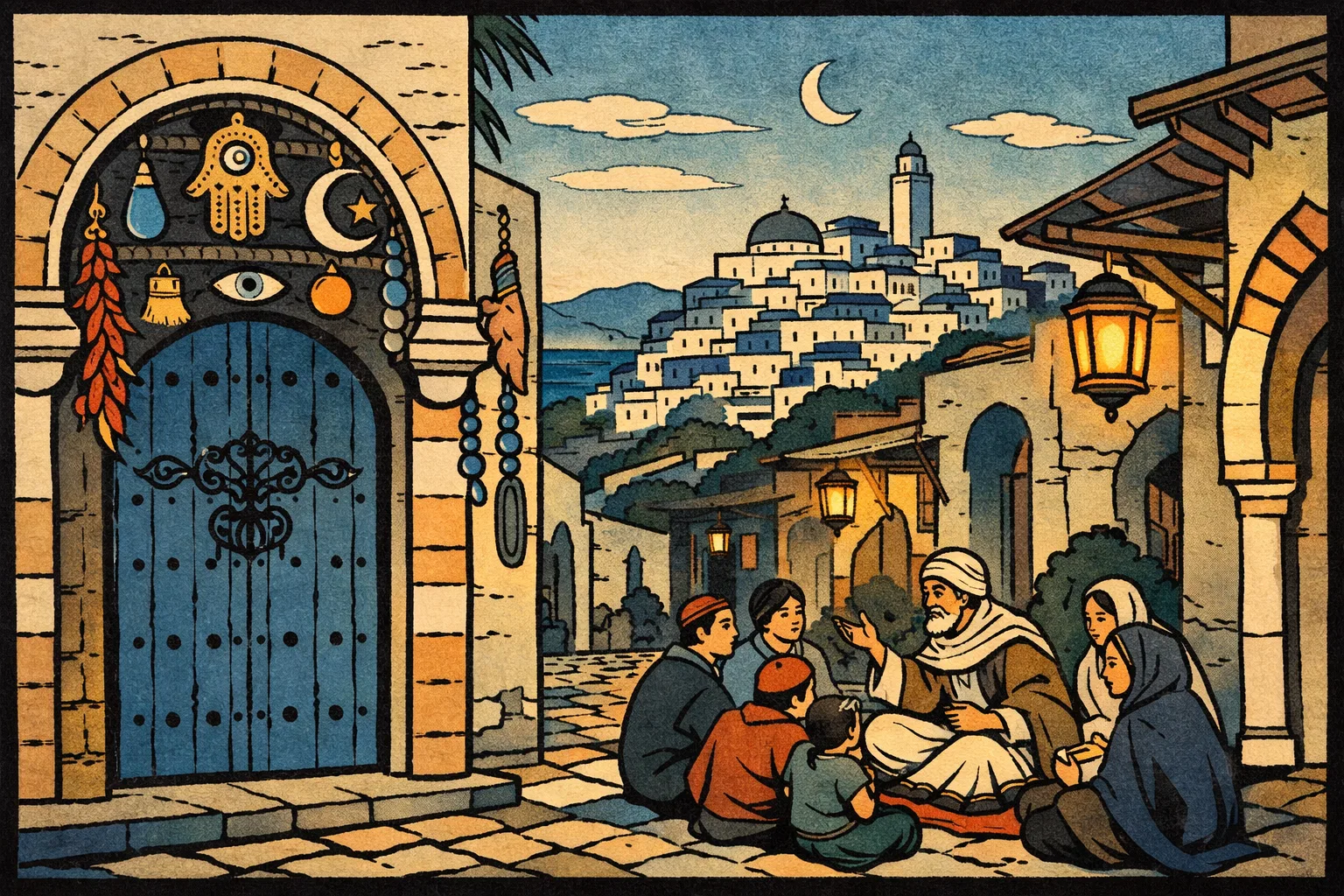
Tunisia’s folklore is best understood as a layered tradition rather than a single mythology.
Page outline Jump by section
What Counts as Tunisian Folklore?
Tunisian folklore includes far more than fairy tales. It covers oral narratives, household beliefs, saint veneration, healing ceremonies, ritual music, seasonal festivals, protective charms, children’s processions, pilgrimage stories and local explanations for why a village, shrine, cave, spring or ruined city matters. Because Tunisia sits between the Mediterranean, the Sahara and the wider Arab and African worlds, many motifs are shared with neighbouring countries, but the local setting changes their meaning.
A jinn story in Tunisia may sound related to wider Islamic and Arabic folklore, yet it becomes specifically Tunisian when attached to a household threshold, a ruined fort, a saint’s shrine, a desert path or a family practice. A sea festival in Sousse may carry hints of Roman or older Mediterranean ritual, but its modern form is a civic carnival. A healing ceremony may involve spirits and trance, but it is also a record of sub-Saharan African communities, enslavement, migration and survival within Tunisia.[goethe.de]goethe.deOpen source on goethe.de.
The evidence is uneven. UNESCO pages, archaeological sites and ethnographic studies give strong anchors for some traditions, especially Carthage, Sousse, Djerba and Stambeli. Rural rain rituals and older folktales are harder to document because they were often performed orally, locally and without written records. That does not make them unimportant; it means they need to be handled as remembered or collected traditions rather than as tidy, fixed myths.[academia.edu]academia.eduPDF) Women's oral narratives in TunisPDF) Women's oral narratives in Tunis
Oral Tales, Storytellers and Everyday Wonder
Tunisia has a strong oral storytelling heritage, especially in Tunisian Arabic. Before modern broadcasting and print, tales, poems and comic or marvellous stories circulated through markets, festivals, cafés, family spaces and public performance. Sources on Tunisian Arabic note a pre-independence body of folk tales and poems, with popular stories later recorded for radio or adapted into written form by authors and cultural associations.[Wikipedia]WikipediaTunisian ArabicTunisian Arabic
These tales often mix entertainment with moral testing. Like many North African and Arab oral traditions, they include clever women, foolish men, dangerous animals, ogres, witches, tricksters, enchanted objects and sudden reversals of fortune. The point is rarely only the monster. The tale asks whether the hero is generous, whether the youngest sibling is underestimated, whether greed brings punishment, or whether quick wit matters more than strength.
One important modern issue is language. Tunisian Arabic has historically been more spoken than formally written, so many traditional stories reached print through French, standard Arabic, English translation, radio performance or recent transcription projects. Modern linguistic work on Tunisian Arabic and Tunisian Arabizi also shows how digital writing is creating new archives of informal language, which may affect how jokes, sayings, ghost stories and folk memory circulate online.[arXiv]arxiv.orgarXiv Normalized Orthography for Tunisian ArabicarXiv Normalized Orthography for Tunisian Arabic
For readers, the key point is that Tunisian folklore is not limited to ancient myths. A grandmother’s warning, a radio storyteller’s comic tale, a local saint story, a child’s rain song and an online retelling can all belong to the same living chain, even when they come from different periods and media.
Jinn, Ghouls and the Unseen
Belief in jinn is one of the most recognisable supernatural frameworks in Tunisia, as in much of the Arabic-speaking and Islamic world. Jinn are not “fairies” in the European sense, although they sometimes play similar narrative roles as hidden beings who occupy places humans cannot fully control. They may be imagined around ruins, deserted places, thresholds, wells, cemeteries, baths, caves or lonely roads. In everyday belief, they help explain sudden misfortune, illness, fear, strange sounds or the feeling that a place is not entirely human.
Ghouls and ogres belong to a related but more openly monstrous story-world. Wider Arabic folklore describes the ghoul as a frightening being associated with deserts, graveyards or desolate places, and North African folktales often use ogres and ogresses as figures of appetite, danger and trickery.[EBSCO]ebsco.comOpen source on ebsco.com.
In Tunisian storytelling, such beings are best read as narrative tools rather than a single fixed bestiary. They mark the edge between safe and unsafe space: home and wilderness, village and desert, childhood and danger, ordinary life and the unseen. They also make practical warnings memorable. Do not wander alone. Do not trust appearances. Do not break hospitality rules. Do not ignore the advice of older people. The supernatural makes social knowledge vivid.
Saints, Shrines and Protective Places
Some of Tunisia’s most powerful folk traditions are attached not to monsters but to holy people. Sufi saints, local patrons and marabout shrines form a sacred map of the country. A marabout is a saintly figure or shrine associated with blessing, protection and local memory. These sites may be visited for prayer, vows, healing, childbirth hopes, family transitions, or simply because the shrine is part of how people know their city.
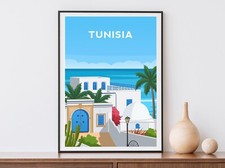
Sidi Bou Said is the clearest example for many visitors. The blue-and-white clifftop town near Tunis takes its name from the Sufi scholar Abu Said al-Baji, and modern accounts still connect the place with Sufi heritage, coastal protection and saintly memory.[Sacred Footsteps]sacredfootsteps.comSacred Footsteps The Café of Saints: Sidi Bou SaidSacred Footsteps The Café of Saints: Sidi Bou Said
Tunis has similar saintly geography. Sidi Mahrez is often remembered as a patron of the medina, and accounts of Tunisian Sufi shrines describe them not only as religious sites but also as landmarks in everyday speech and local orientation.[The Christian Century]christiancentury.orghow tunisia s sufis have withstood attack hard line islamistshow tunisia s sufis have withstood attack hard line islamists
These traditions have also been contested. Some hard-line religious movements reject shrine visitation as improper, and Tunisian shrines have suffered attacks, including the 2013 arson attack on the Sidi Bou Said shrine. Such incidents show that folklore is not just “colourful heritage”. It can sit at the centre of arguments about religion, identity, memory and who has the right to define public culture.[Foreign Policy In Focus]fpif.orgOpen source on fpif.org.
Stambeli: Spirits, Healing and the Memory of Enslavement
Stambeli is one of Tunisia’s most distinctive spirit traditions. It is a music, trance and healing practice associated especially with Black Tunisians descended from enslaved or displaced sub-Saharan Africans. Ethnomusicologist Richard C. Jankowsky’s work describes Stambeli as a Tunisian tradition in which music calls on a pantheon of sub-Saharan spirits and North African Muslim saints through ritualised trance.[Google Books]books.google.comOpen source on google.com.
Its folklore value is enormous because it holds several histories at once. It remembers trans-Saharan movement and slavery; it preserves African spirit concepts in a Tunisian setting; it connects illness, music and ritual; and it shows how spirits may be understood as both dangerous and healing. The point is not simply that people “believe in spirits”. The ritual offers a structured relationship with distress, possession, ancestry and community.
Stambeli also challenges a simplified image of Tunisian culture as only Arab or Mediterranean. Its instruments, rhythms and ritual roles point to connections with other North African possession and healing traditions, including Moroccan Gnawa and related practices across the region, while remaining rooted in Tunisia’s own history.[Africanews]africanews.comtunisian harissa listed as intangible heritage of humanitytunisian harissa listed as intangible heritage of humanity
Today, Stambeli is often discussed as endangered heritage. Public performances, recordings and documentary projects can help preserve awareness, but they also change the context. A ritual performed for healing inside a community is not identical to a staged cultural performance for audiences. That distinction matters when presenting Stambeli to curious readers: it is both heritage and lived religious practice, not merely “folkloric music”.[stambeli.com]stambeli.comBlack spirits, white saintsBlack spirits, white saints
Carthage, Tanit and the Problem of Ancient Survival
Carthage gives Tunisia one of its deepest mythic landscapes. UNESCO describes Carthage as a Phoenician-founded site overlooking the Gulf of Tunis, a centre of Punic civilisation and later a Roman provincial capital.[UNESCO World Heritage Centre]whc.unesco.orgOpen source on unesco.org.
For folklore, Carthage matters because ancient names and symbols still echo in modern culture. The goddess Tanit, strongly associated with Carthage, appears in archaeological discussions, museum objects, popular writing and modern Tunisian cultural symbolism. Yet this is where caution is needed. We have archaeological evidence for Punic religion, but not a continuous, fully documented chain of oral worship from ancient Carthage into modern village custom.
The rainmaking figure known as Omek Tannou is often described in Tunisian cultural writing as a survival or transformation of older Punic and Amazigh rain traditions linked with Tanit. The ritual is usually described as a children’s procession during drought, involving a doll or dressed stick carried from house to house while women pour water and make rain petitions. Stronger evidence supports its existence as a remembered Tunisian rain rite; the exact ancient connection to Tanit is more interpretive and should be presented as a traditional or scholarly association rather than a proven unbroken survival.[wikipedia.org]WikipediaOmek TannouOmek Tannou
This is a useful rule for Tunisian folklore more broadly. Ancient ancestry is often plausible, especially in a country with Carthaginian, Roman, Amazigh and Islamic layers, but “ancient” should not be used as decoration. A tradition can be culturally meaningful even when its oldest roots are uncertain.
Sea, Heat and Festival: The Carnival of Awussu
The Carnival of Awussu in Sousse is one of Tunisia’s most vivid examples of seasonal folklore becoming civic festival. It is held in late July near the beginning of the hottest part of the summer calendar and includes parades, symbolic floats, music and folk groups. Modern accounts connect it with the sea, the heat of summer and older Mediterranean ideas, sometimes linking it to Neptune or even pre-Roman traditions, though those deep origins are not equally well evidenced.[Wikipedia]WikipediaCarnival of AwussuCarnival of Awussu
Sousse itself gives the festival a powerful setting. UNESCO describes the Medina of Sousse as an Aghlabid-period coastal city with a kasbah, ramparts, Great Mosque and ribat, forming part of an early Islamic coastal defence system. The city’s built heritage is therefore already about the sea as both livelihood and threat.[UNESCO World Heritage Centre]whc.unesco.orgWorld Heritage Centre Medina of SousseWorld Heritage Centre Medina of Sousse
Awussu matters because it shows how folklore can shed its older religious meanings and become public culture. A sea rite can become a carnival. A seasonal fear of heat, illness or danger can become a night of music and procession. A local celebration can become part of tourism, civic identity and post-independence cultural display.
That does not make it fake. It means the tradition has changed function. The old question may have been how to ask the sea and season for protection; the modern question is how a city performs its memory in public.
Djerba, El Ghriba and Jewish Legend
Tunisian folklore is also Jewish. Djerba, off Tunisia’s south-eastern coast, is home to one of North Africa’s most important Jewish communities and to the El Ghriba synagogue, the centre of an annual pilgrimage. Recent reporting describes the pilgrimage as a major cultural and religious event involving candle lighting, sacred readings, symbolic egg rituals and the Minara procession.[AP News]apnews.comThe pilgrimage, rooted in traditions thousands of years old, remains a vital cultural and spiritual event for Tunisia’s Jewish community…
El Ghriba is surrounded by foundation legends. One tradition links it to stones or a door from the Jerusalem Temple; another tells of a mysterious isolated young woman whose body became associated with the sacred site. These are not archaeological proofs in a modern sense, but they are exactly the kind of stories that give a shrine emotional authority. They connect Djerba to Jerusalem, exile, holiness, mourning and belonging.[Wikipedia]WikipediaEl Ghriba SynagogueEl Ghriba Synagogue
The pilgrimage also shows how folklore and politics can collide. Reuters and AP reporting in recent years has described security concerns, cancellations or scaled-back rituals, and later partial returns of foreign visitors after violence and regional tensions.[Reuters]reuters.comOrganisers of Jewish pilgrimage in Tunisia cancel annual celebrations over GazaOrganisers of Jewish pilgrimage in Tunisia cancel annual celebrations over Gaza
For a folklore page, the important point is not only that El Ghriba is old or famous. It is that legend, ritual, minority identity and national heritage meet in one place. Djerba’s Jewish traditions are part of Tunisia’s cultural landscape, not a footnote to it.
Haunted and Sacred Landscapes
Tunisia’s folklore is strongly place-based. Old medinas, ribats, oases, cemeteries, caves, shrines, ruins and desert routes all invite stories. The country’s UNESCO sites help explain why: places such as Carthage and Sousse are not empty ruins but landscapes where successive civilisations left visible layers.[UNESCO World Heritage Centre]whc.unesco.orgOpen source on unesco.org.
A ruined place is especially fertile for supernatural storytelling. Carthage can carry ancient grandeur and loss. Sousse’s ribat can suggest defence, prayer and danger from the sea. Desert oases can hold stories about water, saints, jinn and survival. Shrines can become protective centres in a neighbourhood. In folklore, landscape is never just background; it is a participant.
This is also why Tunisian folklore often resists neat classification. A shrine may be religious, architectural, legendary and social all at once. A desert tale may be a warning, a joke and a supernatural story. A festival may be seasonal, touristic and faintly mythic. The same tradition can be many things depending on who is telling it and why.
Folklore in Food, Craft and Daily Protection
Some Tunisian traditions look ordinary until you read them as folklore. Food practices, craft skills, protective symbols, wedding customs, songs, dress and household rituals can all carry inherited meanings. UNESCO’s intangible heritage work on Tunisia includes practices such as harissa-making and craft traditions, reminding readers that heritage is not only monuments or dramatic myths but also knowledge passed through hands, kitchens and communities.[Intangible Cultural Heritage]ich.unesco.orgOpen source on unesco.org.
The evil eye is a good example of daily folklore, even when not unique to Tunisia. Protective gestures, amulets, blessings and avoidance customs belong to a wider Mediterranean and North African world, but they become locally meaningful through Tunisian family life. They speak to envy, vulnerability, children, beauty, success and the fear that good fortune attracts danger.
This everyday layer is important because public-facing folklore pages often over-focus on monsters. In real life, protective customs may matter more than named creatures. A story about a ghoul is memorable; a habit of blessing a child, visiting a saint, avoiding a dangerous place or cooking for a ritual occasion may tell us more about how folklore actually works.
Old Tradition, Modern Retelling and Internet Folklore
Modern Tunisia has not lost folklore; it has changed its media. Radio recordings, bilingual folktale books, cultural festivals, heritage campaigns, museum displays, documentaries, tourism pages, social media posts and diaspora memory all reshape traditional material.[wikipedia.org]WikipediaTunisian ArabicTunisian Arabic
This creates three common traps for readers.
First, not every old-sounding story is ancient. Some “ancient” explanations are modern reconstructions, tourist simplifications or internet repetitions.
Second, not every modern performance is inauthentic. A staged Stambeli concert, an Awussu parade or a printed folktale can still preserve real cultural material, even though the setting has changed.
Third, folklore often survives as fragments. A half-remembered rain song, a family warning about jinn, a saint’s nickname, a festival float or a shrine legend may be the visible remnant of a much larger tradition.
The best approach is to ask what kind of evidence supports each claim. Archaeology supports Carthage’s ancient importance. Ethnography supports Stambeli’s ritual world. News and pilgrimage reporting support El Ghriba’s continuing public role. Oral-history and cultural writing support rain rites and folktales, but their deeper antiquity often needs more caution.[unesco.org]whc.unesco.orgOpen source on unesco.org.
Why Tunisian Folklore Matters Today
Tunisian folklore matters because it shows the country as more than a set of historical periods. It reveals how people connect those periods emotionally: Carthage through Tanit and foundation memory, Islamic cities through saints and shrines, Djerba through Jewish pilgrimage, the Sahel coast through sea festivals, Black Tunisian history through Stambeli, and rural life through rain rituals and oral tales.
It also complicates simple identity labels. Tunisia is Arab and Amazigh, Mediterranean and African, Muslim-majority and religiously plural, ancient and modern. Its folklore preserves that complexity better than a political timeline can. A single shrine may hold local history, Sufi devotion, neighbourhood identity and modern conflict. A single ritual song may carry drought anxiety, children’s performance, women’s household authority and claims about Punic memory.
For curious readers, the most memorable Tunisian folklore is not one monster or one myth. It is the pattern: unseen beings at the edge of ordinary life, saints who protect places, music that negotiates with spirits, festivals that tame dangerous seasons, and stories that keep older landscapes speaking in the present.
Amazon book picks
Further Reading
Books and field guides related to What Lives Inside Tunisia's Folklore?. Use these as the next step if you want deeper reading beyond the article.
The Arabian Nights
Introduces motifs of jinn, magic and oral tradition relevant to Tunisia.
A History of the Maghrib in the Islamic Period
Provides cultural background for Tunisia's layered folklore.
eBay marketplace picks
Marketplace Samples
Live-tested eBay searches with available results related to this page.
Endnotes
1.
Source: whc.unesco.org
Link:https://whc.unesco.org/en/list/37/
2.
Source: whc.unesco.org
Title: World Heritage Centre Medina of Sousse
Link:https://whc.unesco.org/en/list/498/
3.
Source: books.google.com
Link:https://books.google.com/books/about/Stambeli.html?id=TDXHtXRjZbQC
4.
Source: goethe.de
Link:https://www.goethe.de/prj/ruy/en/dos/hkw/25324373.html
5.
Source: academia.edu
Title: (PDF) Women’s oral narratives in Tunis
Link:https://www.academia.edu/96983852/Womens_oral_narratives_in_Tunis
6.
Source: Wikipedia
Title: Tunisian Arabic
Link:https://en.wikipedia.org/wiki/Tunisian_Arabic
7.
Source: meshkal.org
Title: tunisias amazigh seek to preserve unique identity
Link:https://meshkal.org/tunisias-amazigh-seek-to-preserve-unique-identity/
8.
Source: Wikipedia
Title: Culture of Tunisia
Link:https://en.wikipedia.org/wiki/Culture_of_Tunisia
9.
Source: arxiv.org
Title: arXiv Normalized Orthography for Tunisian Arabic
Link:https://arxiv.org/abs/2402.12940
10.
Source: arxiv.org
Link:https://arxiv.org/abs/2003.09520
11.
Source: arxiv.org
Title: arXiv TAr C: Tunisian Arabish Corpus First complete release
Link:https://arxiv.org/abs/2207.04796
12.
Source: ebsco.com
Link:https://www.ebsco.com/research-starters/literature-and-writing/ghoul-mythical-creature
13.
Source: Wikipedia
Title: Sidi Mahrez Mosque
Link:https://en.wikipedia.org/wiki/Sidi_Mahrez_Mosque
14.
Source: africanews.com
Title: tunisian harissa listed as intangible heritage of humanity
Link:https://www.africanews.com/2022/12/01/tunisian-harissa-listed-as-intangible-heritage-of-humanity/
15.
Source: stambeli.com
Title: Black spirits, white saints
Link:https://stambeli.com/the-stambeli/
16.
Source: Wikipedia
Title: Omek Tannou
Link:https://en.wikipedia.org/wiki/Omek_Tannou
17.
Source: Wikipedia
Title: Carnival of Awussu
Link:https://en.wikipedia.org/wiki/Carnival_of_Awussu
18.
Source: unesco.org
Title: Fortified City: Medina of Sousse | World Heritage
Link:https://www.unesco.org/archives/multimedia/document-1457
19.
Source: Wikipedia
Title: El Ghriba Synagogue
Link:https://en.wikipedia.org/wiki/El_Ghriba_Synagogue
20.
Source: reuters.com
Title: Organisers of Jewish pilgrimage in Tunisia cancel annual celebrations over Gaza
Link:https://www.reuters.com/world/africa/organisers-jewish-pilgrimage-tunisia-cancel-annual-celebrations-over-gaza-2024-04-19/
21.
Source: ich.unesco.org
Link:https://ich.unesco.org/en/state/tunisia-TN
22.
Source: ich.unesco.org
Link:https://ich.unesco.org/en/video/64053
23.
Source: amazon.co.uk
Link:https://www.amazon.co.uk/Tunisian-Folktales-Storytelling-Tradition-2015-06-24/dp/B01A0BUIK0?tag=searcht-20
24.
Source: ich.unesco.org
Link:https://ich.unesco.org/en/lists
25.
Source: unesdoc.unesco.org
Link:https://unesdoc.unesco.org/ark%3A/48223/pf0000116260
26.
Source: whc.unesco.org
Link:https://whc.unesco.org/en/list/37/video
27.
Source: Wikipedia
Title: List of Intangible Cultural Heritage elements in Tunisia
Link:https://en.wikipedia.org/wiki/List_of_Intangible_Cultural_Heritage_elements_in_Tunisia
28.
Source: Wikipedia
Link:https://en.wikipedia.org/wiki/Ghoul
29.
Source: Wikipedia
Title: Nja Mahdaoui
Link:https://en.wikipedia.org/wiki/Nja_Mahdaoui
30.
Source: Wikipedia
Title: Sidi Bou Said
Link:https://en.wikipedia.org/wiki/Sidi_Bou_Said
31.
Source: Wikipedia
Title: Medina of Sousse
Link:https://en.wikipedia.org/wiki/Medina_of_Sousse
32.
Source: Wikipedia
Title: Rainmaking (ritual)
Link:https://en.wikipedia.org/wiki/Rainmaking_%28ritual%29
33.
Source: Wikipedia
Link:https://en.wikipedia.org/wiki/Tanit
34.
Source: Wikipedia
Link:https://en.wikipedia.org/wiki/Carthage
35.
Source: reuters.com
Title: jews and muslims celebrate unusual coexistence in tunisias djerba id USKCN1IF1J2
Link:https://www.reuters.com/article/world/jews-and-muslims-celebrate-unusual-coexistence-in-tunisias-djerba-idUSKCN1IF1J2/
36.
Source: reuters.com
Link:https://www.reuters.com/article/world/in-tunisia-jews-gather-at-africas-oldest-synagogue-under-tight-security-idUSKBN1I32ED/
37.
Source: reuters.com
Title: for tunisias jews hope and fears post revolt idUSBRE8431CP
Link:https://www.reuters.com/article/world/for-tunisias-jews-hope-and-fears-post-revolt-idUSBRE8431CP/
38.
Source: reuters.com
Title: jews revive annual pilgrimage to africa s oldest synagogue id USBRE93Q08U
Link:https://www.reuters.com/article/world/jews-revive-annual-pilgrimage-to-africa-s-oldest-synagogue-idUSBRE93Q08U/
39.
Source: reuters.com
Title: jewish pilgrimage in tunisia goes ahead but muted id USTRE74K1MM
Link:https://www.reuters.com/article/world/jewish-pilgrimage-in-tunisia-goes-ahead-but-muted-idUSTRE74K1MM/
40.
Source: academia.edu
Link:https://www.academia.edu/30336141/Music_Spirit_Possession_and_the_In_Between_Ethnomusicological_Inquiry_and_the_Challenge_of_Trance
41.
Source: academia.edu
Title: Tanit of Carthage
Link:https://www.academia.edu/24691657/Tanit_of_Carthage
42.
Source: digitalcollections.sit.edu
Link:https://digitalcollections.sit.edu/cgi/viewcontent.cgi?article=1002&context=tnc3
43.
Source: amazon.com
Link:https://www.amazon.com/-/he/Mohamed-Bacha/dp/B01A0BUIK0?tag=searcht-20
44.
Source: folktales.africa
Link:https://folktales.africa/ghriba-pilgrimage-of-djerba/
45.
Source: stambeli.com
Title: Home english
Link:https://stambeli.com/home-english/
46.
Source: apnews.com
Link:https://apnews.com/article/d19bfdf7c5926c893406a0e07a6c19c9
Source snippet
The pilgrimage, rooted in traditions thousands of years old, remains a vital cultural and spiritual event for Tunisia’s Jewish community...
47.
Source: sacredfootsteps.com
Title: Sacred Footsteps The Café of Saints: Sidi Bou Said
Link:https://sacredfootsteps.com/2017/12/26/cafe-saints-tunisias-trendy-coffee-town-hidden-sufi-connection/
48.
Source: christiancentury.org
Title: how tunisia s sufis have withstood attack hard line islamists
Link:https://www.christiancentury.org/news/how-tunisia-s-sufis-have-withstood-attack-hard-line-islamists
49.
Source: fpif.org
Link:https://fpif.org/purge_of_the_marabouts_salafists_target_tunisias_islamic_heritage/
50.
Source: nationalgeographic.com
Title: jewish pilgrimage
Link:https://www.nationalgeographic.com/travel/article/jewish-pilgrimage
51.
Source: reutersconnect.com
Title: d GFn On Jld XRlcn Mu Y29t LDIw Mj Y6bm V3c21s X01UMVp VTUEw MDBCSTJBNFk
Link:https://www.reutersconnect.com/item/jewish-people-complete-pilgrimage-to-tunisias-el-ghriba-synagogue/dGFnOnJldXRlcnMuY29tLDIwMjY6bmV3c21sX01UMVpVTUEwMDBCSTJBNFk
52.
Source: hotelboufares.com
Title: sidi bou said
Link:https://www.hotelboufares.com/en/sidi-bou-said/
53.
Source: ahk.de
Link:https://www.ahk.de/en/locations/middle-east-north-africa/tunisia
54.
Source: beastsoflegend.com
Title: North Africa
Link:https://beastsoflegend.com/bestiary/africa/north-africa/
55.
Source: shs.hal.science
Link:https://shs.hal.science/halshs-01791452/document
56.
Source: amu.hal.science
Link:https://amu.hal.science/hal-03920092/document
57.
Source: wesaidgotravel.com
Link:https://www.wesaidgotravel.com/tunisia-international-festival-of-sousse/
58.
Source: themediterraneantraveller.com
Link:https://www.themediterraneantraveller.com/carthage/
59.
Source: mythus.fandom.com
Link:https://mythus.fandom.com/wiki/Ghoul
60.
Source: um.edu.mt
Link:https://www.um.edu.mt/library/oar/bitstream/123456789/18975/1/MJES_Vol6-1-2001.pdf
Additional References
61.
Source: youtube.com
Title: Beneath the Wings of Carthage: The Ancient Spirits of Tunisia’s Eagles
Link:https://www.youtube.com/watch?v=ya8wnPWveGA
Source snippet
The Ancient Mediterranean: Uncovering Tunisia's Secrets...
62.
Source: youtube.com
Title: The Ancient Mediterranean: Uncovering Tunisia’s Secrets
Link:https://www.youtube.com/watch?v=m6oiEoVW8FQ
Source snippet
Who Were The Berbers (Amazigh) of North African Civilization? Full Documentary...
63.
Source: raam.org.uk
Link:https://raam.org.uk/archive/raam7/Papers.pdf
64.
Source: researchgate.net
Link:https://www.researchgate.net/publication/277816715_The_Mythical_Ghoul_in_Arabic_Culture
65.
Source: gettyimages.com
Link:https://www.gettyimages.com/photos/goddess-tanit
66.
Source: facebook.com
Link:https://www.facebook.com/africanews.channel/posts/a-harissa-festival-in-tunisia-is-attracting-interest-from-around-the-world-thank/606456628697698/
67.
Source: facebook.com
Link:https://www.facebook.com/groups/1424720167832570/posts/3621390411498857/
68.
Source: carnavalaoussou.com
Link:https://carnavalaoussou.com/en/
69.
Source: facebook.com
Link:https://www.facebook.com/groups/3594617687449028/posts/3656001627977300/
70.
Source: instagram.com
Link:https://www.instagram.com/ccasgu/?hl=en
Topic Tree
Follow this branch
Related pages 192
- Afghan Folklore
- Albanian Folklore
- Algerian Folklore
- Australian Folklore
- Azerbaijan Folklore
- +187 more in sidebar