Why Turkish Folklore Still Feels Alive
Turkey’s folklore is not one single mythology but a layered story-world: Central Asian Turkic epic, Anatolian village tale, Islamic folk religion, Ottoman urban performance, regional saint veneration, Balkan and Caucasian exchange, and modern media reinvention all sit beside one another.
Page outline Jump by section
Why Turkish folklore feels so layered
Turkey sits at a meeting point of Anatolia, the Balkans, the Black Sea, the Caucasus, Mesopotamia and the eastern Mediterranean, and its folklore reflects that geography. Some traditions look back to Turkic-speaking oral cultures moving westward; others belong to settled Anatolian village life, Ottoman city entertainment, Sufi and saintly devotion, Armenian, Greek, Kurdish, Arab, Roma and Balkan neighbourhoods, or modern national culture. That is why a Turkish folklore page can move from nomadic heroic epic to coffeehouse storytelling, from village birth taboos to comic shadow puppets, without leaving the same cultural landscape.[encyclopedia.com]encyclopedia.comOpen source on encyclopedia.com.
The strongest evidence for this mixture is not just in old books. Turkey’s recognised intangible heritage includes oral and performance traditions such as Meddah public storytelling, Karagöz shadow theatre, the Dede Korkut epic tradition, Nasreddin Hodja storytelling, spring rites such as Hıdrellez, minstrelsy, and evil-eye bead craftsmanship. UNESCO listings do not prove that every version is ancient, but they do show which practices are publicly recognised as living traditions with communities, performers, craft knowledge, and transmission routes.[Intangible Cultural Heritage]ich.unesco.orgIntangible Cultural Heritage TürkiyeIntangible Cultural Heritage Türkiye
A useful distinction matters here. “Turkish mythology” is often used online as if it were a neat list of gods and monsters, but much of what ordinary readers meet in Turkey is better described as folklore: jokes, wonder tales, oral epics, seasonal customs, saints’ stories, household protections, and local legends. Older beliefs may survive inside later Islamic language; literary authors may reshape village legends; and tourism may turn a local story into a regional brand. The result is not less authentic, but it does mean that each tradition needs to be read by asking: who tells it, where, in what form, and for what purpose?[jstor.org]jstor.orgOpen source on jstor.org.
The stories most readers meet first
Nasreddin Hodja is probably Turkey’s most widely recognised comic folk figure: a teacher, judge, preacher and trickster whose stories turn on absurd logic, social satire, and sudden reversals. He is often linked to 13th-century Anatolia, especially Akşehir and Sivrihisar traditions, but the tales attached to him have travelled far beyond any one biography. UNESCO lists the telling tradition as a shared heritage across several countries, which fits the way Hodja jokes circulate across Turkish, Balkan, Central Asian and Middle Eastern settings.[pitt.edu]sites.pitt.eduOpen source on pitt.edu.
His importance is not only that he is funny. The tales often give ordinary people a safe way to mock pretension, greed, bureaucracy, empty learning or misplaced piety. A Hodja story can look like a simple joke, but it often ends by flipping the audience’s assumptions: the fool turns out to be wise, the respectable person ridiculous, and common sense more valuable than formal status. That is why collections and official cultural accounts often treat him as a source of sayings, proverbs and everyday moral wit rather than merely as a comic character.[teda.ktb.gov.tr]teda.ktb.gov.trOpen source on ktb.gov.tr.
Dede Korkut belongs to a different register: heroic epic. The Dede Korkut tradition is associated with the Oghuz Turks and is built around heroic legends, music, counsel, family honour, conflict, marriage, birth and death. UNESCO describes the heritage as based on twelve heroic stories and related musical compositions, transmitted through oral expressions, performing arts and cultural codes. For Turkey, these stories matter because they connect Anatolian Turkish culture with a broader Turkic epic world while also showing how older heroic material could be carried into later literary and national forms.[unesco.org]ich.unesco.orgOpen source on unesco.org.
Keloğlan, the “bald boy” of Turkish fairy tales, is the opposite of a grand warrior at first glance. He is usually poor, marginal, underestimated, sometimes foolish-looking, and often apparently lazy or simple. Yet the plot reveals him as clever, lucky, brave or morally sharper than those above him. Modern scholarship and educational studies often treat him as a major Turkish tale type because his stories transmit values through a hero who begins with almost no worldly advantage.[jtade.com]jtade.comOpen source on jtade.com.
These three figures answer different reader questions about Turkish folklore. Nasreddin Hodja shows the culture of comic wisdom; Dede Korkut shows epic memory and heroic values; Keloğlan shows the fairy-tale hope that intelligence and luck can overturn rank. Together they also show why Turkish folklore cannot be reduced to monsters and charms. Much of it is about speech: telling the right joke, singing the right tale, judging a social situation, or remembering the words that make a community recognisable to itself.[iojes.net]iojes.netOpen source on iojes.net.
Performance: coffeehouses, shadows and public storytellers
Some of Turkey’s richest folklore is theatrical. Meddah storytelling was traditionally performed by a single public storyteller who entertained an audience through narration, impersonation and gesture. UNESCO describes it as a Turkish theatre form practised in Turkey and Turkish-speaking regions, while Turkey’s National Commission for UNESCO notes that storytellers historically performed in places such as caravanserais, markets, coffeehouses, mosques and churches, transmitting ideas to audiences that were often not literate.[Intangible Cultural Heritage]ich.unesco.orgOpen source on unesco.org.
That setting matters. A coffeehouse storyteller was not just preserving old tales in a museum-like way; he was adapting speech, humour, accent and character to a live audience. Folklore here was social theatre: people gathered, listened, laughed, argued, remembered and retold. It also helps explain why Turkish oral tradition can be both conservative and flexible. The frame may be inherited, but each performance is shaped by timing, audience, local politics and the performer’s skill.[yakegm.ktb.gov.tr]yakegm.ktb.gov.trOpen source on ktb.gov.tr.
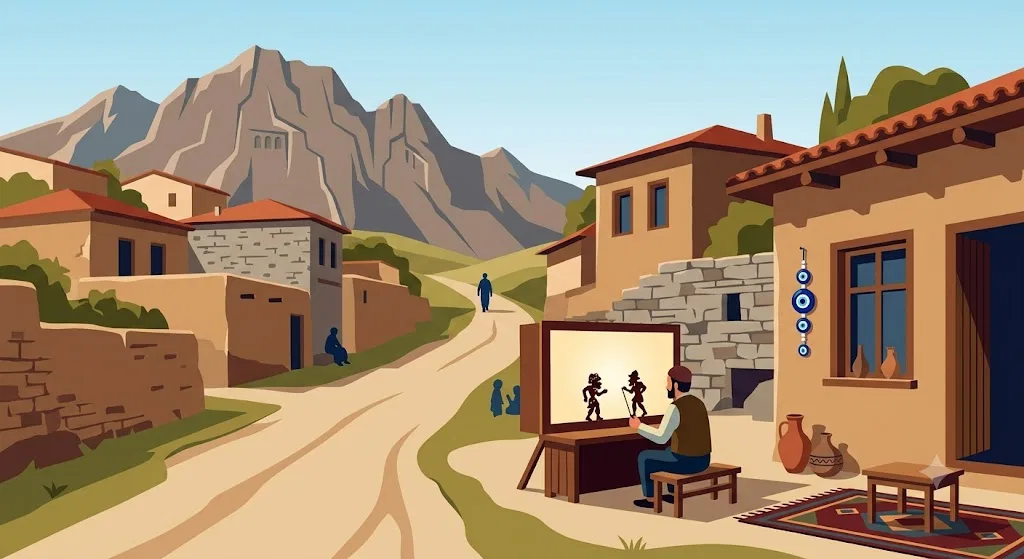
Karagöz shadow theatre works differently but has a similar public energy. In this form, figures cut from camel or ox hide are moved behind a lit screen. The best-known pairing is Karagöz and Hacivat, often understood through contrast: Karagöz is blunt, earthy and comic; Hacivat is more polished, educated and mannered. UNESCO inscribed Karagöz in 2009, and recent preservation efforts show that the tradition is still treated as a living performance art rather than simply a nostalgic emblem.[unesco.org]ich.unesco.orgOpen source on unesco.org.
Karagöz is important because it shows how folklore can thrive in cities as well as villages. It brings together stock characters, dialect humour, satire, music, visual craft and comic misunderstanding. It also travelled across the Ottoman world, leaving related forms in neighbouring cultures. For a modern reader, that means Karagöz should not be seen as a single “Turkish puppet story” but as a performance world shaped by empire, neighbourhood, class, language play and changing ideas of public entertainment.[Wikipedia]WikipediaKaragöz and HacivatKaragöz and Hacivat
Protective belief: the evil eye and everyday danger
The evil eye is one of the most visible Turkish folk beliefs today, partly because the blue glass bead used against it appears in homes, cars, jewellery, baby gifts and tourist shops. The belief is usually that envy, excessive praise or a harmful gaze can bring misfortune, illness or damage. The bead is not just decoration in traditional understanding; it is a protective object that answers a very practical anxiety: what happens when admiration turns dangerous?[Academia]academia.eduOpen source on academia.edu.
This is an old Mediterranean and Middle Eastern pattern, but in Turkey it has a particularly strong public presence. One study cited in a Turkish design and culture article reported evil-eye belief at a far higher level than beliefs such as magic or fortune-telling in the Turkish survey context, while UNESCO documentation describes the glass bead as a handicraft widely used in Turkey to ward off the evil eye. The point is not that all Turkish people believe in it literally; rather, the symbol has become a shared cultural language for vulnerability, envy and protection.[Academia]academia.eduOpen source on academia.edu.
The evil eye also shows how folklore moves between belief, craft and commerce. A bead bought in a market may be a serious amulet, a family custom, a souvenir, a fashion item, or all of these at once. That ambiguity is typical of living folklore. Objects can keep their old story even when many users approach them playfully, aesthetically or as heritage rather than strict belief.[Intangible Cultural Heritage]ich.unesco.orgOpen source on unesco.org.
Spirits, monsters and dangerous thresholds
Turkish supernatural tradition includes many beings that do not fit neatly into the modern categories of “fairy”, “demon” or “ghost”. Islamic language introduced and normalised beings such as jinn, while older Turkic and regional beliefs continued to shape how people imagined illness, birth, night travel, wilderness and bad luck. In folk practice, the most important question is often not “what species is this being?” but “where is danger believed to gather?” Common danger zones include childbirth, winter nights, deserted places, thresholds, water, mountains and the period between seasons.[researchgate.net]researchgate.netResearch Gate(PDF) The Alkarisi beliefs and scienceResearch Gate(PDF) The Alkarisi beliefs and science
One of the clearest examples is the Alkarısı or Albastı complex, a frightening female being associated with childbirth and the postpartum period. Academic summaries describe Alkarısı beliefs as common in Anatolian folk faith, involving a being feared for harming new mothers and babies; comparative Turkic research links related Albasty figures across a much wider Turkic-speaking world. Such traditions often encode real anxieties around childbirth, fever, blood loss, infant mortality and the isolation of the mother after birth.[ResearchGate]researchgate.netResearch Gate(PDF) The Alkarisi beliefs and scienceResearch Gate(PDF) The Alkarisi beliefs and science
Karakoncolos is a different kind of creature: a winter figure associated with the coldest days of the year, often hairy, animal-like and troubling to humans. Research on the Karakoncolos or Kallikantzaros belief places it in a shared Turkish and Greek folk setting and notes that one of the early Turkish written sources to mention it is Evliya Çelebi’s seventeenth-century travel writing. This is a good example of cross-border folklore: the creature belongs not to a sealed national box, but to a winter imagination shared across Anatolia and south-eastern Europe.[academicrepository.khas.edu.tr]academicrepository.khas.edu.trOpen source on edu.tr.
Modern online lists of Turkish monsters often mix well-attested folklore with invented rankings, horror aesthetics and loosely sourced “demonology”. That does not mean the beings are fake; it means the presentation may be modern. A careful reader should separate older collected belief, regional oral tradition, literary retelling, modern horror writing and social-media folklore. Turkey has plenty of supernatural folk material without needing to inflate it into a single tidy bestiary.[academicrepository.khas.edu.tr]academicrepository.khas.edu.trOpen source on edu.tr.
Spring, saints and sacred places
Seasonal folklore in Turkey is especially visible in spring customs. Hıdrellez, celebrated on 6 May, marks the awakening of nature and is recognised by UNESCO as a spring celebration associated with Turkey and North Macedonia. In practice it can include wishes, visits to special places, food, music, games, fire, water, greenery and local variations. Its power comes from timing: it belongs to the turning point when winter is over, fertility is hoped for, and the year feels open to change.[Intangible Cultural Heritage]ich.unesco.orgOpen source on unesco.org.
In Hatay, research on Hıdrellez among Arab Alawites and Orthodox Christians shows how tombs and trees can become active parts of saint-veneration rituals. That is a particularly revealing regional case because it shows Turkish folklore as lived across religious communities, not only inside one official religious frame. Trees, tombs and springs often act as contact points between ordinary life and sacred memory, where people ask for healing, fertility, protection or relief.[Academia]academia.eduTombs and Trees as Indexes of Agency in Saint VenerationTombs and Trees as Indexes of Agency in Saint Veneration
Sacred tombs also shape urban folk geography. In Istanbul and elsewhere, saints’ resting places may function as thresholds where people pause, pray, make vows or seek comfort. This is not the same as ghost tourism; it is a form of popular religious geography in which the dead, the holy, the neighbourhood and the living remain connected. Folklore here is not a monster story but a map of help, memory and obligation.[TRT World]trtworld.comTRT World Guardians of Istanbul: Chronicles of a historical city's fourTRT World Guardians of Istanbul: Chronicles of a historical city's four
Trees add another deep layer. Studies of Turkic tree veneration describe trees as sacred objects associated with life, cosmic order, ancestors and dwelling places of power. In Turkey, that older symbolism can survive in local acts such as tying cloth, making wishes, visiting saintly groves or treating a particular tree as more than ordinary vegetation. These practices vary greatly by region and community, so they are best understood as local traditions rather than a single national rite.[DergiPark]dergipark.org.trDergi Park The Cult of Tree in the Culture of the Turkic PeoplesDergi Park The Cult of Tree in the Culture of the Turkic Peoples
Landscapes that became legends
Mount Ararat, known in Turkey as Mount Ağrı, is one of the most symbolically crowded landscapes in the region. It is tied to biblical and Armenian traditions of Ararat, to local eastern Anatolian storytelling, and to modern Turkish literature through Yaşar Kemal’s The Legend of Mount Ararat. In Kemal’s retelling, a local love story, a white horse, mountain grandeur and the authority of rulers become part of a modern literary epic drawn from oral tradition.[sosyalarastirmalar.com]sosyalarastirmalar.coma mythical approach to yaar kemals novels ari dai efsanesi and yer demrgk bakira mythical approach to yaar kemals novels ari dai efsanesi and yer demrgk bakir
The important point is that literary retelling does not cancel folklore; it changes its medium. Yaşar Kemal was deeply associated with Anatolian oral culture, and accounts of his work emphasise how his novels drew on local legends, folk speech and epic forms. When a regional legend becomes a novel, opera or film, it enters national culture and reaches new audiences, but the reader should still ask what has been reshaped for art, politics, language and publication.[berose.fr]berose.frThe Epic Narrator of Modern Turkey as FolkloristThe Epic Narrator of Modern Turkey as Folklorist
Lake Van offers a more modern example. The Lake Van Monster is often discussed as a contemporary local legend or cryptid, with older water-dragon traditions in the region sometimes brought into the background and 1990s sightings turning the story into a media and tourism phenomenon. Recent cultural discussion treats Lake Van, its monster and related love legends as part of the lake’s symbolic role in local identity. This is a useful case because it shows how folklore can be old, revived, commercialised and contested at the same time.[wikipedia.org]WikipediaLake Van MonsterLake Van Monster
Tourism can keep such legends visible, but it can also flatten them. A statue, festival, souvenir or viral clip may make a story easier to find while also encouraging a simpler version than local memory contains. That tension is not unique to Turkey, but Turkey’s landscapes make it especially clear: mountains, lakes, tombs, caves and old towns often carry several communities’ stories at once. A good folklore reading leaves room for those overlapping memories rather than forcing one final version.[DergiPark]dergipark.org.trOpen source on dergipark.org.tr.
Modern retellings and the living archive
Turkish folklore has not stayed in the village, the coffeehouse or the manuscript. Children encounter Keloğlan through books, school materials and animation; Karagöz survives through heritage projects and puppet laboratories; Nasreddin Hodja jokes circulate in print, education and international heritage contexts; and Dede Korkut continues to be studied, staged and reframed as shared Turkic heritage. These modern forms matter because they are now part of how the traditions are transmitted.[jtade.com]jtade.comOpen source on jtade.com.
At the same time, modernisation changes the texture of folklore. A television Keloğlan is not the same as an old oral tale told at home; a UNESCO file is not the same as a village performance; a tourist evil-eye bead is not the same as an amulet placed for a newborn. But these are not simply “fake” replacements. They are stages in a tradition’s public life. Folklore often survives by becoming teachable, collectable, performable, marketable or adaptable.[jtade.com]jtade.comOpen source on jtade.com.
The main risk for readers is the internet-era habit of treating folklore as a list of monsters detached from place and evidence. Turkey’s supernatural beings are interesting, but the country’s folklore is broader and richer than horror summaries suggest. Its centre of gravity lies in oral performance, comic wisdom, seasonal thresholds, protective practice, heroic memory, sacred landscapes and the constant movement between local telling and public culture.[encyclopedia.com]encyclopedia.comOpen source on encyclopedia.com.
What Turkish folklore reveals about Turkey
Turkish folklore matters because it preserves ways of thinking that formal history often misses. Nasreddin Hodja records the intelligence of humour; Keloğlan protects the hope of the underestimated; Dede Korkut carries heroic and family codes; Karagöz turns social difference into comedy; evil-eye customs give shape to envy and vulnerability; Alkarısı traditions remember the dangers around childbirth; Hıdrellez celebrates renewal; sacred tombs and trees map local trust; and legends of Ararat or Lake Van show how landscape becomes memory.[pitt.edu]sites.pitt.eduOpen source on pitt.edu.
The best way to approach it is with both imagination and caution. The imagination is needed because these stories are vivid: bald boys trick giants, shadow puppets insult the pompous, winter creatures lurk in the cold, and mountains refuse to be merely geological. The caution is needed because traditions change, and evidence varies. Some material is well documented through UNESCO, archives, scholarship and long publication history; some is regional and oral; some is modern literary art; some is internet packaging. Keeping those differences visible makes the folklore more interesting, not less.
Amazon book picks
Further Reading
No matched book cards were available for Why Turkish Folklore Still Feels Alive, so this fallback keeps a direct Amazon reading path visible.
Topical books
Turkish folk heroes guide
Browse books, explainers and reference titles related to this topic.
Search AmazonRelated search
Dede Korkut epic guide
Browse books, explainers and reference titles related to this topic.
Search AmazonRelated search
Keloğlan fairy tales guide
Browse books, explainers and reference titles related to this topic.
Search AmazonEndnotes
1.
Source: encyclopedia.com
Link:https://www.encyclopedia.com/history/encyclopedias-almanacs-transcripts-and-maps/turkish-literature-and-language
2.
Source: ich.unesco.org
Link:https://ich.unesco.org/en/RL/heritage-of-dede-qorqud-korkyt-ata-dede-korkut-epic-culture-folk-tales-and-music-01399
3.
Source: ich.unesco.org
Link:https://ich.unesco.org/en/RL/arts-of-the-meddah-public-storytellers-00037
4.
Source: ich.unesco.org
Link:https://ich.unesco.org/en/RL/spring-celebration-hdrellez-01284
5.
Source: journals.openedition.org
Link:https://journals.openedition.org/epopee/348?lang=en
6.
Source: ich.unesco.org
Title: Intangible Cultural Heritage Türkiye
Link:https://ich.unesco.org/en/state/turkiye-TR?info=elements-on-the-lists
7.
Source: ich.unesco.org
Link:https://ich.unesco.org/en/RL/karagoz-00180
8.
Source: ich.unesco.org
Link:https://ich.unesco.org/doc/src/ITH-11-6.COM-CONF.206-13%2BCorr.%2BAdd.-EN.pdf
9.
Source: jstor.org
Link:https://www.jstor.org/stable/538258
10.
Source: berose.fr
Title: The Epic Narrator of Modern Turkey as Folklorist
Link:https://www.berose.fr/article3368.html
11.
Source: sites.pitt.edu
Link:https://sites.pitt.edu/~dash/hodja.html
12.
Source: teda.ktb.gov.tr
Link:https://teda.ktb.gov.tr/Eklenti/6587%2Cnasreddinhodjapdf.pdf?0=
13.
Source: unesco.org.tr
Link:https://www.unesco.org.tr/Home/Page/1980?slug=Representative+List+of+the+Intangible+Cultural+Heritage+of+Humanity
14.
Source: encyclopedia.com
Link:https://www.encyclopedia.com/arts/culture-magazines/book-dede-korkut
15.
Source: jtade.com
Link:https://www.jtade.com/makale_indir/5129
16.
Source: asosjournal.com
Link:https://asosjournal.com/?makale_id=32903&mod=makale_ing_ozet
17.
Source: iojes.net
Link:https://iojes.net/?makale_id=40999&mod=makale_ing_ozet
18.
Source: yakegm.ktb.gov.tr
Link:https://yakegm.ktb.gov.tr/TR-345097/arts-of-the-meddah-public-storytellers.html
19.
Source: unesco.org
Link:https://www.unesco.org/archives/multimedia/document-640
20.
Source: Wikipedia
Title: Karagöz and Hacivat
Link:https://en.wikipedia.org/wiki/Karag%C3%B6z_and_Hacivat
21.
Source: academia.edu
Link:https://www.academia.edu/35273251/Evil_Eye_Belief_in_Turkish_Culture_Myth_of_Evil_Eye_Bead
22.
Source: researchgate.net
Title: Research Gate(PDF) The Alkarisi beliefs and science
Link:https://www.researchgate.net/publication/291759082_The_Alkarisi_beliefs_and_science
23.
Source: ceeol.com
Title: article detail
Link:https://www.ceeol.com/search/article-detail?id=1205898
24.
Source: academicrepository.khas.edu.tr
Link:https://academicrepository.khas.edu.tr/entities/publication/84d461af-5586-4c43-9c58-f44979f0b9e2
25.
Source: researchgate.net
Title: 341262110 Albasty A Female Demon of Turkic Peoples
Link:https://www.researchgate.net/publication/341262110_Albasty_A_Female_Demon_of_Turkic_Peoples
26.
Source: Wikipedia
Link:https://en.wikipedia.org/wiki/Kallikantzaros
27.
Source: ich.unesco.org
Link:https://ich.unesco.org/en/video/41070
28.
Source: academia.edu
Title: Tombs and Trees as Indexes of Agency in Saint Veneration
Link:https://www.academia.edu/38854497/Tombs_and_Trees_as_Indexes_of_Agency_in_Saint_Veneration_Rituals_Bruno_Latour_s_Actor_Network_Theory_and_the_H%C4%B1d%C4%B1rellez_Festival_in_Hatay_Turkey
29.
Source: researchgate.net
Link:https://www.researchgate.net/publication/408184950_The_Place_of_Tree_Cult_in_Turkish_Mythical_Thought_in_Kutahya-_Aydogdu_Village
30.
Source: researchgate.net
Link:https://www.researchgate.net/publication/311905240_A_MYTHICAL_APPROACH_TO_YASAR_KEMAL_S_NOVELS_AGRI_DAGI_EFSANESI_AND_YER_DEMIR_GOK_BAKIR
31.
Source: encyclopedia.com
Title: yashar kemal
Link:https://www.encyclopedia.com/people/literature-and-arts/asian-literature-biographies/yashar-kemal
32.
Source: Wikipedia
Title: Ağrı Dağı Efsanesi
Link:https://en.wikipedia.org/wiki/A%C4%9Fr%C4%B1_Da%C4%9F%C4%B1_Efsanesi
33.
Source: Wikipedia
Title: Lake Van Monster
Link:https://en.wikipedia.org/wiki/Lake_Van_Monster
34.
Source: ich.unesco.org
Link:https://ich.unesco.org/doc/src/Signed%20periodic%20report%20-%20Periodic%20report-53872.pdf
35.
Source: ich.unesco.org
Title: 06859 EN
Link:https://ich.unesco.org/doc/src/06859-EN.pdf
36.
Source: ich.unesco.org
Title: LHE 22 17.CO M Decisions EN.docx
Link:https://ich.unesco.org/doc/src/LHE-22-17.COM-Decisions-EN.docx
37.
Source: ich.unesco.org
Title: 18440 EN
Link:https://ich.unesco.org/doc/src/18440-EN.pdf
38.
Source: ich.unesco.org
Link:https://ich.unesco.org/doc/src/37586.pdf
39.
Source: ich.unesco.org
Link:https://ich.unesco.org/en/convention?call=film&id=41070&include=film_inc.php&width=700
40.
Source: ich.unesco.org
Link:https://ich.unesco.org/en/video/28841
41.
Source: ich.unesco.org
Title: LHE 23 18.CO M 8.b EN.docx
Link:https://ich.unesco.org/doc/src/LHE-23-18.COM-8.b_EN.docx
42.
Source: ich.unesco.org
Title: 36235 EN.doc
Link:https://ich.unesco.org/doc/src/36235-EN.doc
43.
Source: ich.unesco.org
Title: ITH 09 4.CO M CONF.209 Decisions EN.doc
Link:https://ich.unesco.org/doc/src/ITH-09-4.COM-CONF.209-Decisions-EN.doc
44.
Source: ich.unesco.org
Title: photo pop up 00973
Link:https://ich.unesco.org/en/photo-pop-up-00973?photoID=11067
45.
Source: ich.unesco.org
Title: LHE 25 20.CO M 7.b EN.docx
Link:https://ich.unesco.org/doc/src/LHE-25-20.COM-7.b_EN.docx
46.
Source: ich.unesco.org
Link:https://ich.unesco.org/en/lists
47.
Source: ich.unesco.org
Title: LHE 21 16.CO M 8.b Rev.2 Add.3 EN.docx
Link:https://ich.unesco.org/doc/src/LHE-21-16.COM-8.b_Rev.2_Add.3-EN.docx
48.
Source: ich.unesco.org
Title: arirang lyrical folk song in the republic of korea 00445
Link:https://ich.unesco.org/en/RL/arirang-lyrical-folk-song-in-the-republic-of-korea-00445?call=film&id=41070&include=film_inc.php&width=700
49.
Source: ich.unesco.org
Title: LHE 23 18.CO M Decisions EN.docx
Link:https://ich.unesco.org/doc/src/LHE-23-18.COM-Decisions-EN.docx
50.
Source: ich.unesco.org
Title: 11b representative list 00939
Link:https://ich.unesco.org/en/11b-representative-list-00939?id=01284&include=slideshow_inc.php
51.
Source: ich.unesco.org
Title: LHE 21 16.CO M Decisions Rev. EN.docx
Link:https://ich.unesco.org/doc/src/LHE-21-16.COM-Decisions_Rev.-EN.docx
52.
Source: ich.unesco.org
Title: 10 representative list 00748
Link:https://ich.unesco.org/en/10-representative-list-00748?id=01006&include=slideshow.inc.php
53.
Source: unesco.org
Link:https://www.unesco.org/archives/multimedia/producer/t%C3%BCrkiye.%2Bministry%2Bof%2Bculture%2Band%2Btourism
54.
Source: ich.unesco.org
Link:https://ich.unesco.org/en/%5Bhref%5D?call=film&id=41758&include=film_inc.php&width=700
55.
Source: Wikipedia
Title: Mount Ararat
Link:https://en.wikipedia.org/wiki/Mount_Ararat
56.
Source: Wikipedia
Title: List of Intangible Cultural Heritage elements in Turkey
Link:https://en.wikipedia.org/wiki/List_of_Intangible_Cultural_Heritage_elements_in_Turkey
57.
Source: Wikipedia
Title: List of Turkic mythological figures
Link:https://en.wikipedia.org/wiki/List_of_Turkic_mythological_figures
58.
Source: Wikipedia
Title: Book of Dede Korkut
Link:https://en.wikipedia.org/wiki/Book_of_Dede_Korkut
59.
Source: Wikipedia
Title: Culture of Turkey
Link:https://en.wikipedia.org/wiki/Culture_of_Turkey
60.
Source: Wikipedia
Title: Turkish folk literature
Link:https://en.wikipedia.org/wiki/Turkish_folk_literature
61.
Source: Wikipedia
Title: Div (mythology)
Link:https://en.wikipedia.org/wiki/Div_%28mythology%29
62.
Source: Wikipedia
Title: Al Basty
Link:https://en.wikipedia.org/wiki/Al_Basty
63.
Source: Wikipedia
Link:https://en.wikipedia.org/wiki/Kaloghlan
64.
Source: academia.edu
Link:https://www.academia.edu/43118880/Albasty_A_Female_Demon_of_Turkic_Peoples
65.
Source: academia.edu
Link:https://www.academia.edu/130258089/POSTPARTUM_PROTECTIVE_RITUALS_IN_THE_FOLK_CULTURES_OF_AZERBAIJAN_AND_GAGAUZIA_PRACTICES_AGAINST_KIRKBASMA_AND_ALBASMA
66.
Source: academia.edu
Link:https://www.academia.edu/30191100/Forty_four_Turkish_Fairy_Tales_Compiled_and_Edited
67.
Source: researchgate.net
Title: 303291541 EVIL EYE BELIEF IN TURKISH CULTURE MYTH OF EVIL EYE BEAD
Link:https://www.researchgate.net/publication/303291541_EVIL_EYE_BELIEF_IN_TURKISH_CULTURE_MYTH_OF_EVIL_EYE_BEAD
68.
Source: researchgate.net
Link:https://www.researchgate.net/publication/26605203_Texts_Of_Folk_Literature_Are_Examples_For_Children%27s_Literature_And_Stories_Of_Dede_Korkut_As_A_Sample
69.
Source: researchgate.net
Link:https://www.researchgate.net/publication/298458782_An_Analysis_on_Oral_Literature_Studies_in_the_100th_Century_of_Turkish_Folklore
70.
Source: researchgate.net
Link:https://www.researchgate.net/publication/331682816_The_karakoncoloskalikancaros_belief_in_Turkish_and_Greek_sources
71.
Source: researchgate.net
Link:https://www.researchgate.net/publication/382257061_Exploring_Philosophical_Concepts_with_a_Turkish_Fairy_Tale
72.
Source: encyclopedia.com
Link:https://www.encyclopedia.com/humanities/encyclopedias-almanacs-transcripts-and-maps/literature-turkish
73.
Source: iupress.istanbul.edu.tr
Link:https://iupress.istanbul.edu.tr/en/journal/jos/article/iki-gotik-mitolojik-kahraman-lilith-ve-al-karisi
74.
Source: jstor.org
Link:https://www.jstor.org/stable/599159
75.
Source: jstor.org
Link:https://www.jstor.org/stable/27032529
76.
Source: folklore.ee
Title: atmaca gozdas kartal
Link:https://www.folklore.ee/folklore/vol95/atmaca_gozdas_kartal.pdf
77.
Source: teda.ktb.gov.tr
Title: ktb.gov.tr Turkey’s intangible cultural heritage
Link:https://teda.ktb.gov.tr/Eklenti/6580%2Cintangibleculturalheritagepdf.pdf?0=
78.
Source: teda.ktb.gov.tr
Link:https://teda.ktb.gov.tr/EN-54740/homepage.html
79.
Source: journals.tubitak.gov.tr
Link:https://journals.tubitak.gov.tr/cgi/viewcontent.cgi?article=2651&context=medical
80.
Source: ogm.gov.tr
Link:https://www.ogm.gov.tr/en/Documents/The%20Established%20in%20the%20City.pdf
81.
Source: jtade.com
Link:https://www.jtade.com/makale/5129
82.
Source: archive.org
Link:https://archive.org/details/bookofdedekorkut0000unse
83.
Source: etd.lib.metu.edu.tr
Link:https://etd.lib.metu.edu.tr/upload/12615996/index.pdf
84.
Source: openaccess.iku.edu.tr
Link:https://openaccess.iku.edu.tr/entities/publication/dc1ff481-082c-48ad-b8e5-1f69de6c43a5
85.
Source: youtube.com
Title: Dede Korkut Stories: Kam Büre Bey’s Son Bamsı Beyrek
Link:https://www.youtube.com/watch?v=ydFji08yo9o
Source snippet
Karagöz Shadow Theatre...
86.
Source: youtube.com
Title: Karagöz Shadow Theatre
Link:https://www.youtube.com/watch?v=b97PRbyc1-w
Source snippet
Timeless Tales of Karagoz and Hacivat...
87.
Source: dergipark.org.tr
Link:https://dergipark.org.tr/en/download/article-file/4815793
88.
Source: goturkiye.com
Link:https://goturkiye.com/unesco/intangible-heritage-values-of-turkiye
89.
Source: aa.com.tr
Link:https://www.aa.com.tr/en/culture/unesco-listed-karagoz-shadow-theatre-to-be-preserved-through-new-laboratory-in-turkiye/3781193
90.
Source: trtworld.com
Title: TRT World Guardians of Istanbul: Chronicles of a historical city’s four
Link:https://www.trtworld.com/article/a1d72be452ea
91.
Source: dergipark.org.tr
Title: Dergi Park The Cult of Tree in the Culture of the Turkic Peoples
Link:https://dergipark.org.tr/en/download/article-file/3939999
92.
Source: sosyalarastirmalar.com
Title: a mythical approach to yaar kemals novels ari dai efsanesi and yer demrgk bakir
Link:https://www.sosyalarastirmalar.com/articles/a-mythical-approach-to-yaar-kemals-novels-ari-dai-efsanesi-and-yer-demrgk-bakir.pdf
93.
Source: socjournal.enu.kz
Link:https://socjournal.enu.kz/index.php/main/article/download/37/52/590
94.
Source: wepa.unima.org
Link:https://wepa.unima.org/en/turkey/
95.
Source: dergipark.org.tr
Link:https://dergipark.org.tr/en/download/article-file/5315108
96.
Source: dergipark.org.tr
Title: article file
Link:https://dergipark.org.tr/tr/download/article-file/3368096
97.
Source: cryptidz.fandom.com
Title: Lake Van Monster
Link:https://cryptidz.fandom.com/wiki/Lake_Van_Monster
Additional References
98.
Source: turkishstudies.net
Link:https://turkishstudies.net/turkishstudies?makale_id=20896&mod=makale_ing_ozet
99.
Source: reddit.com
Link:https://www.reddit.com/r/FolkloreAndMythology/comments/1sch2k0/al_kar%C4%B1s%C4%B1_the_lung_hunter_of_turkic_folklore_and/
100.
Source: kureansiklopedi.com
Link:https://kureansiklopedi.com/tr/detay/albasti-6c147
101.
Source: learnturkishwithseda.com
Link:https://www.learnturkishwithseda.com/lands/agri-dagi
102.
Source: amazon.de
Link:https://www.amazon.de/-/en/A%C4%9Fr%C4%B1da%C4%9F%C4%B1-Efsanesi-Ya%C5%9Far-Kemal/dp/9750807413?tag=searcht-20
103.
Source: discovercappadocia.com
Link:https://www.discovercappadocia.com/enjoy-in-cappadocia/enjoy-in-cappadocia/cappadocia-and-haci-bektas-veli-commemorations
104.
Source: ohiostate.pressbooks.pub
Link:https://ohiostate.pressbooks.pub/windowsintoturkishculture/chapter/chapter-7-turkish-literature-through-the-ottoman-empire/
105.
Source: memphistours.com
Link:https://www.memphistours.com/turkey/cappadocia-haci-bektasi-veli-complex
106.
Source: facebook.com
Link:https://www.facebook.com/groups/977540753560496/posts/1092706345377269/
107.
Source: reddit.com
Link:https://www.reddit.com/r/mythology/comments/1sq2wy3/jinn_in_ancient_turkic_mythology_the_%C3%A7or_and_the/

Topic Tree
Follow this branch
Related pages 192
- Afghan Folklore
- Albanian Folklore
- Algerian Folklore
- Australian Folklore
- Azerbaijan Folklore
- +187 more in sidebar