Where Polish Legends Still Haunt the Landscape
Polish folklore is not one single mythology but a layered tradition of legends, local spirits, saints’ days, haunted landscapes, folk magic, seasonal rites, fairy tales, and literary retellings.
Page outline Jump by section
Introduction
The safest way to read Polish folklore is therefore not as a fixed ancient “pantheon”, but as a living archive of stories and practices. Some traditions are well documented in folk collections and regional customs; some are literary or civic legends; some are modern reinterpretations inspired by older motifs; and some, especially “monster lists” online, blur folklore with fantasy. Poland’s folklore matters because it explains how communities imagined danger, belonging, holiness, memory, landscape, and survival across centuries of social change.
Why Polish folklore is bigger than monsters
Many readers arrive at Polish folklore through creatures: dragons, witches, water spirits, vampires, forest beings, night demons. Those are part of the picture, but Polish folklore also includes songs, proverbs, healing formulas, harvest customs, household rituals, wedding and funeral practices, local legends, saintly stories, oral fairy tales, craft traditions, and regional performance. The 19th-century folklorist Oskar Kolberg is central here: his great project documented songs, dances, rites, tales, beliefs and customs across Polish lands, and his manuscripts from 1840–1890 have been digitised as an archive of folk culture.[oskarkolberg.pl]oskarkolberg.plThe Complete WorksThe Complete Works vol. 66: The letters of Oskar Kolberg part 3 (1883-1890). Collected and prepared by M. Turczynowiczo…
That matters because Poland’s folklore is not only a set of “old pagan survivals”. It is also the record of rural social life, religious adaptation, oral performance and regional identity. The national Oskar Kolberg Award, established in 1974, still honours work in folk culture, which shows that folklore in Poland is treated not just as entertainment but as cultural heritage.[en.nagrodakolberg.pl]en.nagrodakolberg.pltant award in the field of folk culture in Poland.Read more…
The Polish case is also complicated by history. Some tales were collected in lands that were historically Polish or culturally mixed but are now outside Poland’s present borders. For example, English-language collections of Polish fairy tales often rely on A. J. Glinski’s 1862 tales from eastern Polish borderlands, including areas described in older sources as “White Russia”. That does not make them irrelevant, but it does mean a careful reader should notice the difference between present-day national borders, older Polish-Lithuanian cultural space, and broader Slavic story patterns.[Project Gutenberg]gutenberg.orgThey represent the folklore current among the peasantry of the Eastern…Read more…
The legends that still shape Polish cities
Kraków’s dragon: a monster turned civic emblem
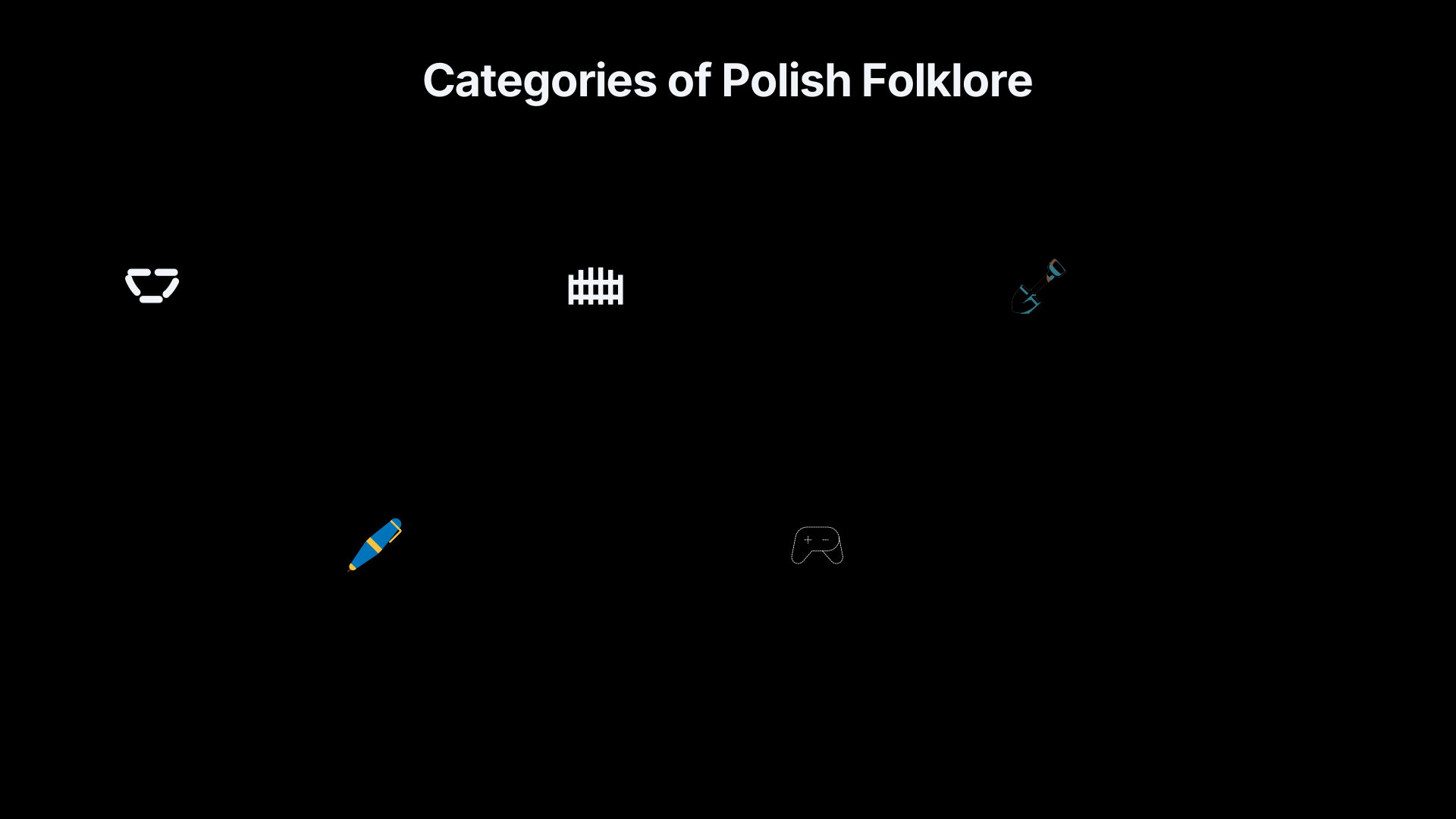
The Wawel Dragon is probably Poland’s most famous legendary creature. In the standard Kraków version, a dragon lives in a cave under Wawel Hill, terrorises the town of King Krak, and is finally defeated not by a knight but by a clever shoemaker or apprentice who feeds it a ram stuffed with sulphur and pitch. The dragon drinks from the Vistula until it bursts, and Kraków gains one of its most memorable foundation legends.[Kraków Travel]krakow.travelOpen source on krakow.travel.
The story works because it joins landscape, politics and folk imagination. Wawel Hill is a real royal and religious centre, and the Dragon’s Den is a real limestone cave in its western slope. The Wawel Royal Castle notes that the cave was formed by karst processes in Jurassic limestone and was prepared for visitors after Poland regained independence in 1918. In other words, the legend is not only a children’s tale; it is attached to a physical place where geology, tourism and national memory meet.[Wawel Castle]wawel.krakow.plWawel Castle Dragon's denWawel Castle Dragon's den
The dragon also shows how Polish folklore often rewards wit over brute force. The hero is not necessarily the strongest warrior. He is the person who understands the monster’s appetite and turns it against itself. That pattern appears widely in European folktale traditions, but in Kraków it has become distinctly local: a cave, a hill, a river, a royal city and a fire-breathing statue all keep the legend visible in everyday public space.
Warsaw’s mermaid: from river tale to city guardian
Warsaw’s mermaid is another city legend that has moved from story into civic identity. The tourist office’s version tells of a mermaid who swims from the Baltic along the Vistula, rests near the site of the Old Town, is captured by a greedy merchant, and is freed by local fishermen. In gratitude, she promises to defend the city; today she appears with sword and shield as Warsaw’s protective emblem.[Go To Warsaw]go2warsaw.plOpen source on go2warsaw.pl.
This is not folklore in the same mode as a village demon belief. It is a civic legend: a story that explains a symbol and gives a city a personality. The mermaid makes Warsaw feel river-born, watchful and resilient. Her weaponry also matters. Unlike the passive mermaid of some romantic art, Warsaw’s figure is armed, closer to a guardian than a temptation.
The dragon and the mermaid are useful together because they show two major functions of Polish legend. One makes Kraków ancient, royal and cunning; the other makes Warsaw defended, riverine and communal. Both are retold today for tourists and children, but their cultural force comes from attaching a memorable supernatural figure to a real urban landscape.
Creatures of fear, water, night and the grave
Polish demonology is not a tidy bestiary. Names, features and explanations vary by region, collector, period and storyteller. A being that appears in one area as a drowned spirit may overlap elsewhere with a broader Slavic water demon; a night-pressure demon may be explained through witchcraft, illness, envy or the unsettled dead. This is why “top 20 monsters” lists can be fun but misleading: they often flatten local variants into fixed fantasy species.
Water beings are among the clearest examples. Folklorist Urszula Lehr’s study of aquatic demons in Polish folklore analyses water spirits in relation to beliefs about water, death and the fate of the soul, drawing on Polish folk texts rather than modern monster fiction. The important point is that rivers, ponds and marshes were not just scenery. They were dangerous thresholds where drowning, disappearance and moral warning could become supernatural narrative.[Folklore]folklore.eeThe transcendental side of life. Aquatic demons in PolishThe transcendental side of life. Aquatic demons in Polish
Night demons show another kind of folk logic. The Polish nightmare being often known as a crushing or oppressive night spirit has been studied as part of folk belief around sleep, bodily pressure and supernatural attack. Modern readers may connect such reports with sleep paralysis, but the older stories made sense within a world where illness, fear, envy and spiritual danger were interpreted socially and religiously, not only medically.[Taylor & Francis Online]tandfonline.comOpen source on tandfonline.com.
Vampire-like beings and revenants are especially important because they connect folklore with archaeology. Poland has produced several unusual burials popularly described as “vampire” graves, but the careful interpretation is more cautious: these are graves with anti-revenant measures, suggesting that some communities feared certain dead people might return or harm the living. Archaeologist Leszek Gardeła notes that Polish archaeological discussion of “vampire” burials goes back to mid-20th-century finds, including an early medieval grave at Radom in Masovia.[Sisu@UT]sisu.ut.eeSisu@UTVampire Burials in Medieval PolandSisu@UTVampire Burials in Medieval Poland
Recent finds have brought this material to a wider audience. A 2024 Reuters report described the facial reconstruction of a young woman found at Pień in northern Poland with a padlock on her foot and an iron sickle across her neck, measures interpreted as attempts to prevent return from the grave. The reconstruction team stressed humanisation rather than sensationalism: the woman, nicknamed “Zosia”, may have suffered from health conditions and was not a monster but a person buried in a climate of fear and supernatural explanation.[Reuters]reuters.comScientists rebuild the face of 400-year-old Polish 'vampireScientists rebuild the face of 400-year-old Polish 'vampire
That distinction is crucial. Polish revenant folklore is fascinating, but “real vampire” headlines can distort it. The evidence points to beliefs, fears and funerary precautions, not to supernatural fact. The most respectful reading asks what anxieties the burial reveals: fear of disease, social difference, sudden death, bodily abnormality, exclusion, or the spiritually unsafe dead.
Witches, healers and folk magic
Polish witchcraft traditions sit at the meeting point of belief, law, gender, neighbourly conflict and folk medicine. In early modern Poland, accusations of harmful magic were not simply fairy-tale inventions; they could become court cases with deadly consequences. Oxford’s summary of scholarship on Polish witchcraft reports at least 867 known witch trials and at least 558 accused witches in the Polish Crown from 1511 until the abolition of witchcraft as a capital offence.[OUP Academic]academic.oup.comAcademic18 Witchcraft in Poland: Milk and MaleficeAcademic18 Witchcraft in Poland: Milk and Malefice
Wanda Wyporska’s work on early modern Poland is useful because it complicates the stereotype of the witch as a universally hated outsider. Her study of demonology and witch trials in Wielkopolska shows that the imagined witch could take several forms, including not only a figure of malice but sometimes a skilled or socially valued woman.[Witchcraft in Poland]witchcraftinpoland.comOpen source on witchcraftinpoland.com.
Folk magic also included plant knowledge, healing gestures, spoken charms and domestic ritual. Culture.pl’s surveys of Polish beliefs about herbs and trees show how plants could be treated as medicinal, protective, erotic, dangerous or spiritually charged. Some beliefs may preserve older symbolic patterns; others are better understood as folk medicine, household practice or storytelling attached to everyday materials.[Culture.pl]culture.plwitches love potions turtles polish folk beliefs about herbswitches love potions turtles polish folk beliefs about herbs
In eastern Poland, one of the most striking living traditions is the practice of folk healers sometimes called “whisperers” in English accounts. Culture.pl describes these healers near the Belarusian border as using prayers of Orthodox provenance alongside rituals such as wax pouring or burning flax fibre. This is not “pagan witchcraft” in a simple sense; it is Christian folk healing, shaped by local borderland religion, inherited practice and community trust.[Culture.pl]culture.plmeet the whisperers the christian folk healers of eastern polandmeet the whisperers the christian folk healers of eastern poland
The wider lesson is that Polish folk magic is not one thing. It includes feared witchcraft, tolerated healing, plant lore, protective gestures, calendar rites and religious formulas. Modern romantic retellings often turn all of this into “Slavic witchiness”, but the historical record is more varied and more human.
The ritual year: when old belief met the Christian calendar
Polish folklore is especially visible in seasonal customs. These traditions often sit inside Christian feasts while preserving older concerns: fertility, the dead, the coming year, protection from evil, the renewal of nature and the management of luck.
Christmas and New Year customs are a good example. Culture.pl describes the Twelve Days of Christmastide as a major period in traditional rural culture, with the 12 days symbolising the 12 months ahead and many associated rituals having pre-Christian roots later absorbed into Christian observance. Carolling groups, masked figures, household visits and symbolic objects all helped turn the season into a ritual forecast and blessing for the year to come.[Culture.pl]culture.plfrom pagan roots to living heritage unusual polish christmas customsfrom pagan roots to living heritage unusual polish christmas customs
Midsummer traditions show the same layering. Kupala Night in Poland is associated with love, fire, water and protection: bonfires, jumping over flames, floating flower crowns with candles, and burning plants such as mullein or wormwood to ward off malicious forces. These are not merely quaint customs. They reveal a worldview in which fire and water could test relationships, protect bodies, mark youth and negotiate risk at the turning point of the year.[Culture.pl]culture.plkupala night mixing pagan christian traditionskupala night mixing pagan christian traditions
The ancestors also have their season. The rite often known through Adam Mickiewicz’s famous drama as “Forefathers’ Eve” was originally a folk ritual for the dead that became mixed with Biblical and Christian elements after the Christianisation of Slavic and Baltic peoples. Culture.pl notes that elements of the custom survived in some places in Poland into the beginning of the 20th century, even though All Saints’ and All Souls’ observances offered Christian frameworks for remembering the dead.[Culture.pl]culture.plOpen source on culture.pl.
Today, some Polish traditions have formal heritage recognition. UNESCO lists several Polish intangible cultural practices, including Kraków nativity-scene making, flower carpets for Corpus Christi processions, and tree beekeeping culture.[ICH UNESCO]ich.unesco.orgICH UNESCOPolandICH UNESCOPoland Kraków’s nativity-scene tradition, inscribed by UNESCO in 2018, is a Christmas practice centred on constructing elaborate cribs, while the Museum of Kraków describes these scenes as slender, multi-storey, richly ornamented structures inspired by the city’s architecture.[ICH UNESCO]ich.unesco.orgOpen source on unesco.org.
This is one of the best ways to understand living Polish folklore: not as a museum shelf of dead superstitions, but as repeated action. People build, sing, process, decorate, visit graves, tell stories, bless houses, light fires, float wreaths and remember ancestors. The form changes; the need to mark danger, hope and belonging remains.

Sacred and haunted landscapes
Polish folklore is strongly attached to place. Some places are legendary because of a story; others become uncanny because of burial, violence, disease or religious memory. Wawel’s cave and Warsaw’s riverbank are famous examples, but the pattern is much wider.
Culture.pl’s guide to supernatural beings and places in Polish folklore points to vampire graves across Poland and to the Skull Chapel at Czermna in Lower Silesia, a baroque chapel built with thousands of human remains from war, disease and famine. The chapel is not “folklore” in the same sense as a fairy tale, yet it belongs to the country’s dark sacred landscape: a place where mortality, Catholic devotion, local memory and visitor imagination converge.[Culture.pl]culture.plOpen source on culture.pl.
Trees and forests also carry folk meaning. Older Slavic traditions treated trees as sacred, and Polish folk belief attributed magical or healing properties to particular trees. Culture.pl records beliefs about trees curing aching legs, sheltering souls, or being linked with vampiric or demonic forces. Such traditions remind us that folklore is not only about beings with names; it is also about how a community reads the natural world.[Culture.pl]culture.pldancing souls vampiric daemons polish folk beliefs about treesdancing souls vampiric daemons polish folk beliefs about trees
This place-based quality is one reason folklore tourism can be powerful but also risky. A cave, chapel, grave or statue can make a story feel immediate. Yet tourism often simplifies: a revenant burial becomes a “vampire attraction”, a civic emblem becomes a fairy-tale mascot, and a regional custom becomes a photo opportunity. The stronger interpretation keeps both layers in view: the visitor-facing story and the older cultural work the place performed.
Fairy tales, collectors and literary retellings
Polish fairy tales reached many English-speaking readers through translated collections rather than directly from oral performance. A. J. Glinski’s 19th-century tales, translated by Maude Ashurst Biggs and published in English as Polish Fairy Tales, include stories such as “The Frog Princess”, “The Good Ferryman and the Water Nymphs” and “The Bear in the Forest Hut”. Digital versions preserve this literary doorway into Polish and borderland tale traditions.[archive.org]archive.orgOpen source on archive.org.
These texts should be enjoyed, but not treated naively. Many were filtered through collectors, translators and publishers who shaped what counted as a “Polish” tale for foreign readers. The prefaces often use older racial or evolutionary language about ancient origins that modern folklore studies would handle more cautiously. The tales remain valuable, but their publication history is part of the evidence.
Polish literary culture also repeatedly reworked folklore. Culture.pl notes that writers including Henryk Sienkiewicz, Eliza Orzeszkowa, Bolesław Prus and Władysław Reymont recognised the power of fairy-tale forms and wrote fantastical stories of their own.[Culture.pl]culture.pllittle known polish fairy taleslittle known polish fairy tales Adam Mickiewicz’s use of ancestral rites in drama is another famous example of folk practice becoming national literature. Once folklore enters literature, it gains new reach but also changes shape: a local rite can become a national symbol, and a village belief can become romantic art.
That process is not a betrayal of folklore. Retelling is how folklore travels. The important distinction is between oral tradition, collected text, literary adaptation and modern fantasy. They are related, but they are not interchangeable evidence.
The Witcher problem: Polish folklore in global pop culture
For many people outside Poland, the first association with Polish folklore is The Witcher. Andrzej Sapkowski’s books, the games and the Netflix adaptation made Polish fantasy globally visible, and they helped popularise names and motifs drawn from Slavic and wider European tradition. Scholarship on The Witcher treats it as adaptation and world-building, not as a direct folklore handbook.[MDPI]mdpi.comOpen source on mdpi.com.
That distinction matters because The Witcher mixes sources freely. Some creatures have recognisable Slavic or Polish connections; others draw from broader European, classical or Middle Eastern traditions; and many are transformed to serve narrative, horror, game design or television spectacle. Time’s discussion of the Netflix monsters, for example, notes that the show’s kikimora differs strongly from the traditional household-spirit image, while the striga/strzyga draws on vampiric demon traditions but is reshaped for the story.[Time]time.com1. Kikimora: Originating from Slavic mythology, traditionally portrayed as female spirits haunting houses, but depicted as a swamp monste…
Academic discussion of Slavic mythology in fantasy makes the same point: modern authors may adapt folk belief faithfully, deny superstition, use a myth to create atmosphere, or keep a demon’s name while adding features from other sources and popular culture.[Hrčak]hrcak.srce.hrOpen source on srce.hr.
So the best answer to “Is The Witcher Polish folklore?” is: partly, but not simply. It is Polish-authored fantasy that uses, transforms and internationalises folklore. It can be a gateway into real traditions, but it should not be mistaken for an ethnographic record. A reader who enjoys The Witcher will understand Polish folklore better by asking what has been borrowed, what has been changed, and what older belief or tale sits behind the entertainment.
What is old, what is modern, and what is invented?
Polish folklore is often presented online as if every creature, custom and legend were ancient, pagan and unchanged. That is rarely true. A more useful guide is to sort material into five overlapping categories.
Well-attested folk practice. Seasonal customs, healing practices, songs, rites, plant beliefs and local legends documented by collectors or still practised in communities belong here. Kolberg’s collections and UNESCO-listed customs are strong examples of evidence-based heritage.[oskarkolberg.pl]oskarkolberg.plThe Complete WorksThe Complete Works vol. 66: The letters of Oskar Kolberg part 3 (1883-1890). Collected and prepared by M. Turczynowiczo…
Civic and regional legends. The Wawel Dragon and Warsaw Mermaid are old and culturally important, but today they are also public symbols shaped by tourism, monuments, school retellings and city branding. Their truth is symbolic rather than historical.[Wawel Castle]wawel.krakow.plWawel Castle Dragon's denWawel Castle Dragon's den
Archaeological evidence of belief. Anti-revenant burials show that some communities feared the dead might return, but archaeology cannot prove every detail of the story people told at the graveside. The material evidence is real; the interpretation must remain cautious.[Sisu@UT]sisu.ut.eeSisu@UTVampire Burials in Medieval PolandSisu@UTVampire Burials in Medieval Poland
Literary and antiquarian retellings. Fairy-tale collections, romantic drama and later national literature preserve or transform folklore through writing. They are essential sources, but they are mediated sources.[Project Gutenberg]gutenberg.orgThey represent the folklore current among the peasantry of the Eastern…Read more…
Modern pop-culture folklore. Fantasy novels, games, films, tourism campaigns and internet monster lists create new expectations. They may revive interest in older traditions, but they often standardise fluid regional beings into fixed “species”.[MDPI]mdpi.comOpen source on mdpi.com.
This sorting does not make the stories less enjoyable. It makes them more interesting. A dragon statue, a village procession, a nightmare demon and a video-game monster all belong to Polish folklore culture in different ways. The reader’s task is not to strip away the magic, but to understand what kind of cultural evidence each example provides.

Why Polish folklore still matters
Polish folklore endures because it answers questions that official history often leaves cold. How does a city imagine its origin? Kraków answers with a dragon; Warsaw with a river guardian. How does a community explain frightening death? Some graves show attempts to restrain the feared dead. How do people make a dangerous year feel manageable? They light fires, sing at thresholds, bless houses, honour ancestors and read signs in plants, weather and ritual behaviour.
It also matters because Polish identity has often been preserved through culture as much as through state power. Folklore collecting, regional craft, seasonal custom and literary retelling helped turn local practices into shared memory. Kolberg’s vast documentation project, Kraków’s nativity scenes, Corpus Christi flower carpets, midsummer rites and ancestral traditions all show how ordinary practices can carry national significance without losing their local texture.[neweasterneurope.eu]neweasterneurope.euNew Eastern Europe The man without a digital recorderNew Eastern Europe The man without a digital recorder
The strongest modern approach is therefore neither sceptical dismissal nor romantic overclaiming. Polish folklore is not proof that monsters existed, and it is not a single untouched survival from pre-Christian religion. It is a living, layered cultural record: part memory, part performance, part warning, part devotion, part entertainment, and part reinvention. Its power lies in that mixture.
Amazon book picks
Further Reading
Books and field guides related to Where Polish Legends Still Haunt the Landscape. Use these as the next step if you want deeper reading beyond the article.
Andrzej Sapkowski's The Witcher: The Last Wish
Draws heavily from Polish and Slavic folklore motifs.

eBay marketplace picks
Marketplace Samples
Live-tested eBay searches with available results related to this page.
Endnotes
1.
Source: oskarkolberg.pl
Link:https://www.oskarkolberg.pl/en-US/Page/511
Source snippet
The Complete WorksThe Complete Works vol. 66: The letters of Oskar Kolberg part 3 (1883-1890). Collected and prepared by M. Turczynowiczo...
2.
Source: oskarkolberg.pl
Link:https://www.oskarkolberg.pl/en-US/Page/551
Source snippet
ArchivesManuscripts. In Kolberg Year 2014 we digitalized the Oskar Kolberg's archive containing manuscripts from 1840-1890.Read more...
3.
Source: oskarkolberg.pl
Link:https://www.oskarkolberg.pl/en-US/Page/572
Source snippet
Volume 1: The Songs of the Polish People'The Songs of the Polish People' constitutes a monographic collection of Polish folk song and dan...
4.
Source: en.nagrodakolberg.pl
Link:https://en.nagrodakolberg.pl/about_the_award
Source snippet
tant award in the field of folk culture in Poland.Read more...
5.
Source: gutenberg.org
Link:https://www.gutenberg.org/files/36668/36668-h/36668-h.htm
Source snippet
They represent the folklore current among the peasantry of the Eastern...Read more...
6.
Source: folklore.ee
Title: The transcendental side of life. Aquatic demons in Polish
Link:https://www.folklore.ee/pubte/eraamat/eestipoola2/lehr.pdf
7.
Source: sisu.ut.ee
Title: Sisu@UTVampire Burials in Medieval Poland
Link:https://sisu.ut.ee/wp-content/uploads/sites/172/gardela_2015_vampire_burials.pdf
8.
Source: reuters.com
Title: Scientists rebuild the face of 400-year-old Polish ‘vampire’
Link:https://www.reuters.com/science/scientists-rebuild-face-400-year-old-polish-vampire-2024-10-30/
9.
Source: academic.oup.com
Title: Academic18 Witchcraft in Poland: Milk and Malefice
Link:https://academic.oup.com/edited-volume/34335/chapter/291372989?searchresult=1
10.
Source: culture.pl
Title: witches love potions turtles polish folk beliefs about herbs
Link:https://culture.pl/en/article/witches-love-potions-turtles-polish-folk-beliefs-about-herbs
11.
Source: culture.pl
Title: dancing souls vampiric daemons polish folk beliefs about trees
Link:https://culture.pl/en/article/dancing-souls-vampiric-daemons-polish-folk-beliefs-about-trees
12.
Source: culture.pl
Title: meet the whisperers the christian folk healers of eastern poland
Link:https://culture.pl/en/article/meet-the-whisperers-the-christian-folk-healers-of-eastern-poland
13.
Source: culture.pl
Title: from pagan roots to living heritage unusual polish christmas customs
Link:https://culture.pl/en/article/from-pagan-roots-to-living-heritage-unusual-polish-christmas-customs
14.
Source: culture.pl
Title: kupala night mixing pagan christian traditions
Link:https://culture.pl/en/article/kupala-night-mixing-pagan-christian-traditions
15.
Source: culture.pl
Link:https://culture.pl/en/article/the-polish-halloween-all-you-need-to-know-about-dziady
16.
Source: ich.unesco.org
Title: ICH UNESCOPoland
Link:https://ich.unesco.org/en/state/poland-PL
17.
Source: ich.unesco.org
Link:https://ich.unesco.org/en/RL/nativity-scene-szopka-tradition-in-krakow-01362
18.
Source: culture.pl
Link:https://culture.pl/en/article/9-supernatural-beings-places-of-polish-folklore
19.
Source: archive.org
Link:https://archive.org/details/polishfairytales001817
20.
Source: worldoftales.com
Link:https://www.worldoftales.com/Polish_folktales.html
21.
Source: culture.pl
Title: little known polish fairy tales
Link:https://culture.pl/en/article/little-known-polish-fairy-tales
22.
Source: mdpi.com
Link:https://www.mdpi.com/2076-0752/9/4/102
23.
Source: time.com
Link:https://time.com/5753369/the-witcher-history-folklore/
Source snippet
1. Kikimora: Originating from Slavic mythology, traditionally portrayed as female spirits haunting houses, but depicted as a swamp monste...
24.
Source: culture.pl
Link:https://culture.pl/en/tag/polish-folklore
25.
Source: culture.pl
Title: 7 confusing polish customs
Link:https://culture.pl/en/article/7-confusing-polish-customs
26.
Source: culture.pl
Link:https://culture.pl/en/article/9-slavic-rituals-customs-of-ye-olden-days
27.
Source: culture.pl
Title: polish christmas traditions the hidden stories behind beloved objects
Link:https://culture.pl/en/article/polish-christmas-traditions-the-hidden-stories-behind-beloved-objects
28.
Source: culture.pl
Link:https://culture.pl/en/tags/wieszczy
29.
Source: culture.pl
Title: slavic daemons the good the bad the ugly
Link:https://culture.pl/en/article/slavic-daemons-the-good-the-bad-the-ugly
30.
Source: oskarkolberg.pl
Link:https://www.oskarkolberg.pl/en-US/Page/552
31.
Source: archive.org
Link:https://archive.org/details/pieniludupolski00kolbgoog
32.
Source: archive.org
Title: polishfairytales 1304 librivox
Link:https://archive.org/details/polishfairytales_1304_librivox
33.
Source: poland.travel
Link:https://www.poland.travel/en/flower-carpets-on-corpus-christi-and-other-customs-learn-about-the-unesco-intangible-heritage/
34.
Source: ich.unesco.org
Link:https://ich.unesco.org/doc/src/36500.pdf
35.
Source: archaeology.org
Link:https://archaeology.org/news/2014/11/30/141127-polish-vampire-burials-studied/
36.
Source: en.wikisource.org
Title: Polish Fairy Tales
Link:https://en.wikisource.org/wiki/Polish_Fairy_Tales
37.
Source: krakow.travel
Link:https://krakow.travel/en/artykul/115/the-legend-of-the-wawel-dragon
38.
Source: wawel.krakow.pl
Title: Wawel Castle Dragon’s den
Link:https://wawel.krakow.pl/en/exhibition-constant/dragon-s-den
39.
Source: go2warsaw.pl
Link:https://go2warsaw.pl/en/legend-about-warsaws-mermaid/
40.
Source: tandfonline.com
Link:https://www.tandfonline.com/doi/full/10.1080/0015587X.2022.2088957
41.
Source: witchcraftinpoland.com
Link:https://witchcraftinpoland.com/
42.
Source: hrcak.srce.hr
Link:https://hrcak.srce.hr/file/416573
43.
Source: neweasterneurope.eu
Title: New Eastern Europe The man without a digital recorder
Link:https://neweasterneurope.eu/2014/09/01/the-man-without-a-digital-recorder/
44.
Source: Wikipedia
Link:https://en.wikipedia.org/wiki/Strzyga
45.
Source: books.google.com
Title: Polish Folk Magic
Link:https://books.google.com/books/about/Polish_Folk_Magic.html?id=NmaVEQAAQBAJ
46.
Source: tickets-krakow.com
Link:https://www.tickets-krakow.com/royal-wawel-castle-tickets/about/
47.
Source: neweasterneurope.eu
Link:https://neweasterneurope.eu/tag/oskar-kolberg/
48.
Source: escooters.krakow.pl
Title: Wawel Dragon
Link:https://escooters.krakow.pl/en/attractions-2/wawel-dragon-a-legend-that-still-lives-under-wawel-castle/
49.
Source: nauka-pan.pl
Link:https://www.nauka-pan.pl/index.php/nauka/article/view/649
Additional References
50.
Source: youtube.com
Link:https://www.youtube.com/watch?v=EcJaLUWG60w
Source snippet
Polish folklore legends myths Slavic mythology What are the Creatures and Monsters of Slavic Mythology and Folklore?...
51.
Source: youtube.com
Title: The Dragon of Krakow
Link:https://www.youtube.com/watch?v=_FxyLJ0RPBw
Source snippet
Slavic Paganism: Creations Stories, Deities, Influences, Spirituality, Folklore, & Baba Yaga...
52.
Source: academia.edu
Link:https://www.academia.edu/111352406/Witch_Hunts_in_Poland_16th_18th_Centuries
53.
Source: researchgate.net
Link:https://www.researchgate.net/publication/366231907_multidisciplinary_study_of_anti-vampire_burials_from_early_medieval_Culmen_Poland_were_the_diseased_and_disabled_regarded_as_vampires
54.
Source: researchgate.net
Link:https://www.researchgate.net/publication/368765083_The_Polish_Nightmare_Being_Zmora_and_the_Problem_with_Defining_the_Category_of_Supernatural_Double-Souled_Beings
55.
Source: academia.edu
Link:https://www.academia.edu/92803511/A_Multidisciplinary_Study_of_Anti_Vampire_Burials_from_Early_Medieval_Culmen_Poland_Were_the_Diseased_and_Disabled_Regarded_as_Vampires
56.
Source: reddit.com
Link:https://www.reddit.com/r/Damnthatsinteresting/comments/1sti8rg/archaeologists_in_poland_reconstructed_the_face/
57.
Source: ebay.com
Link:https://www.ebay.com/itm/362819634910?mkevt=1&mkcid=1&mkrid=710-53481-19255-0&campid=5339151051&customid=endnote-source&toolid=10001
58.
Source: academia.edu
Link:https://www.academia.edu/165213284/From_Baba_Yaga_to_Crookbag_Bog_The_Evolution_of_Slavic_Folklore_in_The_Witcher_3
59.
Source: facebook.com
Link:https://www.facebook.com/polishembassy.telaviv/posts/from-krak%C3%B3ws-colorful-nativity-scenes-to-ancient-forest-beekeeping-traditions-pr/1107681018117740/
Topic Tree
Follow this branch
Related pages 192
- Afghan Folklore
- Albanian Folklore
- Algerian Folklore
- Australian Folklore
- Azerbaijan Folklore
- +187 more in sidebar