Within Venezuela Folklore
How Do Mountains, Masks and Songs Keep Folklore Alive?
Venezuela's folklore also lives in Pemón mountain worlds, Dancing Devils, carnival memory, llano work songs and joropo.
On this page
- Pemón sacred geography and the tepui world
- Dancing Devils, El Callao Carnival and public vows
- Work songs, joropo and heritage in motion
Page outline Jump by section
Introduction
In Venezuela, folklore is not preserved only through stories told around a fire or legends printed in books. It also survives through landscapes that are treated as sacred, through masked processions that fill town streets, and through songs and dances that carry memory from one generation to the next. Few examples show this more clearly than the sacred mountain world of the Pemón people in the south-east, the famous Dancing Devils of Corpus Christi, the Carnival of El Callao, and the musical traditions of the plains. Together, these traditions reveal how folklore remains a living part of community life rather than a relic of the past. UNESCO heritage recognition has helped draw international attention to several of these practices, but their deeper importance lies in the local communities that continue to perform, interpret and transmit them.[UNESCO ICH]ich.unesco.orgUNESCO ICHVenezuela (Bolivarian Republic of)Carnival of El Callao, a festive representation of a memory and cultural identity… Venezue…

Why Sacred Landscapes Matter in Venezuelan Folklore
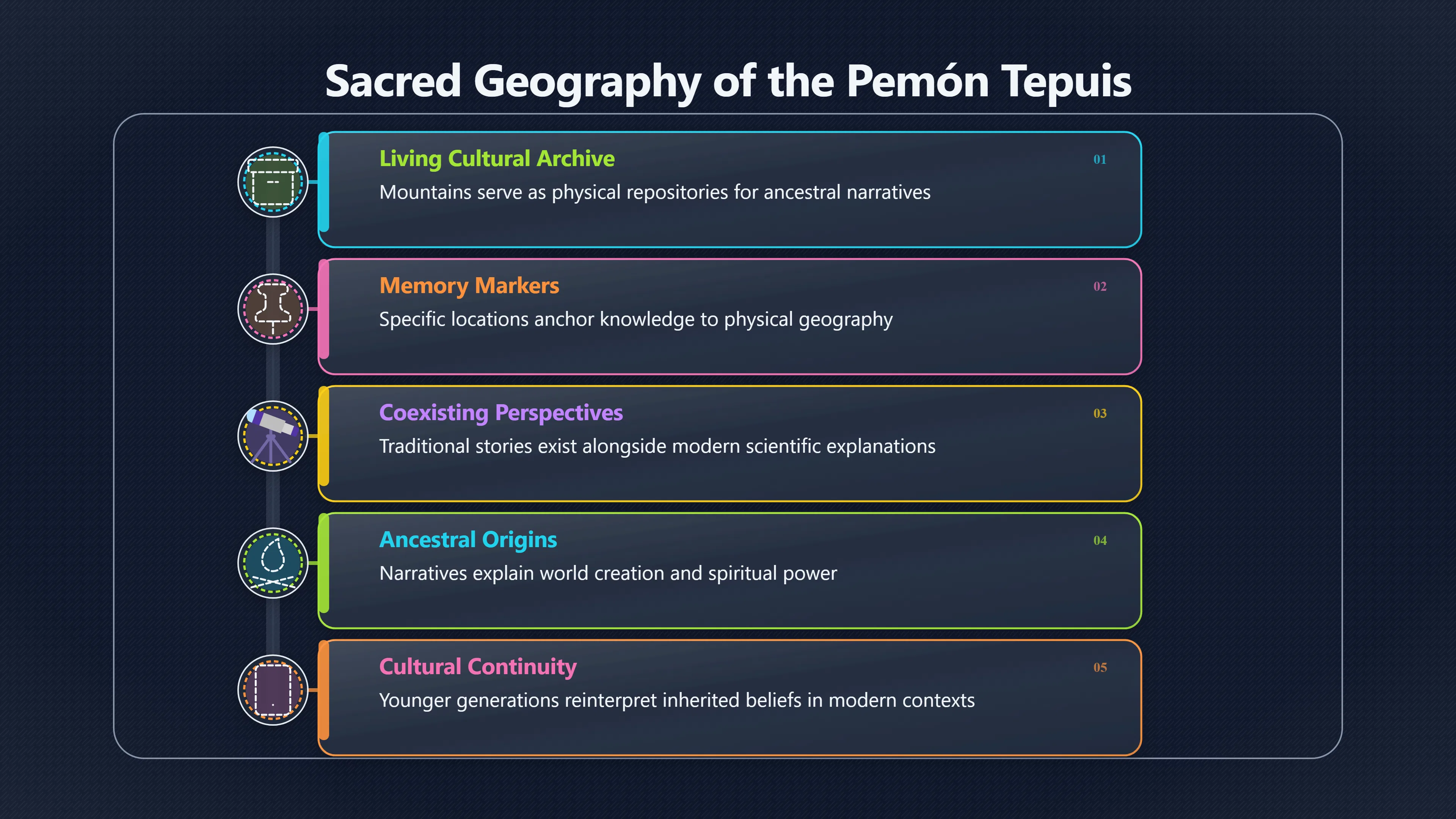
For many Indigenous peoples of Venezuela, mountains are not simply dramatic scenery. They are places where history, ancestry, spiritual power and storytelling meet. Among the Pemón communities of the Gran Sabana, the towering flat-topped mountains known as tepuis occupy a special place in traditional belief. These immense rock formations are often understood as ancient places connected to ancestral narratives and the origins of the world.
Unlike modern tourist descriptions that focus on spectacular views or geological age, Pemón traditions treat the landscape as a living cultural archive. Stories attached to particular mountains help explain how the world came into being, why certain places must be respected, and how human communities relate to forces beyond ordinary experience. The mountains function as memory markers: knowledge is tied to specific locations rather than existing as abstract mythology.
This connection between story and landscape is one reason sacred geography remains important in Venezuelan folklore. The physical environment itself becomes part of the narrative tradition. A mountain is not merely the setting of a story; it is often treated as evidence that the story happened, or as a continuing reminder of ancestral events.
The Tepui World and Cultural Continuity
The tepuis have become internationally famous through travel writing, documentaries and their influence on modern fantasy imagery. Yet their role within Pemón culture is much older and more complex. Traditional narratives connect particular mountains to powerful beings, transformative events and ancestral memory.
As younger generations encounter national education systems, tourism and digital media, these stories increasingly exist alongside scientific explanations of the landscape. Rather than replacing one another, the two perspectives often coexist. The tepuis can simultaneously be understood as extraordinary geological formations and as places carrying traditional cultural meaning.
This coexistence illustrates a broader pattern in Venezuelan folklore: traditions survive not because communities reject modernity, but because they continually reinterpret inherited beliefs within changing circumstances.
How the Dancing Devils Turn Belief into Public Theatre
Among Venezuela’s best-known ritual traditions are the Dancing Devils of Corpus Christi. Celebrated in several communities along the central region of the country, these festivals combine Catholic devotion with local traditions that have developed over centuries. UNESCO recognised the practice as Intangible Cultural Heritage in 2012.[venezuelanalysis.com]venezuelanalysis.comVenezuela's Dancing Devils Receive Country's First…7 Dec 2012 — The Dancing Devils have become Venezuela's first cultu…
The central image is unforgettable. Participants wear elaborate devil masks and red costumes, dance through streets and churchyards, and eventually kneel before the Blessed Sacrament. The dramatic confrontation ends with the devils submitting, symbolising the triumph of good over evil.[unesco.org]unesco.orgdocument 3769Diablos Danzantes de Corpus Christi / Dancing Devils of…5 Dec 2014 — Groups of adults, young men and children disguised as maske…
For outsiders, the masks can appear theatrical or carnival-like. For participants, however, the event is often connected to vows, family commitments and religious obligations. Many dancers inherit membership through family lines, and participation can continue for life. The masks, costumes and ritual knowledge are transmitted within local brotherhoods that preserve distinct traditions from one community to another.[UNESCO]unesco.orgdocument 3769Diablos Danzantes de Corpus Christi / Dancing Devils of…5 Dec 2014 — Groups of adults, young men and children disguised as maske…
The importance of the Dancing Devils lies not only in their symbolism but also in their role as public folklore. Stories, beliefs, music, costume-making and community identity all become visible in a shared annual performance. The tradition transforms abstract religious ideas into a memorable spectacle that reinforces collective memory.
More Than a Victory of Good Over Evil
The festival is often summarised as a representation of good overcoming evil, but that description captures only part of its significance. Scholars and cultural organisations frequently point to the way the tradition blends European Catholic practice with Indigenous and African influences that became part of Venezuelan culture over centuries.[Africanews]africanews.comvenezuelas dancing devils revive centuries old corpus christi riteThe celebration in Tarmas is distinguished by its small masks…Read more…
The result is a ritual that is simultaneously religious, historical and folkloric. It demonstrates how different cultural influences merged within local communities and produced something distinctly Venezuelan rather than simply imported from elsewhere.
Why El Callao Carnival Is a Folklore Archive
The Carnival of El Callao offers a different example of living ritual heritage. UNESCO describes it as a festive expression of memory and cultural identity, recognising the way the celebration preserves the history of migration, mining communities and Afro-Caribbean cultural exchange in south-eastern Venezuela.[UNESCO ICH]ich.unesco.orgUNESCO ICHVenezuela (Bolivarian Republic of)Carnival of El Callao, a festive representation of a memory and cultural identity… Venezue…
Unlike the sacred atmosphere of the Dancing Devils, El Callao Carnival is built around music, dance, costumes and public celebration. Yet it performs a similar cultural function. Through annual performance, communities remember historical experiences that might otherwise fade from view.
The carnival emerged in a region shaped by nineteenth-century gold mining and migration from Caribbean islands. Over time, those influences became woven into local traditions. Songs, costumes and processions preserve traces of that history while continuing to evolve with each generation.[UNESCO ICH]ich.unesco.orgUNESCO ICHVenezuela (Bolivarian Republic of)Carnival of El Callao, a festive representation of a memory and cultural identity… Venezue…
From a folklore perspective, El Callao demonstrates that heritage is not limited to ancient legends. Collective memory can survive through performance as effectively as through storytelling. Every carnival season becomes a public act of remembering.
How Songs and Joropo Keep Tradition Moving
Not all folklore depends on sacred places or annual festivals. In Venezuela, music itself often acts as a vehicle for cultural memory.
The work songs of the plains developed within cattle-herding communities where singing accompanied daily labour. These songs preserved local experiences, personal histories and knowledge of life in the llanos. UNESCO has recognised the cultural importance of these traditions while also noting the pressures that threaten their transmission as rural lifestyles change.[Wikipedia]WikipediaOpen source on wikipedia.org.
Closely connected to this world is joropo, the musical and dance tradition that many Venezuelans regard as a national symbol. Emerging from centuries of interaction among Indigenous, African and European influences, joropo combines music, dance and poetic expression. It is not simply entertainment; it provides a framework through which stories, regional identities and social values are expressed and remembered.[Wikipedia]WikipediaOpen source on wikipedia.org.
One reason joropo remains culturally powerful is that it exists in motion. Unlike a legend fixed on a page, it is recreated whenever musicians perform, dancers step onto a floor or singers exchange improvised verses. Heritage survives because it is actively practised.
From Rural Practice to National Heritage
Many traditions associated with the plains originated in working environments rather than cultural institutions. Herding songs, local dances and musical gatherings were once part of everyday life. As social and economic conditions changed, these practices increasingly became recognised as heritage worth protecting.[Wikipedia]WikipediaOpen source on wikipedia.org.
This transition illustrates an important feature of modern folklore. Communities often begin safeguarding traditions only after recognising that the circumstances which once sustained them naturally are disappearing. Heritage programmes, festivals and cultural recognition become tools for maintaining continuity.
What UNESCO Recognition Changes—and What It Does Not
UNESCO recognition has brought international visibility to several Venezuelan traditions, including the Dancing Devils of Corpus Christi, the Carnival of El Callao and other forms of intangible heritage. Such recognition can encourage documentation, cultural education and preservation efforts.[UNESCO ICH]ich.unesco.orgUNESCO ICHVenezuela (Bolivarian Republic of)Carnival of El Callao, a festive representation of a memory and cultural identity… Venezue…
Yet folklore does not survive because it appears on a list. These traditions remain meaningful because communities continue to practise them. Sacred mountains retain significance because stories are still told about them. Devil dancers continue because families maintain vows and brotherhoods. Carnival persists because people gather to perform it. Music survives because musicians keep playing and teaching it.
Viewed together, the tepuis, ritual festivals and musical traditions reveal a central feature of Venezuelan folklore: heritage is not frozen in the past. It lives through movement across landscapes, streets, dance floors and generations. Mountains provide places of memory, masks transform belief into performance, and songs carry stories forward. Through these forms, folklore remains an active part of Venezuelan cultural life rather than merely a record of what once existed.
Amazon book picks
Further Reading
Books and field guides related to How Do Mountains, Masks and Songs Keep Folklore Alive?. Use these as the next step if you want deeper reading beyond the article.
The Lore of the Land
Helps readers think about sacred geography and place-based tradition.
The Anthropology of Music
Useful for understanding work songs, performance and cultural transmission.
Folklore and Folklife
Explains how rituals, festivals and traditions remain alive in communities.
Folklore and folklife, an introduction
First published 1972. Subjects: Ethnology, Folklore.
eBay marketplace picks
Marketplace Samples
Live-tested eBay searches with available results related to this page.

Endnotes
1.
Source: ich.unesco.org
Link:https://ich.unesco.org/en/state/venezuela-bolivarian-republic-of-VE?cp=VE&info=elements-on-the-lists&topic=en-state
Source snippet
UNESCO ICHVenezuela (Bolivarian Republic of)Carnival of El Callao, a festive representation of a memory and cultural identity... Venezue...
2.
Source: venezuelanalysis.com
Link:https://venezuelanalysis.com/news/7529/
Source snippet
Venezuela's Dancing Devils Receive Country's First...7 Dec 2012 — The Dancing Devils have become Venezuela's first cultu...
3.
Source: unesco.org
Title: document 3769
Link:https://www.unesco.org/archives/multimedia/document-3769
Source snippet
Diablos Danzantes de Corpus Christi / Dancing Devils of...5 Dec 2014 — Groups of adults, young men and children disguised as maske...
4.
Source: Wikipedia
Title: Dancing devils of Corpus Christi
Link:https://en.wikipedia.org/wiki/Dancing_devils_of_Corpus_Christi
Source snippet
Dancing devils of Corpus ChristiDancing Devils of Corpus Christi refers to a set of popular Venezuelan religious festivals held on Cor...
5.
Source: africanews.com
Title: venezuelas dancing devils revive centuries old corpus christi rite
Link:https://www.africanews.com/2026/06/05/venezuelas-dancing-devils-revive-centuries-old-corpus-christi-rite/
Source snippet
The celebration in Tarmas is distinguished by its small masks...Read more...
6.
Source: Wikipedia
Link:https://es.wikipedia.org/wiki/Joropo
7.
Source: Wikipedia
Link:https://en.wikipedia.org/wiki/Joropo
8.
Source: Wikipedia
Title: Dance in Venezuela
Link:https://en.wikipedia.org/wiki/Dance_in_Venezuela
9.
Source: ich.unesco.org
Link:https://ich.unesco.org/en/video/11136
Source snippet
unesco.orgVideo: Venezuela's Dancing Devils of Corpus ChristiVenezuela's Dancing Devils of Corpus Christi (Venezuela (Bolivarian Republic...
10.
Source: youtube.com
Title: Dancing ‘devils’ celebrate Corpus Christi in Venezuela
Link:https://www.youtube.com/watch?v=MT30QGs8Aig
Source snippet
UNESCO Intangible Cultural Heritage...
Additional References
11.
Source: pinterest.com
Link:https://www.pinterest.com/pin/diablos-de-yares-venezuelan-folklore–2040762317550220/
Source snippet
evils of Corpus Christi, a network of devoted Christians...
12.
Source: youtube.com
Title: Venezuela’s Dancing Devils revive centuries-old Corpus Christi rite
Link:https://www.youtube.com/watch?v=T8njL-kFCNc
Source snippet
Carnival of El Callao, a festive representation of a memory and cultural identity...
13.
Source: youtube.com
Link:https://www.youtube.com/watch?v=mGpC3oshv88
Source snippet
Dancing 'devils' celebrate Corpus Christi in Venezuela...
14.
Source: instagram.com
Title: DRG9ZRnj DZc
Link:https://www.instagram.com/reel/DRG9ZRnjDZc/
Source snippet
Venezuela and UNESCO**: Heritage, Culture, and Science...15 Nov 2025 — - Dancing Devils of Corpus Christi - Parranda de San Pedro - Carn...
15.
Source: youtube.com
Title: Venezuela’s Dancing Devils of Corpus Christi
Link:https://www.youtube.com/watch?v=rIZ3J24rk-8
Source snippet
Venezuela's Dancing Devils revive centuries-old Corpus Christi rite...
16.
Source: youtube.com
Title: Angel Falls Trail, Highest Waterfall, Pemon Culture & Jungle Trek AL
Link:https://www.youtube.com/watch?v=txfTqIf-cMY
Topic Tree