Where Island Memory Becomes Legend
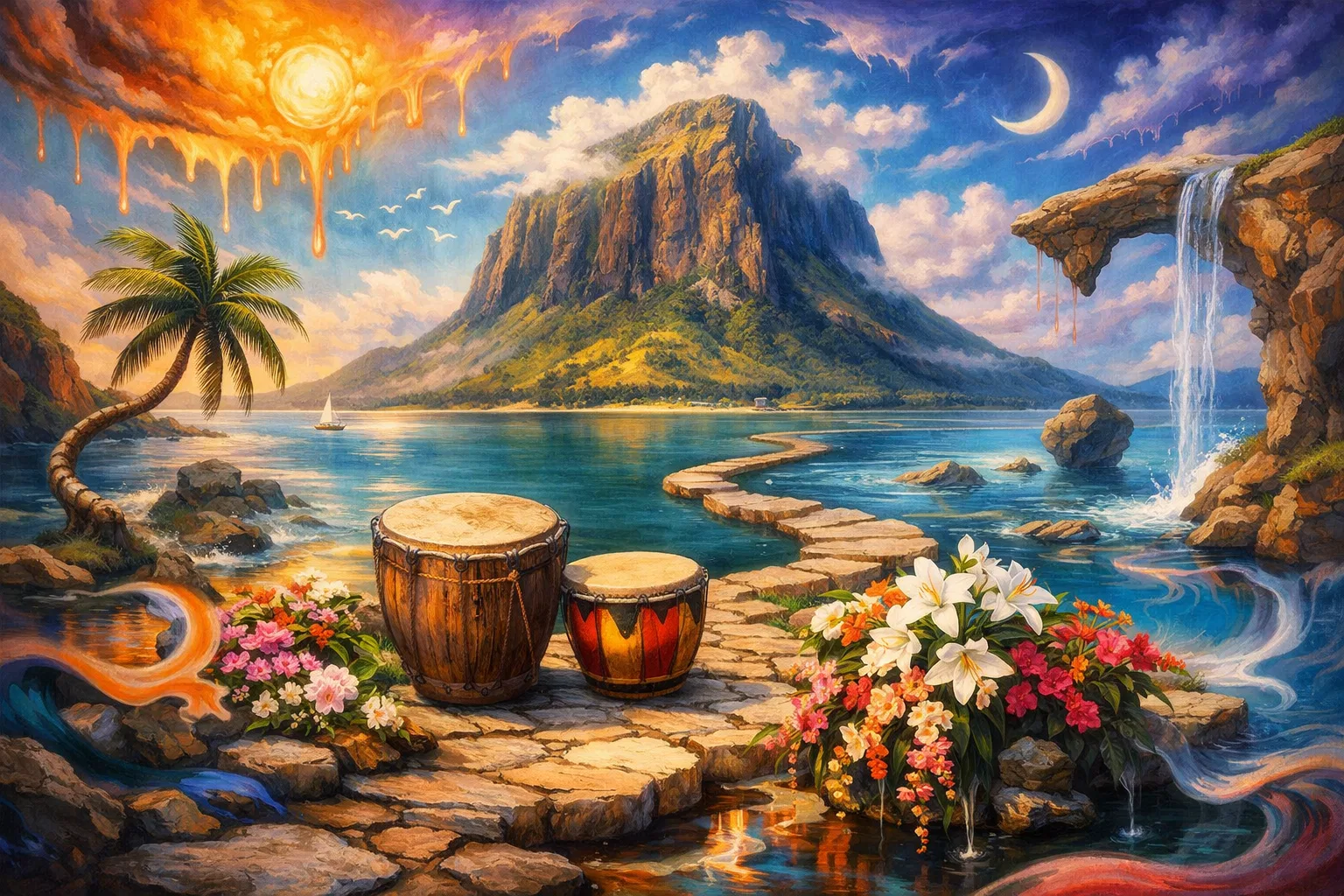
Mauritian folklore is not a single ancient mythology with one pantheon of gods and monsters. It is better understood as a living island culture of oral tales, riddles, songs, sacred places, family rituals, ghostly warnings, literary legends and remembered histories shaped by slavery, indenture, migration and creolisation.
Page outline Jump by section
Introduction
What makes Mauritius especially interesting is that folklore often sits close to public heritage. UNESCO recognises Le Morne as a World Heritage landscape partly because of oral traditions about maroons, and it lists several Mauritian performance traditions as intangible cultural heritage, including Traditional Mauritian Sega, Geet-Gawai and Sega Tambour of Rodrigues. These are not museum pieces: they remain part of weddings, pilgrimages, performances, family memory, tourism and national identity.[unesco.org]whc.unesco.orgWorld Heritage Centre Le Morne Cultural LandscapeUNESCO World Heritage CentreLe Morne Cultural Landscape - UNESCO World Heritage…The oral traditions associated with the maroons, have…
Why Mauritian folklore feels different
Mauritius was uninhabited before European colonisation, so its folklore does not descend from a single pre-colonial indigenous tradition. Instead, it grew out of an island society formed by French and British colonial rule, enslaved Africans and Malagasy people, Indian indentured labourers, Chinese migrants, Creole communities and later global tourism and media. That mixture matters because Mauritian stories often combine remembered suffering, moral instruction, landscape, religion and entertainment rather than separating them neatly into “myth”, “history” and “custom”.
The strongest sources for Mauritian folklore are not always sensational ghost stories. They include old collections of oral literature, UNESCO heritage files, performance traditions, public memorial landscapes and contemporary social research. A key nineteenth-century collection is Charles Baissac’s Le Folk-lore de l’Ile-Maurice, published in 1888 with Creole text and French translation; library records and digitised copies describe it as a collection of Mauritian folklore, tales, riddles and songs.[archive.org]archive.orgOpen source on archive.org.
This means the safest way to read Mauritian folklore is not to ask, “Did this supernatural event really happen?” A better question is: “What did this story help people remember, warn against, celebrate or pass on?” In Mauritius, a mountain can be a landscape feature, a colonial place-name, a climbing challenge, a symbol of resistance and the setting of a legend at the same time.
Le Morne: the mountain where memory became heritage
Le Morne Brabant, on the south-western tip of Mauritius, is the country’s most internationally recognised folklore landscape. UNESCO describes it as a mountain used as a shelter by escaped enslaved people, known as maroons, in the eighteenth and nineteenth centuries. The site’s significance rests not only on archaeology or written documents, but also on oral traditions that made Le Morne a symbol of the fight for freedom, suffering and sacrifice.[UNESCO World Heritage Centre]whc.unesco.orgWorld Heritage Centre Le Morne Cultural LandscapeUNESCO World Heritage CentreLe Morne Cultural Landscape - UNESCO World Heritage…The oral traditions associated with the maroons, have…
The most famous legend says that, after the abolition of slavery, a group of soldiers or officials climbed towards the mountain to announce freedom. The maroons, fearing recapture, misunderstood the approach and leapt to their deaths. This story is widely repeated in Mauritian memory and tourism, but it should be handled carefully. UNESCO’s official framing strongly supports Le Morne as a landscape of maroon resistance and enduring oral tradition, while some later tellings turn the memory into a single dramatic episode whose exact historical details are debated.[unesco.org]whc.unesco.orgWorld Heritage Centre Le Morne Cultural LandscapeUNESCO World Heritage CentreLe Morne Cultural Landscape - UNESCO World Heritage…The oral traditions associated with the maroons, have…
The legend matters because it gives emotional shape to a painful history. Le Morne is not simply “haunted” in the entertainment sense; it is a place where landscape, slavery, resistance and remembrance overlap. UNESCO has recently described it as a place where oral traditions, songs and stories continue to speak to local and global meanings, especially for Mauritius and the African diaspora.[UNESCO]unesco.orgle morne cultural landscape connecting past and future through digital educationle morne cultural landscape connecting past and future through digital education
For readers exploring Mauritian folklore, Le Morne is a reminder that a legend can be culturally true even when historians continue to test the exact details. The mountain’s power lies in how generations have used it to remember maroon courage, fear, loss and freedom.

Pieter Both: the mountain with a human head
Pieter Both is one of the most visually striking mountains in Mauritius, famous for the boulder near its summit that appears almost like a head balanced on a body. That shape has naturally attracted legends. In popular Mauritian retellings, Pieter Both is often connected with a hidden encounter: a milkman or local man sees supernatural women, fairies or witches dancing, is told not to reveal what he has seen, breaks the taboo, and is turned into stone.[cleverdodo.com]cleverdodo.comOpen source on cleverdodo.com.
There is also a historical layer. The mountain is named after Pieter Both, a Dutch colonial figure and Governor-General of the Dutch East Indies who died in a shipwreck; travel and heritage accounts identify the mountain as the second highest in Mauritius and note its difficult ascent.[cdn.beachcomber-hotels.com]cdn.beachcomber-hotels.comOpen source on beachcomber-hotels.com.
That double identity is typical of Mauritian folklore. The same landmark can hold an official colonial name, a geological explanation and a supernatural story. The folk version turns the mountain into a moral landscape: secrecy must be respected, supernatural encounters are dangerous, and a visible rock formation becomes evidence of an old warning.
Pieter Both also shows how modern folklore changes. Older oral variants circulate alongside tourist-friendly summaries, YouTube retellings, social media posts and even game-inspired reinterpretations. Some online versions confidently present details that are hard to trace to older sources, so the most responsible reading is to treat Pieter Both as a living legend complex rather than a single fixed “original” tale.[Generative Arts]genarts.xyzGenerative Arts Pieter Both LegendGenerative Arts Pieter Both Legend
Sega: song, sorrow, satire and survival
Traditional Mauritian Sega is one of the country’s most important folk performance traditions. UNESCO describes it as a performing art emblematic of the Creole community, using improvised solo singing, frame drum, box rattle and triangle, with dancers moving through short steps and expressive gestures. It is transmitted through both formal and informal participation.[ICH UNESCO]ich.unesco.orgOpen source on unesco.org.
Sega is often presented to visitors as cheerful island music, but its roots are deeper than resort entertainment. It is closely associated with communities descended from enslaved people and with the emotional world of plantation society. UNESCO’s material on Traditional Mauritian Sega notes its importance as a community practice, and related sources describe older ritual associations, including communication with ancestors and funerary contexts.[ICH UNESCO]ich.unesco.orgOpen source on unesco.org.
This makes Sega a bridge between folklore and lived performance. Its improvised lyrics can carry humour, complaint, desire, memory and social commentary. It is not a “myth” in the narrow sense, but it performs many of folklore’s jobs: it preserves communal memory, teaches style and gesture, and gives public form to emotions that were once marginalised.
Rodrigues, an autonomous outer island of the Republic of Mauritius, has its own recognised tradition, Sega Tambour. UNESCO describes Sega Tambour of Rodrigues Island as a vibrant performance of music, song and dance with origins in slave communities; the UNESCO archive also stresses its role in socialisation, conflict resolution and community bonds.[ICH UNESCO]ich.unesco.orgOpen source on unesco.org.
Geet-Gawai and the folklore of the wedding house
Mauritian folklore is not only Creole or African-derived. Bhojpuri-speaking Indo-Mauritian communities have preserved and reshaped their own oral and ritual traditions, including Geet-Gawai. UNESCO describes Geet-Gawai as a pre-wedding ceremony combining rituals, prayer, songs, music and dance, usually performed at the home of the bride or groom by family members and neighbours.[ICH UNESCO]ich.unesco.orgOpen source on unesco.org.
Its importance lies in transmission. Songs, gestures, jokes, blessings and ritual roles move across generations in a domestic setting. Women’s participation is central in many descriptions, and the tradition helps keep Bhojpuri cultural memory alive in a country far from the places from which many indentured labourers’ ancestors came.[ICH UNESCO]ich.unesco.orgOpen source on unesco.org.
Geet-Gawai also shows how folklore can become public heritage without losing its family character. Once recognised by UNESCO, it gained international visibility, but its core remains intimate: the wedding house, the gathered women, the ritual preparation, the songs honouring deities, and the movement from solemn blessing to celebration.
The same wider history is embodied by Aapravasi Ghat in Port Louis, the immigration depot through which large numbers of indentured labourers passed. UNESCO describes Aapravasi Ghat as a World Heritage Site keeping alive the memory of indentured labour, while the Aapravasi Ghat Trust Fund stresses that the site represents not only labour migration but also the memories, traditions and values migrants carried and passed on to descendants.[UNESCO]unesco.orgOpen source on unesco.org.
Riddles, tales and the old Creole archive
A quieter but essential part of Mauritian folklore is verbal art: tales, riddles, proverbs, jokes and songs passed through speech. Baissac’s 1888 collection is especially important because it records Creole oral material at a time when such traditions were often ignored or treated as low-status culture. Digitised and catalogue records identify the work as a collection of folktales, legends, riddles and songs from Mauritius.[Internet Archive]archive.orgOpen source on archive.org.
Riddles, often discussed under local Creole names in Mauritian sources, are more than children’s games. They train quick thinking, memory and social wit. A UNESCO intangible heritage inventory document refers to Mauritian Creole riddles told by enslaved people and their descendants, framing them as expressions of cultural transmission and human creativity.[ICH UNESCO]ich.unesco.orgOpen source on unesco.org.
This matters because folklore is sometimes reduced to monsters and haunted places. In Mauritius, a riddle exchanged at home, a proverb used in a market conversation, or a comic tale told in Creole may carry as much cultural weight as a famous legend. Such forms preserve rhythm, humour and social intelligence in ways that formal history often misses.
Modern cultural institutions have also revived and adapted older material. The Creole Speaking Union has publicised a re-edited and adapted version of Baissac’s folklore collection, and the National Library’s bibliography records recent publication activity around Folklor Lil Moris, showing that nineteenth-century oral literature still has a place in twenty-first-century cultural work.[creolespeakingunion.govmu.org]creolespeakingunion.govmu.orgOpen source on govmu.org.
Witchcraft, fear and social pressure
Beliefs about witchcraft and harmful magic remain part of Mauritian supernatural culture, though they should not be treated as exotic curiosities or proof of paranormal events. Recent academic research by A. K. Willard and colleagues examined witchcraft, envy and social norms in Mauritius, using in-person data and coding local references to black magic, sorcery and the figure of the longaniste.[Springer]link.springer.comOpen source on springer.com.
The important point is social. The study argues that witchcraft beliefs can help enforce norms around envy: people may avoid flaunting success or provoking resentment because envy is imagined as spiritually dangerous. This turns witchcraft belief into a moral and social system, not merely a set of scary stories.[Springer]link.springer.comOpen source on springer.com.
Popular Mauritian online discussions and blogs also mention black magic, ghosts and night-time legends, but these sources vary greatly in reliability. They are useful for seeing what people talk about now, not for proving that a tradition is old or widespread. The better-supported conclusion is that witchcraft beliefs are present in contemporary Mauritius and interact with concerns about envy, reputation, family conflict and social conduct.[PMC]pmc.ncbi.nlm.nih.govPMCWitchcraft, Envy, and Norm Enforcement in MauritiusPMCWitchcraft, Envy, and Norm Enforcement in Mauritius
This is where folklore becomes practical. Whether or not a person believes in witchcraft literally, the belief can influence behaviour: how openly people display wealth, how they explain misfortune, and how communities talk about jealousy.
Sacred lakes, saints and pilgrim stories
Mauritian belief culture also includes sacred geography shaped by religion. Ganga Talao, also known as Grand Bassin, is a volcanic crater lake regarded as sacred by many Mauritian Hindus. During Maha Shivaratri, large numbers of devotees walk to the lake carrying offerings or decorated structures, turning the journey into one of the island’s most visible annual acts of devotion.[Wikipedia]WikipediaGanga TalaoGanga Talao
Local retellings connect the lake’s sacred status with visionary discovery and symbolic links to the Ganges. Some visitor-facing sources describe a priest’s dream in which the lake’s water was associated with the sacred river, after which the place became central to pilgrimage. Such accounts should be read as sacred tradition rather than neutral geology, but they are important because they show how a Mauritian landscape was woven into a diasporic Hindu imagination.[Mauritius Attractions]mauritiusattractions.comMauritius Attractions Ganga Talao, Grand BassinMauritius Attractions Ganga Talao, Grand Bassin
Catholic folk devotion has its own major figure in Blessed Jacques-Désiré Laval, commonly known as Père Laval. UNESCO’s Memory of the World material describes him as a unifying figure in Mauritian history who worked among poor and newly liberated enslaved people, while the Mauritian Ministry of Arts and Culture describes the Père Laval pilgrimage as a defining event bringing together different generations, faiths and communities.[UNESCO]unesco.orgOpen source on unesco.org.
These examples show that Mauritian folklore cannot be separated cleanly from religion. Pilgrimage, saints, sacred water, vows, healing hopes and family memory all form part of the country’s traditional belief culture. They are not “folklore” because they are false; they are folklore because they are lived, repeated, narrated and shared.
Paul and Virginia: literary fiction that became island legend
Not every Mauritian legend began as oral tradition. Paul and Virginia, the famous 1788 novel by Jacques-Henri Bernardin de Saint-Pierre, is a literary work set on the island when it was known as Isle de France. The story of two young lovers, nature, separation and shipwreck became deeply associated with the island’s romantic image.[Wikipedia]WikipediaPaul et VirginiePaul et Virginie
Because Bernardin lived in Mauritius for a time and drew on island settings, the novel has often been treated as part of the Mauritian cultural imagination. Museums and travel writing across the south-west Indian Ocean continue to present it as a “mythical” work linked to Mauritius and the wider region.[Tropics]tropics.univ-reunion.frOpen source on univ-reunion.fr.
The distinction matters. Paul and Virginia is not an old anonymous folktale in the way Baissac’s collected oral stories are. It is authored literature that became folkloric through repetition, tourism, monuments, place association and popular memory. It helped shape how outsiders imagined Mauritius as a tropical paradise, but it also carries colonial-era assumptions that modern readers may question.
For a folklore page, its value is not that it reveals ancient Mauritian belief. Its value is that it shows how literature can become local legend, especially when readers attach fictional emotion to real landscapes.
Rodrigues, Chagos and the wider Mauritian folklore map
The Republic of Mauritius includes more than the main island, and folklore does not stop at Mauritius Island’s shoreline. Rodrigues has its own strong identity, especially through Sega Tambour, which UNESCO recognises as a tradition practised across Rodrigues with origins in slave communities. Rodrigues tourism sources describe the sega drum as a symbol passed from generation to generation and present in community rehearsals, competitions and visitor experiences.[ICH UNESCO]ich.unesco.orgOpen source on unesco.org.
Chagossian heritage also belongs in the wider Mauritian cultural frame, though it carries a particular history of displacement. UNESCO’s Mauritius intangible heritage listing includes Sega Tambour Chagos on the List of Intangible Cultural Heritage in Need of Urgent Safeguarding, alongside Traditional Mauritian Sega, Geet-Gawai and Sega Tambour of Rodrigues.[ICH UNESCO]ich.unesco.orgICH UNESCOMauritiusICH UNESCOMauritius
This wider map matters because “Mauritian folklore” can be wrongly reduced to one island, one beach image or one Creole performance. In reality, it includes island-to-island memory, forced movement, outer-island musical styles and community efforts to preserve traditions under pressure.
Old tradition, tourist retelling and internet folklore
Mauritian folklore today moves through several channels at once. Some traditions are old oral forms recorded in nineteenth-century collections. Some are living rituals recognised by UNESCO. Some are sacred practices embedded in religious calendars. Others are modern tourist narratives, social media posts, school retellings, videos or blog versions of older legends.
A useful way to judge a Mauritian folklore claim is to ask where it sits:
- Well-attested heritage: Le Morne’s maroon associations, Traditional Mauritian Sega, Geet-Gawai and Sega Tambour have strong institutional documentation through UNESCO and national heritage bodies.[unesco.org]whc.unesco.orgWorld Heritage Centre Le Morne Cultural LandscapeUNESCO World Heritage CentreLe Morne Cultural Landscape - UNESCO World Heritage…The oral traditions associated with the maroons, have…
- Historic oral literature: Baissac’s 1888 collection gives a valuable early record of Creole tales, riddles and songs, though it was collected in a colonial context and should not be treated as the whole of Mauritian oral culture.[Internet Archive]archive.orgOpen source on archive.org.
- Landscape legends: Pieter Both and Le Morne show how mountains become story-bearing places, but individual plot details can vary between tellings.[cleverdodo.com]cleverdodo.comOpen source on cleverdodo.com.
- Modern supernatural talk: witchcraft, ghosts and night legends remain culturally present, but online examples need caution unless supported by stronger social research or local documentation.[PMC]pmc.ncbi.nlm.nih.govPMCWitchcraft, Envy, and Norm Enforcement in MauritiusPMCWitchcraft, Envy, and Norm Enforcement in Mauritius
- Literary folklore: Paul and Virginia is authored fiction that became part of the island’s mythic image rather than an anonymous oral legend.[Wikipedia]WikipediaPaul et VirginiePaul et Virginie
This does not make modern retellings worthless. Folklore is always changing. The challenge is to avoid flattening everything into either “ancient myth” or “made-up tourist story”. Mauritius has both deep-rooted traditions and newer cultural inventions, and the most interesting material often lies in the overlap.
What Mauritian folklore says about the country
Mauritian folklore is a culture of crossings: between Africa, Madagascar, India, China and Europe; between slavery and freedom; between home ritual and public performance; between sacred landscape and tourist landmark; between Creole speech and official heritage. Its stories are often less about gods and monsters than about memory, dignity and belonging.
Le Morne turns a mountain into a symbol of maroon resistance. Pieter Both turns a rock formation into a warning about forbidden knowledge. Sega turns pain, humour and rhythm into communal performance. Geet-Gawai turns a wedding house into a vessel of diasporic memory. Riddles preserve wit in everyday speech. Witchcraft beliefs reveal anxieties about envy and social balance. Sacred places such as Ganga Talao and the Père Laval shrine show how pilgrimage can become part of national culture.
The result is folklore that feels intimate rather than remote. It is found in songs, family gatherings, festival roads, mountain silhouettes, old books, school stories, shrine visits and social caution. Mauritius may not have a single ancient mythological system, but it has a rich and well-attested belief culture in which stories help people remember where they came from, what they endured, and how many traditions can share one island.
Amazon book picks
Further Reading
Books and field guides related to Where Island Memory Becomes Legend. Use these as the next step if you want deeper reading beyond the article.
Paul et Virginie
A foundational literary legend repeatedly woven into Mauritian folklore and heritage.
The Mauritius Command
Provides cultural and historical context for Mauritius and its colonial-era memory.
eBay marketplace picks
Marketplace Samples
Live-tested eBay searches with available results related to this page.

Endnotes
1.
Source: whc.unesco.org
Title: World Heritage Centre Le Morne Cultural Landscape
Link:https://whc.unesco.org/en/list/1259/
Source snippet
UNESCO World Heritage CentreLe Morne Cultural Landscape - UNESCO World Heritage...The oral traditions associated with the maroons, have...
2.
Source: ich.unesco.org
Link:https://ich.unesco.org/en/RL/traditional-mauritian-sega-01003
3.
Source: ich.unesco.org
Link:https://ich.unesco.org/en/RL/bhojpuri-folk-songs-in-mauritius-geet-gawai-01178
4.
Source: ich.unesco.org
Link:https://ich.unesco.org/en/RL/sega-tambour-of-rodrigues-island-01257
5.
Source: archive.org
Link:https://archive.org/details/lefolkloredelile00bais
6.
Source: catalog.hathitrust.org
Link:https://catalog.hathitrust.org/Record/006934119
7.
Source: earthwise.global
Title: a trilogy 1 the fall the maroon queen
Link:https://www.earthwise.global/blog/a-trilogy-1-the-fall-the-maroon-queen
8.
Source: unesco.org
Title: le morne cultural landscape connecting past and future through digital education
Link:https://www.unesco.org/en/articles/le-morne-cultural-landscape-connecting-past-and-future-through-digital-education
9.
Source: cleverdodo.com
Link:https://www.cleverdodo.com/t/14966/what-are-the-myths-and-legends-of-mauritius
10.
Source: youtube.com
Link:https://www.youtube.com/watch?v=msf6HDwVaZ4
11.
Source: cdn.beachcomber-hotels.com
Link:https://cdn.beachcomber-hotels.com/beachcomber-magazine/06/15/
12.
Source: unesco.org
Title: document 3665
Link:https://www.unesco.org/archives/multimedia/document-3665
13.
Source: ich.unesco.org
Title: ICH UNESCOTRADITIONAL MAURITIAN
Link:https://ich.unesco.org/doc/src/26081-EN.pdf
14.
Source: unesco.org
Title: document 4656
Link:https://www.unesco.org/archives/multimedia/document-4656
15.
Source: unesco.org
Title: document 4367
Link:https://www.unesco.org/archives/multimedia/document-4367
16.
Source: unesco.org
Link:https://www.unesco.org/en/articles/aapravasi-ghat-how-unesco-world-heritage-site-keeps-memory-indentured-labour-alive
17.
Source: aapravasi.govmu.org
Link:https://aapravasi.govmu.org/aapravasi/?page_id=794
18.
Source: ich.unesco.org
Link:https://ich.unesco.org/doc/src/30634-EN.pdf
19.
Source: creolespeakingunion.govmu.org
Link:https://creolespeakingunion.govmu.org/csu/
20.
Source: natlibmu.govmu.org
Title: BIBLIOGRAPHY OF MAURITIUS 2023 1
Link:https://natlibmu.govmu.org/natlibmu/wp-content/uploads/2025/02/BIBLIOGRAPHY-OF-MAURITIUS-2023-1.pdf
21.
Source: link.springer.com
Link:https://link.springer.com/article/10.1007/s12110-024-09484-4
22.
Source: pmc.ncbi.nlm.nih.gov
Title: PMCWitchcraft, Envy, and Norm Enforcement in Mauritius
Link:https://pmc.ncbi.nlm.nih.gov/articles/PMC11836218/
23.
Source: Wikipedia
Title: Ganga Talao
Link:https://en.wikipedia.org/wiki/Ganga_Talao
24.
Source: unesco.org
Link:https://www.unesco.org/en/memory-world/archival-collections-bienheureux-pere-jacques-desire-laval-apostle-mauritius
25.
Source: culture.govmu.org
Link:https://culture.govmu.org/mach/?p=6847
26.
Source: Wikipedia
Title: Paul et Virginie
Link:https://en.wikipedia.org/wiki/Paul_et_Virginie
27.
Source: ich.unesco.org
Title: ICH UNESCOMauritius
Link:https://ich.unesco.org/en/state/mauritius-MU
28.
Source: ich.unesco.org
Title: 40206 EN
Link:https://ich.unesco.org/doc/src/40206-EN.pdf
29.
Source: culture.govmu.org
Link:https://culture.govmu.org/mach/
30.
Source: culture.govmu.org
Link:https://culture.govmu.org/mach/?p=7701
31.
Source: mandelacentre.govmu.org
Link:https://mandelacentre.govmu.org/mandelacentre/?page_id=368
32.
Source: pmo.govmu.org
Title: FINAL Highlights of Cabinet Meeting Friday 02 February 24 1 (1)
Link:https://pmo.govmu.org/CabinetDecision/2024/FINAL_Highlights%20of%20Cabinet%20Meeting%20-%20%20Friday%2002%20February%2024_1%20%281%29.pdf
33.
Source: lawsofmauritius.govmu.org
Link:https://lawsofmauritius.govmu.org/portal/viewlegislationdocument/web/?docnumber=&doctitle=Q29weXJpZ2h0IEFjdA%3D%3D&doctype=act
34.
Source: housing.govmu.org
Title: Master Plan Recreation Zone
Link:https://housing.govmu.org/Documents/Master%20Plan%20%20Recreation%20Zone.pdf
35.
Source: aapravasi.govmu.org
Title: Aapravasi Ghat Magazine 2018 Pdf
Link:https://aapravasi.govmu.org/aapravasi/wp-content/uploads/2020/09/Aapravasi-Ghat-Magazine-2018_Pdf.pdf
36.
Source: mauritiusassembly.govmu.org
Title: Debate No 29 of 2023 UNREVISED Tuesday 14 November 2023
Link:https://mauritiusassembly.govmu.org/mauritiusassembly/wp-content/uploads/2023/11/Debate-No-29-of-2023-UNREVISED-Tuesday-14-November-2023.pdf
Published: November 2023
37.
Source: mauritiusassembly.govmu.org
Link:https://mauritiusassembly.govmu.org/mauritiusassembly/wp-content/uploads/2023/03/bill3013.pdf
38.
Source: ich.unesco.org
Link:https://ich.unesco.org/en/decisions/9.COM/10.28
39.
Source: ich.unesco.org
Title: mauritius MU
Link:https://ich.unesco.org/en/state/mauritius-MU?info=periodic-reporting
40.
Source: whc.unesco.org
Link:https://whc.unesco.org/en/news/1599
41.
Source: ich.unesco.org
Link:https://ich.unesco.org/doc/src/33629.pdf?v=1460731262
42.
Source: whc.unesco.org
Link:https://whc.unesco.org/document/152195
43.
Source: ich.unesco.org
Link:https://ich.unesco.org/en/decisions/12.COM/11.B.22
44.
Source: ich.unesco.org
Title: resources 00385
Link:https://ich.unesco.org/en/resources-00385?id=41046&include=film_inc.php
45.
Source: ich.unesco.org
Title: nigeria NG
Link:https://ich.unesco.org/en/state/nigeria-NG?call=film&id=36590&include=film_inc.php&width=700
46.
Source: ich.unesco.org
Link:https://ich.unesco.org/en/d%C3%A9cisions/11.COM/10.B.21
47.
Source: folktales.africa
Title: the legend of pieter boths head
Link:https://folktales.africa/the-legend-of-pieter-boths-head/
48.
Source: youtube.com
Title: Traditional Mauritian Sega
Link:https://www.youtube.com/watch?v=uanRrlcYg1k
49.
Source: Wikipedia
Title: Culture of Mauritius
Link:https://en.wikipedia.org/wiki/Culture_of_Mauritius
50.
Source: Wikipedia
Title: Geet Gawai
Link:https://en.wikipedia.org/wiki/Geet-Gawai
51.
Source: Wikipedia
Title: Sega tambour of Rodrigues Island
Link:https://en.wikipedia.org/wiki/Sega_tambour_of_Rodrigues_Island
52.
Source: Wikipedia
Title: Mauritian Maroons
Link:https://en.wikipedia.org/wiki/Mauritian_Maroons
53.
Source: Wikipedia
Link:https://en.wikipedia.org/wiki/Mauritius
54.
Source: gothic.lib.virginia.edu
Title: paul and virginia
Link:https://gothic.lib.virginia.edu/access-the-archive-2/paul-and-virginia/
55.
Source: archive.org
Link:https://archive.org/stream/mauritiusillustr00alli/mauritiusillustr00alli_djvu.txt
56.
Source: youtube.com
Title: The Loup-Garou of Le Morne
Link:https://www.youtube.com/watch?v=KmxJyyHbles
Source snippet
Traditional Mauritian Sega...
57.
Source: youtube.com
Title: Traditional Mauritian Sega
Link:https://www.youtube.com/watch?v=TGHl7Rf9e0c
Source snippet
Bhojpuri folk songs in Mauritius, Geet-Gawai...
58.
Source: youtube.com
Title: Bhojpuri folk songs in Mauritius, Geet-Gawai
Link:https://www.youtube.com/watch?v=YXDOBeQQl60
Source snippet
Le Morne: Walking in the Slaves' Footsteps [The Truth Behind the Mountain]...
59.
Source: youtube.com
Title: Le Morne: Walking in the Slaves’ Footsteps [The Truth Behind the Mountain]
Link:https://www.youtube.com/watch?v=jWxZ5wk_208
Source snippet
Pieter Both mountain...
60.
Source: youtube.com
Title: Pieter Both mountain
Link:https://www.youtube.com/watch?v=2W7zibLeiNQ
61.
Source: genarts.xyz
Title: Generative Arts Pieter Both Legend
Link:https://genarts.xyz/news/pieter-both-legend/
62.
Source: mauritiusattractions.com
Title: Mauritius Attractions Ganga Talao, Grand Bassin
Link:https://mauritiusattractions.com/ganga-talao-grand-bassin-mauritius-i-339.html
63.
Source: tropics.univ-reunion.fr
Link:https://tropics.univ-reunion.fr/779
64.
Source: thedocumentarian.org
Title: Mauritius | Isle of Paul et Virginie
Link:https://thedocumentarian.org/mauritius-isle-of-paul-et-virginie/
65.
Source: mauritiusattractions.com
Link:https://mauritiusattractions.com/p%C3%83%C2%A8re-laval-pilgrimage-i-428.html
66.
Source: creolemauritius.com
Title: Le Morne Brabant
Link:https://creolemauritius.com/blog/le-morne-brabant-guide/
67.
Source: shs.cairn.info
Link:https://shs.cairn.info/article/CISL_1702_0045/pdf?lang=fr
Additional References
68.
Source: academia.edu
Link:https://www.academia.edu/38843524/BTreasure
69.
Source: openlibrary.org
Link:https://openlibrary.org/works/OL32570529W/99sirandanes%C3%A0siroter
70.
Source: amazon.nl
Link:https://www.amazon.nl/Contes-l%C3%A9gendes-Maurice-Charles-Baissac/dp/2384690078?tag=searcht-20
71.
Source: rsisinternational.org
Link:https://rsisinternational.org/journals/ijriss/view/geet-gawai-in-mauritius-a-reflection-through-performance-theory
72.
Source: reddit.com
Link:https://www.reddit.com/r/mauritius/comments/x143ny/have_you_experienced_black_magic/
73.
Source: researchgate.net
Link:https://www.researchgate.net/publication/315686355_Indentured_labor_Diaspora_and_Indian_culture_in_Mauritius_First_steps_of_Aapravasi_Ghat_towards_intercultural_education
74.
Source: ijessr.com
Link:https://ijessr.com/uploads2020/ijessr_03_319.pdf
75.
Source: islandsevents.com
Link:https://islandsevents.com/island/mauritius/maha-shivaratri
76.
Source: facebook.com
Link:https://www.facebook.com/MiltonDickMP/posts/it-was-a-solemn-honour-to-visit-the-aapravasi-ghat-world-heritage-site-in-maurit/1225249466073613/
77.
Source: facebook.com
Link:https://www.facebook.com/61566850436344/posts/la-marche-pu-le-pere-laval-is-now-a-national-event-where-all-communities-come-to/122176603022561681/
Topic Tree
Follow this branch
Related pages 192
- Afghan Folklore
- Albanian Folklore
- Algerian Folklore
- Australian Folklore
- Azerbaijan Folklore
- +187 more in sidebar