Where Mozambique's Spirits Still Speak
Mozambique’s folklore is best understood not as a single national mythology, but as a living field of oral stories, spirit beliefs, ritual performance, sacred landscapes and modern retellings shaped by many languages and regions.
Page outline Jump by section
Introduction
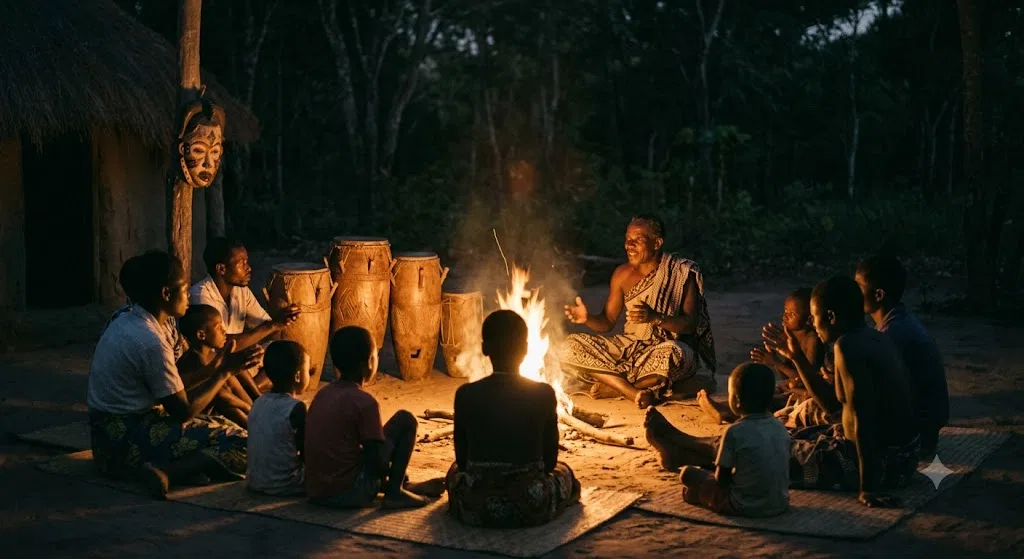
For a curious reader, the most important point is this: Mozambique’s legendary culture is deeply local, but its recurring themes are clear. Ancestors remain close to the living; spirits can heal, warn, punish or possess; animals in tales think and scheme like people; masks and music carry social memory; and sacred places are often protected because they are bound to founders, graves, old heroes or invisible powers. These traditions have also changed under colonial rule, Christianity, Islam, socialism, civil war, migration, tourism and contemporary art.
Why Mozambique’s folklore is regional rather than one national myth
Mozambique stretches along the south-east African coast, facing the Indian Ocean and bordered by Tanzania, Malawi, Zambia, Zimbabwe, South Africa and Eswatini. That geography helps explain why its folklore is so varied. Northern coastal traditions have long been shaped by Islamic and Indian Ocean connections; northern inland traditions include Makonde performance and carving; central Mozambique has strong traditions of spirit possession and healing; southern Mozambique includes Tsonga, Chopi and related oral and ritual traditions, many of which overlap with neighbouring South Africa, Eswatini and Zimbabwe.
The country’s language map is a good guide to this diversity. CLEAR Global describes Mozambique as having over 40 languages, with widely spoken primary languages including Makhuwa, Changana, Nyanja, Ndau, Sena, Chwabo and Tswa, while a UK government toponymic factfile identifies Makhuwa, Tsonga, Lomwe, Chewa, Sena and Chuwabu as indigenous languages used by at least a million people.[CLEAR Global]clearglobal.orgOpen source on clearglobal.org. This means that “Mozambican folklore” is not one seamless tradition. It is a national frame for many local traditions, each with its own names, performance settings, ritual rules and historical memories.
That also means some famous material collected under older ethnic labels needs careful handling. Swiss missionary and ethnographer Henri-Alexandre Junod wrote extensively on Ronga and Tsonga-speaking communities around Delagoa Bay and the wider region in the late nineteenth and early twentieth centuries. His books remain important early written records, but they are colonial-era sources, shaped by missionary assumptions and by older terminology. Junod himself wrote that he had collected “Ronga tales” before expanding his study of local custom and social life.[Internet Archive]archive.orgInternet Archive Full text of "The life of a South African tribeInternet Archive Full text of "The life of a South African tribe They are valuable evidence of oral tradition, not a final or neutral map of living Mozambican belief.
Ancestors, spirits and the living family
A repeated pattern in Mozambican traditional belief is that the dead are not simply gone. Ancestors may protect descendants, become offended, require respect, or be approached through ritual specialists. This is not “mythology” in the narrow sense of old stories about gods. It is a practical religious and social system in which health, misfortune, fertility, rain, family conflict and community wellbeing may be understood through relationships between the living, the dead and the wider environment.
Work on southern Mozambique describes rituals in which families honour ancestral spirits at important moments such as birth, harvest, crisis and return after displacement. One account of post-war healing explains that ancestral spirits are approached through family rites and through healers or diviners, and that health may be understood as harmony among people, spirits and the environment rather than merely the absence of physical illness.[Academia]academia.eduPDF) Healing for peace: Traditional healers and post-warPDF) Healing for peace: Traditional healers and post-war
This helps explain why folklore in Mozambique cannot be separated neatly from healing, law, land or family duty. A story about a spirit may also be a way of talking about inheritance. A ritual at a sacred site may also be a claim to belonging. A possession episode may express trauma, accusation, memory or justice. For readers used to fairy tales as entertainment, this is the crucial shift: many Mozambican traditions are not “just stories”. They are social acts.
The same point appears in research on sacred natural sites in the Xai-Xai region of Gaza Province. Local Tsonga communities are described as maintaining rites of ancestral invocation at places associated with community founders or old heroes, especially in relation to drought, crop pests and agricultural productivity. Custodians of these sites are often descendants of the founding families.[communityconservation.net]communityconservation.netxai xai region mozambiquexai xai region mozambique The sacred place is therefore not merely scenic. It is a remembered address for the dead.

Folktales: clever animals, riddles and village storytelling
The best-attested older folktale material from southern Mozambique comes through collections and descriptions of Ronga and Tsonga-speaking communities, especially Junod’s work. These tales include trickster animals, frightening beings, younger siblings who outwit elders, moral reversals and riddling contests. In one passage, Junod describes children and adults moving from games into riddles and then tales, with audiences laughing at the tricks of the Hare and the frog, shivering at bogeyman stories, and approving when a despised younger brother becomes the saviour of the family.[Internet Archive]archive.orgInternet Archive Full text of "The life of a South African tribeInternet Archive Full text of "The life of a South African tribe
That short description tells us several important things. First, storytelling was social and performative: it belonged to evenings, gatherings, children, adults and skilled narrators. Secondly, tales were not only for amusement. They trained listeners in cleverness, social judgement, fear, respect and moral reversal. Thirdly, animal characters were not random decoration. The hare, frog, lion and other figures offered a way to talk about human behaviour without naming living people directly.
The hare is especially familiar across much of eastern and southern African folklore, where he often appears as a trickster: small, vulnerable, greedy, witty and morally ambiguous. A Yale Teachers Institute unit on African trickster tales notes that Hare appears widely in African traditions and gives a southern African example in which Hare mishandles the Moon’s message about human mortality.[Yale-New Haven Teachers Institute]teachersinstitute.yale.eduOpen source on yale.edu. That does not make every hare story “Mozambican”, but it does show the regional story-world in which Mozambican Ronga and Tsonga tales sit.
One famous tale associated with Junod’s Ronga material is “Motikatika”, later popularised in Andrew Lang’s The Crimson Fairy Book. Modern educational folklore sites identify it as collected by Junod among Ba-Ronga, or Thonga/Tsonga, people of southern Mozambique.[mythfolklore.net]mythfolklore.netOpen source on mythfolklore.net. As with many retold folktales, readers should distinguish the oral source from the literary version. Lang’s fairy-book version belongs to a European publishing tradition; the deeper interest lies in how a local performance tradition was collected, translated, edited and repackaged for global children’s literature.
Sacred landscapes: forests, graves and places where founders remain present
Mozambican sacred geography often works through memory rather than monumentality. A sacred place may be a forest patch, former settlement, founder’s residence, grave area, marsh, old tree or ritual clearing. What makes it powerful is not usually a written myth explaining its origin, but a continuing relationship between a community and the ancestors or spirits associated with the site.
In Gaza Province, research on sacred natural sites in the Xai-Xai region describes places where the residences of community founders once stood and where ancestral spirits are still invoked. These sites are important for drought, crop protection, productivity and community identity, but they are also vulnerable to land-use conflict and pressure on local resources.[communityconservation.net]communityconservation.netxai xai region mozambiquexai xai region mozambique This is a useful example because it shows folklore functioning as land memory. The story of who founded a place is not just historical decoration; it helps decide who cares for the site, who may speak there, and why the place should not be treated as ordinary land.
Similar themes appear in recent work on sacred forests in Moribane Forest Reserve in Manica Province. A 2025 study in Frontiers in Forests and Global Change describes sacred forests as sources of intangible cultural benefits rooted in spiritual beliefs and traditional practices, and investigates their role in conserving forest diversity.[Frontiers]frontiersin.orgOpen source on frontiersin.org. The point is not that belief automatically preserves biodiversity in every case. Research on conservation around Gorongosa and Chimanimani warns that sacred forests or trees are not guaranteed protection if knowledge is not transmitted and population pressure increases.[MDPI]mdpi.comOpen source on mdpi.com. But these studies show how spiritual tradition, conservation and local authority can overlap.
For folklore readers, this matters because “haunted” or “sacred” landscapes in Mozambique are rarely just spooky backdrops. They are often places where ancestry, ecology, memory and authority meet.
Makonde masks and spirit forms
One of Mozambique’s most visible folklore-related traditions is the Makonde masked performance known as Mapiko, practised in northern Mozambique, especially among Makonde communities. UNESCO inscribed the dance on the List of Intangible Cultural Heritage in Need of Urgent Safeguarding in 2023, describing it as a celebratory dance connected with the traditional passage from puberty to adulthood.[ICH UNESCO]ich.unesco.orgOpen source on unesco.org.
Mapiko is not simply “a mask dance” in the museum-label sense. It is a performance field where identity, secrecy, adulthood, gender, social criticism and political history can be acted out. A scholarly review of Mapiko studies describes the dance field as a place where Makonde values, gender roles, religious beliefs, political ideologies, artistic talents and ideas of tradition and modernity have been performed and debated.[SciELO]scielo.org.zaOpen source on scielo.org.za. That makes it one of the clearest examples of Mozambican folklore as changing public theatre rather than frozen custom.
The masks themselves have also travelled into museums and art collections. DITSONG Museums in South Africa records two Mapiko masks collected in Cabo Delgado and donated in 1944, showing how ritual objects entered colonial and postcolonial museum circuits.[Ditsong Museum]ditsong.org.zaOpen source on ditsong.org.za. The World Encyclopedia of Puppetry Arts notes that Makonde figures and performance objects have been associated with spirits, ancestors and humans, while also observing that younger performers may now treat Mapiko as a more secular and modifiable form, sometimes to the concern of traditionalists.[World Encyclopedia of Puppetry Arts]wepa.unima.orgOpen source on unima.org.
Closely related, though not identical, is Makonde spirit sculpture, especially the modern “shetani” style known from Mozambique and Tanzania. Blackwood Conservation describes shetani sculptures as imaginative spirit-world forms in Makonde art, often linked to dreams, emotional states, nature spirits or dangerous beings.[blackwoodconservation.org]blackwoodconservation.orgOpen source on blackwoodconservation.org. This is a good example of the boundary between old belief and modern art. Some forms draw on spirit concepts, but the internationally collected sculpture market also reshaped how those beings were carved, named, sold and understood.
Chopi timbila: music as oral memory
Mozambique’s folklore is not only made of tales and spirits. It is also carried by music. The Chopi timbila tradition of southern Mozambique is one of the country’s best-known forms of intangible heritage. UNESCO’s multimedia archive describes Chopi communities in southern Inhambane Province as famous for orchestral music played on wooden xylophones of varying size and pitch, made from resonant wood and often performed in ensembles.[UNESCO]unesco.orgdocument 636document 636
Smithsonian Folkways, which preserves recordings of Chopi timbila, describes the Chopi people of Zavala as renowned for complex, partly improvised xylophone orchestra music, with lyrics that are “complex and poetic”.[Smithsonian Folkways Recordings]folkways.si.eduOpen source on si.edu. For folklore, the lyrics matter as much as the instruments. Timbila performance can carry praise, satire, social commentary, historical memory and collective identity. It is therefore part of oral tradition even when it appears to outsiders as music first.
UNESCO began safeguarding work for the Chopi timbila tradition after it was proclaimed a Masterpiece of the Oral and Intangible Heritage of Humanity in 2005.[UNESCO Japan]unesco.emb-japan.go.jpOpen source on go.jp. That recognition helped place Mozambique’s oral performance traditions on a global heritage map. It also raised a common question for living folklore: how can a tradition be preserved without turning it into a staged heritage product detached from the communities that give it meaning?
Spirits after war: the gamba tradition in Gorongosa
One of the most striking modern examples of Mozambican spirit tradition is the emergence and spread of gamba or magamba spirit possession in central Mozambique after the civil war. Anthropologist Victor Igreja’s work in Gorongosa is central here. He describes gamba spirits as linked to male soldiers who died in the war, with possession becoming a way to express trauma, social conflict, gender injustice and unresolved responsibility.[biblioteca.biofund.org.mz]biblioteca.biofund.org.mzGamba spirits, gender relations, and healing in post-civilGamba spirits, gender relations, and healing in post-civil
This is not folklore in the sense of a quaint old legend. It is a post-war spiritual idiom: a way communities made sense of violent memory when formal justice, silence or political amnesty did not answer all social needs. One study notes that gamba spirits created healing activity and that, in some cases, they helped address marital and gender injustices while processing memories of civil war.[biblioteca.biofund.org.mz]biblioteca.biofund.org.mzGamba spirits, gender relations, and healing in post-civilGamba spirits, gender relations, and healing in post-civil Another article on post-war recovery in Gorongosa reports local consensus among healers that gamba spirits and specialist healers emerged after the war and spread rapidly.[PubMed]pubmed.ncbi.nlm.nih.govOpen source on nih.gov.
For readers interested in ghosts and possession, the gamba tradition is especially important because it shows how new spirits can enter a cultural system. Not every spirit belief is ancient. Some are old; some are reformulated; some arise from historical rupture. In Gorongosa, the dead soldier spirit became a figure through which families could talk about violence, guilt, suffering and compensation.
This also challenges a common misconception: “traditional” does not mean unchanging. A spirit tradition can be traditional in form while responding to modern war, displacement and gender politics.
Witchcraft, lion-men and the danger of accusation
Mozambique also has traditions and social fears around witchcraft, sorcery and occult harm. These should be treated carefully. Belief in witchcraft is culturally and historically important, but accusations can lead to real violence, especially against vulnerable people. A study of witchcraft accusations in rural Mozambique argues that such accusations are an old institution that has adapted through changing political and social environments, and that they become especially visible during periods of tension. It also notes that older people, particularly women, are frequent targets of accusation.[Academia]academia.edu9 he then beCame a lIon wItChCraFt aCCusatIons In rural moZambIque9 he then beCame a lIon wItChCraFt aCCusatIons In rural moZambIque
One dramatic case is the so-called “War of Lions” in Cabo Delgado, analysed by Paolo Israel. The core pattern involved lions killing people, followed by witch-hunts against suspected sorcerers accused of magically making lions or transforming into lions.[Taylor & Francis Online]tandfonline.comOpen source on tandfonline.com. This is a powerful example of how folklore, fear, wildlife danger and politics can become entangled. A lion attack is a real-world event; the interpretation that a person has magically made the lion belongs to an occult explanation; the accusation can then become a social and political crisis.
The “lion-man” theme is also connected to wider regional ideas about people transforming into animals or using animals as instruments of occult harm. But the Mozambican evidence should not be flattened into a generic “African were-lion” story. In Cabo Delgado, the importance lies in the local political and social crisis produced by attacks, rumours and witch-hunting violence.
Recent reporting shows that witchcraft-related panic remains dangerous. In April 2026, Plataforma reported deaths linked to mob attacks after rumours spread in northern and central provinces.[Plataforma Media]plataformamedia.comPlataforma Media Mozambique: 11 deaths linked to witchcraft superstitionsPlataforma Media Mozambique: 11 deaths linked to witchcraft superstitions Such cases belong in a folklore page because they show how supernatural claims can have real consequences. They should not be sensationalised. The responsible distinction is between documenting belief and endorsing accusation.
Healing, divination and the invisible causes of illness
Traditional healers appear across many Mozambican accounts of spirits, ancestors, illness and misfortune. Their roles vary by region and tradition: some diagnose spirit affliction, some use herbal knowledge, some mediate with ancestors, some perform cleansing, and some are involved in possession cults or divination. These practices may coexist or compete with Christianity, Islam, biomedicine and Pentecostal healing.
Research on post-war healing in southern Mozambique describes rituals that cleanse people after violence, reintegrate them into family and community, and re-establish relationships with ancestral spirits.[Academia]academia.eduPDF) Healing for peace: Traditional healers and post-warPDF) Healing for peace: Traditional healers and post-war In central Mozambique, work on gamba spirits shows healing not only as treatment of symptoms but also as public memory work.[biblioteca.biofund.org.mz]biblioteca.biofund.org.mzGamba spirits, gender relations, and healing in post-civilGamba spirits, gender relations, and healing in post-civil In northern Mozambique, research on spirit possession in Nampula describes different groups of spirits, including Indian Ocean-associated Muslim spirits, and healing practices that combine herbal knowledge, ancestral worship and Islamic coastal elements.[umifre.fr]umifre.frOpen source on umifre.fr.
This gives Mozambican folklore an important coastal dimension. Spirits are not only “ancestral” in a narrow lineage sense. Some are associated with the sea, Islam, foreignness, war, animals or nature. Mozambique’s long Indian Ocean history matters here: coastal religion, trade, migration and healing have helped produce spirit worlds that are mixed, mobile and historically layered.
Islam, Christianity and traditional religion: mixture rather than replacement
Mozambique’s religious life includes Christianity, Islam, people with no declared religion, and traditional or ancestral practices. Current demographic summaries vary by source and category, but they agree that Christianity and Islam are both significant, and that older spirit and ancestor practices remain culturally important even when people also identify with world religions.[Nations Online Project]nationsonline.orgNations Online Project MozambiqueNations Online Project Mozambique
For folklore, the important issue is not simply percentages. It is the way religious systems interact. A person may attend church and still take ancestral obligations seriously. A healer may use Islamic symbols in a coastal context. Pentecostal churches may reinterpret local spirits as demons, while traditional practitioners may understand them as ancestors, war dead, nature spirits or afflicting powers. Research on Brazilian Pentecostal churches in Mozambique notes that such churches often homogenise a wide range of local spirits as demons, including ancestors, dead soldiers, spiritual husbands and other entities.[religiousmatters.nl]religiousmatters.nlcivilizatory magic in brazilian pentecostal churches in mozambiquecivilizatory magic in brazilian pentecostal churches in mozambique
This interaction has changed folklore. Some older practices became stigmatised under missionary Christianity or post-independence socialist campaigns against “obscurantism”. Some went quiet rather than disappearing. Others re-emerged in new public forms, including heritage festivals, museum displays, urban performance, church conflict narratives and contemporary literature.
Modern retellings: from oral story to literature, art and film
Mozambican folklore continues through modern literature and art, not just village performance. The best-known international example is Mia Couto, the Mozambican writer and biologist born in Beira in 1955. Literary profiles and criticism often describe his work as shaped by oral storytelling, linguistic invention and spirit-inflected or animist realism.[Literarische Agentur]mertinwitt-litag.demia coutomia couto
Couto’s novels and stories do not simply reproduce folktales. They transform oral textures, ghostly presences, ecological enchantment and post-war memory into literary fiction. A 2024 scholarly article on Sleepwalking Land discusses his use of water-based indigenous beliefs and magical realism, while a 2025 article reads his treatment of rain and enchantment in ecocritical terms.[Taylor & Francis Online]tandfonline.comOpen source on tandfonline.com. In other words, Mozambique’s folklore is not only a source of old motifs; it is part of contemporary thinking about land, war, language and identity.
Makonde art offers another route into modern reinterpretation. Spirit sculpture, Mapiko performance and blackwood carving have all been reshaped by colonial collecting, anti-colonial politics, socialist cultural policy, tourism and the international art market. The Smithsonian’s modern African art bibliography notes the commercial spread of shetani and “tree of life” styles in East African art markets, while studies of Makonde carving in postcolonial Mozambique link blackwood sculpture to socialist revolution and cooperative cultural production.[Smithsonian Libraries]sil.si.eduOpen source on si.edu.
The result is a folklore field with several layers: ritual masks still tied to initiation and community performance; museum masks treated as ethnographic or art objects; tourist carvings sold as cultural souvenirs; and contemporary artists using spirit forms as imaginative vocabulary.
What is well attested, and what should be treated cautiously?
Mozambique has rich folklore, but the evidence is uneven. Some traditions are well documented through UNESCO heritage files, ethnographic research, museum collections and academic studies. Others are mainly known through scattered local accounts, colonial-era collectors, tourist summaries or later retellings. A good reader should keep these categories separate.
Well-attested areas include Makonde Mapiko, Chopi timbila, sacred natural sites in Gaza and Manica, post-war gamba spirit possession in Gorongosa, and Ronga/Tsonga folktale traditions recorded by Junod and later scholars.[unesco.org]ich.unesco.orgOpen source on unesco.org. These have identifiable sources, places and research histories.
More caution is needed with internet lists of “Mozambican monsters” or unsourced claims about demons, mermaids, witches, vampires or haunted locations. Mozambique certainly has spirit, witchcraft, animal-transformation and sacred-place traditions, but many online monster summaries flatten regional beliefs or borrow from neighbouring countries without showing where the story was collected. When a source cannot name the community, language, collector, performance setting or local context, it should be treated as a modern retelling rather than evidence of an old Mozambican tradition.
Colonial-era sources need a different kind of caution. Junod and other early collectors preserved material that might otherwise be hard to access, but they wrote from missionary and colonial contexts. Their texts are useful, especially when read alongside later scholarship and living heritage work, but they should not be treated as the sole voice of the communities they describe.
Why Mozambique’s folklore matters today
Mozambique’s folklore matters because it explains how people remember, belong and argue about the invisible. Ancestors connect families to land. Sacred sites preserve founder memory. Folktales teach cunning, danger and social judgement. Mapiko masks stage adulthood, secrecy and public commentary. Timbila music turns performance into oral history. Gamba spirits show how the dead of modern war can become part of a living spiritual vocabulary.
The most memorable feature of Mozambican folklore is not a single monster or national epic. It is the way story, ritual and landscape remain tied to social life. A forest can be protected because ancestors are there. A mask can be both an initiation figure and a political performer. A spirit can be both an affliction and a demand for justice. A folktale can be both entertainment and moral argument.
That makes Mozambique a particularly rich country for folklore readers, but also one that rewards care. Its traditions are local, multilingual and historically layered. They should be read as living cultural practices, not as a fixed catalogue of supernatural creatures.
Amazon book picks
Further Reading
Books and field guides related to Where Mozambique's Spirits Still Speak. Use these as the next step if you want deeper reading beyond the article.
African Folktales
Introduces themes common across southern African oral traditions including Mozambique.
A History of Mozambique
Explains historical influences on Mozambican beliefs and folklore.
Tales from Africa
Contains traditional stories reflecting regional African storytelling patterns.
eBay marketplace picks
Marketplace Samples
Live-tested eBay searches with available results related to this page.
Endnotes
1.
Source: archive.org
Title: Internet Archive Full text of “The life of a South African tribe”
Link:https://archive.org/stream/lifeofsouthafric01junouoft/lifeofsouthafric01junouoft_djvu.txt
2.
Source: academia.edu
Title: (PDF) Healing for peace: Traditional healers and post-war
Link:https://www.academia.edu/89429569/Healing_for_peace_Traditional_healers_and_post_war_reconstruction_in_Southern_Mozambique
3.
Source: communityconservation.net
Title: xai xai region mozambique
Link:https://www.communityconservation.net/xai-xai-region-mozambique/
4.
Source: communityconservation.net
Link:https://www.communityconservation.net/wp-content/uploads/2018/06/Mozambique-Community.pdf
5.
Source: teachersinstitute.yale.edu
Link:https://teachersinstitute.yale.edu/curriculum/units/1998/2/98.02.04/3
6.
Source: mythfolklore.net
Link:https://www.mythfolklore.net/3043mythfolklore/reading/africa/background.htm
7.
Source: mdpi.com
Link:https://www.mdpi.com/2071-1050/13/11/6478
8.
Source: ich.unesco.org
Link:https://ich.unesco.org/en/USL/ingoma-ya-mapiko-01996
9.
Source: unesco.org
Link:https://www.unesco.org/en/articles/mozambican-mapiko-traditional-dance-joins-unesco-intangible-cultural-heritage-list
10.
Source: blackwoodconservation.org
Link:https://www.blackwoodconservation.org/makonde-art/
11.
Source: unesco.org
Title: document 636
Link:https://www.unesco.org/archives/multimedia/document-636
12.
Source: biblioteca.biofund.org.mz
Title: Gamba spirits, gender relations, and healing in post-civil
Link:https://biblioteca.biofund.org.mz/wp-content/uploads/2019/02/1549455090-F0992.Gamba%20spirits%2C%20gender%20relations%2C%20and%20healing%20in%20post-civil%20war%20Gorongosa%2C%20Mozambique.pdf
13.
Source: academia.edu
Title: 9 he then beCame a lIon wItChCraFt aCCusatIons In rural moZambIque
Link:https://www.academia.edu/43295304/9_he_then_beCame_a_lIon_wItChCraFt_aCCusatIons_In_rural_moZambIque
14.
Source: umifre.fr
Link:https://www.umifre.fr/c/5097
15.
Source: religiousmatters.nl
Title: civilizatory magic in brazilian pentecostal churches in mozambique
Link:https://religiousmatters.nl/civilizatory-magic-in-brazilian-pentecostal-churches-in-mozambique/
16.
Source: archive.org
Link:https://archive.org/stream/in.ernet.dli.2015.219776/2015.219776.Contributions-To_djvu.txt
17.
Source: ia801303.us.archive.org
Link:https://ia801303.us.archive.org/24/items/cu31924026932875/cu31924026932875.pdf
18.
Source: archive.org
Link:https://archive.org/stream/comparativestudy01johnuoft/comparativestudy01johnuoft_djvu.txt
19.
Source: archive.org
Link:https://archive.org/stream/afrikaundbersee00hambgoog/afrikaundbersee00hambgoog_djvu.txt
20.
Source: archive.org
Title: cu31924026932875 djvu.txt
Link:https://archive.org/download/cu31924026932875/cu31924026932875_djvu.txt
21.
Source: archive.org
Link:https://archive.org/stream/cu31924026932875/cu31924026932875_djvu.txt
22.
Source: ich.unesco.org
Title: oral traditions and expressions 00053
Link:https://ich.unesco.org/en/oral-traditions-and-expressions-00053
23.
Source: ich.unesco.org
Title: chopi timbila 00133
Link:https://ich.unesco.org/en/RL/chopi-timbila-00133
24.
Source: ich.unesco.org
Title: safeguarding the chopi timbila tradition in mozambique 00041
Link:https://ich.unesco.org/en/projects/safeguarding-the-chopi-timbila-tradition-in-mozambique-00041
25.
Source: ich.unesco.org
Title: photo pop up 00973
Link:https://ich.unesco.org/en/photo-pop-up-00973?call=film&id=41658&include=film_inc.php&width=700
26.
Source: communityconservation.net
Link:https://www.communityconservation.net/wp-content/uploads/2020/10/Mozambique-Community-Story.pdf
27.
Source: gorongosa.org
Link:https://gorongosa.org/
28.
Source: academia.edu
Link:https://www.academia.edu/44478797/Introduction_and_Les_chants_des_Ba_Ronga_by_Henri_Alexandre_Junod_Translated_by_Joseph_Talleda
29.
Source: academia.edu
Link:https://www.academia.edu/30078508/Legacies_of_War_Healing_Justice_and_Social_Transformation_in_Mozambique
30.
Source: biblioteca.biofund.org.mz
Title: 1549458726 F281.History of an African Landscape 1921 2014 Gorongosa
Link:https://biblioteca.biofund.org.mz/wp-content/uploads/2019/02/1549458726-F281.History%20of%20an%20African%20Landscape%201921-2014%20-%20Gorongosa.pdf
31.
Source: encyclopedia.com
Link:https://www.encyclopedia.com/humanities/encyclopedias-almanacs-transcripts-and-maps/mozambicans
32.
Source: youtube.com
Title: Music From Mozambique, Vol. 3
Link:https://www.youtube.com/watch?v=YQL_8F6JfDk
Source snippet
The Chopi Timbila...
33.
Source: youtube.com
Title: The Chopi Timbila
Link:https://www.youtube.com/watch?v=IgZV9nR-m2o
Source snippet
Timbila Ceremony...
34.
Source: clearglobal.org
Link:https://clearglobal.org/language-data-for-mozambique/
35.
Source: assets.publishing.service.gov.uk
Link:https://assets.publishing.service.gov.uk/media/6785294af041702a11ca0ef3/Mozambique_Toponymic_Factfile.pdf
36.
Source: frontiersin.org
Link:https://www.frontiersin.org/journals/forests-and-global-change/articles/10.3389/ffgc.2025.1682475/full
37.
Source: scielo.org.za
Link:https://scielo.org.za/scielo.php?pid=S0259-01902015000100016&script=sci_arttext
38.
Source: ditsong.org.za
Link:https://ditsong.org.za/en/the-mapiko-masks/
39.
Source: wepa.unima.org
Link:https://wepa.unima.org/en/mozambique/
40.
Source: folkways.si.edu
Link:https://folkways.si.edu/music-from-mozambique-vol-2-chopi-timbila-two-orchestral-performances/world/album/smithsonian
41.
Source: unesco.emb-japan.go.jp
Link:https://www.unesco.emb-japan.go.jp/htm/d_ich_chopi%20timbila.htm
42.
Source: pubmed.ncbi.nlm.nih.gov
Link:https://pubmed.ncbi.nlm.nih.gov/14979463/
43.
Source: tandfonline.com
Link:https://www.tandfonline.com/doi/abs/10.1080/03057070802685627
44.
Source: plataformamedia.com
Title: Plataforma Media Mozambique: 11 deaths linked to witchcraft superstitions
Link:https://www.plataformamedia.com/en/2026/04/27/mozambique-superstition-violence-hysteria/
45.
Source: nationsonline.org
Title: Nations Online Project Mozambique
Link:https://www.nationsonline.org/oneworld/mozambique.htm
46.
Source: mertinwitt-litag.de
Title: mia couto
Link:https://mertinwitt-litag.de/portfolio-items/mia-couto/
47.
Source: tandfonline.com
Link:https://www.tandfonline.com/doi/full/10.1080/00138398.2024.2347033
48.
Source: scielo.org.za
Link:https://scielo.org.za/scielo.php?pid=S2219-82372025000100002&script=sci_arttext
49.
Source: sil.si.edu
Link:https://www.sil.si.edu/silpublications/modernafricanart/maadetail.cfm?subCategory=Tanzania+–+Makonde+Sculpture
50.
Source: facebook.com
Link:https://www.facebook.com/groups/MozambiqueTourismTurismo/posts/2651888645033909/
51.
Source: openfactbook.org
Link:https://openfactbook.org/countries/mozambique/
52.
Source: Wikipedia
Link:https://en.wikipedia.org/wiki/Mozambique
53.
Source: Wikipedia
Link:https://en.wikipedia.org/wiki/Shetani
54.
Source: Wikipedia
Title: Makonde art
Link:https://en.wikipedia.org/wiki/Makonde_art
55.
Source: Wikipedia
Title: Oral tradition
Link:https://en.wikipedia.org/wiki/Oral_tradition
56.
Source: literaturfestival.com
Link:https://literaturfestival.com/en/authors/mia-couto/
57.
Source: ewalukaszyk.com
Link:https://www.ewalukaszyk.com/mozambique.html
58.
Source: geofactbook.com
Link:https://geofactbook.com/countries/mozambique
59.
Source: pmc.ncbi.nlm.nih.gov
Link:https://pmc.ncbi.nlm.nih.gov/articles/PMC11019105/
60.
Source: pubmed.ncbi.nlm.nih.gov
Link:https://pubmed.ncbi.nlm.nih.gov/16404687/
61.
Source: ojs.unito.it
Link:https://ojs.unito.it/index.php/kervan/article/view/2872/pdf
62.
Source: scielo.org.za
Link:https://scielo.org.za/scielo.php?pid=S0259-01902024000100002&script=sci_arttext
63.
Source: globaledge.msu.edu
Link:https://globaledge.msu.edu/countries/mozambique
64.
Source: thecommonwealth.org
Link:https://thecommonwealth.org/our-member-countries/mozambique
Additional References
65.
Source: fairytalez.com
Link:https://fairytalez.com/region/african/
66.
Source: researchgate.net
Link:https://www.researchgate.net/publication/318659642_Assemblages_of_forest_conservation_in_Tanzania_Gradients_between_chiefs_snakes_spirits_and_witches
67.
Source: researchgate.net
Link:https://www.researchgate.net/publication/401659896_Conserving_biodiversity_and_cultural_heritage_the_role_of_sacred_forests_in_the_Moribane_Forest_Reserve_Mozambique
68.
Source: researchgate.net
Link:https://www.researchgate.net/publication/404642752_Spirits_Ancestors_and_the_Land_Exploring_the_Chthonic_Myths_Of_Mwaghavul_Oral_Narrative
69.
Source: researchgate.net
Link:https://www.researchgate.net/publication/43520213_Restorative_justice_and_the_role_of_magamba_spirits_in_post-civil_war_Gorongosa_central_Mozambique
70.
Source: researchgate.net
Link:https://www.researchgate.net/publication/8640754_%27_Why_Are_There_So_Many_Drums_Playing_until_Dawn%27_Exploring_the_Role_of_Gamba_Spirits_and_Healers_in_the_Post-War_Recovery_Period_in_Gorongosa_Central_Mozambique
71.
Source: pressbooks.pub
Link:https://pressbooks.pub/africanguide/chapter/chapter-1/
72.
Source: instagram.com
Link:https://www.instagram.com/reel/C6J5EOWrRiH/?hl=en
73.
Source: mythfolklore.blogspot.com
Link:https://mythfolklore.blogspot.com/2014/06/africa-motiratika.html
74.
Source: facebook.com
Link:https://www.facebook.com/showoffafrica/posts/african-countries-practicing-traditional-health-beliefs-voodoojujuwitchcraft1-be/3371643349775879/
Topic Tree
Follow this branch
Related pages 192
- Afghan Folklore
- Albanian Folklore
- Algerian Folklore
- Australian Folklore
- Azerbaijan Folklore
- +187 more in sidebar